16-2 Evolution as Genetic Change
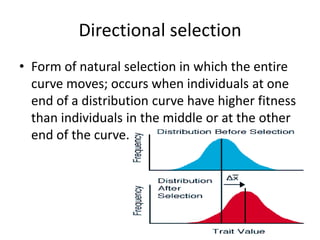
Directional selectionForm of natural selection in which the entire curve moves; occurs when individuals at one end of a distribution curve have higher fitness than individuals in the middle or at the other end of the curve.
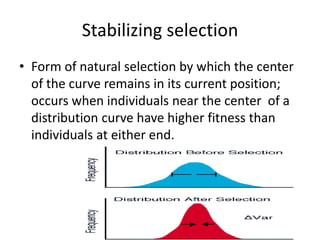
Stabilizing selectionForm of natural selection by which the center of the curve remains in its current position; occurs when individuals near the center  of a distribution curve have higher fitness than individuals at either end.
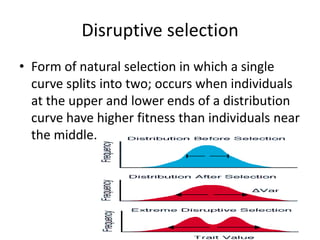
Disruptive selectionForm of natural selection in which a single curve splits into two; occurs when individuals at the upper and lower ends of a distribution curve have higher fitness than individuals near the middle.
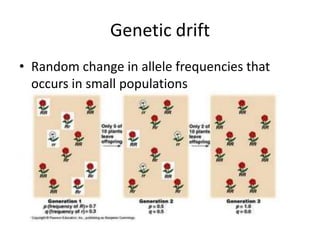
Genetic driftRandom change in allele frequencies that occurs in small populations
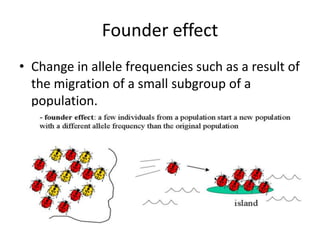
Founder effectChange in allele frequencies such as a result of the migration of a small subgroup of a population.
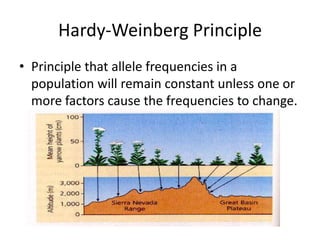
Hardy-Weinberg PrinciplePrinciple that allele frequencies in a population will remain constant unless one or more factors cause the frequencies to change.
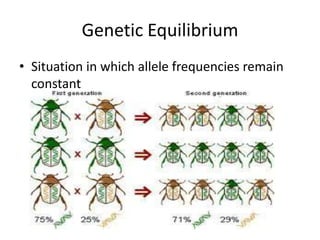
Genetic EquilibriumSituation in which allele frequencies remain constant
Key ConceptNatural selection on single-gene traits can lead to changes in allele frequencies and thus evolution.
Key ConceptNatural selection can affect the distributions of phenotypes in any of three ways: directional selection, stabilizing selection, or disruptive selection.
Key ConceptIn small populations, individuals that carry a particular allele may leave more descendants than other individuals, just by chance. Over time, a series of chance occurrences of this type can cause an allele to become common in a population.
Key ConceptFive conditions are required to maintain genetic equilibrium from generation to generation: (1) there must be random mating: (2) the population must be very large; and (3) there can be no movement into or out of the population, (4) no mutations, and (5) no natural selection.

Biology 16 2 evolution as genetic change[1]

  • 1.
    16-2 Evolution asGenetic Change
  • 2.
    Directional selectionForm ofnatural selection in which the entire curve moves; occurs when individuals at one end of a distribution curve have higher fitness than individuals in the middle or at the other end of the curve.
  • 3.
    Stabilizing selectionForm ofnatural selection by which the center of the curve remains in its current position; occurs when individuals near the center of a distribution curve have higher fitness than individuals at either end.
  • 4.
    Disruptive selectionForm ofnatural selection in which a single curve splits into two; occurs when individuals at the upper and lower ends of a distribution curve have higher fitness than individuals near the middle.
  • 5.
    Genetic driftRandom changein allele frequencies that occurs in small populations
  • 6.
    Founder effectChange inallele frequencies such as a result of the migration of a small subgroup of a population.
  • 7.
    Hardy-Weinberg PrinciplePrinciple thatallele frequencies in a population will remain constant unless one or more factors cause the frequencies to change.
  • 8.
    Genetic EquilibriumSituation inwhich allele frequencies remain constant
  • 9.
    Key ConceptNatural selectionon single-gene traits can lead to changes in allele frequencies and thus evolution.
  • 10.
    Key ConceptNatural selectioncan affect the distributions of phenotypes in any of three ways: directional selection, stabilizing selection, or disruptive selection.
  • 11.
    Key ConceptIn smallpopulations, individuals that carry a particular allele may leave more descendants than other individuals, just by chance. Over time, a series of chance occurrences of this type can cause an allele to become common in a population.
  • 12.
    Key ConceptFive conditionsare required to maintain genetic equilibrium from generation to generation: (1) there must be random mating: (2) the population must be very large; and (3) there can be no movement into or out of the population, (4) no mutations, and (5) no natural selection.