BUILDING INFORMATION
MODELING IN CONSTRUCTION
MANAGEMENT
MD.MANZOOR AKHTAR
14E71DA120
Under the Guidance of
N.PHANI RAJA GOPAL
CONTENTS
 INTRODUCTION
 BUILDING INFORMATION MODELING
 METHODOLOGY
 CASE STUDIES
 CONCLUSIONS
INTRODUCTION
 The Building Information Model is primarily a
three dimensional digital representation of a
building and its intrinsic characteristics.
 It is made of intelligent building components
which includes data attributes and parametric
rules for each object.
 BIM provides consistent and coordinated views
and representations of the digital model including
reliable data for each view.
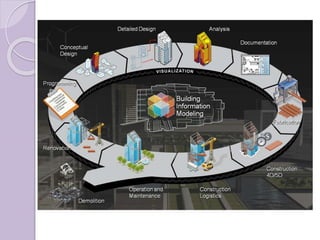
BIM for Construction Managers:
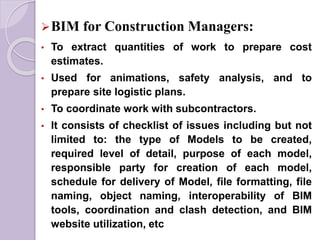
• To extract quantities of work to prepare cost
estimates.
• Used for animations, safety analysis, and to
prepare site logistic plans.
• To coordinate work with subcontractors.
• It consists of checklist of issues including but not
limited to: the type of Models to be created,
required level of detail, purpose of each model,
responsible party for creation of each model,
schedule for delivery of Model, file formatting, file
naming, object naming, interoperability of BIM
tools, coordination and clash detection, and BIM
website utilization, etc
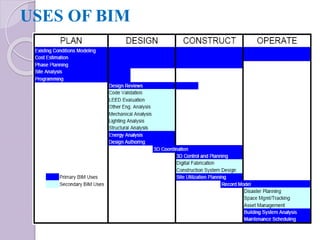
USES OF BIM
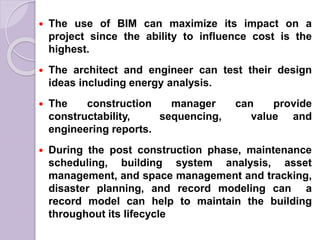
 The use of BIM can maximize its impact on a
project since the ability to influence cost is the
highest.
 The architect and engineer can test their design
ideas including energy analysis.
 The construction manager can provide
constructability, sequencing, value and
engineering reports.
 During the post construction phase, maintenance
scheduling, building system analysis, asset
management, and space management and tracking,
disaster planning, and record modeling can a
record model can help to maintain the building
throughout its lifecycle
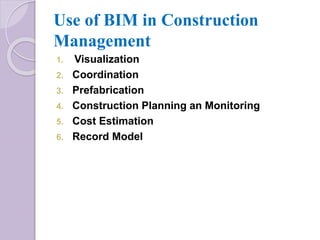
Use of BIM in Construction
Management
1. Visualization
2. Coordination
3. Prefabrication
4. Construction Planning an Monitoring
5. Cost Estimation
6. Record Model
VISUALIZATION
 Visualization provides a better understanding
of what the final product may look like.
 It takes away thought process of bringing the
different traditional 2D views together to come
up with the 3D view of a detail.
 The virtual mock ups help to communicate and
collaborate among the project participants. It
promotes planning, and sequencing the
curtain wall construction.
SIX DISTINCT STAGES IN A BIM
3D VISUALISATION PROJECT
 Consultation and establishing requirements
 Instruction and issue of information
 BIM Model optimization
 3D visualization and draft material
 Sign off and production of final material
 Issue of final material
COORDINATION
 The coordination efforts of construction manager
and specialty contractors in advance of
construction help to reduce design errors
tremendously and to better understand ahead of
time the work to be done.
 The 3D coordination can be started right after the
model is created to ensure that any same space
interference (hard clash) or clearance clash (soft
clash) conflicts are resolved.
IDEAL WORK FLOW IN BIM
COORDINATION
 Update your model as often as relevant
changes occur
 Check your work by running your own clash
analysis
 Use the model and clash analysis for your
purpose whether that's detailed clash review or
general health check
 Communicate everything through clash
comments, views and markups so that it is
visible to the team
PREFABRICATION
 Prefabrication reduces field labor cost and time and
increases accuracy in a good quality construction.
 Prefabricated beam penetrations would save
tremendous time, money and effort in comparison to
onsite beam penetrations
CONSTRUCTION PLANNING
AND MONITORING
 The construction planning involves the scheduling
and sequencing of the model to coordinate virtual
construction in time and space.
 The planning through using BIM enhances site
utilization, space coordination, and product
information.
 The new technology of BIM-based can inculcate the
interest of planners to resolve the construction
project problems with better project planning and
scheduling
 Problem Statement
Three main deficiencies of traditional planning
methods are
 Insubstantial pattern of planning and negligible
or insignificant short term planning.
 Lack of a systematic approach to manage
executive process.
 Insufficient control measurement and utilizing
corrective action rather than learning process.
COST ESTIMATION
 The two main elements of a cost estimate are
Quantity take-off and pricing.
a) Quantities from a Building Information Model
can be extracted to a cost database or an excel
file.
b) Pricing cannot be attained from the model.
The BIM approach
The first step on the investor’s part is to prepare a
3D model of a building along with a knowledge
base, that is, all the vital information available at
each stage of the investment
RECORD MODEL
 Construction Managers can provide a record
Building Information Model to the owner at the
end of a project. The model includes the
integration of the as-builts from the
subcontractors. Furthermore, each object
property in the model can also include links to
submittals, operations and maintenance, and
warranty information
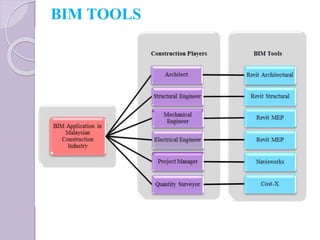
BIM TOOLS
METHODOLOGY
The goal of this project was to examine the uses
and benefits of BIM for construction managers
and analyze BIM based scheduling.
1.The first case study, MIT Kochi project, included
real life examples of BIM uses and benefits.
2.The second case study, a prototype house
project, examined the 3D and 4D Building
Information Modeling as well as BIM based
scheduling.
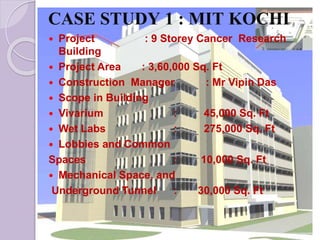
CASE STUDY 1 : MIT KOCHI
 Project : 9 Storey Cancer Research
Building
 Project Area : 3,60,000 Sq. Ft
 Construction Manager : Mr Vipin Das
 Scope in Building
 Vivarium : 45,000 Sq. Ft
 Wet Labs : 275,000 Sq. Ft
 Lobbies and Common
Spaces : 10,000 Sq. Ft
 Mechanical Space, and
Underground Tunnel : 30,000 Sq. Ft
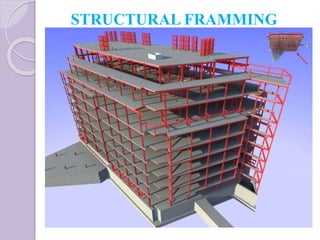
STRUCTURAL FRAMMING
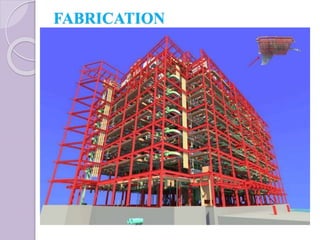
FABRICATION
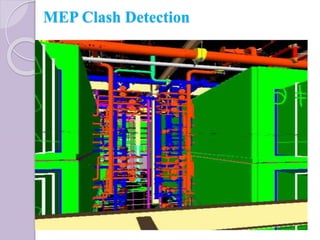
MEP Clash Detection
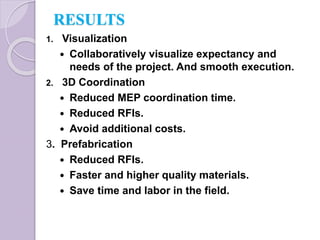
RESULTS
1. Visualization
 Collaboratively visualize expectancy and
needs of the project. And smooth execution.
2. 3D Coordination
 Reduced MEP coordination time.
 Reduced RFIs.
 Avoid additional costs.
3. Prefabrication
 Reduced RFIs.
 Faster and higher quality materials.
 Save time and labor in the field.
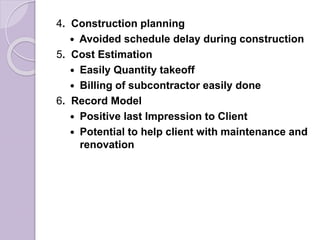
4. Construction planning
 Avoided schedule delay during construction
5. Cost Estimation
 Easily Quantity takeoff
 Billing of subcontractor easily done
6. Record Model
 Positive last Impression to Client
 Potential to help client with maintenance and
renovation
CONCLUSION AND
RECOMMENDATIONS
KEY BIM MANAGEMENT CHOICES THAT
OPTIMIZE PRODUCTIVITY INCREASES
 Effects of Project Delivery Methods on BIM
effectiveness:
 When to Select Design Team
 Coordination Meetings Management.
 IM Software and Modeler’s Experience
 Level of Detail
 When BIM Usage is NOT Warranted
RECOMMENDATIONS
 The use of BIM in comparison to 2D modeling is
strongly encouraged because the parametric
model denies overlapping of the elements and
there are no errors, omissions or conflicts of
information at different views.
 The user should use the currently available
elements and alter them to create new elements
because Revit Architecture requires time and
investment to build brand new elements from
scratch.
 Further study is required for the decomposition
of elements.
 When a project is being modeled, scheduling
activities shall be considered and splitting option
shall be used when necessary.
CONCLUSIONS
1. The visualization is generally the simplest use
of a Building Information Model such as
renderings. As soon as the Building Information
Model are produced, the quantity take- offs can
be generated to provide cost estimations on a
construction project.
2. Furthermore, the 3D coordination was utilized to
detect and eliminate trade clashes and conflicts.
In addition to that, detailed prefabrication
drawings can be generated to review and
coordinate work between trades.
3. Once the drawings are designed to build, the
prefabrication of the components of the
construction facility can be built to design.
4. BIM based 4D scheduling helps understanding of
the construction components and schedule
progress that in turn results better construction
planning. As the materials including but not
limited to prefabricated products arrive at the job
site, the planning techniques and 3D model can be
combined with other BIM enabled tools to provide
construction monitoring services.
5. Finally, the record model can be generated as the
final progress of the construction as the as-builts
are completely updated in the Building Information
Model.
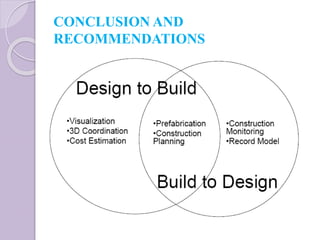
6.“Design to Build” activities which include
visualization, 3D coordination, and cost
estimation, can immediately utilize the
information generated in BIM.
THANK YOU

Bim in Construction Management

  • 1.
    BUILDING INFORMATION MODELING INCONSTRUCTION MANAGEMENT MD.MANZOOR AKHTAR 14E71DA120 Under the Guidance of N.PHANI RAJA GOPAL
  • 2.
    CONTENTS  INTRODUCTION  BUILDINGINFORMATION MODELING  METHODOLOGY  CASE STUDIES  CONCLUSIONS
  • 3.
    INTRODUCTION  The BuildingInformation Model is primarily a three dimensional digital representation of a building and its intrinsic characteristics.  It is made of intelligent building components which includes data attributes and parametric rules for each object.  BIM provides consistent and coordinated views and representations of the digital model including reliable data for each view.
  • 5.
    BIM for ConstructionManagers: • To extract quantities of work to prepare cost estimates. • Used for animations, safety analysis, and to prepare site logistic plans. • To coordinate work with subcontractors. • It consists of checklist of issues including but not limited to: the type of Models to be created, required level of detail, purpose of each model, responsible party for creation of each model, schedule for delivery of Model, file formatting, file naming, object naming, interoperability of BIM tools, coordination and clash detection, and BIM website utilization, etc
  • 6.
  • 7.
     The useof BIM can maximize its impact on a project since the ability to influence cost is the highest.  The architect and engineer can test their design ideas including energy analysis.  The construction manager can provide constructability, sequencing, value and engineering reports.  During the post construction phase, maintenance scheduling, building system analysis, asset management, and space management and tracking, disaster planning, and record modeling can a record model can help to maintain the building throughout its lifecycle
  • 8.
    Use of BIMin Construction Management 1. Visualization 2. Coordination 3. Prefabrication 4. Construction Planning an Monitoring 5. Cost Estimation 6. Record Model
  • 9.
    VISUALIZATION  Visualization providesa better understanding of what the final product may look like.  It takes away thought process of bringing the different traditional 2D views together to come up with the 3D view of a detail.  The virtual mock ups help to communicate and collaborate among the project participants. It promotes planning, and sequencing the curtain wall construction.
  • 10.
    SIX DISTINCT STAGESIN A BIM 3D VISUALISATION PROJECT  Consultation and establishing requirements  Instruction and issue of information  BIM Model optimization  3D visualization and draft material  Sign off and production of final material  Issue of final material
  • 11.
    COORDINATION  The coordinationefforts of construction manager and specialty contractors in advance of construction help to reduce design errors tremendously and to better understand ahead of time the work to be done.  The 3D coordination can be started right after the model is created to ensure that any same space interference (hard clash) or clearance clash (soft clash) conflicts are resolved.
  • 12.
    IDEAL WORK FLOWIN BIM COORDINATION  Update your model as often as relevant changes occur  Check your work by running your own clash analysis  Use the model and clash analysis for your purpose whether that's detailed clash review or general health check  Communicate everything through clash comments, views and markups so that it is visible to the team
  • 13.
    PREFABRICATION  Prefabrication reducesfield labor cost and time and increases accuracy in a good quality construction.  Prefabricated beam penetrations would save tremendous time, money and effort in comparison to onsite beam penetrations
  • 14.
    CONSTRUCTION PLANNING AND MONITORING The construction planning involves the scheduling and sequencing of the model to coordinate virtual construction in time and space.  The planning through using BIM enhances site utilization, space coordination, and product information.  The new technology of BIM-based can inculcate the interest of planners to resolve the construction project problems with better project planning and scheduling
  • 15.
     Problem Statement Threemain deficiencies of traditional planning methods are  Insubstantial pattern of planning and negligible or insignificant short term planning.  Lack of a systematic approach to manage executive process.  Insufficient control measurement and utilizing corrective action rather than learning process.
  • 16.
    COST ESTIMATION  Thetwo main elements of a cost estimate are Quantity take-off and pricing. a) Quantities from a Building Information Model can be extracted to a cost database or an excel file. b) Pricing cannot be attained from the model. The BIM approach The first step on the investor’s part is to prepare a 3D model of a building along with a knowledge base, that is, all the vital information available at each stage of the investment
  • 17.
    RECORD MODEL  ConstructionManagers can provide a record Building Information Model to the owner at the end of a project. The model includes the integration of the as-builts from the subcontractors. Furthermore, each object property in the model can also include links to submittals, operations and maintenance, and warranty information
  • 18.
  • 19.
    METHODOLOGY The goal ofthis project was to examine the uses and benefits of BIM for construction managers and analyze BIM based scheduling. 1.The first case study, MIT Kochi project, included real life examples of BIM uses and benefits. 2.The second case study, a prototype house project, examined the 3D and 4D Building Information Modeling as well as BIM based scheduling.
  • 20.
    CASE STUDY 1: MIT KOCHI  Project : 9 Storey Cancer Research Building  Project Area : 3,60,000 Sq. Ft  Construction Manager : Mr Vipin Das  Scope in Building  Vivarium : 45,000 Sq. Ft  Wet Labs : 275,000 Sq. Ft  Lobbies and Common Spaces : 10,000 Sq. Ft  Mechanical Space, and Underground Tunnel : 30,000 Sq. Ft
  • 21.
  • 22.
  • 23.
  • 24.
    RESULTS 1. Visualization  Collaborativelyvisualize expectancy and needs of the project. And smooth execution. 2. 3D Coordination  Reduced MEP coordination time.  Reduced RFIs.  Avoid additional costs. 3. Prefabrication  Reduced RFIs.  Faster and higher quality materials.  Save time and labor in the field.
  • 25.
    4. Construction planning Avoided schedule delay during construction 5. Cost Estimation  Easily Quantity takeoff  Billing of subcontractor easily done 6. Record Model  Positive last Impression to Client  Potential to help client with maintenance and renovation
  • 26.
  • 27.
    KEY BIM MANAGEMENTCHOICES THAT OPTIMIZE PRODUCTIVITY INCREASES  Effects of Project Delivery Methods on BIM effectiveness:  When to Select Design Team  Coordination Meetings Management.  IM Software and Modeler’s Experience  Level of Detail  When BIM Usage is NOT Warranted
  • 28.
    RECOMMENDATIONS  The useof BIM in comparison to 2D modeling is strongly encouraged because the parametric model denies overlapping of the elements and there are no errors, omissions or conflicts of information at different views.  The user should use the currently available elements and alter them to create new elements because Revit Architecture requires time and investment to build brand new elements from scratch.  Further study is required for the decomposition of elements.  When a project is being modeled, scheduling activities shall be considered and splitting option shall be used when necessary.
  • 29.
    CONCLUSIONS 1. The visualizationis generally the simplest use of a Building Information Model such as renderings. As soon as the Building Information Model are produced, the quantity take- offs can be generated to provide cost estimations on a construction project. 2. Furthermore, the 3D coordination was utilized to detect and eliminate trade clashes and conflicts. In addition to that, detailed prefabrication drawings can be generated to review and coordinate work between trades. 3. Once the drawings are designed to build, the prefabrication of the components of the construction facility can be built to design.
  • 30.
    4. BIM based4D scheduling helps understanding of the construction components and schedule progress that in turn results better construction planning. As the materials including but not limited to prefabricated products arrive at the job site, the planning techniques and 3D model can be combined with other BIM enabled tools to provide construction monitoring services. 5. Finally, the record model can be generated as the final progress of the construction as the as-builts are completely updated in the Building Information Model. 6.“Design to Build” activities which include visualization, 3D coordination, and cost estimation, can immediately utilize the information generated in BIM.
  • 31.