
BIM (Buisness Information
Modeling)
BIM benefits for the construction
industry
 BIM, Building Information Modeling, is
enjoying increasing popularity in the
construction and architectural industries.
 BIM models are considered a better
alternative to the previously famous 3D
CAD models. By working with BIM models,
project team partners can work together
on a single platform.
 Everyone uses the same facts, data and
drawings from the BIM model. Starting
with the designing up to the maintenance
of a building, BIM model sets the basic
framework for all project participants.
 Let's focus on the aspects of BIM models that are highly
relevant to building projects.
 3D BIM model: Information on the dimension, position,
safety and logistics, etc.
 4D BIM model: The time is also added as an additional
dimension that helps in project planning.
 5D BIM models: Construction and material costs are
added as an additional dimension.
 6D BIM models: Extension of the model with additional
elements such as project life cycle,energy consumption
and energy production, etc.
The "I" in BIM
 BIM modeling is the method in which all parties involved in
the lifecycle of a building work together and exchange data.
The true power of BIM, however, lies in the "I" that is
Information. All information collected by our BIM
Consultants- from design to completion - is not only stored but
can also be used at any time from any place. This information
may be used, for the following purposes:
 ➢ Improvement of accuracy.
 ➢ Making construction sites safer.
 ➢ Simple information sharing between the participants.
 ➢ Solving the clashes between different disciplines.
 ➢ Insights into existing buildings for later renovation projects.
 ➢ Sechulding construction time and managing material.
Use of BIM for construction
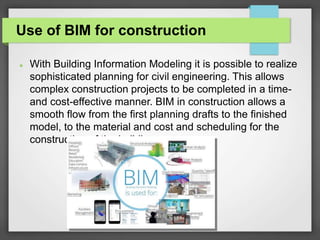
 With Building Information Modeling it is possible to realize
sophisticated planning for civil engineering. This allows
complex construction projects to be completed in a time-
and cost-effective manner. BIM in construction allows a
smooth flow from the first planning drafts to the finished
model, to the material and cost and scheduling for the
construction of the building.
Use of BIM for infrastructure
planning
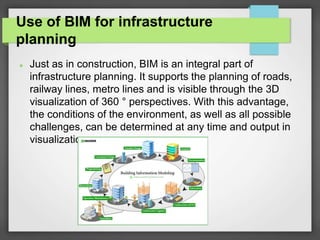
 Just as in construction, BIM is an integral part of
infrastructure planning. It supports the planning of roads,
railway lines, metro lines and is visible through the 3D
visualization of 360 ° perspectives. With this advantage,
the conditions of the environment, as well as all possible
challenges, can be determined at any time and output in
visualizations.
Conclusion on Building
Information Modeling
 Building Information Modeling is a process that covers all
building data from planning to construction, the
maintenance to demolition. The whole life of a building is
documented, expanded and updated with BIM. BIM model
is an effective way to successfully complete the
construction projects for residential, commercial,
institutional and industrial buildings.
 As BIM becomes more advanced, 4D, 5D and even 6D
BIM will play an important role in the building process.
Besides, efforts are being made worldwide to reduce the
amount of construction waste caused by inefficiencies in
the supply chain, collisions and rework. This can be
countered by working together in a BIM environment.
Contact Us
 Offshore Outsourcing India
 321, Patel Avenue
 Opp. Grand Bhagwati,
 S G Road, Thaltej,Ahmedabad,
 Gujarat, INDIA.
 E-mail : info@offshoreoutsourcing-india.com
 URL : www.offshoreoutsourcing-india.com

BIM ppt

  • 1.
  • 2.
    BIM benefits forthe construction industry  BIM, Building Information Modeling, is enjoying increasing popularity in the construction and architectural industries.  BIM models are considered a better alternative to the previously famous 3D CAD models. By working with BIM models, project team partners can work together on a single platform.  Everyone uses the same facts, data and drawings from the BIM model. Starting with the designing up to the maintenance of a building, BIM model sets the basic framework for all project participants.
  • 3.
     Let's focuson the aspects of BIM models that are highly relevant to building projects.  3D BIM model: Information on the dimension, position, safety and logistics, etc.  4D BIM model: The time is also added as an additional dimension that helps in project planning.  5D BIM models: Construction and material costs are added as an additional dimension.  6D BIM models: Extension of the model with additional elements such as project life cycle,energy consumption and energy production, etc.
  • 4.
    The "I" inBIM  BIM modeling is the method in which all parties involved in the lifecycle of a building work together and exchange data. The true power of BIM, however, lies in the "I" that is Information. All information collected by our BIM Consultants- from design to completion - is not only stored but can also be used at any time from any place. This information may be used, for the following purposes:  ➢ Improvement of accuracy.  ➢ Making construction sites safer.  ➢ Simple information sharing between the participants.  ➢ Solving the clashes between different disciplines.  ➢ Insights into existing buildings for later renovation projects.  ➢ Sechulding construction time and managing material.
  • 5.
    Use of BIMfor construction  With Building Information Modeling it is possible to realize sophisticated planning for civil engineering. This allows complex construction projects to be completed in a time- and cost-effective manner. BIM in construction allows a smooth flow from the first planning drafts to the finished model, to the material and cost and scheduling for the construction of the building.
  • 6.
    Use of BIMfor infrastructure planning  Just as in construction, BIM is an integral part of infrastructure planning. It supports the planning of roads, railway lines, metro lines and is visible through the 3D visualization of 360 ° perspectives. With this advantage, the conditions of the environment, as well as all possible challenges, can be determined at any time and output in visualizations.
  • 7.
    Conclusion on Building InformationModeling  Building Information Modeling is a process that covers all building data from planning to construction, the maintenance to demolition. The whole life of a building is documented, expanded and updated with BIM. BIM model is an effective way to successfully complete the construction projects for residential, commercial, institutional and industrial buildings.  As BIM becomes more advanced, 4D, 5D and even 6D BIM will play an important role in the building process. Besides, efforts are being made worldwide to reduce the amount of construction waste caused by inefficiencies in the supply chain, collisions and rework. This can be countered by working together in a BIM environment.
  • 8.
    Contact Us  OffshoreOutsourcing India  321, Patel Avenue  Opp. Grand Bhagwati,  S G Road, Thaltej,Ahmedabad,  Gujarat, INDIA.  E-mail : info@offshoreoutsourcing-india.com  URL : www.offshoreoutsourcing-india.com