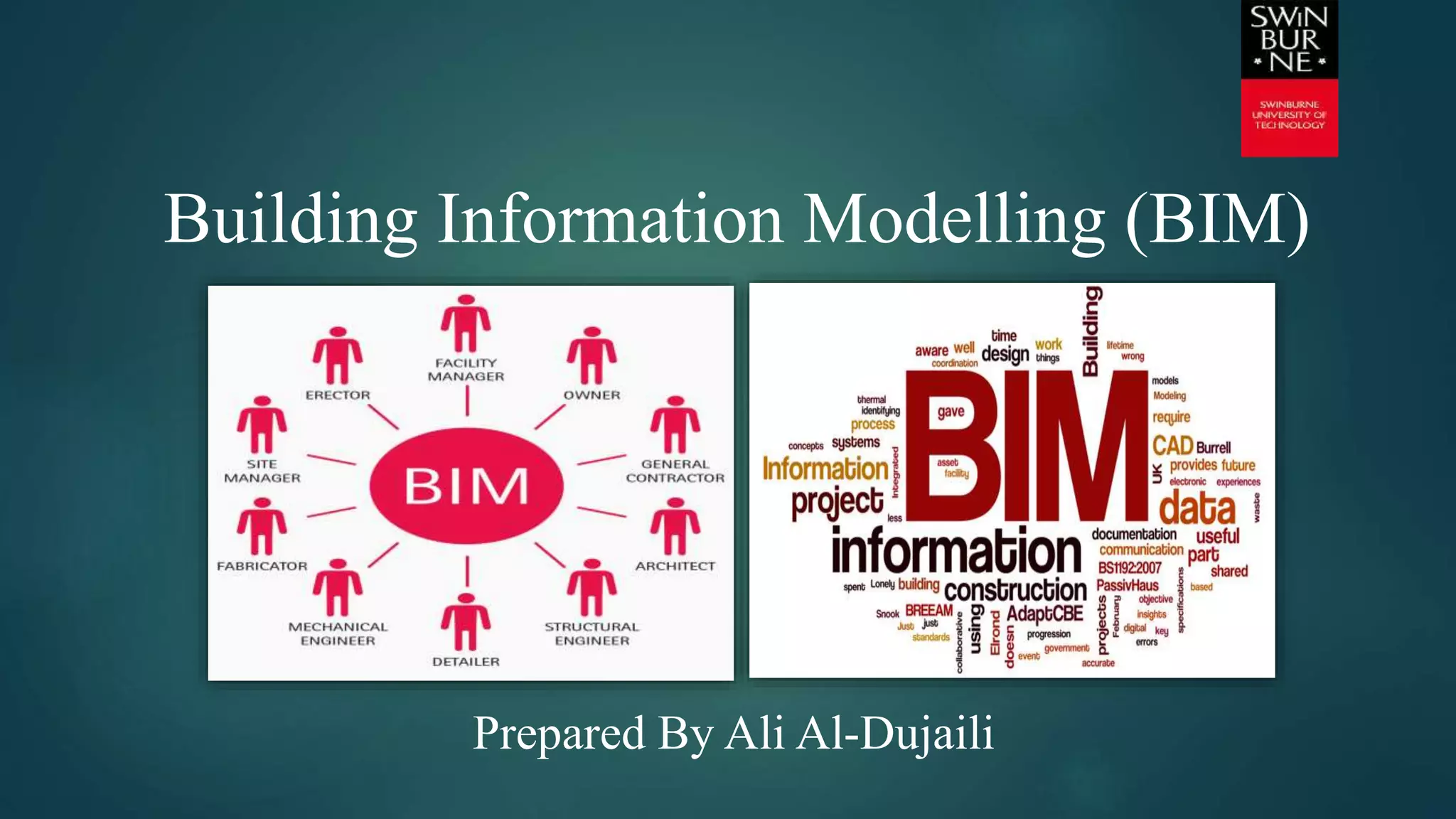
Building Information Modelling (BIM)
Prepared By Ali Al-Dujaili
Introduction:
 What is BIM?
BIM: can be defined as the creation and coordinated, consistent,
computable information about a building in design – parametric
information used for design :
• Decision making.
• Production of high quality construction of building performance.
• Cost estimation.
• Construction planning.
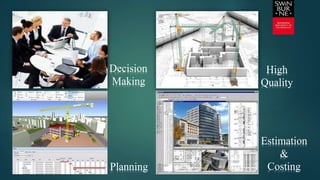
High
Quality
Decision
Making
Planning
Estimation
&
Costing
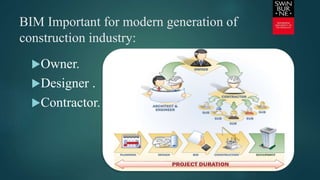
BIM Important for modern generation of
construction industry:
Owner.
Designer .
Contractor.
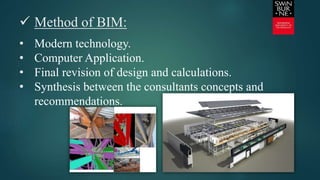
 Method of BIM:
• Modern technology.
• Computer Application.
• Final revision of design and calculations.
• Synthesis between the consultants concepts and
recommendations.
Concepts:
 Building information modelling simulates the construction project in a virtual
environment.
 A simulation has the advantage of taking place in a computer through the use of a
software package.
 Virtual building implies that it is possible to practice construction, to experiment,
and to make adjustments in the project before it is actualized.
 Virtual mistakes generally do not have serious consequences—provided that they
are identified and addressed early enough that they can be avoided “in the field”
(the actual construction of the project).
Benefit of BIM
 The entire BIM process is one of collaboration among Owner, design
consultants, and, more often than not, the General Contractor/Construction
Manager.
 The BIM process allows the designers to spot these "conflicts" or "clashes"
(as they are referred to) during the design process and make the necessary
changes to the drawings.
 The first benefit of detecting and curing these coordination problems
during design is that it allows mechanical, plumbing, and electrical
subcontractors to prefabricate some assemblies with assurance that they
will fit when installed.
Conclusion:-
In conclusion, BIM helps construction industry in many
aspects but the main points as below:
 BIM has created many new systems for working smarter
and producing better buildings.
 BIM has assist your company meet its goals better, stay
workable, and maintain success.
Bibliography:
 Krygiel, Eddy; Nies, Brad 2008, Green BIM : Successful Sustainable Design with Building Information
Modeling, e-book, accessed 17 August 2015,
<http://SWIN.eblib.com.au/patron/FullRecord.aspx?p=362054>.
 Hardin, Brad 2011, BIM and Construction Management : Proven Tools, Methods, and Workflows, e-book,
accessed 17 August 2015, <http://SWIN.eblib.com.au/patron/FullRecord.aspx?p=706579>.
 WILLEM, K. 2008. Building Information Modeling. Building Information Modeling: Planning and
Managing Construction Projects with 4D CAD and Simulations (McGraw-Hill Construction Series).
McGraw Hill Professional, Access Engineering.
 SIDNEY, M. L. & ANDREW M. CIVITELLO, JR. 2014. Section 11: Building Information Modeling.
Construction Operations Manual of Policies and Procedures, Fifth Edition. McGraw Hill Professional,
Access Engineering.
 Epstein, Erika. ( © 2012). Implementing successful building information modeling. [Books24x7 version]
Available fromhttp://common.books24x7.com.ezproxy.lib.swin.edu.au/toc.aspx?bookid=65227.
Any Question
?

BIM presentation by ali al dujaili

  • 1.
    Building Information Modelling(BIM) Prepared By Ali Al-Dujaili
  • 2.
    Introduction:  What isBIM? BIM: can be defined as the creation and coordinated, consistent, computable information about a building in design – parametric information used for design : • Decision making. • Production of high quality construction of building performance. • Cost estimation. • Construction planning.
  • 3.
  • 4.
    BIM Important formodern generation of construction industry: Owner. Designer . Contractor.
  • 5.
     Method ofBIM: • Modern technology. • Computer Application. • Final revision of design and calculations. • Synthesis between the consultants concepts and recommendations.
  • 6.
    Concepts:  Building informationmodelling simulates the construction project in a virtual environment.  A simulation has the advantage of taking place in a computer through the use of a software package.  Virtual building implies that it is possible to practice construction, to experiment, and to make adjustments in the project before it is actualized.  Virtual mistakes generally do not have serious consequences—provided that they are identified and addressed early enough that they can be avoided “in the field” (the actual construction of the project).
  • 7.
    Benefit of BIM The entire BIM process is one of collaboration among Owner, design consultants, and, more often than not, the General Contractor/Construction Manager.  The BIM process allows the designers to spot these "conflicts" or "clashes" (as they are referred to) during the design process and make the necessary changes to the drawings.  The first benefit of detecting and curing these coordination problems during design is that it allows mechanical, plumbing, and electrical subcontractors to prefabricate some assemblies with assurance that they will fit when installed.
  • 8.
    Conclusion:- In conclusion, BIMhelps construction industry in many aspects but the main points as below:  BIM has created many new systems for working smarter and producing better buildings.  BIM has assist your company meet its goals better, stay workable, and maintain success.
  • 9.
    Bibliography:  Krygiel, Eddy;Nies, Brad 2008, Green BIM : Successful Sustainable Design with Building Information Modeling, e-book, accessed 17 August 2015, <http://SWIN.eblib.com.au/patron/FullRecord.aspx?p=362054>.  Hardin, Brad 2011, BIM and Construction Management : Proven Tools, Methods, and Workflows, e-book, accessed 17 August 2015, <http://SWIN.eblib.com.au/patron/FullRecord.aspx?p=706579>.  WILLEM, K. 2008. Building Information Modeling. Building Information Modeling: Planning and Managing Construction Projects with 4D CAD and Simulations (McGraw-Hill Construction Series). McGraw Hill Professional, Access Engineering.  SIDNEY, M. L. & ANDREW M. CIVITELLO, JR. 2014. Section 11: Building Information Modeling. Construction Operations Manual of Policies and Procedures, Fifth Edition. McGraw Hill Professional, Access Engineering.  Epstein, Erika. ( © 2012). Implementing successful building information modeling. [Books24x7 version] Available fromhttp://common.books24x7.com.ezproxy.lib.swin.edu.au/toc.aspx?bookid=65227.
  • 10.