Prepared by:
Abdul AzizAbas
Nur Ilylia Iryani Mohamed Nasir
Anis Mardhiah Mukhtar
Nor Yatini Isa
2.
Contents
Introduction
Benefits of BIM
Barriersof BIM Implementation
Case Study: BIM Implementation in Kwasaland
Case Study: Strategies to overcome the barriers
Conclusion & Recommendations
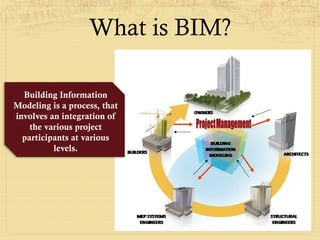
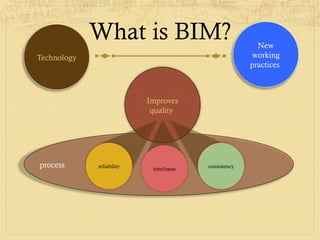
What is BIM?
“BuildingInformation Modeling (BIM) is a digital
representation of physical and functional characteristics
of a facility. BIM is a shared knowledge resource for information
about a facility forming a reliable basis for decisions during its life-
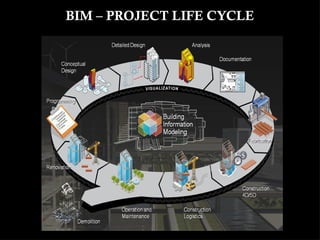
cycle; defined as existing from earliest conception to demolition.”
The National Building Information Model Standard Project Committee (March, 2012)
8.
minimizes
risk and
promote
quality
Staub-French &Khanzode (2007)
3D & 4D
Modeling
BIM
will be accepted
as industry copes
with realities of
tight labor market
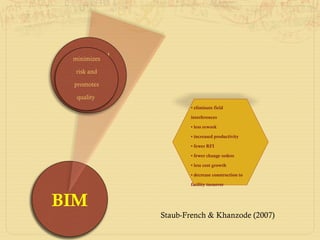
minimizes
risk and
promotes
quality
• eliminate field
interferences
• less rework
• increased productivity
• fewer RFI
• fewer change orders
• less cost growth
• decrease construction to
facility turnover
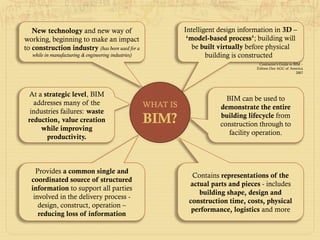
Intelligent design informationin 3D –
‘model-based process’; building will
be built virtually before physical
building is constructed
Contractor’s Guide to BIM –
Edition One AGC of America
2007
New technology and new way of
working, beginning to make an impact
to construction industry (has been used for a
while in manufacturing & engineering industries)
At a strategic level, BIM
addresses many of the
industries failures: waste
reduction, value creation
while improving
productivity.
Provides a common single and
coordinated source of structured
information to support all parties
involved in the delivery process -
design, construct, operation –
reducing loss of information
BIM can be used to
demonstrate the entire
building lifecycle from
construction through to
facility operation.
Contains representations of the
actual parts and pieces - includes
building shape, design and
construction time, costs, physical
performance, logistics and more
WHAT IS
BIM?
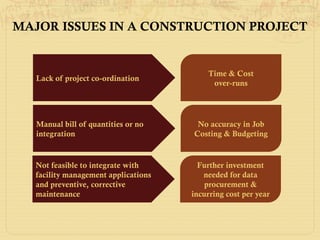
Lack of projectco-ordination
Time & Cost
over-runs
Manual bill of quantities or no
integration
No accuracy in Job
Costing & Budgeting
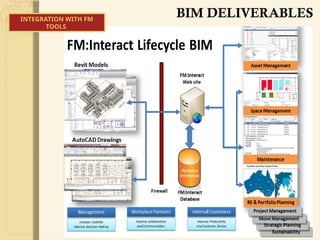
Not feasible to integrate with
facility management applications
and preventive, corrective
maintenance
Further investment
needed for data
procurement &
incurring cost per year
MAJOR ISSUES IN A CONSTRUCTION PROJECT
13.
IPD
-
BIM
Deliverables
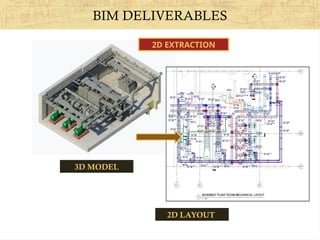
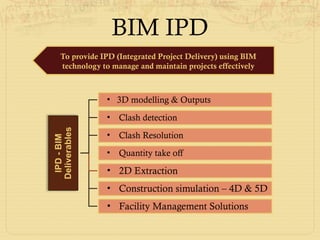
• 3D modelling& Outputs
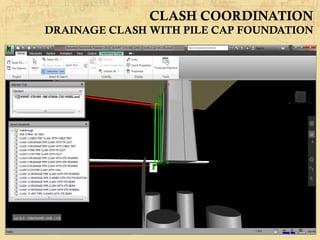
• Clash detection
• Clash Resolution
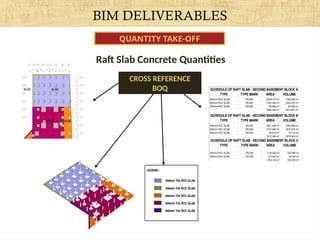
• Quantity take off
• 2D Extraction
• Construction simulation – 4D & 5D
• Facility Management Solutions
To provide IPD (Integrated Project Delivery) using BIM
technology to manage and maintain projects effectively
BIM IPD
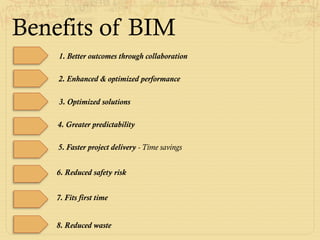
1. Better outcomesthrough collaboration
4. Greater predictability
5. Faster project delivery - Time savings
6. Reduced safety risk
7. Fits first time
8. Reduced waste
Benefits of BIM
2. Enhanced & optimized performance
3. Optimized solutions
17.
1. Better outcomesthrough collaboration
2. Enhanced & optimized performance
3. Optimized solutions
4. Greater predictability
5. Faster project delivery - Time savings
6. Reduced safety risk
7. Fits first time
8. Reduced waste
Benefits of BIM
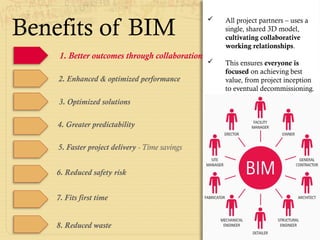
All project partners – uses a
single, shared 3D model,
cultivating collaborative
working relationships.
This ensures everyone is
focused on achieving best
value, from project inception
to eventual decommissioning.
18.
1. Better outcomesthrough collaboration
2. Enhanced & optimized performance
BIM makes possible swift
and accurate comparison of
different design options.
enabling development
of more efficient, cost-
effective and
sustainable solutions.
3. Optimized solutions
4. Greater predictability
5. Faster project delivery - Time savings
6. Reduced safety risk
7. Fits first time
8. Reduced waste
Benefits of BIM
19.
Benefits of BIM
1.Better outcomes through collaboration
4. Greater predictability
5. Faster project delivery - Time savings
6. Reduced safety risk
7. Fits first time
8. Reduced waste
Through deployment of
new generative modeling
technologies, solutions can
be cost-effectively
optimized against agreed
parameters.
2. Enhanced & optimized performance
3. Optimized solutions
20.
4. Greater predictability
5.Faster project delivery - Time savings
6. Reduced safety risk
7. Fits first time
8. Reduced waste
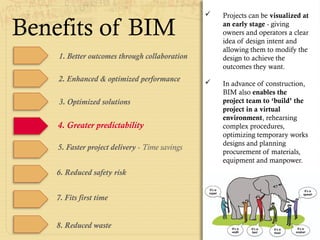
Projects can be visualized at
an early stage - giving
owners and operators a clear
idea of design intent and
allowing them to modify the
design to achieve the
outcomes they want.
In advance of construction,
BIM also enables the
project team to ‘build’ the
project in a virtual
environment, rehearsing
complex procedures,
optimizing temporary works
designs and planning
procurement of materials,
equipment and manpower.
2. Enhanced & optimized performance
3. Optimized solutions
1. Better outcomes through collaboration
Benefits of BIM
21.
Benefits of BIM
4.Greater predictability
5. Faster project delivery - Time savings
6. Reduced safety risk
7. Fits first time
8. Reduced waste
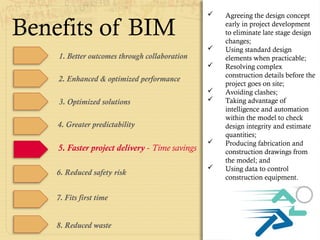
Agreeing the design concept
early in project development
to eliminate late stage design
changes;
Using standard design
elements when practicable;
Resolving complex
construction details before the
project goes on site;
Avoiding clashes;
Taking advantage of
intelligence and automation
within the model to check
design integrity and estimate
quantities;
Producing fabrication and
construction drawings from
the model; and
Using data to control
construction equipment.
2. Enhanced & optimized performance
3. Optimized solutions
1. Better outcomes through collaboration
22.
Benefits of BIM
4.Greater predictability
5. Faster project delivery - Time savings
6. Reduced safety risk
7. Fits first time
8. Reduced waste
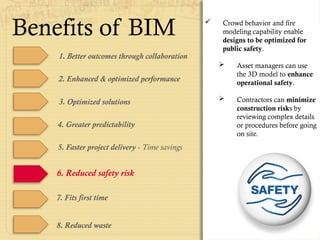
Crowd behavior and fire
modeling capability enable
designs to be optimized for
public safety.
Asset managers can use
the 3D model to enhance
operational safety.
Contractors can minimize
construction risks by
reviewing complex details
or procedures before going
on site.
2. Enhanced & optimized performance
3. Optimized solutions
1. Better outcomes through collaboration
23.
Benefits of BIM
4.Greater predictability
5. Faster project delivery - Time savings
6. Reduced safety risk
7. Fits first time
8. Reduced waste
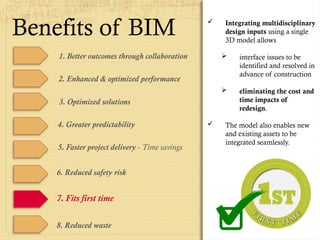
Integrating multidisciplinary
design inputs using a single
3D model allows
interface issues to be
identified and resolved in
advance of construction
eliminating the cost and
time impacts of
redesign.
The model also enables new
and existing assets to be
integrated seamlessly.
2. Enhanced & optimized performance
3. Optimized solutions
1. Better outcomes through collaboration
24.
Benefits of BIM
4.Greater predictability
5. Faster project delivery - Time savings
6. Reduced safety risk
7. Fits first time
8. Reduced waste
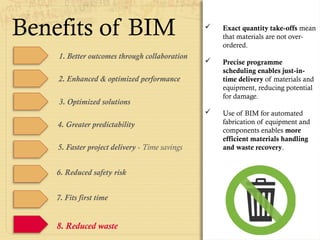
Exact quantity take-offs mean
that materials are not over-
ordered.
Precise programme
scheduling enables just-in-
time delivery of materials and
equipment, reducing potential
for damage.
Use of BIM for automated
fabrication of equipment and
components enables more
efficient materials handling
and waste recovery.
2. Enhanced & optimized performance
3. Optimized solutions
1. Better outcomes through collaboration
25.
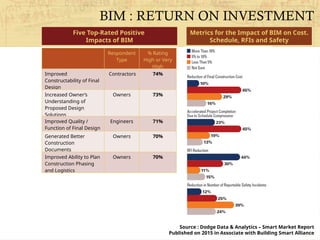
Five Top-Rated Positive
Impactsof BIM
Metrics for the Impact of BIM on Cost.
Schedule, RFIs and Safety
BIM : RETURN ON INVESTMENT
Respondent
Type
% Rating
High or Very
High
Improved
Constructability of Final
Design
Contractors 74%
Increased Owner’s
Understanding of
Proposed Design
Solutions
Owners 73%
Improved Quality /
Function of Final Design
Engineers 71%
Generated Better
Construction
Documents
Owners 70%
Improved Ability to Plan
Construction Phasing
and Logistics
Owners 70%
Source : Dodge Data & Analytics – Smart Market Report
Published on 2015 in Associate with Building Smart Alliance
The effective implementationand use of BIM remains a
major issue for the construction industry. Whilst the
technology underpinning BIM has been around for well over
a decade BIM implementation and take-up has been
relatively slow in the construction industry compared
to industries such as manufacturing and engineering.
(Smith, 2014)
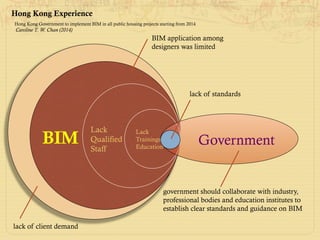
29.
lack of clientdemand
BIM
BIM application among
designers was limited
Lack
Qualified
Staff
Caroline T. W. Chan (2014)
Hong Kong Experience
Lack
Trainings
Education
government should collaborate with industry,
professional bodies and education institutes to
establish clear standards and guidance on BIM
Government
Hong Kong Government to implement BIM in all public housing projects starting from 2014
lack of standards
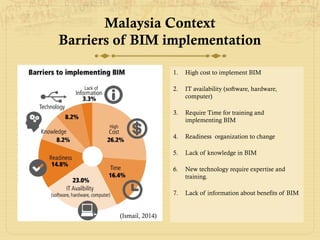
30.
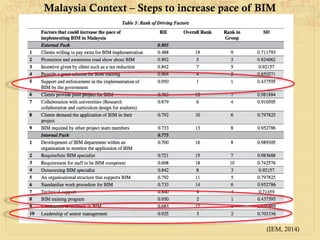
1. High costto implement BIM
2. IT availability (software, hardware,
computer)
3. Require Time for training and
implementing BIM
4. Readiness organization to change
5. Lack of knowledge in BIM
6. New technology require expertise and
training.
7. Lack of information about benefits of BIM
(Ismail, 2014)
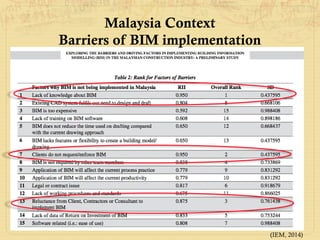
Malaysia Context
Barriers of BIM implementation
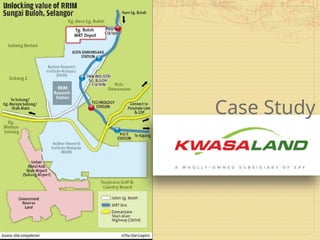
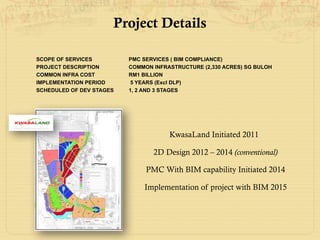
Project Details
SCOPE OFSERVICES PMC SERVICES ( BIM COMPLIANCE)
PROJECT DESCRIPTION COMMON INFRASTRUCTURE (2,330 ACRES) SG BULOH
COMMON INFRA COST RM1 BILLION
IMPLEMENTATION PERIOD 5 YEARS (Excl DLP)
SCHEDULED OF DEV STAGES 1, 2 AND 3 STAGES
PMC With BIM capability Initiated 2014
Implementation of project with BIM 2015
KwasaLand Initiated 2011
2D Design 2012 – 2014 (conventional)
34.
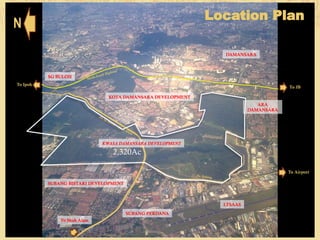
LTSAAS
SUBANG BISTARI DEVELOPMENT
KOTADAMANSARA DEVELOPMENT
SUBANG PERDANA
SG BULOH
DAMANSARA
Jln Sg Buloh – Shah Alam
North-South Highway
Location Plan
ARA
DAMANSARA
Jln Subang
To Ipoh
To JB
To Airport
To Shah Alam
N
KWASA DAMANSARA DEVELOPMENT
2,320Ac
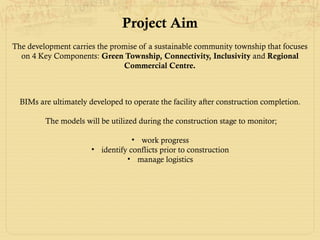
Project Aim
The developmentcarries the promise of a sustainable community township that focuses
on 4 Key Components: Green Township, Connectivity, Inclusivity and Regional
Commercial Centre.
BIMs are ultimately developed to operate the facility after construction completion.
The models will be utilized during the construction stage to monitor;
• work progress
• identify conflicts prior to construction
• manage logistics
37.
Project initially implementedusing Non-BIM
BIM
BIM application among designers
was limited (Critical @ time of
implementation)
Lack
Qualified
Staff
Lack
Trainings
Education
Client
Initiative
lack of standards
[Uses BIM execution plan
Technology transfer from foreign]
On the work Workshops
(Consultants & Contractors)
[Technology transfer from foreign
experience]
Employment of BIM foreign experts
With local inputs
Project Experience
38.
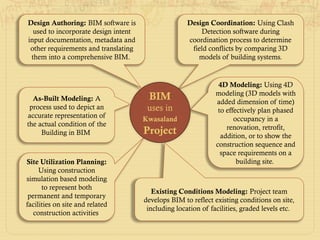
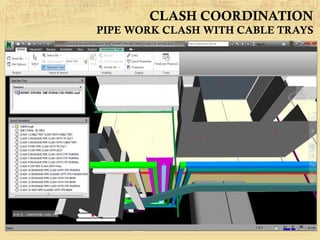
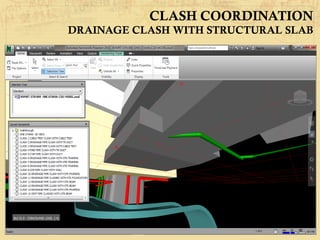
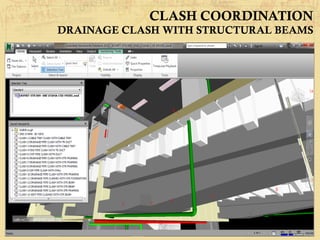
Design Coordination: UsingClash
Detection software during
coordination process to determine
field conflicts by comparing 3D
models of building systems.
Design Authoring: BIM software is
used to incorporate design intent
input documentation, metadata and
other requirements and translating
them into a comprehensive BIM.
As-Built Modeling: A
process used to depict an
accurate representation of
the actual condition of the
Building in BIM
Site Utilization Planning:
Using construction
simulation based modeling
to represent both
permanent and temporary
facilities on site and related
construction activities
4D Modeling: Using 4D
modeling (3D models with
added dimension of time)
to effectively plan phased
occupancy in a
renovation, retrofit,
addition, or to show the
construction sequence and
space requirements on a
building site.
Existing Conditions Modeling: Project team
develops BIM to reflect existing conditions on site,
including location of facilities, graded levels etc.
BIM
uses in
Kwasaland
Project
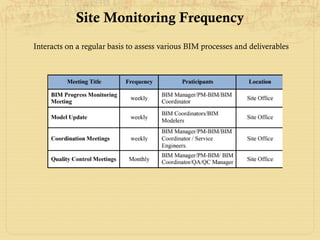
Interacts on aregular basis to assess various BIM processes and deliverables
Site Monitoring Frequency
41.
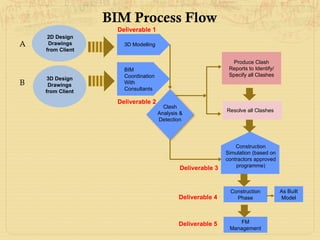
Construction
Simulation (based on
contractorsapproved
programme)
2D Design
Drawings
from Client
3D Modelling
Clash
Analysis &
Detection
Produce Clash
Reports to Identify/
Specify all Clashes
Resolve all Clashes
Deliverable 1
Deliverable 2
Deliverable 3
3D Design
Drawings
from Client
BIM
Coordination
With
Consultants
A
B
Deliverable 4
Construction
Phase
Deliverable 5 FM
Management
As Built
Model
BIM Process Flow
42.
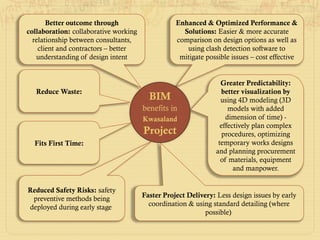
Enhanced & OptimizedPerformance &
Solutions: Easier & more accurate
comparison on design options as well as
using clash detection software to
mitigate possible issues – cost effective
Better outcome through
collaboration: collaborative working
relationship between consultants,
client and contractors – better
understanding of design intent
Fits First Time:
Reduced Safety Risks: safety
preventive methods being
deployed during early stage
Greater Predictability:
better visualization by
using 4D modeling (3D
models with added
dimension of time) -
effectively plan complex
procedures, optimizing
temporary works designs
and planning procurement
of materials, equipment
and manpower.
Faster Project Delivery: Less design issues by early
coordination & using standard detailing (where
possible)
BIM
benefits in
Kwasaland
Project
Reduce Waste:
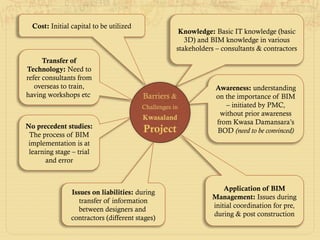
Knowledge: Basic ITknowledge (basic
3D) and BIM knowledge in various
stakeholders – consultants & contractors
Cost: Initial capital to be utilized
No precedent studies:
The process of BIM
implementation is at
learning stage – trial
and error
Issues on liabilities: during
transfer of information
between designers and
contractors (different stages)
Awareness: understanding
on the importance of BIM
– initiated by PMC,
without prior awareness
from Kwasa Damansara’s
BOD (need to be convinced)
Application of BIM
Management: Issues during
initial coordination for pre,
during & post construction
Barriers &
Challenges in
Kwasaland
Project
Transfer of
Technology: Need to
refer consultants from
overseas to train,
having workshops etc
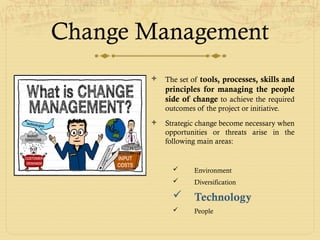
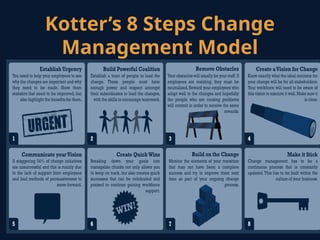
Change Management
Theset of tools, processes, skills and
principles for managing the people
side of change to achieve the required
outcomes of the project or initiative.
Strategic change become necessary when
opportunities or threats arise in the
following main areas:
Environment
Diversification
Technology
People
55.
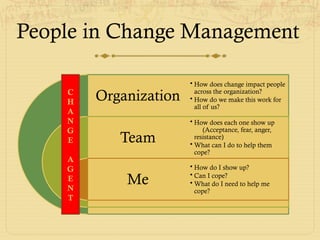
People in ChangeManagement
Organization
Team
Me
• How does change impact people
across the organization?
• How do we make this work for
all of us?
• How does each one show up
(Acceptance, fear, anger,
resistance)
• What can I do to help them
cope?
• How do I show up?
• Can I cope?
• What do I need to help me
cope?
C
H
A
N
G
E
A
G
E
N
T
56.
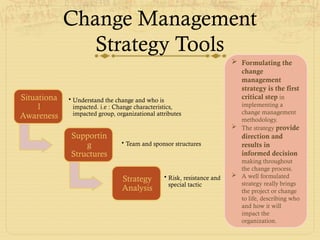
Change Management
Strategy Tools
Situationa
l
Awareness
•Understand the change and who is
impacted. i.e : Change characteristics,
impacted group, organizational attributes
Supportin
g
Structures
• Team and sponsor structures
Strategy
Analysis
• Risk, resistance and
special tactic
Formulating the
change
management
strategy is the first
critical step in
implementing a
change management
methodology.
The strategy provide
direction and
results in
informed decision
making throughout
the change process.
A well formulated
strategy really brings
the project or change
to life, describing who
and how it will
impact the
organization.
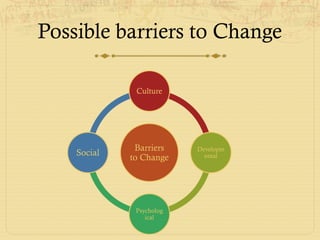
Possible barriers toChange
Barriers
to Change
Culture
Developm
ental
Psycholog
ical
Social
60.
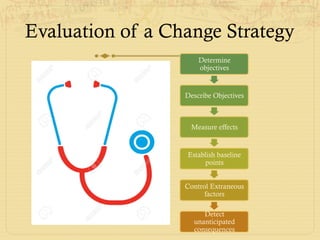
Evaluation of aChange Strategy
Determine
objectives
Describe Objectives
Measure effects
Establish baseline
points
Control Extraneous
factors
Detect
unanticipated
consequences
61.
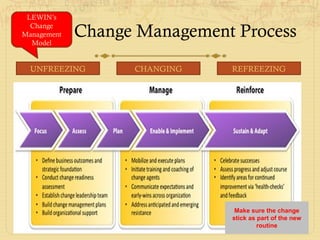
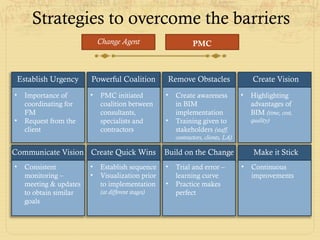
Strategies to overcomethe barriers
Change Agent PMC
Establish Urgency Powerful Coalition Remove Obstacles Create Vision
Communicate Vision Create Quick Wins Build on the Change Make it Stick
• Importance of
coordinating for
FM
• Request from the
client
• PMC initiated
coalition between
consultants,
specialists and
contractors
• Create awareness
in BIM
implementation
• Training given to
stakeholders (staff,
contractors, clients, LA)
• Highlighting
advantages of
BIM (time, cost,
quality)
• Consistent
monitoring –
meeting & updates
to obtain similar
goals
• Establish sequence
• Visualization prior
to implementation
(at different stages)
• Trial and error –
learning curve
• Practice makes
perfect
• Continuous
improvements
Conclusion
• BIM isan important management tool in mitigating most
construction issues
• BIM is seen to be a technology that might be mandatory
implementation in the construction industry in Malaysia


![Project initially implemented using Non-BIM
BIM
BIM application among designers
was limited (Critical @ time of
implementation)
Lack
Qualified
Staff
Lack
Trainings
Education
Client
Initiative
lack of standards
[Uses BIM execution plan
Technology transfer from foreign]
On the work Workshops
(Consultants & Contractors)
[Technology transfer from foreign
experience]
Employment of BIM foreign experts
With local inputs
Project Experience](https://image.slidesharecdn.com/bimassignmentpresentation-250319110533-cd15f52f/85/BIM-Assignment-Presentation-BIM-Assignment-Presentation-BIM-Assignment-Presentation-37-320.jpg)