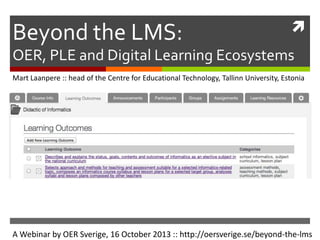
Beyond the LMS:



OER, PLE and Digital Learning Ecosystems
Mart Laanpere :: head of the Centre for Educational Technology, Tallinn University, Estonia

A Webinar by OER Sverige, 16 October 2013 :: http://oersverige.se/beyond-the-lms
E-learning strategies in Estonia
SCHOOLS

Computerisation,
internet

ICT integration,
competencies

E-learning, OER,
ICT innovation

1:1 computing,
E-textbooks,
Pilot schools

Tiger Leap
strategy

Tiger Leap +
strategy

Learning
Tiger strategy

LLL strategy
2014-2020

HIGHER EDUCATION

1997

2000

2003

E-university
consortium
First e-courses
in WebCT

2006
E-voc.school
consortium

ESF-funded programs: OER,
e-courses, staff training

2009

2014
FITE
strategy

Digital competences
infrastructure, resources
Institutions consolidated to FITE in 2013
 Tiger Leap Foundation (1997-2013, www.tiigrihype.ee):
 Tiger Trainers, courses, regional training centres
 Grants: ICT innovation, research, OER, software, portal, repository
 Programmes: robotics, science, handicraft, animation, coding
 EENet.ee (NREN): ISP, virtual hosting (Wordpress, Mediawiki,

Joomla, Moodle, Limesurvey, CMSimple, HTML)
 Estonian IT Foundation (www.e-ope.ee):
 Consortia: E-university, E-vocschool
 Conferences, staff training, newsletters, networking, support
 Large-scale ESF-funded programmes: OER, repository, LMS hosting
LMS and OER in Estonia
 WebCT: since 1997 in UT & TLU, national license 2003-2009

 VIKO (since 2001, built by CET): 70 schools
 IVA (2003-14, built by CET): 28 schools & colleges, 4800 courses
 Moodle:
 One central/national instance: 98 000 users, 5900 courses
 Tartu University institutional instance: 25 243 users, 2250 courses
 School instances hosted by EENet HaViKe service
 Blogs & wikis: around 1% of teachers use, primary teachers lead
 OER repositories: koolielu.ee, www.e-ope.ee/repositoorium
Discussion
 Where do you keep the largest amount of your self-

developed digital learning resources?
 Inside LMS (e.g. Moodle)
 In the institutional repository

 In the national repository
 In a global OER repository
 Scattered around in social media, services etc
 Elsewhere (specify in chat)

 I have not developed any digital learning resources
Geels 2002
Mobile communication generations
Moodle servers: global stats
Three generations of TEL systems
Dimension

1.generation

2.generation

Software
architecture

Educational software Course management Digital Learning
systems
Ecosystems

Pedagogical
foundation

Bihaviorism

Content
management

Integrated with code Learning Objects,
content packages

Mash-up, remixed,
user-generated

Dominant
affordances

E-textbook, drill &
practice, tests

Sharing LO’s, forum
discussions, quiz

Reflections, collab.
production, design

Access

Computer lab in
school

Home computer

Everywhere – thanks
to mobile devices

Cognitivism

3.generation

Knowledge building,
connectivism
Dialectics of TEL system evolution
 THESIS: mainstream TEL systems today are LMS (e.g. Moodle)

 ANTITHESIS: innovators among academic staff are radically

opposing LMS and propose using PLE and social media instead
 SYNTHESIS: new quality, taking the best from both worlds.

Digital Learning Ecosystem?
1.2. Participatory
design
1.3. Evaluation

IVA LMS

1.1 Initial ped. framework

Pedagogy-driven design

2.2. Participatory
design

3.3. Participatory
action research

2.3. Case
studies

Blog-based
PLE

!

2.1. Experimenting with blogs

User-centered design

3.4. Generic ped.
model for DLE

3.2. Updated
ped. framework

Dippler
DLE

3.1. Participatory design
Discussion
 What do you think about claimed generation shift

in TEL systems?
 There will be no changes, LMS will stay mainstream
 LMS will change and improve

 PLE will replace LMS
 New type of TEL systems will emerge
 Digital Learning Ecosystems will replace LMS
 Other (specify in chat)
Digital Learning Ecosystem
 Ecosystem (biol.) is a community of living organisms

(plants, animals and microbes) in conjunction with
the nonliving components of their environment
(e.g. air, water, light and soil), interacting as a
system. Nutricion cycle, energy flow, self-regulation
 DLE is an adaptive socio-technical system consisting

of mutually interacting digital agents (tools,
services, content used in learning process) and
communities of users (learners, facilitators, trainers,
developers) together with their social, economical
and cultural environment.
Dippler as DLE
 Core services (digital specimen): BackOffice (BOS wsdl), Wordpress as

PLE, Learning Object Repository, online testing service Questr,
institutional client, mobile clients
 Secondary services: social media (SlideShare, YouTube), identity

management (to come: concept mapping, 6 thinking hats)
 User communities: learners, facilitators, administrative staff, software

developers
 Adaptive: institutions and users can expand and adapt the ecosystem

 Self-regulation: users can change affiliation, design learning paths
 Learning analytics: annotating with domain-specific categories
Software implementation
Learner's Wordpress
with Dippler plugin

BOS Middleware:
BackOffice Service

Dippler: institutional
client, teacher's tool

WS
Blog
Widgets

Profile

HTTP
Users

Activities
Categories

RSS

Courses

Analytics
Course page

Courses

Institutional

Social media

IOS
app:
mobile
client

All courses
Featured
My courses

Cloud
Storage

Types of tasks:
Post
Structured post
Artefact (file)
Discussion
Self-test
Test
Group task
Offline task

Summary
Course info
Outcomes
Announcem.
Participants
Groups
Resources
Tasks
Settings
Conclusion
 LMS and OER in Estonia: consolidation vs institutionalisation
 Conceptual framework for Digital Learning Ecosystems as the

next-generation TEL systems
 Illustrated by a case study: design and development of Dippler

(Distributed Portfolio-based Personal Learning Ecosystem)
 The next steps: enhancing adaptivity and self-regulation of

Dippler DLE, pedagogical model, advanced learning analytics
 How well does the ecosystem metaphor work for

you?
 It is confusing, does not help
 I prefer to use familiar vocabulary (LMS, PLE)

 I like it, DLE captures the main idea of generation

shift beyond LMS
 I have to think about it

Beyond the LMS

  • 1.
    Beyond the LMS:  OER,PLE and Digital Learning Ecosystems Mart Laanpere :: head of the Centre for Educational Technology, Tallinn University, Estonia A Webinar by OER Sverige, 16 October 2013 :: http://oersverige.se/beyond-the-lms
  • 2.
    E-learning strategies inEstonia SCHOOLS Computerisation, internet ICT integration, competencies E-learning, OER, ICT innovation 1:1 computing, E-textbooks, Pilot schools Tiger Leap strategy Tiger Leap + strategy Learning Tiger strategy LLL strategy 2014-2020 HIGHER EDUCATION 1997 2000 2003 E-university consortium First e-courses in WebCT 2006 E-voc.school consortium ESF-funded programs: OER, e-courses, staff training 2009 2014 FITE strategy Digital competences infrastructure, resources
  • 3.
    Institutions consolidated toFITE in 2013  Tiger Leap Foundation (1997-2013, www.tiigrihype.ee):  Tiger Trainers, courses, regional training centres  Grants: ICT innovation, research, OER, software, portal, repository  Programmes: robotics, science, handicraft, animation, coding  EENet.ee (NREN): ISP, virtual hosting (Wordpress, Mediawiki, Joomla, Moodle, Limesurvey, CMSimple, HTML)  Estonian IT Foundation (www.e-ope.ee):  Consortia: E-university, E-vocschool  Conferences, staff training, newsletters, networking, support  Large-scale ESF-funded programmes: OER, repository, LMS hosting
  • 4.
    LMS and OERin Estonia  WebCT: since 1997 in UT & TLU, national license 2003-2009  VIKO (since 2001, built by CET): 70 schools  IVA (2003-14, built by CET): 28 schools & colleges, 4800 courses  Moodle:  One central/national instance: 98 000 users, 5900 courses  Tartu University institutional instance: 25 243 users, 2250 courses  School instances hosted by EENet HaViKe service  Blogs & wikis: around 1% of teachers use, primary teachers lead  OER repositories: koolielu.ee, www.e-ope.ee/repositoorium
  • 5.
    Discussion  Where doyou keep the largest amount of your self- developed digital learning resources?  Inside LMS (e.g. Moodle)  In the institutional repository  In the national repository  In a global OER repository  Scattered around in social media, services etc  Elsewhere (specify in chat)  I have not developed any digital learning resources
  • 6.
  • 7.
  • 8.
  • 9.
    Three generations ofTEL systems Dimension 1.generation 2.generation Software architecture Educational software Course management Digital Learning systems Ecosystems Pedagogical foundation Bihaviorism Content management Integrated with code Learning Objects, content packages Mash-up, remixed, user-generated Dominant affordances E-textbook, drill & practice, tests Sharing LO’s, forum discussions, quiz Reflections, collab. production, design Access Computer lab in school Home computer Everywhere – thanks to mobile devices Cognitivism 3.generation Knowledge building, connectivism
  • 10.
    Dialectics of TELsystem evolution  THESIS: mainstream TEL systems today are LMS (e.g. Moodle)  ANTITHESIS: innovators among academic staff are radically opposing LMS and propose using PLE and social media instead  SYNTHESIS: new quality, taking the best from both worlds. Digital Learning Ecosystem? 1.2. Participatory design 1.3. Evaluation IVA LMS 1.1 Initial ped. framework Pedagogy-driven design 2.2. Participatory design 3.3. Participatory action research 2.3. Case studies Blog-based PLE ! 2.1. Experimenting with blogs User-centered design 3.4. Generic ped. model for DLE 3.2. Updated ped. framework Dippler DLE 3.1. Participatory design
  • 11.
    Discussion  What doyou think about claimed generation shift in TEL systems?  There will be no changes, LMS will stay mainstream  LMS will change and improve  PLE will replace LMS  New type of TEL systems will emerge  Digital Learning Ecosystems will replace LMS  Other (specify in chat)
  • 12.
    Digital Learning Ecosystem Ecosystem (biol.) is a community of living organisms (plants, animals and microbes) in conjunction with the nonliving components of their environment (e.g. air, water, light and soil), interacting as a system. Nutricion cycle, energy flow, self-regulation  DLE is an adaptive socio-technical system consisting of mutually interacting digital agents (tools, services, content used in learning process) and communities of users (learners, facilitators, trainers, developers) together with their social, economical and cultural environment.
  • 13.
    Dippler as DLE Core services (digital specimen): BackOffice (BOS wsdl), Wordpress as PLE, Learning Object Repository, online testing service Questr, institutional client, mobile clients  Secondary services: social media (SlideShare, YouTube), identity management (to come: concept mapping, 6 thinking hats)  User communities: learners, facilitators, administrative staff, software developers  Adaptive: institutions and users can expand and adapt the ecosystem  Self-regulation: users can change affiliation, design learning paths  Learning analytics: annotating with domain-specific categories
  • 14.
    Software implementation Learner's Wordpress withDippler plugin BOS Middleware: BackOffice Service Dippler: institutional client, teacher's tool WS Blog Widgets Profile HTTP Users Activities Categories RSS Courses Analytics Course page Courses Institutional Social media IOS app: mobile client All courses Featured My courses Cloud Storage Types of tasks: Post Structured post Artefact (file) Discussion Self-test Test Group task Offline task Summary Course info Outcomes Announcem. Participants Groups Resources Tasks Settings
  • 15.
    Conclusion  LMS andOER in Estonia: consolidation vs institutionalisation  Conceptual framework for Digital Learning Ecosystems as the next-generation TEL systems  Illustrated by a case study: design and development of Dippler (Distributed Portfolio-based Personal Learning Ecosystem)  The next steps: enhancing adaptivity and self-regulation of Dippler DLE, pedagogical model, advanced learning analytics
  • 16.
     How welldoes the ecosystem metaphor work for you?  It is confusing, does not help  I prefer to use familiar vocabulary (LMS, PLE)  I like it, DLE captures the main idea of generation shift beyond LMS  I have to think about it