Mart Laanpere Head of the Centre for Educational Technology Tallinn University, Estonia
Maintaining the  status quo Bureaucratic school systems continue Teacher exodus: the ‘Meltdown scenario’ Re-schooling Schools as core social centres Schools as focused learning organisations De-schooling Learning Networks and the Network Society Extending the Market Model
Chaos theory: extrapolation does not work in predicting  the changes in social systems, especially during ‘moments of bifurcation’ The next bifurcation in educational domain: disruptive technologies may radically change the classrooms, schools and related behavior patterns Disruptive technology: unexpected innovation, replaces the existing mainstream technologies  Previous radical changes in learning environment: Writing (banned by Socrates) Textbooks (16th century) School-classroom-subject system (19th century) The next change: slate PC instead textbooks?
 
Diffusion of innovations Adoption phases:  knowledge > persuasion > decision > implementation > confirmation Moore’s chasm
Research problem: validity of Rogers’ theory in the context of technology-driven educational change Catalyst  for reform vs. lever (tool, resource) Diffusion  of ICT in school: traditional patterns in most of the cases Implementation  success factors : teachers’ & students’ ICT competencies, infrastructure Equity : ICT in classroom does not widen the performance gap based on SE factors OECD/CERI study 2002
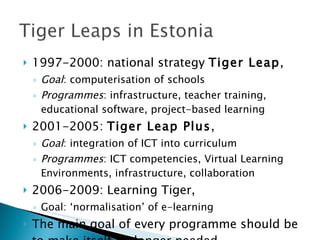
1997-2000:  national strategy  Tiger Leap ,  Goal :  computerisation of schools Programmes :  infrastructure, teacher training, educational software, project-based learning 2001-2005:  Tiger Leap Plus ,  Goal :  integration of ICT into curriculum Programmes :  ICT competencies, Virtual Learning Environments, infrastructure, collaboration 2006-2009:  Learning Tiger ,  Goal :  ‘normalisation’ of e-learning The main goal of every programme should be to make itself no longer needed
Tiger Leap Foundation : semi-independent public body with small office, experienced programme managers, ‘rented expertise’ Engaging local municipalities (school-owners) Systemic approach: providing infrastructure is not enough Support at local level: IT managers (educational technologists) hired by schools Crossing the Moore’s chasm: grants for innovators, disseminating the best practice, training and digital resources to everyone
Infrastructure : computers/devices, power, peripherals, connectivity (WAN/LAN), security, data protection, identity management Content and services : communication, information systems, virtual learning environments, digital learning resources ICT competencies : pupils, teachers, staff Integration  of ICT into curriculum Support  and management Dissemination , PR, teacher’s communities
 
In emergence of disruptive technology, the systemic management of change is needed – otherwise we ‘try to connect a jet engine to a horse carriage’ (S.Papert) or will face the risk of reaching only a small group of innovators among teachers Systemic change management could turn new technology into a catalyst for educational change in much larger scale, affecting school architecture, classroom settings, teaching and learning methods Conclusion

Disruptive technology

  • 1.
    Mart Laanpere Headof the Centre for Educational Technology Tallinn University, Estonia
  • 2.
    Maintaining the status quo Bureaucratic school systems continue Teacher exodus: the ‘Meltdown scenario’ Re-schooling Schools as core social centres Schools as focused learning organisations De-schooling Learning Networks and the Network Society Extending the Market Model
  • 3.
    Chaos theory: extrapolationdoes not work in predicting the changes in social systems, especially during ‘moments of bifurcation’ The next bifurcation in educational domain: disruptive technologies may radically change the classrooms, schools and related behavior patterns Disruptive technology: unexpected innovation, replaces the existing mainstream technologies Previous radical changes in learning environment: Writing (banned by Socrates) Textbooks (16th century) School-classroom-subject system (19th century) The next change: slate PC instead textbooks?
  • 4.
  • 5.
    Diffusion of innovationsAdoption phases: knowledge > persuasion > decision > implementation > confirmation Moore’s chasm
  • 6.
    Research problem: validityof Rogers’ theory in the context of technology-driven educational change Catalyst for reform vs. lever (tool, resource) Diffusion of ICT in school: traditional patterns in most of the cases Implementation success factors : teachers’ & students’ ICT competencies, infrastructure Equity : ICT in classroom does not widen the performance gap based on SE factors OECD/CERI study 2002
  • 7.
    1997-2000: nationalstrategy Tiger Leap , Goal : computerisation of schools Programmes : infrastructure, teacher training, educational software, project-based learning 2001-2005: Tiger Leap Plus , Goal : integration of ICT into curriculum Programmes : ICT competencies, Virtual Learning Environments, infrastructure, collaboration 2006-2009: Learning Tiger , Goal : ‘normalisation’ of e-learning The main goal of every programme should be to make itself no longer needed
  • 8.
    Tiger Leap Foundation: semi-independent public body with small office, experienced programme managers, ‘rented expertise’ Engaging local municipalities (school-owners) Systemic approach: providing infrastructure is not enough Support at local level: IT managers (educational technologists) hired by schools Crossing the Moore’s chasm: grants for innovators, disseminating the best practice, training and digital resources to everyone
  • 9.
    Infrastructure : computers/devices,power, peripherals, connectivity (WAN/LAN), security, data protection, identity management Content and services : communication, information systems, virtual learning environments, digital learning resources ICT competencies : pupils, teachers, staff Integration of ICT into curriculum Support and management Dissemination , PR, teacher’s communities
  • 10.
  • 11.
    In emergence ofdisruptive technology, the systemic management of change is needed – otherwise we ‘try to connect a jet engine to a horse carriage’ (S.Papert) or will face the risk of reaching only a small group of innovators among teachers Systemic change management could turn new technology into a catalyst for educational change in much larger scale, affecting school architecture, classroom settings, teaching and learning methods Conclusion