Fostering New Learning Communities, Nurturing Online Learning EcosystemsJune 19, 2009 #sloancsym #nlc San FranciscoSloan C International Symposium on Emerging Technology Applications for Online Learninghttp://newlearningcommunities.pbworks.comHolly Rae Bemis-Schurtz, M.A. @hollyraeSusan Bussmann, Ph.D. @suceppibNew Mexico State UniversityWe apply these concepts to foster experiential learning for K-20 educators.
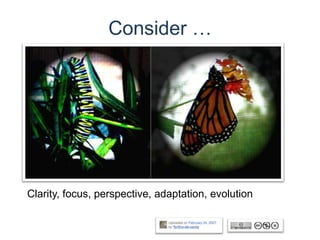
Consider …Clarity, focus, perspective, adaptation, evolution
Influential ConceptsLearning Ecosystems(Gutl & Chang)Connectivism(Siemens & Downes)Bioteaming(Thompson)
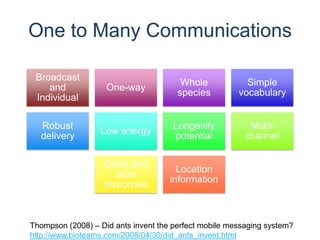
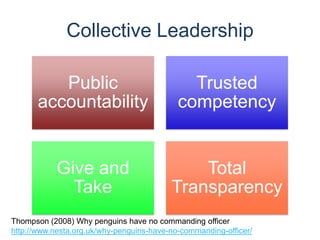
OverviewNew Learning Contexts & SkillsLearning Ecosystem as a ModelCharacteristics of New Learning Communities (NLCs)Organizational BiomimicryOne to many communicationsSelf organizing, collective leadershipDeveloping NLCsNurturing & Supporting NLCsAssessing NLCs
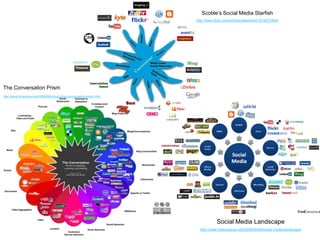
Scoble’s Social Media Starfishhttp://www.flickr.com/photos/dbarefoot/1814873464/The Conversation Prismhttp://www.briansolis.com/2008/08/introducing-conversation-prism.htmlSocial Media Landscapehttp://www.fredcavazza.net/2008/06/09/social-media-landscape/
What happens to learning in this context?“Our learning and information acquisition is a mashup. We take pieces, add pieces, dialogue, reframe, rethink, connect, and ultimately, we end up with some type of pattern that symbolizes what’s happening ‘out there’ and what it means to us. And that pattern changes daily.G. Siemens and P. Tittenberger. Handbook of emerging technologies for learning, March 2009.
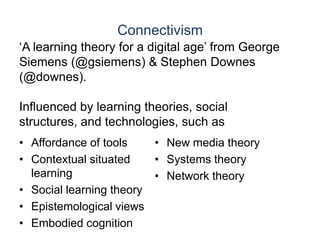
Connectivism‘A learning theory for a digital age’ from George Siemens (@gsiemens) & Stephen Downes (@downes).Influenced by learning theories, social structures, and technologies, such asAffordance of toolsContextual situated learningSocial learning theoryEpistemological viewsEmbodied cognitionNew media theorySystems theoryNetwork theory
In a nutshell…‘knowledge and cognition are distributed across networks of people and technology is the process of connecting, growing, and navigating those networks'the knowledge of the network is bigger than any one node Handbook of emerging technologies for learning, March 2009http://ltc.umanitoba.ca/wikis/etl/index.php/Handbook_of_Emerging_Technologies_for_Learning
Learning is forming connectionsConnectivism(George Siemens & Stephen Downes)Learning is connecting new experiences within our neural, conceptual and social networksDepth and diversity of the connections is what determines understanding Frequency of exposure and integration with other concepts can strengthen understandingConnections can be strong or weak – different networks serve different needsExpertise (the facility of using networks) is what is needed to learn in this new context
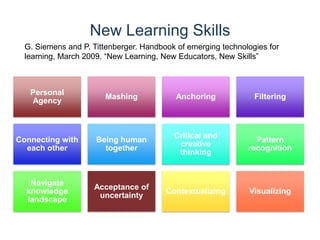
New Learning SkillsG. Siemens and P. Tittenberger. Handbook of emerging technologies for learning, March 2009. “New Learning, New Educators, New Skills”
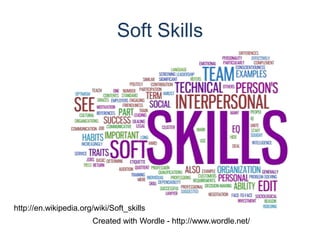
http://en.wikipedia.org/wiki/Soft_skillsCreated with Wordle - http://www.wordle.net/Soft Skills
Flickr Creative Commons Search for ‘early adopters’ or ‘power users’Technology Fluency & Adeptnesshttp://www.flickr.com/photos/hbemisschurtz/favorites/
WayfindingWayfinding encompasses all of the ways in which people and animals orient themselves in physical space and navigate from place to placetraditional navigation methods used by indigenous peoples
in the context of architecture to refer to the user experience of orientation and choosing a path within the built environment
the set of architectural and/or design elements that aid orientation.From http://en.wikipedia.org/wiki/Wayfinding
SensemakingSensemaking is the ability or attempt to make sense of an ambiguous situation. creating situational awareness and understanding in situations of high complexity or uncertainty in order to make decisions. "a motivated, continuous effort to understand connections (which can be among people, places, and events) in order to anticipate their trajectories and act effectively" (Klein et al., 2006a). http://en.wikipedia.org/wiki/SensemakingKlein, G., Moon, B. and Hoffman, R.F. (2006a). Making sense of sensemaking I: alternative perspectives.IEEE Intelligent Systems, 21(4), 70-73.
How do you support the development of personal learning skills?
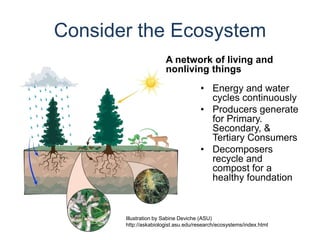
Consider the EcosystemA network of living and nonliving thingsEnergy and water cycles continuouslyProducers generate for Primary. Secondary, & Tertiary ConsumersDecomposers recycle and compost for a healthy foundationIllustration by Sabine Deviche (ASU) http://askabiologist.asu.edu/research/ecosystems/index.html
Learning Ecosystem as a ModelGutl & Chang, 2008a comprehensive review of the ecosystem model as used to describe highly dynamic learning environments that change organically and oftena model to identify perspectives, relationships, approaches and implementationsassists in identifying pedagogical, cognitive, social, organizational, and technological aspects
CharacteristicsOpen and flexible to allow for student's self directionSupport the individual learner and the community in a natural learning processNetwork of learning agents and sources dynamically changes according to situations and context (Gutl & Chang, 2008)
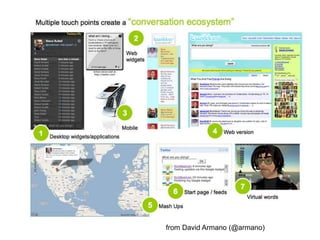
from David Armano (@armano)
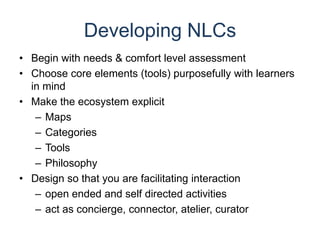
Our working definitionA learning ecosystem is…a framework for understanding new learning environments that incorporate a variety oftools (ie: course management systems, Web 2.0 applications) and multiple touch points (web, client, mobile) that aims to make transparent to the members of the learning community various channels (relationships, pathways, protocols) for learning.
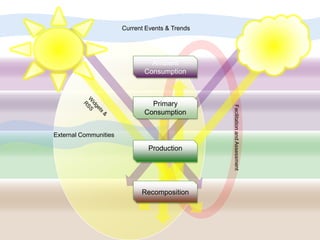
So we’ve tried…To establish a framework which shows our ecosystem.The next few slides show this over time.Each is only a snapshot of a dynamic system~ a moment in time.
Current Events & TrendsAmbient ConsumptionWidgets & RSSPrimary ConsumptionExternal CommunitiesFacilitation and AssessmentProductionRecomposition
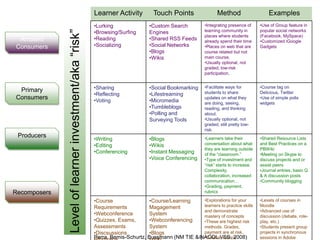
Level of learner investment/aka “risk”Ambient ConsumersPrimary ConsumersProducersRecomposersParra, Bemis-Schurtz, Bussmann (NM TIE & iNACOL VSS, 2008)
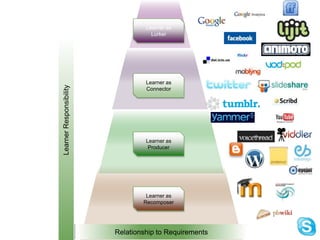
Learner ResponsibilityLearner as LurkerLearner as ConnectorRelationship to RequirementsLearner as ProducerLearner as Recomposer
Learning/Course Management System
Webconferencing System
VOIP Instant Messaging Tool
Robust Wiki
Blogs
Micromedia
Robust Wikis
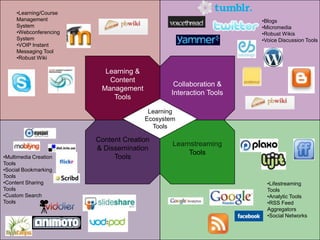
Voice Discussion ToolsCollaboration & Interaction Tools Learning & Content Management ToolsLearningEcosystem ToolsLearnstreaming ToolsContent Creation & Dissemination ToolsMultimedia Creation Tools
Social Bookmarking Tools
Content Sharing Tools
Custom Search Tools
Lifestreaming Tools
Analytic Tools
RSS Feed Aggregators
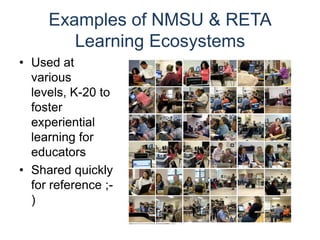
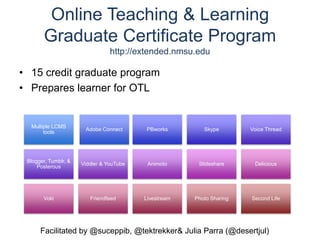
Social NetworksExamples of NMSU & RETALearning EcosystemsUsed at various levels, K-20 to foster experiential learning for educatorsShared quickly for reference ;-)
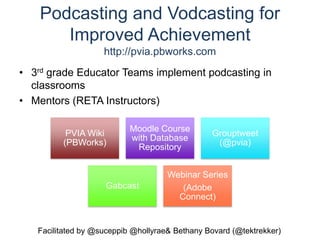
Podcasting and Vodcasting for Improved Achievementhttp://pvia.pbworks.com3rd grade Educator Teams implement podcasting in classroomsMentors (RETA Instructors)Facilitated by @suceppib @hollyrae & Bethany Bovard (@tektrekker)

New Learning Communities

  • 1.
    Fostering New LearningCommunities, Nurturing Online Learning EcosystemsJune 19, 2009 #sloancsym #nlc San FranciscoSloan C International Symposium on Emerging Technology Applications for Online Learninghttp://newlearningcommunities.pbworks.comHolly Rae Bemis-Schurtz, M.A. @hollyraeSusan Bussmann, Ph.D. @suceppibNew Mexico State UniversityWe apply these concepts to foster experiential learning for K-20 educators.
  • 2.
    Consider …Clarity, focus,perspective, adaptation, evolution
  • 3.
    Influential ConceptsLearning Ecosystems(Gutl& Chang)Connectivism(Siemens & Downes)Bioteaming(Thompson)
  • 4.
    OverviewNew Learning Contexts& SkillsLearning Ecosystem as a ModelCharacteristics of New Learning Communities (NLCs)Organizational BiomimicryOne to many communicationsSelf organizing, collective leadershipDeveloping NLCsNurturing & Supporting NLCsAssessing NLCs
  • 7.
    Scoble’s Social MediaStarfishhttp://www.flickr.com/photos/dbarefoot/1814873464/The Conversation Prismhttp://www.briansolis.com/2008/08/introducing-conversation-prism.htmlSocial Media Landscapehttp://www.fredcavazza.net/2008/06/09/social-media-landscape/
  • 8.
    What happens tolearning in this context?“Our learning and information acquisition is a mashup. We take pieces, add pieces, dialogue, reframe, rethink, connect, and ultimately, we end up with some type of pattern that symbolizes what’s happening ‘out there’ and what it means to us. And that pattern changes daily.G. Siemens and P. Tittenberger. Handbook of emerging technologies for learning, March 2009.
  • 9.
    Connectivism‘A learning theoryfor a digital age’ from George Siemens (@gsiemens) & Stephen Downes (@downes).Influenced by learning theories, social structures, and technologies, such asAffordance of toolsContextual situated learningSocial learning theoryEpistemological viewsEmbodied cognitionNew media theorySystems theoryNetwork theory
  • 10.
    In a nutshell…‘knowledgeand cognition are distributed across networks of people and technology is the process of connecting, growing, and navigating those networks'the knowledge of the network is bigger than any one node Handbook of emerging technologies for learning, March 2009http://ltc.umanitoba.ca/wikis/etl/index.php/Handbook_of_Emerging_Technologies_for_Learning
  • 11.
    Learning is formingconnectionsConnectivism(George Siemens & Stephen Downes)Learning is connecting new experiences within our neural, conceptual and social networksDepth and diversity of the connections is what determines understanding Frequency of exposure and integration with other concepts can strengthen understandingConnections can be strong or weak – different networks serve different needsExpertise (the facility of using networks) is what is needed to learn in this new context
  • 12.
    New Learning SkillsG.Siemens and P. Tittenberger. Handbook of emerging technologies for learning, March 2009. “New Learning, New Educators, New Skills”
  • 13.
  • 14.
    Flickr Creative CommonsSearch for ‘early adopters’ or ‘power users’Technology Fluency & Adeptnesshttp://www.flickr.com/photos/hbemisschurtz/favorites/
  • 15.
    WayfindingWayfinding encompasses allof the ways in which people and animals orient themselves in physical space and navigate from place to placetraditional navigation methods used by indigenous peoples
  • 16.
    in the contextof architecture to refer to the user experience of orientation and choosing a path within the built environment
  • 17.
    the set ofarchitectural and/or design elements that aid orientation.From http://en.wikipedia.org/wiki/Wayfinding
  • 18.
    SensemakingSensemaking is theability or attempt to make sense of an ambiguous situation. creating situational awareness and understanding in situations of high complexity or uncertainty in order to make decisions. "a motivated, continuous effort to understand connections (which can be among people, places, and events) in order to anticipate their trajectories and act effectively" (Klein et al., 2006a). http://en.wikipedia.org/wiki/SensemakingKlein, G., Moon, B. and Hoffman, R.F. (2006a). Making sense of sensemaking I: alternative perspectives.IEEE Intelligent Systems, 21(4), 70-73.
  • 19.
    How do yousupport the development of personal learning skills?
  • 20.
    Consider the EcosystemAnetwork of living and nonliving thingsEnergy and water cycles continuouslyProducers generate for Primary. Secondary, & Tertiary ConsumersDecomposers recycle and compost for a healthy foundationIllustration by Sabine Deviche (ASU) http://askabiologist.asu.edu/research/ecosystems/index.html
  • 21.
    Learning Ecosystem asa ModelGutl & Chang, 2008a comprehensive review of the ecosystem model as used to describe highly dynamic learning environments that change organically and oftena model to identify perspectives, relationships, approaches and implementationsassists in identifying pedagogical, cognitive, social, organizational, and technological aspects
  • 22.
    CharacteristicsOpen and flexibleto allow for student's self directionSupport the individual learner and the community in a natural learning processNetwork of learning agents and sources dynamically changes according to situations and context (Gutl & Chang, 2008)
  • 23.
  • 24.
    Our working definitionAlearning ecosystem is…a framework for understanding new learning environments that incorporate a variety oftools (ie: course management systems, Web 2.0 applications) and multiple touch points (web, client, mobile) that aims to make transparent to the members of the learning community various channels (relationships, pathways, protocols) for learning.
  • 25.
    So we’ve tried…Toestablish a framework which shows our ecosystem.The next few slides show this over time.Each is only a snapshot of a dynamic system~ a moment in time.
  • 26.
    Current Events &TrendsAmbient ConsumptionWidgets & RSSPrimary ConsumptionExternal CommunitiesFacilitation and AssessmentProductionRecomposition
  • 27.
    Level of learnerinvestment/aka “risk”Ambient ConsumersPrimary ConsumersProducersRecomposersParra, Bemis-Schurtz, Bussmann (NM TIE & iNACOL VSS, 2008)
  • 28.
    Learner ResponsibilityLearner asLurkerLearner as ConnectorRelationship to RequirementsLearner as ProducerLearner as Recomposer
  • 29.
  • 30.
  • 31.
  • 32.
  • 33.
  • 34.
  • 35.
  • 36.
    Voice Discussion ToolsCollaboration& Interaction Tools Learning & Content Management ToolsLearningEcosystem ToolsLearnstreaming ToolsContent Creation & Dissemination ToolsMultimedia Creation Tools
  • 37.
  • 38.
  • 39.
  • 40.
  • 41.
  • 42.
  • 43.
    Social NetworksExamples ofNMSU & RETALearning EcosystemsUsed at various levels, K-20 to foster experiential learning for educatorsShared quickly for reference ;-)
  • 44.
    Podcasting and Vodcastingfor Improved Achievementhttp://pvia.pbworks.com3rd grade Educator Teams implement podcasting in classroomsMentors (RETA Instructors)Facilitated by @suceppib @hollyrae & Bethany Bovard (@tektrekker)

Editor's Notes

  • #2 Focus on these key wordsHow many have heard about learning communities and learning ecosystemsWhen you think about the two ideas together, just one or two word snapshots what associated concepts pop into our head
  • #3 ShiftPerspectiveClarity
  • #4 Gütl, C. & Chang, V. (2008). Ecosystem-based Theoretical Models for Learning in Environments of the 21st Century. International. Journal of Emerging Technologies in Learning (iJET), Vol 3 (2008), 50-60.G. Siemens and P. Tittenberger. Handbook of emerging technologies for learning, March 2009. Available at http://ltc.umanitoba.ca/wikis/etl/index.php/Handbook_of_Emerging_Technologies_for_LearningThompson, K. ‘Bioteaming: A manifesto for virtually networked business teams’, http://www.bioteams.comAdditional Web resources can be found at * http://delicious.com/hollyrae/connectivism * http://delicious.com/hollyrae/ecosystem * http://delicious.com/hollyrae/bioteams
  • #9 IndividualizedUniqueCan go awry