Beyond Discussions Presented by Jordan Epp & Jeanette McKee CCDE Instructional Designers May 27, 2009
Beyond Discussions Who has used the Blackboard Discussion tool? Who has a Facebook account? Who uses Twitter?
Objectives To suggest learning strategies for expanded use of the Discussion tool in Blackboard To explore social networking tools for expanding discussions:  Twitter and Facebook To determine interest in pilot projects using these or other tools
LMS - Blackboard Discussion Tool A tool in Blackboard used to facilitate online class discussions. Typically, instructor posts a discussion topic; students respond. Messages are organized into threads. Asynchronous - flexible, convenient for distance learning
Discussion Tool in Blackboard Can be set up for small and large groups Usually graded for evaluation Tracked in the course; instructor can view participation for evaluation and run reports
Discussion Tool in Blackboard Strategies for a Successful Discussion Need structure, facilitation, & marks: Have a moderator for each group to keep the discussion moving and on track Assign roles and rotate them among the students Require a no. of posts and replies per week Include in course evaluation
Discussion Tool in Blackboard Example of discussion tool
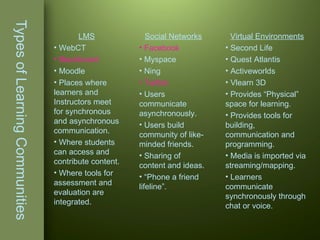
Types of Learning Communities LMS WebCT Blackboard Moodle Places where learners and Instructors meet for synchronous and asynchronous communication.  Where students can access and contribute content. Where tools for assessment and evaluation are integrated. Social Networks Facebook Myspace Ning Twitter Users communicate asynchronously. Users build community of like-minded friends. Sharing of content and ideas. “ Phone a friend lifeline”. Virtual Environments Second Life Quest Atlantis Activeworlds Vlearn 3D Provides “Physical” space for learning. Provides tools for building, communication and programming. Media is imported via streaming/mapping. Learners communicate synchronously through chat or voice.
Social Networks Social Networks In Plain English   1:53 Social capital:  resources accumulated through relationships among people Filter the info from the web:  build your social network with like-minded people and interests Once you build the network, info will come to you continually
Social Networking Tools Facebook Largest social network for N.Americans Network map built through viewing friends of friends or searching for interests.  Join Groups and Networks through searches and invites. Prolific participation/profiling reaps rewards. Activities: Commenting, tagging, uploading, linking, inviting, and joining.
Facebook Media/information Literacy Networking Build your own Network of Friends based on professional colleagues Create a Group for your course Encourage non-evaluated discussion and collaboration Chris Avenir - Ryerson Chem. How to use Facebook in learning
Facebook Edublogs Live: May 31st 6pm Pimp My Facebook Regardless of your personal feelings towards Facebook it is the preferred method of social networking for many people.  But are you using Facebook to your advantage?  Join Frances McLean (http://yourpda.edublogs.org/) while she pimps Larry Ferlazzo's Facebook account (http://larryferlazzo.edublogs.org/) to demonstrate the different ways educators and bloggers can use the power of Facebook.  Click on this link to join: https://sas.elluminate.com/d.jnlp?sid=vclass&password=LPCBZLAT4D3Y921591JT
Social Networking Tools Twitter The new front porch - Darryl Dash Use up to 140 characters Messages are called  tweets Public or private Purpose:  To share short updates about what you are doing, where you are, a question you pose, and/or resources to share.
Twitter Started in 2006 March 2009: 15M users per month and increasing rapidly  Hospitals - fastest growing users (I.e. surgeons) May 31 Conference “Twitter for Business” in San Francisco
Twitter Twitter and Learning: “ The process of  forming a community of learners  is an important issue in distance learning because it can affect student satisfaction, retention, and learning (Brown, 2001) Foster interaction  - active learning Support metacognition  (thinking about and reflecting on your learning) which benefits comprehension and retention.
Twitter “ The brilliance of Twitter is that it so easily connects people on all different types of computers and cell phone platforms” (Whaley, 2009)
Twitter Twitter.com Tweetdeck.com  Twitterfox - plug-in for Firefox; messages pop up when open browser  Free! Add-ons:  webcam, songs
Discussion Think about how these technological tools could be used to enhance learning in our courses. Q  What ideas do you have for pilot  projects using any of these  technological tools  or   other  technological tools??

Beyond Discussions: Expanding Social Networks

  • 1.
    Beyond Discussions Presentedby Jordan Epp & Jeanette McKee CCDE Instructional Designers May 27, 2009
  • 2.
    Beyond Discussions Whohas used the Blackboard Discussion tool? Who has a Facebook account? Who uses Twitter?
  • 3.
    Objectives To suggestlearning strategies for expanded use of the Discussion tool in Blackboard To explore social networking tools for expanding discussions: Twitter and Facebook To determine interest in pilot projects using these or other tools
  • 4.
    LMS - BlackboardDiscussion Tool A tool in Blackboard used to facilitate online class discussions. Typically, instructor posts a discussion topic; students respond. Messages are organized into threads. Asynchronous - flexible, convenient for distance learning
  • 5.
    Discussion Tool inBlackboard Can be set up for small and large groups Usually graded for evaluation Tracked in the course; instructor can view participation for evaluation and run reports
  • 6.
    Discussion Tool inBlackboard Strategies for a Successful Discussion Need structure, facilitation, & marks: Have a moderator for each group to keep the discussion moving and on track Assign roles and rotate them among the students Require a no. of posts and replies per week Include in course evaluation
  • 7.
    Discussion Tool inBlackboard Example of discussion tool
  • 8.
    Types of LearningCommunities LMS WebCT Blackboard Moodle Places where learners and Instructors meet for synchronous and asynchronous communication. Where students can access and contribute content. Where tools for assessment and evaluation are integrated. Social Networks Facebook Myspace Ning Twitter Users communicate asynchronously. Users build community of like-minded friends. Sharing of content and ideas. “ Phone a friend lifeline”. Virtual Environments Second Life Quest Atlantis Activeworlds Vlearn 3D Provides “Physical” space for learning. Provides tools for building, communication and programming. Media is imported via streaming/mapping. Learners communicate synchronously through chat or voice.
  • 9.
    Social Networks SocialNetworks In Plain English 1:53 Social capital: resources accumulated through relationships among people Filter the info from the web: build your social network with like-minded people and interests Once you build the network, info will come to you continually
  • 10.
    Social Networking ToolsFacebook Largest social network for N.Americans Network map built through viewing friends of friends or searching for interests. Join Groups and Networks through searches and invites. Prolific participation/profiling reaps rewards. Activities: Commenting, tagging, uploading, linking, inviting, and joining.
  • 11.
    Facebook Media/information LiteracyNetworking Build your own Network of Friends based on professional colleagues Create a Group for your course Encourage non-evaluated discussion and collaboration Chris Avenir - Ryerson Chem. How to use Facebook in learning
  • 12.
    Facebook Edublogs Live:May 31st 6pm Pimp My Facebook Regardless of your personal feelings towards Facebook it is the preferred method of social networking for many people. But are you using Facebook to your advantage? Join Frances McLean (http://yourpda.edublogs.org/) while she pimps Larry Ferlazzo's Facebook account (http://larryferlazzo.edublogs.org/) to demonstrate the different ways educators and bloggers can use the power of Facebook. Click on this link to join: https://sas.elluminate.com/d.jnlp?sid=vclass&password=LPCBZLAT4D3Y921591JT
  • 13.
    Social Networking ToolsTwitter The new front porch - Darryl Dash Use up to 140 characters Messages are called tweets Public or private Purpose: To share short updates about what you are doing, where you are, a question you pose, and/or resources to share.
  • 14.
    Twitter Started in2006 March 2009: 15M users per month and increasing rapidly Hospitals - fastest growing users (I.e. surgeons) May 31 Conference “Twitter for Business” in San Francisco
  • 15.
    Twitter Twitter andLearning: “ The process of forming a community of learners is an important issue in distance learning because it can affect student satisfaction, retention, and learning (Brown, 2001) Foster interaction - active learning Support metacognition (thinking about and reflecting on your learning) which benefits comprehension and retention.
  • 16.
    Twitter “ Thebrilliance of Twitter is that it so easily connects people on all different types of computers and cell phone platforms” (Whaley, 2009)
  • 17.
    Twitter Twitter.com Tweetdeck.com Twitterfox - plug-in for Firefox; messages pop up when open browser Free! Add-ons: webcam, songs
  • 18.
    Discussion Think abouthow these technological tools could be used to enhance learning in our courses. Q What ideas do you have for pilot projects using any of these technological tools or other technological tools??