Social Networking
  in Education


     The advantages &
disadvantages of using social
networking media in education
Introduction
• As technology evolves, education must
  evolve
• Social networking provides a new outlet to
  advance education
• Social networking promotes collaboration and
  communication skills
• Social networking in education can broaden
  our students technical proficiency
• Social media instills advanced communication
  skills
Relative Advantage
Project based learning using social networking
  & online communities provide…
•   Collaboration Skills
•   Communication Skills
•   Problem-Solving Skills
•   These skills are necessary in real-world
    problem solving
Social Media Definition
• According to Dictionary.com, social
  networking is the use of social networking
  media throughout the use of online media
  that people may use to communicate and
  interact with each other
  (Dictionary.com,2012).
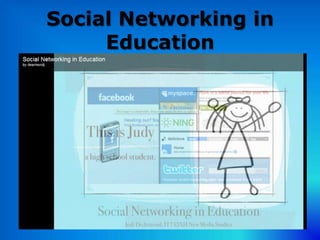
Social Networking in
     Education
Advantages of Social Media
      in Education
• Students may become advocates in their
  communities(Wolpert-Gawron, 2010)
• Promotes individual expression (Willard, 2011)
• A forum to create new friendships (Willard,
  2011)
• Promotes communication (Dearmondj, 2011)
• Enhances teamwork &
  collaboration(Dearmondj, 2011)
• Varies learning environments(Dearmondj,
  2011)
Advantages of Social Media
      in Education
• Promotes critical thinking, problem solving,
  and global participation (Huffington Post,
  2011)
• Creates teacher/student communication
  (Magid, 2010)
• Provides medium for class announcements
  (Magid, 2010)
• Creates forum for peer tutoring, reviews, and
  communication (Magid, 2010)
• Creates varied learning environments (Magid,
  2010)
Disadvantages of Social
     Media in Education
• Students may become victims to sexual
  predators (Huffington Post, 2011)
• Cyber bullying may occur without a
  moderator (Huffington Post, 2011)
• Overuse of social media= addiction (Willard,
  2011)
• Privacy/ Trust issues within the cyber world
  (Willard, 2011)
• Text language is often used (Willard, 2011)
Disadvantages of Social
     Media in Education
• Inappropriate relationship between
  teachers & students (Huffington Post,
  2011)
• Profiles are often public & not private
  (Huffington Post, 2011)
• Inappropriate materials viewed online by
  students (Huffington Post, 2011)
The Social Networking
         Contenders
• FaceBook: is an free interactive world wide
  social network that includes, photos, videos,
  a blog, and chat.
• Twitter: is a free microblogging service
  similar to Tumblr.
• Ning: is an free interactive social media that
  allows the user to create his or her own
  social network
• Flickr: is an free interactive online photo
  sharing community.
                      Image courtesy of Fun Spill
The Social Networking
         Contenders
• You Tube: is an free online community
  tool used to store and view videos.
• Myspace: is an free online social media
  networking tool similar to FaceBook.
• Tumblr: A free microblogging social
  network, user posts quick blog posts.
• Pinterest: is an free online community
  and a social networking site where users
  create virtual pins & boards.
                  Image courtesy of Fun Spill
The Social Networking
         Contenders
How can education benefit from social
 networking?
• Students can create history presentation
  videos (Upload videos to You Tube or Teacher
  Tube)
• Ning- could be used to create a Business
  Technology class social networking site
• Twitter could be used for a class discussion

                  Image courtesy of Fun Spill
The Social Networking
         Contenders
How can education benefit from social
  networking?
• Flickr could be used in a secondary level
  business/technology course for digital
  photography
• Pinterest could be used to gather images for
  class projects in secondary history, science,
  or English Literature classes

                   Image courtesy of Fun Spill
Examples of Social
     Networks in Education
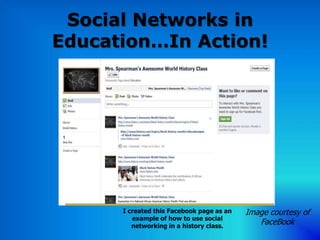
• Mrs. Spearman’s World History Class
      This FaceBook page I created as an example of
  how an educators can use a Facebook page in a
  secondary level history course.
• Mrs. Page’s 3rd Grade Class
     This FaceBook page was created by a 3rd grade
  teacher to use to communicate with her class.
• FaceBook in Education
      The official FaceBook education tab includes
  ideas, suggestions, and assistance in learning how
  to use FaceBook in education.
Examples of Social
  Networks in Education


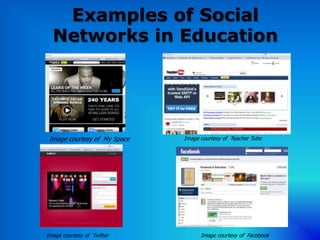
 Image courtesy of My Space   Image courtesy of Teacher Tube


Image courtesy of Twitter           Image courtesy of Facebook
Alternative Examples of
      Social Networks in
          Education
• Teacher Tube- This free online collaboration
  tool provides an alternative video library with
  educational videos.
• All subject areas, K-12 grade level
• Fatclass- Free academic Social networking site,
  secondary education, all subject areas
• Educators Connect- Fee based academic
  social networking site for educators

                    Image courtesy of Fun Spill
Alternative Examples of
      Social Networks in
          Education
• Woogi World- An safe virtual world for
  K-6 students, parents, and educators.
• Classroom 2.0- Created with the Ning
  social networking site, this site was
  created for educators only.
• Imbee- A free safe social networking site
  for teens, secondary level education

                     Image courtesy of Fun Spill
Social Networks in
Education…In Action!


      I created this Facebook page as an   Image courtesy of
         example of how to use social
         networking in a history class.
                                              FaceBook
Social Networks in
Education…In Action!


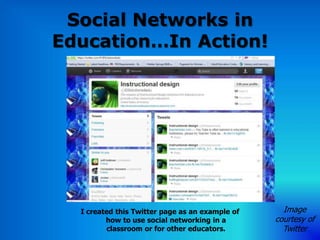
  I created this Twitter page as an example of     Image
         how to use social networking in a       courtesy of
         classroom or for other educators.         Twitter
Examples of Online
 Communities in Education
• Wikis: Community communication &
  collaboration skill builders
• E.g. Wiki Spaces
• WetPaint
• PB Wiki
• Great for elementary and secondary
  Science, English, and History courses
Examples of Online
 Communities in Education
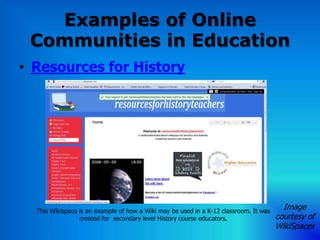
• Resources for History


  This Wikispace is an example of how a Wiki may be used in a K-12 classroom. It was
                                                                                         Image
                 created for secondary level History course educators.                 courtesy of
                                                                                       WikiSpaces
Examples of Online
Communities in Education
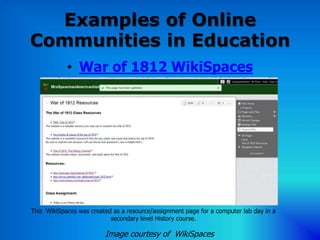
            • War of 1812 WikiSpaces


This WikiSpaces was created as a resource/assignment page for a computer lab day in a
                           secondary level History course.

                         Image courtesy of WikiSpaces
Examples of Online
 Communities in Education
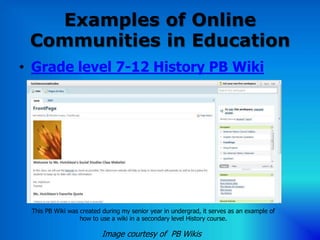
• Grade level 7-12 History PB Wiki


 This PB Wiki was created during my senior year in undergrad, it serves as an example of
                  how to use a wiki in a secondary level History course.

                          Image courtesy of PB Wikis
Examples of Online
 Communities in Education
• Blogs: Community communication &
  collaboration skill builders
• E.g. Blogger
• Word Press
• Thoughts
• Great for secondary level student
  journaling, History, English, Literature
  courses, including foreign Language
  courses
Examples of Online
 Communities in Education
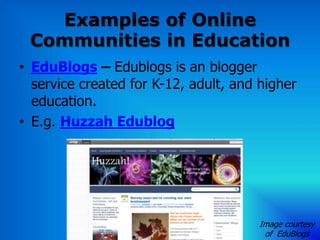
• EduBlogs – Edublogs is an blogger
  service created for K-12, adult, and higher
  education.
• E.g. Huzzah Edublog


                                      Image courtesy
                                       of EduBlogs
Examples of Online
 Communities in Education
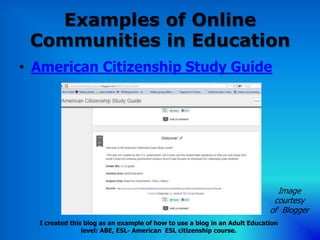
• American Citizenship Study Guide


                                                                             Image
                                                                            courtesy
                                                                           of Blogger
  I created this blog as an example of how to use a blog in an Adult Education
                level: ABE, ESL- American ESL citizenship course.
Examples of Online
Communities in Education


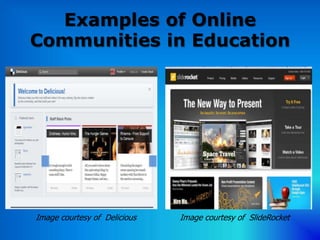
Image courtesy of Delicious   Image courtesy of SlideRocket
Resources
• Dearmondj (2011, July 14). Social Networking in Education . You
  Tube. Retrieved      February 20, 2012, from
       http://www.youtube.com/watch?v=3ZLtP5ug9jc&context=C3c3
  885aADOEgsTo         PDskIphMDQ1JoVExYb2X_vFJ3V
• Huffington Post (2011, May 27). Social Networking In Schools:
  Educators Debate The         Merits Of Technology In Classrooms .
  Huff Post Education. Retrieved February      20, 2012, from
  http://www.huffingtonpost.com/2011/03/27/social-networking-s
       chools_n_840911.html
• Magid, L. (2010, February 25). Social networking belongs in school.
  CNET. Retrieved      February 20, 2012, from
  http://news.cnet.com/8301-19518_3-10459983-          238.html
Resources
• Using Social Networking In The Classroom . (2011, July 12). You
  Tube. Retrieved       February 20, 2012, from
  http://www.youtube.com/watch?v=Na7GVlqB-
       Vc&feature=related
• Willard, N. (2011). Schools and Online Social Networking . Education
  World.        Retrieved February 20, 2012, from
       http://www.educationworld.com/a_issues/issues/issues423.sht
  ml
• Wolpert-Gawron, H. (2010, May 7). Social Media in Education: The
  Power of      Facebook. Edutopia. Retrieved February 20, 2012, from
       http://www.edutopia.org/social-media-education-examples-
  facebook
Resources
• https://www.facebook.com/pages/Mrs-
  Pages-3rd-Grade-Classroom-Lake-
  Contrary/225394044198256
• http://www.teachertube.com/
• https://www.facebook.com/education?sk=
  wall
• http://pinterest.com/
• http://youtube.com/
• http://facebook.com/
Resources
• http://pbworks.com/pbworks-basic-edition
• http://hutchisonsocialstudies.pbworks.com
  /w/page/19773123/FrontPage?lo=46adf3b
  b
• http://resourcesforhistoryteachers.wikispa
  ces.com/
• http://www.accreditedonlinecolleges.com/
  blog/2010/50-free-collaboration-tools/
• http://www.sliderocket.com/
Resources
• http://www.ning.com/
• http://delicious.com/
• https://www.facebook.com/HHSworldhisto
  ryClass
• http://oedb.org/library/features/top-100-
  education-blogs
• http://www.wikispaces.com/content/teach
  er
Additional Resources
• http://myspace.com/

• http://www.woogiworld.com/

• http://www.fatclass.com/share/

• http://educatorsconnect.com/
Additional Resources
• http://www.classroom20.com/

• http://imbee.com/

• http://www.youtube.com/watch?v=3ZLtP5ug
  9jc&feature=player_embedded

• https://www.facebook.com/education?sk=wa
  ll
• http://huzzah.edublogs.org/
Additional Resources
• http://sbmsworldhistory.wetpaint.com/

• http://www.thoughts.com/

• http://wordpress.org/

• http://www.blogger.com/
Additional Resources
• http://www.wikispaces.com/

• http://www.uscis.gov/USCIS/Office%20of
  %20Citizenship/Citizenship%20Resource%
  20Center%20Site/Publications/100q.pdf

• http://americancitizenshipstudyguide.blogs
  pot.com/

Social networking presentation

  • 1.
    Social Networking in Education The advantages & disadvantages of using social networking media in education
  • 2.
    Introduction • As technologyevolves, education must evolve • Social networking provides a new outlet to advance education • Social networking promotes collaboration and communication skills • Social networking in education can broaden our students technical proficiency • Social media instills advanced communication skills
  • 3.
    Relative Advantage Project basedlearning using social networking & online communities provide… • Collaboration Skills • Communication Skills • Problem-Solving Skills • These skills are necessary in real-world problem solving
  • 4.
    Social Media Definition •According to Dictionary.com, social networking is the use of social networking media throughout the use of online media that people may use to communicate and interact with each other (Dictionary.com,2012).
  • 5.
  • 6.
    Advantages of SocialMedia in Education • Students may become advocates in their communities(Wolpert-Gawron, 2010) • Promotes individual expression (Willard, 2011) • A forum to create new friendships (Willard, 2011) • Promotes communication (Dearmondj, 2011) • Enhances teamwork & collaboration(Dearmondj, 2011) • Varies learning environments(Dearmondj, 2011)
  • 7.
    Advantages of SocialMedia in Education • Promotes critical thinking, problem solving, and global participation (Huffington Post, 2011) • Creates teacher/student communication (Magid, 2010) • Provides medium for class announcements (Magid, 2010) • Creates forum for peer tutoring, reviews, and communication (Magid, 2010) • Creates varied learning environments (Magid, 2010)
  • 8.
    Disadvantages of Social Media in Education • Students may become victims to sexual predators (Huffington Post, 2011) • Cyber bullying may occur without a moderator (Huffington Post, 2011) • Overuse of social media= addiction (Willard, 2011) • Privacy/ Trust issues within the cyber world (Willard, 2011) • Text language is often used (Willard, 2011)
  • 9.
    Disadvantages of Social Media in Education • Inappropriate relationship between teachers & students (Huffington Post, 2011) • Profiles are often public & not private (Huffington Post, 2011) • Inappropriate materials viewed online by students (Huffington Post, 2011)
  • 10.
    The Social Networking Contenders • FaceBook: is an free interactive world wide social network that includes, photos, videos, a blog, and chat. • Twitter: is a free microblogging service similar to Tumblr. • Ning: is an free interactive social media that allows the user to create his or her own social network • Flickr: is an free interactive online photo sharing community. Image courtesy of Fun Spill
  • 11.
    The Social Networking Contenders • You Tube: is an free online community tool used to store and view videos. • Myspace: is an free online social media networking tool similar to FaceBook. • Tumblr: A free microblogging social network, user posts quick blog posts. • Pinterest: is an free online community and a social networking site where users create virtual pins & boards. Image courtesy of Fun Spill
  • 12.
    The Social Networking Contenders How can education benefit from social networking? • Students can create history presentation videos (Upload videos to You Tube or Teacher Tube) • Ning- could be used to create a Business Technology class social networking site • Twitter could be used for a class discussion Image courtesy of Fun Spill
  • 13.
    The Social Networking Contenders How can education benefit from social networking? • Flickr could be used in a secondary level business/technology course for digital photography • Pinterest could be used to gather images for class projects in secondary history, science, or English Literature classes Image courtesy of Fun Spill
  • 14.
    Examples of Social Networks in Education • Mrs. Spearman’s World History Class This FaceBook page I created as an example of how an educators can use a Facebook page in a secondary level history course. • Mrs. Page’s 3rd Grade Class This FaceBook page was created by a 3rd grade teacher to use to communicate with her class. • FaceBook in Education The official FaceBook education tab includes ideas, suggestions, and assistance in learning how to use FaceBook in education.
  • 15.
    Examples of Social Networks in Education Image courtesy of My Space Image courtesy of Teacher Tube Image courtesy of Twitter Image courtesy of Facebook
  • 16.
    Alternative Examples of Social Networks in Education • Teacher Tube- This free online collaboration tool provides an alternative video library with educational videos. • All subject areas, K-12 grade level • Fatclass- Free academic Social networking site, secondary education, all subject areas • Educators Connect- Fee based academic social networking site for educators Image courtesy of Fun Spill
  • 17.
    Alternative Examples of Social Networks in Education • Woogi World- An safe virtual world for K-6 students, parents, and educators. • Classroom 2.0- Created with the Ning social networking site, this site was created for educators only. • Imbee- A free safe social networking site for teens, secondary level education Image courtesy of Fun Spill
  • 18.
    Social Networks in Education…InAction! I created this Facebook page as an Image courtesy of example of how to use social networking in a history class. FaceBook
  • 19.
    Social Networks in Education…InAction! I created this Twitter page as an example of Image how to use social networking in a courtesy of classroom or for other educators. Twitter
  • 20.
    Examples of Online Communities in Education • Wikis: Community communication & collaboration skill builders • E.g. Wiki Spaces • WetPaint • PB Wiki • Great for elementary and secondary Science, English, and History courses
  • 21.
    Examples of Online Communities in Education • Resources for History This Wikispace is an example of how a Wiki may be used in a K-12 classroom. It was Image created for secondary level History course educators. courtesy of WikiSpaces
  • 22.
    Examples of Online Communitiesin Education • War of 1812 WikiSpaces This WikiSpaces was created as a resource/assignment page for a computer lab day in a secondary level History course. Image courtesy of WikiSpaces
  • 23.
    Examples of Online Communities in Education • Grade level 7-12 History PB Wiki This PB Wiki was created during my senior year in undergrad, it serves as an example of how to use a wiki in a secondary level History course. Image courtesy of PB Wikis
  • 24.
    Examples of Online Communities in Education • Blogs: Community communication & collaboration skill builders • E.g. Blogger • Word Press • Thoughts • Great for secondary level student journaling, History, English, Literature courses, including foreign Language courses
  • 25.
    Examples of Online Communities in Education • EduBlogs – Edublogs is an blogger service created for K-12, adult, and higher education. • E.g. Huzzah Edublog Image courtesy of EduBlogs
  • 26.
    Examples of Online Communities in Education • American Citizenship Study Guide Image courtesy of Blogger I created this blog as an example of how to use a blog in an Adult Education level: ABE, ESL- American ESL citizenship course.
  • 27.
    Examples of Online Communitiesin Education Image courtesy of Delicious Image courtesy of SlideRocket
  • 28.
    Resources • Dearmondj (2011,July 14). Social Networking in Education . You Tube. Retrieved February 20, 2012, from http://www.youtube.com/watch?v=3ZLtP5ug9jc&context=C3c3 885aADOEgsTo PDskIphMDQ1JoVExYb2X_vFJ3V • Huffington Post (2011, May 27). Social Networking In Schools: Educators Debate The Merits Of Technology In Classrooms . Huff Post Education. Retrieved February 20, 2012, from http://www.huffingtonpost.com/2011/03/27/social-networking-s chools_n_840911.html • Magid, L. (2010, February 25). Social networking belongs in school. CNET. Retrieved February 20, 2012, from http://news.cnet.com/8301-19518_3-10459983- 238.html
  • 29.
    Resources • Using SocialNetworking In The Classroom . (2011, July 12). You Tube. Retrieved February 20, 2012, from http://www.youtube.com/watch?v=Na7GVlqB- Vc&feature=related • Willard, N. (2011). Schools and Online Social Networking . Education World. Retrieved February 20, 2012, from http://www.educationworld.com/a_issues/issues/issues423.sht ml • Wolpert-Gawron, H. (2010, May 7). Social Media in Education: The Power of Facebook. Edutopia. Retrieved February 20, 2012, from http://www.edutopia.org/social-media-education-examples- facebook
  • 30.
    Resources • https://www.facebook.com/pages/Mrs- Pages-3rd-Grade-Classroom-Lake- Contrary/225394044198256 • http://www.teachertube.com/ • https://www.facebook.com/education?sk= wall • http://pinterest.com/ • http://youtube.com/ • http://facebook.com/
  • 31.
    Resources • http://pbworks.com/pbworks-basic-edition • http://hutchisonsocialstudies.pbworks.com /w/page/19773123/FrontPage?lo=46adf3b b • http://resourcesforhistoryteachers.wikispa ces.com/ • http://www.accreditedonlinecolleges.com/ blog/2010/50-free-collaboration-tools/ • http://www.sliderocket.com/
  • 32.
    Resources • http://www.ning.com/ • http://delicious.com/ •https://www.facebook.com/HHSworldhisto ryClass • http://oedb.org/library/features/top-100- education-blogs • http://www.wikispaces.com/content/teach er
  • 33.
    Additional Resources • http://myspace.com/ •http://www.woogiworld.com/ • http://www.fatclass.com/share/ • http://educatorsconnect.com/
  • 34.
    Additional Resources • http://www.classroom20.com/ •http://imbee.com/ • http://www.youtube.com/watch?v=3ZLtP5ug 9jc&feature=player_embedded • https://www.facebook.com/education?sk=wa ll • http://huzzah.edublogs.org/
  • 35.
    Additional Resources • http://sbmsworldhistory.wetpaint.com/ •http://www.thoughts.com/ • http://wordpress.org/ • http://www.blogger.com/
  • 36.
    Additional Resources • http://www.wikispaces.com/ •http://www.uscis.gov/USCIS/Office%20of %20Citizenship/Citizenship%20Resource% 20Center%20Site/Publications/100q.pdf • http://americancitizenshipstudyguide.blogs pot.com/