Social Networking Sites for
               ELT Professionals

Twitter ID: @Tweet4education               Ismail Fayed
 Ismailfayed [at] yahoo.com               ESL Teacher
           www.edunile.net     TESOL Arabia Webmaster
Outline
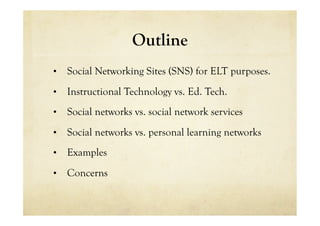
•  Social Networking Sites (SNS) for ELT purposes.

•  Instructional Technology vs. Ed. Tech.

•  Social networks vs. social network services

•  Social networks vs. personal learning networks

•  Examples

•  Concerns
A. Instructional Technology vs. Ed. Tech.

   
   “The theory and practice of design, development,
      utilization, management, and evaluation of processes and
      resources for learning… as a part of educational
      technology” – The Association for Educational Communications and
      Technology (AECT)


   “While instructional technology covers the processes and
      systems of learning and instruction, educational technology
      includes other systems used in the process of developing
      human capability.” – Wikipedia (2010)


                http://www.catawba.k12.nc.us/pages/its/black/_borders/top.ht1.jpg
Tech Talk!

   Technology
  o  Educational Technology
     •  Instructional Technology
         VLEs, CMSs, etc
         Social Networking
         Web 2.0 & web 3.0
         Virtual worlds
         What’s next?!
http://cstrips.bitstrips.com/44b3dd0595b5abe6d76ede4a22ea7e37.png
Sociology: Social Networks

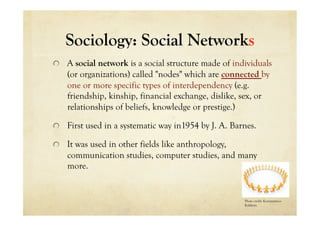
   A social network is a social structure made of individuals
    (or organizations) called "nodes" which are connected by
    one or more specific types of interdependency (e.g.
    friendship, kinship, financial exchange, dislike, sex, or
    relationships of beliefs, knowledge or prestige.)


   First used in a systematic way in1954 by J. A. Barnes.


   It was used in other fields like anthropology,
    communication studies, computer studies, and many
    more.


                                                      Photo credit: Konstantinos
                                                      Kokkinis
Social Network Services/websites

   Is the missing link between Web 1.0 & Web 2.0


   Building and reflecting on social relations among PEOPLE


   The ‘social’ aspect is highlighted through new and emerging
    interaction technologies (e.g. group messaging, online
    communities, etc.)

   It is mostly ‘web-based’


   Free


   User-friendly


   Popular!
“Social networking is in its infancy and I’m
   guessing it will become as widespread as
                    email,”*

                                                *Richard Kimber,
                  Google’s former managing director for South Asia
Social Constructivism Theory of Learning
               - Piaget (1960)

   Learning by doing … & playing


   Humans develop knowledge from their own experiences


   Human assimilate and accommodate to ‘construct’ their own
    knowledge


   The learner is a unique individual with unique needs &
    background (context)


   The learner has to be active, responsible & motivate


   The teacher is rather a facilitator
                                                   Atherton (2009)
A social network vs. a personal learning network?


   Members in social networks  must be actually ‘social’

  
   Personal learning network  can simply be acquiring
     info without contributing in return


                                                   Alan Levine (2007)
Examples?
B.
                   SNS & Models
     
   CMS (TACON Online 2010 & Moodle)

     
   Social Networking Websites
        
   Twitter.com
        
   Slideshare.com
        
   Wave.Google.com
        
   Google documents (doc.goolge.ae)
        
   pbwiki.com
        
   Ning.com
        
   Teachertube.com

     
   Avatar (3D) Worlds
        
   Second life
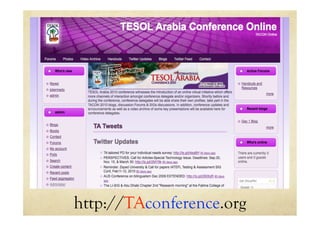
Taconference Initial Plan
http://TAconference.org
TESOL Arabia Conference Online 2010
TESOL Arabia on Twitter
Edmodo or Twitter?


http://www.slideshare.net/egermann/using-edmodo-in-the-classroom
Slideshare your presentation
Google Wave: a new generation..
SNS Networks Concepts
                 Network                   Represents
Slideshare                  PowerPoint
Twitter                     Mobile SMS
Google Documents & Pbwiki   Office Applications, Surveys, Collaborative
                            spaces, etc.

Ning, edublogs              Teachers’ room!
Teachertube                 TV & Mobile vides
Google wave                 Email
Moodle, BB, WebCT           Virtual Classrooms
Avatar worlds               Advanced Virtual reality/ simulation
Avatars.. Second Life


http://www.slideshare.net/nnoakes/virtual-worlds-and-language-learning
C.
           Issues & Concerns


     privacy
Guidelines for Educators Using Social
      and Educational Networking Sites

   Use Educational networking sites rather than just social
    networking sites (e.g. teachertube vs. youtube)


   When online, maintain your professional image all the time in
    your communications and media sharing with students,
    parents, or others.


   It is important to maintain a professional relationship with
    students to avoid relationships that could cause bias in the
    classroom. (Don’t grant your students access to your personal
    network)

http://doug-johnson.squarespace.com/blue-skunk-blog/2009/8/20/networking-
guidelines-revised.html
Guidelines for the use of social networking sites
                    by professional staff Hegna & Johnson (2009).

      Do not accept students as friends on personal SNS. Decline any student-
       initiated friend requests.


      Do not initiate friendships with students


      Remember that people classified as “friends” have the ability to download and
       share your information with others.


      Post only what you want the world to see. Imagine your students, their parents,
       your administrator, visiting your site. On a SNS, basically once you post
       something it may be available, even after it is removed from the site.


      Do not discuss students or coworkers or publicly criticize school policies or
       personnel.


      Visit your profile’s security and privacy settings. At a minimum, educators
       should have all privacy settings set to “only friends”. “Friends of friends” and
       “Networks and Friends” open your content to a large group of unknown
       people. Your privacy and that of your family may be a risk.
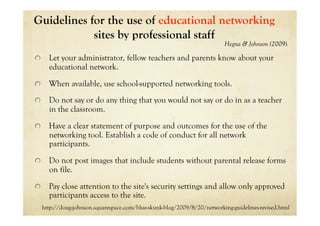
Guidelines for the use of educational networking
            sites by professional staff
                                                                        Hegna & Johnson (2009).


   Let your administrator, fellow teachers and parents know about your
    educational network.


   When available, use school-supported networking tools.


   Do not say or do any thing that you would not say or do in as a teacher
    in the classroom.


   Have a clear statement of purpose and outcomes for the use of the
    networking tool. Establish a code of conduct for all network
    participants.


   Do not post images that include students without parental release forms
    on file.


   Pay close attention to the site's security settings and allow only approved
    participants access to the site.
  http://doug-johnson.squarespace.com/blue-skunk-blog/2009/8/20/networking-guidelines-revised.html
References
ATHERTON J S (2009) Learning and teaching; constructivism in learning. Retrieved:
   Jan. 2010, from: http://www.learningandteaching.info/learning/
   constructivism.htm

Barnes, J. A. Class and committees in a Norwegian island parish", Human Relations
    7:39-58
Garrison, R. & Anderson. T. (2003). E-Learning in the 21st Century: A Framework for
    Research and Practice. Routledge.
Piaget, J. (1983). Piaget's theory. In P. Mussen (ed). Handbook of Child Psychology.
     4th ed. Vol. 1. New York: Wiley.
Hegna, J. & Johnson, D. (2009). Guidelines for Educators Using Social and Educational
     Networking Sites. The Blue Skunk Blog. Retrieved: Jan. 2010, from: http://doug-
     johnson.squarespace.com/blue-skunk-blog/2009/8/20/networking-guidelines-revised.html

Levine, A. (2007). Social networking for teachers. Retrieved: Jan. 2010, from: http://
    socialnetworking4teachers.wikispaces.com
Wikipedia website (2010). Instructional Technology. Retrieved: Jan. 2010, from:
   http://en.wikipedia.org/wiki/Instructional_technology

Social Networking 4 Elt

  • 1.
    Social Networking Sitesfor ELT Professionals Twitter ID: @Tweet4education Ismail Fayed Ismailfayed [at] yahoo.com ESL Teacher www.edunile.net TESOL Arabia Webmaster
  • 2.
    Outline •  Social NetworkingSites (SNS) for ELT purposes. •  Instructional Technology vs. Ed. Tech. •  Social networks vs. social network services •  Social networks vs. personal learning networks •  Examples •  Concerns
  • 3.
    A. Instructional Technologyvs. Ed. Tech.   “The theory and practice of design, development, utilization, management, and evaluation of processes and resources for learning… as a part of educational technology” – The Association for Educational Communications and Technology (AECT)   “While instructional technology covers the processes and systems of learning and instruction, educational technology includes other systems used in the process of developing human capability.” – Wikipedia (2010) http://www.catawba.k12.nc.us/pages/its/black/_borders/top.ht1.jpg
  • 4.
    Tech Talk!  Technology o  Educational Technology •  Instructional Technology   VLEs, CMSs, etc   Social Networking   Web 2.0 & web 3.0   Virtual worlds   What’s next?!
  • 5.
  • 6.
    Sociology: Social Networks   A social network is a social structure made of individuals (or organizations) called "nodes" which are connected by one or more specific types of interdependency (e.g. friendship, kinship, financial exchange, dislike, sex, or relationships of beliefs, knowledge or prestige.)   First used in a systematic way in1954 by J. A. Barnes.   It was used in other fields like anthropology, communication studies, computer studies, and many more. Photo credit: Konstantinos Kokkinis
  • 7.
    Social Network Services/websites   Is the missing link between Web 1.0 & Web 2.0   Building and reflecting on social relations among PEOPLE   The ‘social’ aspect is highlighted through new and emerging interaction technologies (e.g. group messaging, online communities, etc.)   It is mostly ‘web-based’   Free   User-friendly   Popular!
  • 8.
    “Social networking isin its infancy and I’m guessing it will become as widespread as email,”* *Richard Kimber, Google’s former managing director for South Asia
  • 9.
    Social Constructivism Theoryof Learning - Piaget (1960)   Learning by doing … & playing   Humans develop knowledge from their own experiences   Human assimilate and accommodate to ‘construct’ their own knowledge   The learner is a unique individual with unique needs & background (context)   The learner has to be active, responsible & motivate   The teacher is rather a facilitator Atherton (2009)
  • 10.
    A social networkvs. a personal learning network?   Members in social networks  must be actually ‘social’   Personal learning network  can simply be acquiring info without contributing in return Alan Levine (2007)
  • 11.
  • 12.
    B. SNS & Models   CMS (TACON Online 2010 & Moodle)   Social Networking Websites   Twitter.com   Slideshare.com   Wave.Google.com   Google documents (doc.goolge.ae)   pbwiki.com   Ning.com   Teachertube.com   Avatar (3D) Worlds   Second life
  • 13.
  • 14.
  • 15.
  • 17.
  • 18.
  • 19.
  • 20.
    Google Wave: anew generation..
  • 21.
    SNS Networks Concepts Network Represents Slideshare PowerPoint Twitter Mobile SMS Google Documents & Pbwiki Office Applications, Surveys, Collaborative spaces, etc. Ning, edublogs Teachers’ room! Teachertube TV & Mobile vides Google wave Email Moodle, BB, WebCT Virtual Classrooms Avatar worlds Advanced Virtual reality/ simulation
  • 22.
  • 23.
    C. Issues & Concerns privacy
  • 24.
    Guidelines for EducatorsUsing Social and Educational Networking Sites   Use Educational networking sites rather than just social networking sites (e.g. teachertube vs. youtube)   When online, maintain your professional image all the time in your communications and media sharing with students, parents, or others.   It is important to maintain a professional relationship with students to avoid relationships that could cause bias in the classroom. (Don’t grant your students access to your personal network) http://doug-johnson.squarespace.com/blue-skunk-blog/2009/8/20/networking- guidelines-revised.html
  • 25.
    Guidelines for theuse of social networking sites by professional staff Hegna & Johnson (2009).   Do not accept students as friends on personal SNS. Decline any student- initiated friend requests.   Do not initiate friendships with students   Remember that people classified as “friends” have the ability to download and share your information with others.   Post only what you want the world to see. Imagine your students, their parents, your administrator, visiting your site. On a SNS, basically once you post something it may be available, even after it is removed from the site.   Do not discuss students or coworkers or publicly criticize school policies or personnel.   Visit your profile’s security and privacy settings. At a minimum, educators should have all privacy settings set to “only friends”. “Friends of friends” and “Networks and Friends” open your content to a large group of unknown people. Your privacy and that of your family may be a risk.
  • 26.
    Guidelines for theuse of educational networking sites by professional staff Hegna & Johnson (2009).   Let your administrator, fellow teachers and parents know about your educational network.   When available, use school-supported networking tools.   Do not say or do any thing that you would not say or do in as a teacher in the classroom.   Have a clear statement of purpose and outcomes for the use of the networking tool. Establish a code of conduct for all network participants.   Do not post images that include students without parental release forms on file.   Pay close attention to the site's security settings and allow only approved participants access to the site. http://doug-johnson.squarespace.com/blue-skunk-blog/2009/8/20/networking-guidelines-revised.html
  • 27.
    References ATHERTON J S(2009) Learning and teaching; constructivism in learning. Retrieved: Jan. 2010, from: http://www.learningandteaching.info/learning/ constructivism.htm Barnes, J. A. Class and committees in a Norwegian island parish", Human Relations 7:39-58 Garrison, R. & Anderson. T. (2003). E-Learning in the 21st Century: A Framework for Research and Practice. Routledge. Piaget, J. (1983). Piaget's theory. In P. Mussen (ed). Handbook of Child Psychology. 4th ed. Vol. 1. New York: Wiley. Hegna, J. & Johnson, D. (2009). Guidelines for Educators Using Social and Educational Networking Sites. The Blue Skunk Blog. Retrieved: Jan. 2010, from: http://doug- johnson.squarespace.com/blue-skunk-blog/2009/8/20/networking-guidelines-revised.html Levine, A. (2007). Social networking for teachers. Retrieved: Jan. 2010, from: http:// socialnetworking4teachers.wikispaces.com Wikipedia website (2010). Instructional Technology. Retrieved: Jan. 2010, from: http://en.wikipedia.org/wiki/Instructional_technology