……………………………………………………………….


                            1
Benzene and Aromatic Compounds

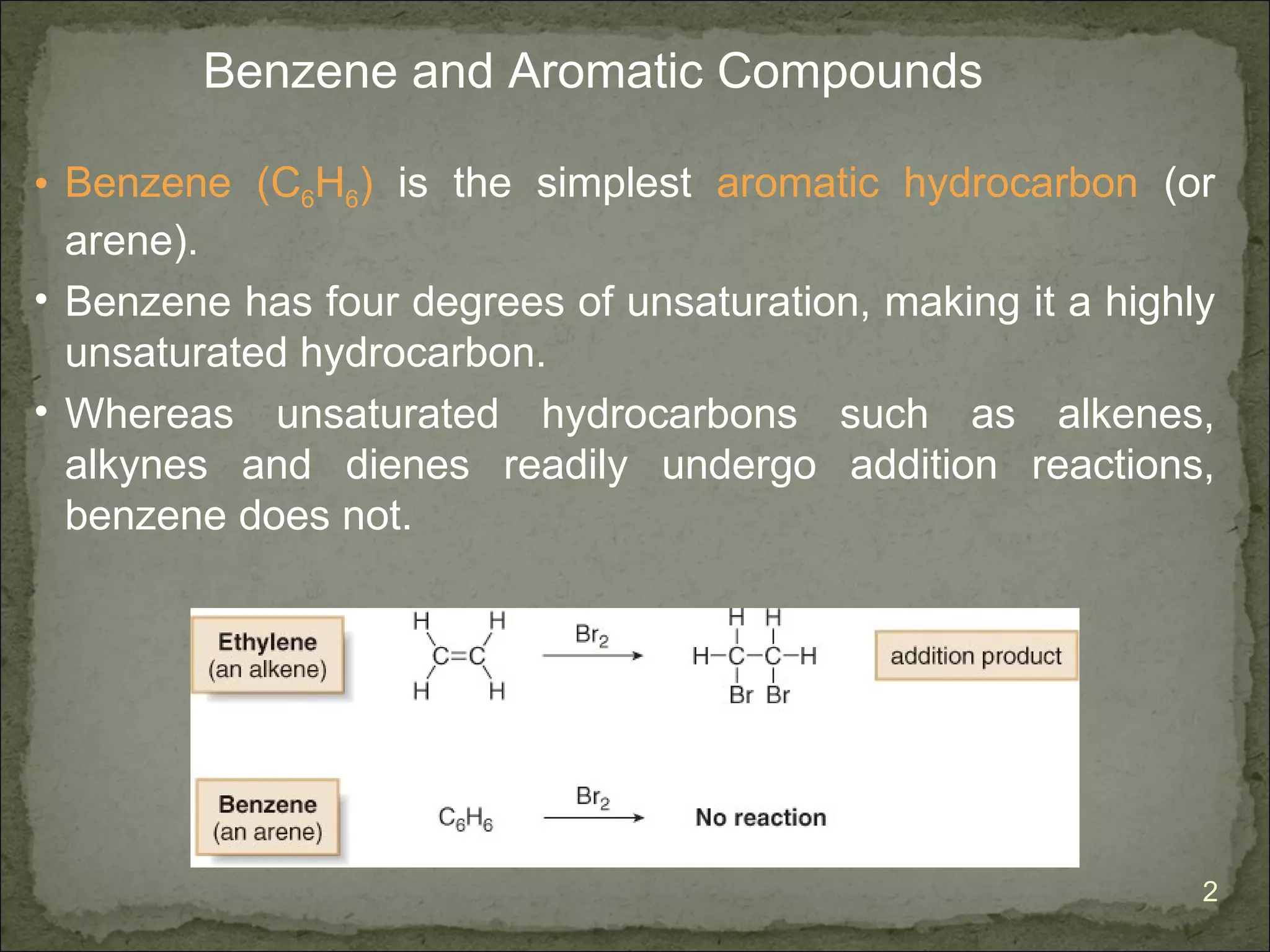
• Benzene (C6H6) is the simplest aromatic hydrocarbon (or
  arene).
• Benzene has four degrees of unsaturation, making it a highly
  unsaturated hydrocarbon.
• Whereas unsaturated hydrocarbons such as alkenes,
  alkynes and dienes readily undergo addition reactions,
  benzene does not.


                                                             2
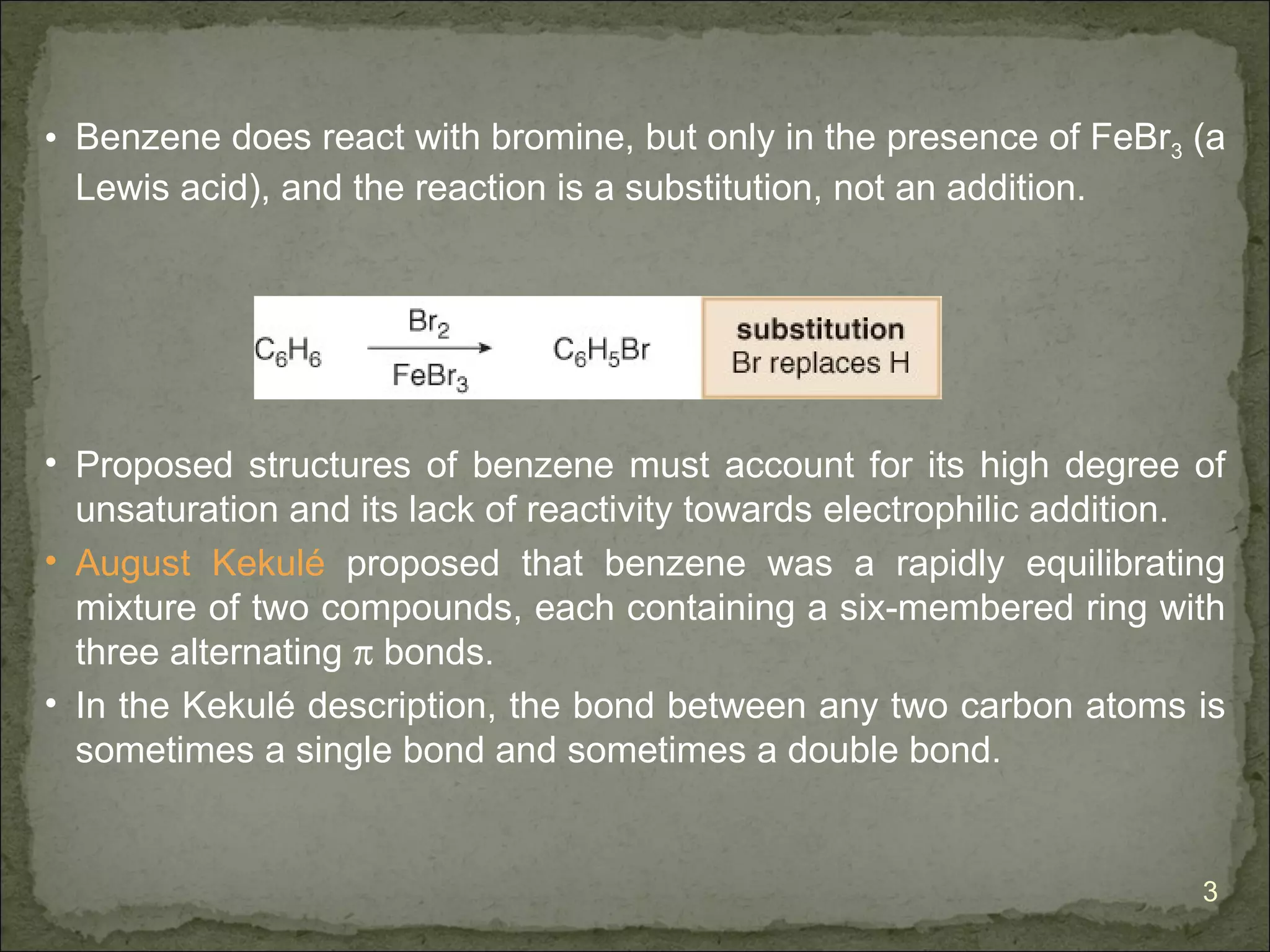
• Benzene does react with bromine, but only in the presence of FeBr3 (a
  Lewis acid), and the reaction is a substitution, not an addition.


• Proposed structures of benzene must account for its high degree of
  unsaturation and its lack of reactivity towards electrophilic addition.
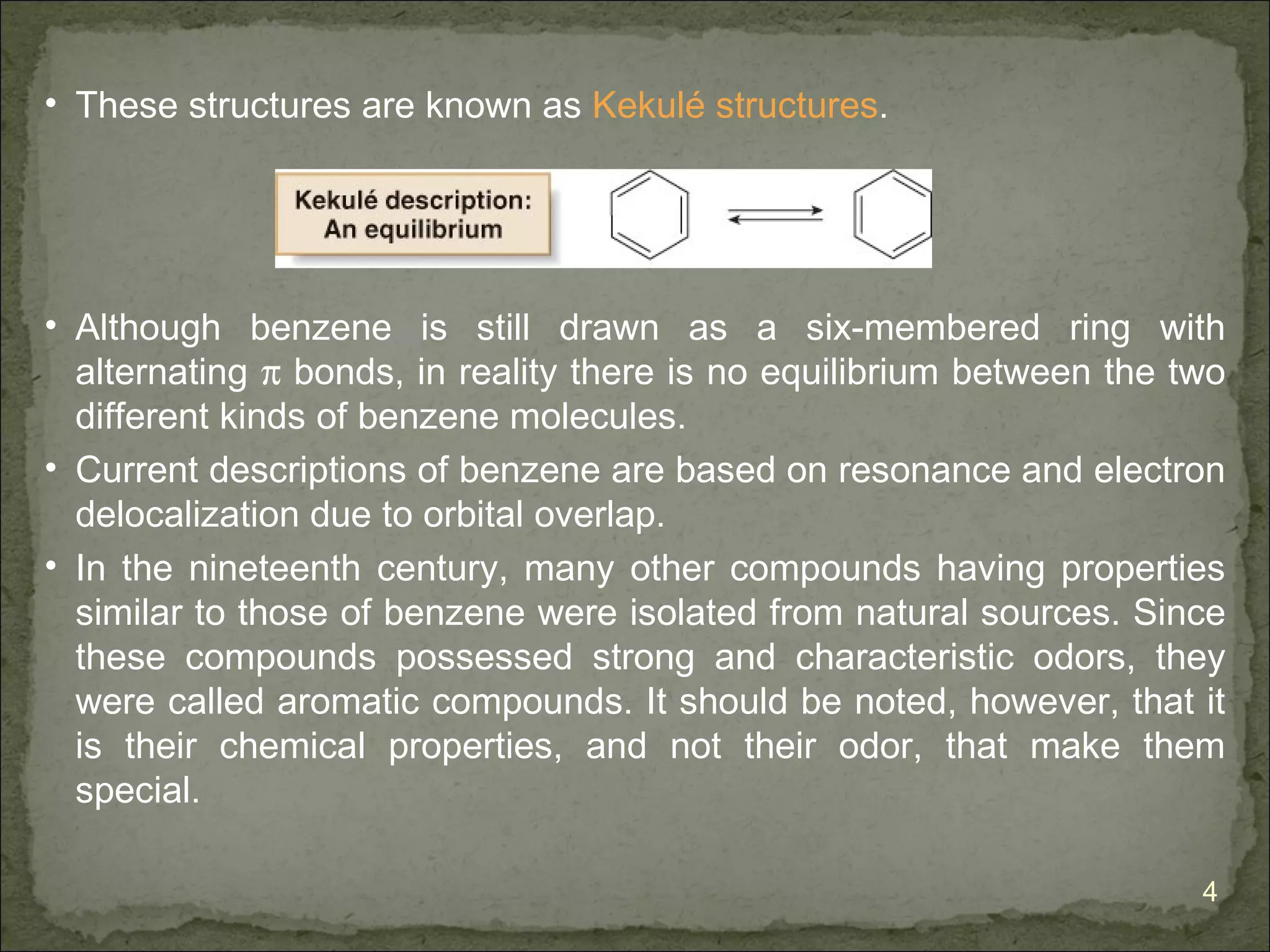
• August Kekulé proposed that benzene was a rapidly equilibrating
  mixture of two compounds, each containing a six-membered ring with
  three alternating π bonds.
• In the Kekulé description, the bond between any two carbon atoms is
  sometimes a single bond and sometimes a double bond.


                                                                       3
• These structures are known as Kekulé structures.


• Although benzene is still drawn as a six-membered ring with
  alternating π bonds, in reality there is no equilibrium between the two
  different kinds of benzene molecules.
• Current descriptions of benzene are based on resonance and electron
  delocalization due to orbital overlap.
• In the nineteenth century, many other compounds having properties
  similar to those of benzene were isolated from natural sources. Since
  these compounds possessed strong and characteristic odors, they
  were called aromatic compounds. It should be noted, however, that it
  is their chemical properties, and not their odor, that make them
  special.

                                                                       4
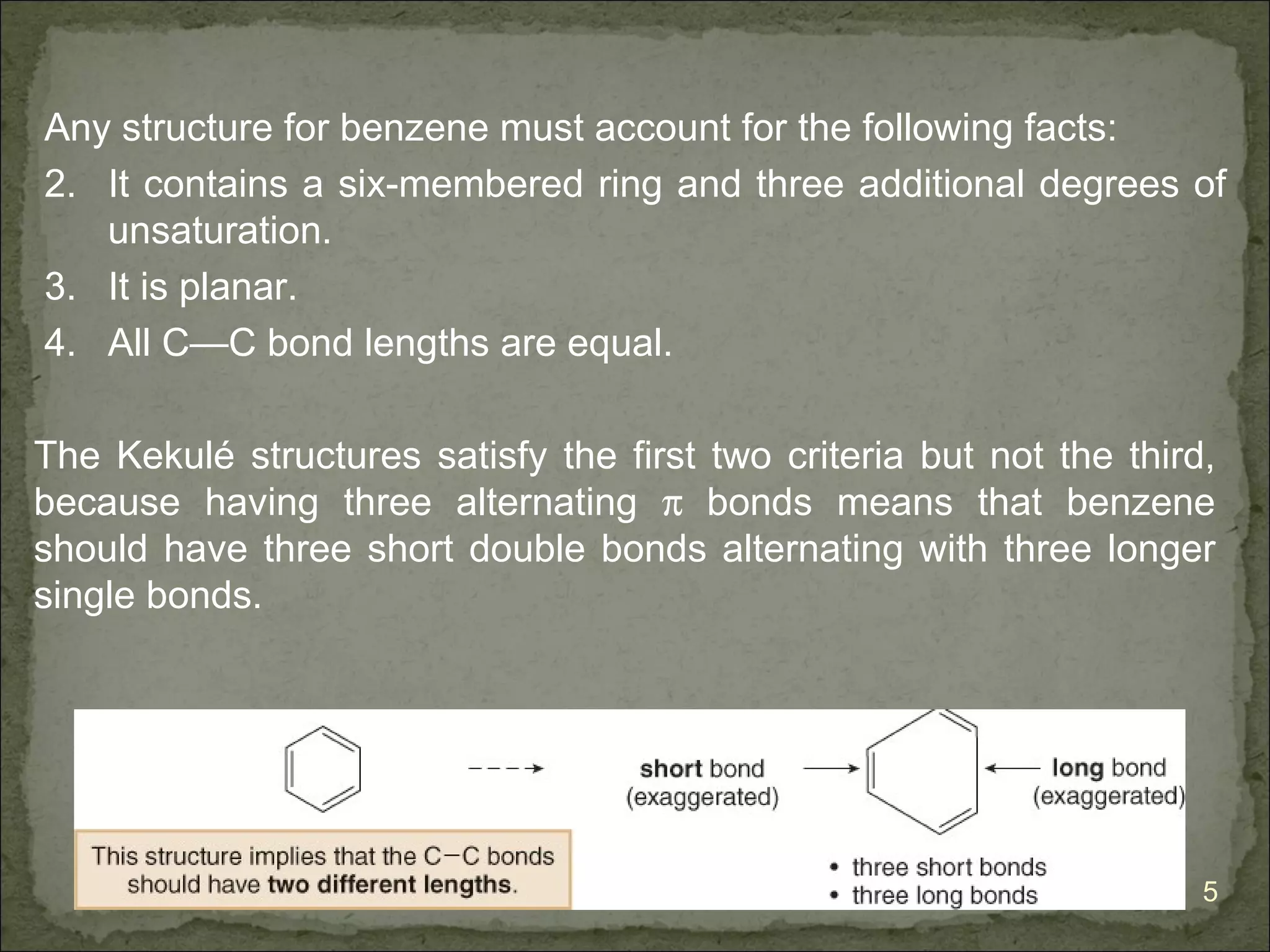
Any structure for benzene must account for the following facts:
2. It contains a six-membered ring and three additional degrees of
   unsaturation.
3. It is planar.
4. All C—C bond lengths are equal.

The Kekulé structures satisfy the first two criteria but not the third,
because having three alternating π bonds means that benzene
should have three short double bonds alternating with three longer
single bonds.


                                                                      5
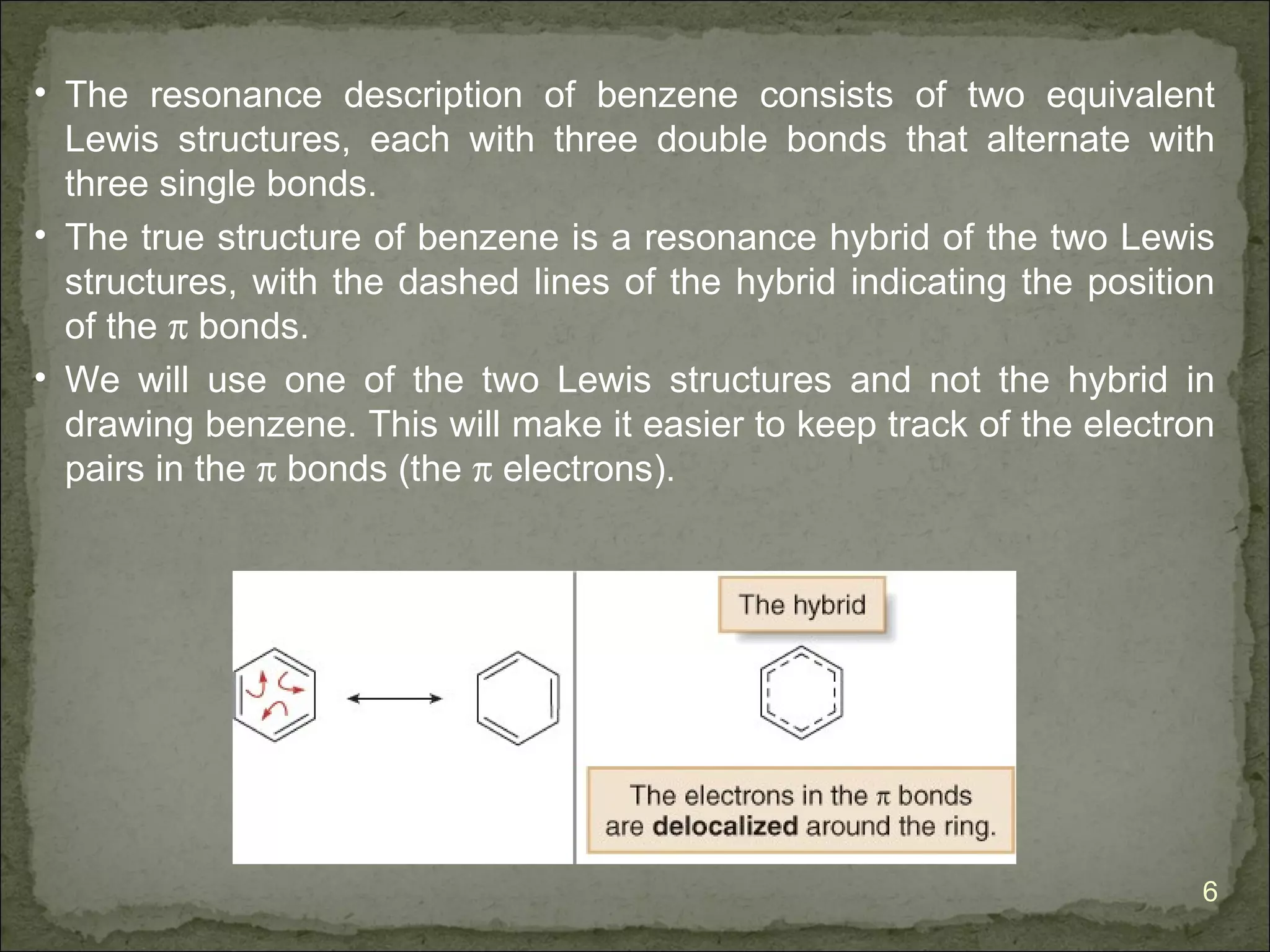
• The resonance description of benzene consists of two equivalent
  Lewis structures, each with three double bonds that alternate with
  three single bonds.
• The true structure of benzene is a resonance hybrid of the two Lewis
  structures, with the dashed lines of the hybrid indicating the position
  of the π bonds.
• We will use one of the two Lewis structures and not the hybrid in
  drawing benzene. This will make it easier to keep track of the electron
  pairs in the π bonds (the π electrons).


                                                                        6
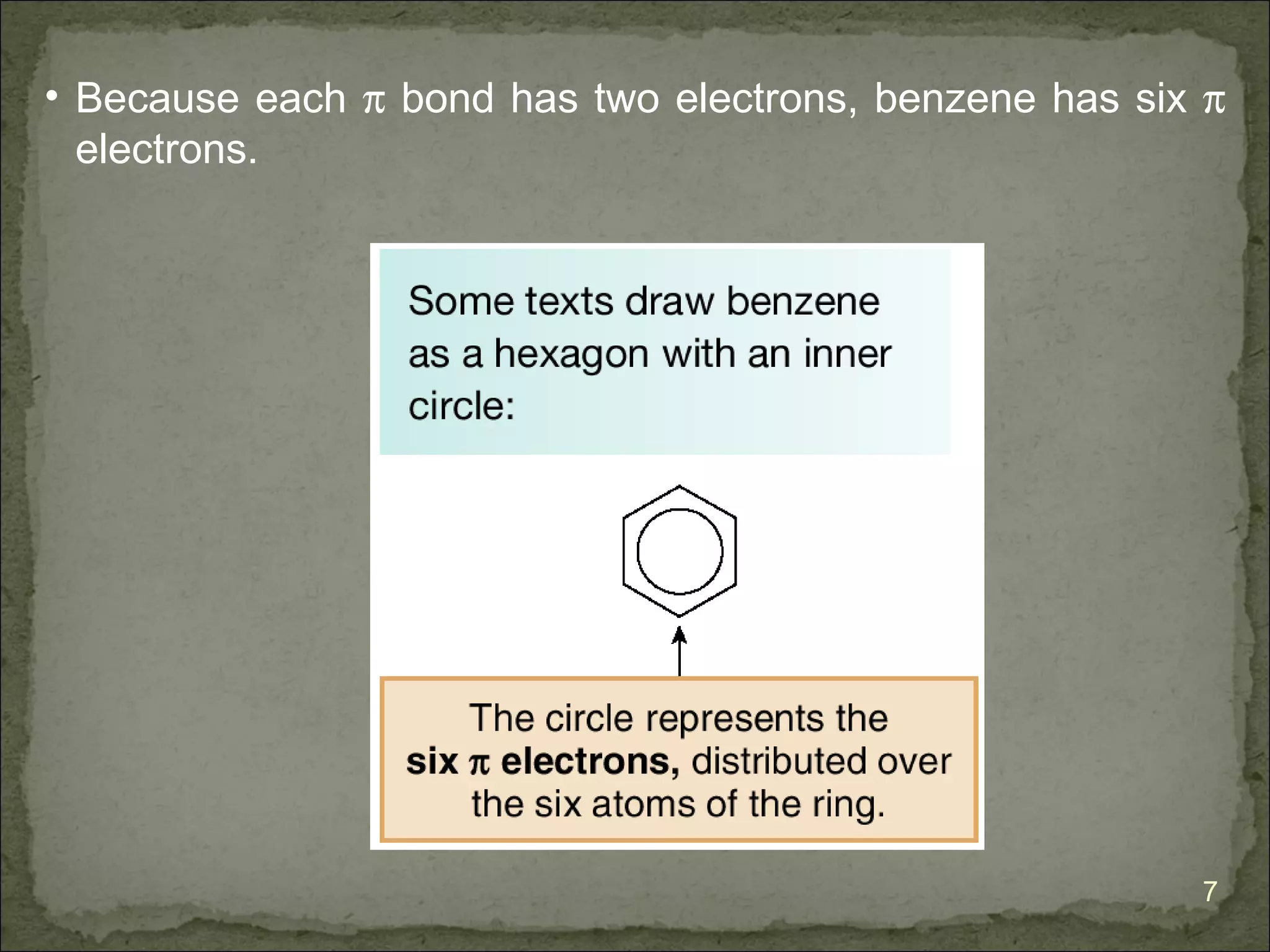
• Because each π bond has two electrons, benzene has six π
  electrons.


                                                        7
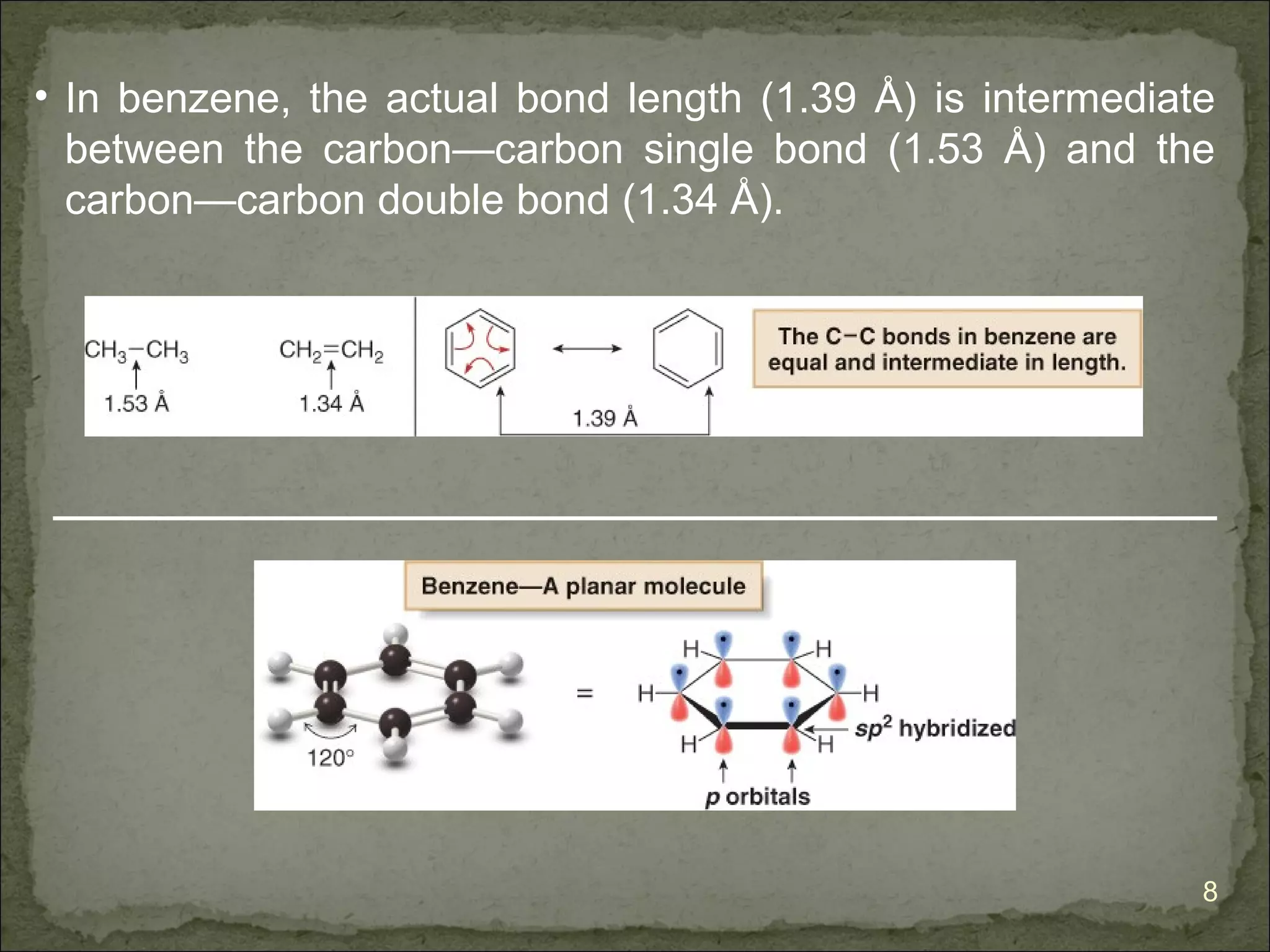
• In benzene, the actual bond length (1.39 Å) is intermediate
  between the carbon—carbon single bond (1.53 Å) and the
  carbon—carbon double bond (1.34 Å).


                                                            8
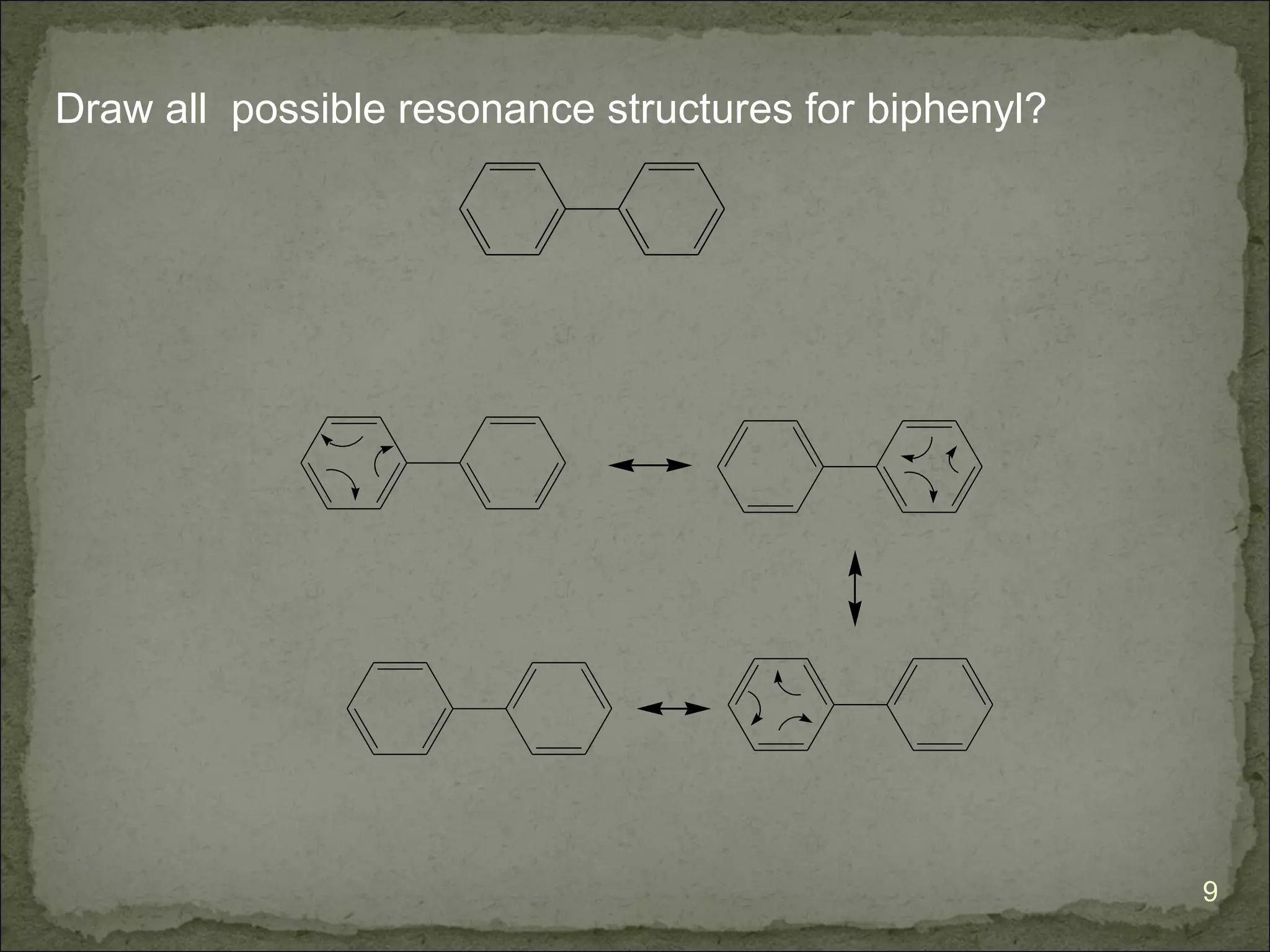
Draw all possible resonance structures for biphenyl?


                                                       9
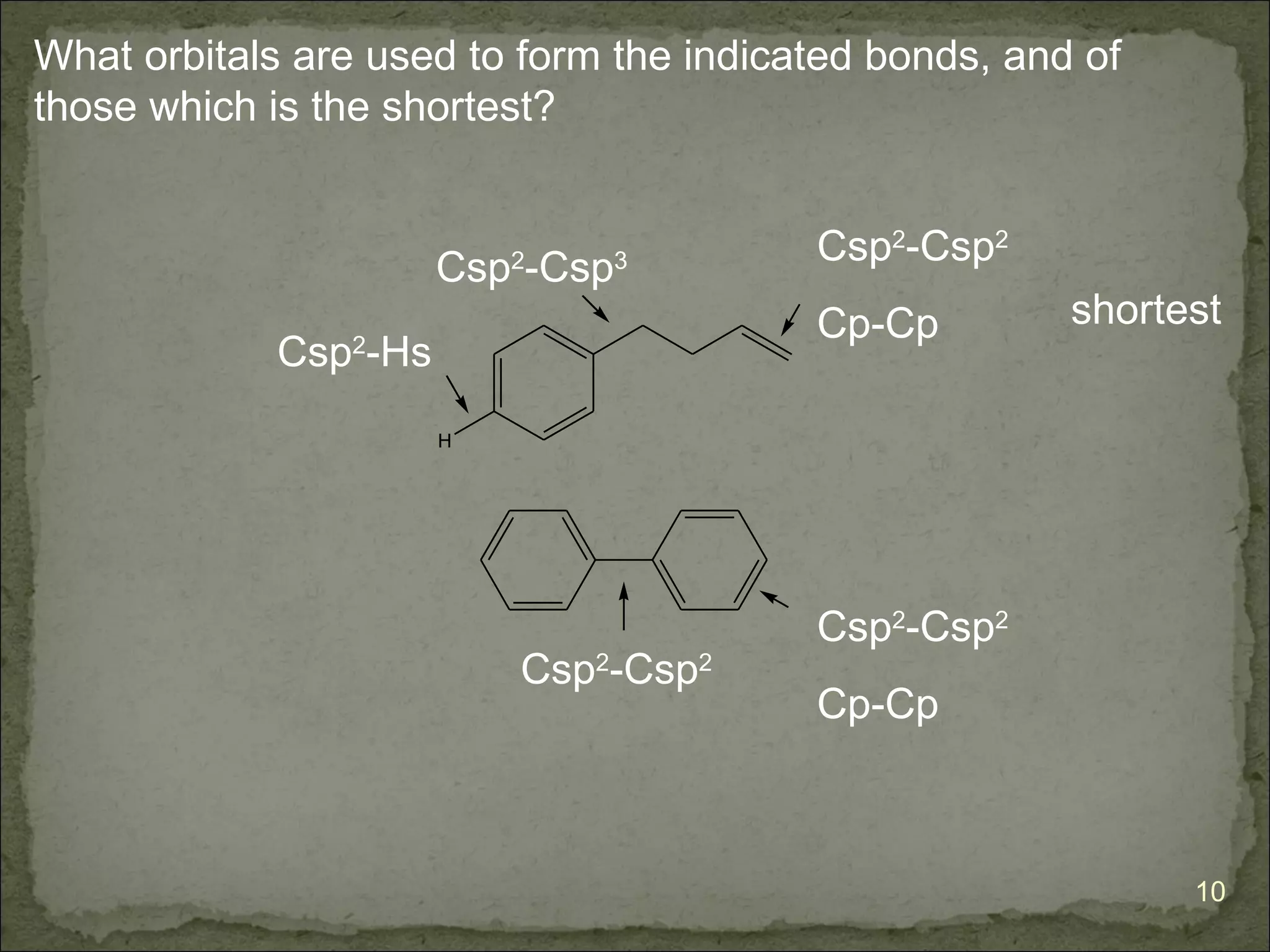
What orbitals are used to form the indicated bonds, and of
those which is the shortest?


                                         Csp2-Csp2
                      Csp -Csp
                          2   3

                                         Cp-Cp         shortest
            Csp2-Hs
                      H


                                         Csp2-Csp2
                          Csp2-Csp2
                                         Cp-Cp


                                                             10
Nomenclature of Benzene Derivatives

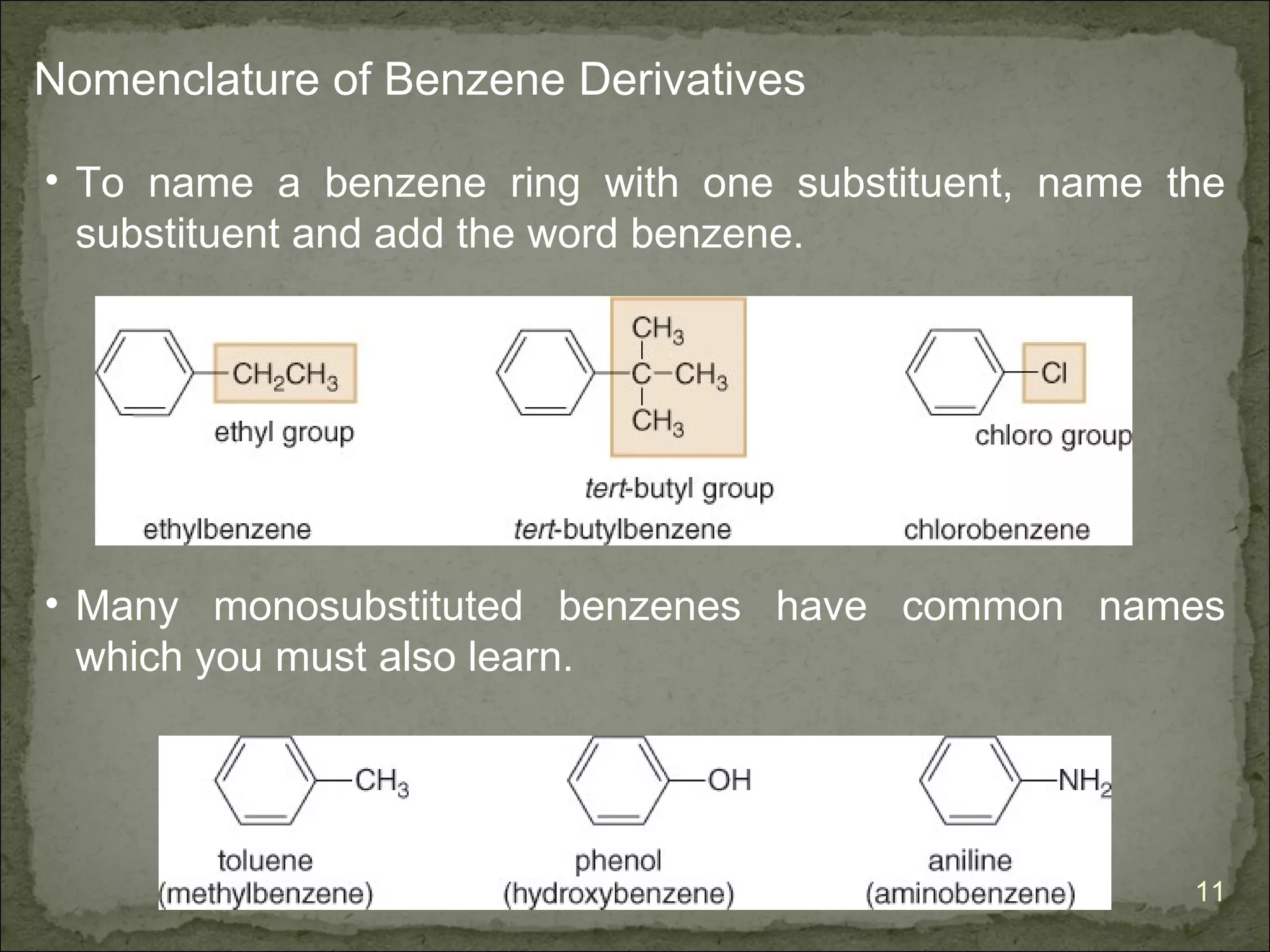
• To name a benzene ring with one substituent, name the
  substituent and add the word benzene.


• Many monosubstituted benzenes have common names
  which you must also learn.


                                                     11
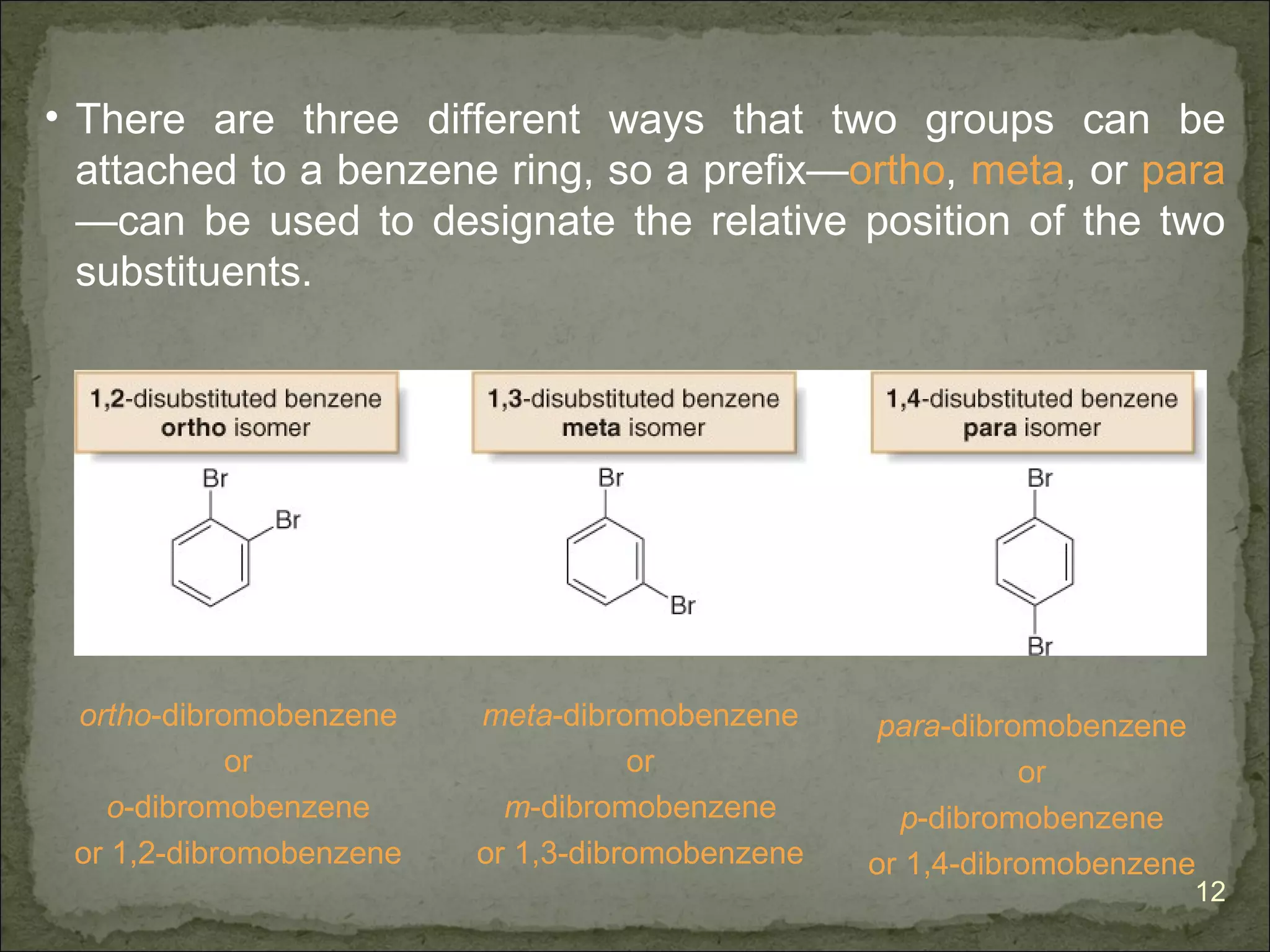
• There are three different ways that two groups can be
  attached to a benzene ring, so a prefix—ortho, meta, or para
  —can be used to designate the relative position of the two
  substituents.


 ortho-dibromobenzene    meta-dibromobenzene      para-dibromobenzene
            or                      or                      or
   o-dibromobenzene        m-dibromobenzene        p-dibromobenzene
 or 1,2-dibromobenzene   or 1,3-dibromobenzene   or 1,4-dibromobenzene
                                                                     12
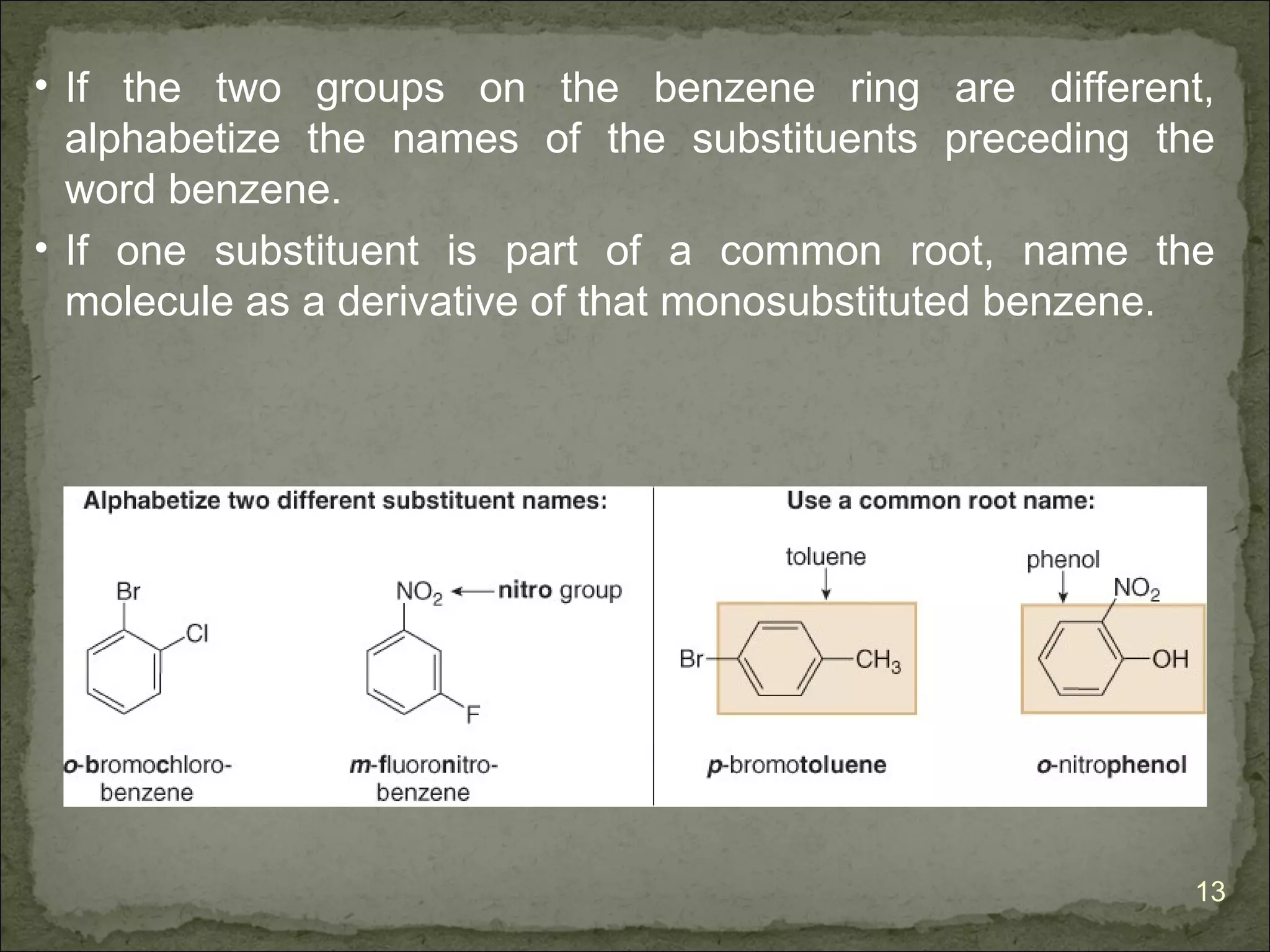
• If the two groups on the benzene ring are different,
  alphabetize the names of the substituents preceding the
  word benzene.
• If one substituent is part of a common root, name the
  molecule as a derivative of that monosubstituted benzene.


                                                         13
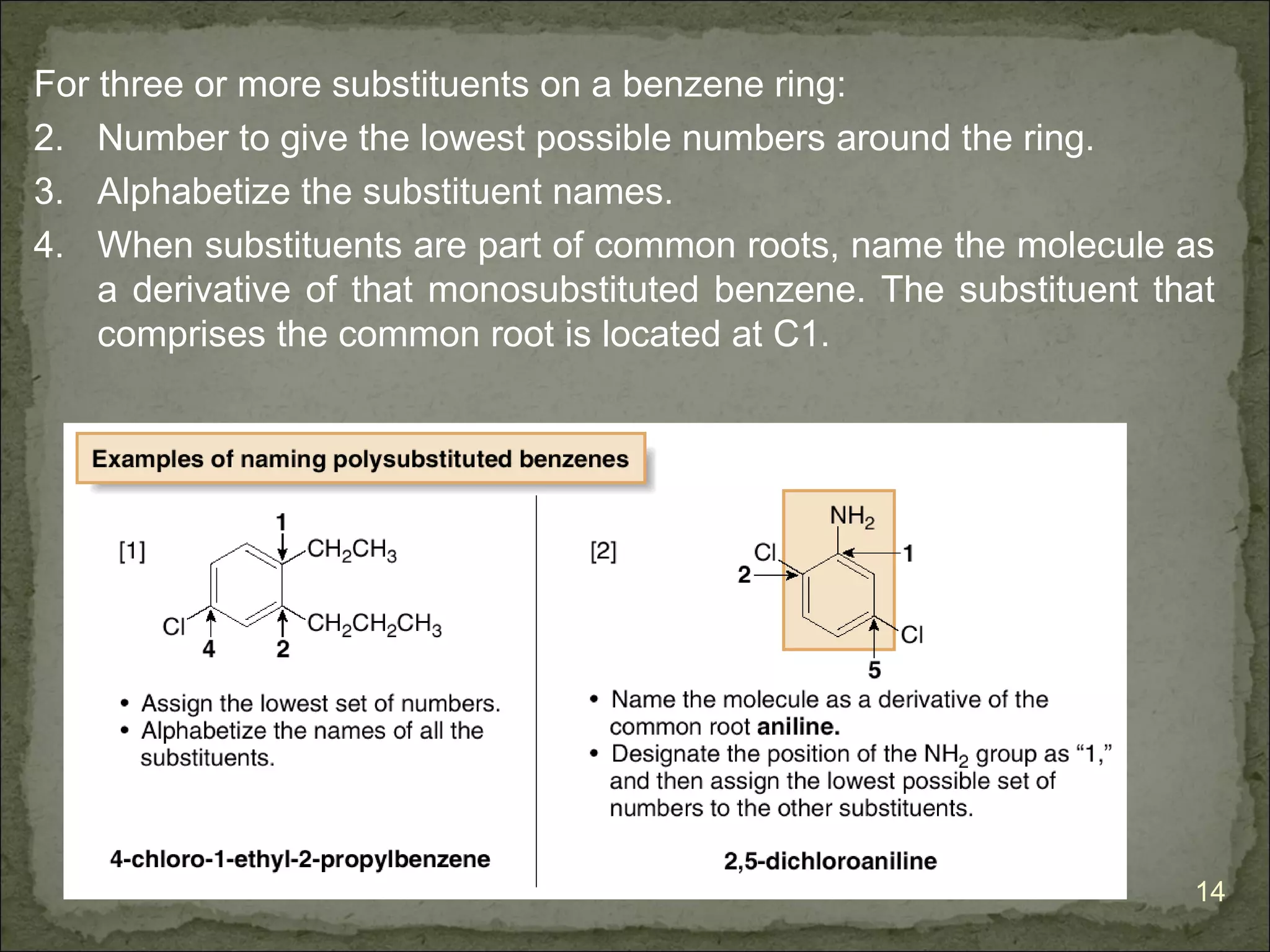
For three or more substituents on a benzene ring:
2. Number to give the lowest possible numbers around the ring.
3. Alphabetize the substituent names.
4. When substituents are part of common roots, name the molecule as
    a derivative of that monosubstituted benzene. The substituent that
    comprises the common root is located at C1.


                                                                    14
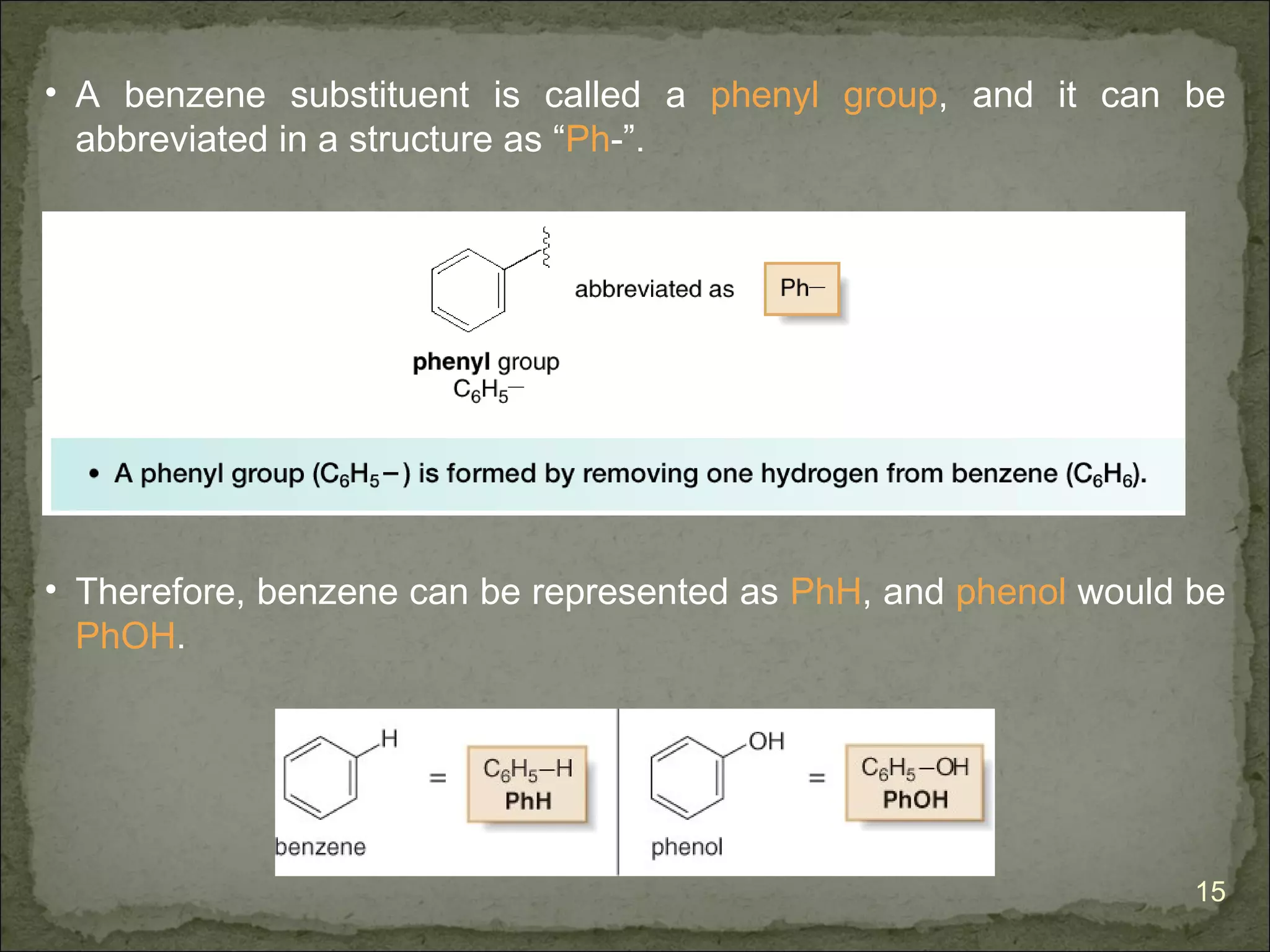
• A benzene substituent is called a phenyl group, and it can be
  abbreviated in a structure as “Ph-”.


• Therefore, benzene can be represented as PhH, and phenol would be
  PhOH.


                                                                 15
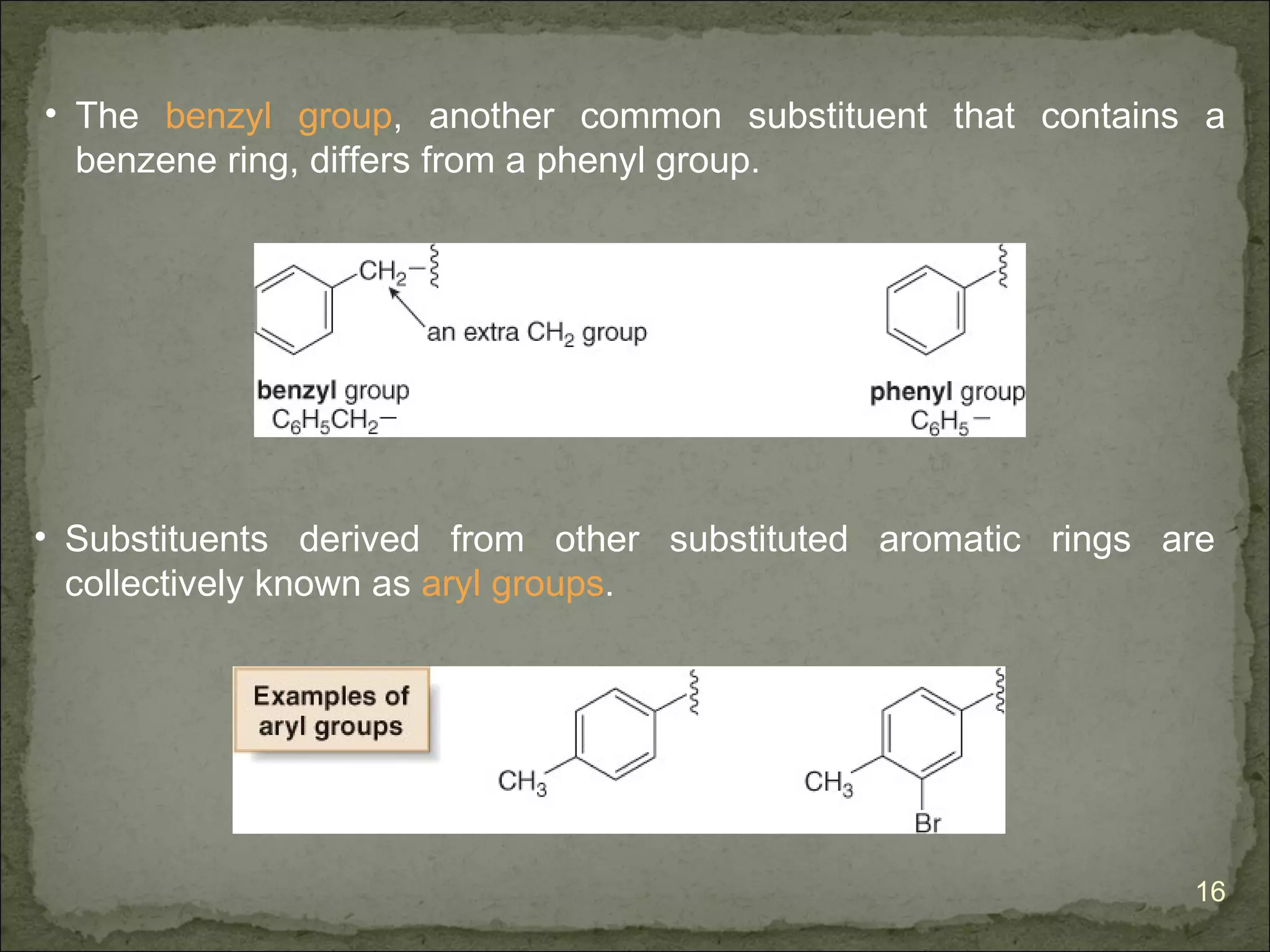
• The benzyl group, another common substituent that contains a
  benzene ring, differs from a phenyl group.


• Substituents derived from other substituted aromatic rings are
  collectively known as aryl groups.


                                                              16
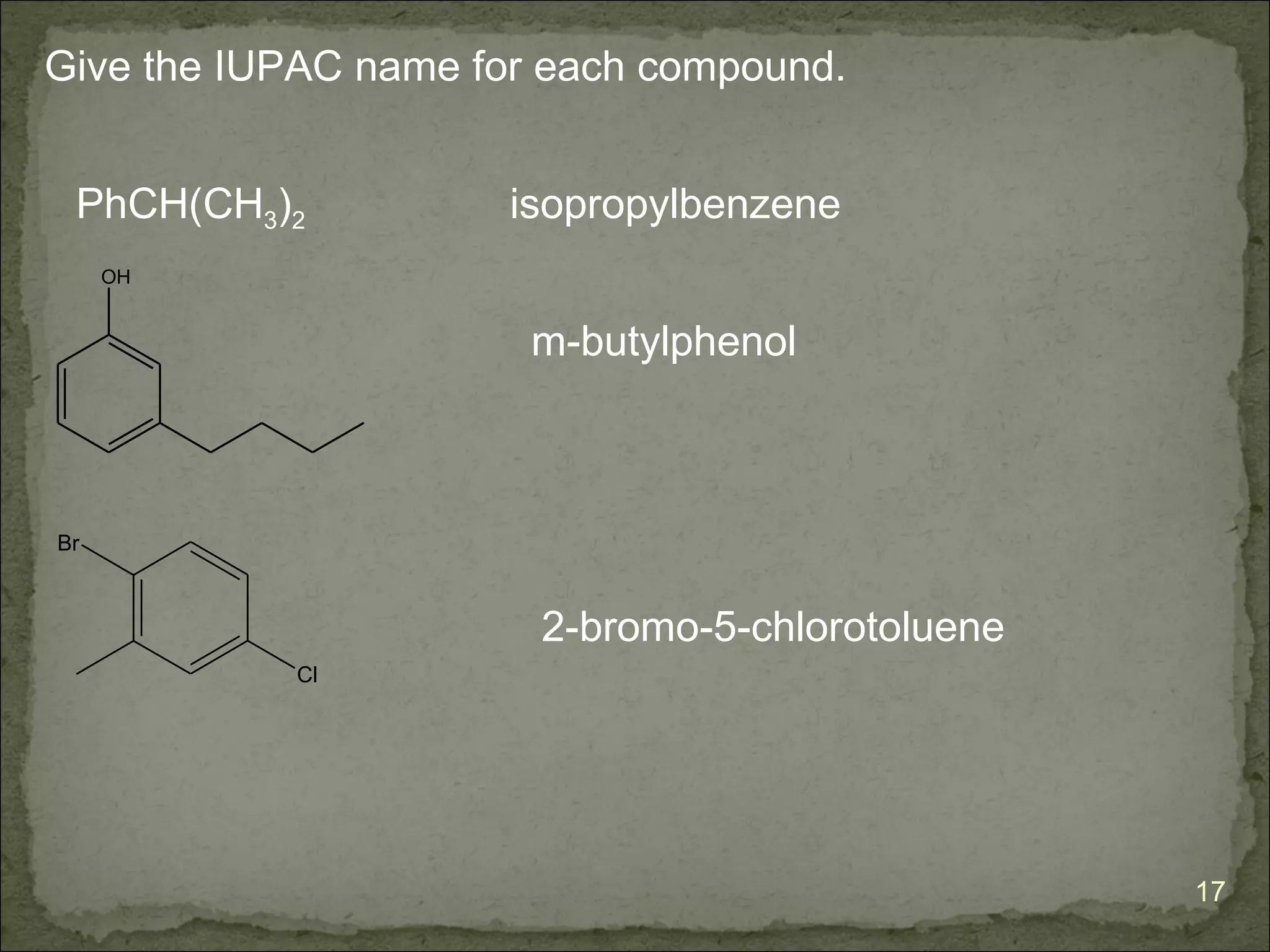
Give the IUPAC name for each compound.


 PhCH(CH3)2           isopropylbenzene
     OH


                       m-butylphenol


Br


                       2-bromo-5-chlorotoluene
           Cl


                                                 17
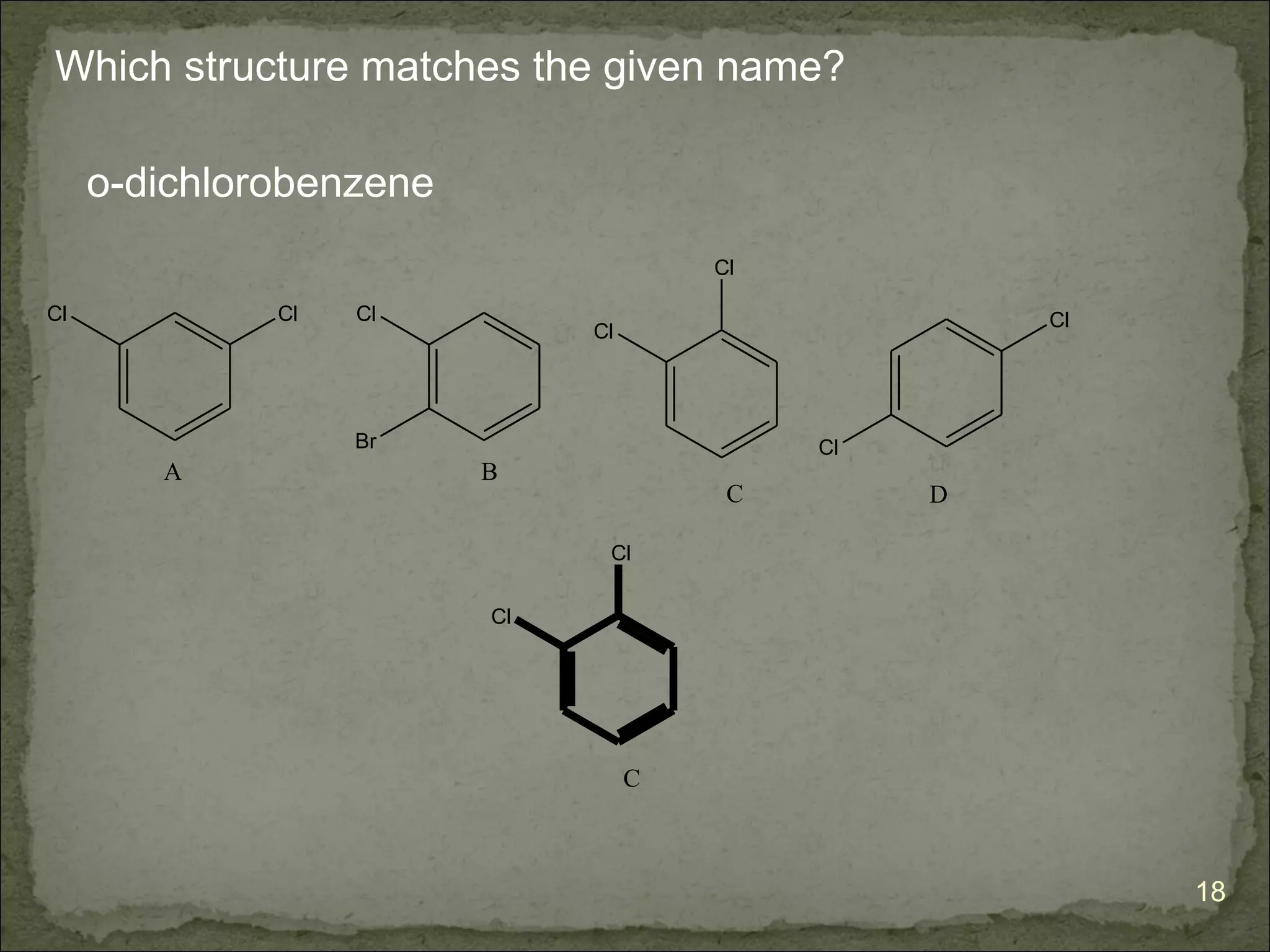
Which structure matches the given name?

     o-dichlorobenzene
                                       Cl

Cl            Cl   Cl                                Cl
                              Cl


                   Br                       Cl
        A                B
                                        C        D

                               Cl

                         Cl


                                   C


                                                          18
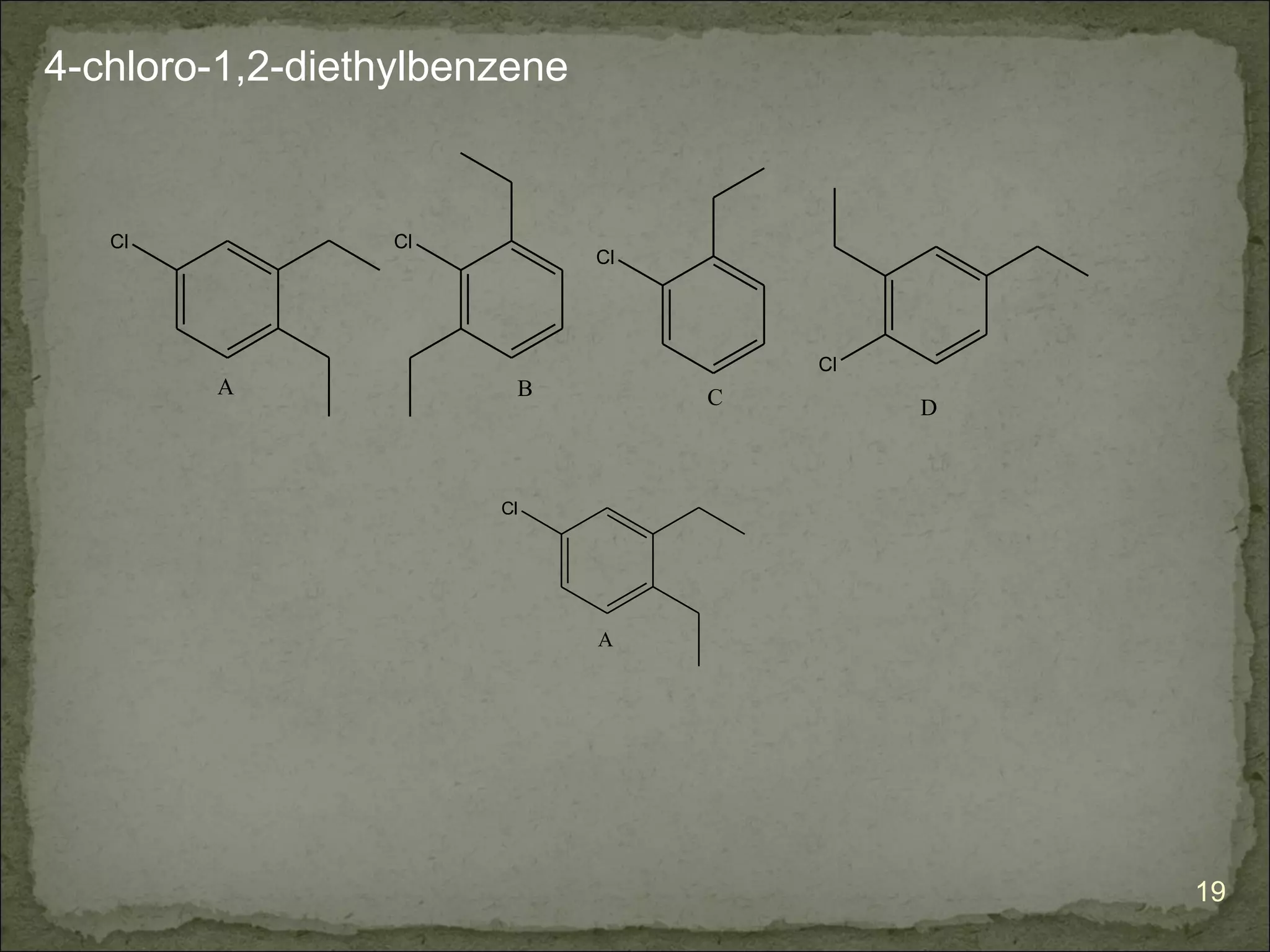
4-chloro-1,2-diethylbenzene


   Cl             Cl
                              Cl


                                       Cl
        A               B          C        D


                       Cl


                              A


                                                19
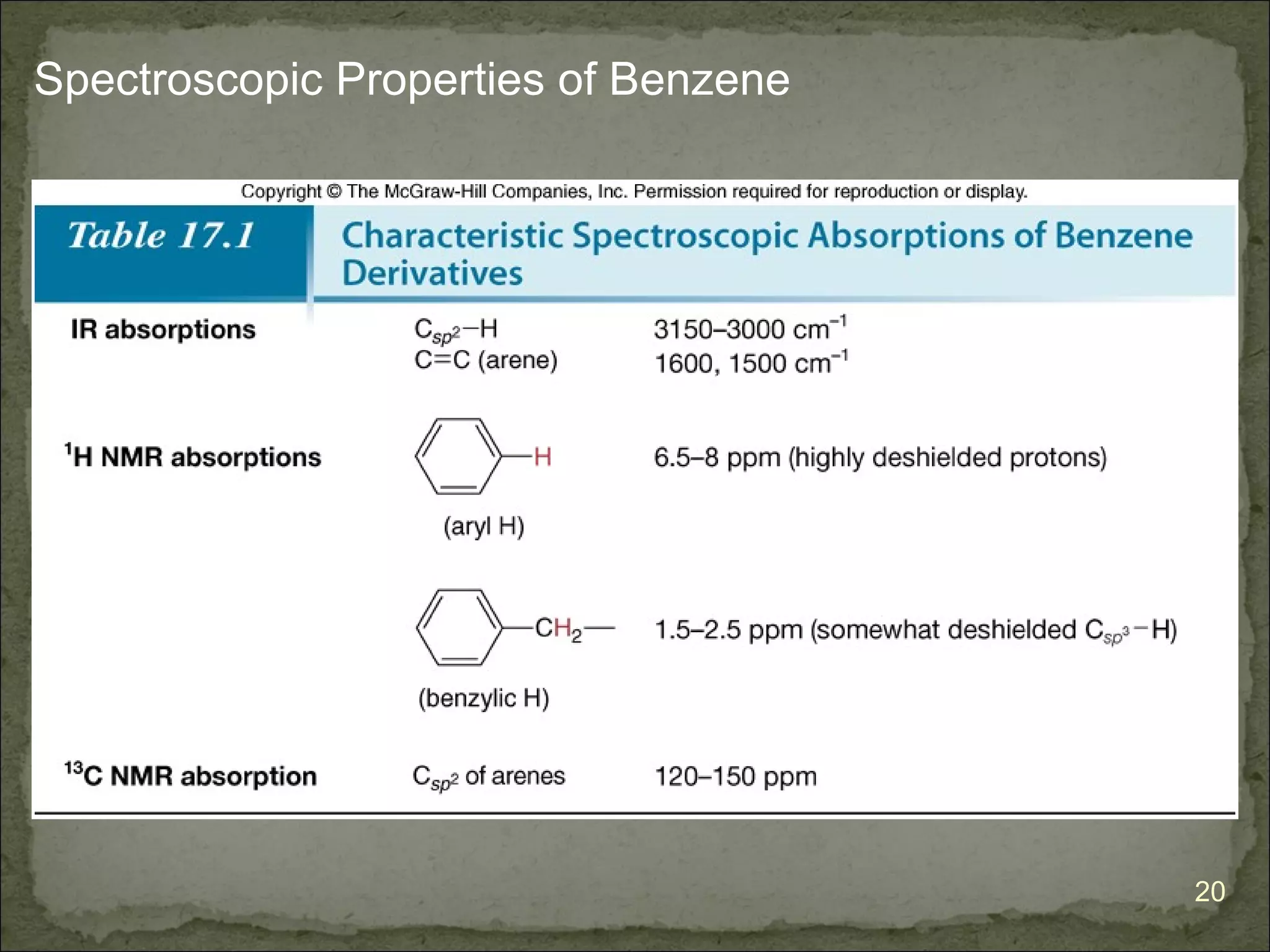
Spectroscopic Properties of Benzene


                                      20
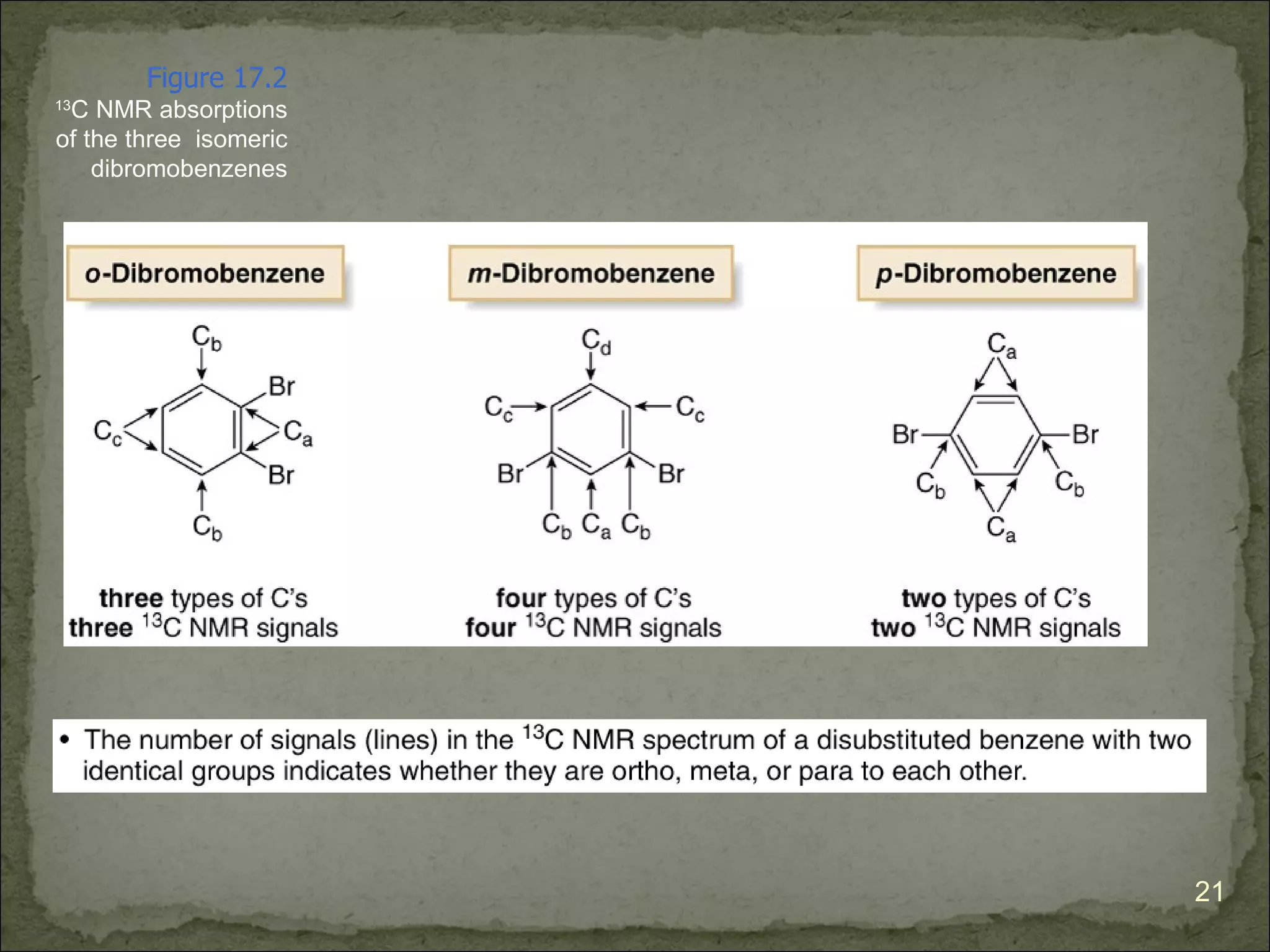
Figure 17.2
 C NMR absorptions
13

of the three isomeric
    dibromobenzenes


                        21
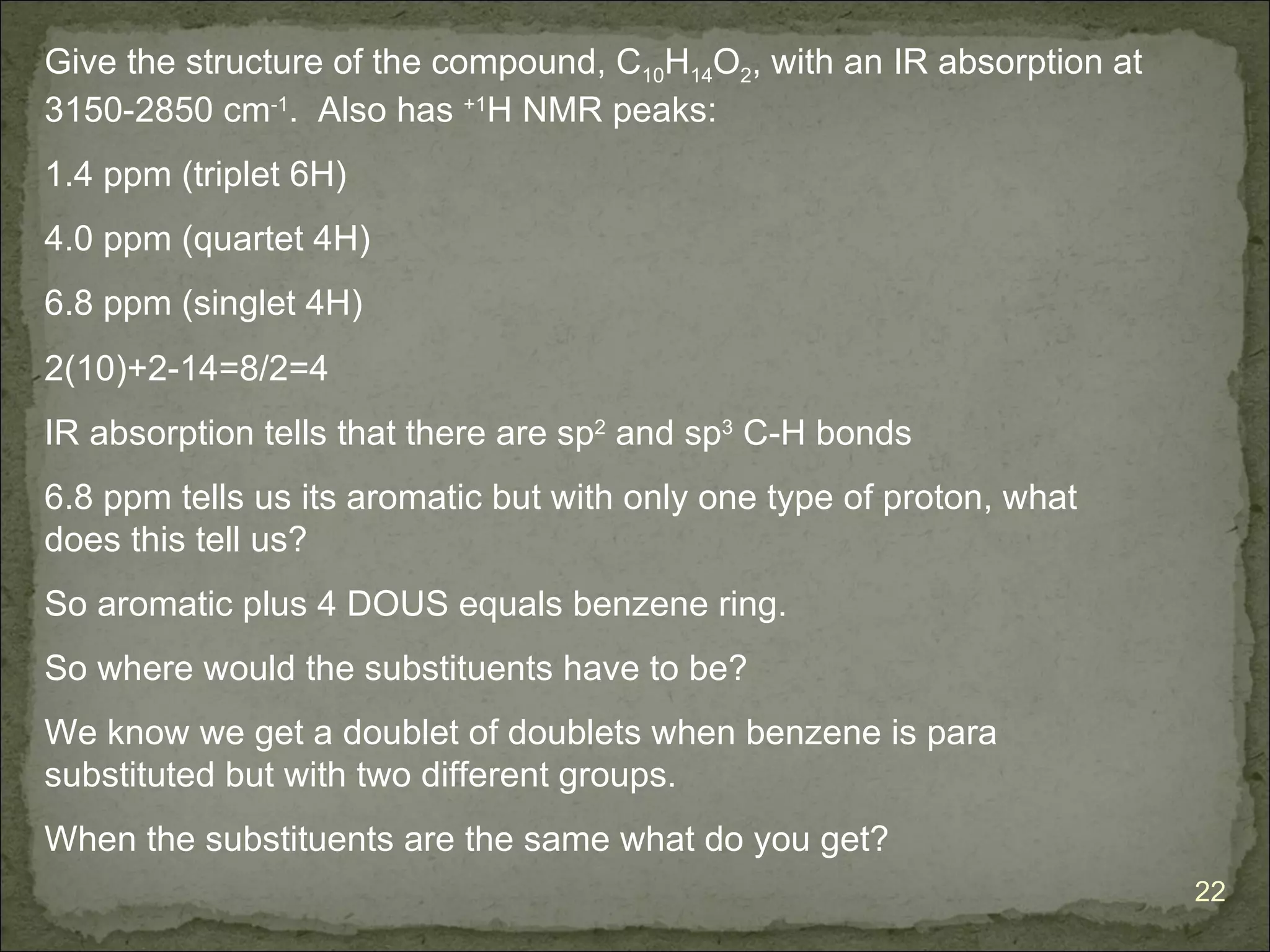
Give the structure of the compound, C10H14O2, with an IR absorption at
3150-2850 cm-1. Also has +1H NMR peaks:
1.4 ppm (triplet 6H)
4.0 ppm (quartet 4H)
6.8 ppm (singlet 4H)
2(10)+2-14=8/2=4
IR absorption tells that there are sp2 and sp3 C-H bonds
6.8 ppm tells us its aromatic but with only one type of proton, what
does this tell us?
So aromatic plus 4 DOUS equals benzene ring.
So where would the substituents have to be?
We know we get a doublet of doublets when benzene is para
substituted but with two different groups.
When the substituents are the same what do you get?
                                                                         22
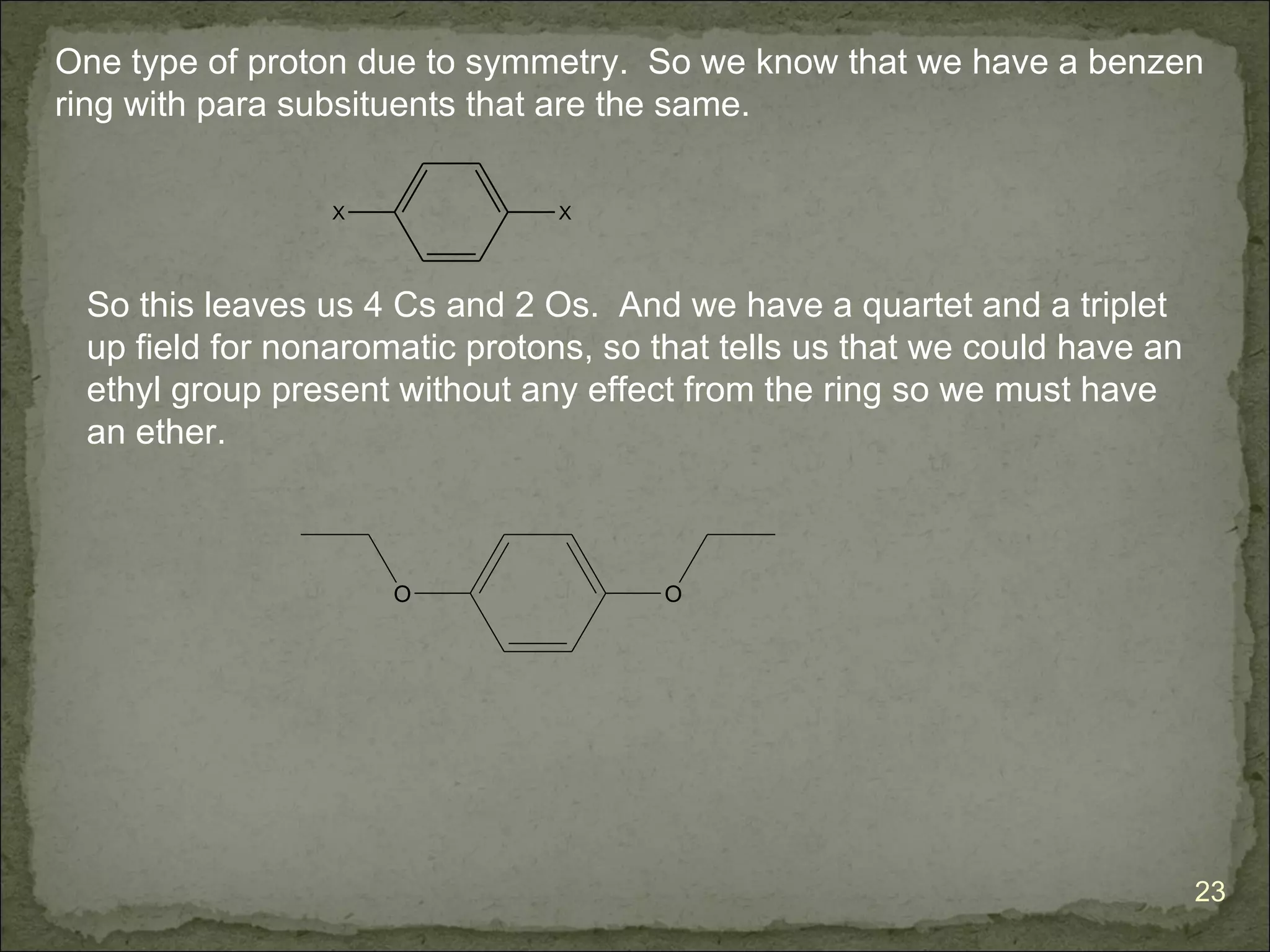
One type of proton due to symmetry. So we know that we have a benzen
ring with para subsituents that are the same.

                 X              X


 So this leaves us 4 Cs and 2 Os. And we have a quartet and a triplet
 up field for nonaromatic protons, so that tells us that we could have an
 ethyl group present without any effect from the ring so we must have
 an ether.


                     O                O


                                                                            23
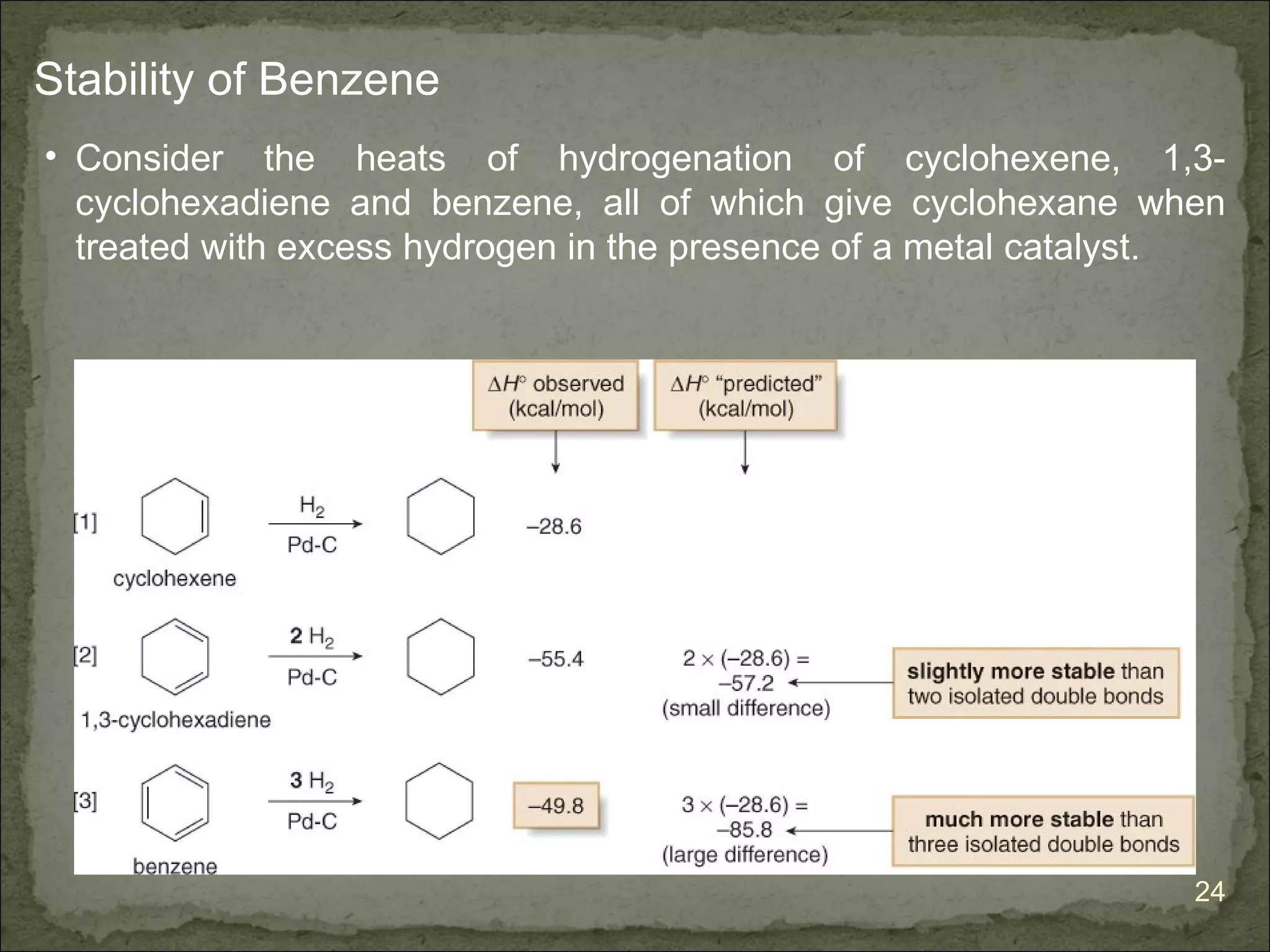
Stability of Benzene
• Consider the heats of hydrogenation of cyclohexene, 1,3-
  cyclohexadiene and benzene, all of which give cyclohexane when
  treated with excess hydrogen in the presence of a metal catalyst.


                                                                 24
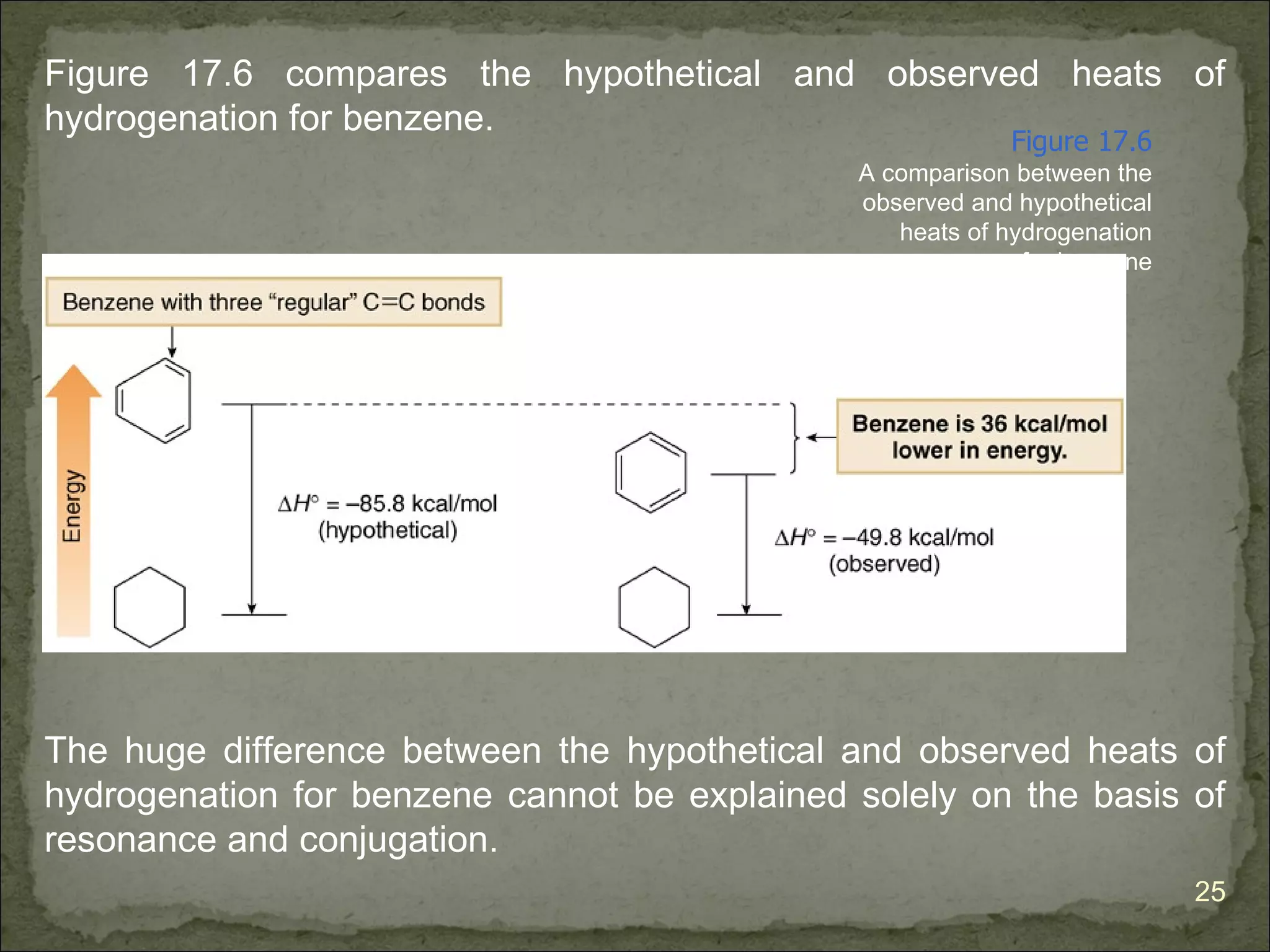
Figure 17.6 compares the hypothetical and observed heats of
hydrogenation for benzene.
                                                           Figure 17.6
                                              A comparison between the
                                              observed and hypothetical
                                                 heats of hydrogenation
                                                            for benzene


The huge difference between the hypothetical and observed heats of
hydrogenation for benzene cannot be explained solely on the basis of
resonance and conjugation.
                                                                          25
• The low heat of hydrogenation of benzene means that benzene is
  especially stable—even more so than conjugated polyenes. This
  unusual stability is characteristic of aromatic compounds.
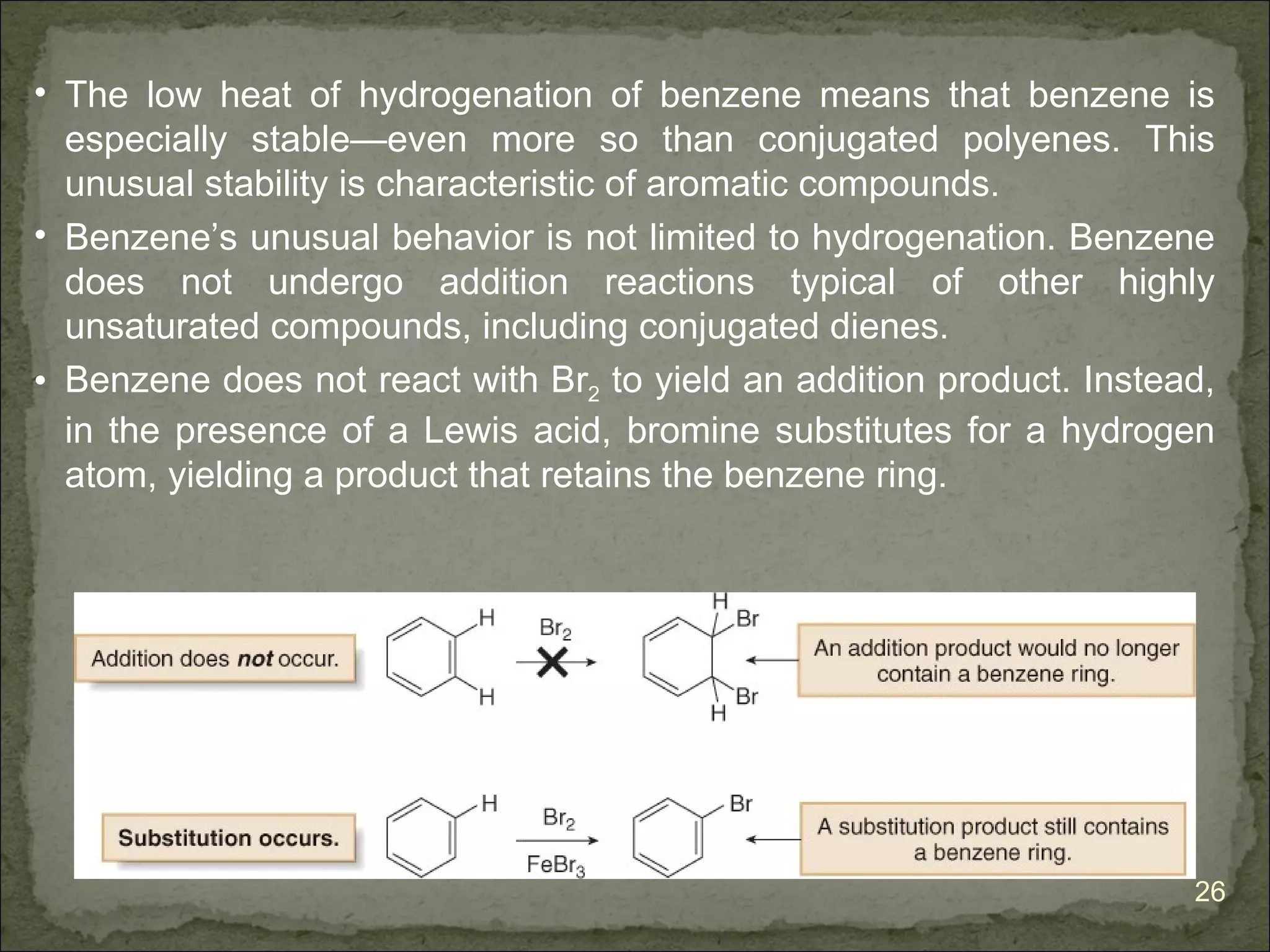
• Benzene’s unusual behavior is not limited to hydrogenation. Benzene
  does not undergo addition reactions typical of other highly
  unsaturated compounds, including conjugated dienes.
• Benzene does not react with Br2 to yield an addition product. Instead,
  in the presence of a Lewis acid, bromine substitutes for a hydrogen
  atom, yielding a product that retains the benzene ring.


                                                                      26
The Criteria for Aromaticity—Hückel’s Rule
Four structural criteria must be satisfied for a compound to be
aromatic.

[1] A molecule must be cyclic.


To be aromatic, each p orbital must overlap with p orbitals on
adjacent atoms.
                                                             27
[2] A molecule must be planar.

All adjacent p orbitals must be aligned so that the π electron
density can be delocalized.


Since cyclooctatetraene is non-planar, it is not aromatic, and it
undergoes addition reactions just like those of other alkenes.


                                                               28
[3] A molecule must be completely conjugated.
Aromatic compounds must have a p orbital on every atom.


                                                          29
[4] A molecule must satisfy Hückel’s rule, and contain
    a particular number of π electrons.
 Hückel's rule:


Benzene is aromatic and especially stable because it contains
6 π electrons. Cyclobutadiene is antiaromatic and especially
unstable because it contains 4 π electrons.


                                                           30
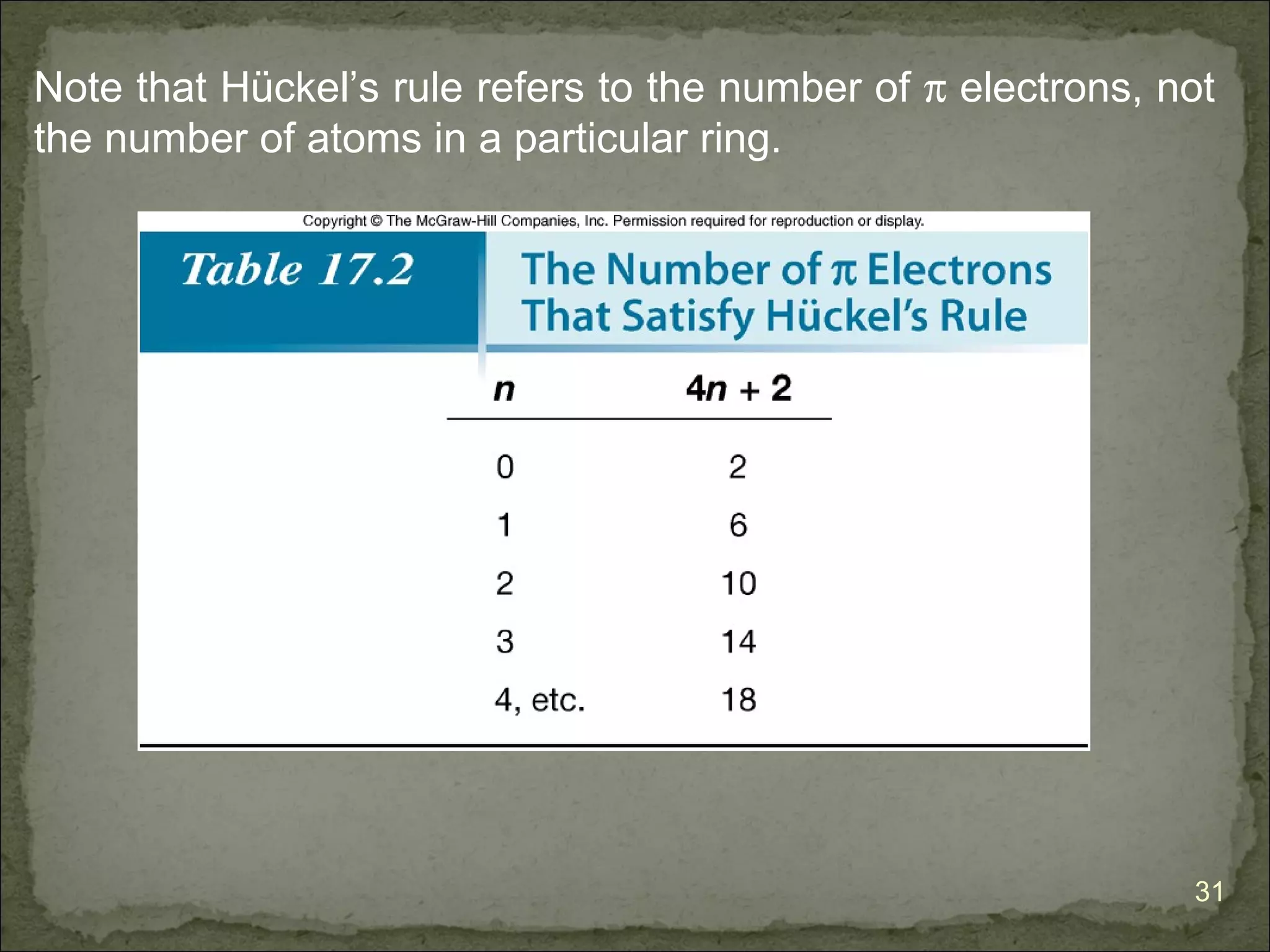
Note that Hückel’s rule refers to the number of π electrons, not
the number of atoms in a particular ring.


                                                              31
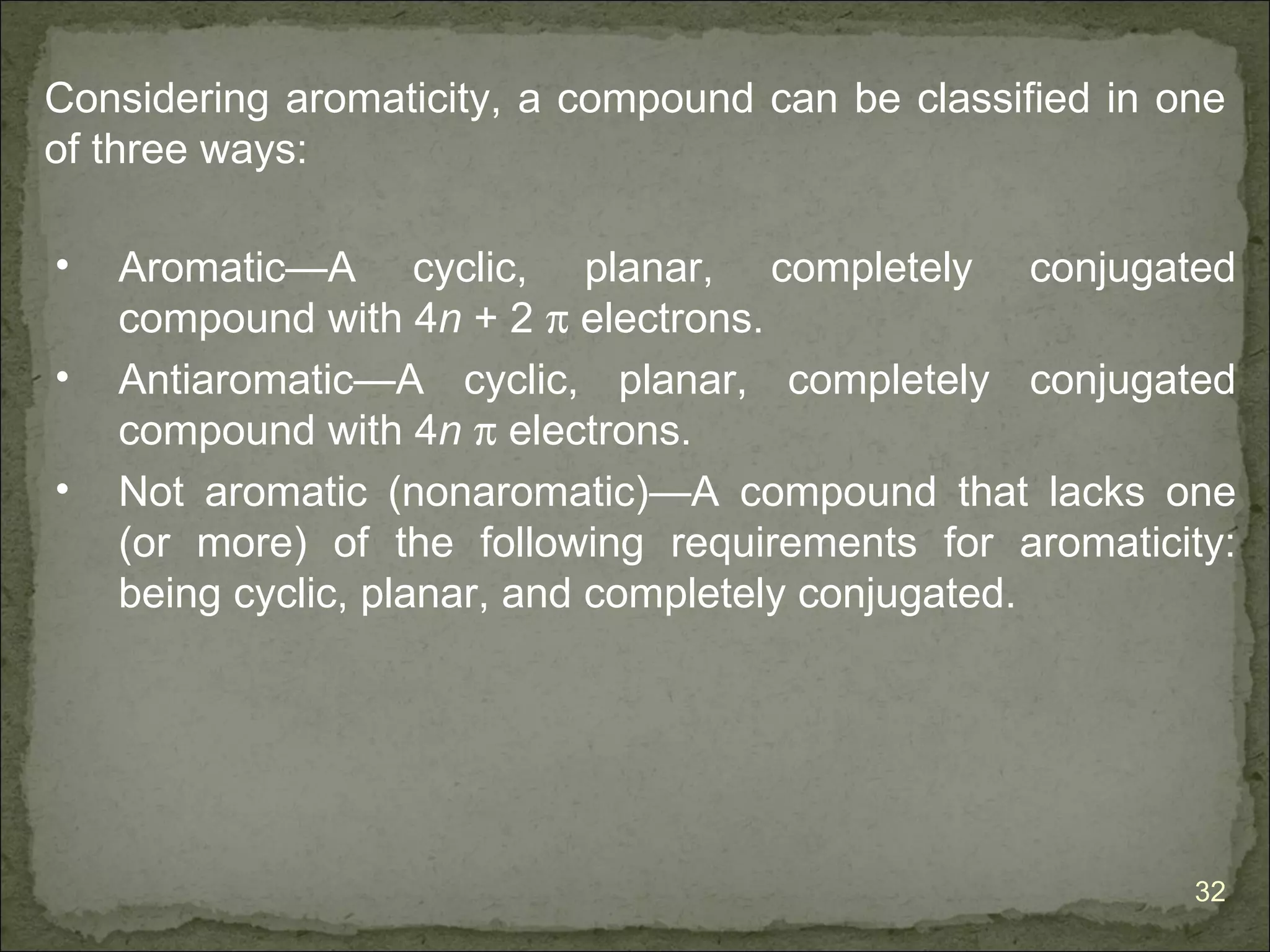
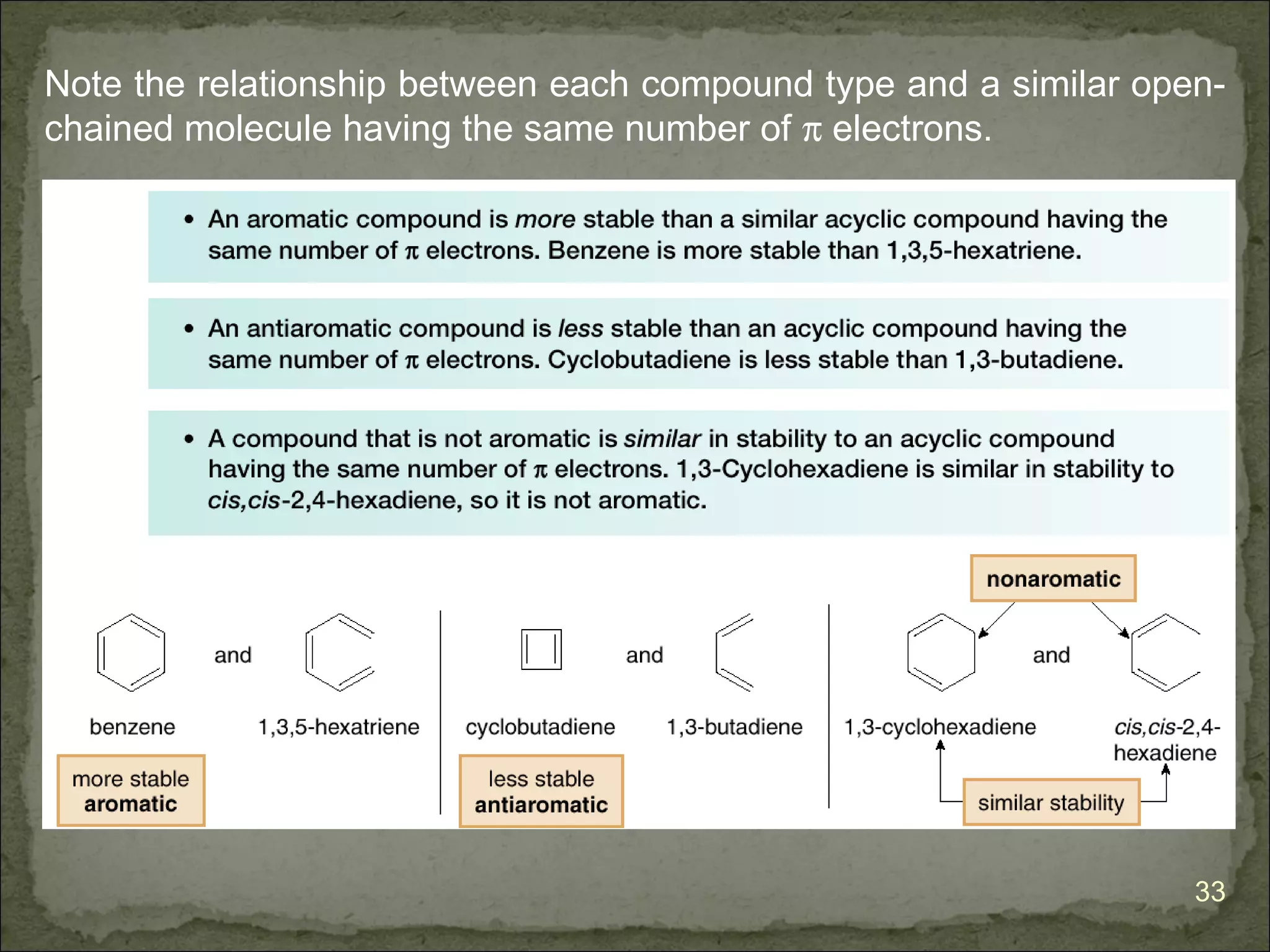
Considering aromaticity, a compound can be classified in one
of three ways:

•   Aromatic—A cyclic, planar, completely conjugated
    compound with 4n + 2 π electrons.
•   Antiaromatic—A cyclic, planar, completely conjugated
    compound with 4n π electrons.
•   Not aromatic (nonaromatic)—A compound that lacks one
    (or more) of the following requirements for aromaticity:
    being cyclic, planar, and completely conjugated.


                                                          32
Note the relationship between each compound type and a similar open-
chained molecule having the same number of π electrons.


                                                                  33
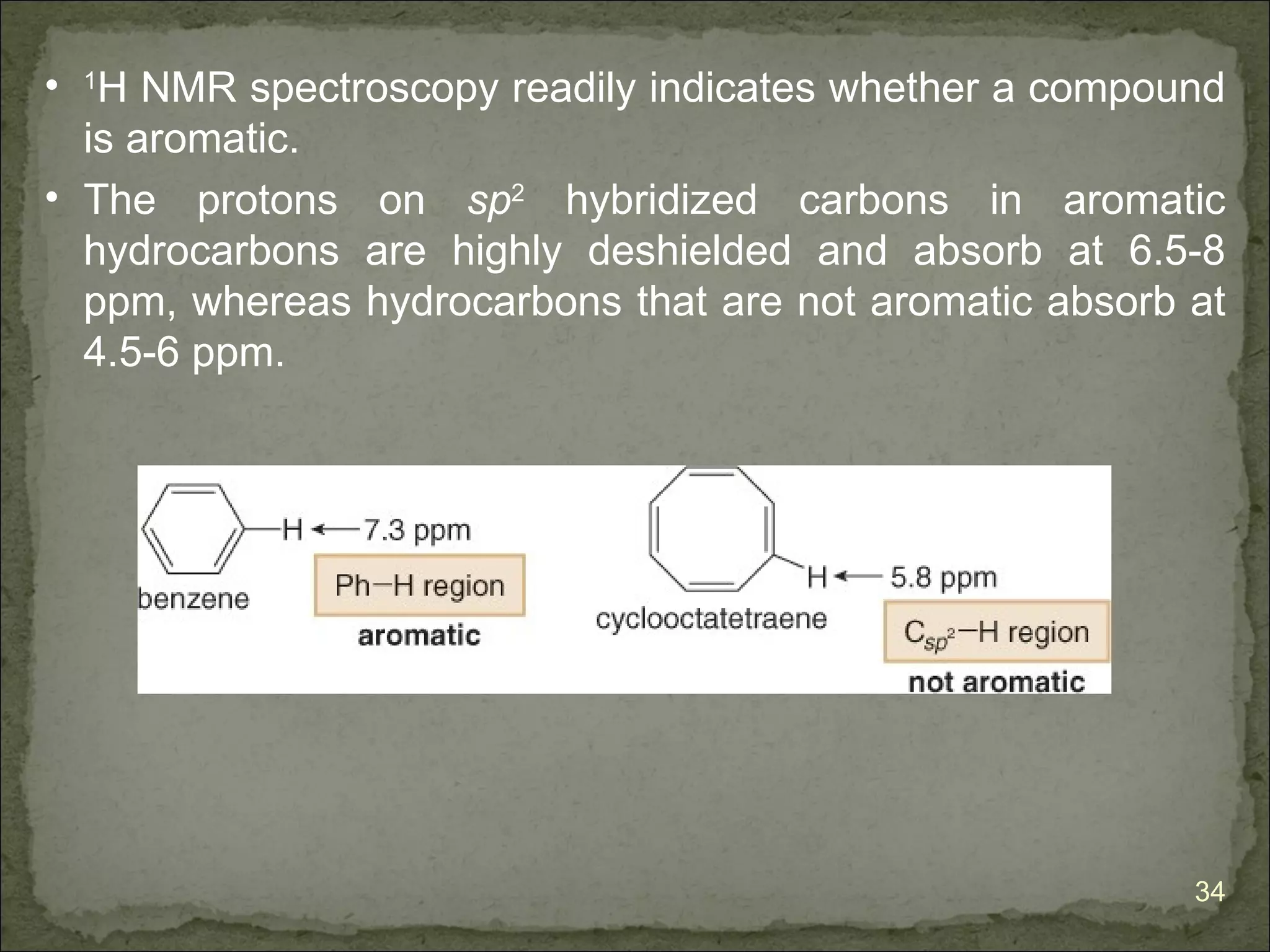
• 1H NMR spectroscopy readily indicates whether a compound
  is aromatic.
• The protons on sp2 hybridized carbons in aromatic
  hydrocarbons are highly deshielded and absorb at 6.5-8
  ppm, whereas hydrocarbons that are not aromatic absorb at
  4.5-6 ppm.


                                                         34
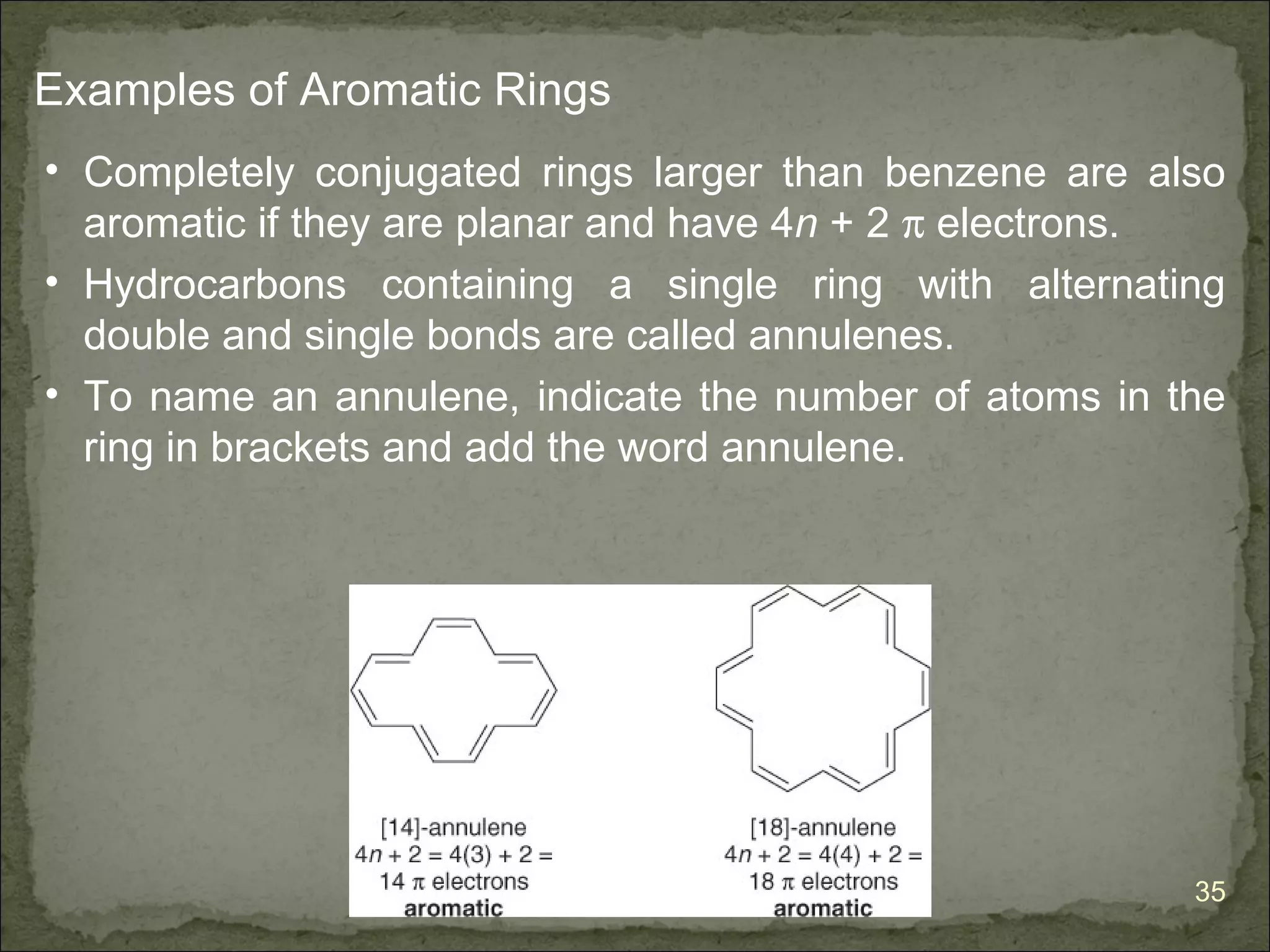
Examples of Aromatic Rings
• Completely conjugated rings larger than benzene are also
  aromatic if they are planar and have 4n + 2 π electrons.
• Hydrocarbons containing a single ring with alternating
  double and single bonds are called annulenes.
• To name an annulene, indicate the number of atoms in the
  ring in brackets and add the word annulene.


                                                        35
• [10]-Annulene has 10 π electrons, which satisfies Hückel's
  rule, but a planar molecule would place the two H atoms
  inside the ring too close to each other. Thus, the ring
  puckers to relieve this strain.
• Since [10]-annulene is not planar, the 10 π electrons can’t
  delocalize over the entire ring and it is not aromatic.


                                                           36
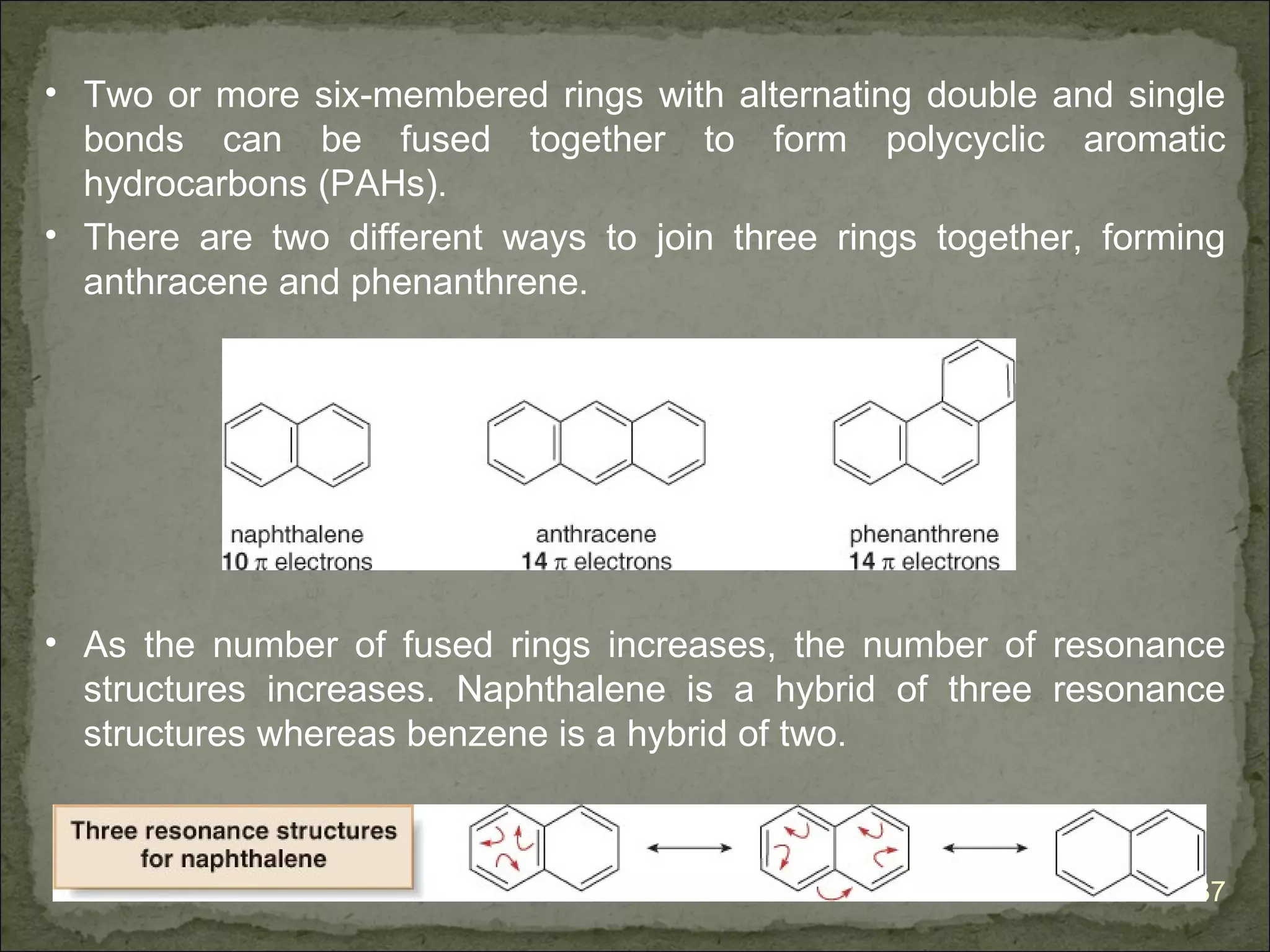
• Two or more six-membered rings with alternating double and single
  bonds can be fused together to form polycyclic aromatic
  hydrocarbons (PAHs).
• There are two different ways to join three rings together, forming
  anthracene and phenanthrene.


• As the number of fused rings increases, the number of resonance
  structures increases. Naphthalene is a hybrid of three resonance
  structures whereas benzene is a hybrid of two.


                                                                  37
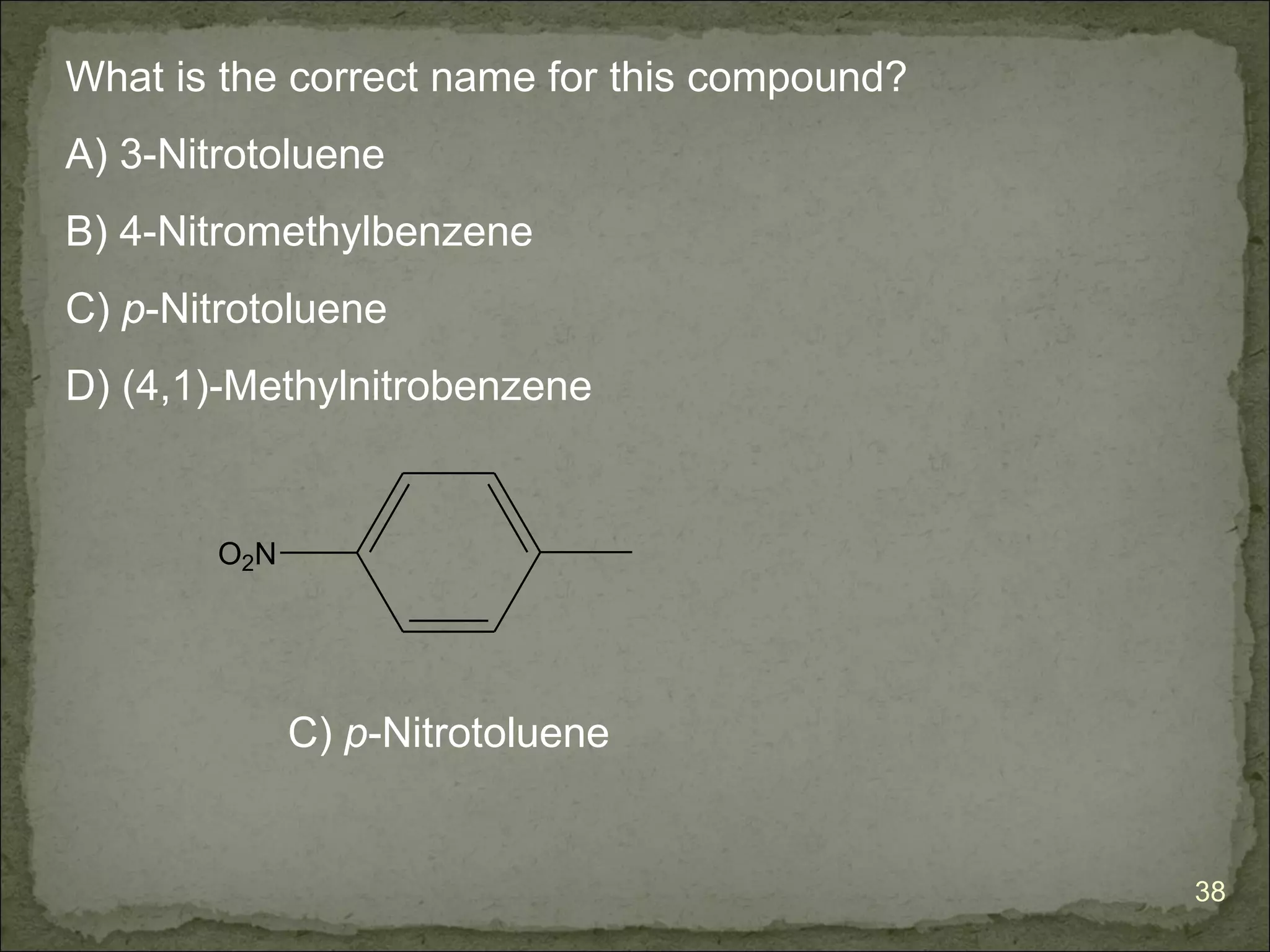
What is the correct name for this compound?
A) 3-Nitrotoluene
B) 4-Nitromethylbenzene
C) p-Nitrotoluene
D) (4,1)-Methylnitrobenzene


        O2N


              C) p-Nitrotoluene


                                              38
Xi science

             39

Benzen lecture

  • 1.
  • 2.
    Benzene and AromaticCompounds • Benzene (C6H6) is the simplest aromatic hydrocarbon (or arene). • Benzene has four degrees of unsaturation, making it a highly unsaturated hydrocarbon. • Whereas unsaturated hydrocarbons such as alkenes, alkynes and dienes readily undergo addition reactions, benzene does not. 2
  • 3.
    • Benzene doesreact with bromine, but only in the presence of FeBr3 (a Lewis acid), and the reaction is a substitution, not an addition. • Proposed structures of benzene must account for its high degree of unsaturation and its lack of reactivity towards electrophilic addition. • August Kekulé proposed that benzene was a rapidly equilibrating mixture of two compounds, each containing a six-membered ring with three alternating π bonds. • In the Kekulé description, the bond between any two carbon atoms is sometimes a single bond and sometimes a double bond. 3
  • 4.
    • These structuresare known as Kekulé structures. • Although benzene is still drawn as a six-membered ring with alternating π bonds, in reality there is no equilibrium between the two different kinds of benzene molecules. • Current descriptions of benzene are based on resonance and electron delocalization due to orbital overlap. • In the nineteenth century, many other compounds having properties similar to those of benzene were isolated from natural sources. Since these compounds possessed strong and characteristic odors, they were called aromatic compounds. It should be noted, however, that it is their chemical properties, and not their odor, that make them special. 4
  • 5.
    Any structure forbenzene must account for the following facts: 2. It contains a six-membered ring and three additional degrees of unsaturation. 3. It is planar. 4. All C—C bond lengths are equal. The Kekulé structures satisfy the first two criteria but not the third, because having three alternating π bonds means that benzene should have three short double bonds alternating with three longer single bonds. 5
  • 6.
    • The resonancedescription of benzene consists of two equivalent Lewis structures, each with three double bonds that alternate with three single bonds. • The true structure of benzene is a resonance hybrid of the two Lewis structures, with the dashed lines of the hybrid indicating the position of the π bonds. • We will use one of the two Lewis structures and not the hybrid in drawing benzene. This will make it easier to keep track of the electron pairs in the π bonds (the π electrons). 6
  • 7.
    • Because eachπ bond has two electrons, benzene has six π electrons. 7
  • 8.
    • In benzene,the actual bond length (1.39 Å) is intermediate between the carbon—carbon single bond (1.53 Å) and the carbon—carbon double bond (1.34 Å). 8
  • 9.
    Draw all possibleresonance structures for biphenyl? 9
  • 10.
    What orbitals areused to form the indicated bonds, and of those which is the shortest? Csp2-Csp2 Csp -Csp 2 3 Cp-Cp shortest Csp2-Hs H Csp2-Csp2 Csp2-Csp2 Cp-Cp 10
  • 11.
    Nomenclature of BenzeneDerivatives • To name a benzene ring with one substituent, name the substituent and add the word benzene. • Many monosubstituted benzenes have common names which you must also learn. 11
  • 12.
    • There arethree different ways that two groups can be attached to a benzene ring, so a prefix—ortho, meta, or para —can be used to designate the relative position of the two substituents. ortho-dibromobenzene meta-dibromobenzene para-dibromobenzene or or or o-dibromobenzene m-dibromobenzene p-dibromobenzene or 1,2-dibromobenzene or 1,3-dibromobenzene or 1,4-dibromobenzene 12
  • 13.
    • If thetwo groups on the benzene ring are different, alphabetize the names of the substituents preceding the word benzene. • If one substituent is part of a common root, name the molecule as a derivative of that monosubstituted benzene. 13
  • 14.
    For three ormore substituents on a benzene ring: 2. Number to give the lowest possible numbers around the ring. 3. Alphabetize the substituent names. 4. When substituents are part of common roots, name the molecule as a derivative of that monosubstituted benzene. The substituent that comprises the common root is located at C1. 14
  • 15.
    • A benzenesubstituent is called a phenyl group, and it can be abbreviated in a structure as “Ph-”. • Therefore, benzene can be represented as PhH, and phenol would be PhOH. 15
  • 16.
    • The benzylgroup, another common substituent that contains a benzene ring, differs from a phenyl group. • Substituents derived from other substituted aromatic rings are collectively known as aryl groups. 16
  • 17.
    Give the IUPACname for each compound. PhCH(CH3)2 isopropylbenzene OH m-butylphenol Br 2-bromo-5-chlorotoluene Cl 17
  • 18.
    Which structure matchesthe given name? o-dichlorobenzene Cl Cl Cl Cl Cl Cl Br Cl A B C D Cl Cl C 18
  • 19.
    4-chloro-1,2-diethylbenzene Cl Cl Cl Cl A B C D Cl A 19
  • 20.
  • 21.
    Figure 17.2 CNMR absorptions 13 of the three isomeric dibromobenzenes 21
  • 22.
    Give the structureof the compound, C10H14O2, with an IR absorption at 3150-2850 cm-1. Also has +1H NMR peaks: 1.4 ppm (triplet 6H) 4.0 ppm (quartet 4H) 6.8 ppm (singlet 4H) 2(10)+2-14=8/2=4 IR absorption tells that there are sp2 and sp3 C-H bonds 6.8 ppm tells us its aromatic but with only one type of proton, what does this tell us? So aromatic plus 4 DOUS equals benzene ring. So where would the substituents have to be? We know we get a doublet of doublets when benzene is para substituted but with two different groups. When the substituents are the same what do you get? 22
  • 23.
    One type ofproton due to symmetry. So we know that we have a benzen ring with para subsituents that are the same. X X So this leaves us 4 Cs and 2 Os. And we have a quartet and a triplet up field for nonaromatic protons, so that tells us that we could have an ethyl group present without any effect from the ring so we must have an ether. O O 23
  • 24.
    Stability of Benzene •Consider the heats of hydrogenation of cyclohexene, 1,3- cyclohexadiene and benzene, all of which give cyclohexane when treated with excess hydrogen in the presence of a metal catalyst. 24
  • 25.
    Figure 17.6 comparesthe hypothetical and observed heats of hydrogenation for benzene. Figure 17.6 A comparison between the observed and hypothetical heats of hydrogenation for benzene The huge difference between the hypothetical and observed heats of hydrogenation for benzene cannot be explained solely on the basis of resonance and conjugation. 25
  • 26.
    • The lowheat of hydrogenation of benzene means that benzene is especially stable—even more so than conjugated polyenes. This unusual stability is characteristic of aromatic compounds. • Benzene’s unusual behavior is not limited to hydrogenation. Benzene does not undergo addition reactions typical of other highly unsaturated compounds, including conjugated dienes. • Benzene does not react with Br2 to yield an addition product. Instead, in the presence of a Lewis acid, bromine substitutes for a hydrogen atom, yielding a product that retains the benzene ring. 26
  • 27.
    The Criteria forAromaticity—Hückel’s Rule Four structural criteria must be satisfied for a compound to be aromatic. [1] A molecule must be cyclic. To be aromatic, each p orbital must overlap with p orbitals on adjacent atoms. 27
  • 28.
    [2] A moleculemust be planar. All adjacent p orbitals must be aligned so that the π electron density can be delocalized. Since cyclooctatetraene is non-planar, it is not aromatic, and it undergoes addition reactions just like those of other alkenes. 28
  • 29.
    [3] A moleculemust be completely conjugated. Aromatic compounds must have a p orbital on every atom. 29
  • 30.
    [4] A moleculemust satisfy Hückel’s rule, and contain a particular number of π electrons. Hückel's rule: Benzene is aromatic and especially stable because it contains 6 π electrons. Cyclobutadiene is antiaromatic and especially unstable because it contains 4 π electrons. 30
  • 31.
    Note that Hückel’srule refers to the number of π electrons, not the number of atoms in a particular ring. 31
  • 32.
    Considering aromaticity, acompound can be classified in one of three ways: • Aromatic—A cyclic, planar, completely conjugated compound with 4n + 2 π electrons. • Antiaromatic—A cyclic, planar, completely conjugated compound with 4n π electrons. • Not aromatic (nonaromatic)—A compound that lacks one (or more) of the following requirements for aromaticity: being cyclic, planar, and completely conjugated. 32
  • 33.
    Note the relationshipbetween each compound type and a similar open- chained molecule having the same number of π electrons. 33
  • 34.
    • 1H NMRspectroscopy readily indicates whether a compound is aromatic. • The protons on sp2 hybridized carbons in aromatic hydrocarbons are highly deshielded and absorb at 6.5-8 ppm, whereas hydrocarbons that are not aromatic absorb at 4.5-6 ppm. 34
  • 35.
    Examples of AromaticRings • Completely conjugated rings larger than benzene are also aromatic if they are planar and have 4n + 2 π electrons. • Hydrocarbons containing a single ring with alternating double and single bonds are called annulenes. • To name an annulene, indicate the number of atoms in the ring in brackets and add the word annulene. 35
  • 36.
    • [10]-Annulene has10 π electrons, which satisfies Hückel's rule, but a planar molecule would place the two H atoms inside the ring too close to each other. Thus, the ring puckers to relieve this strain. • Since [10]-annulene is not planar, the 10 π electrons can’t delocalize over the entire ring and it is not aromatic. 36
  • 37.
    • Two ormore six-membered rings with alternating double and single bonds can be fused together to form polycyclic aromatic hydrocarbons (PAHs). • There are two different ways to join three rings together, forming anthracene and phenanthrene. • As the number of fused rings increases, the number of resonance structures increases. Naphthalene is a hybrid of three resonance structures whereas benzene is a hybrid of two. 37
  • 38.
    What is thecorrect name for this compound? A) 3-Nitrotoluene B) 4-Nitromethylbenzene C) p-Nitrotoluene D) (4,1)-Methylnitrobenzene O2N C) p-Nitrotoluene 38
  • 39.