BENZENE
B.PHARM SEMESTER III
PREPARED BY
DR.M.D.GAME
1
Physicai properties of Benzene
Benzene is a colourless or light yellow It is
liquid at room temperature. It has a sweet
odour and is highly flammable.
Natural sources of benzene include volcanoes
and forest fires. Benzene is also a natural part
of crude oil, gasoline, and cigarette smoke.
IUPAC name Benzene
Other names Benzol
(historic/German)
Cyclohexa-1,3,5-triene;1,3,5-
Cyclohexatriene
2
Space-filling model
Ball and stick model
 Benzene is an organic chemical compound consisting
of carbon and hydrogen atoms with alternating double
bonds. As it contains only carbon and hydrogen
atoms, benzene is classed as a hydrocarbon.
 The chemical formula of benzene is C6H6 , so it
consists of six carbon atoms and six hydrogen atoms.
joined in a ring with one hydrogen atom attached to
each.
NOMENCLATURE
Monosubstituted alkylbenzenes are named as
derivatives of benzene. For example, ethylbenzene.
The IUPAC system retains certain common
names for several of the simpler monosubstituted alkyl
benzenes
CH2CH3 CH3 CH=CH2
To lu e n e
Eth ylb e nze ne Styre ne
NOMENCLATURE
Common names for some monosubstituted benzenes are as
follows
Phenyl group (C6H5- or Ph-): Derived by loss of an H from
benzene,
OCH3 C-OH
O
NH2
OH C-H
O
Ph e n o l A n ilin e B e n z o ic acid
A n iso le B e n zald e h y d e
C6 H5
1-Ph e nylcyclo he xe ne 4-Phe n yl-1-b ute ne
Ph e nyl gro up
1
2
4
3
NOMENCLATURE
When two substituents occur on a benzene ring, three
isomers are possible, they may be located by
1. numbering the atoms of the ring or
2. using the locators ortho (o), meta (m), and para (p)
COOH
Br
CH3
CH3
Cl
CH2 CH3
1
2-Brom o be nzo ic acid
(o -Bro m o be n zoic acid)
1,3-D im e thylbe n ze ne
(m- Xyle n e )
1-Ch loro -4-e thylbe nze n e
(p-C hlo roe th ylb e nze ne )
1
2
2
2
3
3
4
1
NOMENCLATURE
When two substituents occur on a benzene ring, three
isomers are possible; they may be located by
1. numbering the atoms of the ring or
2. using the locators ortho (o), meta (m), and para (p)
COOH
Br
CH3
CH3
Cl
CH2 CH3
1
2-Brom o be nzo ic acid
(o -Bro m o be n zoic acid)
1,3-D im e thylbe n ze ne
(m- Xyle n e )
1-Ch loro -4-e thylbe nze n e
(p-C hlo roe th ylb e nze ne )
1
2
2
2
3
3
4
1
STRUCTURE OF BENZENE
Facts that supported Kekulè Formula
 1) Molecular formula
 2) Open Chain Structure not accepted
 3) Evidences in favor of Ring Structure
a) Catalytic Hydrogenation of benzene yields
cyclohexane
b) Benzene yields one mono substitution product:
c) Benzene forms 3-di and trisubstituted product which
can be explained on basic of ring structure.
 4) Resonance hybrid Structure
 5) Molecular Orbital Structure
8
MOLECULAR FORMULA
1)Benzene has molecular formula- C6H6.
From its elemental composition and molecular weight,
benzene was known to contain 6-C and 6-H atoms. Benzene
has molecular formula C6H6 as compared to hexane C6H12
which confirms that benzene is highly unsaturated than
hexane.From this, it was concluded that 6-C atoms in the
benzene were linked by double or triple bonds so as to form
a straight chain or closed ring as proposed by Kekulè.
9
C
C
C
C
C
C
H
H
H
H
H
H
A Ke k u lé s tru c tu re
s h o w in g all ato m s
A K e k u lé s tru ctu re
as a lin e -an gle fo rm u la
2) OPEN CHAIN STRUCTURE NOT ACCEPTED
The possible open chain structure for benzene could have
been
CH2 = CH − C ≡ C − CH = CH2 - structure I
CH3 − C ≡ C − C ≡ C − CH3 - structure II
CH ≡ C − CH2 − CH2 − C ≡ CH - structure III
All this structures were ruled out because benzene didn’t
give the usual reactions of alkenes, alkynes
10
For example when above open chain structured
compounds containing double and triple bonds are
added to solution of bromine in carbon
tetrachloride which is red in colour becomes
colourless but benzene do not give this reactions
benzene can not have open chain structure .
11
3) EVIDENCE IN FAVOR OF RING STRUCTURE
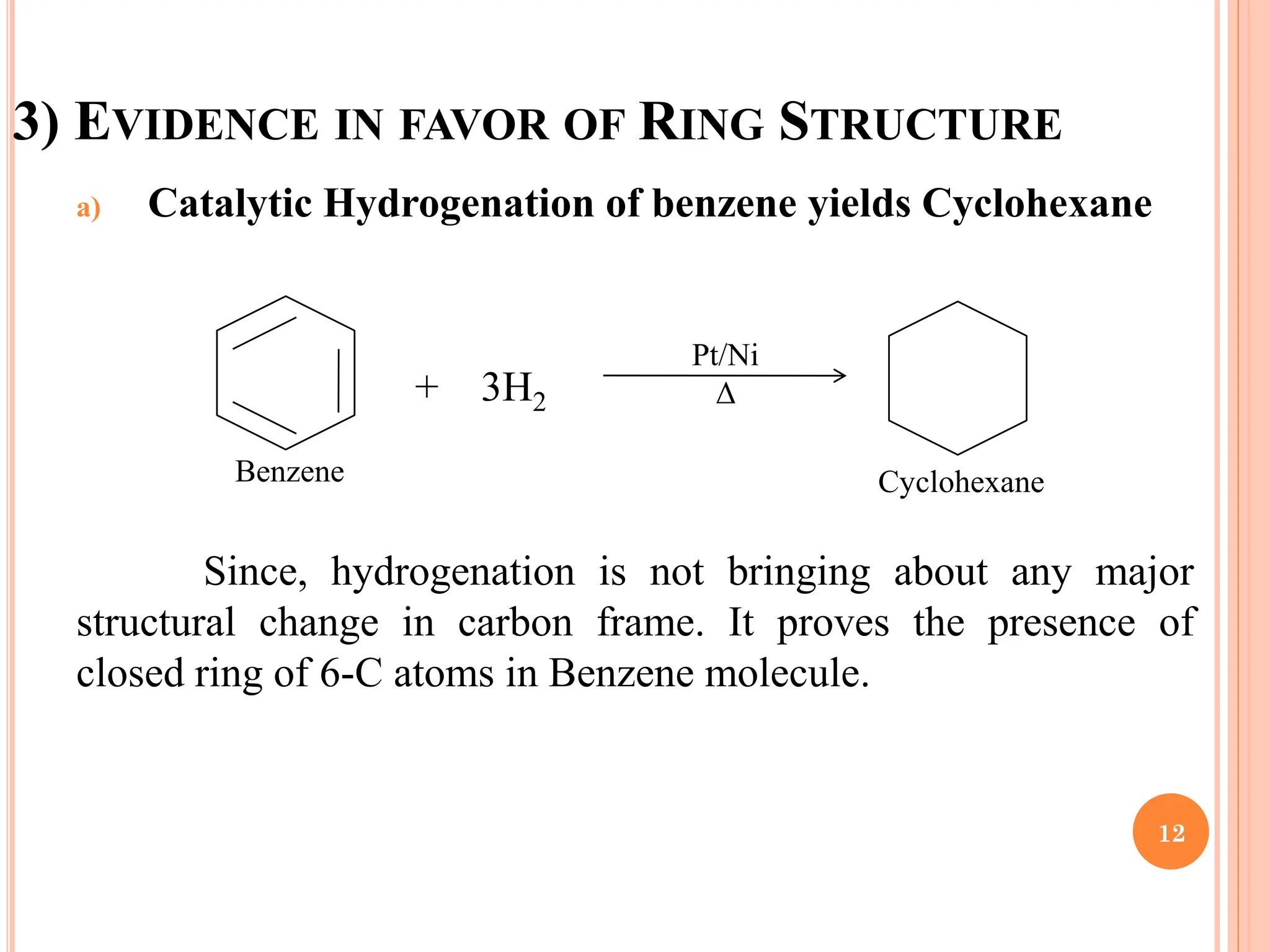
a) Catalytic Hydrogenation of benzene yields Cyclohexane
+ 3H2
Since, hydrogenation is not bringing about any major
structural change in carbon frame. It proves the presence of
closed ring of 6-C atoms in Benzene molecule.
12
Pt/Ni
Δ
Benzene Cyclohexane
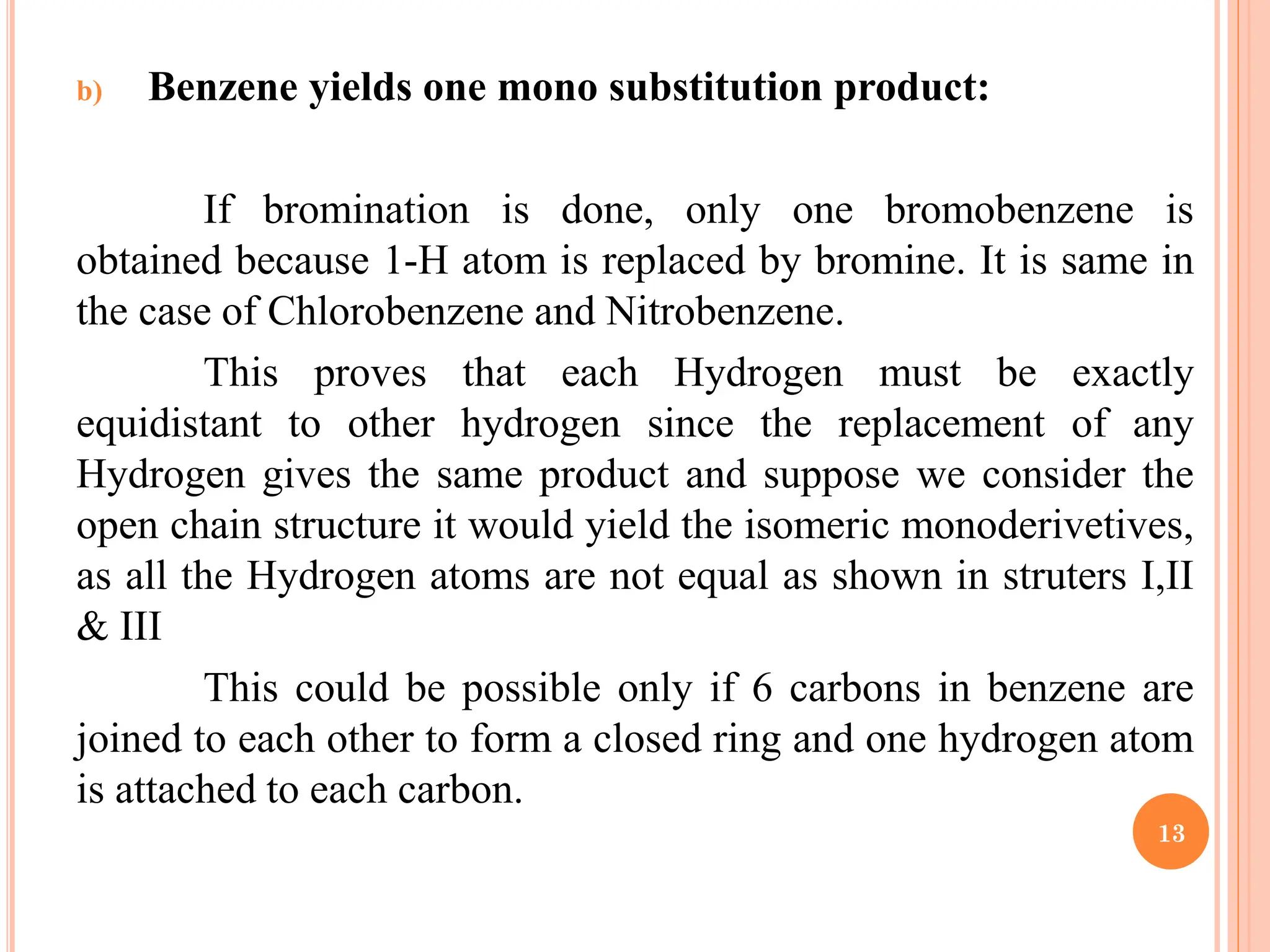
b) Benzene yields one mono substitution product:
If bromination is done, only one bromobenzene is
obtained because 1-H atom is replaced by bromine. It is same in
the case of Chlorobenzene and Nitrobenzene.
This proves that each Hydrogen must be exactly
equidistant to other hydrogen since the replacement of any
Hydrogen gives the same product and suppose we consider the
open chain structure it would yield the isomeric monoderivetives,
as all the Hydrogen atoms are not equal as shown in struters I,II
& III
This could be possible only if 6 carbons in benzene are
joined to each other to form a closed ring and one hydrogen atom
is attached to each carbon.
13
C) BENZENE FORMS 3-DI AND 3-TRISUBSTITUTED PRODUCTS
WHICH CAN BE EXPLAINED ON BASIC OF RING STRUCTURE.
POSITIONS 2 AND 6 ARE SAME (ORTHO PRODUCT)
POSITIONS 3 AND 5 ARE SAME (META PRODUCT)
POSITION 4 IS PARA POSITION
14
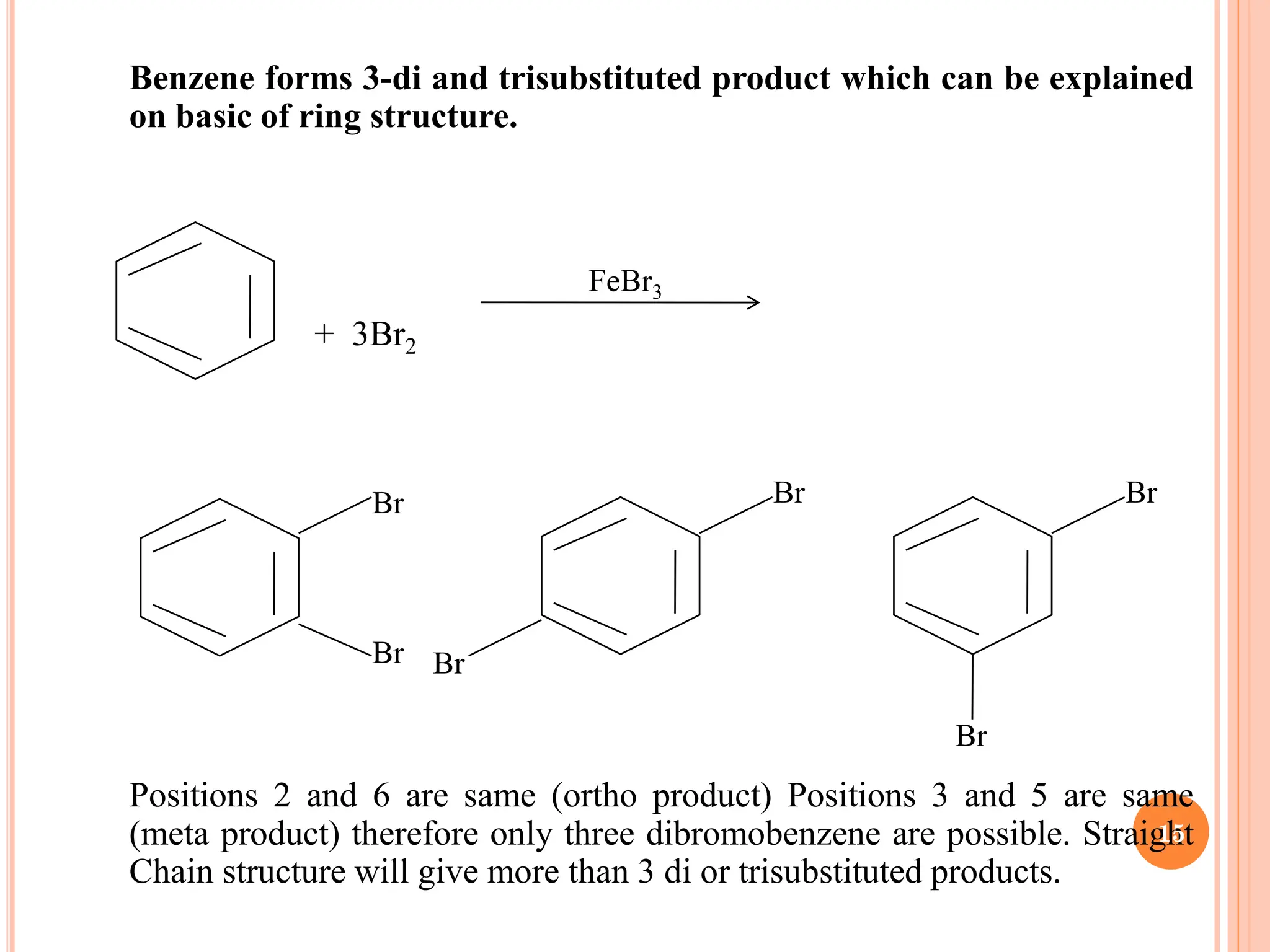
Benzene forms 3-di and trisubstituted product which can be explained
on basic of ring structure.
+ 3Br2
Positions 2 and 6 are same (ortho product) Positions 3 and 5 are same
(meta product) therefore only three dibromobenzene are possible. Straight
Chain structure will give more than 3 di or trisubstituted products.
15
FeBr3
Br
Br
Br Br
Br Br
RESONANCE HYBRID STRUCTURE OF BENZENE
The above Kekulè structures of benzene differ in
position of electrons.Benzene is a hybrid of
structures I & II are exactly equivalent and have
same stability and they make equal contribution to
the hybrid structure . The resonance stabilization
energy which is responsible for the unusual stability
of benzene can be calculated from the measurement
of heat of combustion or heat of hydrogenation 16
C
C
C
C
C
C C
C
C
C
C
C
H
H
H
H
H
H H
H
H
H
H
H
STABILITY OF BENZENE
Stability of benzene can be explained in the following way Heat
of Hydrogenation is the quantity of heat evolved when mole of an
unsaturated compound is hydrogenated.Addition of Hydrogen to
a double bond is an exothermic reaction. As heat is given out in
hydrogenation means the product in each case is more stable than
the original one.
+ H2 + 28.6 kcal/mol
+ 2H2 + 55 kcal/mol
+ 3H2 + 50 kcal/mol 17
Cyclohexane
Cyclohexadiene
Cyclohexane
Cyclohexene
Cyclohexane
Benzene
Cyclohexene has heat of hydrogenation 28.6
kcal/mol and cyclohexadiene has its twice i.e. 55
kcal/mol so we expect cyclohexatriene to have
heat of hydrogenation about three times as large as
cyclohexene which should be about 85.8 kcal/mol
and value of benzene is 50 kcal/moli.e. when
benzene is actually hydrogenated only 50 kcal/mol
of heat is evolved .So difference
85.8- 50 kcal/mol = 35.8 kcal/mol. It is resonance
stabilization energy of benzene
18
MOLECULAR ORBITAL STRUCTURE
By the X ray diffraction mechanism ,it is proved that
benzene consists of planar hexagon of 6-c atoms havinh
all c-c bonds equal in length i.e. 1.4 Angstron c-c-c
bond angle is 120 degrees .Therefore ,it can be proved
that each of this 6-c in benzene ring is in the state of
trigonal hybridization.The ring system is costructed
from six sp2-hybridized carbons by the overlapping of
two hybrid orbitals each to form sigma bonds
19
The structure of benzene molecule is best described in terms
of molecular orbital treatment theory. According to
this theory, all the C-atoms in benzene are sp2-hybridized.
Remaining six sp2-orbital of six C-atoms overlap with
1s orbital of six H-atoms individually to form six sigma
bonds.
20
HUCKEL’S RULE AND AROMATICITY
The complete delocalization of π electrons caused by side-side
overlapping gives benzene aromatic character.An aromatic
compound must contain 4n+2 electrons (n=0, 1, 2, and so forth).
Cyclic, planar and completely conjugated compounds that contain
4n π electrons are especially unstable, and are said to be
antiaromatic. Benzene is aromatic and especially stable because it
contains 6 π electrons. Cyclobutadiene is antiaromatic and
especially unstable because it contains 4π electrons.
21
Characteristic reaction of benzene involves substitution in
which resonance stabilized ring is preserved.This reaction is
called Aromatic Substitution.
Compared to sigma bonds pi electrons are loosely held and
are available to the reagent i.e. seeking electrons.So typical
reaction of benzene is electrophilic substitution reaction,
where hydrogen of aromatic ring is substituted by an atom
or group
Ar-H  Ar-X
22
Reactions of Benzene
GENERAL MECHANISM OF ELECTROPHILIC
SUBSTITUTION REACTIONS.
Aromatic substitution reactions are initiated by the
attack of electrophile on the ring followed by the
elimination of proton.Such reactions are called
electrophilic substitution reactions.
Benzene with its pi electrons behaves as an
electron rich system.Electrons in the pi clouds are
readily available to form a new bond with electron
deficient species,i.e. the electrophile.Electrophilic
substitution reactions folows the following
mechanism 23
Step-1:Generation of electrophile either by spontaneous
dissociation of reagent or by acid catalyzed dissociation
E-Nu E+ +Nu
E-Nu +A-  E-Nu+-A-  E+ +Nu-A-
Step-2:Formation of the -complex first then-complex
-complex forms by association of electrophile with the
aromatic ring .In this -complex,an electrophile is not
attached to any specific position of ring but later it
rearranges to give -complex. -complex is a resonance
hybrid of stabilized carbonium (arenium) ion produced by
the attack of electrophile on benzene ring
Step-3:A proton H + is then eliminated from -complex by
the base to yield the final substitution product.
24
25
HALOGENATION
NITRATION AND SULFONATION
Nitration and sulfonation of benzene are two examples of
electrophilic aromatic substitution. The nitronium ion
(NO2
+) and sulfur trioxide (SO3) are the electrophiles and
individually react with benzene to give nitrobenzene and
benzenesulfonic acid respectively.
26
NITRATION OF BENZENE
Mechanism
Step-1- Generation of electrophile HNO3 is activated with
sulfuric acid through protonation which then causes the loss of a
water molecule and forms a nitronium ion,which is a stronger
electrophile,.
27
H HNO3
H2SO4
NO2 H2O
+
+
Nitrob e nze ne
NITRATION OF BENZENE
Step-2 & Step-3- Formation of the -complex and
then elimination of proton H + from -complex takes place
to get the final product
28
SULFONATION
Sulfonation is a reversible reaction that produces
benzenesulfonic acid by adding sulfur trioxide and
fuming sulfuric acid. The reaction is reversed by
adding hot aqueous acid to benzenesulfonic acid to
produce benzene.
29
MECHANISM OF SULFONATION
Step-1-Generation of electrophile
The sulfur in sulfur trioxide is electrophilic because the oxygens
pull electrons away from it as oxygen is very electronegative.To
produce benzenesulfonic acid from benzene, fuming sulfuric acid
and sulfur trioxide are added. Fuming sulfuric acid, also refered
to as oleum, is a concentrated solution of dissolved sulfur trioxide
in sulfuric acid.
30
STEP-2 & STEP-3- THE BENZENE ATTACKS THE SULFUR AND
SUBSEQUENT PROTON TRANSFERS OCCUR TO PRODUCE
BENZENESULFONIC ACID. I.E. FORMATION OF THE -COMPLEX AND
THEN ELIMINATION OF PROTON H + FROM -COMPLEX TAKES PLACE
TO GET THE FINAL PRODUCT
31
FRIEDEL CRAFTS ACYLATION
This reaction involves the introduction of RCO (acyl)
group in the aromatic ring in presence of AlCl3,BF3,
FeCl3 etc
32
MECHANISM
Step 1- The very first step involves the generation of
the electrophile i.e. the acylium ion
33
34
Step 2- The second step involves the attack of the acylium
ion on benzene as a new electrophile to form one
complex:
Step 3- The third step involves the departure of the
proton in order for aromaticity to return to benzene
35
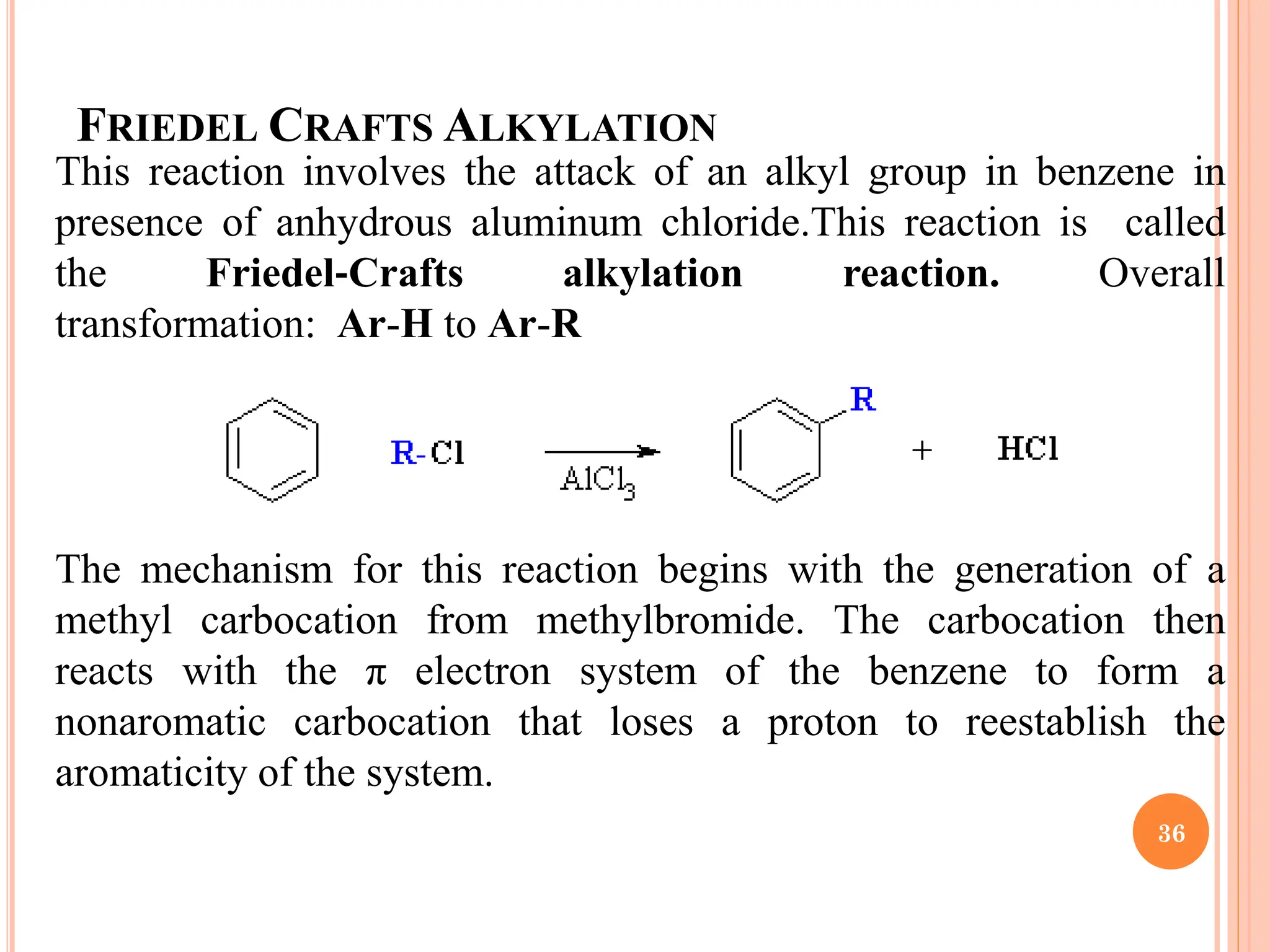
FRIEDEL CRAFTS ALKYLATION
This reaction involves the attack of an alkyl group in benzene in
presence of anhydrous aluminum chloride.This reaction is called
the Friedel‐Crafts alkylation reaction. Overall
transformation: Ar-H to Ar-R
The mechanism for this reaction begins with the generation of a
methyl carbocation from methylbromide. The carbocation then
reacts with the π electron system of the benzene to form a
nonaromatic carbocation that loses a proton to reestablish the
aromaticity of the system.
36
FRIEDEL CRAFTS ALKYLATION
1. Step 1- The first step involves the generation of the electrophile
methyl carbocation by the reaction of methylchloride with
aluminum chloride.
2. Step 2- The electrophile attacks the π electron system of the
benzene ring to form a nonaromatic carbocation.
37
FRIEDEL CRAFTS ALKYLATION
The positive charge on the carbocation that is formed is delocalized
throughout the molecule.
Step 3- The aromaticity is restored by the loss of a proton from the
atom to which the methyl group has bonded.
38
FRIEDEL CRAFTS ALKYLATION
Step 4- Finally, the proton reacts with the AlCl 4
− to regenerate the
AlCl 3 catalyst and form the product HCl.
Carbocations can rearrange during the Friedel‐Crafts alkylation
reaction, leading to the formation of unpredicted products. One
example is the formation of isopropyl benzene by the reaction of
propyl chloride with benzene.
39
REFERENCES
 Organic Chemistry: Morrison & Boyd.
 Textbook of Organic Chemistry: Arun Bahl,
B.S.Bahl.
 Essentialsof Physical Chemistry Arun Bahl,
B.S.Bahl.G.D.Tuli
 Advanced general Organic Chemistry Sachin K.
Ghosh
 Textbook of Organic Chemistry for Pharmacy
students K.S.Mukherjee
40
THANK YOU
41

Benzene Pharmaceutical organic chemistry ll unit 1

  • 1.
  • 2.
    Physicai properties ofBenzene Benzene is a colourless or light yellow It is liquid at room temperature. It has a sweet odour and is highly flammable. Natural sources of benzene include volcanoes and forest fires. Benzene is also a natural part of crude oil, gasoline, and cigarette smoke. IUPAC name Benzene Other names Benzol (historic/German) Cyclohexa-1,3,5-triene;1,3,5- Cyclohexatriene 2 Space-filling model Ball and stick model
  • 3.
     Benzene isan organic chemical compound consisting of carbon and hydrogen atoms with alternating double bonds. As it contains only carbon and hydrogen atoms, benzene is classed as a hydrocarbon.  The chemical formula of benzene is C6H6 , so it consists of six carbon atoms and six hydrogen atoms. joined in a ring with one hydrogen atom attached to each.
  • 4.
    NOMENCLATURE Monosubstituted alkylbenzenes arenamed as derivatives of benzene. For example, ethylbenzene. The IUPAC system retains certain common names for several of the simpler monosubstituted alkyl benzenes CH2CH3 CH3 CH=CH2 To lu e n e Eth ylb e nze ne Styre ne
  • 5.
    NOMENCLATURE Common names forsome monosubstituted benzenes are as follows Phenyl group (C6H5- or Ph-): Derived by loss of an H from benzene, OCH3 C-OH O NH2 OH C-H O Ph e n o l A n ilin e B e n z o ic acid A n iso le B e n zald e h y d e C6 H5 1-Ph e nylcyclo he xe ne 4-Phe n yl-1-b ute ne Ph e nyl gro up 1 2 4 3
  • 6.
    NOMENCLATURE When two substituentsoccur on a benzene ring, three isomers are possible, they may be located by 1. numbering the atoms of the ring or 2. using the locators ortho (o), meta (m), and para (p) COOH Br CH3 CH3 Cl CH2 CH3 1 2-Brom o be nzo ic acid (o -Bro m o be n zoic acid) 1,3-D im e thylbe n ze ne (m- Xyle n e ) 1-Ch loro -4-e thylbe nze n e (p-C hlo roe th ylb e nze ne ) 1 2 2 2 3 3 4 1
  • 7.
    NOMENCLATURE When two substituentsoccur on a benzene ring, three isomers are possible; they may be located by 1. numbering the atoms of the ring or 2. using the locators ortho (o), meta (m), and para (p) COOH Br CH3 CH3 Cl CH2 CH3 1 2-Brom o be nzo ic acid (o -Bro m o be n zoic acid) 1,3-D im e thylbe n ze ne (m- Xyle n e ) 1-Ch loro -4-e thylbe nze n e (p-C hlo roe th ylb e nze ne ) 1 2 2 2 3 3 4 1
  • 8.
    STRUCTURE OF BENZENE Factsthat supported Kekulè Formula  1) Molecular formula  2) Open Chain Structure not accepted  3) Evidences in favor of Ring Structure a) Catalytic Hydrogenation of benzene yields cyclohexane b) Benzene yields one mono substitution product: c) Benzene forms 3-di and trisubstituted product which can be explained on basic of ring structure.  4) Resonance hybrid Structure  5) Molecular Orbital Structure 8
  • 9.
    MOLECULAR FORMULA 1)Benzene hasmolecular formula- C6H6. From its elemental composition and molecular weight, benzene was known to contain 6-C and 6-H atoms. Benzene has molecular formula C6H6 as compared to hexane C6H12 which confirms that benzene is highly unsaturated than hexane.From this, it was concluded that 6-C atoms in the benzene were linked by double or triple bonds so as to form a straight chain or closed ring as proposed by Kekulè. 9 C C C C C C H H H H H H A Ke k u lé s tru c tu re s h o w in g all ato m s A K e k u lé s tru ctu re as a lin e -an gle fo rm u la
  • 10.
    2) OPEN CHAINSTRUCTURE NOT ACCEPTED The possible open chain structure for benzene could have been CH2 = CH − C ≡ C − CH = CH2 - structure I CH3 − C ≡ C − C ≡ C − CH3 - structure II CH ≡ C − CH2 − CH2 − C ≡ CH - structure III All this structures were ruled out because benzene didn’t give the usual reactions of alkenes, alkynes 10
  • 11.
    For example whenabove open chain structured compounds containing double and triple bonds are added to solution of bromine in carbon tetrachloride which is red in colour becomes colourless but benzene do not give this reactions benzene can not have open chain structure . 11
  • 12.
    3) EVIDENCE INFAVOR OF RING STRUCTURE a) Catalytic Hydrogenation of benzene yields Cyclohexane + 3H2 Since, hydrogenation is not bringing about any major structural change in carbon frame. It proves the presence of closed ring of 6-C atoms in Benzene molecule. 12 Pt/Ni Δ Benzene Cyclohexane
  • 13.
    b) Benzene yieldsone mono substitution product: If bromination is done, only one bromobenzene is obtained because 1-H atom is replaced by bromine. It is same in the case of Chlorobenzene and Nitrobenzene. This proves that each Hydrogen must be exactly equidistant to other hydrogen since the replacement of any Hydrogen gives the same product and suppose we consider the open chain structure it would yield the isomeric monoderivetives, as all the Hydrogen atoms are not equal as shown in struters I,II & III This could be possible only if 6 carbons in benzene are joined to each other to form a closed ring and one hydrogen atom is attached to each carbon. 13
  • 14.
    C) BENZENE FORMS3-DI AND 3-TRISUBSTITUTED PRODUCTS WHICH CAN BE EXPLAINED ON BASIC OF RING STRUCTURE. POSITIONS 2 AND 6 ARE SAME (ORTHO PRODUCT) POSITIONS 3 AND 5 ARE SAME (META PRODUCT) POSITION 4 IS PARA POSITION 14
  • 15.
    Benzene forms 3-diand trisubstituted product which can be explained on basic of ring structure. + 3Br2 Positions 2 and 6 are same (ortho product) Positions 3 and 5 are same (meta product) therefore only three dibromobenzene are possible. Straight Chain structure will give more than 3 di or trisubstituted products. 15 FeBr3 Br Br Br Br Br Br
  • 16.
    RESONANCE HYBRID STRUCTUREOF BENZENE The above Kekulè structures of benzene differ in position of electrons.Benzene is a hybrid of structures I & II are exactly equivalent and have same stability and they make equal contribution to the hybrid structure . The resonance stabilization energy which is responsible for the unusual stability of benzene can be calculated from the measurement of heat of combustion or heat of hydrogenation 16 C C C C C C C C C C C C H H H H H H H H H H H H
  • 17.
    STABILITY OF BENZENE Stabilityof benzene can be explained in the following way Heat of Hydrogenation is the quantity of heat evolved when mole of an unsaturated compound is hydrogenated.Addition of Hydrogen to a double bond is an exothermic reaction. As heat is given out in hydrogenation means the product in each case is more stable than the original one. + H2 + 28.6 kcal/mol + 2H2 + 55 kcal/mol + 3H2 + 50 kcal/mol 17 Cyclohexane Cyclohexadiene Cyclohexane Cyclohexene Cyclohexane Benzene
  • 18.
    Cyclohexene has heatof hydrogenation 28.6 kcal/mol and cyclohexadiene has its twice i.e. 55 kcal/mol so we expect cyclohexatriene to have heat of hydrogenation about three times as large as cyclohexene which should be about 85.8 kcal/mol and value of benzene is 50 kcal/moli.e. when benzene is actually hydrogenated only 50 kcal/mol of heat is evolved .So difference 85.8- 50 kcal/mol = 35.8 kcal/mol. It is resonance stabilization energy of benzene 18
  • 19.
    MOLECULAR ORBITAL STRUCTURE Bythe X ray diffraction mechanism ,it is proved that benzene consists of planar hexagon of 6-c atoms havinh all c-c bonds equal in length i.e. 1.4 Angstron c-c-c bond angle is 120 degrees .Therefore ,it can be proved that each of this 6-c in benzene ring is in the state of trigonal hybridization.The ring system is costructed from six sp2-hybridized carbons by the overlapping of two hybrid orbitals each to form sigma bonds 19
  • 20.
    The structure ofbenzene molecule is best described in terms of molecular orbital treatment theory. According to this theory, all the C-atoms in benzene are sp2-hybridized. Remaining six sp2-orbital of six C-atoms overlap with 1s orbital of six H-atoms individually to form six sigma bonds. 20
  • 21.
    HUCKEL’S RULE ANDAROMATICITY The complete delocalization of π electrons caused by side-side overlapping gives benzene aromatic character.An aromatic compound must contain 4n+2 electrons (n=0, 1, 2, and so forth). Cyclic, planar and completely conjugated compounds that contain 4n π electrons are especially unstable, and are said to be antiaromatic. Benzene is aromatic and especially stable because it contains 6 π electrons. Cyclobutadiene is antiaromatic and especially unstable because it contains 4π electrons. 21
  • 22.
    Characteristic reaction ofbenzene involves substitution in which resonance stabilized ring is preserved.This reaction is called Aromatic Substitution. Compared to sigma bonds pi electrons are loosely held and are available to the reagent i.e. seeking electrons.So typical reaction of benzene is electrophilic substitution reaction, where hydrogen of aromatic ring is substituted by an atom or group Ar-H  Ar-X 22 Reactions of Benzene
  • 23.
    GENERAL MECHANISM OFELECTROPHILIC SUBSTITUTION REACTIONS. Aromatic substitution reactions are initiated by the attack of electrophile on the ring followed by the elimination of proton.Such reactions are called electrophilic substitution reactions. Benzene with its pi electrons behaves as an electron rich system.Electrons in the pi clouds are readily available to form a new bond with electron deficient species,i.e. the electrophile.Electrophilic substitution reactions folows the following mechanism 23
  • 24.
    Step-1:Generation of electrophileeither by spontaneous dissociation of reagent or by acid catalyzed dissociation E-Nu E+ +Nu E-Nu +A-  E-Nu+-A-  E+ +Nu-A- Step-2:Formation of the -complex first then-complex -complex forms by association of electrophile with the aromatic ring .In this -complex,an electrophile is not attached to any specific position of ring but later it rearranges to give -complex. -complex is a resonance hybrid of stabilized carbonium (arenium) ion produced by the attack of electrophile on benzene ring Step-3:A proton H + is then eliminated from -complex by the base to yield the final substitution product. 24
  • 25.
  • 26.
    HALOGENATION NITRATION AND SULFONATION Nitrationand sulfonation of benzene are two examples of electrophilic aromatic substitution. The nitronium ion (NO2 +) and sulfur trioxide (SO3) are the electrophiles and individually react with benzene to give nitrobenzene and benzenesulfonic acid respectively. 26
  • 27.
    NITRATION OF BENZENE Mechanism Step-1-Generation of electrophile HNO3 is activated with sulfuric acid through protonation which then causes the loss of a water molecule and forms a nitronium ion,which is a stronger electrophile,. 27 H HNO3 H2SO4 NO2 H2O + + Nitrob e nze ne
  • 28.
    NITRATION OF BENZENE Step-2& Step-3- Formation of the -complex and then elimination of proton H + from -complex takes place to get the final product 28
  • 29.
    SULFONATION Sulfonation is areversible reaction that produces benzenesulfonic acid by adding sulfur trioxide and fuming sulfuric acid. The reaction is reversed by adding hot aqueous acid to benzenesulfonic acid to produce benzene. 29
  • 30.
    MECHANISM OF SULFONATION Step-1-Generationof electrophile The sulfur in sulfur trioxide is electrophilic because the oxygens pull electrons away from it as oxygen is very electronegative.To produce benzenesulfonic acid from benzene, fuming sulfuric acid and sulfur trioxide are added. Fuming sulfuric acid, also refered to as oleum, is a concentrated solution of dissolved sulfur trioxide in sulfuric acid. 30
  • 31.
    STEP-2 & STEP-3-THE BENZENE ATTACKS THE SULFUR AND SUBSEQUENT PROTON TRANSFERS OCCUR TO PRODUCE BENZENESULFONIC ACID. I.E. FORMATION OF THE -COMPLEX AND THEN ELIMINATION OF PROTON H + FROM -COMPLEX TAKES PLACE TO GET THE FINAL PRODUCT 31
  • 32.
    FRIEDEL CRAFTS ACYLATION Thisreaction involves the introduction of RCO (acyl) group in the aromatic ring in presence of AlCl3,BF3, FeCl3 etc 32
  • 33.
    MECHANISM Step 1- Thevery first step involves the generation of the electrophile i.e. the acylium ion 33
  • 34.
    34 Step 2- Thesecond step involves the attack of the acylium ion on benzene as a new electrophile to form one complex:
  • 35.
    Step 3- Thethird step involves the departure of the proton in order for aromaticity to return to benzene 35
  • 36.
    FRIEDEL CRAFTS ALKYLATION Thisreaction involves the attack of an alkyl group in benzene in presence of anhydrous aluminum chloride.This reaction is called the Friedel‐Crafts alkylation reaction. Overall transformation: Ar-H to Ar-R The mechanism for this reaction begins with the generation of a methyl carbocation from methylbromide. The carbocation then reacts with the π electron system of the benzene to form a nonaromatic carbocation that loses a proton to reestablish the aromaticity of the system. 36
  • 37.
    FRIEDEL CRAFTS ALKYLATION 1.Step 1- The first step involves the generation of the electrophile methyl carbocation by the reaction of methylchloride with aluminum chloride. 2. Step 2- The electrophile attacks the π electron system of the benzene ring to form a nonaromatic carbocation. 37
  • 38.
    FRIEDEL CRAFTS ALKYLATION Thepositive charge on the carbocation that is formed is delocalized throughout the molecule. Step 3- The aromaticity is restored by the loss of a proton from the atom to which the methyl group has bonded. 38
  • 39.
    FRIEDEL CRAFTS ALKYLATION Step4- Finally, the proton reacts with the AlCl 4 − to regenerate the AlCl 3 catalyst and form the product HCl. Carbocations can rearrange during the Friedel‐Crafts alkylation reaction, leading to the formation of unpredicted products. One example is the formation of isopropyl benzene by the reaction of propyl chloride with benzene. 39
  • 40.
    REFERENCES  Organic Chemistry:Morrison & Boyd.  Textbook of Organic Chemistry: Arun Bahl, B.S.Bahl.  Essentialsof Physical Chemistry Arun Bahl, B.S.Bahl.G.D.Tuli  Advanced general Organic Chemistry Sachin K. Ghosh  Textbook of Organic Chemistry for Pharmacy students K.S.Mukherjee 40
  • 41.