Unit-I
BENZENE AND ITS
DERIVATIVES
HELLO!
2
I am
Mr. ANSARI SHOAIB AHMED
Assistant Professor
Department of Pharmaceutical Chemistry
Oriental College of Pharmacy
BENZENE
Introduction
Benzene is an organic chemical compound with the molecular
formula C6H6. The benzene molecule is composed of six carbon
atoms joined in a planar ring with one hydrogen atom attached to
each. Because it contains only carbon and hydrogen atoms,
benzene is classed as a hydrocarbon.
3
 Benzene is a natural constituent of crude oil and is one of the
elementary petrochemicals.
 Due to the cyclic continuous pi bonds between the carbon
atoms, benzene is classed as an aromatic hydrocarbon.
 It is sometimes abbreviated PhH.
4
Source
 Benzene is a colorless and highly flammable liquid with a
sweet smell, and is partially responsible for the aroma around
petrol (gasoline) stations.
 It is used primarily as a precursor to the manufacture of
chemicals with more complex structure, such as ethylbenzene
and cumene, of which billions of kilograms are produced
annually.
 Although a major industrial chemical, benzene finds limited
use in consumer items because of its toxicity
5
Properties
NOMENCLATURE
Let’s start with the first set
of slides
“
Benzene and its homologues are frequently called by the Common
Names which are accepted by the IUPAC system.
The homologues of benzene having a single alkyl group are named
as Alkylbenzenes.
These are made of a benzene ring to which is attached the alkyl
group. The all group bonded to a ring carbon is designated as the
Side-Chain.
7
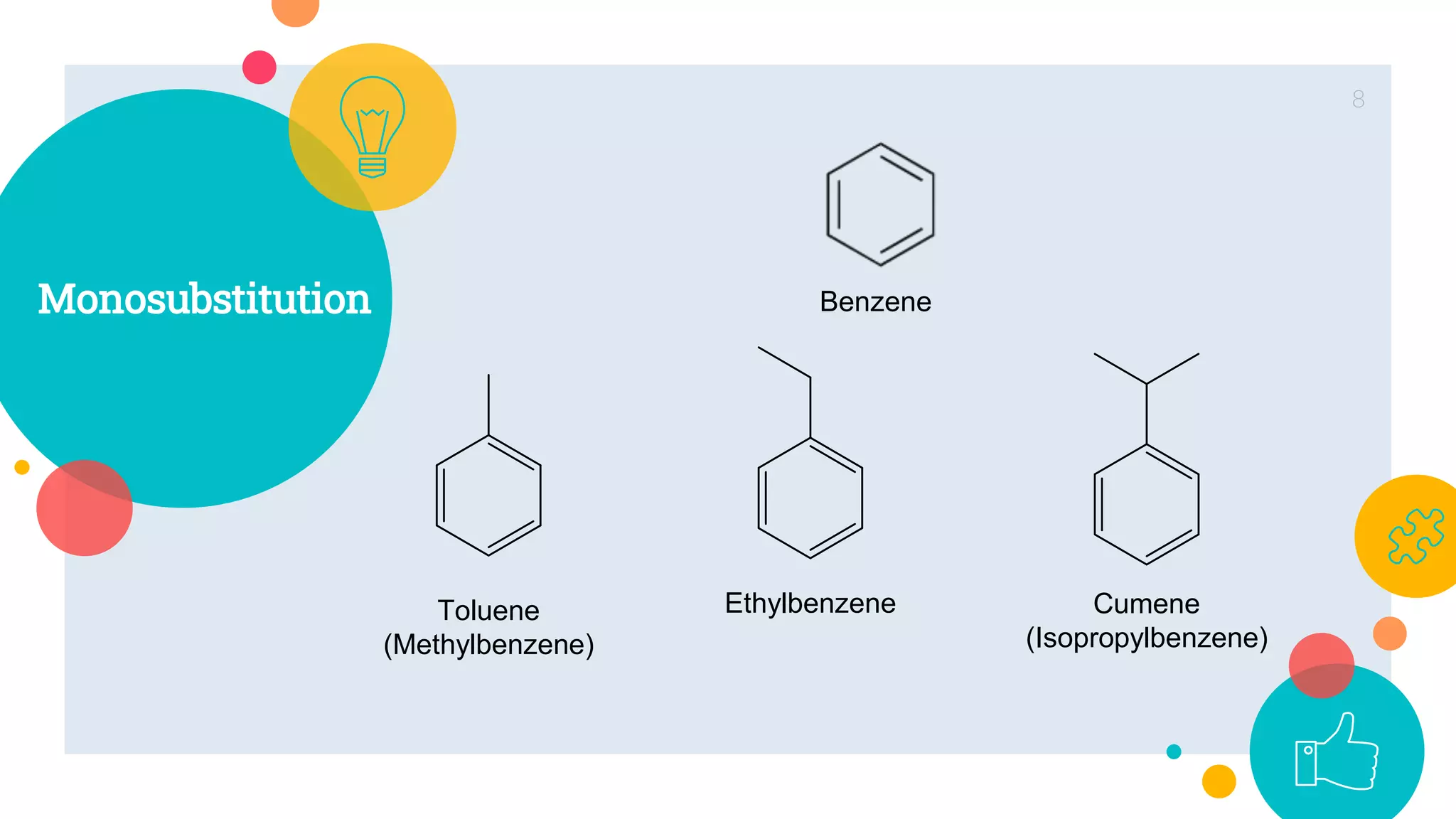
Monosubstitution
8
Benzene
Toluene
(Methylbenzene)
Ethylbenzene Cumene
(Isopropylbenzene)
Alkyl substitution
is larger than the
ring ?
9
3-Phenyldecane
5-Phenylpentanoic Acid
2
3
4
5
6
7
8
9
10
1
5
4
3
2
1
Disubstitution
10
o-Xylene m-Xylene p-Xylene
Dimethylbenzenes have the common name Xylenes. The three
isomeric xylenes are:
ortho
meta
para
o-bromotoluene m-dibromobenzene p-cloronitrobenzene
Polysubstituted
Derivatives
11
3,5-Dibromophenol
1-Bromo-3,5-Dichlorobenzene 2,4,6-Trinitrotoluene
Structure of
Benzene
12
Elemental analysis and molecular weight determination
showed that benzene had the molecular formula C6H6.
This indicated that benzene was a highly unsaturated
compound (compare it with n-hexane, C6H14).
Molecular
Formula
13
n-hexane
(C6H14)
Cyclo-hexane
(C6H12)
Cyclo-hexatriene
Benzene
(C6H6)
Molecular
Orbital Structure
of Benzene
14
15
Hybridization
16
 The structure of benzene is best described in terms of the modern molecular orbital
theory.
 All six carbon atoms in benzene are sp² hybridized.
 The sp² hybrid orbitals overlap with each other and with s orbitals of the six hydrogen
atoms forming C-C and C-Hσ bonds
EVIDENCES
Analytical, synthetic and
other evidences in the
derivation of structure of
benzene
Synthetic Evidences
 Benzene could be constructed as a straight-chain or ring
compound having double (C=C) and/or triple (C≡C)
bonds.
 But benzene did not behave like alkenes or alkynes. It did
not decolorize bromine in carbon tetrachloride or cold
aqueous potassium permanganate. It did not add water
in the presence of acids.
Straight Chain not Possible
01
19
NO REACTION
NO REACTION
NO REACTION
Cyclo-hexatriene
Benzene
(C6H6)
Br2/CCl4
H2O/H+
KMnO4
Dilute cold
Evidence of
Cyclic Structure
1) Substitution of Benzene
Benzene reacted with bromine in the presence of FeBr3 (catalyst) to form
monobromobenzene.
20
The fact that only one monobromo and no isomeric products were obtained
indicated that all six hydrogen atoms in benzene were identical. This could be
possible only if benzene had a cyclic structure of six carbons and to each carbon
was attached one hydrogen.
Monobromobenzene
Benzene
02
21
2) Addition of Hydrogen to Benzene
Benzene added three moles of hydrogen in the presence of nickel catalyst to give
cyclohexane.
This confirmed the cyclic structure of benzene and also showed the presence of three
carbon-carbon double bonds.
Cyclo-hexane
(C6H12)
Cyclo-hexatriene
Benzene
(C6H6)
Ni
150o/Pressure
+ 3 H2
Analytical Evidence
1) IR SPECTROSCOPY
Aromatic compounds produce a large number of characteristic bands in
the infra-red region. The following regions are particularly useful for
recognizing the presence of benzene (and polynuclear aromatics) and
benzene derivatives: the C-H (stretch) absorption region is 3080-3030
cm¹ (w), and the bands for C=C (in-plane vibration) are: 1625-1 600 cm-¹
(v), 1 590-1 575 cm (v) and 1 525-1475 cm¯¹ (v)..
22
03
23
IR Spectra
of
Benzene
24
2) NMR SPECTROSCOPY
NMR spectroscopy is an analytical technique used in structural elucidation. NMR spectroscopy used
to identify total number of carbon and total number of hydrogen. There are two types of NMR
spectroscopy.
I. H1-NMR SPECTROSCOPY
II. C13-NMR SPECTROSCOPY
Benzene contains six carbon and six hydrogen. H1 NMR spectra shows a single peak with chemical
shift of 7.34, while C13 NMR spectra shows a single peak with a chemical shift of 128.5 . It confirms
that all the carbon in benzene are identical in nature and there is one hydrogen attached to each
carbon.
25
3) MASS SPECTROSCOPY
In mass spectrometry, a substance is bombarded with an electron beam having sufficient energy to
fragment the molecule. The positive fragments which are produced (cations and radical cations) are
accelerated in a vacuum through a magnetic field and are sorted on the basis of mass-to-charge
ratio. Since the bulk of the ions produced in the mass spectrometer carry a unit positive charge, the
value m/e is equivalent to the molecular weight of the fragment. The analysis of mass spectroscopy
information involves the re-assembling of fragments, working backwards to generate the original
molecule.
26
MASS
Spectra of
Benzene
“
KEKULE’ STRUCTURE OF
BENZENE
27
28
In 1865, August Kekule suggested that benzene consist of a cyclic planar structure of six carbons
with alternate double and single bonds. To each carbon attached one hydrogen. Benzene according
to this proposal, was simple, 1,3,5-cyclohexatriene.
There were two objections:
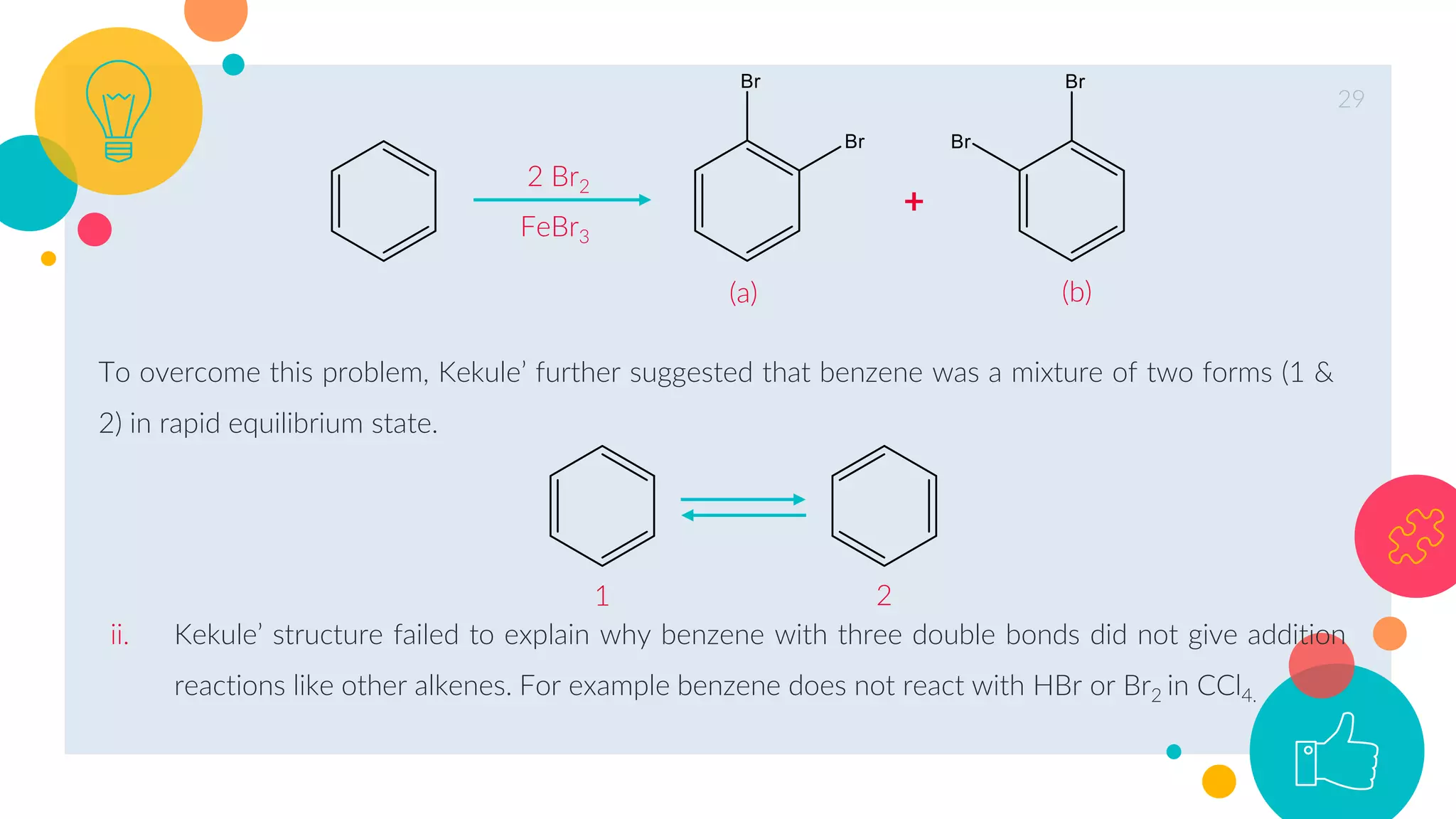
i. If the Kekule's structure was correct, there should exist two or isomers of dibromobenzene. In
one isomer, the two bromine atoms should be on carbons that are connected by a double bond,
as shown in structure (a). In the other isomer, the bromines should be carbons connected by a
single bond, as shown in structure (b). In fact, only one ortho-dibromobenezene could be
prepared.
Usually written as
29
2 Br2
FeBr3
(a) (b)
+
To overcome this problem, Kekule’ further suggested that benzene was a mixture of two forms (1 &
2) in rapid equilibrium state.
1 2
ii. Kekule’ structure failed to explain why benzene with three double bonds did not give addition
reactions like other alkenes. For example benzene does not react with HBr or Br2 in CCl4.
RESONANCE
Resonance description of
Benzene
30
Resonance
description of
Benzene
 The phenomenon in which two or more structures can be
written for a substance which involve identical positions of
atoms is called Resonance.
 The actual structure of the molecule is said to be Resonance
Hybrid of various possible alternative structures.
32
 The alternative structures are referred to as the Resonance Structures or Contributing
Forms.
 A double-headed arrow (↔) between the resonance structures is used to represent the
resonance hybrid.
 Thus in the case of benzene, Kekule's structures (1) and (2) represent the resonance
structures. The actual structure of the molecule may be represented as a hybrid of these
two resonance structures, by the single structural formula (3).
1 2 3
33
It should be clearly understood that the resonance structures (1) and (2) are not the actual
structures of the benzene molecule. They exist only in theory. None of these structures
adequately represents the molecule. In resonance theory, we view the benzene molecule
(which of course is a real entity) as being a hybrid of these two hypothetical resonance
structures.
Look at the structures (1 and 2) carefully. All single bonds in structure (1) are double bonds in
structure (2), which is considered a hybrid of them, then the carbon-carbon bonds in benzene
are neither single bonds nor double bonds. Rather, they are something halfway between. This is
exactly what we find experimentally. Spectroscopic measurements show that benzene is planar
and that all of its carbon-carbon bonds are of equal length, 1.40 Å. This value lies i between the
carbon-carbon single bond length (1.54 Å) and the carbon-carbon double bond length 1.34 Å).
Resonance
Energies of
Benzene.
Benzene's special stability is due to the formation of the
delocalized molecular orbital. The magnitude of this extra stability
can be estimated by measuring the changes in heat of
hydrogenations that are associated with reactions. Hydrogenation
of cyclohexene evolves 28.6 kcal/mole, a value typical for
hydrogenation of alkenes.
34
+ H2 + 28.6 kcal
35
 Hydrogenation of both double bonds of 1,3-cyclohexadiene evolves 54.4
kcal/mole, approximately double the amount observed for cyclohexene.
+ 2 H2 + 55.4 kcal
 The molecule of 1,3,5-cyclohexatriene (Kekule structure), containing three ordinary
double bonds, is hypothetical-any efforts to produce it yields benzene. We would,
however, expect complete hydrogenation of the unknown 1.3.5-cyclohexatriene to evolve
approximately 3x 28.6 or 85.8 kcal/mole.
Actual
Resonance
Energy
36
Cyclo-hexane
(C6H12)
Hypothetical
Cyclo-hexatriene
+ 3 H2
+ 85.8 kcal
Cyclo-hexane
(C6H12)
Hypothetical
Cyclo-hexatriene
+ 3 H2
+ 49.8 kcal
Hydrogenation of benzene gives only 49.8 kcal/mole.
37
Figure (PTO) makes these energy relationships more evident. The 36 kcal
difference between the heat evolved in the hydrogenation of benzene and
that estimated for hydrogenation of a compound with three ordinary
double bonds is the added stability. This added stability is sometimes
called Resonance Energy. Resonance energy is a measure of how much
more stable a resonance bybrid structure is than its extreme resonance
structures.
38
AROMATICITY
Huckel Rule
39
Aromaticity
In chemistry, aromaticity is a property of cyclic (ring-shaped),
planar (flat) structures with pi bonds in resonance (those
containing delocalized electrons) that gives increased stability
compared to other geometric or connective arrangements
with the same set of atoms. Aromatic rings are very stable and
do not break apart easily. Organic compounds that are not
aromatic are classified as aliphatic compounds—they might be
cyclic, but only aromatic rings have enhanced stability.
41
The aromatic compounds apparently contain alternate double and single bonds in a
cyclic structure and resemble benzene in chemical behavior. They undergo
substitution rather than addition reaction This characteristic behavior is called
Aromatic Character or Aromaticity. Aromaticity is, in fact, property of the sp²
hybridized planar rings in which the p orbitals (one on each atom) allow cycle
delocalization of electrons.
42
Criteria for Aromaticity
On the basis of the above considerations, can be laid down criteria or rules which
help us in knowing whether a particular compound is aromatic or non-aromatic.
Rule 1. An aromatic compound is cyclic and planar.
Rule 2. Each atom in an aromatic ring has a p orbital. These p orbitals must be
parallel so that a continuous overlap is possible around the ring.
Rule 3. The cyclic molecular orbital (electron cloud) formed by overlap of p
orbitals must contain (4n+2) electrons, where n-integer 0, 1, 2, 3 etc. This is
known as Huckel Rule
Let us apply these rules to the following examples:
Aromaticity
Aromatic
 Cyclic structure
 Complete resonance
 Odd pair of electrons
Anti-Aromatic
 Cyclic structure
 Complete resonance
 Even pair of electrons
43
44
Cyclic
?
Conjugated
?
Pi bonds? Lone pairs of
electrons?
Total  E’s (4n+)
E
Aromatic?
Yes Yes 3 0 6 Yes Yes
Cyclic
?
Conjugated
?
Pi bonds? Lone pairs of
electrons?
Total  E’s (4n+)
E
Aromatic?
Yes Yes 3 0 6 Yes Yes
REACTIONS OF
BENZENE
(Chemical Properties)
45
Electrophilic
Aromatic
Substitution
Benzene undergoes electrophilic substitution reactions. The
benzene ring with its delocalized electrons is an electron-rich
system. It is attacked by electrophiles, giving substitution
products.
These reactions can be represented as:
Substitution
Product
+ E-Nu + H-Nu
47
01
02
03
04
05
Reactions of
benzene
Halogenation
Nitration
Sulphonation
Alkylation
Acylation
REACTIONS
OF
BENZENE
48
Want big impact?
Use big image.
49
Use charts to
explain your
ideas
Yellow
Red
Blue
50
And tables to
compare data
A B C
Yellow 10 20 7
Blue 30 15 10
Orange 5 24 16
51
Maps
our office
52
89,526,124
Whoa! That’s a big number, aren’t you proud?
53
89,526,124$
That’s a lot of money
100%
Total success!
185,244 users
And a lot of users
54
second
last
first
Our process is
easy
55
Yellow
Is the color of gold,
butter and ripe lemons.
In the spectrum of visible
light, yellow is found
between green and
orange.
Blue
Is the colour of the clear
sky and the deep sea. It
is located between violet
and green on the optical
spectrum.
Red
Is the color of blood, and
because of this it has
historically been
associated with sacrifice,
danger and courage.
Let’s review
some concepts
Yellow
Is the color of gold,
butter and ripe lemons.
In the spectrum of visible
light, yellow is found
between green and
orange.
Blue
Is the colour of the clear
sky and the deep sea. It
is located between violet
and green on the optical
spectrum.
Red
Is the color of blood, and
because of this it has
historically been
associated with sacrifice,
danger and courage.
56
You can insert graphs from Excel or Google Sheets 57
4000
3000
2000
1000
0
Mobile project
Show and explain
your web, app or
software projects
using these gadget
templates.
58
Tablet project
Show and explain
your web, app or
software projects
using these gadget
templates.
59
Desktop project
Show and explain
your web, app or
software projects
using these gadget
templates.
60
Thanks!
Any questions?
You can find me at @username & user@mail.me
61
Credits
Special thanks to all the people who
made and released these awesome
resources for free:
○ Presentation template by
SlidesCarnival
○ Photographs by Unsplash
62
Presentation
design
This presentation uses the following typographies and colors:
○ Titles: Roboto Slab Light
○ Body copy: Lato Light
You can download the fonts on these pages:
http://www.latofonts.com/lato-free-fonts/
https://www.fontsquirrel.com/fonts/roboto-slab
Aqua #02bdc7 · Yellow #ffb600 · Magenta #fc4067
You don’t need to keep this slide in your presentation. It’s only here
to serve you as a design guide if you need to create new slides or
download the fonts to edit the presentation in PowerPoint®
63
2.
Extra
Resources
For Business Plans,
Marketing Plans, Project
Proposals, Lessons, etc
Timeline
65
DEC
NOV
OCT
SEP
AUG
JUL
JUN
MAY
APR
MAR
FEB
JAN
Blue is the colour
of the clear sky
and the deep sea
Red is the colour
of danger and
courage
Black is the color
of ebony and of
outer space
Yellow is the color
of gold, butter and
ripe lemons
White is the color
of milk and fresh
snow
Blue is the colour
of the clear sky
and the deep sea
Yellow is the color
of gold, butter and
ripe lemons
White is the color
of milk and fresh
snow
Blue is the colour
of the clear sky
and the deep sea
Red is the colour
of danger and
courage
Black is the color
of ebony and of
outer space
Yellow is the
color of gold,
butter and ripe
lemons
Roadmap
66
1 3 5
6
4
2
Blue is the colour of the
clear sky and the deep
sea
Red is the colour of
danger and courage
Black is the color of
ebony and of outer space
Yellow is the color of
gold, butter and ripe
lemons
White is the color of milk
and fresh snow
Blue is the colour of the
clear sky and the deep
sea
Gantt chart
67
Week 1 Week 2
1 2 3 4 5 6 7 8 9 10 11 12 13 14
Task 1
Task 2 ◆
Task 3
Task 4 ◆
Task 5 ◆
Task 6
Task 7
Task 8
68
STRENGTHS
Blue is the colour of the
clear sky and the deep sea
WEAKNESSES
Yellow is the color of gold,
butter and ripe lemons
Black is the color of ebony
and of outer space
OPPORTUNITIES
White is the color of milk
and fresh snow
THREATS
SWOT Analysis
Business Model Canvas
69
Key Activities
Insert your content
Key Resources
Insert your content
Value Propositions
Insert your content
Customer Relationships
Insert your content
Channels
Insert your content
Customer Segments
Insert your content
Key Partners
Insert your content
Cost Structure
Insert your content
Revenue Streams
Insert your content
Funnel
70
PURCHASE
LOYALTY
AWARENESS
EVALUATION
DISCOVERY
INTENT
Insert your content
Insert your content
Insert your content
Insert your content
Insert your content
Insert your content
Team
Presentation
71
Imani Jackson
JOB TITLE
Blue is the colour of the
clear sky and the deep sea
Marcos Galán
JOB TITLE
Blue is the colour of the
clear sky and the deep sea
Ixchel Valdía
JOB TITLE
Blue is the colour of the
clear sky and the deep sea
Nils Årud
JOB TITLE
Blue is the colour of the
clear sky and the deep sea
Competitor Matrix
72
LOW
VALUE
1
HIGH
VALUE
1
LOW VALUE 2
HIGH VALUE 2
Our company
Competitor
Competitor
Competitor
Competitor
Competitor
Compe
titor
Weekly Planner
73
SUNDAY MONDAY TUESDAY WEDNESDAY THURSDAY FRIDAY SATURDAY
09:00 -
09:45
Task Task Task Task Task Task Task
10:00 -
10:45
Task Task Task Task Task Task Task
11:00 -
11:45
Task Task Task Task Task Task Task
12:00 -
13:15
✔ Free time ✔ Free time ✔ Free time ✔ Free time ✔ Free time ✔ Free time ✔ Free time
13:30 -
14:15
Task Task Task Task Task Task Task
14:30 -
15:15
Task Task Task Task Task Task Task
15:30 -
16:15
Task Task Task Task Task Task Task
SlidesCarnival icons are editable shapes.
This means that you can:
● Resize them without losing quality.
● Change line color, width and style.
Isn’t that nice? :)
Examples:
74
Diagrams and infographics
75
You can also use any emoji as an icon!
And of course it resizes without losing quality.
How? Follow Google instructions
https://twitter.com/googledocs/status/730087240156643328
✋👆👉👍👤👦👧👨👩👪💃🏃💑❤😂
😉😋😒😭👶😸🐟🍒🍔💣📌📖🔨🎃🎈
🎨🏈🏰🌏🔌🔑 and many more...
76
Free templates for all your presentation needs
Ready to use,
professional and
customizable
100% free for personal
or commercial use
Blow your audience
away with attractive
visuals
For PowerPoint and
Google Slides
77

BENZENE AND ITS DERIVATIVES.pptx

  • 1.
  • 2.
    HELLO! 2 I am Mr. ANSARISHOAIB AHMED Assistant Professor Department of Pharmaceutical Chemistry Oriental College of Pharmacy
  • 3.
    BENZENE Introduction Benzene is anorganic chemical compound with the molecular formula C6H6. The benzene molecule is composed of six carbon atoms joined in a planar ring with one hydrogen atom attached to each. Because it contains only carbon and hydrogen atoms, benzene is classed as a hydrocarbon. 3
  • 4.
     Benzene isa natural constituent of crude oil and is one of the elementary petrochemicals.  Due to the cyclic continuous pi bonds between the carbon atoms, benzene is classed as an aromatic hydrocarbon.  It is sometimes abbreviated PhH. 4 Source
  • 5.
     Benzene isa colorless and highly flammable liquid with a sweet smell, and is partially responsible for the aroma around petrol (gasoline) stations.  It is used primarily as a precursor to the manufacture of chemicals with more complex structure, such as ethylbenzene and cumene, of which billions of kilograms are produced annually.  Although a major industrial chemical, benzene finds limited use in consumer items because of its toxicity 5 Properties
  • 6.
    NOMENCLATURE Let’s start withthe first set of slides
  • 7.
    “ Benzene and itshomologues are frequently called by the Common Names which are accepted by the IUPAC system. The homologues of benzene having a single alkyl group are named as Alkylbenzenes. These are made of a benzene ring to which is attached the alkyl group. The all group bonded to a ring carbon is designated as the Side-Chain. 7
  • 8.
  • 9.
    Alkyl substitution is largerthan the ring ? 9 3-Phenyldecane 5-Phenylpentanoic Acid 2 3 4 5 6 7 8 9 10 1 5 4 3 2 1
  • 10.
    Disubstitution 10 o-Xylene m-Xylene p-Xylene Dimethylbenzeneshave the common name Xylenes. The three isomeric xylenes are: ortho meta para o-bromotoluene m-dibromobenzene p-cloronitrobenzene
  • 11.
  • 12.
  • 13.
    Elemental analysis andmolecular weight determination showed that benzene had the molecular formula C6H6. This indicated that benzene was a highly unsaturated compound (compare it with n-hexane, C6H14). Molecular Formula 13 n-hexane (C6H14) Cyclo-hexane (C6H12) Cyclo-hexatriene Benzene (C6H6)
  • 14.
  • 15.
  • 16.
    Hybridization 16  The structureof benzene is best described in terms of the modern molecular orbital theory.  All six carbon atoms in benzene are sp² hybridized.  The sp² hybrid orbitals overlap with each other and with s orbitals of the six hydrogen atoms forming C-C and C-Hσ bonds
  • 17.
    EVIDENCES Analytical, synthetic and otherevidences in the derivation of structure of benzene
  • 18.
    Synthetic Evidences  Benzenecould be constructed as a straight-chain or ring compound having double (C=C) and/or triple (C≡C) bonds.  But benzene did not behave like alkenes or alkynes. It did not decolorize bromine in carbon tetrachloride or cold aqueous potassium permanganate. It did not add water in the presence of acids. Straight Chain not Possible 01
  • 19.
    19 NO REACTION NO REACTION NOREACTION Cyclo-hexatriene Benzene (C6H6) Br2/CCl4 H2O/H+ KMnO4 Dilute cold
  • 20.
    Evidence of Cyclic Structure 1)Substitution of Benzene Benzene reacted with bromine in the presence of FeBr3 (catalyst) to form monobromobenzene. 20 The fact that only one monobromo and no isomeric products were obtained indicated that all six hydrogen atoms in benzene were identical. This could be possible only if benzene had a cyclic structure of six carbons and to each carbon was attached one hydrogen. Monobromobenzene Benzene 02
  • 21.
    21 2) Addition ofHydrogen to Benzene Benzene added three moles of hydrogen in the presence of nickel catalyst to give cyclohexane. This confirmed the cyclic structure of benzene and also showed the presence of three carbon-carbon double bonds. Cyclo-hexane (C6H12) Cyclo-hexatriene Benzene (C6H6) Ni 150o/Pressure + 3 H2
  • 22.
    Analytical Evidence 1) IRSPECTROSCOPY Aromatic compounds produce a large number of characteristic bands in the infra-red region. The following regions are particularly useful for recognizing the presence of benzene (and polynuclear aromatics) and benzene derivatives: the C-H (stretch) absorption region is 3080-3030 cm¹ (w), and the bands for C=C (in-plane vibration) are: 1625-1 600 cm-¹ (v), 1 590-1 575 cm (v) and 1 525-1475 cm¯¹ (v).. 22 03
  • 23.
  • 24.
    24 2) NMR SPECTROSCOPY NMRspectroscopy is an analytical technique used in structural elucidation. NMR spectroscopy used to identify total number of carbon and total number of hydrogen. There are two types of NMR spectroscopy. I. H1-NMR SPECTROSCOPY II. C13-NMR SPECTROSCOPY Benzene contains six carbon and six hydrogen. H1 NMR spectra shows a single peak with chemical shift of 7.34, while C13 NMR spectra shows a single peak with a chemical shift of 128.5 . It confirms that all the carbon in benzene are identical in nature and there is one hydrogen attached to each carbon.
  • 25.
    25 3) MASS SPECTROSCOPY Inmass spectrometry, a substance is bombarded with an electron beam having sufficient energy to fragment the molecule. The positive fragments which are produced (cations and radical cations) are accelerated in a vacuum through a magnetic field and are sorted on the basis of mass-to-charge ratio. Since the bulk of the ions produced in the mass spectrometer carry a unit positive charge, the value m/e is equivalent to the molecular weight of the fragment. The analysis of mass spectroscopy information involves the re-assembling of fragments, working backwards to generate the original molecule.
  • 26.
  • 27.
  • 28.
    28 In 1865, AugustKekule suggested that benzene consist of a cyclic planar structure of six carbons with alternate double and single bonds. To each carbon attached one hydrogen. Benzene according to this proposal, was simple, 1,3,5-cyclohexatriene. There were two objections: i. If the Kekule's structure was correct, there should exist two or isomers of dibromobenzene. In one isomer, the two bromine atoms should be on carbons that are connected by a double bond, as shown in structure (a). In the other isomer, the bromines should be carbons connected by a single bond, as shown in structure (b). In fact, only one ortho-dibromobenezene could be prepared. Usually written as
  • 29.
    29 2 Br2 FeBr3 (a) (b) + Toovercome this problem, Kekule’ further suggested that benzene was a mixture of two forms (1 & 2) in rapid equilibrium state. 1 2 ii. Kekule’ structure failed to explain why benzene with three double bonds did not give addition reactions like other alkenes. For example benzene does not react with HBr or Br2 in CCl4.
  • 30.
  • 31.
    Resonance description of Benzene  Thephenomenon in which two or more structures can be written for a substance which involve identical positions of atoms is called Resonance.  The actual structure of the molecule is said to be Resonance Hybrid of various possible alternative structures.
  • 32.
    32  The alternativestructures are referred to as the Resonance Structures or Contributing Forms.  A double-headed arrow (↔) between the resonance structures is used to represent the resonance hybrid.  Thus in the case of benzene, Kekule's structures (1) and (2) represent the resonance structures. The actual structure of the molecule may be represented as a hybrid of these two resonance structures, by the single structural formula (3). 1 2 3
  • 33.
    33 It should beclearly understood that the resonance structures (1) and (2) are not the actual structures of the benzene molecule. They exist only in theory. None of these structures adequately represents the molecule. In resonance theory, we view the benzene molecule (which of course is a real entity) as being a hybrid of these two hypothetical resonance structures. Look at the structures (1 and 2) carefully. All single bonds in structure (1) are double bonds in structure (2), which is considered a hybrid of them, then the carbon-carbon bonds in benzene are neither single bonds nor double bonds. Rather, they are something halfway between. This is exactly what we find experimentally. Spectroscopic measurements show that benzene is planar and that all of its carbon-carbon bonds are of equal length, 1.40 Å. This value lies i between the carbon-carbon single bond length (1.54 Å) and the carbon-carbon double bond length 1.34 Å).
  • 34.
    Resonance Energies of Benzene. Benzene's specialstability is due to the formation of the delocalized molecular orbital. The magnitude of this extra stability can be estimated by measuring the changes in heat of hydrogenations that are associated with reactions. Hydrogenation of cyclohexene evolves 28.6 kcal/mole, a value typical for hydrogenation of alkenes. 34 + H2 + 28.6 kcal
  • 35.
    35  Hydrogenation ofboth double bonds of 1,3-cyclohexadiene evolves 54.4 kcal/mole, approximately double the amount observed for cyclohexene. + 2 H2 + 55.4 kcal  The molecule of 1,3,5-cyclohexatriene (Kekule structure), containing three ordinary double bonds, is hypothetical-any efforts to produce it yields benzene. We would, however, expect complete hydrogenation of the unknown 1.3.5-cyclohexatriene to evolve approximately 3x 28.6 or 85.8 kcal/mole.
  • 36.
    Actual Resonance Energy 36 Cyclo-hexane (C6H12) Hypothetical Cyclo-hexatriene + 3 H2 +85.8 kcal Cyclo-hexane (C6H12) Hypothetical Cyclo-hexatriene + 3 H2 + 49.8 kcal Hydrogenation of benzene gives only 49.8 kcal/mole.
  • 37.
    37 Figure (PTO) makesthese energy relationships more evident. The 36 kcal difference between the heat evolved in the hydrogenation of benzene and that estimated for hydrogenation of a compound with three ordinary double bonds is the added stability. This added stability is sometimes called Resonance Energy. Resonance energy is a measure of how much more stable a resonance bybrid structure is than its extreme resonance structures.
  • 38.
  • 39.
  • 40.
    Aromaticity In chemistry, aromaticityis a property of cyclic (ring-shaped), planar (flat) structures with pi bonds in resonance (those containing delocalized electrons) that gives increased stability compared to other geometric or connective arrangements with the same set of atoms. Aromatic rings are very stable and do not break apart easily. Organic compounds that are not aromatic are classified as aliphatic compounds—they might be cyclic, but only aromatic rings have enhanced stability.
  • 41.
    41 The aromatic compoundsapparently contain alternate double and single bonds in a cyclic structure and resemble benzene in chemical behavior. They undergo substitution rather than addition reaction This characteristic behavior is called Aromatic Character or Aromaticity. Aromaticity is, in fact, property of the sp² hybridized planar rings in which the p orbitals (one on each atom) allow cycle delocalization of electrons.
  • 42.
    42 Criteria for Aromaticity Onthe basis of the above considerations, can be laid down criteria or rules which help us in knowing whether a particular compound is aromatic or non-aromatic. Rule 1. An aromatic compound is cyclic and planar. Rule 2. Each atom in an aromatic ring has a p orbital. These p orbitals must be parallel so that a continuous overlap is possible around the ring. Rule 3. The cyclic molecular orbital (electron cloud) formed by overlap of p orbitals must contain (4n+2) electrons, where n-integer 0, 1, 2, 3 etc. This is known as Huckel Rule Let us apply these rules to the following examples:
  • 43.
    Aromaticity Aromatic  Cyclic structure Complete resonance  Odd pair of electrons Anti-Aromatic  Cyclic structure  Complete resonance  Even pair of electrons 43
  • 44.
    44 Cyclic ? Conjugated ? Pi bonds? Lonepairs of electrons? Total  E’s (4n+) E Aromatic? Yes Yes 3 0 6 Yes Yes Cyclic ? Conjugated ? Pi bonds? Lone pairs of electrons? Total  E’s (4n+) E Aromatic? Yes Yes 3 0 6 Yes Yes
  • 45.
  • 46.
    Electrophilic Aromatic Substitution Benzene undergoes electrophilicsubstitution reactions. The benzene ring with its delocalized electrons is an electron-rich system. It is attacked by electrophiles, giving substitution products. These reactions can be represented as: Substitution Product + E-Nu + H-Nu
  • 47.
  • 48.
  • 49.
    Want big impact? Usebig image. 49
  • 50.
    Use charts to explainyour ideas Yellow Red Blue 50
  • 51.
    And tables to comparedata A B C Yellow 10 20 7 Blue 30 15 10 Orange 5 24 16 51
  • 52.
  • 53.
    89,526,124 Whoa! That’s abig number, aren’t you proud? 53
  • 54.
    89,526,124$ That’s a lotof money 100% Total success! 185,244 users And a lot of users 54
  • 55.
  • 56.
    Yellow Is the colorof gold, butter and ripe lemons. In the spectrum of visible light, yellow is found between green and orange. Blue Is the colour of the clear sky and the deep sea. It is located between violet and green on the optical spectrum. Red Is the color of blood, and because of this it has historically been associated with sacrifice, danger and courage. Let’s review some concepts Yellow Is the color of gold, butter and ripe lemons. In the spectrum of visible light, yellow is found between green and orange. Blue Is the colour of the clear sky and the deep sea. It is located between violet and green on the optical spectrum. Red Is the color of blood, and because of this it has historically been associated with sacrifice, danger and courage. 56
  • 57.
    You can insertgraphs from Excel or Google Sheets 57 4000 3000 2000 1000 0
  • 58.
    Mobile project Show andexplain your web, app or software projects using these gadget templates. 58
  • 59.
    Tablet project Show andexplain your web, app or software projects using these gadget templates. 59
  • 60.
    Desktop project Show andexplain your web, app or software projects using these gadget templates. 60
  • 61.
    Thanks! Any questions? You canfind me at @username & user@mail.me 61
  • 62.
    Credits Special thanks toall the people who made and released these awesome resources for free: ○ Presentation template by SlidesCarnival ○ Photographs by Unsplash 62
  • 63.
    Presentation design This presentation usesthe following typographies and colors: ○ Titles: Roboto Slab Light ○ Body copy: Lato Light You can download the fonts on these pages: http://www.latofonts.com/lato-free-fonts/ https://www.fontsquirrel.com/fonts/roboto-slab Aqua #02bdc7 · Yellow #ffb600 · Magenta #fc4067 You don’t need to keep this slide in your presentation. It’s only here to serve you as a design guide if you need to create new slides or download the fonts to edit the presentation in PowerPoint® 63
  • 64.
    2. Extra Resources For Business Plans, MarketingPlans, Project Proposals, Lessons, etc
  • 65.
    Timeline 65 DEC NOV OCT SEP AUG JUL JUN MAY APR MAR FEB JAN Blue is thecolour of the clear sky and the deep sea Red is the colour of danger and courage Black is the color of ebony and of outer space Yellow is the color of gold, butter and ripe lemons White is the color of milk and fresh snow Blue is the colour of the clear sky and the deep sea Yellow is the color of gold, butter and ripe lemons White is the color of milk and fresh snow Blue is the colour of the clear sky and the deep sea Red is the colour of danger and courage Black is the color of ebony and of outer space Yellow is the color of gold, butter and ripe lemons
  • 66.
    Roadmap 66 1 3 5 6 4 2 Blueis the colour of the clear sky and the deep sea Red is the colour of danger and courage Black is the color of ebony and of outer space Yellow is the color of gold, butter and ripe lemons White is the color of milk and fresh snow Blue is the colour of the clear sky and the deep sea
  • 67.
    Gantt chart 67 Week 1Week 2 1 2 3 4 5 6 7 8 9 10 11 12 13 14 Task 1 Task 2 ◆ Task 3 Task 4 ◆ Task 5 ◆ Task 6 Task 7 Task 8
  • 68.
    68 STRENGTHS Blue is thecolour of the clear sky and the deep sea WEAKNESSES Yellow is the color of gold, butter and ripe lemons Black is the color of ebony and of outer space OPPORTUNITIES White is the color of milk and fresh snow THREATS SWOT Analysis
  • 69.
    Business Model Canvas 69 KeyActivities Insert your content Key Resources Insert your content Value Propositions Insert your content Customer Relationships Insert your content Channels Insert your content Customer Segments Insert your content Key Partners Insert your content Cost Structure Insert your content Revenue Streams Insert your content
  • 70.
    Funnel 70 PURCHASE LOYALTY AWARENESS EVALUATION DISCOVERY INTENT Insert your content Insertyour content Insert your content Insert your content Insert your content Insert your content
  • 71.
    Team Presentation 71 Imani Jackson JOB TITLE Blueis the colour of the clear sky and the deep sea Marcos Galán JOB TITLE Blue is the colour of the clear sky and the deep sea Ixchel Valdía JOB TITLE Blue is the colour of the clear sky and the deep sea Nils Årud JOB TITLE Blue is the colour of the clear sky and the deep sea
  • 72.
    Competitor Matrix 72 LOW VALUE 1 HIGH VALUE 1 LOW VALUE2 HIGH VALUE 2 Our company Competitor Competitor Competitor Competitor Competitor Compe titor
  • 73.
    Weekly Planner 73 SUNDAY MONDAYTUESDAY WEDNESDAY THURSDAY FRIDAY SATURDAY 09:00 - 09:45 Task Task Task Task Task Task Task 10:00 - 10:45 Task Task Task Task Task Task Task 11:00 - 11:45 Task Task Task Task Task Task Task 12:00 - 13:15 ✔ Free time ✔ Free time ✔ Free time ✔ Free time ✔ Free time ✔ Free time ✔ Free time 13:30 - 14:15 Task Task Task Task Task Task Task 14:30 - 15:15 Task Task Task Task Task Task Task 15:30 - 16:15 Task Task Task Task Task Task Task
  • 74.
    SlidesCarnival icons areeditable shapes. This means that you can: ● Resize them without losing quality. ● Change line color, width and style. Isn’t that nice? :) Examples: 74
  • 75.
  • 76.
    You can alsouse any emoji as an icon! And of course it resizes without losing quality. How? Follow Google instructions https://twitter.com/googledocs/status/730087240156643328 ✋👆👉👍👤👦👧👨👩👪💃🏃💑❤😂 😉😋😒😭👶😸🐟🍒🍔💣📌📖🔨🎃🎈 🎨🏈🏰🌏🔌🔑 and many more... 76
  • 77.
    Free templates forall your presentation needs Ready to use, professional and customizable 100% free for personal or commercial use Blow your audience away with attractive visuals For PowerPoint and Google Slides 77