Electromagnetism
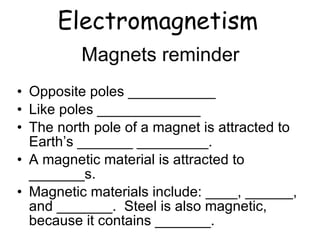
Magnets reminder Opposite poles ___________ Like poles _____________ The north pole of a magnet is attracted to Earth’s _______ _________. A magnetic material is attracted to _______s. Magnetic materials include: ____, ______, and _______.  Steel is also magnetic, because it contains _______. Electromagnetism
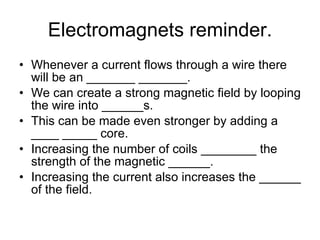
Electromagnets reminder. Whenever a current flows through a wire there will be an _______ _______. We can create a strong magnetic field by looping the wire into ______s. This can be made even stronger by adding a ____ _____ core. Increasing the number of coils ________ the strength of the magnetic ______. Increasing the current also increases the ______ of the field.
Electromagnets reminder. Whenever a current flows through a wire there will be an  electromagnetic field . We can create a strong magnetic field by looping the wire into  coil s. This can be made even stronger by adding a  soft iron  core. Increasing the number of coils  increases  the strength of the magnetic  field . Increasing the current also increases the  strength  of the field.
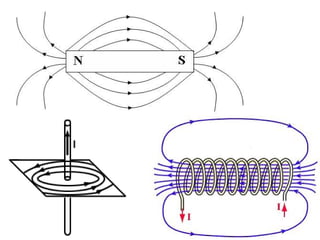
Rules for good field diagrams. Include at least 3 lines above the magnet/solenoid, and 3 below. Show three lines leaving the North Pole, and three lines arriving at the South Pole. Mark direction arrows on to every line, showing the field going from North to South. Show lines closer together where the field is strongest, and further apart where the field is weakest.
 
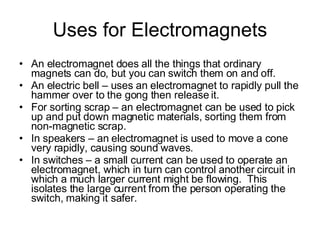
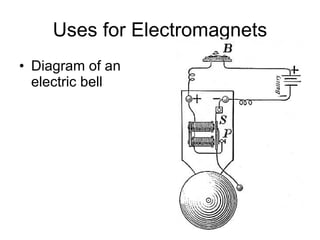
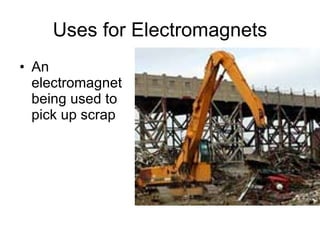
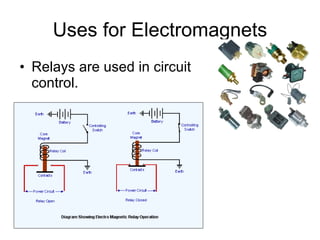
Uses for Electromagnets An electromagnet does all the things that ordinary magnets can do, but you can switch them on and off. An electric bell – uses an electromagnet to rapidly pull the hammer over to the gong then release it. For sorting scrap – an electromagnet can be used to pick up and put down magnetic materials, sorting them from non-magnetic scrap. In speakers – an electromagnet is used to move a cone very rapidly, causing sound waves. In switches – a small current can be used to operate an electromagnet, which in turn can control another circuit in which a much larger current might be flowing.  This isolates the large current from the person operating the switch, making it safer.
Uses for Electromagnets Diagram of an electric bell
Uses for Electromagnets An electromagnet being used to pick up scrap
Uses for Electromagnets Relays are used in circuit control.
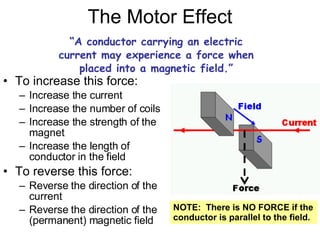
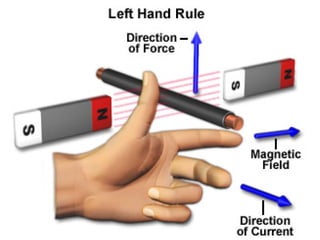
The Motor Effect To increase this force: Increase the current Increase the number of coils  Increase the strength of the magnet  Increase the length of conductor in the field To reverse this force: Reverse the direction of the current  Reverse the direction of the (permanent) magnetic field  “ A conductor carrying an electric current may experience a force when placed into a magnetic field.” NOTE:  There is NO FORCE if the conductor is parallel to the field.
 
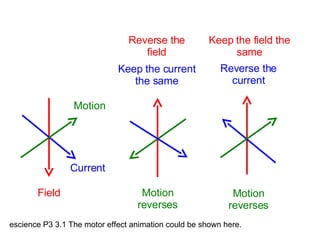
Motion escience P3 3.1 The motor effect animation could be shown here. Keep the field the same Reverse the field Field Current Motion reverses Reverse the current Motion reverses Keep the current the same
 
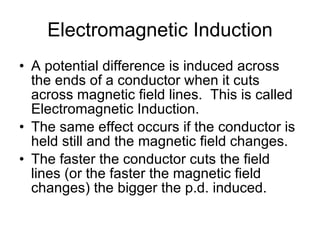
Electromagnetic Induction A potential difference is induced across the ends of a conductor when it cuts across magnetic field lines.  This is called Electromagnetic Induction. The same effect occurs if the conductor is held still and the magnetic field changes. The faster the conductor cuts the field lines (or the faster the magnetic field changes) the bigger the p.d. induced.
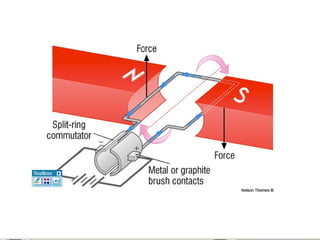
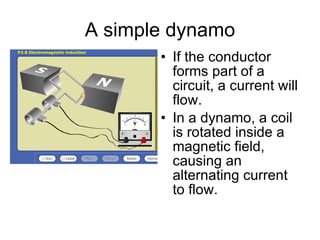
A simple dynamo If the conductor forms part of a circuit, a current will flow.  In a dynamo, a coil is rotated inside a magnetic field, causing an alternating current to flow.
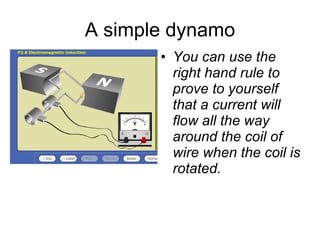
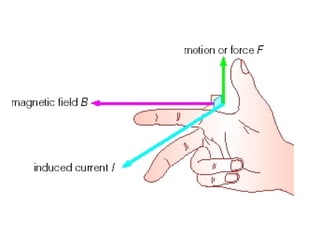
A simple dynamo You can use the right hand rule to prove to yourself that a current will flow all the way around the coil of wire when the coil is rotated.
 
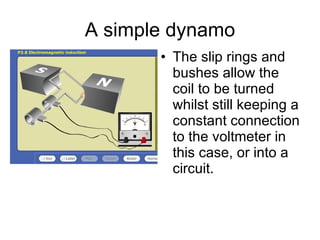
A simple dynamo The slip rings and bushes allow the coil to be turned whilst still keeping a constant connection to the voltmeter in this case, or into a circuit.
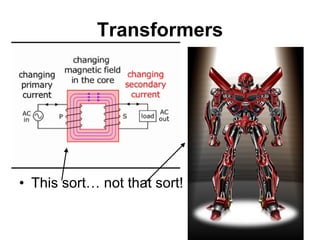
Transformers This sort… not that sort!
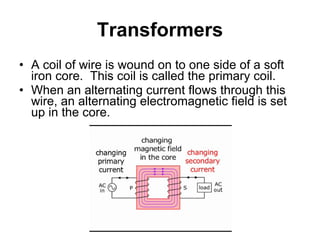
Transformers A coil of wire is wound on to one side of a soft iron core.  This coil is called the primary coil. When an alternating current flows through this wire, an alternating electromagnetic field is set up in the core.
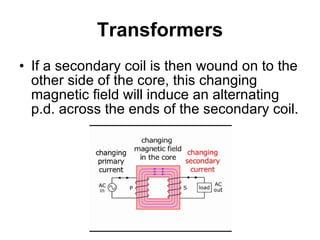
Transformers If a secondary coil is then wound on to the other side of the core, this changing magnetic field will induce an alternating p.d. across the ends of the secondary coil.
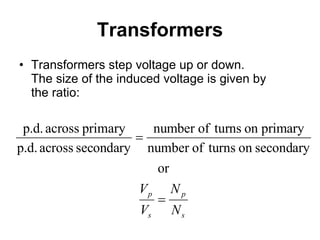
Transformers Transformers step voltage up or down.  The size of the induced voltage is given by the ratio:
Transformers and Mains supply Electricity is generated at the power station at about 33,000V. A step-up transformer steps this up to about 400,000V for transmission in overhead cables. This is then stepped down for use in homes, to 230V (or for industrial uses, to 11,000V). WHY?
Transformers and Mains supply When the p.d. is stepped up, the current is stepped down. So there is a lower current flowing through the wires. This means that less energy is lost to heat (P=I 2 R). So more of the power supply’s energy gets to the appliance, rather than being lost in the wires.

Electromagnetism

  • 1.
  • 2.
    Magnets reminder Oppositepoles ___________ Like poles _____________ The north pole of a magnet is attracted to Earth’s _______ _________. A magnetic material is attracted to _______s. Magnetic materials include: ____, ______, and _______. Steel is also magnetic, because it contains _______. Electromagnetism
  • 3.
    Electromagnets reminder. Whenevera current flows through a wire there will be an _______ _______. We can create a strong magnetic field by looping the wire into ______s. This can be made even stronger by adding a ____ _____ core. Increasing the number of coils ________ the strength of the magnetic ______. Increasing the current also increases the ______ of the field.
  • 4.
    Electromagnets reminder. Whenevera current flows through a wire there will be an electromagnetic field . We can create a strong magnetic field by looping the wire into coil s. This can be made even stronger by adding a soft iron core. Increasing the number of coils increases the strength of the magnetic field . Increasing the current also increases the strength of the field.
  • 5.
    Rules for goodfield diagrams. Include at least 3 lines above the magnet/solenoid, and 3 below. Show three lines leaving the North Pole, and three lines arriving at the South Pole. Mark direction arrows on to every line, showing the field going from North to South. Show lines closer together where the field is strongest, and further apart where the field is weakest.
  • 6.
  • 7.
    Uses for ElectromagnetsAn electromagnet does all the things that ordinary magnets can do, but you can switch them on and off. An electric bell – uses an electromagnet to rapidly pull the hammer over to the gong then release it. For sorting scrap – an electromagnet can be used to pick up and put down magnetic materials, sorting them from non-magnetic scrap. In speakers – an electromagnet is used to move a cone very rapidly, causing sound waves. In switches – a small current can be used to operate an electromagnet, which in turn can control another circuit in which a much larger current might be flowing. This isolates the large current from the person operating the switch, making it safer.
  • 8.
    Uses for ElectromagnetsDiagram of an electric bell
  • 9.
    Uses for ElectromagnetsAn electromagnet being used to pick up scrap
  • 10.
    Uses for ElectromagnetsRelays are used in circuit control.
  • 11.
    The Motor EffectTo increase this force: Increase the current Increase the number of coils Increase the strength of the magnet Increase the length of conductor in the field To reverse this force: Reverse the direction of the current Reverse the direction of the (permanent) magnetic field “ A conductor carrying an electric current may experience a force when placed into a magnetic field.” NOTE: There is NO FORCE if the conductor is parallel to the field.
  • 12.
  • 13.
    Motion escience P33.1 The motor effect animation could be shown here. Keep the field the same Reverse the field Field Current Motion reverses Reverse the current Motion reverses Keep the current the same
  • 14.
  • 15.
    Electromagnetic Induction Apotential difference is induced across the ends of a conductor when it cuts across magnetic field lines. This is called Electromagnetic Induction. The same effect occurs if the conductor is held still and the magnetic field changes. The faster the conductor cuts the field lines (or the faster the magnetic field changes) the bigger the p.d. induced.
  • 16.
    A simple dynamoIf the conductor forms part of a circuit, a current will flow. In a dynamo, a coil is rotated inside a magnetic field, causing an alternating current to flow.
  • 17.
    A simple dynamoYou can use the right hand rule to prove to yourself that a current will flow all the way around the coil of wire when the coil is rotated.
  • 18.
  • 19.
    A simple dynamoThe slip rings and bushes allow the coil to be turned whilst still keeping a constant connection to the voltmeter in this case, or into a circuit.
  • 20.
  • 21.
    Transformers A coilof wire is wound on to one side of a soft iron core. This coil is called the primary coil. When an alternating current flows through this wire, an alternating electromagnetic field is set up in the core.
  • 22.
    Transformers If asecondary coil is then wound on to the other side of the core, this changing magnetic field will induce an alternating p.d. across the ends of the secondary coil.
  • 23.
    Transformers Transformers stepvoltage up or down. The size of the induced voltage is given by the ratio:
  • 24.
    Transformers and Mainssupply Electricity is generated at the power station at about 33,000V. A step-up transformer steps this up to about 400,000V for transmission in overhead cables. This is then stepped down for use in homes, to 230V (or for industrial uses, to 11,000V). WHY?
  • 25.
    Transformers and Mainssupply When the p.d. is stepped up, the current is stepped down. So there is a lower current flowing through the wires. This means that less energy is lost to heat (P=I 2 R). So more of the power supply’s energy gets to the appliance, rather than being lost in the wires.