PREPARED BY-
KRISHN KUMAR BARMASE
ASSISTANCE PROFESSOR
DEPARTMENT OF PHARMACEUTICAL CHEMISTRY
S.D.COLLEGE OF PHARMACY,BETUL
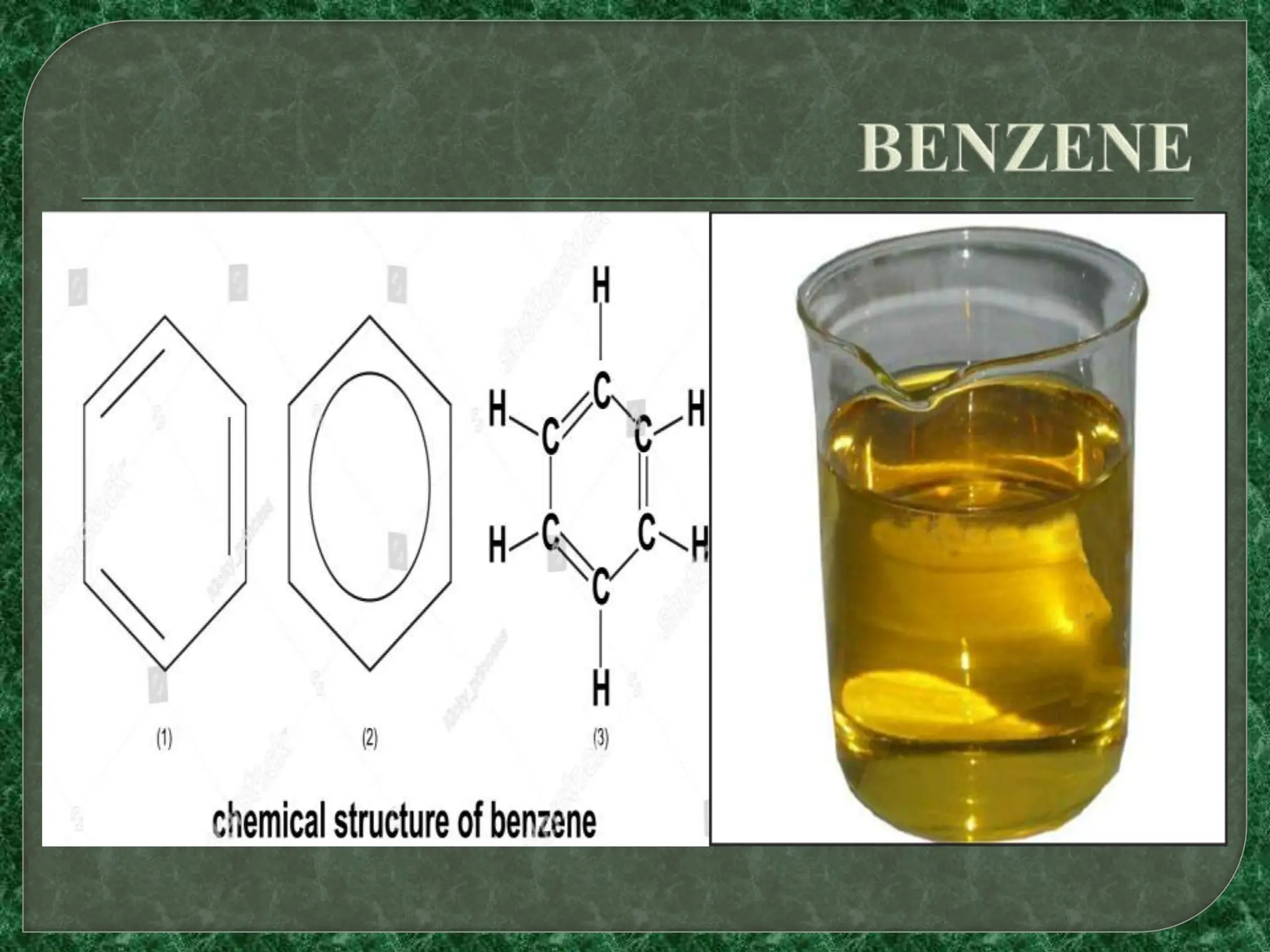
 Benzene is the simplest organic, aromatic hydrocarbon.
Benzene is a volatile, clear, colorless, and flammable
liquid aromatic hydrocarbon possessing a distinct,
characteristic odor.
 Benzene is the simplest aromatic compound, with a six
carbon ring, a hydrogen atom attached to each carbon
atom, and alternating double bonds in the ring structure
 Benzene is a naturally occurring substance produced by
volcanoes and forest fires and present in many plants
and animals, but benzene is also a major industrial
chemical made from coal and oil.
 Benzene is one of the elementary petrochemicals and a
natural constituent of crude oil.
 Benzene is highly toxic and carcinogenic in nature.
C6H6
The benzene molecule is composed of
six carbon atoms joined in a
planar ring with one hydrogen atom
attached to each. Because it contains
only carbon and hydrogen atoms,
benzene is classed as a hydrocarbon.
 The word "benzene" derives historically from
"gum benzoin", sometimes called "benjamin"
an aromatic resin known to European
pharmacists and perfumers since the 15th
century as a product of southeast Asia. •
 Michael Faraday first isolated and identified
benzene in 1825 from the oily residue derived
from the production of illuminating gas, giving
it the name bicarburet of hydrogen.
Benzol (historic/German)
IUPAC Name-
- Cyclohexa-1,3,5-triene
- 1,3,5-Cyclohexatriene
Monosubstituted derivatives of bezene-
Toluene,Cumene , Phenol, Aniline,
Benzoic acid, Benzaldehyde , styrene.
Disubstituted derivatives of benzene-
Xylene , Phthalic acid , Isophthlic acid ,
Cresol, salicylic acid
 When one of the positions on the ring has been
substituted with another atom or group of atoms,
the compound is a monosubstituted benzene.
 When two of the positions on the ring has been
substituted with another atom or group of atoms,
the compound is a Disubstituted benzene.
 the Toluene with another methyl group is called
“xylene”. Depending on the positions of the
methyl groups, we have ortho, meta, and para-
Xylenes:
MOLECULAR FORMULA
STRAIGHT-CHAIN STRUCTURE
NOT POSSIBLE
EVIDENCE OF CYCLIC
STRUCTURE
KEKULE’S STRUCTURE
RESONANCE DISCRIPTION
MOLECULAR ORBITAL
STRUCTURE
Elemental analysis and molecular weight
determination showed that benzene had
the molecular formula-
C6H6
This indicated that benzene was a
highly unsaturated compound.
Benzene constructed as a straight chain or
ring compound having double (C=C) and
or (C=C) bonds But benzene does not
behave like alkenes and alkynes.
 A) Substitution of benzene:-
Benzene reacts with bromine in the presence of FeBr3
to form monobromobenzene.
Only one monobromo and no isomeric products
obtained, becoz all hydrogens are identical.
Benzene had cyclic structure Of six carbons and to
each carbon was attach. one hydrogen.
Benzene Br2/Ccl 4 Dilute cold Kmno 4 H2O/H + No
reaction Bromobenzene
 B) Addition of Hydrogen:-
Benzene added three moles of hydrogen in
presence of nickel catalyst to give
cyclohexane.
It porved that presence of three carbon-carbon
double bonds.
German chemist Friedrich August Kekulé
von Stradonitz •
 A structure of benzene, containing 3 cyclic
conjugated double bonds which
systematically called 1,3,5-
cyclohexatriene.
 • The true structure of benzene is a
resonance hybrid of the two Lewis
structures, with the dashed lines of the
hybrid indicating the position of the π
bonds.
 the phenomenon in which two or more structures can be
written for a substance which involve identical positions of
atoms is called as resonance.
Actual structure is called as resonance hybrid.
Alternating structure is called as resonance structure.
Resonance energy:-
Resonance energy is a measure of how
much more stable a resonance hybrid
structure than extreme resonance
structures
 1.all carbons are sp2 hybridized
 2. Carbons linked together with sigma linkage
 3. Carbon and hydrogen linked by sigma linkage
 4. The bond angle present is 120° 5.
 The distance between carbon and hydrogen is 1.34A°
THE CRITERIA FOR AROMATICITY—
Four structural criteria must be satisfied for a compound to be aromatic.
Hückel’s Rule:
[1] A molecule must be cyclic. To be aromatic, each p orbital must overlap with
p orbitals on adjacent atoms.
[2] A molecule must be planar. All adjacent p orbitals must be aligned so that
the electron density can be delocalized.
[3] Each atom in an aromatic ring has a p orbital. These p orbitals must be
parallel so that a continuous overlap is possible around the ring.
[4] A molecule must satisfy Hückel’s rule, and contain a particular number of
electrons.
Benzene is aromatic and especially stable because it contains 6 electrons.
 Large scale preparation:-
From Petroleum(By Aromatisation):-
Substrate - C6-C8 fraction of
petroleum neptha
Reactant - Pt/Al2O3
Temperature - 500 C
Products - Mixture of
Benzene,Toluene and
Xylenes
Isolation - By fractional Distillation
at 81 C
 Small scale preparation:-
1. Heating Phenol with Zinc :
To make Benzene from Phenol, Phenol reacts
with Zinc dust at a higher temperature, the
phenol, is converted to a phenoxide ion and a
proton, which accepts an electron from Zn
forming an H radical. Which results in the
formation of ZnO and the phenoxide ion that
was formed, converts itself into Benzene.
2. Polymerization of Ethyne :
To produce Benzene from Ethyne (acetylene),
it has to undergo cyclic polymerization. For
this, Ethyne is made to pass through a red
hot tube at a temperature of 873K, which in
turn, converts itself into Benzene.
colourless
liquid compound in room
temperature
Melting point : 5.50C
Boiling point : 800C
There is a harsh smell
Burns with high smoke
A good solution for non-polar
substances such as I2
 Benzene is an industrial chemical which is widely used in the
production of pesticides, resins, detergents, synthetic fibers, plastics,
drugs, dyes. Benzene can be naturally produced from volcanoes and
forest fires. It evaporates rapidly from soil and water, if it leaks from
storage tanks it can lead to the contamination of water wells and
water sources situated close by.
 Benzene also has household uses too, but the extent of its use is
limited due to its toxic and carcinogenic nature. In homes, Benzene
is used in glue, adhesive, cleaning products, tobacco smoke, etc.
• It is also used to prepare phenol and aniline which is used in dyes.
• It is used to manufacture nylon fibers.
• Degreasing metals.
• One of the most important uses of benzene is to manufacture
different chemicals such as ethylbenzene, cyclohexane, cumene,
nitrobenzene, etc.
BENZENE AND ITS DERIVATIVES.pptx

BENZENE AND ITS DERIVATIVES.pptx

  • 1.
    PREPARED BY- KRISHN KUMARBARMASE ASSISTANCE PROFESSOR DEPARTMENT OF PHARMACEUTICAL CHEMISTRY S.D.COLLEGE OF PHARMACY,BETUL
  • 3.
     Benzene isthe simplest organic, aromatic hydrocarbon. Benzene is a volatile, clear, colorless, and flammable liquid aromatic hydrocarbon possessing a distinct, characteristic odor.  Benzene is the simplest aromatic compound, with a six carbon ring, a hydrogen atom attached to each carbon atom, and alternating double bonds in the ring structure  Benzene is a naturally occurring substance produced by volcanoes and forest fires and present in many plants and animals, but benzene is also a major industrial chemical made from coal and oil.  Benzene is one of the elementary petrochemicals and a natural constituent of crude oil.  Benzene is highly toxic and carcinogenic in nature.
  • 4.
    C6H6 The benzene moleculeis composed of six carbon atoms joined in a planar ring with one hydrogen atom attached to each. Because it contains only carbon and hydrogen atoms, benzene is classed as a hydrocarbon.
  • 5.
     The word"benzene" derives historically from "gum benzoin", sometimes called "benjamin" an aromatic resin known to European pharmacists and perfumers since the 15th century as a product of southeast Asia. •  Michael Faraday first isolated and identified benzene in 1825 from the oily residue derived from the production of illuminating gas, giving it the name bicarburet of hydrogen.
  • 6.
    Benzol (historic/German) IUPAC Name- -Cyclohexa-1,3,5-triene - 1,3,5-Cyclohexatriene
  • 7.
    Monosubstituted derivatives ofbezene- Toluene,Cumene , Phenol, Aniline, Benzoic acid, Benzaldehyde , styrene. Disubstituted derivatives of benzene- Xylene , Phthalic acid , Isophthlic acid , Cresol, salicylic acid
  • 8.
     When oneof the positions on the ring has been substituted with another atom or group of atoms, the compound is a monosubstituted benzene.
  • 9.
     When twoof the positions on the ring has been substituted with another atom or group of atoms, the compound is a Disubstituted benzene.  the Toluene with another methyl group is called “xylene”. Depending on the positions of the methyl groups, we have ortho, meta, and para- Xylenes:
  • 11.
    MOLECULAR FORMULA STRAIGHT-CHAIN STRUCTURE NOTPOSSIBLE EVIDENCE OF CYCLIC STRUCTURE KEKULE’S STRUCTURE RESONANCE DISCRIPTION MOLECULAR ORBITAL STRUCTURE
  • 12.
    Elemental analysis andmolecular weight determination showed that benzene had the molecular formula- C6H6 This indicated that benzene was a highly unsaturated compound.
  • 13.
    Benzene constructed asa straight chain or ring compound having double (C=C) and or (C=C) bonds But benzene does not behave like alkenes and alkynes.
  • 14.
     A) Substitutionof benzene:- Benzene reacts with bromine in the presence of FeBr3 to form monobromobenzene. Only one monobromo and no isomeric products obtained, becoz all hydrogens are identical. Benzene had cyclic structure Of six carbons and to each carbon was attach. one hydrogen. Benzene Br2/Ccl 4 Dilute cold Kmno 4 H2O/H + No reaction Bromobenzene
  • 15.
     B) Additionof Hydrogen:- Benzene added three moles of hydrogen in presence of nickel catalyst to give cyclohexane. It porved that presence of three carbon-carbon double bonds.
  • 16.
    German chemist FriedrichAugust Kekulé von Stradonitz •  A structure of benzene, containing 3 cyclic conjugated double bonds which systematically called 1,3,5- cyclohexatriene.
  • 17.
     • Thetrue structure of benzene is a resonance hybrid of the two Lewis structures, with the dashed lines of the hybrid indicating the position of the π bonds.
  • 18.
     the phenomenonin which two or more structures can be written for a substance which involve identical positions of atoms is called as resonance. Actual structure is called as resonance hybrid. Alternating structure is called as resonance structure.
  • 19.
    Resonance energy:- Resonance energyis a measure of how much more stable a resonance hybrid structure than extreme resonance structures
  • 20.
     1.all carbonsare sp2 hybridized  2. Carbons linked together with sigma linkage  3. Carbon and hydrogen linked by sigma linkage  4. The bond angle present is 120° 5.  The distance between carbon and hydrogen is 1.34A°
  • 23.
    THE CRITERIA FORAROMATICITY— Four structural criteria must be satisfied for a compound to be aromatic. Hückel’s Rule: [1] A molecule must be cyclic. To be aromatic, each p orbital must overlap with p orbitals on adjacent atoms. [2] A molecule must be planar. All adjacent p orbitals must be aligned so that the electron density can be delocalized. [3] Each atom in an aromatic ring has a p orbital. These p orbitals must be parallel so that a continuous overlap is possible around the ring. [4] A molecule must satisfy Hückel’s rule, and contain a particular number of electrons. Benzene is aromatic and especially stable because it contains 6 electrons.
  • 24.
     Large scalepreparation:- From Petroleum(By Aromatisation):- Substrate - C6-C8 fraction of petroleum neptha Reactant - Pt/Al2O3 Temperature - 500 C Products - Mixture of Benzene,Toluene and Xylenes Isolation - By fractional Distillation at 81 C
  • 26.
     Small scalepreparation:- 1. Heating Phenol with Zinc : To make Benzene from Phenol, Phenol reacts with Zinc dust at a higher temperature, the phenol, is converted to a phenoxide ion and a proton, which accepts an electron from Zn forming an H radical. Which results in the formation of ZnO and the phenoxide ion that was formed, converts itself into Benzene.
  • 27.
    2. Polymerization ofEthyne : To produce Benzene from Ethyne (acetylene), it has to undergo cyclic polymerization. For this, Ethyne is made to pass through a red hot tube at a temperature of 873K, which in turn, converts itself into Benzene.
  • 28.
    colourless liquid compound inroom temperature Melting point : 5.50C Boiling point : 800C There is a harsh smell Burns with high smoke A good solution for non-polar substances such as I2
  • 30.
     Benzene isan industrial chemical which is widely used in the production of pesticides, resins, detergents, synthetic fibers, plastics, drugs, dyes. Benzene can be naturally produced from volcanoes and forest fires. It evaporates rapidly from soil and water, if it leaks from storage tanks it can lead to the contamination of water wells and water sources situated close by.  Benzene also has household uses too, but the extent of its use is limited due to its toxic and carcinogenic nature. In homes, Benzene is used in glue, adhesive, cleaning products, tobacco smoke, etc. • It is also used to prepare phenol and aniline which is used in dyes. • It is used to manufacture nylon fibers. • Degreasing metals. • One of the most important uses of benzene is to manufacture different chemicals such as ethylbenzene, cyclohexane, cumene, nitrobenzene, etc.