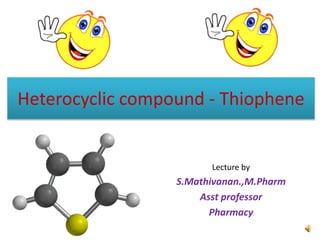
Heterocyclic compound - Thiophene
Lecture by
S.Mathivanan.,M.Pharm
Asst professor
Pharmacy
History of Thiophene
•Viktor Meyer was a German chemist and significant contributor to
both organic and inorganic chemistry. He is best known for inventing
an apparatus for determining vapour densities, the Viktor Meyer
apparatus, and for discovering thiophene, a heterocyclic compound.
•In 1882 Victor Meyer discovered thiophene as contaminant in benzene.
•It was observed that isatin (an indole) forms a blue dye if it is mixed
with sulfuric acid and crude benzene. The formation of the blue
indophenin had long been believed to be a reaction of benzene itself.
Viktor Meyer was able to isolate thiophene as the actual substance responsible for this
reaction.
Thiophene
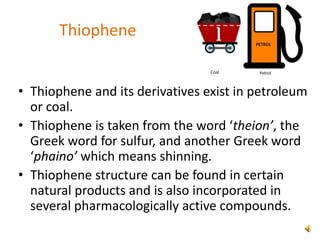
• Thiophene and its derivatives exist in petroleum
or coal.
• Thiophene is taken from the word ‘theion’, the
Greek word for sulfur, and another Greek word
‘phaino’ which means shinning.
• Thiophene structure can be found in certain
natural products and is also incorporated in
several pharmacologically active compounds.
Properties of Thiophene
• At room temperature, thiophene is a toxic,
flammable and colourless liquid with a mildly
pleasant odor reminiscent of benzene.
• The molecular mass of thiophene is 84.14 16
g/mol, density is 1.051 g/ml and Melting Point is
-38 °C.
• It is insoluble in water but soluble in most of the
organic solvents including alcohol and ether.
• The "electron pairs" on sulfur are significantly
delocalized in the π electron system, due to this it
behaves extremely reactive benzene derivative.
BIOISOSTERISM (Benzene vs Thiophene)
• Like benzene, thiophene forms an azeotrope with
ethanol.
• The similarity between the physicochemical
properties of benzene and thiophene is striking.
• For example, the boiling point of benzene is
81.1 ˚ C and that of thiophene is 84.4 ˚ C (at
760mm Hg) and therefore, thiophene and
benzene is a well known example of
bioisosterism.
• It can be easily sulfonated, nitrated, halogenated,
acylated, but cannot be alkylated and oxidized.
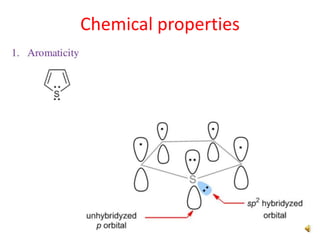
Chemical properties
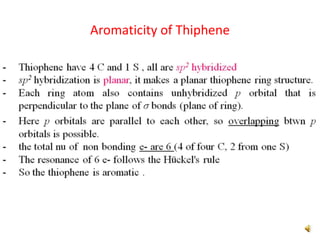
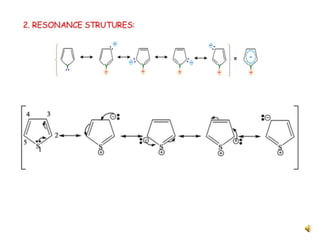
Aromaticity of Thiphene
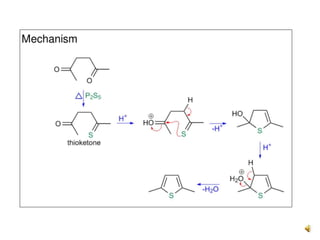
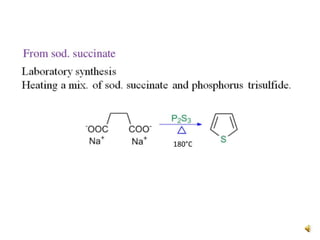
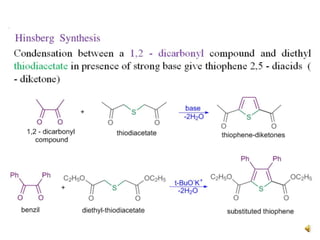
Synthesis of Thiophene
Acetonyl acetone 2,5-Dimethyl thiophene
180°C
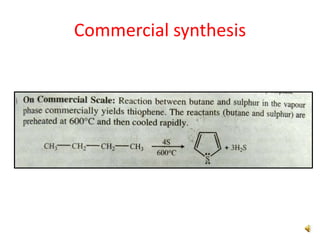
Commercial synthesis
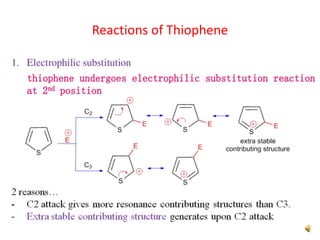
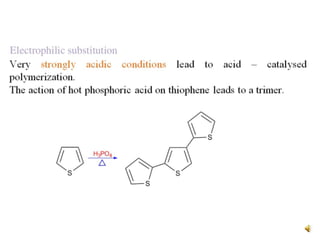
Reactions of Thiophene
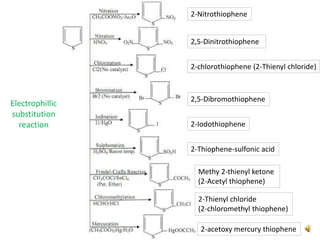
Electrophillic
substitution
reaction
2-Nitrothiophene
2,5-Dinitrothiophene
2-chlorothiophene (2-Thienyl chloride)
2,5-Dibromothiophene
2-Iodothiophene
2-Thiophene-sulfonic acid
Methy 2-thienyl ketone
(2-Acetyl thiophene)
2-Thienyl chloride
(2-chloromethyl thiophene)
2-acetoxy mercury thiophene
Reduction
[O]
Tetramethylene
sulphone
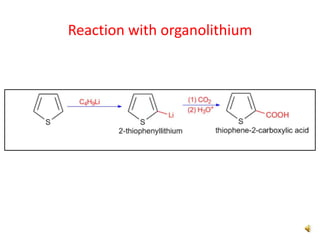
Reaction with organolithium
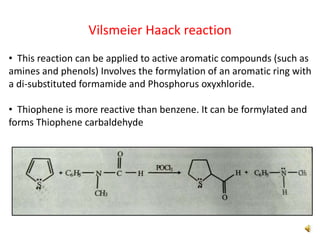
Vilsmeier Haack reaction
• This reaction can be applied to active aromatic compounds (such as
amines and phenols) Involves the formylation of an aromatic ring with
a di-substituted formamide and Phosphorus oxyxhloride.
• Thiophene is more reactive than benzene. It can be formylated and
forms Thiophene carbaldehyde
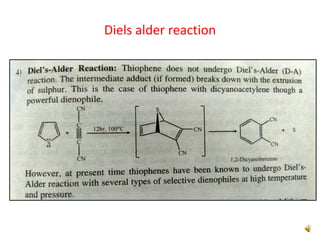
Diels alder reaction
Medicinal value of Thiophene
• Thiophene with its 6π electrons aromaticity and
sterically similar to benzene derivatives may well
exhibits similar activities (Bioisosterism).
• At the same time presence of heteroatom in
thiophene may alter its metabolic fate, thus
thiophene derivatives may have less toxic effects
and/or better therapeutic profile.
• Thiophene is used in two principal ways.
• The most interesting chemically is the use of
thiophene either as central rings or as a part of
fused ring system
Medicinal importance of Thiophene
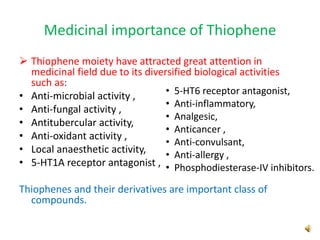
 Thiophene moiety have attracted great attention in
medicinal field due to its diversified biological activities
such as:
• Anti-microbial activity ,
• Anti-fungal activity ,
• Antitubercular activity,
• Anti-oxidant activity ,
• Local anaesthetic activity,
• 5-HT1A receptor antagonist ,
Thiophenes and their derivatives are important class of
compounds.
• 5-HT6 receptor antagonist,
• Anti-inflammatory,
• Analgesic,
• Anticancer ,
• Anti-convulsant,
• Anti-allergy ,
• Phosphodiesterase-IV inhibitors.
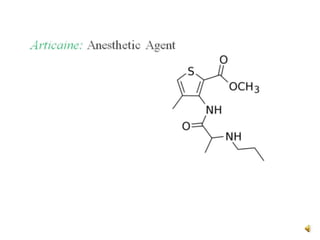
Medicinal uses of some Thiophene derivatives
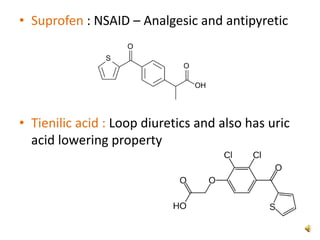
• Suprofen : NSAID – Analgesic and antipyretic
• Tienilic acid : Loop diuretics and also has uric
acid lowering property
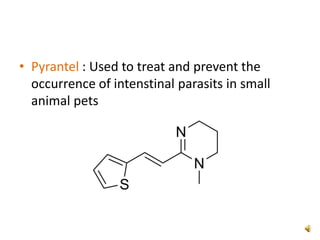
• Pyrantel : Used to treat and prevent the
occurrence of intenstinal parasits in small
animal pets
Thank you..Ellarum safe ah irunga..Byee.!!

Heterocycic compound Thiophene

  • 1.
    Heterocyclic compound -Thiophene Lecture by S.Mathivanan.,M.Pharm Asst professor Pharmacy
  • 2.
    History of Thiophene •ViktorMeyer was a German chemist and significant contributor to both organic and inorganic chemistry. He is best known for inventing an apparatus for determining vapour densities, the Viktor Meyer apparatus, and for discovering thiophene, a heterocyclic compound. •In 1882 Victor Meyer discovered thiophene as contaminant in benzene. •It was observed that isatin (an indole) forms a blue dye if it is mixed with sulfuric acid and crude benzene. The formation of the blue indophenin had long been believed to be a reaction of benzene itself. Viktor Meyer was able to isolate thiophene as the actual substance responsible for this reaction.
  • 5.
    Thiophene • Thiophene andits derivatives exist in petroleum or coal. • Thiophene is taken from the word ‘theion’, the Greek word for sulfur, and another Greek word ‘phaino’ which means shinning. • Thiophene structure can be found in certain natural products and is also incorporated in several pharmacologically active compounds.
  • 6.
    Properties of Thiophene •At room temperature, thiophene is a toxic, flammable and colourless liquid with a mildly pleasant odor reminiscent of benzene. • The molecular mass of thiophene is 84.14 16 g/mol, density is 1.051 g/ml and Melting Point is -38 °C. • It is insoluble in water but soluble in most of the organic solvents including alcohol and ether. • The "electron pairs" on sulfur are significantly delocalized in the π electron system, due to this it behaves extremely reactive benzene derivative.
  • 7.
    BIOISOSTERISM (Benzene vsThiophene) • Like benzene, thiophene forms an azeotrope with ethanol. • The similarity between the physicochemical properties of benzene and thiophene is striking. • For example, the boiling point of benzene is 81.1 ˚ C and that of thiophene is 84.4 ˚ C (at 760mm Hg) and therefore, thiophene and benzene is a well known example of bioisosterism. • It can be easily sulfonated, nitrated, halogenated, acylated, but cannot be alkylated and oxidized.
  • 8.
  • 9.
  • 12.
    Synthesis of Thiophene Acetonylacetone 2,5-Dimethyl thiophene
  • 14.
  • 16.
  • 17.
  • 19.
    Electrophillic substitution reaction 2-Nitrothiophene 2,5-Dinitrothiophene 2-chlorothiophene (2-Thienyl chloride) 2,5-Dibromothiophene 2-Iodothiophene 2-Thiophene-sulfonicacid Methy 2-thienyl ketone (2-Acetyl thiophene) 2-Thienyl chloride (2-chloromethyl thiophene) 2-acetoxy mercury thiophene
  • 20.
  • 21.
  • 22.
    Vilsmeier Haack reaction •This reaction can be applied to active aromatic compounds (such as amines and phenols) Involves the formylation of an aromatic ring with a di-substituted formamide and Phosphorus oxyxhloride. • Thiophene is more reactive than benzene. It can be formylated and forms Thiophene carbaldehyde
  • 23.
  • 24.
    Medicinal value ofThiophene • Thiophene with its 6π electrons aromaticity and sterically similar to benzene derivatives may well exhibits similar activities (Bioisosterism). • At the same time presence of heteroatom in thiophene may alter its metabolic fate, thus thiophene derivatives may have less toxic effects and/or better therapeutic profile. • Thiophene is used in two principal ways. • The most interesting chemically is the use of thiophene either as central rings or as a part of fused ring system
  • 25.
    Medicinal importance ofThiophene  Thiophene moiety have attracted great attention in medicinal field due to its diversified biological activities such as: • Anti-microbial activity , • Anti-fungal activity , • Antitubercular activity, • Anti-oxidant activity , • Local anaesthetic activity, • 5-HT1A receptor antagonist , Thiophenes and their derivatives are important class of compounds. • 5-HT6 receptor antagonist, • Anti-inflammatory, • Analgesic, • Anticancer , • Anti-convulsant, • Anti-allergy , • Phosphodiesterase-IV inhibitors.
  • 26.
    Medicinal uses ofsome Thiophene derivatives
  • 28.
    • Suprofen :NSAID – Analgesic and antipyretic • Tienilic acid : Loop diuretics and also has uric acid lowering property
  • 29.
    • Pyrantel :Used to treat and prevent the occurrence of intenstinal parasits in small animal pets
  • 30.
    Thank you..Ellarum safeah irunga..Byee.!!