INVASIVE ALIEN SPECIES(IAS):
     A THREAT TO THE
    BIODIVERSITY AND
      ENVIRONMENT


             BY
        Surendra Bam
Outline
 Introduction
 Conditions that lead to invasion

                   -> Species-based
  mechanisms
                -> Ecosystem-based
  mechanisms
 Pathway of Introduction

 Impacts

 Control and management
Introduction
 An Invasive species is an
  organism      that     is  not
  indigenous/native       to  its
  environment.
 Invasive  species can be a
  plant, animal or insect.
 Different words are used to

  describe species occurring in
Introduction
        contd..
According    to   the   Global
 Invasive   Species   Program
 (GISP):
 “Invasive alien species (IAS)
 are non-native organisms that
 cause, or have the potential
 to cause, harm to the
 environment, economies, or
   Invasion is considered as the
    second most important threat to
    biodiversity   after All Species
                                habitat
    destruction.


                                  Marine Species


   Invasive species are so much important in
the present scenario that, article 8(h) of the
Biodiversity Convention asks for measures ‘‘to
prevent the introduction, control or even
Conditions that
Two lead to that when combined
     mechanisms, invasion
  establish invasiveness in a newly
  introduced species;
1. Species-based mechanisms
 Invasive species appear to have specific

  traits that allow them to outcompete
  native species.
 Common invasive species traits include:

    -Fast growth, for e.g.Mile-a-minute
    weed (Mikania micarantha),i) a fast
                                  Mikania
- Rapid reproduction
 - High dispersal ability
 - Phenotypic plasticity
   (the ability to alter growth
                                ii) Barbed
    form to suit current conditions)
                     goatgrass

     -Tolerance of a wide range of
 environmental             conditions         (
 Ecological competence),           For     e.g.
 Barbed         goatgrass            (Aegilops
 triuncialis) introduced to California
 on serpentine soils (low water-
- They are usually generalist.
  - Association with humans
  - Prior successful invasions
  - Ecological facilitation Lantana
                          iii)
                               like
    alleopathy mechanism. For e.g.
  Lantana (Lantana camara).
2.                Ecosystem-based
  mechanisms
 describe a situation in which the
-   changes such as a forest fire.
    For            e.g. Bromus tectorum,
    highly fire-adapted. It not only
    spreads rapidly after burning
    but        also      increases              the
    frequency and intensity of
    fires,       by     providing             large
    amounts of dry detritus.
        iv) Bromus          v) Water hyacinth
- Habitat
        fragmentation and
 Edge effect, brings change in
 species composition with
 invasion of exotic species.


                   vi) woodthrush nest
                     parasitized by cowbird
Pathway of
      Introduction
    Non-native species have many
    vectors,     including          many
    biogenic ones, but most
    species considered "invasive"
    are associated with human
    activity.
                         vii) zebra mussel
    - Ballast water taken up at sea
        and released in port is a
    major
-   Plants or seeds imported for
  horticulture.
- The pet trade moves animals
  across borders, where they can
  escape and become invasive.
- Chinese mitten crab,
   introduced        viii) Chinese mitten crab

   in foreign water for
   economic purpose.
Impacts
1. Ecological
 Disturbed habitats are prone to
  invasions that can have adverse
  effects on
    local ecosystems, changing
    ecosystem functions.
 In the Waterberg region of South

  Africa, cattle grazing over the past
  six centuries has allowed invasive
  scrub and small trees to displace
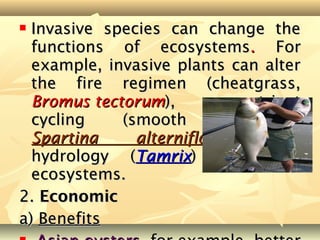
 Invasive species can change the
  functions of ecosystems. For
  example, invasive plants can alter
  the fire regimen (cheatgrass,
  Bromus tectorum),           nutrient
  cycling    (smooth       cordgrass
  Spartina     alterniflora),     and
  hydrology (Tamrix) in native
  ecosystems.
2. Economic
a) Benefits
 Vegetative invasives such as
  water hyacinth can be turned
  into fuel by methane digesters.
b) Cost
 Estimated damage and control

  cost of invasive species in the
  U.S. alone amount to more than
  $138 billion annually.
 If    monetary    values   were
  assigned to the extinction of
3. Agriculture
 Many introduced weeds in

   agriculture field compete
   with native crops.
                        ix) Mikania on banana plants
 A decline in pollinator services and

  loss of fruit production has been
  caused
   by honey bees infected by
   the invasive varroa mite. mite
                            x) Varroa

 Introduced rats (Rattus rattus and
4. Forestry
 The unintentional introduction of
  forest pest species and plant
  pathogens can change                   forest
  ecology.
    For e.g. Mikania micarantha
                        xi) Mikania covering trees
    (Lahare banmara).
5. Health
 Introduced    birds (e.g. pigeons),
  rodents and insects (e.g. mosquito,
6. Biodiversity
 Biotic invasion is considered one of

  the five top drivers for global
  biodiversity loss and is increasing
  because       of     tourism    and
  globalization.

     xii) Invasive plant in Rhino   xiii) American alligator attacking
     habitat                        a Burmese python in florida.


   Invasive species may drive local
Control and
            management

  xiv) Harvesting vehicles   xv) Root talon   xvi) weed wrench

1. Physical (Mechanical) control
- It involves directly removing the
   species   by    hand   or    with
   appropriate machines.
 - such as harvesting vehicles (e.g.,
2. Chemical control
- Involves the use of
 herbicides, insecticides, and
 rodenticides that primarily
 affect the target species.
3. Biological control
- Intentional use of populations of
  natural enemies of the target
  invasive alien species.
 For e.g. Mikania is an excellent

  example where this new generation
  of classical biological control
  agents, namely fungal pathogens
  are used to control it.
4. Integrated pest management
  (IPM) and Habitat management
-       Habitat     management
    involves measures such as
    prescribed burning, grazing
    and other activities.

- Therefore, given the high
 complexity of the ecology
 of invasive species and
 habitats affected, control
Conclusion
 Invasive Alien Species (IAS) are the
  second greatest threat to biological
  diversity globally and the highest
  threat on many island ecosystems.
 The adverse environmental impacts

  such as alteration of habitat and
  species composition have been
  experienced due to some alien
  species.
 The control and management of
References
   Drake, J. A., Mooney, H. A., Di Castri,
    F., Groves, R.H., Kruger, F. J.,
    Rejmanek, M. and Williamson, M.
    1989. Biological invasion: A global
    perspective.    Scope     37.    Wiley,
    Chichester, London, England.
   Mooney, H.A. and Hobbs, R.J. 2000.
    Invasive species in a changing world.
    Island (press,Washington, D.C.)
   Tiwari, S., Adhikari, B., Siwakoti, M.
    and Subedi, K. 2005. An inventory
Invasive alien species

Invasive alien species

  • 1.
    INVASIVE ALIEN SPECIES(IAS): A THREAT TO THE BIODIVERSITY AND ENVIRONMENT BY Surendra Bam
  • 2.
    Outline  Introduction  Conditionsthat lead to invasion -> Species-based mechanisms -> Ecosystem-based mechanisms  Pathway of Introduction  Impacts  Control and management
  • 3.
    Introduction  An Invasivespecies is an organism that is not indigenous/native to its environment.  Invasive species can be a plant, animal or insect.  Different words are used to describe species occurring in
  • 4.
    Introduction contd.. According to the Global Invasive Species Program (GISP): “Invasive alien species (IAS) are non-native organisms that cause, or have the potential to cause, harm to the environment, economies, or
  • 5.
    Invasion is considered as the second most important threat to biodiversity after All Species habitat destruction. Marine Species Invasive species are so much important in the present scenario that, article 8(h) of the Biodiversity Convention asks for measures ‘‘to prevent the introduction, control or even
  • 6.
    Conditions that Two leadto that when combined mechanisms, invasion establish invasiveness in a newly introduced species; 1. Species-based mechanisms  Invasive species appear to have specific traits that allow them to outcompete native species.  Common invasive species traits include: -Fast growth, for e.g.Mile-a-minute weed (Mikania micarantha),i) a fast Mikania
  • 7.
    - Rapid reproduction - High dispersal ability - Phenotypic plasticity (the ability to alter growth ii) Barbed form to suit current conditions) goatgrass -Tolerance of a wide range of environmental conditions ( Ecological competence), For e.g. Barbed goatgrass (Aegilops triuncialis) introduced to California on serpentine soils (low water-
  • 8.
    - They areusually generalist. - Association with humans - Prior successful invasions - Ecological facilitation Lantana iii) like alleopathy mechanism. For e.g. Lantana (Lantana camara). 2. Ecosystem-based mechanisms  describe a situation in which the
  • 9.
    - changes such as a forest fire. For e.g. Bromus tectorum, highly fire-adapted. It not only spreads rapidly after burning but also increases the frequency and intensity of fires, by providing large amounts of dry detritus. iv) Bromus v) Water hyacinth
  • 10.
    - Habitat fragmentation and Edge effect, brings change in species composition with invasion of exotic species. vi) woodthrush nest parasitized by cowbird
  • 11.
    Pathway of  Introduction Non-native species have many vectors, including many biogenic ones, but most species considered "invasive" are associated with human activity. vii) zebra mussel - Ballast water taken up at sea and released in port is a major
  • 12.
    - Plants or seeds imported for horticulture. - The pet trade moves animals across borders, where they can escape and become invasive. - Chinese mitten crab, introduced viii) Chinese mitten crab in foreign water for economic purpose.
  • 13.
    Impacts 1. Ecological  Disturbedhabitats are prone to invasions that can have adverse effects on local ecosystems, changing ecosystem functions.  In the Waterberg region of South Africa, cattle grazing over the past six centuries has allowed invasive scrub and small trees to displace
  • 16.
     Invasive speciescan change the functions of ecosystems. For example, invasive plants can alter the fire regimen (cheatgrass, Bromus tectorum), nutrient cycling (smooth cordgrass Spartina alterniflora), and hydrology (Tamrix) in native ecosystems. 2. Economic a) Benefits
  • 17.
     Vegetative invasivessuch as water hyacinth can be turned into fuel by methane digesters. b) Cost  Estimated damage and control cost of invasive species in the U.S. alone amount to more than $138 billion annually.  If monetary values were assigned to the extinction of
  • 18.
    3. Agriculture  Manyintroduced weeds in agriculture field compete with native crops. ix) Mikania on banana plants  A decline in pollinator services and loss of fruit production has been caused by honey bees infected by the invasive varroa mite. mite x) Varroa  Introduced rats (Rattus rattus and
  • 19.
    4. Forestry  Theunintentional introduction of forest pest species and plant pathogens can change forest ecology. For e.g. Mikania micarantha xi) Mikania covering trees (Lahare banmara). 5. Health  Introduced birds (e.g. pigeons), rodents and insects (e.g. mosquito,
  • 20.
    6. Biodiversity  Bioticinvasion is considered one of the five top drivers for global biodiversity loss and is increasing because of tourism and globalization. xii) Invasive plant in Rhino xiii) American alligator attacking habitat a Burmese python in florida.  Invasive species may drive local
  • 21.
    Control and management xiv) Harvesting vehicles xv) Root talon xvi) weed wrench 1. Physical (Mechanical) control - It involves directly removing the species by hand or with appropriate machines. - such as harvesting vehicles (e.g.,
  • 22.
    2. Chemical control -Involves the use of herbicides, insecticides, and rodenticides that primarily affect the target species.
  • 23.
    3. Biological control -Intentional use of populations of natural enemies of the target invasive alien species.  For e.g. Mikania is an excellent example where this new generation of classical biological control agents, namely fungal pathogens are used to control it. 4. Integrated pest management (IPM) and Habitat management
  • 24.
    - Habitat management involves measures such as prescribed burning, grazing and other activities. - Therefore, given the high complexity of the ecology of invasive species and habitats affected, control
  • 25.
    Conclusion  Invasive AlienSpecies (IAS) are the second greatest threat to biological diversity globally and the highest threat on many island ecosystems.  The adverse environmental impacts such as alteration of habitat and species composition have been experienced due to some alien species.  The control and management of
  • 27.
    References  Drake, J. A., Mooney, H. A., Di Castri, F., Groves, R.H., Kruger, F. J., Rejmanek, M. and Williamson, M. 1989. Biological invasion: A global perspective. Scope 37. Wiley, Chichester, London, England.  Mooney, H.A. and Hobbs, R.J. 2000. Invasive species in a changing world. Island (press,Washington, D.C.)  Tiwari, S., Adhikari, B., Siwakoti, M. and Subedi, K. 2005. An inventory