Presented by;
Surendra Bam
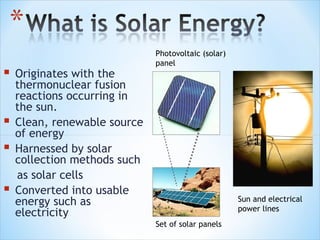
   What is solar energy?
   Putting solar energy in use
      - Solar Heating Systems
      - Power towers
      - Parabolic Dishes and Troughs
      - Photovoltaic cells (solar cells)
      - Solar Ponds
   “Solar Tuki” – a clean alternative
      to “wicked” kerosene lamp (case study)
   Advantages and Disadvantages of solar energy
   Conclusion
Photovoltaic (solar)
                              panel
   Originates with the
    thermonuclear fusion
    reactions occurring in
    the sun.
   Clean, renewable source
    of energy
   Harnessed by solar
    collection methods such
    as solar cells
   Converted into usable
    energy such as                                   Sun and electrical
                                                     power lines
    electricity
                              Set of solar panels
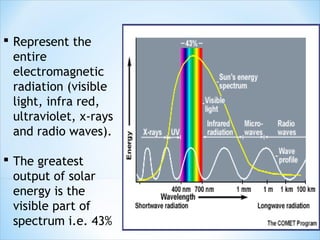
 Represent the
  entire
  electromagnetic
  radiation (visible
  light, infra red,
  ultraviolet, x-rays
  and radio waves).

 The greatest
  output of solar
  energy is the
  visible part of
  spectrum i.e. 43%
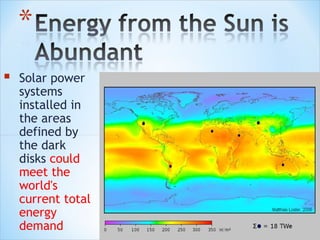
   Solar power
    systems
    installed in
    the areas
    defined by
    the dark
    disks could
    meet the
    world's
    current total
    energy
    demand
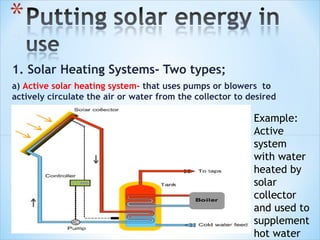
1. Solar Heating Systems- Two types;
a) Active solar heating system- that uses pumps or blowers to
actively circulate the air or water from the collector to desired
location.
                                                           Example:
                                                           Active
                                                           system
                                                           with water
                                                           heated by
                                                           solar
                                                           collector
                                                           and used to
                                                           supplement
                                                           hot water
Solar water heating system:
Efficiency of solar heating system is always less than
100% because;
  a) % transmitted depends on angle of incidence,
  b) number of glass sheets (single glass sheet transmits 90-
     95%)
  c) composition of the glass
Solar water heating saves approx. 1000 megawatts of
energy a yr., equivalent to eliminating the emissions
from two medium sized coal burning power plant.
By using solar water heating over gas water heater, a
family will save 1200 pounds of pollution each year.
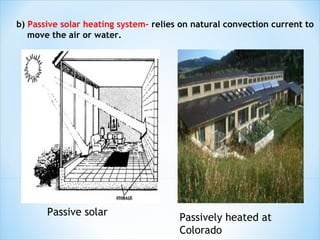
b) Passive solar heating system- relies on natural convection current to
   move the air or water.


       Passive solar
                                       Passively heated at
                                       Colorado
Heating living spaces:
Best design of a building is for it to act as a solar collector
and storage unit. This is achieved through three elements:
insulation, collection, and storage.

Efficient heating starts with proper insulation on external
walls, roof, and the floors. The doors, windows, and vents
must be designed to minimize heat loss.

Collection: south-facing windows and appropriate
landscaping.

Storage: Thermal mass—holds heat.
      a) Water= 62 BTU per cubic foot per degree F.
      b) Iron=54, Wood (oak) =29, Brick=25, concrete=22,
         and loose stone = 20.
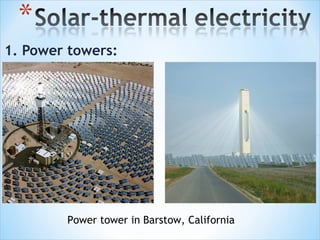
1. Power towers:


        Power tower in Barstow, California
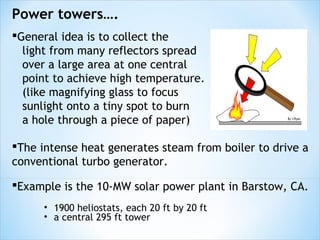
Power towers….
General idea is to collect the
  light from many reflectors spread
  over a large area at one central
  point to achieve high temperature.
  (like magnifying glass to focus
  sunlight onto a tiny spot to burn
  a hole through a piece of paper)

The intense heat generates steam from boiler to drive a
conventional turbo generator.

Example is the 10-MW solar power plant in Barstow, CA.
      • 1900 heliostats, each 20 ft by 20 ft
      • a central 295 ft tower
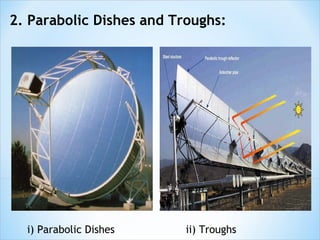
2. Parabolic Dishes and Troughs:


  i) Parabolic Dishes     ii) Troughs
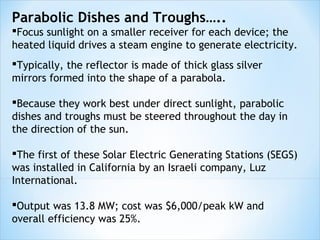
Parabolic Dishes and Troughs…..
Focus sunlight on a smaller receiver for each device; the
heated liquid drives a steam engine to generate electricity.
Typically, the reflector is made of thick glass silver
mirrors formed into the shape of a parabola.

Because they work best under direct sunlight, parabolic
dishes and troughs must be steered throughout the day in
the direction of the sun.

The first of these Solar Electric Generating Stations (SEGS)
was installed in California by an Israeli company, Luz
International.

Output was 13.8 MW; cost was $6,000/peak kW and
overall efficiency was 25%.
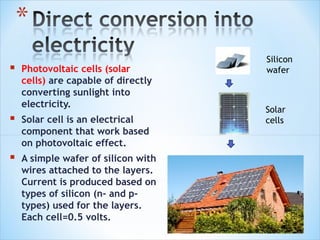
Silicon
   Photovoltaic cells (solar        wafer
    cells) are capable of directly
    converting sunlight into
    electricity.
                                     Solar
   Solar cell is an electrical      cells
    component that work based
    on photovoltaic effect.
   A simple wafer of silicon with
    wires attached to the layers.
    Current is produced based on
    types of silicon (n- and p-
    types) used for the layers.
    Each cell=0.5 volts.
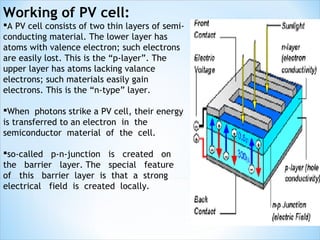
Working of PV cell:
A PV cell consists of two thin layers of semi-
conducting material. The lower layer has
atoms with valence electron; such electrons
are easily lost. This is the “p-layer”. The
upper layer has atoms lacking valance
electrons; such materials easily gain
electrons. This is the “n-type” layer.

When photons strike a PV cell, their energy
is transferred to an electron in the
semiconductor material of the cell.

so-called p-n-junction is created on
the barrier layer. The special feature
of this barrier layer is that a strong
electrical field is created locally.
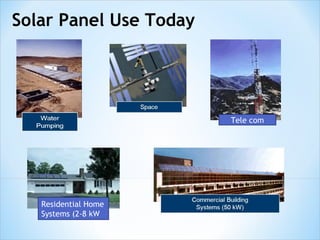
Solar Panel Use Today


                        Tele com


   Residential Home
   Systems (2-8 kW
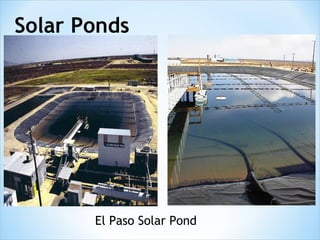
Solar Ponds


       El Paso Solar Pond
Solar ponds…….
One way to tap solar energy is through the use of
solar ponds. Solar ponds are large-scale energy
collectors with integral heat storage for supplying
thermal energy. It can be use for various
applications, such as process heating, water
desalination, refrigeration, drying and power
generation.

The 6000-square-metre solar pond in Bhuj, the first
large-scale pond in industrial environment to cater to
actual user demand, supplied totally about 15 million
litres of hot water to the dairy at an average
temperature of 75°C between September 1993 and
April 1995.
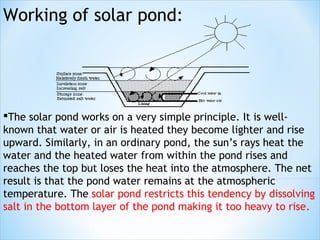
Working of solar pond:


The solar pond works on a very simple principle. It is well-
known that water or air is heated they become lighter and rise
upward. Similarly, in an ordinary pond, the sun’s rays heat the
water and the heated water from within the pond rises and
reaches the top but loses the heat into the atmosphere. The net
result is that the pond water remains at the atmospheric
temperature. The solar pond restricts this tendency by dissolving
salt in the bottom layer of the pond making it too heavy to rise.
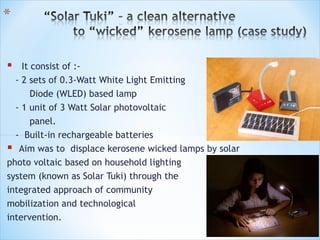
 It consist of :-
  - 2 sets of 0.3-Watt White Light Emitting
      Diode (WLED) based lamp
  - 1 unit of 3 Watt Solar photovoltaic
      panel.
  - Built-in rechargeable batteries
 Aim was to displace kerosene wicked lamps by solar
photo voltaic based on household lighting
system (known as Solar Tuki) through the
integrated approach of community
mobilization and technological
intervention.
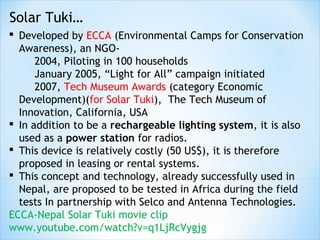
Solar Tuki…
 Developed by ECCA (Environmental Camps for Conservation
  Awareness), an NGO-
      2004, Piloting in 100 households
      January 2005, “Light for All” campaign initiated
      2007, Tech Museum Awards (category Economic
  Development)(for Solar Tuki), The Tech Museum of
  Innovation, California, USA
 In addition to be a rechargeable lighting system, it is also
  used as a power station for radios.
 This device is relatively costly (50 US$), it is therefore
  proposed in leasing or rental systems.
 This concept and technology, already successfully used in
  Nepal, are proposed to be tested in Africa during the field
  tests In partnership with Selco and Antenna Technologies.
ECCA-Nepal Solar Tuki movie clip
www.youtube.com/watch?v=q1LjRcVygjg
1.Saves you money
a) After the initial investment has been recovered, the energy from the sun
 is practically free.
b) Solar energy does not require any fuel. It's not affected by the supply
and demand of fuel and is therefore not subjected to the ever-increasing
price of gasoline.
c) The savings are immediate and for many years to come.
d) The use of solar energy    indirectly reduces health costs.

2. Environmentally friendly

a) Solar Energy is clean, renewable (unlike gas, oil and coal) and
sustainable, helping to protect our environment
b) It does not pollute our air by releasing carbon dioxide, nitrogen oxide,
sulphur dioxide or mercury into the atmosphere like many traditional forms
of electrical generations does
c) Therefore Solar Energy does not contribute to global warming, acid
rain or smog.
d) By not using any fuel, Solar Energy does not contribute to the cost
and problems of the recovery and transportation of fuel or the
storage of radioactive waste

3. Independent/ semi-independent
a) A Solar Energy system can operate entirely independent, not requiring a
connection to a power or gas grid at all. Systems can therefore be
installed in remote locations (like holiday log cabins), making it more
practical and cost-effective than the supply of utility electricity to a new
site.

4. Low/ no maintenance
a) Solar Energy systems are virtually maintenance free and will last for
decades.
b) Once installed, there are no recurring costs
c) They operate silently, have no moving parts, do not release offensive
smells and do not require you to add any fuel
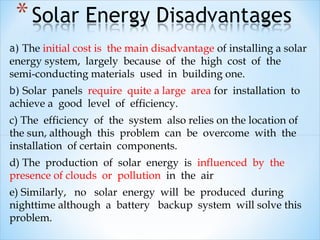
a) The initial cost is the main disadvantage of installing a solar
energy system, largely because of the high cost of the
semi-conducting materials used in building one.
b) Solar panels require quite a large area for installation to
achieve a good level of efficiency.
c) The efficiency of the system also relies on the location of
the sun, although this problem can be overcome with the
installation of certain components.
d) The production of solar energy is influenced by the
presence of clouds or pollution in the air
e) Similarly, no solar energy will be produced during
nighttime although a battery backup system will solve this
problem.
   Argument that sun provides power only during the
    day is countered by the fact that 70% of energy
    demand is during daytime hours. At night,
    traditional methods can be used to generate the
    electricity.
   Goal is to decrease our dependence on fossil fuels.
   Mitigates the effects of acid rain, carbon dioxide,
    and other impacts of burning coal and counters
    risks associated with nuclear energy.
   pollution free, indefinitely sustainable.
   Innovation like Solar Tuki is important because it
    can be useful for those rural life which are faraway
    from main power lines.
Solar energy

Solar energy

  • 1.
  • 2.
    What is solar energy?  Putting solar energy in use - Solar Heating Systems - Power towers - Parabolic Dishes and Troughs - Photovoltaic cells (solar cells) - Solar Ponds  “Solar Tuki” – a clean alternative to “wicked” kerosene lamp (case study)  Advantages and Disadvantages of solar energy  Conclusion
  • 3.
    Photovoltaic (solar) panel  Originates with the thermonuclear fusion reactions occurring in the sun.  Clean, renewable source of energy  Harnessed by solar collection methods such as solar cells  Converted into usable energy such as Sun and electrical power lines electricity Set of solar panels
  • 4.
     Represent the entire electromagnetic radiation (visible light, infra red, ultraviolet, x-rays and radio waves).  The greatest output of solar energy is the visible part of spectrum i.e. 43%
  • 5.
    Solar power systems installed in the areas defined by the dark disks could meet the world's current total energy demand
  • 6.
    1. Solar HeatingSystems- Two types; a) Active solar heating system- that uses pumps or blowers to actively circulate the air or water from the collector to desired location. Example: Active system with water heated by solar collector and used to supplement hot water
  • 7.
    Solar water heatingsystem: Efficiency of solar heating system is always less than 100% because; a) % transmitted depends on angle of incidence, b) number of glass sheets (single glass sheet transmits 90- 95%) c) composition of the glass Solar water heating saves approx. 1000 megawatts of energy a yr., equivalent to eliminating the emissions from two medium sized coal burning power plant. By using solar water heating over gas water heater, a family will save 1200 pounds of pollution each year.
  • 8.
    b) Passive solarheating system- relies on natural convection current to move the air or water. Passive solar Passively heated at Colorado
  • 9.
    Heating living spaces: Bestdesign of a building is for it to act as a solar collector and storage unit. This is achieved through three elements: insulation, collection, and storage. Efficient heating starts with proper insulation on external walls, roof, and the floors. The doors, windows, and vents must be designed to minimize heat loss. Collection: south-facing windows and appropriate landscaping. Storage: Thermal mass—holds heat. a) Water= 62 BTU per cubic foot per degree F. b) Iron=54, Wood (oak) =29, Brick=25, concrete=22, and loose stone = 20.
  • 10.
    1. Power towers: Power tower in Barstow, California
  • 11.
    Power towers…. General ideais to collect the light from many reflectors spread over a large area at one central point to achieve high temperature. (like magnifying glass to focus sunlight onto a tiny spot to burn a hole through a piece of paper) The intense heat generates steam from boiler to drive a conventional turbo generator. Example is the 10-MW solar power plant in Barstow, CA. • 1900 heliostats, each 20 ft by 20 ft • a central 295 ft tower
  • 12.
    2. Parabolic Dishesand Troughs: i) Parabolic Dishes ii) Troughs
  • 13.
    Parabolic Dishes andTroughs….. Focus sunlight on a smaller receiver for each device; the heated liquid drives a steam engine to generate electricity. Typically, the reflector is made of thick glass silver mirrors formed into the shape of a parabola. Because they work best under direct sunlight, parabolic dishes and troughs must be steered throughout the day in the direction of the sun. The first of these Solar Electric Generating Stations (SEGS) was installed in California by an Israeli company, Luz International. Output was 13.8 MW; cost was $6,000/peak kW and overall efficiency was 25%.
  • 14.
    Silicon  Photovoltaic cells (solar wafer cells) are capable of directly converting sunlight into electricity. Solar  Solar cell is an electrical cells component that work based on photovoltaic effect.  A simple wafer of silicon with wires attached to the layers. Current is produced based on types of silicon (n- and p- types) used for the layers. Each cell=0.5 volts.
  • 15.
    Working of PVcell: A PV cell consists of two thin layers of semi- conducting material. The lower layer has atoms with valence electron; such electrons are easily lost. This is the “p-layer”. The upper layer has atoms lacking valance electrons; such materials easily gain electrons. This is the “n-type” layer. When photons strike a PV cell, their energy is transferred to an electron in the semiconductor material of the cell. so-called p-n-junction is created on the barrier layer. The special feature of this barrier layer is that a strong electrical field is created locally.
  • 16.
    Solar Panel UseToday Tele com Residential Home Systems (2-8 kW
  • 17.
    Solar Ponds El Paso Solar Pond
  • 18.
    Solar ponds……. One wayto tap solar energy is through the use of solar ponds. Solar ponds are large-scale energy collectors with integral heat storage for supplying thermal energy. It can be use for various applications, such as process heating, water desalination, refrigeration, drying and power generation. The 6000-square-metre solar pond in Bhuj, the first large-scale pond in industrial environment to cater to actual user demand, supplied totally about 15 million litres of hot water to the dairy at an average temperature of 75°C between September 1993 and April 1995.
  • 19.
    Working of solarpond: The solar pond works on a very simple principle. It is well- known that water or air is heated they become lighter and rise upward. Similarly, in an ordinary pond, the sun’s rays heat the water and the heated water from within the pond rises and reaches the top but loses the heat into the atmosphere. The net result is that the pond water remains at the atmospheric temperature. The solar pond restricts this tendency by dissolving salt in the bottom layer of the pond making it too heavy to rise.
  • 20.
     It consistof :- - 2 sets of 0.3-Watt White Light Emitting Diode (WLED) based lamp - 1 unit of 3 Watt Solar photovoltaic panel. - Built-in rechargeable batteries  Aim was to displace kerosene wicked lamps by solar photo voltaic based on household lighting system (known as Solar Tuki) through the integrated approach of community mobilization and technological intervention.
  • 21.
    Solar Tuki…  Developedby ECCA (Environmental Camps for Conservation Awareness), an NGO- 2004, Piloting in 100 households January 2005, “Light for All” campaign initiated 2007, Tech Museum Awards (category Economic Development)(for Solar Tuki), The Tech Museum of Innovation, California, USA  In addition to be a rechargeable lighting system, it is also used as a power station for radios.  This device is relatively costly (50 US$), it is therefore proposed in leasing or rental systems.  This concept and technology, already successfully used in Nepal, are proposed to be tested in Africa during the field tests In partnership with Selco and Antenna Technologies. ECCA-Nepal Solar Tuki movie clip www.youtube.com/watch?v=q1LjRcVygjg
  • 22.
    1.Saves you money a)After the initial investment has been recovered, the energy from the sun is practically free. b) Solar energy does not require any fuel. It's not affected by the supply and demand of fuel and is therefore not subjected to the ever-increasing price of gasoline. c) The savings are immediate and for many years to come. d) The use of solar energy indirectly reduces health costs. 2. Environmentally friendly a) Solar Energy is clean, renewable (unlike gas, oil and coal) and sustainable, helping to protect our environment b) It does not pollute our air by releasing carbon dioxide, nitrogen oxide, sulphur dioxide or mercury into the atmosphere like many traditional forms of electrical generations does
  • 23.
    c) Therefore SolarEnergy does not contribute to global warming, acid rain or smog. d) By not using any fuel, Solar Energy does not contribute to the cost and problems of the recovery and transportation of fuel or the storage of radioactive waste 3. Independent/ semi-independent a) A Solar Energy system can operate entirely independent, not requiring a connection to a power or gas grid at all. Systems can therefore be installed in remote locations (like holiday log cabins), making it more practical and cost-effective than the supply of utility electricity to a new site. 4. Low/ no maintenance a) Solar Energy systems are virtually maintenance free and will last for decades. b) Once installed, there are no recurring costs c) They operate silently, have no moving parts, do not release offensive smells and do not require you to add any fuel
  • 24.
    a) The initialcost is the main disadvantage of installing a solar energy system, largely because of the high cost of the semi-conducting materials used in building one. b) Solar panels require quite a large area for installation to achieve a good level of efficiency. c) The efficiency of the system also relies on the location of the sun, although this problem can be overcome with the installation of certain components. d) The production of solar energy is influenced by the presence of clouds or pollution in the air e) Similarly, no solar energy will be produced during nighttime although a battery backup system will solve this problem.
  • 25.
    Argument that sun provides power only during the day is countered by the fact that 70% of energy demand is during daytime hours. At night, traditional methods can be used to generate the electricity.  Goal is to decrease our dependence on fossil fuels.  Mitigates the effects of acid rain, carbon dioxide, and other impacts of burning coal and counters risks associated with nuclear energy.  pollution free, indefinitely sustainable.  Innovation like Solar Tuki is important because it can be useful for those rural life which are faraway from main power lines.