Freshwater Microbiology Biodiversity And Dynamic
Interactions Of Microorganisms In The Aquatic
Environment David Sigee download
https://ebookbell.com/product/freshwater-microbiology-
biodiversity-and-dynamic-interactions-of-microorganisms-in-the-
aquatic-environment-david-sigee-2146966
Explore and download more ebooks at ebookbell.com
Here are some recommended products that we believe you will be
interested in. You can click the link to download.
Freshwater Microbiology Perspectives Of Bacterial Dynamics In Lake
Ecosystems Suhaib A Bandh Phd Editor
https://ebookbell.com/product/freshwater-microbiology-perspectives-of-
bacterial-dynamics-in-lake-ecosystems-suhaib-a-bandh-phd-
editor-11022822
Freshwater Aquaculture A Functional Approach Biplab Kumar
Bandyopadhyay
https://ebookbell.com/product/freshwater-aquaculture-a-functional-
approach-biplab-kumar-bandyopadhyay-46182194
Freshwater Mycology Perspectives Of Fungal Dynamics In Freshwater
Ecosystems Suhaib A Bandh
https://ebookbell.com/product/freshwater-mycology-perspectives-of-
fungal-dynamics-in-freshwater-ecosystems-suhaib-a-bandh-46454586
Freshwater Pollution And Aquatic Ecosystems Environmental Impact And
Sustainable Management Gowhar Hamid Dar
https://ebookbell.com/product/freshwater-pollution-and-aquatic-
ecosystems-environmental-impact-and-sustainable-management-gowhar-
hamid-dar-48719244
Freshwater Invertebrates In Central Europe A Field Guide 2nd Edition
Gyrgy Kriska
https://ebookbell.com/product/freshwater-invertebrates-in-central-
europe-a-field-guide-2nd-edition-gyrgy-kriska-48920352
Freshwater Fungi And Fungallike Organisms E B Gareth Jones Editor
Kevin D Hyde Editor Kalai Pang Editor
https://ebookbell.com/product/freshwater-fungi-and-fungallike-
organisms-e-b-gareth-jones-editor-kevin-d-hyde-editor-kalai-pang-
editor-50931380
Freshwater Access From A Human Rights Perspective A Challenge To
International Water And Human Rights Law 1st Edition Knut Bourquain
https://ebookbell.com/product/freshwater-access-from-a-human-rights-
perspective-a-challenge-to-international-water-and-human-rights-
law-1st-edition-knut-bourquain-51616252
Freshwater Mussel Ecology A Multifactor Approach To Distribution And
Abundance David L Strayer
https://ebookbell.com/product/freshwater-mussel-ecology-a-multifactor-
approach-to-distribution-and-abundance-david-l-strayer-51824086
Freshwater Politics In Canada Peter Clancy
https://ebookbell.com/product/freshwater-politics-in-canada-peter-
clancy-51919116
Freshwater Microbiology
Biodiversity and Dynamic Interactions of
Microorganisms in the Aquatic Environment
David C. Sigee
University of Manchester, UK
Copyright # 2005 John Wiley & Sons Ltd, The Atrium, Southern Gate, Chichester,
West Sussex PO19 8SQ, England
Telephone (+44) 1243 779777
Email (for orders and customer service enquiries): cs-books@wiley.co.uk
Visit our Home Page on www.wileyeurope.com or www.wiley.com
All Rights Reserved. No part of this publication may be reproduced, stored in a retrieval system or transmitted
in any form or by any means, electronic, mechanical, photocopying, recording, scanning or otherwise, except
under the terms of the Copyright, Designs and Patents Act 1988 or under the terms of a licence issued by the
Copyright Licensing Agency Ltd, 90 Tottenham Court Road, London W1T 4LP, UK, without the permission
in writing of the Publisher. Requests to the Publisher should be addressed to the Permissions Department,
John Wiley & Sons Ltd, The Atrium, Southern Gate, Chichester, West Sussex PO19 8SQ, England, or
emailed to permreq@wiley.co.uk, or faxed to (þ44) 1243 770620.
This publication is designed to provide accurate and authoritative information in regard to the subject matter
covered. It is sold on the understanding that the Publisher is not engaged in rendering professional services. If
professional advice or other expert assistance is required, the services of a competent professional should be sought.
Other Wiley Editorial Offices
John Wiley & Sons Inc., 111 River Street, Hoboken, NJ 07030, USA
Jossey-Bass, 989 Market Street, San Francisco, CA 94103-1741, USA
Wiley-VCH Verlag GmbH, Boschstr. 12, D-69469 Weinheim, Germany
John Wiley & Sons Australia Ltd, 33 Park Road, Milton, Queensland 4064, Australia
John Wiley & Sons (Asia) Pte Ltd, 2 Clementi Loop #02-01, Jin Xing Distripark, Singapore 129809
John Wiley & Sons Canada Ltd, 22 Worcester Road, Etobicoke, Ontario, Canada M9W 1L1
Wiley also publishes its books in a variety of electronic formats. Some content that appears in print may not
be available in electronic books.
Library of Congress Cataloging-in-Publication Data
Sigee, D. C.
Freshwater microbiology: biodiversity and dynamic interactions of microorganisms in the freshwater
environment / David C. Sigee.
p. ; cm.
Includes bibliographical references and index.
ISBN 0-471-48528-4 (cloth : alk. paper) – ISBN 0-471-48529-2 (pbk. : alk. paper) 1. Freshwater
microbiology.
[DNLM: 1. Fresh Water – microbiology. QW 80 S574f 2004] I. Title.
QR105.5.S545 2004
5790
.176–dc22 2004021738
British Library Cataloguing in Publication Data
A catalogue record for this book is available from the British Library
ISBN 0 471 48528 4 hardback
ISBN 0 471 48529 2 paperback
Typeset in 10/12 pt Times by Thomson Press, New Delhi, India
Printed and bound in Great Britain by Antony Rowe, Ltd, Chippenham, Wiltshire
This book is printed on acid-free paper responsibly manufactured from sustainable forestry
in which at least two trees are planted for each one used for paper production.
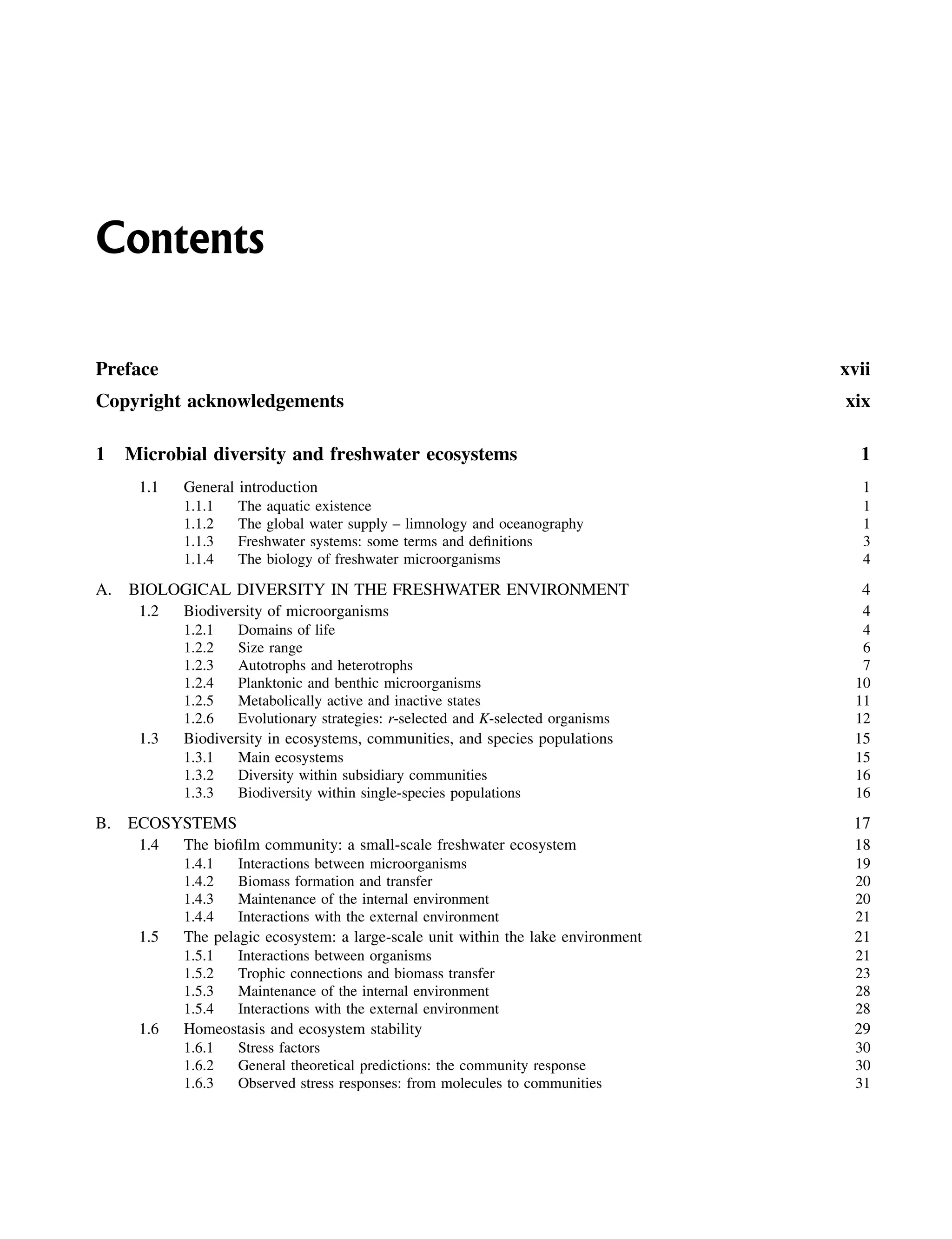
Contents
Preface xvii
Copyright acknowledgements xix
1 Microbial diversity and freshwater ecosystems 1
1.1 General introduction 1
1.1.1 The aquatic existence 1
1.1.2 The global water supply – limnology and oceanography 1
1.1.3 Freshwater systems: some terms and definitions 3
1.1.4 The biology of freshwater microorganisms 4
A. BIOLOGICAL DIVERSITY IN THE FRESHWATER ENVIRONMENT 4
1.2 Biodiversity of microorganisms 4
1.2.1 Domains of life 4
1.2.2 Size range 6
1.2.3 Autotrophs and heterotrophs 7
1.2.4 Planktonic and benthic microorganisms 10
1.2.5 Metabolically active and inactive states 11
1.2.6 Evolutionary strategies: r-selected and K-selected organisms 12
1.3 Biodiversity in ecosystems, communities, and species populations 15
1.3.1 Main ecosystems 15
1.3.2 Diversity within subsidiary communities 16
1.3.3 Biodiversity within single-species populations 16
B. ECOSYSTEMS 17
1.4 The biofilm community: a small-scale freshwater ecosystem 18
1.4.1 Interactions between microorganisms 19
1.4.2 Biomass formation and transfer 20
1.4.3 Maintenance of the internal environment 20
1.4.4 Interactions with the external environment 21
1.5 The pelagic ecosystem: a large-scale unit within the lake environment 21
1.5.1 Interactions between organisms 21
1.5.2 Trophic connections and biomass transfer 23
1.5.3 Maintenance of the internal environment 28
1.5.4 Interactions with the external environment 28
1.6 Homeostasis and ecosystem stability 29
1.6.1 Stress factors 30
1.6.2 General theoretical predictions: the community response 30
1.6.3 Observed stress responses: from molecules to communities 31
1.6.4 Assessment of ecosystem stability 31
1.6.5 Ecosystem stability and community structure 32
1.6.6 Biological response signatures 34
C. FOOD WEBS IN LENTIC AND LOTIC SYSTEMS 34
1.7 Pelagic food webs 34
CASE STUDY 1.1 MICROBIAL FOOD WEB ASSOCIATED WITH AN ALGAL BLOOM 34
CASE STUDY 1.2 GENERAL FOOD WEB IN THE WATER COLUMN OF LAKE BAIKAL (RUSSIA) 36
1.8 Communities and food webs of running waters 40
1.8.1 Allochthonous carbon: dissolved and particulate matter in river systems 40
1.8.2 Pelagic and benthic communities 42
1.8.3 The microbial food web 43
2 Freshwater environments: the influence of physico-chemical
conditions on microbial communities 47
A. INTRODUCTION 47
2.1 The aquatic medium: water, dissolved and particulate components 47
2.1.1 Particulate matter 47
2.1.2 Aquatic matrix 48
2.2 Freshwater environments 52
B. LAKES 53
2.3 Lake morphology and hydrology 53
2.3.1 Lake morphology 53
2.3.2 Lake hydrology and the surrounding terrestrial environment 57
2.4 Lakes as isolated environments 60
2.4.1 Isolated development 60
2.4.2 Lake Baikal: an ancient lake with a diverse and unique fauna and flora 60
2.5 Climatic influences on lakes 62
2.5.1 Temperate lakes – seasonal variations and lake stratification 63
2.5.2 Biological significance of stratification 65
2.5.3 Tropical lakes 66
2.5.4 Polar and sub-polar lakes 67
C. WETLANDS 68
2.6 General characteristics 68
2.6.1 Wetland diversity and global scale 68
2.6.2 Unifying features of wetlands 68
2.6.3 The role of wetlands in energy and material flow 69
2.7 Wetland habitats and communities 69
2.8 Case studies on wetland areas 70
CASE STUDY 2.1 TŘEBOŇ BASIN BIOSPHERE RESERVE 71
D. STREAMS AND RIVERS 72
2.9 Comparison of lotic and lentic systems 72
2.10 River flow and the benthic community 73
2.10.1 Flow characteristics of lotic systems 73
2.10.2 Influence of water flow on benthic microorganisms 75
2.11 River hydrology 78
E. ESTUARIES 79
2.12 River inflow: water mixing, estuarine productivity, and eutrophication of coastal areas 80
vi CONTENTS
2.12.1 Mixing of fresh and saltwaters 80
2.12.2 High productivity of estuarine systems 81
2.12.3 Eutrophication of surrounding coastal areas 82
2.13 Habitats and communities 82
2.13.1 Pelagic zone 82
2.13.2 Sediments and mudflats 82
F. ADVERSE AND EXTREME CONDITIONS IN FRESHWATER ENVIRONMENTS 84
2.14 Adverse conditions as part of the environmental continuum 85
2.14.1 Variations in oxygen concentration 85
2.14.2 Nutrient availability 85
2.14.3 Solar radiation 86
2.15 Extreme environmental conditions 86
2.15.1 Temperature 86
2.15.2 pH 89
2.15.3 Conditions of low water availability: saline environments 91
2.15.4 Conditions of low water availability: ice and snow environments 92
2.15.5 Variations in hydrostatic pressure 93
2.15.6 Organic and inorganic pollution 93
2.16 A potentially extreme microenvironment: the air–water surface 95
2.16.1 Chemical composition of the surface microlayer 95
2.16.2 Physical processes and transformations in the surface biofilm 96
2.16.3 Microbial community at the air–water interface 98
2.17 Microbial communities of snow and ice: life in the frozen state 99
2.17.1 Snow and ice as an extreme environment 99
2.17.2 Requirement for water in the liquid state 99
2.17.3 Snow ecosystems 99
2.17.4 The physical properties of snow 100
2.17.5 Snow and ice microorganisms 102
3 Algae: the major microbial biomass in freshwater systems 105
A. TAXONOMIC AND MOLECULAR CHARACTERIZATION 107
3.1 Major taxonomic divisions of freshwater algae 107
3.1.1 Microscopical appearance, motility and ecological features 107
3.1.2 Biochemical and cytological characteristics 110
3.1.3 General summary of the different groups 112
3.2 Algal species: taxonomy and intraspecific variation 114
3.2.1 Taxonomy of algal species 114
3.2.2 Chemical diversity within species – enzyme analysis, molecular groups,
and elemental composition 115
3.3 Molecular analysis 116
3.3.1 Molecular characterization and identification of algae 116
3.3.2 Investigation of gene function in freshwater algae 119
B. SIZE, SHAPE, AND SURFACE MUCILAGE 123
3.4 Phytoplankton size and shape 123
3.4.1 Cell counts and biovolume 123
3.4.2 From picoplankton to macroplankton 123
3.4.3 Biological significance of size and shape 124
3.4.4 Variation in size and shape within phytoplankton populations 128
3.5 Mucilaginous and non-mucilaginous algae 130
3.5.1 Chemical composition of mucilage 131
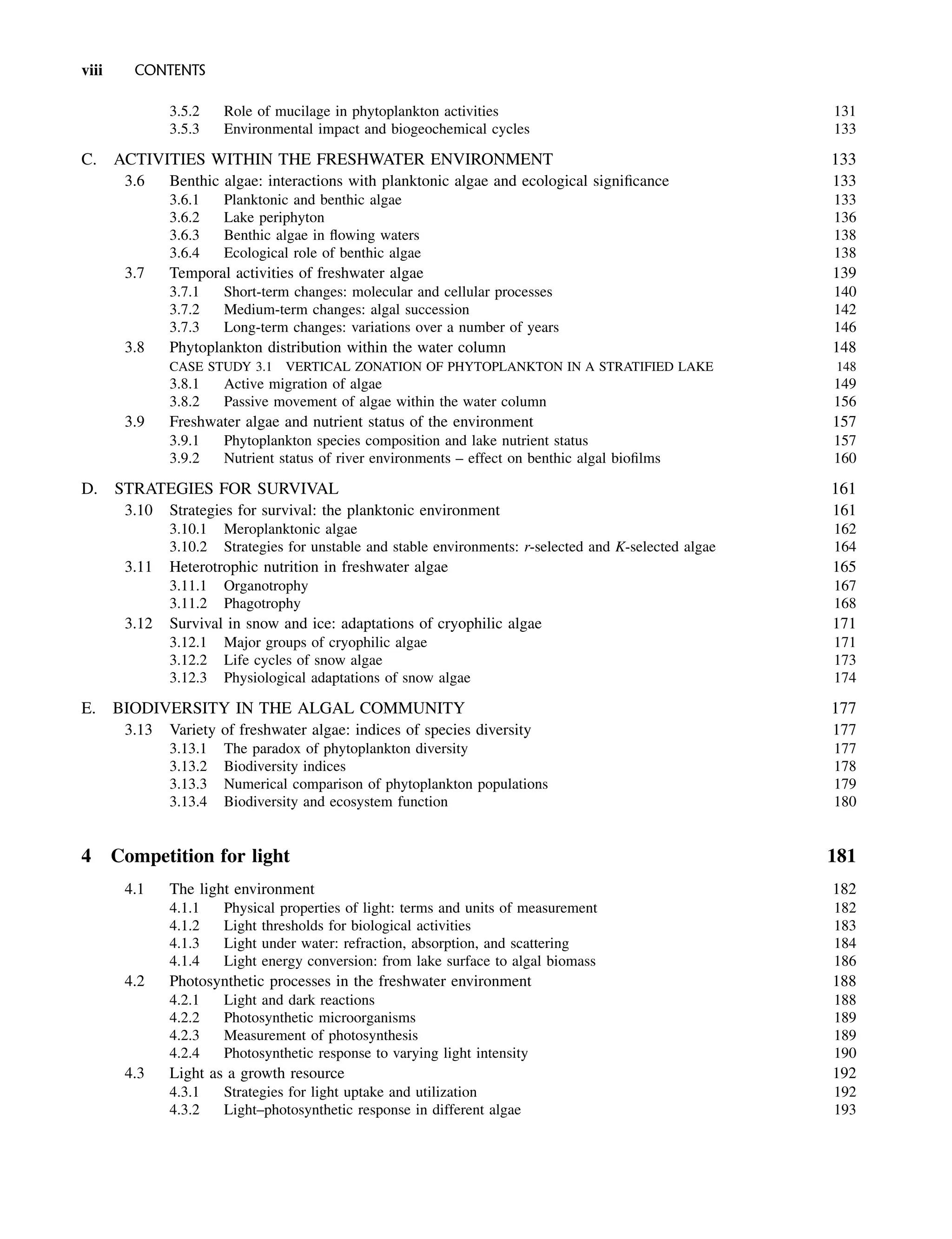
CONTENTS vii
3.5.2 Role of mucilage in phytoplankton activities 131
3.5.3 Environmental impact and biogeochemical cycles 133
C. ACTIVITIES WITHIN THE FRESHWATER ENVIRONMENT 133
3.6 Benthic algae: interactions with planktonic algae and ecological significance 133
3.6.1 Planktonic and benthic algae 133
3.6.2 Lake periphyton 136
3.6.3 Benthic algae in flowing waters 138
3.6.4 Ecological role of benthic algae 138
3.7 Temporal activities of freshwater algae 139
3.7.1 Short-term changes: molecular and cellular processes 140
3.7.2 Medium-term changes: algal succession 142
3.7.3 Long-term changes: variations over a number of years 146
3.8 Phytoplankton distribution within the water column 148
CASE STUDY 3.1 VERTICAL ZONATION OF PHYTOPLANKTON IN A STRATIFIED LAKE 148
3.8.1 Active migration of algae 149
3.8.2 Passive movement of algae within the water column 156
3.9 Freshwater algae and nutrient status of the environment 157
3.9.1 Phytoplankton species composition and lake nutrient status 157
3.9.2 Nutrient status of river environments – effect on benthic algal biofilms 160
D. STRATEGIES FOR SURVIVAL 161
3.10 Strategies for survival: the planktonic environment 161
3.10.1 Meroplanktonic algae 162
3.10.2 Strategies for unstable and stable environments: r-selected and K-selected algae 164
3.11 Heterotrophic nutrition in freshwater algae 165
3.11.1 Organotrophy 167
3.11.2 Phagotrophy 168
3.12 Survival in snow and ice: adaptations of cryophilic algae 171
3.12.1 Major groups of cryophilic algae 171
3.12.2 Life cycles of snow algae 173
3.12.3 Physiological adaptations of snow algae 174
E. BIODIVERSITY IN THE ALGAL COMMUNITY 177
3.13 Variety of freshwater algae: indices of species diversity 177
3.13.1 The paradox of phytoplankton diversity 177
3.13.2 Biodiversity indices 178
3.13.3 Numerical comparison of phytoplankton populations 179
3.13.4 Biodiversity and ecosystem function 180
4 Competition for light 181
4.1 The light environment 182
4.1.1 Physical properties of light: terms and units of measurement 182
4.1.2 Light thresholds for biological activities 183
4.1.3 Light under water: refraction, absorption, and scattering 184
4.1.4 Light energy conversion: from lake surface to algal biomass 186
4.2 Photosynthetic processes in the freshwater environment 188
4.2.1 Light and dark reactions 188
4.2.2 Photosynthetic microorganisms 189
4.2.3 Measurement of photosynthesis 189
4.2.4 Photosynthetic response to varying light intensity 190
4.3 Light as a growth resource 192
4.3.1 Strategies for light uptake and utilization 192
4.3.2 Light–photosynthetic response in different algae 193
viii CONTENTS
4.3.3 Conservation of energy 194
4.3.4 Diversity in small molecular weight solutes and osmoregulation 195
4.4 Algal growth and productivity 196
4.4.1 Primary production: concepts and terms 196
4.4.2 Primary production and algal biomass 197
4.4.3 Field measurements of primary productivity 197
4.5 Photosynthetic bacteria 199
4.5.1 Major groups 200
4.5.2 Photosynthetic pigments 200
4.5.3 Bacterial primary productivity 201
4.6 Photoadaptation: responses of aquatic algae to limited supplies of light energy 202
4.6.1 Different aspects of light limitation 203
4.6.2 Variable light intensity: light-responsive gene expression 204
4.6.3 Photosynthetic responses to low light intensity 205
4.6.4 Spectral composition of light: changes in pigment composition 209
4.7 Carbon uptake and excretion by algal cells 210
4.7.1 Changes in environmental CO2 and pH 210
4.7.2 Excretion of dissolved organic carbon by phytoplankton cells 211
4.8 Competition for light and carbon dioxide between algae and higher plants 215
4.8.1 The balance between algae and macrophytes in different aquatic environments 215
CASE STUDY 4.1 COMPETITION BETWEEN ALGAE AND MACROPHYTES IN SHALLOW
LAKES OF THE TŘEBOŇ WETLANDS 216
4.8.2 Physiological and environmental adaptations in the competition between
algae and macrophytes 218
4.9 Damaging effects of high levels of solar radiation: photoinhibition 221
4.9.1 Specific mechanisms of photoinhibition 221
4.9.2 General effects of photoinhibition 224
4.9.3 Strategies for the avoidance of photoinhibition 225
4.9.4 Photoinhibition and cell size 227
4.9.5 Lack of photoinhibition in benthic communities 228
4.9.6 Photoinhibition in extreme high-light environments 228
4.10 Periodic effects of light on seasonal and diurnal activities of freshwater biota 230
4.10.1 Seasonal periodicity 230
4.10.2 Diurnal changes 231
4.10.3 Circadian rhythms in blue-green algae 232
4.10.4 Circadian rhythms in dinoflagellates 234
5 Inorganic nutrients: uptake and cycling in freshwater systems 235
5.1 Chemical composition of natural waters 235
5.1.1 Soluble inorganic matter in lakes and rivers 235
5.1.2 Aerial deposition of nutrients 237
5.1.3 Nutrient inflow from terrestrial sources 237
5.1.4 Chemical requirements and composition of freshwater biota 238
CASE STUDY 5.1 ELEMENTAL COMPOSITION OF CERATIUM HIRUNDINELLA 240
5.1.5 Nutrient availability and cycling in aquatic systems 243
5.2 Nutrient uptake and growth kinetics 246
5.2.1 Empirical models for algal nutrient kinetics 246
5.2.2 Competition and growth in the aquatic environment 248
5.2.3 Nutrient availability and water movement 250
5.2.4 Acute nutrient deprivation as an environmental stress factor 251
A. NITROGEN 251
5.3 Biological availability of nitrogen in freshwater environments 251
5.3.1 Soluble nitrogenous compounds 251
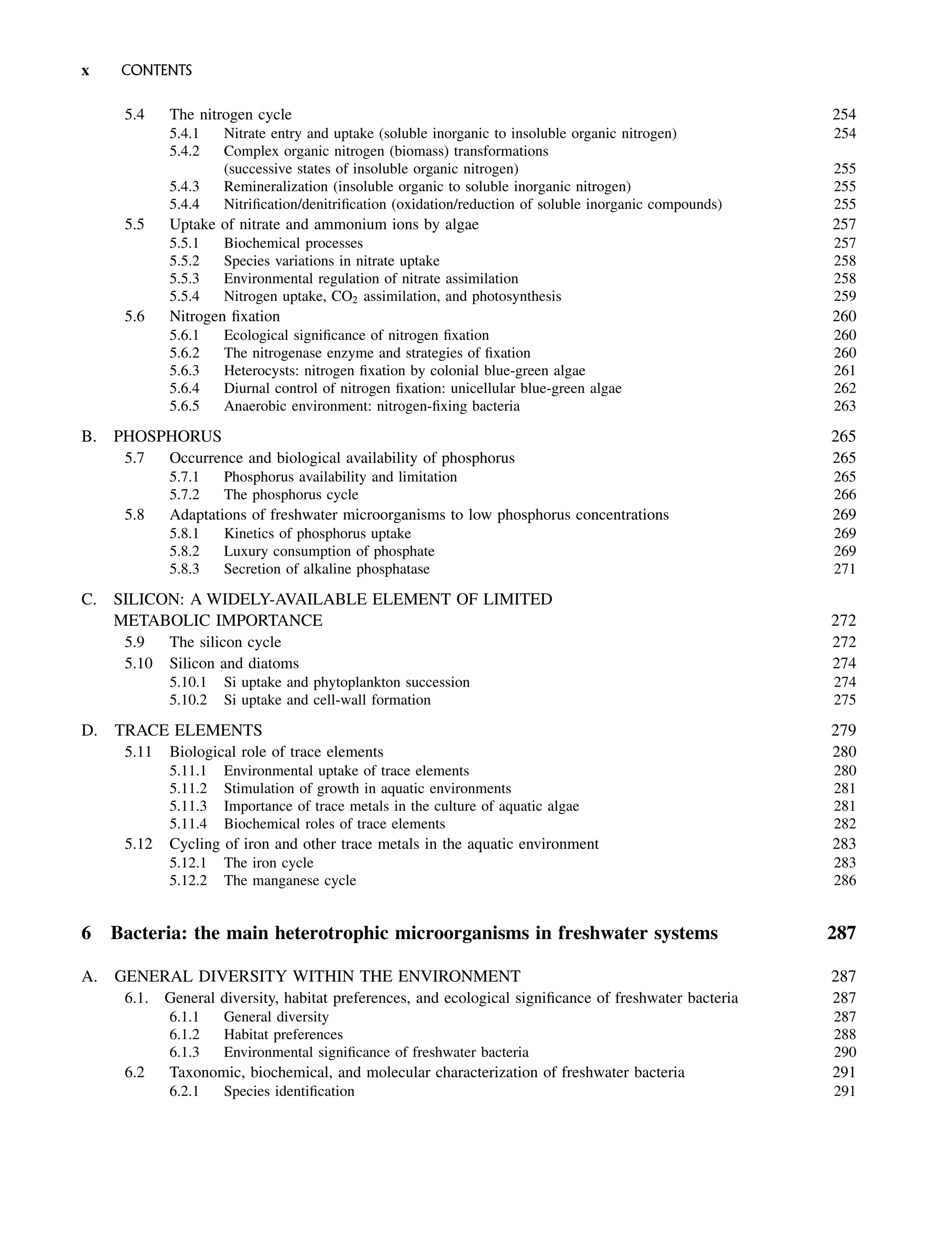
CONTENTS ix
5.4 The nitrogen cycle 254
5.4.1 Nitrate entry and uptake (soluble inorganic to insoluble organic nitrogen) 254
5.4.2 Complex organic nitrogen (biomass) transformations
(successive states of insoluble organic nitrogen) 255
5.4.3 Remineralization (insoluble organic to soluble inorganic nitrogen) 255
5.4.4 Nitrification/denitrification (oxidation/reduction of soluble inorganic compounds) 255
5.5 Uptake of nitrate and ammonium ions by algae 257
5.5.1 Biochemical processes 257
5.5.2 Species variations in nitrate uptake 258
5.5.3 Environmental regulation of nitrate assimilation 258
5.5.4 Nitrogen uptake, CO2 assimilation, and photosynthesis 259
5.6 Nitrogen fixation 260
5.6.1 Ecological significance of nitrogen fixation 260
5.6.2 The nitrogenase enzyme and strategies of fixation 260
5.6.3 Heterocysts: nitrogen fixation by colonial blue-green algae 261
5.6.4 Diurnal control of nitrogen fixation: unicellular blue-green algae 262
5.6.5 Anaerobic environment: nitrogen-fixing bacteria 263
B. PHOSPHORUS 265
5.7 Occurrence and biological availability of phosphorus 265
5.7.1 Phosphorus availability and limitation 265
5.7.2 The phosphorus cycle 266
5.8 Adaptations of freshwater microorganisms to low phosphorus concentrations 269
5.8.1 Kinetics of phosphorus uptake 269
5.8.2 Luxury consumption of phosphate 269
5.8.3 Secretion of alkaline phosphatase 271
C. SILICON: A WIDELY-AVAILABLE ELEMENT OF LIMITED
METABOLIC IMPORTANCE 272
5.9 The silicon cycle 272
5.10 Silicon and diatoms 274
5.10.1 Si uptake and phytoplankton succession 274
5.10.2 Si uptake and cell-wall formation 275
D. TRACE ELEMENTS 279
5.11 Biological role of trace elements 280
5.11.1 Environmental uptake of trace elements 280
5.11.2 Stimulation of growth in aquatic environments 281
5.11.3 Importance of trace metals in the culture of aquatic algae 281
5.11.4 Biochemical roles of trace elements 282
5.12 Cycling of iron and other trace metals in the aquatic environment 283
5.12.1 The iron cycle 283
5.12.2 The manganese cycle 286
6 Bacteria: the main heterotrophic microorganisms in freshwater systems 287
A. GENERAL DIVERSITY WITHIN THE ENVIRONMENT 287
6.1. General diversity, habitat preferences, and ecological significance of freshwater bacteria 287
6.1.1 General diversity 287
6.1.2 Habitat preferences 288
6.1.3 Environmental significance of freshwater bacteria 290
6.2 Taxonomic, biochemical, and molecular characterization of freshwater bacteria 291
6.2.1 Species identification 291
x CONTENTS
6.2.2 Genetic markers: detection of particular strains in the aquatic environment 292
6.2.3 Biochemical characterization of bacterial communities 293
CASE STUDY 6.1 CHANGES IN BACTERIAL COMMUNITY FUNCTION AND COMPOSITION AS
A RESPONSE TO VARIATIONS IN THE SUPPLY OF DISSOLVED ORGANIC MATERIAL (DOM) 293
B. GENETIC INTERACTIONS 294
6.3 Genetic diversity 294
6.3.1 Chromosomal and accessory DNA 294
6.3.2 The ecological importance of gene transfer in freshwater systems 295
6.3.3 Total genetic diversity: the ‘community genome’ 296
6.4 Mechanisms for gene transfer in freshwater systems 297
6.4.1 Transformation: uptake of exogenous DNA 297
6.4.2 Transduction: gene transfer between bacteria via bacteriophages 300
6.4.3 Conjugation: transfer of plasmid DNA by direct cell contact 300
6.5 Evidence for gene transfer in the aquatic environment 300
6.5.1 Retrospective analysis 300
CASE STUDY 6.2 PLASMID-BORNE RESISTANCE IN AQUATIC BACTERIA 301
6.5.2 Laboratory (in vitro) studies on plasmid transfer 301
CASE STUDY 6.3 PLASMID TRANSFER IN PSEUDOMONAS AERUGINOSA 302
6.5.3 Field (in situ) studies on bacterial gene transfer 303
C. METABOLIC ACTIVITIES 304
6.6 Metabolic diversity of freshwater bacteria 304
6.6.1 Key metabolic parameters 304
6.6.2 CO2 fixation 304
6.6.3 Breakdown of organic matter in aerobic and anaerobic environments 305
6.6.4 Bacterial adaptations to low-nutrient environments 310
6.7 Photosynthetic bacteria 312
6.7.1 General characteristics 312
6.7.2 Motility 312
6.7.3 Ecology 314
6.8 Bacteria and inorganic cycles 314
6.8.1 Bacterial metabolism and the sulphur cycle 315
D. BACTERIAL POPULATIONS AND PRODUCTIVITY 316
6.9 Bacterial populations 316
6.9.1 Techniques for counting bacterial populations 316
6.9.2 Biological significance of total and viable counts 317
6.10 Bacterial productivity 318
6.10.1 Measurement of productivity 318
6.10.2 Regulation of bacterial populations and biomass 319
6.10.3 Primary and secondary productivity: correlation between bacterial and algal populations 320
6.10.4 Primary and secondary productivity: the role of dissolved organic carbon 321
6.10.5 Bacterial productivity and aquatic food webs 323
E. BACTERIAL COMMUNITIES IN THE LOTIC ENVIRONMENT 324
6.11 Bacterial Biofilms 324
6.11.1 The development of biofilms 324
6.11.2 Dynamic interactions in the establishment of biofilms: the role of bacterial co-aggregation 326
CASE STUDY 6.4 SPECIFIC RECOGNITION AND ADHESION AMONGST AQUATIC BIOFILM BACTERIA 326
F. BACTERIAL INTERACTIONS WITH PHYTOPLANKTON 328
6.12 Interactions between phytoplankton and planktonic bacteria 328
6.12.1 Competition for inorganic nutrients 328
6.12.2 Antagonistic interactions between bacteria and algae 329
CONTENTS xi
6.13 Epiphytic associations of bacteria with phytoplankton 332
6.13.1 Bacteria within the phycosphere 333
6.13.2 Observation and enumeration of epiphytic bacteria 334
6.13.3 Specific associations between bacteria and blue-green algae 336
7 Viruses: major parasites in the freshwater environment 339
7.1 Viruses as freshwater biota 339
7.1.1 General role in the freshwater environment 339
7.1.2 Major groups and taxonomy of freshwater viruses 340
7.2 The virus life cycle: intracellular and free viral states 340
7.2.1 Significance of the lysogenic state 341
7.3 Detection and quantitation of freshwater viruses 342
7.3.1 Free particulate viruses 342
7.3.2 Infected host cells 345
7.4 The growth and control of viral populations 345
7.4.1 Virus productivity 345
7.4.2 Regulation of viral abundance 346
7.5 Control of host populations by aquatic viruses: impact on the microbial food web 349
7.5.1 Metabolic effects of viruses: reduction of algal primary productivity 349
7.5.2 Destruction of algal and bacterial populations 350
7.5.3 Viruses and the microbial loop 350
7.6 Cyanophages: viruses of blue-green algae 351
7.6.1 Classification and taxonomic characteristics 351
7.6.2 Infection of host cells 352
7.7 Phycoviruses: parasites of eukaryote algae 354
7.7.1 General characteristics 354
7.7.2 Host cell infection 356
CASE STUDY 7.1 THE INFECTIVE LIFE CYCLE OF CHLOROVIRUS 356
7.7.3 Ecological impact of phycoviruses 359
7.8 Virus infection of freshwater bacteria 360
7.8.1 General role of bacteriophages in the biology of freshwater bacteria 360
7.8.2 Bacteriophages in pelagic and benthic systems 360
7.8.3 Occurrence of free bacteriophages in aquatic systems 361
7.8.4 Incidence of bacterial infection 361
7.8.5 Temperate/virulent phage equilibrium and bacterial survival 363
7.8.6 Bacteriophage control of planktonic bacterial populations 365
CASE STUDY 7.2 VIRAL LYSIS OF BACTERIA IN A EUTROPHIC LAKE 365
7.8.7 Transduction: bacteriophage-mediated gene transfer between freshwater bacteria 367
CASE STUDY 7.3 TRANSDUCTION OF PLASMID AND CHROMOSOMAL DNA IN
PSEUDOMONAS AERUGINOSA 368
8 Fungi and fungal-like organisms: aquatic biota with a mycelial growth form 371
A. ACTINOMYCETES, OOMYCETES, AND TRUE FUNGI 371
8.1 Fungi and fungal-like organisms: the mycelial growth habit 371
8.2 Actinomycetes 372
8.2.1 Taxonomic characteristics 372
8.2.2 Habitat 373
8.2.3 Nutrition 374
8.2.4 Competition with other microorganisms 374
8.3 Oomycetes 374
8.3.1 Oomycetes and true fungi 375
xii CONTENTS
8.3.2 Taxonomic diversity 376
8.4 True fungi 377
8.4.1 Old and new terminology 377
8.4.2 Taxonomic diversity within the true fungi 378
B. FUNGI AS SAPROPHYTES AND PARASITES 381
8.5 Saprophytic activity of fungi 381
8.5.1 Colonization, growth, and fungal succession 382
8.5.2 Breakdown of leaf litter 383
8.5.3 Saprophytic fungi – chytrids and deuteromycetes 386
8.6 Parasitic activities of aquatic fungi 388
8.6.1 Parasitic and predatory deuteromycetes: fungi that attack small animals 388
8.6.2 Parasitic chytrids: highly specialized parasites of freshwater organisms 389
8.7 Fungal epidemics in the control of phytoplankton populations 392
8.7.1 Ecological significance 392
CASE STUDY 8.1 CHYTRID INFECTION OF THE ASTERIONELLA DURING AN
AUTUMN DIATOM BLOOM 392
8.7.2 Net effect of infected and non-infected host cells 394
8.7.3 Factors affecting the development of fungal infection 395
9 Grazing activities in the freshwater environment: the role of
protozoa and invertebrates 401
A. PROTOZOA 401
9.1 Introduction 401
9.1.1 Relative importance of protozoans, rotifers, and crustaceans in pelagic communities 401
9.1.2 Ecological role of protozoa 402
9.2 Protozoa, algae, and indeterminate groups 402
9.3 Taxonomic diversity of protozoa in the freshwater environment 403
9.3.1 Ciliates 403
9.3.2 Flagellate protozoa 407
9.3.3 Amoeboid protozoa 409
9.4 Ecological impact of protozoa: the pelagic environment 412
9.4.1 Positioning within the water column 412
9.4.2 Trophic interactions in the water column 413
9.5 Heterotrophic nanoflagellates: an integral component of planktonic communities 413
9.5.1 Enumeration of nanoflagellate populations in aquatic samples 414
9.5.2 Taxonomic composition of HNF communities 415
9.5.3 Abundance and control of flagellate populations 415
9.5.4 Nanoflagellate grazing rates and control of bacterial populations 416
9.5.5 Co-distribution of bacteria and protozoa within the water column 418
9.6 Ecological impact of protozoa: the benthic environment 419
9.6.1 Benthic microenvironments 419
9.6.2 Seasonal changes 421
9.6.3 Organic pollution 421
9.6.4 Sewage-treatment plants: activated sludge 422
B. GRAZING OF MICROBIAL POPULATIONS BY ZOOPLANKTON 423
9.7 General features of zooplankton: rotifers, cladocerans and copepods 423
9.7.1 Morphology and size 423
9.7.2 Reproduction and generation times 426
9.7.3 Predation of zooplankton 426
9.8 Grazing activity and prey selection 427
9.8.1 Seasonal succession in zooplankton feeding 427
CONTENTS xiii
9.8.2 Method of feeding 429
9.8.3 Selection of food by zooplankton 429
9.9 Grazing rates of zooplankton 432
9.9.1 Measurement 432
9.9.2 Factors affecting grazing rates 433
9.9.3 Diurnal variations in grazing activity 434
9.10 Effects of algal toxins on zooplankton 435
9.11 Biomass relationships between phytoplankton and zooplankton populations 437
9.11.1 Control of zooplankton populations 437
9.11.2 Biomass transfer 437
C. GRAZING OF BENTHIC MICROORGANISMS 438
9.12 Comparison of pelagic and benthic systems 438
9.13 Role of invertebrates in consuming river microorganisms 440
9.13.1 Grazing of periphyton biomass 440
9.13.2 Effects of grazing on periphyton community structure 441
10 Eutrophication: the microbial response to high nutrient levels 443
A. ORIGINS OF EUTROPHICATION 444
10.1 Nutrient status of freshwater environments: from oligotrophic to eutrophic systems 444
10.1.1 Eutrophic and oligotrophic lakes: definition of terms 444
10.1.2 Determinants of trophic status: location, morphology and hydrology 445
10.1.3 Artificial eutrophication: the impact of human activities 446
10.1.4 Eutrophication of rivers and streams 446
B. ECOLOGICAL EFFECTS OF EUTROPHICATION IN STANDING WATERS 448
10.2 General biological changes 448
10.2.1 The progression from oligotrophic to eutrophic waters 448
10.2.2 Effects of eutrophication on the water column of stratified lakes 452
10.2.3 Major changes in ecological balance: the breakdown of homeostasis 452
10.3 Biological assessment of water quality 453
10.3.1 Algal indicator groups 453
CASE STUDY 10.1 USING THE A/C (ARAPHID PENNATE/CENTRIC) DIATOM RATIO TO ASSESS
EUTROPHICATION IN LAKE TAHOE (USA) 454
10.3.2 Indices of species diversity 455
10.4 Problems with intentional eutrophication: destabilization of fishpond ecosystems 455
10.4.1 Promotion of high productivity in fishponds 455
10.4.2 Destabilization and restoration of the ecosystem 456
C. THE GROWTH AND IMPACT OF ALGAL BLOOMS 457
10.5 Algal blooms and eutrophication 457
10.6 Formation of colonial blue-green algal blooms 459
10.6.1 General requirements for bloom formation 459
10.6.2 Competition with other algae 459
CASE STUDY 10.2 USE OF ENCLOSURE EXPERIMENTS TO STUDY FACTORS AFFECTING
BLUE-GREEN DOMINANCE 461
10.7 Environmental effects of blue-green blooms 461
10.7.1 General environmental changes 461
10.7.2 Specific effects on water quality 462
10.7.3 Production of toxins 462
xiv CONTENTS
D. CONTROL OF BLUE-GREEN ALGAE 464
10.8 Strategies for the control of blue-green algae 464
10.8.1 Nutrient limitation (bottom-up control) 465
CASE STUDY 10.3 RESTORATION OF WATER QUALITY IN LAKE WASHINGTON, NORTH WEST USA 466
10.8.2 Direct eradication 466
10.8.3 Top-down control of blue-green algae: the use of biomanipulation 467
CASE STUDY 10.4 TOP-DOWN AND BOTTOM-UP CONTROL OF ALGAL POPULATIONS IN
THE BROADS WETLAND AREA (UK) 467
10.9 Biological control of blue-green algae 471
10.9.1 Biological control agents 472
10.9.2 Protocol for the development of biological control agents 474
CASE STUDY 10.5 POTENTIAL PROTOZOON CONTROL AGENTS 475
10.9.3 Application of plant litter to control blue-green algae 475
10.10 Strategies for the control of blue-green algae in different water bodies 477
10.10.1 Integrated management policy 477
CASE STUDY 10.6 ENVIRONMENTAL MONITORING AT HOLLINGWORTH LAKE,
GREATER MANCHESTER (UK) 479
10.10.2 Specific remedial measures in different freshwater systems 481
Glossary 483
References 495
Index 517
CONTENTS xv
Preface
Although freshwater microorganisms are not as
readily apparent as macroscopic fauna (inverte-
brates, fish) and flora (higher plants, large algae),
they are universally present within aquatic habitats
and their ecological impact is of fundamental
importance. This book examines the diversity and
dynamic activities of freshwater microbes including
micro-algae, bacteria, viruses, actinomycetes, fungi,
and protozoa.
On an environmental scale, the activities of
these organisms range from the microlevel (e.g.,
localized adsorption of nutrients, surface secretion
of exoenzymes) through community dynamics
(interactions within planktonic and benthic popula-
tions) to large-scale environmental effects. These
include major changes in inorganic nutrient con-
centrations, formation of anaerobic hypolimnia,
and stabilization of mudflats. Thus, although fresh-
water microorganisms are strongly influenced
by their physical and chemical environment,
they can in turn exert their own effects on their
surroundings.
In a temporal dimension, the biology of these
biota embraces activities which range from femto-
seconds (e.g., light receptor parameters) to sec-
onds (light responsive gene activity), diurnal
oscillations, seasonal changes (phytoplankton
succession), and transitions over decades and cen-
turies (e.g., long-term response to acidification and
nutrient changes).
The study of freshwater microorganisms involves
all major disciplines within biology, and I have
attempted to bring together aspects of taxonomy,
molecular biology, biochemistry, structural biology,
and classical ecology within this volume. A com-
plete study of freshwater microorganisms must also
clearly relate to other freshwater biota, and I have
emphasized links in relation to general food webs –
plus specific interactions such as zooplankton graz-
ing, algal/higher plant competition, and the role of
fish and macrophytes in the biomanipulation of
algal populations.
In addition to being an area of intrinsic biol-
ogical interest, freshwater microbiology has
increasing practical relevance in relation to human
activities, population increase, and our use of
environmental resources. In this respect microor-
ganisms play a key role in the deterioration of
freshwater environments that results from eutro-
phication, and management of aquatic systems
requires a good understanding of the principles of
freshwater microbiology. The biology of these
biota is also important in relation to other applied
aspects such as the breakdown of organic pollutants,
the spread of human pathogens, and the environ-
mental impact of genetically-engineered micro-
organisms.
Inevitably, a book of this type relies heavily on
previously published work, and I would like to
thank holders of copyright (see separate listing)
for granting permission to publish original diagrams
and figures. I am also grateful to colleagues (parti-
cularly Professor A.P.J. Trinci and Dr R.D. Butler)
for commenting on sections of the manuscript, and
for the helpful, detailed comments of anonymous
reviewers. Finally, my thanks are due to the
numerous research colleagues who I have worked
with over the years, including Jo Abraham,
Martin Andrews, Ed Bellinger, Karen Booth, Ron
Butler, Sue Clay, Andrew Dean, Ebtesam El-
Bestawy, Robert Glenn, Harry Epton, Larry Kearns,
Vlad Krivtsov, Eugenia Levado, Christina Tien, and
Keith White.
David Sigee
Manchester, 2004.
xiv PREFACE
Copyright acknowledgements
I am very grateful to the following individuals
for allowing me to use previously unpublished
material – Drs Nina Bondarenko, Andrew Dean,
Harry Epton, Robert Glenn, Eugenia Levado, Ms
Elishka Rigney, Mr Richard Sigee, Mrs Rosemary
Sigee, Dr Christina Tien, Professor James Van Etten
and Dr Keith White.
I also thank the following copyright holders for
giving me permission to use previously published
material – The American Society for Micro-
biology, Biopress Ltd., Blackwell Publishing
Ltd., Cambridge University Press, Elsevier
Science, European Journal of Phycology, Inter-
research Science, John Wiley & Sons, Parthenon
Publishing, Kluwer Academic Publishers, The
Linnean Society of London, NRC Research
Press, Scanning Microscopy Inc. and Springer-
Verlag.
1
Microbial diversity and freshwater
ecosystems
1.1 General introduction
This book explores the diversity, interactions and
activities of microbes (microorganisms) within
freshwater environments. These form an important
part of the biosphere, which also includes oceans,
terrestrial environments and the earth’s atmosphere.
1.1.1 The aquatic existence
It is now generally accepted that life originated
between 3.5 and 4 billion years ago in the aquatic
environment, initially as self-replicating molecules
(Alberts et al., 1962). The subsequent evolution of
prokaryotes, followed by eukaryotes, led to the
existence of microorganisms which are highly
adapted to aquatic systems. The biological import-
ance of the physical properties of water is discussed
in Section 2.1.2.
Life in the aquatic environment (freshwater and
marine) has numerous potential advantages over
terrestrial existence. These include physical support
(buoyancy), accessibility of three-dimensional
space, passive movement by water currents, disper-
sal of motile gametes in a liquid medium, minimal
loss of water (freshwater systems), lower extremes
of temperature and solar radiation, and ready avail-
ability of soluble organic and inorganic nutrients.
Potential disadvantages of aquatic environments
include osmotic differences between the organism
and the surrounding aquatic medium (leading to
endosmosis or exosmosis) and a high degree of
physical disturbance in many aquatic systems. In
undisturbed aquatic systems such as lakes, photosyn-
thetic organisms have to maintain their position at
the top of the water column for light availability. In
many water bodies (e.g., lake water column), physi-
cal and chemical parameters show a continuum –
with few distinct microhabitats. In these situations,
species compete in relation to different growth and
reproductive strategies rather than specific adapta-
tions to localized environmental conditions.
1.1.2 The global water supply – limnology
and oceanography
Water covers seven tenths of the Earth’s surface and
occupies an estimated total volume of 1.38 
109
km3
(Table 1.1). Most of this water occurs
between continents, where it is present as oceans
(96.1 per cent of global water) plus a major part of
the atmospheric water. The remaining 3.9 per cent
of water (Table 1.1 shaded boxes), present within
continental boundaries (including polar ice-caps),
occurs mainly as polar ice and ground water. The
latter is present as freely exchangeable (i.e., not
Freshwater Microbiology: Biodiversity and Dynamic Interactions of Microorganisms in the Aquatic Environment David C. Sigee
# 2005 John Wiley  Sons, Ltd ISBNs: 0-471-48529-2 (pbk) 0-471-48528-4 (hbk)
chemically-bound) water in subterranean regions
such as aquifers at varying depths within the Earth’s
crust. Non-polar surface freshwaters, including soil
water, lakes, rivers and streams occupy approxi-
mately 0.0013 per cent of the global water, or
0.37 per cent of water occurring within continental
boundaries. The volume of saline lakewater approxi-
mately equals that of freshwater lakes. The largest
uncertainty is the estimation of ground water
volume. Annual inputs by precipitation are esti-
mated at 5:2  108
km3
, with a resulting flow from
continental (freshwater) systems to oceans of about
38 600 km3
.
The distinction between oceans and continental
water bodies leads to the two main disciplines of
aquatic biology – oceanography and limnology.
 Oceanography is the study of aquatic systems
between continents. It mainly involves saltwater,
with major impact on global parameters such as
temperature change, the carbon cycle and water
circulation.
 Limnology is the study of aquatic systems con-
tained within continental boundaries, including
freshwater and saltwater sites.
The study of freshwater biology is thus part of
limnology. Although freshwater systems do not
have the global impact of oceans, they are of
major importance to biology. They are important
ecological features within continental boundaries,
have distinctive groups of organisms, and show
close links with terrestrial ecosystems.
The two main sites (over 99 per cent by volume)
of continental water – the polar ice-caps and
exchangeable ground water – are extreme environ-
ments which have received relatively little micro-
biological attention until recent years. Although
most limnological studies have been carried out
on lakes, rivers, and wetlands the importance of
other water bodies – particularly the vast frozen
environments of the polar regions (see below) –
should not be overlooked. Microbiological aspects
of snow and ice environments are discussed in
Sections 2.17 and 3.12, and the metabolic activities
of bacteria in ground water in Section 2.14.2.
Although there are many differences between
limnological (inland) and oceanic (intercontinental)
systems, there are also some close similarities. The
biology of planktonic organisms in lakes, for exam-
ple, shows many similarities to that of oceans – and
much of our understanding of freshwater biota (e.g.,
Table 1.1 Global distribution of water (adapted from Horne and Goldman, 1994)
Site Volume (km3
) % of water within continents
Oceans 1 322 000 000
Polar ice caps and glaciers 29 200 000 54.57
Exchangeable ground water 24 000 000 44.85
Freshwater lakes 125 000 0.23
Saline lakes and inland seas 104 000 0.19
Soil and subsoil water 65 000 0.12
Atmospheric vapour 14 000 0.026
Rivers and streams 1 200 0.022
Annual inputs
Surface runoff to ocean 37 000
Ground water to sea 1 600
Precipitation
Rainfall on ocean 412 000 000
Rainfall on land and lakes 108 000 000
2 MICROBIAL DIVERSITY AND FRESHWATER ECOSYSTEMS
the biology of aquatic viruses (Chapter 7) comes
from studies on marine systems.
1.1.3 Freshwater systems: some terms
and definitions
Freshwater microorganisms
Microorganisms may be defined as those organisms
that are not readily visible to the naked eye, requir-
ing a microscope for detailed observation. These
biota have a size range (maximum linear dimension)
up to 200 mm, and vary from viruses, through
bacteria and archea, to micro-algae, fungi and pro-
tozoa. Higher plants, macro-algae, invertebrates and
vertebrates do not fall in this category and are not
considered in detail, except where they relate to
microbial activities. These include photosynthetic
competition between higher plants and micro-algae
(Section 4.8) and the role of zooplankton as grazers
of algae and bacteria (Section 9.8).
Freshwater environments: water in the
liquid and frozen state
Freshwater environments are considered to include
all those sites where freshwater occurs as the main
external medium, either in the liquid or frozen state.
Although frozen aquatic environments have long
been thought of as microbiological deserts, recent
studies have shown this not to be the case. The
Antarctic sub-continent, for example, is now known
to be rich in microorganisms (Vincent, 1988), with
protozoa, fungi, bacteria, and microalgae often
locally abundant and interacting to form highly-
structured communities. New microorganisms,
including freeze-tolerant phototrophs and hetero-
trophs, have been discovered and include a number
of endemic organisms. New biotic environments
have also been discovered within this apparently
hostile environment – which includes extensive
snow-fields, tidal lakes, ice-shelf pools, rock crystal
pools, hypersaline soils, fellfield microhabitats, and
glacial melt-water streams. Many of these polar en-
vironments are saline, and the aquatic microbiology
of these regions is considered here mainly in terms
of freshwater snow-fields in relation to extreme
aquatic environments (Section 2.17) and the cryo-
philic adaptations of micro-algae (Section 3.12).
This book deals with aquatic systems where water
is present in the liquid state for at least part of the
year. In most situations (temperate lakes, rivers, and
wetlands) water is frozen for only a limited time,
but in polar regions the reverse is true. Some regions
of the ice-caps are permanently frozen, but other
areas have occasional or periodic melting. In many
snow-fields, the short-term presence of water in the
liquid state during the annual melt results in a burst
of metabolic activity and is important for the lim-
ited growth and dispersal of snow microorganisms
and for the completion of microbial life cycles
(Section 3.12).
Freshwater and saline environments
Within inland waters, aquatic sites show a gradation
from water with a low ionic content (freshwater) to
environments with a high ionic content (saline) –
typically dominated by sodium and chlorine ions.
Saline waters include estuaries (Sections 2.12 and
2.13), saline lakes (Section 2.15.3) and extensive
regions of the polar ice-caps (Vincent, 1988). The
high ionic concentrations of these sites can also be
recorded in terms of high electrical conductivity
(specific conductance) and high osmotic potential.
The physiological demands of saline and fresh-
water conditions are so different that aquatic orga-
nisms are normally adapted to one set of conditions
but not the other, so they occur in either saline or
freshwater conditions. The importance of salinity in
determining the species composition of the aquatic
microbial community was demonstrated in a recent
survey of Australian saline lakes (Gell and Gasse,
1990), where distinct assemblages of diatoms were
present in low salinity (oligosaline) and high sali-
nity (hypersaline) waters. Some diatom species,
however, were present over the whole range of
saline conditions, indicating the ability of some
microorganisms to be completely independent of
salt concentration and ionic ratios. Long-term adapt-
ability to different saline conditions is also indicated
GENERAL INTRODUCTION 3
by the ability of some organisms to migrate from
saltwater to freshwater sites, and establish them-
selves in their new conditions. This appears to be
the case for various littoral red algae of freshwater
lakes (Section 3.1.3), which were originally derived
from marine environments (Lin and Blum, 1977).
Differences between freshwater/saltwater environ-
ments and their microbial communities, are parti-
cularly significant in global terms (Chapter 2),
where the dominance of saline conditions is clear
in terms of area coverage, total biomass, and overall
contribution to carbon cycling.
Lentic and lotic freshwater systems
Freshwater environments show wide variations in
terms of their physical and chemical characteristics,
and the influence these parameters have on the micro-
bial communities they contain. These aspects are
considered in Chapter 2, but one important distinc-
tion needs to be made at this stage – between lentic
and lotic systems. Freshwater environments can be
grouped into standing waters (lentic systems –
including ponds, lakes, marshes and other enclosed
water bodies) and flowing waters (lotic systems –
rivers, estuaries and canals). The distinction
between lentic and lotic systems is not absolute,
and almost all water bodies have some element of
through-flow. Key differences between lentic and
lotic systems in terms of carbon availability and
food webs are considered in Section 1.8.
1.1.4 The biology of freshwater microorganisms
In this book the biology of freshwater microorga-
nisms is considered from five major aspects:
 Microbial diversity and interactions within eco-
systems (Chapter 1); these interactions include
temporal changes in succession and feeding
(trophic) interactions.
 Variations between different environmental sys-
tems, including lakes, rivers, and wetlands (Chap-
ter 2). Each system has its own mixture of
microbial communities, and its own set of physi-
cal and biological characteristics.
 Characteristics and activities of the five major
groups of microbial organisms – algae (Chapter 3),
bacteria (Chapter 6), viruses (Chapter 7), fungi
(Chapter 8), and protozoa (Chapter 9).
 The requirement of freshwater microorganisms
for two major environmental resources – light
(Chapter 4) and inorganic nutrients (Chapter 5).
These are considered immediately after the sec-
tion on algae, since these organisms are the major
consumers of both commodities.
 The microbial response to eutrophication. Environ-
mental problems associated with nutrient increase
are of increasing importance and reflect both a
microbial response to environmental change and
a microbial effect on environmental conditions.
A. BIOLOGICAL DIVERSITY IN THE FRESHWATER ENVIRONMENT
1.2 Biodiversity of microorganisms
1.2.1 Domains of life
With the exception of viruses (which constitute a
distinct group of non-freeliving organisms) the most
fundamental element of taxonomic diversity within
the freshwater environment lies in the separation of
biota into three major domains – the Bacteria,
Archaea, and Eukarya. Organisms within these
domains can be distinguished in terms of a number
of key fine-structural, biochemical, and physiologi-
cal characteristics (Table 1.2).
Cell organization is a key feature, with the
absence of a nuclear membrane defining the
Bacteria (Figure 3.2) and Archaea as prokaryotes.
These prokaryote domains also lack complex
systems of membrane-enclosed organelles, have
4 MICROBIAL DIVERSITY AND FRESHWATER ECOSYSTEMS
70s ribosomes and have genetic systems which
include plasmids and function by operons.
Prokaryote features also include a unicellular or
colonial (but not multicellular) organization, and a
small cell size (5 mm diameter). The domain
Bacteria is widely represented in all freshwater
environments and contains a single kingdom, the
Eubacteria, which includes bacteria, actinomycetes
and blue-green algae (see Figure 3.2). In contrast to
this, members of the domain Archaea (single
kingdom Archaebacteria) tend to be restricted
within freshwater environments to extreme situa-
tions (Section 2.15). Further subdivisions within
this diverse group are shown in Table 2.13 and
Figure 2.20.
The domain Eukarya takes its name from the
fundamental eukaryote organization of its cells and
may be conveniently divided (Purves et al., 1997)
into four kingdoms – the Protista (unicellular and
colonial organisms), Plantae (multicellular photo-
synthetic eukaryotes), Fungi (see Chapter 8) and
Animalia (multicellular heterotrophic eukaryotes).
The Protista include two important groups of
freshwater microorganisms – the micro-algae and
protozoa.
Taxonomic characteristics of the five major groups
of freshwater microorganisms – algae, bacteria,
viruses, fungi (with actinomycetes), and protozoa –
are detailed in the respective chapters on these
organisms.
Table 1.2 The three domains of life
in freshwater environments (adapted from Purves et al., 1997 – shaded areas:
distinctive prokaryote/eukaryote features). The four major kingdoms within the Domain Eukarya simply group organisms
with broadly similar features, and do not imply any phyllogenetic interrelationships. The Protista (protozoa, algae, sline
moulds) and Fungi are particularly heterogeneous assemblages, containing organisms that have arisen via diverse
evolutionary routes (polyphyletic)
Domains
Characteristic Bacteria Archaea Eukarya
Kingdoms Eubacteria Archaebacteria Fungi Protista Plantae
Animalia
Level of cellular organisation prokaryote prokaryote eukaryote
Membrane-enclosed nucleus Absent Absent Present
Membrane-enclosed organelles Absent Absent Present
Ribosomes 70s 70s 80s
Peptidoglycan cell wall Present Absent Absent
Membrane lipids Ester-linked Ether-linked Ester-linked
Unbranched Branched Unbranched
Initiator tRNA Formyl-methionine Methionine Methionine
Operons Yes Yes No
Plasmids Yes Yes Rare
RNA polymerases One Several Three
Sensitive to chloramphenicol Yes No No
 streptomycin
Ribosomes sensitive to No Yes Yes
diphtheria toxin
Some are methanogens No Yes No
Some fix nitrogen Yes Yes No
Some conduct chlorophyll – Yes No Yes
based photosynthesis

Excluding viruses, which are not free-living organisms.
BIODIVERSITY OF MICROORGANISMS 5
1.2.2 Size range
Size is an important parameter for all freshwater
microorganisms, affecting their location within the
freshwater environment, their biological activities,
and their removal by predators. The importance
of size and shape in planktonic algae is considered
in some detail in Section 3.4, and includes aspects
such as predation by other organisms, sinking rates,
and potential growth rates.
In the case of free-floating (planktonic) orga-
nisms, the maximum linear dimension ranges from
0.2 mm–200 mm, with separation of the biota
into five major size categories (Table 1.3), from
femtoplankton to macroplankton.
Femtoplankton (0.2 m)
The distinction between particulate (insoluble) and
non-particulate (soluble) material in freshwater sys-
tems is usually defined in terms of retention by a
0.2 mm pore-size filter membrane. On this basis, the
smallest size group, the Femtoplankton (0.2 mm)
falls within the non-particulate category and the
constituent viruses and small bacteria are strictly
part of the dissolved organic material (DOM) or
dissolved organic carbon (DOC) of the freshwater
environment.
Picoplankton (0.2–2 m)
This group is almost entirely composed of prokar-
yotes (bacteria and blue-green algae) with poten-
tially rapid growth rates and the ability to carry out
rapid colonization of freshwater environments.
These organisms have negligible sinking rates, and
are subject to significant predation by small rotifers,
protozoa, and filter-feeding crustaceans. Some large
linear viruses (family Inoviridae) also fit into this
size category (Figure 7.14) and have been linked to
the infection of bacterial populations (Section 7.8).
Nanoplankton (2–20 m)
Typically eukaryote flagellated unicellular organ-
isms, this group includes fungal zoospores, algae,
and protozoa. These organisms are the principal
food of micro- and macrozooplankton, and have
low sinking rates and high potential growth rates.
Table 1.3 Size range of major freshwater planktonic organisms (the shaded area falls within the category of dissolved
organic carbon (0.2 mm))
Maximum linear Viruses, fungi,
Size Group dimension (mm) and bacteria Algae Protozoa Zooplankton
Femtoplankton 0.2 Viruses and
small bacteria
Picoplankton 0.2–2 Some large, linear Unicellular
viruses (Inoviridae) blue-green algae
Most of the bacterial
population
Nanoplankton 2–20 Larger bacteria Fungal Unicellular Nanoflagellates
zoospores and hyphae eukaryotic algae
(diameter)
Microplankton 20–200 Unicellular and Most planktonic Rotifers
colonial algae protozoa Copepod
larvae
Macroplankton 200 Large colonial
blue-green algae Crustacea
6 MICROBIAL DIVERSITY AND FRESHWATER ECOSYSTEMS
Within this assemblage, unicellular algae, along
with picocyanobacteria, are particularly important
in the short-term development of algal blooms
which may occur during brief growing seasons or
at various points in a more prolonged seasonal
sequence.
Microplankton (20–200 m)
Larger microplankton are retained by traditional
70 mm mesh size phytoplankton nets, and are
highly prone to sinking in the absence of buoyancy
aids. These organisms are consumed by larger
crustacea, and are also the principal food of pelagic
and benthic omnivorous fish. Growth rates are mode-
rate to low.
Macroplankton (200 m)
These have similar biological features to the larger
microplankton, and are characterized by the colonial
blue-green algae and by the multicellular zooplank-
ton (rotifers and crustacea). The biology of meso-
trophic and eutrophic lakes in temperate climates
are typically dominated by these size categories
over the summer growth period, with separate
population peaks of colonial algae (diatoms, blue-
greens) and zooplankton (crustacea) at different
times of year. Although macroplanktonic organisms
are characteristically slow-growing, they typically
make the greatest contribution to biomass under
conditions of adequate nutrient supply. Differences
between picoplankton and macroplankton in terms
of growth rate, short-term colonization and long-
term domination of freshwater environments reflect
fundamental differences in evolutionary selection
strategy and the way these biota are adapted to
different environmental conditions. The distinction
between small size (r-strategist) and large size (K-
strategist) organisms is considered more fully below.
1.2.3 Autotrophs and heterotrophs
Freshwater microorganisms may be divided accord-
ing to their feeding activity (trophic status) into two
major groups:
 Autotrophs – synthesize their complex carbon
compounds from external CO2. Most also obtain
their supplies of nutrient (e.g., nitrogen and
phosphorus) from simple inorganic compounds.
These phototrophic microorganisms include
microalgae and photosynthetic bacteria, and are
the main creators of biomass (primary producers)
in many freshwater ecosystems. This is not
always the case, however, since photosynthetic
microorganisms are outcompeted by larger algae
and macrophytes in some aquatic systems, parti-
cularly wetland communities (Section 4.8).
 Heterotrophs – use complex organic compounds
as a source of carbon. By far the majority of
freshwater microorganisms (most bacteria, proto-
zoa, fungi) are heterotrophic. Even within the
algae, various groups have evolved the capacity
for heterotrophic nutrition (Section 3.11) and
many organisms currently included in the proto-
zoon assemblage have probably evolved from
photosynthetic ancestors.
Heterotrophic nutrition involves a wide diversity
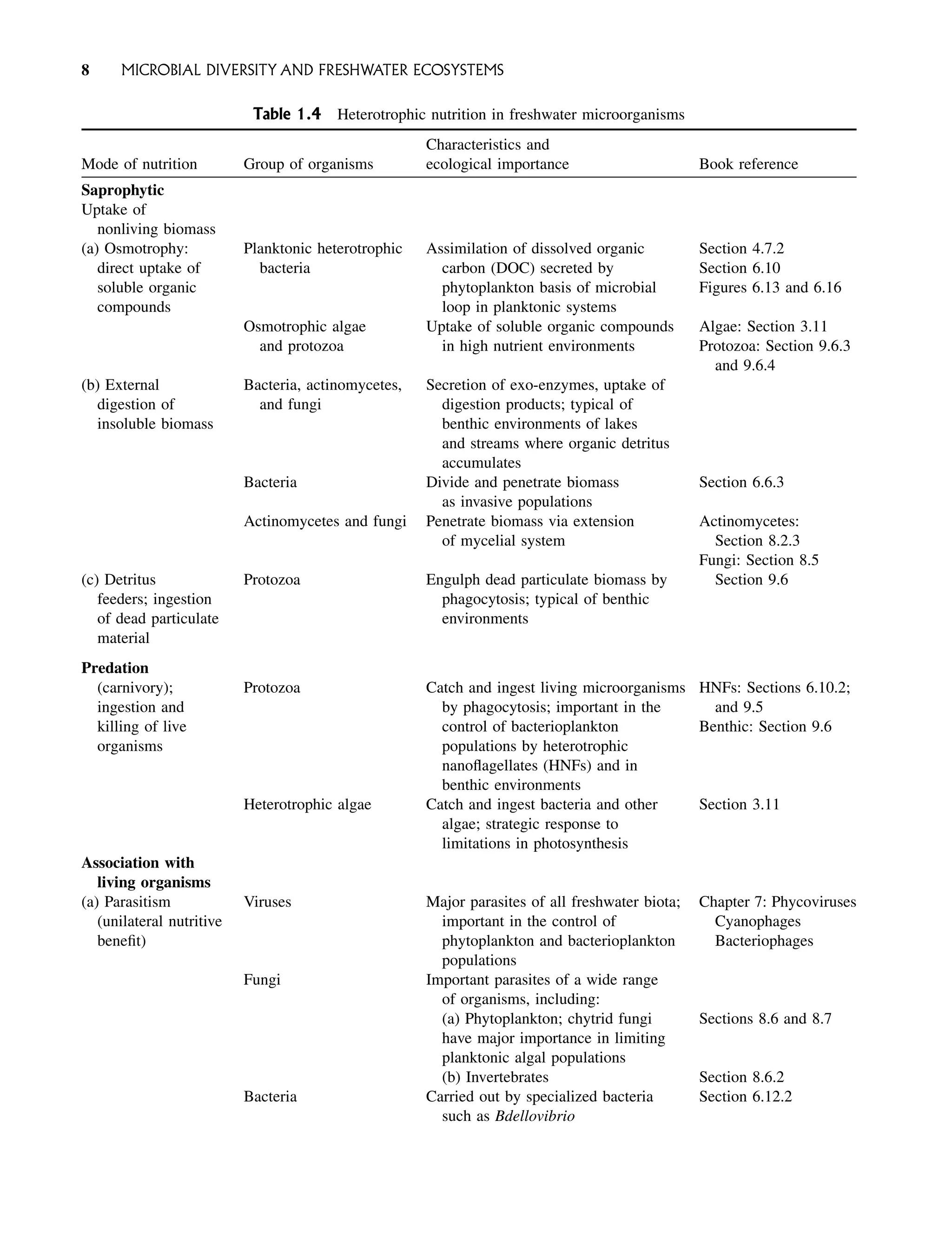
of activities (Table 1.4) with microorganisms ob-
taining their organic material in three main ways –
saprotrophy, predation, and in association with
living organisms. Saprotrophic organisms obtain
their nutrients from non-living material. This may
be assimilated in three main ways: direct uptake
as soluble compounds (chiefly bacteria), indirect
uptake by secretion of external enzymes (exo-
enzymes) followed by absorption of the hydrolytic
products (bacteria and fungi), and ingestion of
particulate matter by phagocytosis (protozoa). Pre-
dation is carried out by protozoa, and involves
capture, ingestion, and internal digestion of other
living organisms such as bacteria and algae. Proto-
zoa can capture their prey either by active motility
or, as sedentary organisms, by the use of filter feed-
ing processes. The third major aspect of hetero-
trophy involves associations with living organisms
and includes parasitism and symbiosis. Parasitism
almost invariably involves a strict dependence of the
parasite on the host organism as part of the parasitic
life cycle, though in some cases the benefits to
the parasite are not entirely clear. The common
BIODIVERSITY OF MICROORGANISMS 7
Table 1.4 Heterotrophic nutrition in freshwater microorganisms
Mode of nutrition Group of organisms
Characteristics and
ecological importance Book reference
Saprophytic
Uptake of
nonliving biomass
(a) Osmotrophy:
direct uptake of
soluble organic
compounds
Planktonic heterotrophic
bacteria
Assimilation of dissolved organic
carbon (DOC) secreted by
phytoplankton basis of microbial
loop in planktonic systems
Section 4.7.2
Section 6.10
Figures 6.13 and 6.16
Osmotrophic algae
and protozoa
Uptake of soluble organic compounds
in high nutrient environments
Algae: Section 3.11
Protozoa: Section 9.6.3
and 9.6.4
(b) External
digestion of
insoluble biomass
Bacteria, actinomycetes,
and fungi
Secretion of exo-enzymes, uptake of
digestion products; typical of
benthic environments of lakes
and streams where organic detritus
accumulates
Bacteria Divide and penetrate biomass
as invasive populations
Section 6.6.3
Actinomycetes and fungi Penetrate biomass via extension
of mycelial system
Actinomycetes:
Section 8.2.3
Fungi: Section 8.5
(c) Detritus
feeders; ingestion
of dead particulate
material
Protozoa Engulph dead particulate biomass by
phagocytosis; typical of benthic
environments
Section 9.6
Predation
(carnivory);
ingestion and
killing of live
organisms
Protozoa Catch and ingest living microorganisms
by phagocytosis; important in the
control of bacterioplankton
populations by heterotrophic
nanoflagellates (HNFs) and in
benthic environments
HNFs: Sections 6.10.2;
and 9.5
Benthic: Section 9.6
Heterotrophic algae Catch and ingest bacteria and other
algae; strategic response to
limitations in photosynthesis
Section 3.11
Association with
living organisms
(a) Parasitism
(unilateral nutritive
benefit)
Viruses Major parasites of all freshwater biota;
important in the control of
phytoplankton and bacterioplankton
populations
Chapter 7: Phycoviruses
Cyanophages
Bacteriophages
Fungi Important parasites of a wide range
of organisms, including:
(a) Phytoplankton; chytrid fungi
have major importance in limiting
planktonic algal populations
Sections 8.6 and 8.7
(b) Invertebrates Section 8.6.2
Bacteria Carried out by specialized bacteria
such as Bdellovibrio
Section 6.12.2
8 MICROBIAL DIVERSITY AND FRESHWATER ECOSYSTEMS
presence of Opalinid protozoa in the gut of adult
amphibia, for example, is thought to involve nour-
ishment from mucous secretions and gut fluids, but
there is no penetration of host tissues or any appar-
ent adverse effects on the host (Sleigh, 1973). As
with other freshwater parasites, this organism has a
well-defined life cycle that fits in with the aquatic
biology of the host. Commensal microorganisms
such as epiphytic bacteria, protozoa, and algae
derive no direct nutrient from their associated
host, though there may be indirect nutritive benefits.
These are seen in the phycosphere community that
occurs in association with mucilaginous colonial
algae (Figure 6.23), where a close coupling occurs
between the local growth of bacterial populations
and the trophic activities of bacterivorous protozoa.
Within the nutritive diversity shown in Table 1.4,
particular heterotrophic activities stand out as hav-
ing special ecological significance. These include
the uptake of DOC by planktonic bacteria, break-
down of detritus by benthic organisms (bacteria,
fungi, and protozoa) and limitation of phytoplank-
ton populations by parasitic activity (viruses and
fungi). The importance of heterotrophic nutrition in
the freshwater environment runs as a theme through-
out the book, with specific examples discussed in
appropriate sections (listed in Table 1.4).
Autotrophic and heterotrophic activities
within communities
The overall balance between autotrophic and hetero-
trophic activities within freshwater communities
is an important aspect of ecosystem function
(Pradeep Ram et al., 2003). This determines the
net exchange of carbon with the surrounding atmo-
sphere (which influences global warming) and can
be expressed as the net ecosystem production
(NEP), where
NEP ¼ P  R ð1:1Þ
and P ¼ primary productivity (carbon uptake during
photosynthesis) R ¼ community respiration (carbon
loss by respiratory breakdown).
NEP will have a positive value in ecosystems that
are net autotrophic (P  R), and a negative value
where the community is net heterotrophic (P  R).
The balance between P and R is determined by
the relative metabolic contributions of autotrophic
and heterotrophic organisms, which in turn relates
to environmental parameters such as light avail-
ability (promoting phototrophy) and availability
of externally-derived (allochthonous) carbon-
promoting heterotrophy.
Table 1.4 (Continued)
Mode of nutrition Group of organisms
Characteristics and
ecological importance Book reference
Protozoa Opalinid protozoa commonly occur
as parasites in the gut of
freshwater amphibiaa
(b) Symbiosis
(mutual nutritive
benefit)
Bacteria Association with blue-green algal
heterocyst
Section 6.13.3
Figures 6.23 and 6.24
(c) Commensalism
(no direct nutritive
benefit)
Bacteria, protozoa, algae Many microorganisms have a casual
epiphytic association with the
surfaces of other biota; the
phycosphere of colonial algae may
have a diverse population of such
organisms
Section 6.13.1
Figure 6.23
The above table contains examples of the major heterotrophic interactions and associations occurring in the freshwater environment and
is not intended to be a complete listing.
a
Sleigh, 1973.
BIODIVERSITY OF MICROORGANISMS 9
Benthic communities vary from net heterotrophy
(e.g., profundal sediments, dominated by anaerobic
heterotrophic bacteria) to net autotrophy (e.g.,
shallow lake sediments, dominated by benthic
algae – Figure 2.4). Pelagic communities typically
have greater light exposure than benthic systems,
and (in lentic water bodies) often have a greater
autotrophic contribution. The balance of available
nutrients is important, and low nutrient (oligo-
trophic) lakes are typically net heterotrophic while
high nutrient (eutrophic) lakes show net autotrophy
(see Tables 2.6 and 10.3). This difference arises
because oligotrophic conditions support only limit-
ed carbon uptake by phototrophy (low inorganic
nutrient availability) but significant heterotrophy
can still occur due to input of allochthonous carbon.
In eutrophic lakes, both modes of nutrition are
increased, but the increased availability of soluble
inorganic nutrients promotes autotrophy to a greater
extent.
The pelagic communities of lotic systems may
also show great variation in net ecosystem produc-
tion. This is seen particularly well in some estuaries
(Section 2.12), where the value for NEP shows
marked seasonal fluctuation with river inflow
(Pradeep Ram et al., 2003).
1.2.4 Planktonic and benthic microorganisms
Freshwater organisms can be divided into two main
groups, according to where they spend the major
part of their growth phase – pelagic organisms (pre-
sent in the main body of water) and benthic orga-
nisms (associated with the sediments). Pelagic biota
can be further subdivided into nekton (strongly
swimming organisms such as fish) and plankton
(free-floating). The latter tend to drift within the
water body, though they may have limited motility
and achieve vertical movement. Pelagic microorga-
nisms are essentially plankton, so the distinction
within this assemblage is between planktonic and
benthic states.
Although freshwater organisms can be catego-
rized as planktonic or benthic, most species have
both planktonic and benthic phases within their life
cycle. Biofilm bacteria, for example, have a dyna-
mic equilibrium between attached and planktonic
states, and freshwater algae also show clear plank-
tonic/benthic interactions in lake and stream en-
vironments (Section 3.6.1). Planktonic and benthic
phases of the same species typically show consider-
able differences in metabolic activity. This is parti-
cularly the case for freshwater bacteria, where
quorum-sensing mechanisms lead to the induction
of stationary-phase physiology in biofilm commu-
nities (Figure 1.7).
Planktonic microorganisms
These biota frequently have specialized mechan-
isms to migrate or maintain their position vertically
within the water column, and are particularly well
represented by micro-algae and bacteria. Planktonic
organisms can be further divided into holoplank-
tonic forms (where the organism is present in the
water column for a major part of the annual cycle)
and meroplanktonic organisms (where the plank-
tonic phase is restricted over time) biota. The
distinction between holoplanktonic and meroplank-
tonic species is particularly well shown by the
algae, where the meroplanktonic state can be viewed
as an adaptation for short-term competition (Sec-
tion 3.10.1).
Benthic microorganisms
Present at the surface and within sediments, these
are dominated by biota such as fungi, protozoa, and
bacteria that are able to break down sedimented
organic debris. The diversity of benthic life forms
is particularly well represented by the protozoa
(Section 9.6), which include both attached and
freely-motile organisms, with a variety of feeding
mechanisms.
A number of key terms have been used to define
particular groups of benthic organisms, including
one major group – the periphyton. This term is
used to describe all the ‘plant-like’ microorgan-
isms (microflora) present on substrata, including
microscopic algae, bacteria and fungi. This term
excludes ‘animal-like’ organisms, such as micro-
invertebrates and protozoa, but includes filamentous
10 MICROBIAL DIVERSITY AND FRESHWATER ECOSYSTEMS
algae (e.g., Cladophora, Spirogyra, Chara, and
Vaucheria).
Differences occur within the periphyton in terms
of the nature of the substrate, which may be living
(e.g., plant surfaces) or non-living (organic or inor-
ganic, with different particle sizes).
 Epiphytic organisms are associated with the sur-
faces of higher plants and macroalgae. The sub-
stratum in this case is often metabolically active,
and the epiphytic association may be important in
terms of competition for light, metabolic ex-
change and nutrient availability.
 Epilithic, epipsammic and epipelic microorgan-
isms grow on non-living substrates which differ
in particle size. Epilithic biota occur on hard,
relatively inert substrata such as gravel, pebbles
and large rocks. Decrease in particle size leads to
epipsammic organisms (present on sand) and
epipelic organisms (present on fine sediments
such as mud). Relatively few of the larger micro-
organisms, such as algae, live in sand, since parti-
cles are too unstable and may crush them. Quite
large algae are present on fine sediments, how-
ever. including large motile diatoms, motile fila-
mentous algae and large motile flagellates such
as Euglena.
A further group of plant-like benthic organisms
includes the metaphyton, which are loosely asso-
ciated (but not attached) to the substratum. These
are characterized by clouds of filamentous green
algae such as Spirogyra, Mougeotia or Zygnema,
which become loosely aggregated and accumulate
in regions of substratum that are free from currents
and waves. Metaphyton usually arises from other
substrata, such as higher plant surfaces (epiphyton).
1.2.5 Metabolically active and inactive states
Although freshwater microorganisms are often
thought of as dynamic, metabolically active biota,
this is not always the case. All species have inactive
or inert periods for at least part of their life cycle;
these may occur as temporary dormant phases (sur-
viving adverse conditions) or terminal phases of
senescence, leading to death.
Dormant phases
In temperate climates, particularly, many micro-
organisms overwinter on the sediments in a dormant
state. The formation of resistant spores typically
occurs as environmental conditions deteriorate
(overcrowding, reduced nutrient and light avail-
ability, accumulation of toxic metabolites, reduced
temperature), and may be preceded by sexual repro-
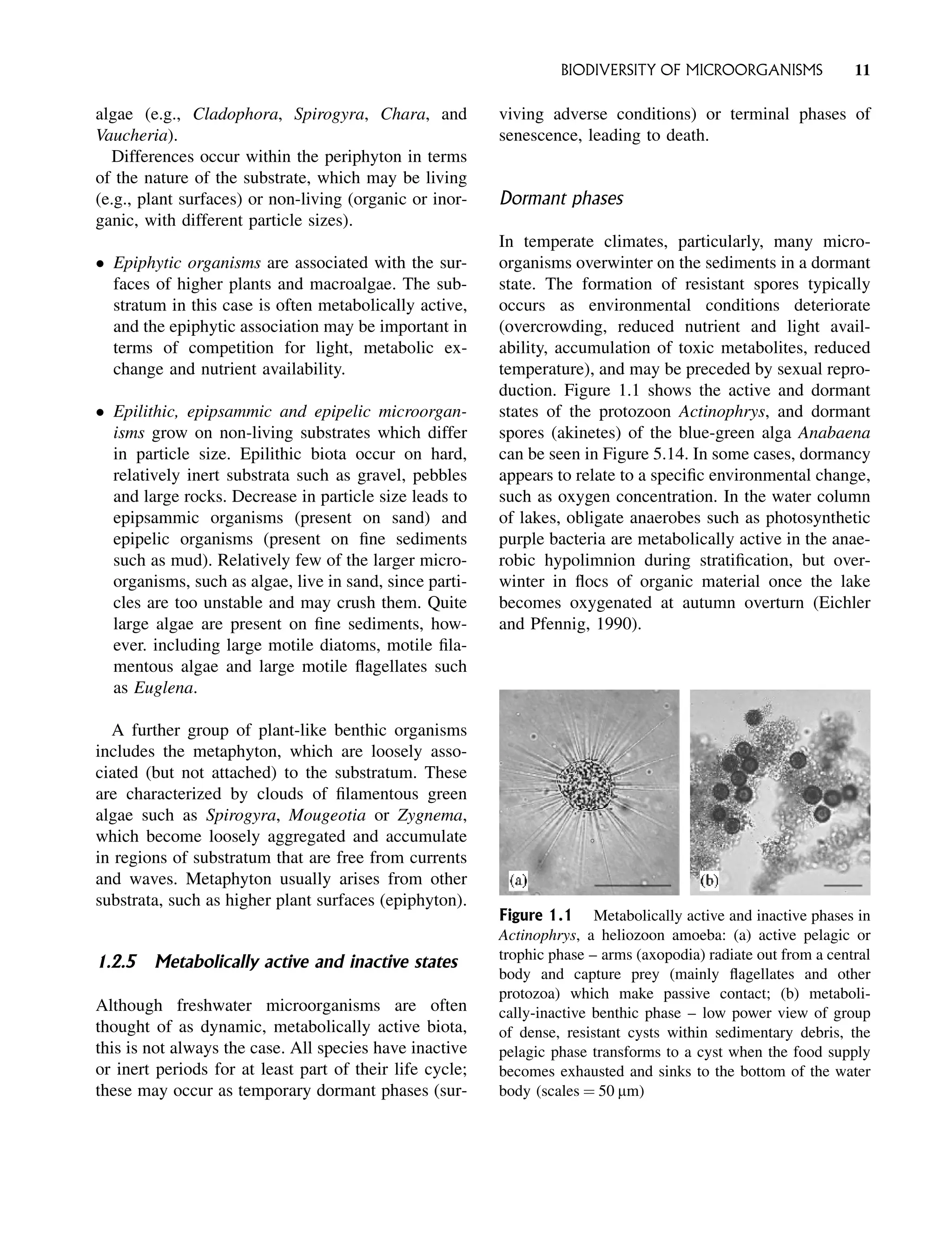
duction. Figure 1.1 shows the active and dormant
states of the protozoon Actinophrys, and dormant
spores (akinetes) of the blue-green alga Anabaena
can be seen in Figure 5.14. In some cases, dormancy
appears to relate to a specific environmental change,
such as oxygen concentration. In the water column
of lakes, obligate anaerobes such as photosynthetic
purple bacteria are metabolically active in the anae-
robic hypolimnion during stratification, but over-
winter in flocs of organic material once the lake
becomes oxygenated at autumn overturn (Eichler
and Pfennig, 1990).
Figure 1.1 Metabolically active and inactive phases in
Actinophrys, a heliozoon amoeba: (a) active pelagic or
trophic phase – arms (axopodia) radiate out from a central
body and capture prey (mainly flagellates and other
protozoa) which make passive contact; (b) metaboli-
cally-inactive benthic phase – low power view of group
of dense, resistant cysts within sedimentary debris, the
pelagic phase transforms to a cyst when the food supply
becomes exhausted and sinks to the bottom of the water
body (scales ¼ 50 mm)
BIODIVERSITY OF MICROORGANISMS 11
In bacteria and viruses, metabolic inactivity is
also nutrient-related. Comparisons of total and
viable bacterial counts suggest that only a small
fraction of aquatic populations are metabolically-
active. Under certain environmental conditions, bac-
teria remain inert until they encounter appropriate
growth conditions – particularly in relation to
nutrient supply. Viruses are also metabolically
inactive within the water medium, and are only
activated when they encounter a healthy host cell
(Section 7.2). In the inert state, they occur as free
particles (virions) within the water medium, and
are vulnerable to inactivation and loss processes
(Figure 7.1).
Senescence
Senescence and cell death are just as much a part of
population development as growth processes, and
play an important role in the dynamics of microbial
communities. In some situations, death is induced
by specific environmental factors such as nutrient
limitation (Section 5.2.4), solar irradiation (photo-
inhibition, Section 4.9) and parasitism (Chapters 7
and 8). In other situations, senescence may occur
due to internal changes, particularly after a long
sequence of divisions and probably due to pro-
grammed cell death.
The occurrence of growth and senescence within
a single-species population is shown in Figure 1.2,
which is taken from a stationary phase in a labora-
tory monoculture of the green alga Micrasterias.
Mature cells (M) of this placoderm desmid have
two halves (semicells) of equal size, each with a
single chloroplast. Cells that are undergoing sen-
escence (S) show condensation of the chloroplasts
to the centre of the cell, leading to degeneration and
the formation of colourless dead cells that just
have the remains of the cell wall. Actively growing
cells that have recently divided (inset) have one
normal sized semicell (b) derived from the mother
cell, plus a new semicell (a) that will attain full size
on completion of the growth cycle. Although cell
differences in growth cycle and the onset of senes-
cence are particularly clear in populations of this
organism, they are also characteristic of other popu-
lations where they are not so easily observed. Within
phytoplankton populations at the top of the water
column, for example, senescence and cell death
occurring in a wide range of species results in a
continuous rain of mixed organisms to the lower
part of the water column and the sediments. These
can be collected in sediment traps suspended in the
water column and subsequently analysed.
1.2.6 Evolutionary strategies: r-selected
and K-selected organisms
In the population of cells shown in Figure 1.2,
regeneration (formation of new organisms) and
death continuously occur. The growth of popula-
tions that include continuous cycles of regeneration
and death is best described by ‘models of conti-
nuous growth’ (Begon et al., 1996), and leads to a
consideration of the importance of competition in
population increase and the designation of two
opposing evolutionary strategies – adopted by
r-selected and K-selected organisms.
Exponential and sigmoidal models
of continuous growth
The speed with which a single-species population
(N) increases with time will be denoted by dN=dt.
Figure 1.2 Cycles of death and regeneration in an algal
population (scale ¼ 100 mm)
12 MICROBIAL DIVERSITY AND FRESHWATER ECOSYSTEMS
The increase in size of the whole population is the
sum of the growth contribution of all individuals,
so the rate of increase per individual (r) will be:
r ¼
dN
dt
1
N
 
ð1:2Þ
or
rN ¼
dN
dt
The parameter r is also referred to as the ‘per capita
rate of increase’ and describes the fundamental abi-
lity of individual organisms to grow and reproduce.
The above equation describes population growth
in conditions of unlimited resources and generates
an exponential increase in population with time
(dashed line, Figure 1.3). In practice, intra-specific
competition for resources (particularly nutrients and
space) must also be taken into account, and the
population growth curve then becomes sigmoidal
(solid line, Figure 1.3). In this situation, the popula-
tion (N) rises to a maximum value (K), which is the
maximum value (the carrying capacity) that the en-
vironment can support.
The growth equation which describes the sigmoi-
dal curve is referred to as the ‘logistic equation’ and
has the form:
dN
dt
¼ rN
K  N
K
 
ð1:3Þ
This sigmoidal curve is well-known to microbio-
logists, where the growth of microorganisms in
batch culture follows a sequence of lag, logarithmic
and stationary phases. In the lower part of the curve
(lag phase), when population is sparse, the popula-
tion is beginning to colonize the new environment
and relatively little competition occurs between
cells. As the population approaches the carrying
capacity (K), resources (nutrients, space) become
limited and high levels of competition occur
between cells.
r-selected and K-selected organisms
The conditions seen in the single-species growth
curves of organisms cultured under laboratory con-
ditions (Figure 1.3) can also be applied to fresh-
water environments, where mixed populations occur.
Some environments have low population densities,
and are dominated by organisms that are adapted
for high rates of growth and rapid colonization,
while others have high population densities and
Dense population:
intense competition
for space and nutrients
Sparse population:
little competition Time (t)
Exponential growth
− no competition
Sigmoid growth
− with competition
Population
(N)
K
0 Figure 1.3 Effect of intra-specific
competition on the population growth
of a single species (based on a figure
from Begon et al., 1996)
BIODIVERSITY OF MICROORGANISMS 13
are dominated by organisms that are adapted to
survive in these highly competitive conditions.
This fundamental distinction between two major
types of adaptation was first described by MacArthur
and Wilson (1967) in relation to differences in
selection pressure at different phases in the coloni-
zation of oceanic islands. These authors separated
organisms into r-strategists, which were the initial
colonizers of the island environment, and K-strate-
gists – adapted to the more crowded, later condi-
tions. In uncrowded environments, organisms able
to grow and reproduce rapidly, with high productiv-
ity, will be most suited to dominate the environ-
ment. They are subsequently replaced by organisms
which are more suited to a crowded community that
is approaching its population limit and are referred
to as K-strategists. The terms r and K are derived
from the logistic equation for population growth,
which specifies that the per capita rate of increase
(r) is maximized under sparse conditions. With
increasing crowding, a decline in the per capita rate
of increase occurs until the population density equi-
librates to its upper level or carrying capacity (K).
The adaptation of r- and K-strategists to environ-
ments of differing population density has a range of
biological implications (Table 1.5), including differ-
ences in biological diversity, competition, accu-
mulation of metabolites, resource availability, and
liability to parasitic attack. The incidence of eco-
logical stress (see Section 1.6) can be high or low in
either situation, depending on the particular circum-
stances. The adaptation of r-strategists to uncrowd-
ed conditions also makes them suitable to unstable
environments, where growth is limited to short
periods of time and high population levels cannot
become established. Under such conditions the abi-
lity of these organisms to grow rapidly and exploit
growth opportunities as they become available gives
them a competitive advantage. In line with this,
r-strategists are typically small, with a short life
cycle and high growth rate. In contrast, K-strategists
are adapted to stable environmental conditions,
where dense populations develop and rapid growth
is not an advantage (Andrews, 1992). All groups
of freshwater microorganisms contain r- and
K-selected species, and all aquatic environments
Table 1.5 Biological characteristics of environments that are dominated by r-selected and K-selected organisms. Many
of these characteristics (shaded boxes) directly relate to differences in population level
Domination by Domination by
Environmental parameter r-selected organisms K-selected organisms
Example  Lake Clearwater phase  Lake autumn bloom
 Early biofilm  Maturating biofilm
Population density Low High
Biological diversity Low to moderate Typically high
Competition Low High
Accumulation of metabolites in water medium Low High – including DOC and
blue-green toxins
Resource availability High availability of space Limited
and/or nutrients
Liability of a species population to parasitic Typically low, but may be high High (high host population
(virus, fungal) attack in high-stress situations density)
Population stability Low – populations liable to High
sudden change
Stress level May be low (biofilm colonization) May be low (normal autumn
or high (lake Clearwater phase) algal bloom) or high
(intense blue-green
dominance)
14 MICROBIAL DIVERSITY AND FRESHWATER ECOSYSTEMS
have situations (during colonization, and at different
times in the mature community) when r- and
K-strategists are respectively adapted to the prevail-
ing situation. Planktonic bacteria are particularly
good examples of r-strategists (Section 6.1.3), exist-
ing in a metabolically inert form for much of their
life cycle, but able to grow and multiply within
a short space of time when nutrients become
available. Phytoplankton contain well-adapted
examples of both types of organism, with changes
in dominance of r- and K-selected algae during
the seasonal progression. One particular group of
algae, the dinoflagellates, are perhaps the best
example of all microbial K-strategists (see Section
3.10.2).
1.3 Biodiversity in ecosystems,
communities, and species
populations
Individual microorganisms are part of larger groups
or communities, and any consideration of biodiver-
sity must take into account the wider community
and the environment in which it occurs.
A community is a naturally occurring group of
organisms living in a particular location, such as a
lake or stream. The occurrence and interactions of
organisms living within a discrete environment
constitutes a functional unit, referred to by Tansley
(1935) as an ecological system or ‘ecosystem’. This
was considered by Tansley to consist of two major
components – the biome or ecosystem community
(the entire group of organisms) and the habitat
(physical environment). Each particular ecosystem
can be regarded to some extent as self-contained
and as a basic unit of ecology. Ecosystems are
themselves part of a larger geographic or global
unit, the biosphere, which is the sum of all ecosys-
tems within a particular zone.
The nature and evaluation of community diversity
partly depends on environmental scale and can be
considered as a hierachy of three levels – main
ecosystems, subsidiary communities, and species
populations (Figure 1.4).
1.3.1 Main ecosystems
Major aquatic environments such as lakes, rivers
and wetlands form a discrete ecological unit, with
their own characteristic community of organisms;
they can be referred to as main ecosystems. Each
of these main ecosystems contains a diverse array
of distinctive groups of organisms (subsidiary com-
munities), each in their own particular environment,
forming subsidiary ecosystems.
As an example of this, a typical temperate lake
(main ecosystem) can be divided into two major
regions – the peripheral shoreline (littoral) zone and
the central zone (Figure 2.4), each with its own
subsidiary communities and ecosystems. The cen-
tral zone can be separated into pelagic and benthic
groups of organisms, with further resolution within
the pelagic zone of neuston, phycosphere and photo-
synthetic bacterial communities (Table 1.6). These
occur in discrete small-scale environments, and are
entirely composed of microorganisms.
The littoral zone of the lake is dominated by att-
ached organisms, which in eutrophic lakes can be
divided into three major groups – macrophyte, upper
MAIN ECOSYSTEM
(e.g., lake, river, wetland)
Mixture of subsidiary
ecosystems, each with
its own community
Single community, with:
• Different types of organism
• Variety of species
SUBSIDIARY
COMMUNITIES
(e.g., biofilm, pelagic community)
Diversity within species
− molecular, chemical, and
physiological variation
SINGLE SPECIES
POPULATION
(e.g., single algal species in
water column)
ECOLOGICAL UNIT
BIOLOGICAL
DIVERSITY
Figure 1.4 Diversity within species, communities, and
groups of communities at different levels of organisation
in freshwater systems
BIODIVERSITY IN ECOSYSTEMS, COMMUNITIES, AND SPECIES POPULATIONS 15
periphyton and lower periphyton communities (see
Figure 3.11). Within these, various distinctive micro-
communities occur including epiphytic communities
on macrophyte leaves, and algal and bacterial bio-
films on exposed rock surfaces.
Although these various groups of organisms have
a degree of autonomy, they all interrelate within the
main ecosystem. The pelagic and benthic commu-
nities, for example, may appear very distinct during
the summer growth phase of eutrophic lakes but the
benthic community depends on continuous biomass
input from the pelagic zone by sedimentation, and
populations of planktonic organisms arise by recruit-
ment from the benthic zone.
1.3.2 Diversity within subsidiary communities
Different communities have their own distinctive
pattern of organisms with their own level of biodi-
versity. Within these communities, this diversity can
be measured in various ways including variation in
size of organisms, presence of mucilaginous and
non-mucilaginous types, attached and free-floating
biota and proportions of autotrophic and hetero-
trophic species. In practice, diversity is often deter-
mined simply in terms of species content. This is
illustrated in Section 3.13. where the variety of
algae within phytoplankton is considered in terms
of indices of species diversity. Significant changes
occur in these indices during seasonal development
of phytoplankton (Figure 3.28), indicating funda-
mental changes in community diversity throughout
the growth season.
1.3.3 Biodiversity within single-species
populations
Phenotypic and genetic diversity within the ecosys-
tem populations of individual species represents
an important but relatively unexplored area of
Table 1.6 Subsidiary communities within the central and littoral zones of a stratified temperate lake (main ecosystem)
Main part of lake Subsidiary community Physical characteristics Book reference
Central zone Pelagic community Varied throughout water Section 3.7.2
column – epilimnion and hypolimnion
Neuston Lake surface microlayer Section 2.16
Figure 2.21
Phycosphere community Colony mucilage – attachment and Section 6.13
matrix for biota Figure 6.23
Population of Top of hypolimnion – anaerobic Section 6.7.3
photosynthetic bacteria plus limited light
Benthic community Bottom of water column and sediments; Section 6.6.3
anaerobic, nutrient-rich, no light
Littoral zone Macrophyte community Exposed to high light Section 3.6.2
Upper periphyton High sunlight and temperature, with Figure 3.11
(eulittoral) community wave action in some lakes
Lower periphyton
(sublittoral community) Thermally stable region, with low Figure 3.11
light and turbulence
Epiphytic community Attached to plant surface; high light, Figure 3.10
on macrophyte leaves oxygenated, water motion
Algal and bacterial Thin surface layer on hard substrate Sections 3.7.2
biofilms on exposed and 6.11
rock surfaces
Microbial communities are indicated by shading.
16 MICROBIAL DIVERSITY AND FRESHWATER ECOSYSTEMS
biological diversity in freshwater systems. One of
the problems in studying variability at this level is
that classical biochemical (test-tube) techniques are
difficult to apply to single species within mixed
populations.
The use of analytical microscopical techniques,
however, has gone some way to overcoming this
problem since these have sufficient spatial resolu-
tion to determine the chemical and molecular com-
position of single microorganisms within mixed
populations. Some of these techniques are discussed
in relation to algal populations (Section 3.2.2)
and include the use of light microscope infrared
spectroscopy to study the vibrational states of differ-
ent molecular groups (Figure 3.3; Sigee et al., 2002)
and the use of scanning electron microscope X-ray
micro-analaysis to determine variations in elemen-
tal composition (Figure 5.2; Sigee et al., 1993).
Both of these approaches have demonstrated
considerable variability within the single-species
populations that make up the mixed phytoplankton
assemblage, indicating that intra-specific variation
in planktonic algae is an important feature of the
pelagic environment.
Molecular techniques also have considerable
potential for looking at biodiversity within single
species populations, and have been used to study
various aspects of genetical variation within natural
populations. These include sub-species (strain)
variation in blue-green algae (Section 3.3.1) and
variations in plasmid-borne resistance in aquatic
bacteria (Section 6.5.1). Differences between plank-
tonic and attached (biofilm) bacteria in terms of the
expression of stationary phase genes (Section 1.4.1)
also constitute an important an important intra-
specific variable within benthic systems.
B. ECOSYSTEMS
Ecosystems vary in size and composition, and con-
tain a wide range of organisms which interact with
each other and with the environment. Individual
ecosystems have a number of important properties
(McNaughton, 1993; Berendse, 1993):
 a distinct pattern of interactions between
organisms,
 defined routes of biomass formation and transfer,
 maintenance of the internal environment,
 interactions with the external environment.
The range of organisms present in aquatic com-
munities define and characterize the system con-
cerned, and are involved in the generation and
transfer of biomass. They have distinct roles and
interactions within the ecosystem, occupying parti-
cular trophic levels and forming an interconnected
system of feeding relationships (the food web). The
balance of individual species within the food web is
determined primarily by resource (light, nutrient
availability) and competition. This in turn affects
variety in the range and proportions of the different
organisms (biodiversity), with important implica-
tions for the overall functioning of the system. Com-
munity structure is closely related to ecosystem
stability and physical stress levels in the environ-
ment (see Section 1.6). Interactions between eco-
systems and their surrounding environment occur
in various ways. One example of this is the net
exchange of carbon between the aquatic ecosystem
and the adjacent atmosphere, which can be quanti-
fied in relation to net ecosystem production (NEP)
(see Section 1.2.3.)
This section considers the dynamic properties of
freshwater communities within two ecosystems
where microorganisms have a key role – the micro-
bial biofilm and the pelagic ecosystem of lakes. The
microbial biofilm is a small-scale ecosystem com-
posed entirely of microorganisms, while the pelagic
ecosystem is a large-scale functional unit containing
a wide range of biota. Summary diagrams of eco-
system functions for these two systems are respec-
tively given in Figures 1.6 and 1.8. Contrasts
between the diagrams to some extent reflect diver-
sity in research approach rather than fundamental
BIODIVERSITY IN ECOSYSTEMS, COMMUNITIES, AND SPECIES POPULATIONS 17
ecosystem differences. In the case of biofilms, for
example, a lot of information has been obtained on
genetic interactions, but relatively little is known
about food webs. The reverse is true for pelagic
ecosystems.
1.4 The biofilm community: a small-scale
freshwater ecosystem
Microbial biofilms provide a useful model system
for considering fundamental aspects of community
interactions and ecosystem function (Allison et al.,
2000). Their small scale makes them amenable
to laboratory as well as environmental experimenta-
tion, and the close proximity of organisms within
the biofilm leads to high levels of biological inter-
action. Within the context of this book, the exclu-
sively microbial composition of biofilms also makes
them particularly appropriate for consideration.
Microbial biofilms occur as discrete communities
within a gelatinous matrix, and are present as a sur-
face layer on rocks and stones in lakes and rivers.
The biological composition of biofilms varies with
environmental conditions, including factors such as
ambient light intensity, water flow rate and prior
colonization history. In some cases they are entirely
bacterial (Section 6.11), while in others they initiate
with the settlement of diatoms and develop into
larger scale periphyton communities (Figure 9.17).
The biofilm shown in Figure 1.5 is a mature mixed
biofilm, such as might occur on a river substratum
under conditions of limited light, and consists of a
balanced community composed mainly of bacteria,
with algae, protozoa, and fungi also present. The
Secretion
Gene
transfer
Loss and
recruitment
of cells
MATRIX
DOC
Photosynthesis
LIGHT
Specific
adhesion
mechanisms
Inorganic
nutrients
Population increase
Quorum
sensing
Current
SOLID SUBSTRATUM
Conditioning film
Organic
solute
EXTERNAL
WATER
MEDIUM
Ingestion
Figure 1.5 Biological interactions with-
in a mixed biofilm: A small-scale micro-
bial ecosystem. Found as a surface layer on
rocks and stones in rivers and the littoral
zone of lakes, the thickness of the biofilm
ranges from a few micrometers (mm) to
several millimetres (mm). Different micro-
organisms within the biofilm (not drawn to
scale) are indicated by the following sym-
bols: Bacteria - Algae Protozoa
Fungi In a mature biofilm, the
gelatinous matrix ( ) is typically
highly structured, occurring as columns
with interstitial spaces through which
water can percolate ( ). Water flow also
occurs across the surface of the biofilm.
Solid arrows simply relate organisms to
particular activities (see also Figure 6.17)
18 MICROBIAL DIVERSITY AND FRESHWATER ECOSYSTEMS
organisms are largely present within a gelatinous
matrix, which defines the extent of the ecosystem.
The matrix typically has a columnar appearance,
with channels or pores between the columns through
which water percolates.
The microbial biofilm shares with other small-
scale microbial (e.g., neuston and phycosphere)
ecosystems and with larger ecosystems the four
key aspects of ecosystem function listed above –
interactions between organisms, biomass transfer,
homoestasis and interactions with the external en-
vironment (Figure 1.6).
1.4.1 Interactions between microorganisms
Microbial interactions illustrated in Figure 1.6 occur
both within the main population of bacteria and in
relation to other microorganisms. Bacterial interac-
tions determine the structure and diversity of the
biofilm and include gene transfer, quorum sensing
and specific adhesion processes. Trophic (feeding)
interactions occur between different groups of biota
and can be considered in terms of food webs.
Gene transfer
Microbial biofilms are particularly important in
relation to gene transfer between bacterial cells,
since they are a part of the aquatic environment
where the transfer process is optimized due to the
close proximity of the organisms concerned. The
importance of genetic diversity and spread of novel
genes is discussed in Section 6.3, and the mecha-
nisms of transfer by transformation, transduction or
conjugation, in Section 6.4. Gene transfer between
bacterial cells has been studied under both labo-
ratory and environmental conditions.
Quorum sensing
The physiological activities of bacteria vary consi-
derably in relation to population density (number of
cells per unit volume of medium). The pattern of
gene activity, in particular, differs markedly within a
single bacterial species between the sparse plank-
tonic populations that occur in the general water
medium and the dense community of cells present
in the microbial biofilm. The mechanism underlying
this difference in gene expression is referred to as
‘quorum sensing’ and depends (in Gram-negative
bacteria) on the release of the signal molecule acyl
homoserine lactone (AHL) into the water medium
(Davies, 2000).
At low population density, release of AHL results
in the formation of low signal concentrations in the
water medium, and no quorum response. At high
population density, the concentration of AHL in the
water reaches a critical level, activating DNA tran-
scription factors (by binding to them) and triggering
the activation of AHL-responsive genes (Figure 1.7).
These AHL-responsive genes have been shown to
be present in a wide range of biofilm bacteria (inclu-
ding Pseudomonas aeruginosa) and to operate in
environmental (stream) biofilms (McLean et al.,
1997). They encode a variety of cell functions,
including population density regulation, pseu-
domonad virulence factors and stationary-phase
characteristics. The induction of stationary-phase
physiology is an important feature of biofilms, dis-
tinguishing these organisms from their planktonic
counterparts. In Pseudomonas aeruginosa, the
stationary phase state is caused by induction of a
stationary phase sigma (transcription) factor known
as RpoS (Suh et al., 1999), which activates a wide
Interactions between
microorganisms
• Gene transfer
• Competition for space
and nutrients
• Quorum sensing
• Specific adhesion processes
• D efined colonization sequence
Interactions with
external environment
• Light absorption by algae
• Uptake of inorganic nutrients
• Loss and recruitment of bacteria
• Colonization by algae, fungi and
protozoa
Maintenance of internal
environment
• Production of environmental
(gelatinous) matrix
• Balance in population dynamics
within biofilm
• No net loss or gain of cells
• Balance of cell types − specific
adhesion mechanisms
Biomass formation and transfer,
energy and carbon flow
• Carbon fixation by algae
• Uptake of complex solutes
by bacteria and fungi
• Ingestion of particulates by
protozoa
Figure 1.6 Major ecosystem functions in a mixed
microbial biofilm community
THE BIOFILM COMMUNITY: A SMALL-SCALE FRESHWATER ECOSYSTEM 19
spectrum of stationary phase characteristics. These
include greater antibiotic resistance, decrease in pro-
tease secretion, reduced motility and higher levels
of extracellular polysaccharide (EPS) synthesis.
These changes promote the formation of the biofilm
(EPS) matrix, and the retention of cells within the
surface film (reduced motility), and are thus crucial
in forming and maintaining the biofilm ecosystem.
Specific adhesion processes
Specific adhesion mechanisms are important in the
secondary colonization and maturation of bacterial
biofilms (Section 6.11). During biofilm develop-
ment, different species of bacteria enter the
community at different times, and there is a need
for specific recognition systems to maintain the
necessary sequence and hierarchy of association.
This is achieved by specific co-aggregation, which
involves receptor-mediated recognition and specific
binding between different species of bacteria
(Figure 6.18).
Trophic interactions
Ingestion of biofilm bacteria, diatoms and blue-
green algae is carried out by protozoa that move
over exposed submerged surfaces. These protozoa
include hypotrich ciliates, hypostome ciliates (with
ventral mouths) plus bodonid and euglenoid flagel-
lates (Section 9.3). Ingestion of biofilm microorga-
nisms is the first stage in the sequence of biomass
transfers that forms the food web of the biofilm
ecosystem, but also connects with the food web of
the wider lake or river ecosystem.
In addition to protozoa, surface biofilms are
also grazed by larger invertebrates such as snails
and larvae of Ephemeroptera and Trichoptera
(Section 9.13). These larger organisms are extra-
neous to the biofilm community.
1.4.2 Biomass formation and transfer
Relatively little is known about biomass formation
and transfer in aquatic biofilms. The presence of
autotrophic algae such as diatoms and blue-
green algae generates fixed carbon by photosyn-
thesis, and some release of dissolved organic carbon
(DOC) would be expected. Biomass transfer occurs
via ingestion of cellular and other particulate mater-
ial by protozoa and invertebrates (see above), and
also by assimilation of secreted organic material
such as DOC and matrix by bacteria and fungi.
Extraneous organic material may also enter biofilms
and become part of the biomass transfer.
1.4.3 Maintenenace of the internal
environment
The microbial biofilm illustrated in Figure 1.5 is a
mature film that has arisen from a sequence of
colonization processes (Section 6.11). This has
resulted in a stable and balanced internal environ-
ment which has two major components:
 The gelatinous matrix, secreted by the bacteria,
and forming a complex architecture that includes
AHL
AHL
AHL
Low concentration
of AHL in medium
Low density
of bacteria
(planktonic phase)
AHL
AHL
AHL
AHL
AHL
High concentration
of AHL in medium
High density
of bacteria
(biofilm phase)
DNA-binding protein
+ AHL
Activation of
AHL-response genes
Stationary phase
induction factor
RpoS
Stationary phase physiology
• antibiotic resistance
• decrease in protease secretion
• high level of EPS synthesis
Critical
concentration
Figure 1.7 Quorum sensing in Gram-negative bacteria:
induction of stationary phase physiology at high popula-
tion density in biofilms (AHL – acyl homoserine lactone
signal molecule)
20 MICROBIAL DIVERSITY AND FRESHWATER ECOSYSTEMS
internal spaces (pores and channels) with a water
circulation connecting to the outside medium.
 Populations of different microorganisms that are
in a state of balanced equilibrium.
Once the biofilm has become established, the
internal environment will be maintained and con-
trolled by the resident microorganisms. This in-
volves the following processes.
1. Continued production of gelatinous matrix. Con-
tinued secretion of the extracellular polysacchar-
ide (EPS) matrix by bacterial cells tends to
balance the loss caused by detachment of pieces
of biofilm at the water surface and entrainment in
the current.
2. Controlled population growth. Growth rates of
bacteria within the biofilm are controlled by the
quorum sensing system that acts as a negative
feedback process. High population densities trig-
ger the induction of stationary phase character-
istics, including reduced rates of cell division. If
the population of bacteria becomes depleted
(e.g., due to ingestion) the quorum control will
cease to operate, and division will increase.
3. Balance of mixed populations. The balance of
different organisms will be determined by differ-
ential growth rates, stable food webs and specific
adhesion mechanisms. The latter is particularly
important during biofilm development and matu-
ration, when the changing pattern of species
composition that accompanies the colonization
process is determined by differential recognition
and adhesion characteristics. These features may
also control the entry of bacteria into the mature
biofilm and their retention within the community.
1.4.4 Interactions with the external
environment
Although microbial biofilms operate as a functional
(and to some extent self-contained) unit, they are
not separate from either their physicochemical or
biological surrounding environment. Important phy-
sicochemical characteristics include light (required
for photosynthesis), inorganic nutrients, soluble
organic nutrients and dissolved oxygen. The entry
and exit of soluble components into and out of the
biofilm is promoted by internal water circulation,
and leads to concentration gradients within the
gelatinous matrix. These concentration gradients
may be important determinants of local biofilm
physiology and microstructure. The potential impor-
tance of nutrients is indicated by laboratory studies
on monospecies biofilms (Molin et al., 2000), which
have suggested that biofilm structure is greatly influ-
enced by the concentration and quality of nutrients.
The external biotic environment also has direct
influences on biofilms. These are exerted through
invertebrate grazing activities, and also entry and
loss of resident microbes at the water interface. The
entry of particulate (by sedimentation) or soluble
(water flow) organic materials into the biofilm is a
further biotic effect that provides important sub-
strates for heterotrophic nutrition.
1.5 The pelagic ecosystem: a large-scale
unit within the lake environment
Pelagic ecosystems occupy the main water body of
the lake and contain the largest subsidiary commu-
nity within the main lake ecosystem, encompassing
all the free floating (planktonic) and strongly swim-
ming (nektonic) organisms. Pelagic ecosystems of
lakes occupy the largest volume of all freshwater
environments (excluding snow and ice systems),
and show close similarities to the marine pelagic
ecosystems of seas and oceans.
Characteristics of lake pelagic ecosystems in
relation to the four key parameters of ecosystem
function are summarized in Figure 1.8.
1.5.1 Interactions between organisms
A range of defined interactions occur between
microorganisms in pelagic lake ecosystems, includ-
ing competition for resources, antagonism, trophic
THE PELAGIC ECOSYSTEM: A LARGE-SCALE UNIT WITHIN THE LAKE ENVIRONMENT 21
interactions and epiphytic associations. Some of the
major microbial interactions are listed in Table 1.7.
Competition for resources such as light and inor-
ganic nutrients (silicate, phosphate, nitrate) are an
important contributory factor in determining the
relative ability of different species populations to
grow and dominate the pelagic environment. In
cases where competition for more than one nutrient
is involved, a change in algal dominance may occur
with shift in nutrient balance (Figure 5.26).
Antagonistic interactions may also occur as part
of the competition for resources, allowing the popu-
lation of the successful antagonist to access the
resources and also generating nutrients from the
target organism. Freshwater bacteria in particular,
which are known to produce a range of anti-algal
metabolites, may be important as antagonists in the
termination of algal blooms, and are also potentially
useful as biological control agents. Dominance of
blue-green algae in bloom conditions may also be
regarded as antagonistic activity, since the low CO2/
high pH micro-environment created by these orga-
nisms inhibits the growth of eukaryote algae in the
top part of the water column.
Trophic interactions in the pelagic zone are often
very specific, and may result in close coupling of
particular microbial populations. This is the case for
heterotrophic bacteria and phytoplankton, which are
linked by algal DOC production. A trophic link also
occurs between bacteria and predatory heterotrophic
nanoflagellate (HNF) protozoa, with a buildup of
HNF populations in some lakes at times of high
bacterial count. Parasitic viral and fungal infections
of lake bacteria and phytoplankton provide exam-
ples of highly specific microbial interactions and are
ecologically important in limiting host population
growth and productivity.
Epiphytic associations are common in the pelagic
environment, with many unicellular organisms (bac-
teria, protozoa and algae) occurring on (or within)
the surface of larger biota such as colonial algae and
zooplankton. With the exception of blue-green algal
heterocyst bacteria, little is known about the pos-
sible exchange of nutrients between epiphyte and
host. Whether this occurs or not, epiphytic sites such
as colonial blue-green algae are trophically signifi-
cant in providing microcosms of microbial activity,
each with its own localized food web. Epiphytic
sites also provide a point of attachment in a part of
the lake that is otherwise devoid of substratum, and
allow planktonic organisms the opportunity to exist
in equilibrium with a sedentary (non-planktonic)
phase.
Seasonal changes in a temperate lake
The importance of microbial interactions in the
pelagic ecosystem of temperate lakes is seen in
the seasonal progression of biomass and populations
that occurs during the growth season (Figure 3.14).
This sequence is considered in the section on algae,
since it is driven primarily by the response of
phytoplankton populations to environmental alter-
ation, and all other lake biota show correlated
changes. The role of other lake biota within the
seasonal transition is important and includes:
 control of phytoplankton spring and autumn
blooms by fungal and viral epidemics;
 control of phytoplankton populations by proto-
zoon and zooplankton grazing, with the occur-
rence of a clear-water phase;
Interactions between
microorganisms
• Competition for resources
• Antagonism
• Trophic interactions
• Epiphytic associations
Interactions with
external environment
• Light activation of gene activity
and photosynthesis
• Seasonal changes in light,
temperature and wind
• Diurnal periodicity
• Inflow and outflow of nutrients
and biota
Maintenance of internal
environment
• Ecosystem response to
eutrophication
• Balance of populations
– trophic interactions
Biomass formation and transfer,
energy and carbonflow
• Well-defined food webs
− main trophic sequence
and microbial loop
Figure 1.8 Major ecosystem functions in a lake pelagic
community
22 MICROBIAL DIVERSITY AND FRESHWATER ECOSYSTEMS
peaks in total bacterial count that correlate
(slightly out of phase) with phytoplankton blooms,
in relation to DOC production and accumulation.
1.5.2 Trophic connections and
biomass transfer
Biomass is created by the photosynthetic activity of
autotrophic organisms and is subsequently con-
sumed by heterotrophs, passing from one group to
another in a defined sequence of trophic progres-
sion. The interconnections and transfer processes
that are involved in this sequence can be considered
at three main levels of complexity:
 the food chain – a linear sequence describing
the progression in terms of major groups of
organisms;
 the ecological pyramid – a linear sequence,
in which organisms are grouped in terms of
Table 1.7 Interactions between microorganisms in lake pelagic ecosystems
Major parameter involved or
Type of interaction Interaction between organisms result of interaction
1. Competition for resources Competition between Light (Section 4.3)
phytoplankton species Inorganic nutrients
(Section 5.2)
Nutrient competition between Inorganic nutrients
algae and bacteria (Section 6.12)
2. Antagonism Repression of eukaryote algae by CO2/pH equilibrium
blue-greens under bloom conditions in blooms (Sections 4.7
and 10.6)
Destruction of blue-green algae by Anti-microbial compounds
antagonistic bacteria (Section 6.12)
3. Trophic interactions Association between bacteria and Heterocyst symbiotic
blue-green algae association (Section 6.13)
Coupling of productivity between DOC production and uptake
phytoplankton and bacterioplankton (Section 6.10)
Ingestion of bacteria by HNF protozoa Control of bacterial
populations (Section 9.5)
Infection of phytoplankton by Cyanophage Parasitic control of algal
and phycovirus Viruses populations (Sections 7.6
and 7.7)
Infection of phytoplankton populations by Parasitic control of algal
chytrid fungi populations (Sections 8.6
and 8.7)
Infection of bacterial populations by Parasitic control of bacterial
bacteriophages populations (Section 7.8)
4. Epiphytic associations Associations between protozoa, bacteria,  Spatial association –
and algae with colonial blue greens evidence of direct nutrient
(phycosphere ecosystem) interaction with host
(Section 6.13.1)
 Local microcosm; food
web with diverse
microbial population
(Figure 6.23)
THE PELAGIC ECOSYSTEM: A LARGE-SCALE UNIT WITHIN THE LAKE ENVIRONMENT 23
ecological role, and dynamics of biomass transfer
are quantified – diagrammatic representations
have a pyramidal shape, hence the name;
 the food web – showing detailed interactions
between particular groups and species, often in-
cluding details of biomass or energy transfer
within the network.
The pelagic food chain
In pelagic environments, interactions between orga-
nisms can be considered in relation to two major
routes of biomass transfer – the major trophic se-
quence and the microbial loop.
The major trophic sequence The major tro-
phic or grazing sequence is the principal system
of mass transfer in the aquatic environment
(Figure 1.9(a)). It involves production of biomass
by photosynthetic algae (primary producers) fol-
lowed by a succession of grazing and ingestion.
Ingestion of algae is carried out by herbivores
(e.g., zooplankton), followed by a series of carni-
vores (e.g., zooplankivorous then piscivorous fish).
Further details of the grazing sequence are given in
later sections in reference to specific lake systems
(Section 1.7).
Until quite recently, trophic interactions within
freshwater systems were considered almost entirely
in relation to this classic sequence, involving organ-
isms which could be caught in plankton nets or were
clearly visible as planktonic or benthic biota. This
has now changed, with the realization that:
 in many pelagic systems, primary production is
also carried out by algae which pass through
phytoplankton nets and form major populations
of actively photosynthetic picoplankton;
 in addition to algae, primary production is also
carried out by photosynthetic bacteria and by
some protozoa (containing symbionts);
 many planktonic and benthic algae also have
heterotrophic capabilities, able to assimilate com-
plex carbon compounds in addition to their auto-
trophic activities;
 primary productivity is also channelled into a
second major trophic sequence which involves
bacterial and protozoon populations and is
referred to as the microbial loop.
The microbial loop The existence of a second
major trophic sequence, the microbial loop, was
realized when it became clear that:
Nekton
Predatory zooplankton
Grazing zooplankton
Multicellular
--------------------------------------------
Unicellular
Phytoplankton
Nekton
Predatory zooplankton
Grazing zooplankton
---------------------------------------------------- -
Ciliates
Algae
Flagellates
Heterotrophic Phytobacteria
Bacteria
DOC
(a) (b)
Figure 1.9 Incorporation of micro-
bial loop into the classical pelagic
food chain: (a) classical pelagic food
chain; (b) incorporation of various
microbial components (based on a
figure from Dobson and Frid, 1998)
24 MICROBIAL DIVERSITY AND FRESHWATER ECOSYSTEMS
a substantial part of primary productivity does not
enter the grazing sequence, but is released as
dissolved organic carbon (DOC) into the envir-
onment;
 large populations of viruses, bacteria and proto-
zoa are present in many aquatic systems and play
a major role in the release and utilization of algal
DOC.
In the microbial loop (Figure 1.9(b)), DOC re-
leased by microalgae is routed back to the grazing
sequence via a succession of microbial organisms.
DOC is metabolized by bacteria, which are then
ingested in sequence by protozoa and smaller zoo-
plankton, leading back into the main sequence. The
microbial loop is particularly well seen in plank-
tonic systems, where stable populations of protozoa,
algae and bacteria may occur under balanced
(steady-state) conditions. At other times, popula-
tions are not in equilibrium, and many studies have
confirmed a temporal sequence of microorganisms
in such circumstances, with bacteria succeeding
phytoplankton blooms and protozoa succeeding the
bacteria.
The ecological pyramid
At any point in time, the biota contained within the
pelagic zone of a lake may be considered to be in a
state of equilibrium – with a balance between major
groups in terms of numbers, biomass and energy
content. These broad interrelationships are typically
illustrated as ecological pyramids, as shown in
Figure 1.10 for the pelagic community of a temperate
lake during winter and summer. The main conclu-
sions that emerge from this concept are as follows.
105
103
10-1
10-2
10-3
Numbers,
individuals per
litre
104
103
102
10
10-1
Mass, energy,
nutritional value,
kcal m-2 year-1
C3
C1
C2
H
P
Top carnivores: large
fish, birds and aquatic
mammals
Medium-sized fish
Large, predatory zooplankton,
Small fish
Herbivorous fish and
zooplankton
Phytoplankton and
benthic algae
10-1
10-2
10-3
102
101
10-1
102
2 ⫻ 102
102
C3
C2
C1
H
P
SUMMER
WINTER
2 ⫻ 102
Figure 1.10 Ecological pyramid
for the pelagic ecosystem of a typical
temperate lake. Population levels for
different trophic levels within the lake
water column are shown as total
counts on the left side, and biomass
(also equivalent to energy and nutri-
tional value) on the right. The patterns
of population counts and biomass
have a clear pyramidal shape during
the summer growth phase (top dia-
gram) but not during winter (bottom
diagram) – when many of the organ-
isms occur on the sediments in a non-
metabolic resistant state. Symbols for
different trophic levels are: P (pri-
mary producers), H (herbivores), C1
to C3 (carnivores) (based on a figure
from Horne and Goldman, 1994)
THE PELAGIC ECOSYSTEM: A LARGE-SCALE UNIT WITHIN THE LAKE ENVIRONMENT 25
Summer populations show a clear pyramid of
biomass, with phytoplankton occupying the base
of the pyramid (108
individuals l1
) leading to
herbivores, primary carnivores and secondary
carnivores (103
individuals l1
, or one indivi-
dual every 1000 l of lake water).
 Winter conditions do not permit active growth of
the primary producer, and the overall pyramidal
structure is lost. At this time of year, the popula-
tion of primary producer is down to about
102
organisms l1
and herbivorous fish and zoo-
plankton are the main population.
The classical concept of the ecological pyramid
is based on growth of the primary producer, with
a succession of dependent groups of primary and
secondary consumers. Although it provides a use-
ful overview of population levels at different stages
in the trophic sequence, there are a number of
limitations.
 Organisms are considered either as producers or
consumers. Recent studies have shown that this is
not the case with a number of algal groups –
where organisms can exist either as autotrophs or
as heterotrophs (Section 3.11).
 The classical ecological pyramid deals only
with the main trophic sequence and ignores the
microbial loop. A substantial amount of primary
productivity is diverted into the production of
dissolved organic carbon (DOC), and is then
routed into the microbial community via the loop
system, supporting a large population of hetero-
trophic bacteria and protozoa (Figure 1.9(b)).
The food web
Trophic interactions between individual species or
particular groups of biota can be considered in more
detail as a two-dimensional interconnected flow
diagram (food web).
Generalized food web A generalized food web
for the major groups of biota within the pelagic lake
system is shown in Figure 1.11. This diagram inclu-
des the five major groups of microorganisms –
viruses, fungi, bacteria, protozoa and algae – and
again emphasizes the distinction between the main
trophic sequence (ingestion) and the microbial loop.
Dissolved organic carbon (DOC) plays a key role in
linking the productivity of phytoplankton and zoo-
plankton to bacteria, and also linking the pelagic
ecosystem to the external environment via exogen-
ous DOC.
The main trophic sequence involves input of
energy (light), CO2 and inorganic nutrients into
Rotifers Copepods Cladocera
Light
Inorganic
nutrients
FISH
CO2
External
sources
BACTERIA
PROTOZOA
VIRUSES
FUNGI
Pico-algae Single cells and
small colonies
Large
colonial algae
DOC
Figure 1.11 Simplified scheme (generalized food web)
for trophic interactions in the pelagic freshwater environ-
ment. Microorganisms are indicated by shaded boxes.
Solid arrows indicate direction of carbon flow, including
main trophic sequence ( ) and microbial loop
( ). Carbon flow from protozoa is part of the main
sequence (ingestion of pico-algae) and also the microbial
loop (ingestion of bacteria). The sequence of organisms
(individual or in groups) from top carnivore (fish) to
primary producers (algae) is referred to as the trophic
cascade. The zooplankton assemblage is represented by
three major groups (rotifers, copepods, and Cladocera),
and phytoplankton by pico-algae, small colonial and
single-called micro-algae, and large colonial forms.
DOC is dissolved organic carbon
26 MICROBIAL DIVERSITY AND FRESHWATER ECOSYSTEMS
phytoplankton, which can be separated into a grada-
tion of subgroups. These are then differentially
consumed by protozoa and different zooplankton
groups, which are then consumed by zooplanktivor-
ous fish – and ultimately piscivorous fish and other
vertebrates as top predators. Trophic interactions
between groups are indicated as carbon flow. This
relatively simple diagram illustrates some of the
complexities of the food web. These include multi-
ple connections – picoalgae, for example, are con-
sumed by protozoa, rotifers and copepods – and the
fact that protozoa have a key role in both the main
trophic sequence and the microbial loop. Intercon-
nections between the different groups give the
appearance of a cascade of organisms, and this
generalized food web is sometimes referred to as
the ‘trophic cascade’ (Carpenter and Kitchell,
1993). One other important aspect that emerges
from this diagram is the question of control of
phytoplankton and zooplankton productivity. Is
this determined primarily by the supply of light
and nutrients (bottom-up control) or by fish preda-
tion (top-down control)? The question of bottom-up
and top-down control is considered later in relation
to particular microbial groups, and also in relation
to the control of blue-green algal blooms resulting
from eutrophication.
Patterns of ingestion and biomass transfer Pat-
terns of ingestion (i.e., which organisms are eating
which) within aquatic food webs can be determined
by gut content analysis, though this may fail where
soft-bodied organisms are ingested or where ad-
vanced digestion has occurred (Stübing et al.,
2003). In most situations, food web interactions
may also be inferred from known predator–prey
relationships, particularly in relation to ingestion
of defined size ranges by zooplankton (Section 9.8).
Other approaches may also be useful, such as the
use of X-ray microanalysis (Section 5.1.2) to detect
silicon in groups of zooplankton that are feeding on
diatoms, and the use of trophic biomarker com-
pounds and stable isotope analyses.
Trophic biomarker compounds. The trophic bio-
marker concept is based on observations that parti-
cular dietary components pass from one organism to
another, and are incorporated without any chemical
change. This has been used particularly in relation
to lipid composition, where fatty acid profiles of
primary producers, herbivores and carnivores have
revealed useful information on aquatic food web
relationships (Stübing et al., 2003).
Stable isotope analysis. Uptake of stable carbon
and nitrogen isotopes by primary consumers, and
selective retention during biomass transfer, provides
useful information on patterns of ingestion in aqua-
tic food webs.
Analysis of carbon and nitrogen stable isotopes in
Lake Baikal (Russia), for example, has shown that
the pelagic food web has an isotopically ordered
structure (Yoshii et al., 1999), where the concentra-
tions of 13
C and 15
N within individual species
both showed a well-defined relationship to trophic
level (Figure 1.12). 15
N levels in particular had a
clear trend of stepwise enrichment with progression
from primary producer to zooplankton, pelagic fish
and freshwater seal. Further details on the food web
in this lake are given in Case Study 1.2.
The technique can also be used to demonstrate
changes in food web dynamics caused, for example,
by eutrophication. The resulting transition in shal-
low Greenland lakes, from benthic to pelagic pri-
mary production, is matched by a change in the
feeding habits of primary consumers (Vadeboncoeur
et al., 2003). The use of carbon stable isotope
analysis in this situation to detect changes in
resource use is possible because phytoplankton
discriminate against 13
C more than benthic algae
(periphyton), and consumers conserve these differ-
ences. During the eutrophication process, the 13
C
content of benthic grazers (amphipods, isopods and
snails feeding on benthic algae) changes to that of
benthic filter feeders (mussels and chironomids
consuming phytoplankton). This transition in the
13
C signature of grazers results from a decrease
in periphyton availability and an increase in
phytoplankton biomass, which settles out on the
sediments.
Biomass and energy flow The flow of biol-
ogical material within the food web involves a
sequence of ingestion, breakdown and synthesis of
THE PELAGIC ECOSYSTEM: A LARGE-SCALE UNIT WITHIN THE LAKE ENVIRONMENT 27
new biomass. During the transition from one organ-
ism to another there are progressive changes in the
chemical composition of biomass (e.g., alterations
in isotope content, see Figure 1.12) and also loss of
potential energy (biomass) due to inefficiencies in
the conversion process and respiratory breakdown
of some of the ingested material.
Incorporation of data on mass or energy content
of different groups provides quantitative informa-
tion on the flow of materials within the food web
and the efficiency of energy conversion within the
ecosystem. Information is provided later on these
aspects in relation to two case studies (Section 1.7).
1.5.3 Maintenance of the internal environment
Maintenance of the internal environment (homeo-
stasis) is an important property of all ecosystems
and is particularly well seen in the pelagic environ-
ment. In practical terms, homeostasis involves the
ability of the system to overcome short-term physi-
cal, chemical and biological perturbations which
may be imposed from outside (e.g., severe climatic
change, pollutant inflow), or arise internally (e.g.,
random increase in a microbial population). Homeo-
stasis operates to restore the ecological balance that
occurs between biota and to maintain the biodiver-
sity of the ecosystem.
In addition to its importance for natural ecologi-
cal processes, homeostasis has a key role in the
community response to human-mediated nutrient-
enrichment (eutrophication) of the freshwater en-
vironment. The adverse environmental effects that
result from eutrophication arise due to a breakdown
in ecosystem homeostasis, and the recovery of fresh-
water systems requires the restoration of a balanced
community and the return of homeostatic mechan-
isms. The role of homeostasis in eutrophication is
discussed in Chapter 10, and the relationship between
homeostasis and ecosystem stability in Section 1.6.
1.5.4 Interactions with the external
environment
Interactions with the external environment have a
key effect on both parts (Tansley, 1935) of the
pelagic ecosystem, influencing both the community
of organisms and the habitat that they occupy. These
interactions have particular importance for the lake
pelagic ecosystem.
 A large surface area of the pelagic system is
directly exposed to the atmosphere, and is thus
rapidly affected by external physico-chemical
change.
-30 -25
δ13C level
δ
15
N
level
5
10
15
Trophic
level
1
2
3
4
Phytoplankton
Mesozooplankton
Macro-
zooplankton
Pelagic fish
Baikal seal
Figure 1.12 Stable isotope transitions in the pelagic
food web of Lake Baikal (Russia). The levels of two
stable isotopes ((15N and (13C) are shown within
individual species at four trophic levels:
(1) Phytoplankton: Aulacoseira
(2) Zooplankton: Epischura (meso-) and Macrohecto-
pus (macro-)
(3) Pelagic fish: Coregonus
(4) Freshwater seal: Phoca
Isotope levels are expressed as arbitrary units in refer-
ence to non-biological standards, and are shown as the
area around the mean ( one standard deviation) (based
on a figure from Yoshii et al., 1999)
28 MICROBIAL DIVERSITY AND FRESHWATER ECOSYSTEMS
The pelagic ecosystem is the major area in the
lake for penetration of light and the generation of
biomass through photosynthesis (primary produc-
tivity). The pelagic system acts as a source of
biomass for other systems such as the deep
benthic environment, and for littoral microsys-
tems such as bacterial (non-mixed) biofilms.
 External changes lead to seasonal stratification
(and subsequent de-stratification) of the pelagic
environment, with major impact on the biology of
lake organisms.
During daytime hours, penetration of light into
the pelagic environment is continuously changing,
with correlated changes in the response of phyto-
plankton cells. These changes include activation of
light-responsive genes (Section 3.3.2) and altera-
tions in the rate of photosynthesis. Longer-term
changes in light level are also important, particu-
larly in relation to seasonal changes and diurnal
periodicity.
Seasonal changes. The impact of external effects is
seen particularly clearly in seasonal changes in lake
biota (Figure 3.14), where alterations in surface
light, temperature and wind trigger the onset of
the spring diatom bloom, cause stratification in the
water column, and promote a succession of changes
in phytoplankton and other lake organisms.
Diurnal periodicity. In addition to seasonal effects,
external changes in light intensity also promote
a diurnal periodicity in phytoplankton activities
(Section 4.10). These involve entrainment of phyto-
plankton dynamic activities (vertical migration),
physiological processes (photosynthetic activity,
nitrogen fixation) and gene transcription (expression
of clock genes). Other biota such as zooplankton are
also directly affected by daily changes in light
intensity, and diurnal periodicity promotes the verti-
cal migration of these organisms and their interac-
tions with phytoplankton. These include the timing
and position (within the water column) of zooplank-
ton grazing of phytoplankton and the recycling of
phosphorus from zooplankton to phytoplankton.
The dynamics of lake hydrology may also exert
an important external effect on the pelagic ecosys-
tem, with inflow and outflow of aquatic biota, parti-
culate matter and soluble nutrients. Towards the end
of the growth season, for example, inflow may be
particularly important in the supply of soluble
inorganic nutrients to a nutrient-depleted system,
while the outflow of biota such as planktonic algae
may influence bloom formation. Flushing the pela-
gic system is an important management option
with many freshwater systems in the control of
late summer blue-green algal blooms. The loss and
recruitment of biota may also occur via the surface
of the lake. This does not appear to have been
documented for lake microorganisms, but insects
such as mosquitoes and chironomid flies enter the
system as eggs, have an aquatic larval stage, then
exit the ecosystem on metamorphosis to the imago
stage.
1.6 Homeostasis and ecosystem stability
All biological systems are subject to environmental
changes that may impair function. These are referr-
ed to as ‘stress factors’ and can operate at the
level of ecosystems (this section), individual orga-
nisms (e.g., physiological influence of high light,
Section 4.9) and molecular systems. Prokaryotes
respond to physicochemical stresses such as salinity,
high temperature and acute nutrient deprivation by
the induction of special transcription factors (sigma
proteins) that lead to the expression of a range of
stress genes (Sections 3.3.2 and 6.6.4).
Ecosystems are frequently subject to external or
internal environmental effects that tend to bring
about changes in the biological community. These
effects can be defined as ‘environmental stress’
when they impair the structure or function of food
webs and other dynamic aspects of the biological
system. In this section, the response of aquatic eco-
systems (including microbial communities) to stress
is considered in relation to general ecosystem the-
ory, observed stress responses, assessment of eco-
system stability, changes in community structure
and biological response signatures.
HOMEOSTASIS AND ECOSYSTEM STABILITY 29
1.6.1 Stress factors
Examples of external environmental stresses which
affect aquatic environments include major environ-
mental change (floods, alteration of land usage),
climatic change (droughts, temperature, wind dis-
turbance), local physical parameters (rate of water
flow) and chemical effects (toxic pollutants, nutrient
enrichment). Biological perturbations, such as the
introduction of new species, may also be important
stress factors. The ecology of many lakes in the UK,
for example, is affected by the introduction and
spread of non-native plants such as the New Zealand
pygmyweed. Originally brought into the country for
use as a garden pond plant, this readily colonizes
other freshwater habitats – spreading across water
bodies, eliminating native plants and reducing habi-
tat diversity.
Stress factors affecting microbial communities
Various examples are given in this volume of the
effects of external stress on aquatic microbial com-
munities. The rate of water flow is an important
parameter in lotic systems, for example, affecting
the development of biofilm and epilithon commu-
nities. The flow rate of effluent into activated sludge
(sewage) systems also provides a good example of
external stress. At high flow rates the protozoon
community is limited to rapidly reproducing species,
with all the features typical of r-selected organisms
(Chapter 9). In lakes and other standing waters,
inflow of inorganic nutrients also constitutes a major
stress factor, leading to eutrophication and the break-
down of ecosystem homeostasis (Chapter 10).
Stress factors developing internally within aquatic
environments may also be important. In some cases
these internal stresses are secondary effects of exter-
nal factors, such as the effects of blue-green algal
blooms resulting from eutrophication. Another
example of an internal stress that may result from
external factors is the induction of anoxic conditions
by the bacterial bloom that develops as a response to
organic pollution. This has an important effect on
the composition and activities of the emergent
protozoon community (Chapter 9).
In other cases, internal stress factors are not
directly linked to external perturbations. In lakes,
they may occur as part of the seasonal cycle – and
include the substantial increase in zooplankton
grazing activity that occurs during the clear-water
phase, which has a major influence on the phyto-
plankton population. Development of late summer
intense blue-green algal blooms in natural eutrophic
waters may also impose stress on the ecosystem,
affecting the growth of other algae and in some
cases limiting the development of zooplankton.
1.6.2 General theoretical predictions: the
community response
Theoretical considerations suggest that a number of
general responses may be expected in ecosystem
communities in relation to external stress (Odum,
1985; Cairns, 2002). The principles that underlie
these responses apply equally to combinations of
communities as well as single communities (e.g.,
biofilms, plankton populations) within complex
ecosystems. These responses are summarized in
Figure 1.13, and include changes in energetics,
nutrient cycling, community structure and general
system characteristics.
 Energetics. Energy changes would be expected as
an early response to external stress, with an in-
crease in respiration (R) as organisms cope with the
disorder caused by disturbance. Chemical energy
within the system is directed from biomass produc-
tion (productivity P) to respiration, the P=R ratio
becomes unbalanced and the R=B (respiration/
biomass) ratio increases. The drain of productive
energy within the system means that auxiliary
energy (from outside) becomes increasingly
important for continued survival. Disturbance
also results in less efficient use of primary pro-
duction, with an increase in unused resources.
 Nutrient cycling. Increased nutrient turnover and
decreased cycling frequently appear in stressed
ecosystems. The decreased nutrient cycling
results from changes in community structure
30 MICROBIAL DIVERSITY AND FRESHWATER ECOSYSTEMS
(Figure 1.14), with increased horizontal transport
but reduced vertical cycling. Together, these
changes in turnover and cycling result in nutrient
accumulation which, as with unused primary
production, may be lost from the system.
 Community structure. Under stressed conditions,
we would expect an increase in species that are
able to grow rapidly and exploit temporary ad-
vantages. Such opportunistic (r-selected) orga-
nisms typically have a small size and decreased
life spans. The competitive strategy of r-selected
organisms and their adaptation to uncrow-
ded and unstable environments has been consi-
dered in Section 1.2.6. Disturbance to the food
web also results in shorter food chains and de-
creased species diversity as particular species
attain temporary dominance.
 General system-level trends. Under stress condi-
tions, ecosystems tend to become more open and
existing (autogenic) successional changes become
reversed. The efficiency of resource use decreases
due to unused primary production and increased
nutrient loss. As individual organisms become
physiologically stressed, their susceptibility to
parasitic infection increases.
1.6.3 Observed stress responses: from
molecules to communities
Observed responses to stress range from molecular
events (e.g., light inactivation of proteins) to altera-
tions in physiology, balance of populations (selec-
tive mortality), ecological dynamics (reduced
recruitment) and community composition (reduced
diversity). In terms of the aquatic community, many
of the observed stress responses have been predicted
on the basis of general ecosystem theory (previous
section), which applies equally to aquatic and ter-
restrial systems.
Aquatic ecosystems show many of the stress res-
ponses noted in Figure 1.13. Cattaneo et al. (1988),
for example, demonstrated a general decrease in
size in a range of lake biota (diatoms, thecamo-
ebians and cladocerans) under chronic and progres-
sive conditions of metal pollution. Havens and
Carlson (1998), investigating plankton community
structure in a range of lakes of different pH level
(7.3 to 4.2), showed that reductions in pH correlated
with reductions in food web complexity and species
diversity. Schindler (1987), in a study of lake com-
munity responses to anthropogenic stress, demon-
strated changes in the proportion of r-strategists,
organism life spans, species diversity and the rela-
tive openness of the ecosystem.
1.6.4 Assessment of ecosystem stability
The ability of ecosystems to resist stress and return
to, or maintain, their biological integrity is an
example of the general principle of homeostasis or
maintenance of the internal environment. In ecosys-
tems, the internal environment comprises the bio-
logical, chemical and physical characteristics of
the system – with particular emphasis on the species
composition and dynamic interactions of the
ENVIRONMENTAL
STRESS
ENERGETICS
- Community respiration
increases
- P/R becomes unbalanced
- R/B ratio increases
- Importance of auxiliary
energy increases
- Unused primary
production increases
NUTRIENT CYCLING
- Nutrient turnover increases
- Horizontal transport
increases
-Vertical cycling of nutrients
decreases
- Nutrient loss increases
COMMUNITY STRUCTURE
- Proportion of r-strategists
increases
- Size of organisms decreases
- Decreased life spans
- Shorter food chains
- Decreased species diversity,
increased dominance
GENERAL SYSTEM
TRENDS
-Ecosystem becomes more
open
-Autogenic successional
trends reverse
-Efficiency of resource use
decreases
- Parasitism increases
Figure 1.13 Stress responses expected in aquatic sys-
tems, based on general ecosystem theory: P – energy for
biomass production, R – respiration, B – biomass (based
on a figure from Odum, 1985)
HOMEOSTASIS AND ECOSYSTEM STABILITY 31
constituent organisms. The extent to which an
ecosystem is altered by any of the above stress
factors (Section 1.6.1) is a measure of its stability
– the greater the stability, the more able is the
system to resist external change.
Although concepts of ecosystem stability and the
mechanisms that control it have been developed
mainly in relation to terrestrial environments, many
of the principles may also be applied to aquatic
systems. The stability of ecosystems has been de-
fined and discussed in relation to three interrelated
aspects.
 Species composition. Stable systems show con-
stancy in overall species numbers or relative
proportions of individual species under stress.
This has been defined as ‘no-oscillation stability’
and implies predictability and continuity of spe-
cies composition within the ecosystem (Dunbar,
1973).
 Biodiversity and complexity of the food web. It is
generally accepted that ecosystem stability is
partly a function of trophic structure and the
overall diversity of food webs (see Elton, 1958).
This diversity of trophic interconnections means
that oscillations within the ecosystem are reduced
and that there is increased resilience to outside
influences. MacArthur (1955) has proposed a
direct quantitative relationship between ecosys-
tem stability and the number of links in the food
web, and suggested that a large number of inter-
active feeding links allows a wide variety of
adjustments to stress within the system and also
provides alternative channels for energy flow.
 The ability of the system to maintain (or return
to) its original state under external stress. This
property has been referred to as ‘stability resis-
tance’ (Regier and Cowell, 1972). This property
of environmental homeostasis is particularly rele-
vant when considering the impact of blue-green
algal blooms on the lake ecosystem.
Some freshwater bodies have developed very
stable ecosystems with high levels of biodiversity.
This is particularly the case for ancient lakes such as
Lake Baikal (Russia), where a diverse assemblage
of species has evolved in a relatively stable environ-
ment over a long period of time (Mazepova, 1998).
1.6.5 Ecosystem stability and community
structure
Although some freshwater systems have evolved
relatively stable and complex communities, the con-
cept that ecosystem stability relates primarily to
biotic interactions and food web diversity applies
particularly to established terrestrial systems such as
tropical rain forests. These typically conform to the
community structure model developed by Hairston
et al. (1960), where physical disturbance is of mini-
mal importance. In this model (Figure 1.14(a)), com-
petition occurs mainly between primary producers
(for space, nutrients, light) and between predators
(competition for limited food resource). Popula-
tions of herbivores are unable to limit the growth
of primary producers, and are kept below the theo-
retical carrying capacity of their available food
supply by predation.
Freshwater ecosystems frequently differ from ter-
restrial ones in having greater physical disturbance
and greater physical heterogeneity. These systems
relate more to the community structure model deve-
loped by Menge and Sutherland (1987), where vary-
ing levels of physical stress (disturbance) cause
major alterations in competition and predation
(Figure 1.14(b)). Highest stress levels (continual
disturbance) do not allow any species to establish,
but as stress is reduced the community becomes
more complex until, at low stress levels, it is equi-
valent to that envisaged by Hairston et al. (1960).
Variations in stress level and community structure
can be seen in both lotic and lentic aquatic systems.
Streams and rivers
Turbulent water disturbance in fast-moving rivers
provides a good example of a high-stress envir-
onment, corresponding to stages (3) and (4) of
the Menge–Sutherland model (Figure 1.14(b)). In
this situation, unattached organisms such as
32 MICROBIAL DIVERSITY AND FRESHWATER ECOSYSTEMS
invertebrates and free-moving microorganisms are
not able to establish themselves and are swept away
by the current. Only attached microorganisms such
as periphyton communities and biofilms are able to
remain in such conditions, with varying degrees of
competition between organisms colonizing exposed
surfaces. Even these attached communities may be
limited by environmental stress. In highly disturbed
ecosystems such as head-water streams, algal suc-
cession may show little progression beyond diatom
colonization of exposed surfaces (Section 3.7.2,
Figure 3.15).
Lakes
The microbiology of lakes is influenced by stress
factors in both natural and derived situations.
Under natural conditions, variations in commu-
nity structure and stress levels are seen during the
seasonal cycle (Section 3.13.2). High stress levels
occur during the clear-water phase, where competi-
tion between herbivores (zooplankton) is high and
phytoplankton populations are low and show rapid
change (Figure 1.14.(b), stage (2)). Only rapidly
growing algae (r-selected organisms) are able to
survive the adverse conditions at this time. In con-
trast to this, the summer bloom period is typically a
phase of minimal stress levels, where zooplankton
grazing pressure is reduced and high levels of
competition occur between established populations
of different phytoplankton species (Figure 1.14(b),
stage (1)).
An example of induced stress occurs where lakes
are subject to high nutrient pollution (eutrophica-
tion) as a result of human activities. This has major
effects on the microbial community and is discussed
in Chapter 10. The growth of blue-green algae
results in the suppression of both herbivores (zoo-
plankton) and predators (fish), with strong competi-
tion within the phytoplankton community leading to
blue-green dominance (Figure 1.14(b), stage (3)).
Predators
Herbivores
Primary
producers
C
P
P
P
P
P
C
C
C
C
C
P
High Low
Physical stress
(a) The Hairston−Smith-
Slobodkin model
(b) The Menge−Sutherland model
4 3 2 1
Figure 1.14 Alternative models of community structure showing interactions between the main groups of aquatic
organisms under varying conditions of physical stress: (a) in the Hairston–Smith–Solobodkin model, predator and
primary producer populations are controlled by competition, but herbivores are controlled by predation; (b) in the
Menge–Sutherland model, community structure varies with stress level. With increasing stress (level 1 to level 4),
community structure becomes simpler and moves from the Hairston model, to situations where there is a progressive
decrease in the effect of predators (level 2), then herbivores (level 3). The model is related to specific ecological examples
in Section 1.6 (figure adapted and redrawn from Dobson and Frid, 1998, based on original papers by Hairston et al., 1960,
and Menge and Sutherland, 1987)
HOMEOSTASIS AND ECOSYSTEM STABILITY 33
Other documents randomly have
different content
rumah bichara, i.e. “house of talk”. With one or two utterly tasteless
exceptions, the rest of the Government and private buildings,
including the palaces of the Governor-General at Weltevreden and
Buitenzorg, descend in their architecture to the lowest grade of the
commonplace. To his Excellency’s ill-kept country-seat in the
Preanger subverted Mojopahit seems almost preferable,
notwithstanding the squalor of its threadbare kaïn klambu
decoration; the meanness of the viceregal reception- and living-
rooms at Chipanas is not even picturesque and surely some of the
public money regularly paid out for the maintenance of the
“Government hotels” might be profitably expended on the
improvement of the surroundings of Her Majesty the Queen of the
Netherlands’ representative in the Dutch East Indies, including the
rickety furniture, shabby napery, etc., which has a pitiful tale of
unseemly parsimony to tell: the superiority of high rank needs
decorum and nowhere more than in oriental countries, a truth lately
too much lost sight of by officials, high and low, who, following the
example set at Buitenzorg, hoarding against the hour of their
demission, presume on their “prestige” without anything to back it.
Mojopahit had ceased to exist and the Muhammadans with the
Christians in their wake overran Java, despoiling the land in which
toleration and art could no more flourish, but dissension throve as
the tree prophetically imaged at the Boro Budoor, whose branches
bear swords and daggers instead of wholesome, luscious fruit. The
old quarrels over political supremacy were surpassed in violence by
religious strife, and fanaticism is still held responsible in our day for
disturbances conveniently ascribed to Moslim cussedness when the
acknowledgment of the real cause, discontent born from over-
taxation, would be tantamount to a confession of administrative
impotence. It was not Hanoman, the deliverer of Sita, who troubled
the repose of Ravana’s garden, but the raksasas and raksasis who
kept her in bonds, and there are two solutions of the Dutch East
Indian problem, independent of the issue celebrated in the
Ramayana and both suggested in the ornament of Java’s temples:
the devourer Time destroying all with his sharp teeth, and the lion,
or tiger, to preserve the local colour, master of the fleeting moment,
with a garland of flowers in his mouth, image of the clouded present
holding out the promise of a brighter future. The two auguries, dark
yet hopeful, belong to one old order of ideas, prefiguring things to
come in dubious language, after the wont of oracles, ancient and
modern, and we can choose the forecast which likes us best. So did
the princes of Daha, Tumapel and Mojopahit, not to mention the
lesser fry, creatures of a breath as we deem them now, doughty
warriors and far-seeing statesmen to their contemporaries, who
consulted their soothsayers before treading the fields of fame and
blood whence they were carried to their graves, admiring nations
rearing the mausoleums which now constitute the greater part of the
historic monuments of East Java. The Pararaton mentions no fewer
than seventy-three structures of that description. Such as have been
left are, for various reasons, hard to classify, the greatest difficulty
arising from their bad state of preservation, though deciphered dates
furnish important clues, for instance regarding some chandis in
Kediri: Papoh (1301), Tagal Sari (1309), Kali Chilik (1349), Panataran
(1319-1375),[93] the last named being probably the principal tomb
of the dynasty of Mojopahit. Springing from the soil in amazing
dissimilitude, their architects seeking new modes of expression in
new forms and never hesitating at any oddity, at any audacity to
proclaim the message of artistic freedom from convention, they
struggled free from the sober lines and harmonious distribution of
spaces always maintained in Central Java, to run riot in fantastic
innovations. Yet, they held communion with nature and neither
shirked their responsibility nor sinned against the proper relations
between their purpose and the visible consummation of their task as
those of our modern master-builders do who contrive churches like
barns or cattle-sheds, stables like gothic chapels, prisons like halls of
fame and cottages like mediaeval donjons. From such architectural
absurdities it is pleasant to turn, e.g., to the chandi Papoh, a temple
whose corner-shrines might pass for daintily wrought golden
reliquaries inlaid with jewels, when the minute detail of their
exquisite decoration is shone upon by the setting sun; or to the
chandi Sangrahan, when warmed to life from death and fearful
decay, by the blue of a measureless sky, again budding from the
earth, lovely as the lotus in the bliss bestowing hand of one of the
five finely chiselled but headless statues near by.
XV. CHANDI PAPOH
(Archaeological Service through Charls and van Es.)
Holiness in East Java, as everywhere in the island, took naturally to
bathing. The retreat Bookti in the district Rembes, set apart for that
pastime, according to the legend by Semu Mangaran, first king of
Ngarawan (the later Bowerno and still later Rembang), had and has
many rivals, nearly all in possession of antiquities to show their
sacred character and the regard in which they were held. Some, like
Bookti and Banyu Biru, the deservedly popular “blue water” of
Pasuruan, are enlivened by colonies of monkeys, descendants of the
apes kept there in Hindu times, beggars by profession, whose antics
reap a rich reward. Sarangan in Madioon, Trawulan and Jalatoonda
in Surabaya, Jati Kuwoong and Panataran in Kediri, Ngaglik and
Balahan in Pasuruan, shared in olden times the renown which now is
principally divided between Banyu Biru and Wendit, not to forget
Oombulan, delightful spots, typical of a land where life is a
continuous caress. Ngaglik has a beautiful female statue, evidently
destined to do service as a fountain-figure after the manner of the
nymphs which grace John the Fleming’s[94] Fontana del Nettuno in
Bologna and countless other waterworks of his and the succeeding
period. Wendit has Sivaïte remains: the prime god’s nandi, statues of
Doorga, Ganesa, etc.; most of the lingas and yonis that used to keep
them company as reminders of their inmost nature, have been
carried off. Banyu Biru has a statue of Doorga, raksasas, fragments
of Banaspatis, etc., and a very remarkable image of Ganesa with
female aspect, an object of veneration, especially on Friday evenings
when flowers and copper, even silver coins are strewn round to
propitiate his dual spirit, candles are lighted and sweetmeats offered
to the ancient deities taken collectively. The chandis Jalatoonda and
Putri Jawa served a double purpose: devotion and ablution, facilities
for an invigorating bath playing a prominent part. The former, in the
district Mojokerto, residency Surabaya, is the mausoleum of King
Udayana, father of King Erlangga, and one of the oldest monuments
in East Java; the latter, in the district Pandakan, residency Pasuruan,
has much in common, as to ornament, with the chandi Surawana of
the year 1365 and belongs on the contrary to the younger products
of Hindu architecture. Chandi Putri Jawa means “temple of the
Javanese princesses”, and Ratu Kenya, the Virgin Queen of
Mojopahit (1328-1353), who spoiled her reputation for chastity by
losing her heart to a groom in her stables and making him share her
throne, as the Damar Wulan informs us, may have repaired thither
with her ladies-in-waiting to sacrifice and disport in the swimming-
tank which is still replenished with water from the neighbouring river,
flowing through the cleverly devised conduits; or the women of her
luckless last successor, King Bra Wijaya, may have taken their
pleasure there along with their devotional exercises before the
Moslim torrent swamped their lord and master’s high estate, harem
and all.
Cave temples have been found in Surabaya (Jedoong), in Besuki
(Salak) and in Kediri (Jurang Limas and Sela Mangleng). The latter,
of greatest interest and Buddhist in character, can be divided into
pairs: Sela Baleh and Guwa Tritis, Joonjoong and Jajar. They are
easily reached from Tuloong Agoong and, though the removable
statuary is gone, except the heavy raksasas, defaced figures on
pedestals, etc., the sculpture of the interior walls of the caves
remained in a tolerable state of preservation. Above on the ridge is a
spot much resorted to for meditation and prayer, where the view of
the charming valley of the Brantas, bounded by the beetling cliffs of
the south coast, the treacherous Keloot to the northeast and the
majestic Wilis[95] to the northwest, prepares the soul for communion
with the Spirit of the Universe. Remains of brick structures abound in
East Java; besides the ruins of Daha and Mojopahit we have, for
instance, the walls of the Guwa Tritis under the jutting Gunoong
Budek, the chandis Ngetos at the foot of the Wilis, Kali Chilik near
Panataran, Jaboong in Probolinggo and Derma in Pasuruan. The
chandi Jaboong presents a remarkable instance of tower-
construction applied to religious buildings in Java as further
exemplified, conjointly with terraces, in the chandi Toompang. The
surprises offered by the chandi Derma are no less gratifying, firstly
to travellers in general who visit Bangil and, approaching the temple,
which remains hidden to the last moment, suddenly come upon it in
an open space adapted to full examination; secondly to
archaeologists in particular because, dating from the reign of Mpu
Sindok (850 Saka or before) and therefore one of the oldest
monuments in East Java, if not the oldest in a recognisable state of
preservation, it must be accepted as the prototype of Javanese
architecture bequeathed by Old Mataram and is a valuable help to
the study of the ancient builders’ technique, showing, among other
things, says Dr. Brandes, that the larger ornamental units are of one
piece of terra-cotta, joined to the masonry by means of tenons and
mortises.
About a mile to the southeast of Malang, on the top of a hill near the
kampong Bureng, are traces of more buildings constructed in brick,
the ruins of Kota Bedah. The foundation of that city is attributed to a
son of Gajah Mada, chief minister of the last king of Mojopahit who,
after his master’s fall, fled eastward and, subjecting Singosari with
adjoining territories, became the progenitor of the dynasty of Supit
Urang. The Moslemin pushing on and harassing the Saivas wherever
met, invested Kota Bedah but, not prevailing against the strong
defence of its commander Ronga Parmana, they caught the citizens’
pigeons which flew over their camp and, attaching pieces of burning
match-rope to the birds’ wings and tail-feathers, they set fire to the
thatch of the houses within the walls and so gained their end.
Thereupon they destroyed the royal residence Gedondong, to the
east of Malang, and those of Supit Urang took refuge in the Tengger
mountains. This is one of several traditions explaining the existence
of Sivaïte remains scattered in that neighbourhood: at Dinoyo,
Karanglo, Singoro, Katu, Pakentan, etc. On the road to Toompang
stands the chandi Kidal, one of the best preserved in Java, only the
upper part of the roof having fallen down. It is the mausoleum of
Anusapati, the Hamlet of Javanese history, referred to in the
preceding chapter, who was killed in 1249 by his step-brother. His
likeness has been sought in an image of Siva, on the supposition
that some statues of deities there erected, which point to the use of
living models, represent the features of exalted personages. An
enormous Banaspati over the entrance with smaller ones over the
niches, garudas and lions form the principal decoration in frames of
highly finished ornament. Dr. Brandes remarks that in contrast to the
decoration of the temples in Central Java, the heavy ornament of the
relief-tableaux is here distributed over the parts which carry the
weight of the superstructure, while the lighter ornament finds
employment on the panels and facings. The methods of construction
and the treatment of details mark clearly a transition to the younger
period of eastern Javanese architecture best illustrated by the chandi
Panataran.
XVI. CHANDI SINGOSARI
(Archaeological Service through Charls and
van Es.)
Somewhat older, built in 1278 as a mausoleum for Kertanegara, the
last king of Tumapel, who reigned from 1264 to 1292 and was killed
in battle by Jaya Katong, King of Daha, is the chandi Singosari, near
the railway station of that name, an excellent starting-point for an
ascension of the fire-mountain Arjuno or Widadaren. It has been
called one of the most unfortunate monuments in the island; not,
presumably, because it shared the common lot, being gradually
deprived of its finest ornament while its stones were freely disposed
of for building material without the local authorities minding in the
least, but because the spoliation could be watched by a
comparatively large number of planters and industrials, settled in the
neighbourhood, none of them interfering unless to its detriment.
Insurmountable difficulties of transportation opposed the removal of
the colossal raksasas and so they were left with a nandi, a sun-
carriage and, among fragments too defaced for recognition, a
Ganesa and a female Buddhist saint, for this temple-tomb is of a
mixed character in its religious aspect. A Javanese chronicle relates
that Kertanegara was buried at Singosari in 1295, three years after
his death, in the guise of Siva-Buddha, and at Sakala conformably to
a more pronounced Buddhist rite. He was considered a wise ruler,
notwithstanding his abusive attitude towards China, which had such
dire results. He built an edifice, continues the babad, divided into
two parts, the lower one Sivaïtic, the upper one Buddhistic, because
in his life he prided himself on being a Saiva as well as a Buddhist. A
richly ornamented kala-head in eastern Javanese style testifies to
the admirable technique of the builders and decorators. According to
popular belief a subterranean passage leads from Singosari to
Polaman, about six miles away, a place of sacrifice in Hindu days,
and another to Mondoroko, close by, the site of a ruin with a
graceful statue of a female deity, two smaller ones which remind the
beholder of Siva’s and Doorga’s creative faculties, and sadly
damaged bas-reliefs. In 1904 an inscribed stone was recovered, at
the intimation of a native, from a pond near Singosari. Confirming
the data furnished by the Javanese chronicles, the inscription states
that in 1351 Gajah Mada, the Prime Minister of Mojopahit, acting for
King Wisnuwardhani, founded a temple-tomb, sacred to the memory
of the priests, Saivas and Buddhists, who, in the year 1292, had
followed their King Kertanegara in death, and of the old Prime
Minister who had been killed at his feet.... “See here the foundation
of the most honourable Prime Minister of Java’s sea-girt domain.”
XVII. CHANDI TOOMPANG
(Archaeological Service through Charls and van Es.)
Finest and most interesting of the Malang complex is the chandi
Jago, about twelve miles to the east of the capital of the assistant-
residency, in the aloon aloon of Toompang and hence more
commonly named chandi Toompang. It was the first taken in hand
by the Commission appointed in 1901 and we owe most of the
information, summarised in the following lines, to Dr. Brandes’
reports on this archaeological debut. A rare example of tower-
construction of the kind also observed in the chandi Jaboong,
superposed on a raised level reached by terraces like those of the
chandis Panataran and Boro Budoor, the extraordinary Javanese
mixture of Sivaïsm and Buddhism with a dash of Vishnuïsm has
affected it to such a degree that even a recent description declares it
to be a Buddhist pit-temple—a contradiction in terms. Begun in the
middle of the thirteenth century, i.e. in the time of Tumapel’s political
ascendency when Sivaïsm was the state religion, if we may speak of
a state religion among peoples and princes whose predominant
article of faith was tolerance and concession of equal rights to all
religions, some of the learned investigators suppose with Professor
Speyer that the Buddhist note was a consequence of the persecution
of the adherents of Gautama’s creed in India and the hospitality
extended to the emigrants all over the island Java. However this
may be, syncretism became rampant in both the ground-plan and
the decoration of the chandi Toompang, conceived as an elevated
dodecagonal structure on the highest of three irregularly shaped
terraces, something quite exceptional in Javanese architecture.
Apparently while the building was in progress, remarks Rouffaer,
changes were made in the original project, and the more is the pity
that the temple proper has fallen into almost complete ruin: not only
that the roof is lacking, but the toppling back wall has dragged the
greater part of the north and south walls down with it. The front or
west wall has held out to a certain extent with the gateway, the chief
entrance, a lofty, rectangular, monumental passage, ornamented on
both sides and locked with a key-stone whose smooth middle space
was destined, in the opinion of Dr. Brandes, to receive, but never did
receive, the date of completion. Heaps of debris round about lead to
the conjecture that the whole was encircled by a wall of brick and
that the dwellings of the keepers or officiating priests were
composed of the same material.
Several of the bas-reliefs fortunately escaped destruction and found
an interpreter in Dr. Brandes, to whom we also owe explanations of
the stereotyped decorative scrolls and flourishes. Though inferior in
workmanship to the reliefs of Panataran, those of Toompang,
“speaking” reliefs as he called them, are vigorously animated,
gaining in interest to the devotee as he ascends the terraces, their
masterly treatment culminating in what has been preserved on the
portion still standing of the temple-walls. No better illustration of
high and low life, of the nobility and the riff-raff portrayed in classic
Javanese literature, could be imagined; the typical perfect knights
and sly buffoons are there in crowds, princes and courtiers, warriors
and peasants, gallivanting beaux and love-sick maidens, jealous
husbands and frisky wives, worldwise sages and babbling fools,
Javanese Don Quijotes riding out with their trusty squires of the
Sancho Panza species, go-betweens neither better nor worse than
Celestina, entangling dusky Melibeas. Every honourable soul is set
off by his or her vulgar counterpart, of the earth earthy: the
panakawan (page) and the inya (nurse) play most important rôles,
almost equally important with those of the hero and heroine, and
their characters are, conformably to the requirements of Javanese
literature, clumsy and coarse but droll; their actions, whether they
accomplish or fail to accomplish their tasks, reflect the performances
of the born ladies and gentlemen whom they accompany, who lose
each other and are reunited, who quarrel and make up, always in a
comely, stately way, proud and sensitive, expressing their feelings in
graceful gestures corresponding with the choicest words. When
treating of Panataran, the ornamentation of the ancient monuments
of East Java in its relation to Javanese literature will be more fully
discussed. Here, however, belongs a reference to Dr. Brandes’
ingenious explanation of the slanting stripes or bars, left uncarved at
irregular intervals on the narrow tiers of bas-reliefs at the chandi
Toompang; comparing those sculptured bands with the lontar[96]
leaves on which the tales, whose illustration they furnish, were
originally written, he saw in them the finishing strokes of the
different chapters.
The statuary of the chandi Toompang has been removed, for the
greater part, to the Museum at Batavia and, possibly, one or two
images, with Professor Reinwardt’s invoice of 1820, to that of
Leyden. The deities are brilliantly executed, of idealistic design, to
borrow Rouffaer’s words, exuberant to the point of effeminacy. Some
of them show the conventional Hindu type and we can imagine the
wonderful effect they produced among the essentially Javanese
scenes chiselled on the walls. For their inscriptions Nagari characters
have been used, a circumstance adduced to prove the predominant
Buddhist significance of this temple. The principal statue seems to
have been the decapitated and otherwise damaged, eight-armed,[97]
colossal Amoghapasa, Lord of the World, reproduced by Raffles,
including the head, “carried to Malang some years ago by a
Dutchman,” he informs us, which, symbolic of unity with Padmapani,
displays Amitabha, the Dhyani Buddha of the West, the Buddha of
Endless Light, in the manner of a frontal. The goddess Mamakhi,
scarcely less beautifully cut and also reproduced by Raffles in his
History of Java, was carried to England in tota by himself. Efforts to
trace her whereabouts have not met with success; she remains more
securely hidden, probably in one of the store-rooms of the British
Museum, than the stone with inscription recording an endowment,
transported from Java to the grounds of Minto House near
Hassendean, Scotland. Talking of carrying away: a little to the
southeast of the chandi Toompang stood a temple of which hardly a
stone has been left; a little to the south of the chandi Singosari
another is visibly melting into air. The Chinese community at Malang,
as Dr. Brandes informed the Batavian Society of Arts and Sciences,
boast of a permanent exhibition of Hindu statuary and ornament,
consisting of more than 160 numbers, gathered together in the
neighbourhood and on view in their cemetery. Baba collects Sivaïte
and Buddhist antiquities with great impartiality, subordinating
religious scruples to practical considerations, as when he lights his
long-stemmed pipe at one of the votive candles on the altars in his
places of worship. Excellent opportunities for the study of Chinese
influences on Javanese art are offered by the decoration of his
temple in Malang with its motives derived from creeping, fluttering,
running, pursuing and fleeing things: tigers, deer, dragons, bats,
especially bats, shooting up and down, flitting off, swiftly turning
back, circling and scudding. The mural paintings of a good many
other klentengs, too, are of more than passing interest since they
promote a right understanding of the development of the Greater
Vehicle of the Law, which in Java exchanged fancies and notions
with both Chinese Buddhism and Taoïsm, discarded the classic for
the romantic, if the expression be permissible in this connection, and
still continues to live among the island’s inhabitants of Mongolian
extraction, as Sivaïsm among the Balinese, their creative thought
moulding old fundamental ideas in unexpected new forms. If
Buddhism brought new elements into Chinese art, stimulating ideals
and religious imagery, as the Count de Soissons remarks,[98]
leading, for instance, to sublime personifications of Mercy,
Tenderness and Love, the debt is repaid and emigrating Chinese
decorators shower the graces of their benign goddess Kwan Yin on
their labours in distant climes. As to Java, with which China
entertained relations from the remotest Hindu period, they animated
and reshaped in endless variation the ornament they found, the
makaras, the kala-heads, at last, in their saï-shiho tracery, being
gradually supplanted by the bat-motive.
XVIII. CHANDI PANATARAN
(Archaeological Service through Charls and van Es.)
The chandi Panataran is the most beautiful, for many reasons also
the most remarkable temple in East Java and, with the exception of
the Boro Budoor, the largest in the whole island. It was discovered
by the American explorer Thomas Horsfield. Its foundations and the
interior of its sepulchral pit are constructed in brick; its terraces are
in general design not unlike those of the chandi Toompang; among
its statues, stolen and scattered far and wide, it may have contained
images of Buddhist purport and inspiration. Sivaïtic in aspect,
however, as it stands now, it is the only one of the monuments in
Kediri sufficiently preserved to determine its religious origin.
Fergusson classes the chandi Panataran with the tree- and serpent-
temples whose most peculiar feature in the residencies Malang and
Kediri consists in having “a well-hole in the centre of their upper
platform, extending apparently to their basement,” and the
suggestion occurring to him “as at all likely to meet the case, (is)
that they were tree-temples, that a sacred tree was planted in these
well-holes, either in the virgin soil, or that they were wholly or
partially filled with earth and the tree planted in them.” He compares
the chandi Panataran with the Naha Vihara or Temple of the Bo-tree
in Ceylon and bases its claim to being called a serpent-temple on the
fact that “the whole of the basement moulding is made up of eight
great serpents, two on each face, whose upraised breasts in the
centre form the side-pieces of the steps that lead up to the central
building, whatever that was. These serpents are not, however, our
familiar seven-headed Nagas that we meet with everywhere in India
and Cambodja, but more like the fierce, crested serpents of Central
America.” So far Fergusson; but the well or pit, notwithstanding the
veneration of which the bo-tree was the object, seems rather to
have been a receptacle for the ashes of the princes of Mojopahit
whose memory the founder of this mausoleum, probably Queen
Jayavisnuvardhani, the above-mentioned Ratu Kenya, immortalised
in the Damar Wulan, intended to perpetuate. The raksasas,
guardians of the ruins of the principal structure, bear the date 1242
Saka (a.d. 1320); a minor temple and terrace give the dates 1369
and 1375, from which it has been concluded that they were added in
the reign of Ratu Kenya’s son Hayam Wurook.
The edifice rose from a square base and large statues of Siva as Kala
adorn the feet of the staircases which lead to the first and second
terrace. Of the temple proper not a stone is left; the walls of pit and
terraces are covered with sculpture, a sort of griffins on the highest,
scenes from the Ramayana and illustrations of other popular poems
and fables on the lower ones, beautiful work but irreparably
damaged by official bungling. As if the apathy which suffered this
noble monument to be despoiled and the providentially
undemolished parts to crumble away, had not done enough harm,
an amateur invested with local authority conceived a plan of
restoration and preservation on official lines, that beat even the
methods of the art-connoisseurs of the chain-gang to whom the care
for the antiquities at Jogjakarta is entrusted, which would make
reconstruction impossible for all time to come and deface the
ornament in the thoroughest possible way. In obedience to a
Government resolution of June 22, 1900, Nr. 18, the Batavian
Society of Arts and Sciences having been consulted with a view to
save the chandi Panataran from further decay, the Contrôleur in
charge of the administrative division within whose boundaries it is
situated, engaged native masons who, following their instructions,
cemented, plastered and whitewashed to the tune of fl. 989.10
(about £82) with the magnificent result that the upper terrace has
been transformed into a thickly plastered reception-bower for picnic
parties; that everything has received a neat coat of whitewash to
rejoice the hearts of housewives out for the day with their husbands,
little family and friends; that the architectural detail has been hidden
under solid layers of mortar and cement. Plaster, whitewash and
cement everywhere: the noses and other extremities of the scanty
statuary still in place but injured by time and hand of man, have
been touched up with it; from top to bottom it has been smeared
over whatever could be reached, making the venerable old temple
hideously ridiculous—an orgy of “conservation” in the pernicious
official acceptance of the word, hoary age being ravaged by cheap,
destructive “tidying up”. This is how the theory of Government
solicitude for the ancient monuments of Java works out in practice.
It must be considered a miracle or evidence of the native masons
possessing a higher developed artistic sense than their employer,
that the bas-reliefs have suffered less than this extraordinary process
of restoration and preservation portended, though much detail has
been destroyed, thanks to their vandalism under orders from Batavia
as understood by the Philistine of Blitar. In the first place we find
again, divided by medallions with representations of animal life, a
sculptural delineation of the Ramayana, the artist’s buoyant fancy,
blending the celestial with the human, shedding a divine light on
acts of most common daily occurrence by making gods and semi-
gods partake of man’s estate in deeds sublimely natural. The
Ramayana was a great favourite for the decoration of temples, as
proved by the chandis Panataran, Toompang, Surawana and
Prambanan; the Mahabharata or, rather, its Javanese version, the
Brata Yuda, came as a good second; the Arjuno Wiwaha of the poet
Mpu Kanwa has been put to use for the embellishment of the
chandis Surawana and Toompang; the Kersnayana for that of the
chandis Toompang and Panataran. We might do worse and, in fact,
we are doing worse with our insipid epitaphs and tasteless lapidary
pomposity in our cemeteries, than adorn the tombs of our great
departed with imagery taken from our poets, tellers of good tales
and fabulists, the life they knew so well aiding us to fathom death
with its mysteries and promises. The promise most cherished by the
Hindu Javanese was that personified in Siva: death to make new life
grow and increase in beauty among mortals feeding on happiness,
by reason of Kala’s breath destroying the misery of tottering old age,
raising man to equality with the gods. That is what the people, for
whom the marvellous ancient monuments of Java were built, loved
to read in the masterpieces of their literature, carved for their
benefit on the mausoleums of their kings, heeding the wise lessons
for whoso chooses to reflect, of their Canterbury Tales, Faerie
Queene, Paradise Lost and Paradise Regained; their Narrenschiff, Dil
Ulenspigel and Faust; their Divina Commedia and Decameron; their
Romancero del Cid and Conde Lucanor; their nouvelles and joyeux
devis, their vies très horrifiques of their Gargantuas and Pantagruels.
Life in their thought being intimately connected with death, which
consequently inspired nothing of the abject terror the practice of
western Christianity clothes it with, in curious contrast to the saving
hope of its eastern origin, we discern cheerfulness, the effect of
serene meditation, the true amrita, the rejuvenating nectar of self-
existent immortality, as the keynote also to sensible earthly
existence in the infinitely varied forms inviting our examination on
the walls of the chandi Panataran. Greift nur hinein ins volle
Menschenleben! If the beholder be a philosopher or an artist, or
both, desirous to grasp the full life of man, he will receive rare
instruction; and if a lustige Person as well, joy will accrue to him
from the sempiternal relevancy of Javanese allegorical humour, at
times almost prophetic: the sculptor of the pigheaded but self-
satisfied peasant who cultivates his land with a plow drawn by crabs,
[99] must have had a vision of the Dutch Government endeavouring,
after periodical visitations of worse than customary want, misery and
famine, to secure progress and prosperity in the island by appointing
long commissions with long names, toiling long years over long
reports that leave matters exactly where they were.
The skies in the scenery of the bas-reliefs on the lowest terrace of
the chandi Panataran have something very peculiar, termed cloud-
faces by Dr. Brandes, who recognised in the fantastic forms of the
floating vapour as reproduced in the hard stone, demons and
animals to which he drew special attention: a kala-head, a furious
elephant threatening to charge, etc. The figures of all bas-reliefs,
mostly perhaps those of the second tier from below, are notable for
their departure from the smooth treatment generally accorded to
Javanese sculpture of the period and best defined perhaps in the
phrase of one of Canova’s critics when he derided that artist’s
“peeled-radish” style. Angular and flat, they remind one of the
wayang-puppets, and the obvious correspondence between the
manner in which the chandi Panataran illustrates some of the chief
productions of Javanese literature and the performances of the
Javanese national theatre, has been cleverly insisted upon by
Rouffaer. The wayang, i.e. the dramatic art of the island, sprang
probably from religious observances of pre-Hindu origin. Dr. G. A. J.
Hazeu[100] is of opinion that it formed part of the ritual of the
ancient faith, and even now the hadat requires a sacrifice, the
burning of incense, etc., before the play commences. The Javanese
word lakon, a derivation from laku, which signifies both “to run” and
“to act”, applied to stage composition, is the exact etymological
equivalent of our “drama”; the lakon yèyèr (layer or lugu) confines
itself to tradition, the lakon karangan to subjects taken from tradition
but freely handled, the lakon sempalan to episodes from works
otherwise unsuitable because of their length. The wayang appears,
according to means of interpretation, as wayang poorwa or kulit,
[101] gedog, kelitik or karucil, golek, topeng, wong and bèbèr, of
which the wayang poorwa holds the oldest title to direct descent
from the ancestral habit of invocation of the spirits of the dead. The
epithet poorwa has been derived from the parwas of the
Mahabharata which, together with the Ramayana and similar
sources, offered an abundant supply of dramatic material; it is from
the wayang poorwa that the Javanese people derive their notions of
past events, as the inhabitants of another island did theirs from their
poet and playwright Shakespeare’s histories before eminent actor-
managers set to “improve” upon his work, mutilating him on his
country’s stage in the evolution of a (fortunately more textual)
interpretation, pointedly designated as Shakespearian post-
impressionism.
A wayang poorwa performance knows nothing of the showy
accessories devised by and for our histrions to hide poverty of
mentality and poorness of acting, futile attempts to make up in
settings, properties, costumes and trappings, tailoring, millinery and
disproportionate finery what they lack in essentials. The performer
sits under his lamp behind a white, generally red-bordered piece of
cloth stretched over a wooden frame on which he projects the
figures. He speaks for them and intersperses explanations and
descriptions, directing the musicians with his gavel of wood or horn,
striking disks of copper or brass to intimate alarums, excursions, etc.
Formerly all the spectators were seated before the screen, as they
still are in West Java, Bali and Lombok, but gradually the men,
separating from the women and children, moved behind, so that in
Central and East Java they see both the puppets and their shadows.
The wayang gedog, much less popular than the wayang poorwa,
evolved from it in the days of Mojopahit as Dr. L. Serrurier informs
us; while the latter draws its repertory principally from Indian epics,
the former with Raden Panji, Prince of Jenggala, for leading hero, is
more exclusively Javanese and prefers the low metallic music of the
gamelan pelog[102] to that of the gamelan salendro[102] with its high
notes as of ringing glass. In the wayang kelitik or karucil, of later
invention and never of a religious character, the puppets themselves
are shown: since wayang means “shadow”, the use of that word is
here, for that reason, less correct, and the same applies to the
wayang golek in which the marionettes lose their spare dimensions
and become stout and podgy; to the wayang topeng[103] and
wong[104] in which living actors perform, an innovation not
countenanced by the orthodox, who are afraid that such deviations
from the hadat may result in dread calamities; and to the wayang
bèbèr which consists in displaying the scenes otherwise enacted, in
the form of pictures. Every one finds in the wayang, of whatever
description, an echo of his innermost self: the high-born, smarting
under a foreign yoke, in the penantang (challenge and defiance), the
lowly in the banolan (farce), the fair ones of all classes in the
prenesan (sentimental, gushing, spoony speech). It is a treat to look
at the natives, squatted motionless for hours and hours together,
their eyes riveted on the screen, listening to the voice of the invisible
performer, marvelling at the adventures of the men and women who
peopled the negri jawa before them and faded into nothingness,
even the mightiest among them, whose mausolea at Prambanan,
Toompang, Panataran, bear witness to the truth of those amazing
deeds of derring-do, love and hate, which will remain the wonder of
the world. To them the phantom-shadows are reality of happiness in
a dull, vexatious life which is but the veil of death.
From Java, says Dr. Juynboll, the wayang poorwa was transplanted
to Bali, where it is still called wayang parwa and the puppets present
a more human appearance. Beside it thrives, especially in Karang
Asam, the wayang sasak, introduced from Lombok and more
Muhammadan in character, whose puppets have longer necks after
the later Javanese fashion. Apart from such influences, Balinese art,
however, does not disown its Hindu-Javanese origin. The inhabitants
of the island, with the exception of the Bali aga, the aborigines in
the mountains, different in many respects, pride themselves on the
name of wong (men of) Mojopahit and adhere to the Brahman
religion, though here and there a few Buddhists may be
encountered. They are divided into castes and Sivaïte rites play an
important part in the religious ceremonial of the upper classes. The
common people have adopted a sort of pantheism which makes
them sacrifice in the family circle to benevolent and malevolent
spirits of land and water, domiciled in the sea, rivers, hills, valleys,
cemeteries, etc. The village temples are more specifically resorted to
for propitiation of the jero taktu, a superior being entrusted with the
guidance of commercial affairs and best approached through the
guardian of his shrine, who is held in greater respect than the real
priests. Every village has also a house of the dead, consecrated to
Doorga, a goddess in high repute with those desirous to dispel
illness, to secure a favourable issue of some enterprise, to learn the
trend of coming events; the heavenly lady enjoys in Bali a far wider
renommée than her lord and master Siva, who is honoured in six
comparatively little-frequented temples. As to the decadent
architecture and excessive ornamentation[105] of the Balinese
houses of worship, Dr. Brandes considers both the one and the other
a direct outcome of the decay of the eastern Javanese style,
exemplified in the chandis Kedaton (1292), Machan Puti,[106]
Surawana and Tegawangi. The leading ideas of the chandi bentar or
entrance gate, and of the paduraksa or middle gate, adduces
Rouffaer, are related respectively to those of the gate Wringin
Lawang at Mojopahit and of what the present day Javanese call
gapura in sacred edifices as old kratons, old burial-grounds, etc.;
and to those of the gate Bajang Ratu, also at Mojopahit. These gates
Wringin Lawang and Bajang Ratu, states the same authority further,
can teach us moreover a few things anent the architecture of the
puris (palaces). The temples and princely dwellings of Mataram in
Lombok were completely destroyed during the inglorious war of
1894; the country-seat of Narmada, however, a fine specimen of an
eastern pleasance, has escaped demolition. For how long?
In this respect it seems relevant to point to the circumstance that
the monuments of the smaller Soonda islands, much more
conveniently placed for the unscrupulous spoiler because under less
constant observation of the general public, are exposed to even
greater danger than those in Java, Government supervision counting
for worse than nothing. A Batavia paper denounced quite recently a
Welcome to our website – the perfect destination for book lovers and
knowledge seekers. We believe that every book holds a new world,
offering opportunities for learning, discovery, and personal growth.
That’s why we are dedicated to bringing you a diverse collection of
books, ranging from classic literature and specialized publications to
self-development guides and children's books.
More than just a book-buying platform, we strive to be a bridge
connecting you with timeless cultural and intellectual values. With an
elegant, user-friendly interface and a smart search system, you can
quickly find the books that best suit your interests. Additionally,
our special promotions and home delivery services help you save time
and fully enjoy the joy of reading.
Join us on a journey of knowledge exploration, passion nurturing, and
personal growth every day!
ebookbell.com

Freshwater Microbiology Biodiversity And Dynamic Interactions Of Microorganisms In The Aquatic Environment David Sigee

  • 1.
    Freshwater Microbiology BiodiversityAnd Dynamic Interactions Of Microorganisms In The Aquatic Environment David Sigee download https://ebookbell.com/product/freshwater-microbiology- biodiversity-and-dynamic-interactions-of-microorganisms-in-the- aquatic-environment-david-sigee-2146966 Explore and download more ebooks at ebookbell.com
  • 2.
    Here are somerecommended products that we believe you will be interested in. You can click the link to download. Freshwater Microbiology Perspectives Of Bacterial Dynamics In Lake Ecosystems Suhaib A Bandh Phd Editor https://ebookbell.com/product/freshwater-microbiology-perspectives-of- bacterial-dynamics-in-lake-ecosystems-suhaib-a-bandh-phd- editor-11022822 Freshwater Aquaculture A Functional Approach Biplab Kumar Bandyopadhyay https://ebookbell.com/product/freshwater-aquaculture-a-functional- approach-biplab-kumar-bandyopadhyay-46182194 Freshwater Mycology Perspectives Of Fungal Dynamics In Freshwater Ecosystems Suhaib A Bandh https://ebookbell.com/product/freshwater-mycology-perspectives-of- fungal-dynamics-in-freshwater-ecosystems-suhaib-a-bandh-46454586 Freshwater Pollution And Aquatic Ecosystems Environmental Impact And Sustainable Management Gowhar Hamid Dar https://ebookbell.com/product/freshwater-pollution-and-aquatic- ecosystems-environmental-impact-and-sustainable-management-gowhar- hamid-dar-48719244
  • 3.
    Freshwater Invertebrates InCentral Europe A Field Guide 2nd Edition Gyrgy Kriska https://ebookbell.com/product/freshwater-invertebrates-in-central- europe-a-field-guide-2nd-edition-gyrgy-kriska-48920352 Freshwater Fungi And Fungallike Organisms E B Gareth Jones Editor Kevin D Hyde Editor Kalai Pang Editor https://ebookbell.com/product/freshwater-fungi-and-fungallike- organisms-e-b-gareth-jones-editor-kevin-d-hyde-editor-kalai-pang- editor-50931380 Freshwater Access From A Human Rights Perspective A Challenge To International Water And Human Rights Law 1st Edition Knut Bourquain https://ebookbell.com/product/freshwater-access-from-a-human-rights- perspective-a-challenge-to-international-water-and-human-rights- law-1st-edition-knut-bourquain-51616252 Freshwater Mussel Ecology A Multifactor Approach To Distribution And Abundance David L Strayer https://ebookbell.com/product/freshwater-mussel-ecology-a-multifactor- approach-to-distribution-and-abundance-david-l-strayer-51824086 Freshwater Politics In Canada Peter Clancy https://ebookbell.com/product/freshwater-politics-in-canada-peter- clancy-51919116
  • 6.
    Freshwater Microbiology Biodiversity andDynamic Interactions of Microorganisms in the Aquatic Environment David C. Sigee University of Manchester, UK
  • 7.
    Copyright # 2005John Wiley & Sons Ltd, The Atrium, Southern Gate, Chichester, West Sussex PO19 8SQ, England Telephone (+44) 1243 779777 Email (for orders and customer service enquiries): cs-books@wiley.co.uk Visit our Home Page on www.wileyeurope.com or www.wiley.com All Rights Reserved. No part of this publication may be reproduced, stored in a retrieval system or transmitted in any form or by any means, electronic, mechanical, photocopying, recording, scanning or otherwise, except under the terms of the Copyright, Designs and Patents Act 1988 or under the terms of a licence issued by the Copyright Licensing Agency Ltd, 90 Tottenham Court Road, London W1T 4LP, UK, without the permission in writing of the Publisher. Requests to the Publisher should be addressed to the Permissions Department, John Wiley & Sons Ltd, The Atrium, Southern Gate, Chichester, West Sussex PO19 8SQ, England, or emailed to permreq@wiley.co.uk, or faxed to (þ44) 1243 770620. This publication is designed to provide accurate and authoritative information in regard to the subject matter covered. It is sold on the understanding that the Publisher is not engaged in rendering professional services. If professional advice or other expert assistance is required, the services of a competent professional should be sought. Other Wiley Editorial Offices John Wiley & Sons Inc., 111 River Street, Hoboken, NJ 07030, USA Jossey-Bass, 989 Market Street, San Francisco, CA 94103-1741, USA Wiley-VCH Verlag GmbH, Boschstr. 12, D-69469 Weinheim, Germany John Wiley & Sons Australia Ltd, 33 Park Road, Milton, Queensland 4064, Australia John Wiley & Sons (Asia) Pte Ltd, 2 Clementi Loop #02-01, Jin Xing Distripark, Singapore 129809 John Wiley & Sons Canada Ltd, 22 Worcester Road, Etobicoke, Ontario, Canada M9W 1L1 Wiley also publishes its books in a variety of electronic formats. Some content that appears in print may not be available in electronic books. Library of Congress Cataloging-in-Publication Data Sigee, D. C. Freshwater microbiology: biodiversity and dynamic interactions of microorganisms in the freshwater environment / David C. Sigee. p. ; cm. Includes bibliographical references and index. ISBN 0-471-48528-4 (cloth : alk. paper) – ISBN 0-471-48529-2 (pbk. : alk. paper) 1. Freshwater microbiology. [DNLM: 1. Fresh Water – microbiology. QW 80 S574f 2004] I. Title. QR105.5.S545 2004 5790 .176–dc22 2004021738 British Library Cataloguing in Publication Data A catalogue record for this book is available from the British Library ISBN 0 471 48528 4 hardback ISBN 0 471 48529 2 paperback Typeset in 10/12 pt Times by Thomson Press, New Delhi, India Printed and bound in Great Britain by Antony Rowe, Ltd, Chippenham, Wiltshire This book is printed on acid-free paper responsibly manufactured from sustainable forestry in which at least two trees are planted for each one used for paper production.
  • 8.
    Contents Preface xvii Copyright acknowledgementsxix 1 Microbial diversity and freshwater ecosystems 1 1.1 General introduction 1 1.1.1 The aquatic existence 1 1.1.2 The global water supply – limnology and oceanography 1 1.1.3 Freshwater systems: some terms and definitions 3 1.1.4 The biology of freshwater microorganisms 4 A. BIOLOGICAL DIVERSITY IN THE FRESHWATER ENVIRONMENT 4 1.2 Biodiversity of microorganisms 4 1.2.1 Domains of life 4 1.2.2 Size range 6 1.2.3 Autotrophs and heterotrophs 7 1.2.4 Planktonic and benthic microorganisms 10 1.2.5 Metabolically active and inactive states 11 1.2.6 Evolutionary strategies: r-selected and K-selected organisms 12 1.3 Biodiversity in ecosystems, communities, and species populations 15 1.3.1 Main ecosystems 15 1.3.2 Diversity within subsidiary communities 16 1.3.3 Biodiversity within single-species populations 16 B. ECOSYSTEMS 17 1.4 The biofilm community: a small-scale freshwater ecosystem 18 1.4.1 Interactions between microorganisms 19 1.4.2 Biomass formation and transfer 20 1.4.3 Maintenance of the internal environment 20 1.4.4 Interactions with the external environment 21 1.5 The pelagic ecosystem: a large-scale unit within the lake environment 21 1.5.1 Interactions between organisms 21 1.5.2 Trophic connections and biomass transfer 23 1.5.3 Maintenance of the internal environment 28 1.5.4 Interactions with the external environment 28 1.6 Homeostasis and ecosystem stability 29 1.6.1 Stress factors 30 1.6.2 General theoretical predictions: the community response 30 1.6.3 Observed stress responses: from molecules to communities 31
  • 9.
    1.6.4 Assessment ofecosystem stability 31 1.6.5 Ecosystem stability and community structure 32 1.6.6 Biological response signatures 34 C. FOOD WEBS IN LENTIC AND LOTIC SYSTEMS 34 1.7 Pelagic food webs 34 CASE STUDY 1.1 MICROBIAL FOOD WEB ASSOCIATED WITH AN ALGAL BLOOM 34 CASE STUDY 1.2 GENERAL FOOD WEB IN THE WATER COLUMN OF LAKE BAIKAL (RUSSIA) 36 1.8 Communities and food webs of running waters 40 1.8.1 Allochthonous carbon: dissolved and particulate matter in river systems 40 1.8.2 Pelagic and benthic communities 42 1.8.3 The microbial food web 43 2 Freshwater environments: the influence of physico-chemical conditions on microbial communities 47 A. INTRODUCTION 47 2.1 The aquatic medium: water, dissolved and particulate components 47 2.1.1 Particulate matter 47 2.1.2 Aquatic matrix 48 2.2 Freshwater environments 52 B. LAKES 53 2.3 Lake morphology and hydrology 53 2.3.1 Lake morphology 53 2.3.2 Lake hydrology and the surrounding terrestrial environment 57 2.4 Lakes as isolated environments 60 2.4.1 Isolated development 60 2.4.2 Lake Baikal: an ancient lake with a diverse and unique fauna and flora 60 2.5 Climatic influences on lakes 62 2.5.1 Temperate lakes – seasonal variations and lake stratification 63 2.5.2 Biological significance of stratification 65 2.5.3 Tropical lakes 66 2.5.4 Polar and sub-polar lakes 67 C. WETLANDS 68 2.6 General characteristics 68 2.6.1 Wetland diversity and global scale 68 2.6.2 Unifying features of wetlands 68 2.6.3 The role of wetlands in energy and material flow 69 2.7 Wetland habitats and communities 69 2.8 Case studies on wetland areas 70 CASE STUDY 2.1 TŘEBOŇ BASIN BIOSPHERE RESERVE 71 D. STREAMS AND RIVERS 72 2.9 Comparison of lotic and lentic systems 72 2.10 River flow and the benthic community 73 2.10.1 Flow characteristics of lotic systems 73 2.10.2 Influence of water flow on benthic microorganisms 75 2.11 River hydrology 78 E. ESTUARIES 79 2.12 River inflow: water mixing, estuarine productivity, and eutrophication of coastal areas 80 vi CONTENTS
  • 10.
    2.12.1 Mixing offresh and saltwaters 80 2.12.2 High productivity of estuarine systems 81 2.12.3 Eutrophication of surrounding coastal areas 82 2.13 Habitats and communities 82 2.13.1 Pelagic zone 82 2.13.2 Sediments and mudflats 82 F. ADVERSE AND EXTREME CONDITIONS IN FRESHWATER ENVIRONMENTS 84 2.14 Adverse conditions as part of the environmental continuum 85 2.14.1 Variations in oxygen concentration 85 2.14.2 Nutrient availability 85 2.14.3 Solar radiation 86 2.15 Extreme environmental conditions 86 2.15.1 Temperature 86 2.15.2 pH 89 2.15.3 Conditions of low water availability: saline environments 91 2.15.4 Conditions of low water availability: ice and snow environments 92 2.15.5 Variations in hydrostatic pressure 93 2.15.6 Organic and inorganic pollution 93 2.16 A potentially extreme microenvironment: the air–water surface 95 2.16.1 Chemical composition of the surface microlayer 95 2.16.2 Physical processes and transformations in the surface biofilm 96 2.16.3 Microbial community at the air–water interface 98 2.17 Microbial communities of snow and ice: life in the frozen state 99 2.17.1 Snow and ice as an extreme environment 99 2.17.2 Requirement for water in the liquid state 99 2.17.3 Snow ecosystems 99 2.17.4 The physical properties of snow 100 2.17.5 Snow and ice microorganisms 102 3 Algae: the major microbial biomass in freshwater systems 105 A. TAXONOMIC AND MOLECULAR CHARACTERIZATION 107 3.1 Major taxonomic divisions of freshwater algae 107 3.1.1 Microscopical appearance, motility and ecological features 107 3.1.2 Biochemical and cytological characteristics 110 3.1.3 General summary of the different groups 112 3.2 Algal species: taxonomy and intraspecific variation 114 3.2.1 Taxonomy of algal species 114 3.2.2 Chemical diversity within species – enzyme analysis, molecular groups, and elemental composition 115 3.3 Molecular analysis 116 3.3.1 Molecular characterization and identification of algae 116 3.3.2 Investigation of gene function in freshwater algae 119 B. SIZE, SHAPE, AND SURFACE MUCILAGE 123 3.4 Phytoplankton size and shape 123 3.4.1 Cell counts and biovolume 123 3.4.2 From picoplankton to macroplankton 123 3.4.3 Biological significance of size and shape 124 3.4.4 Variation in size and shape within phytoplankton populations 128 3.5 Mucilaginous and non-mucilaginous algae 130 3.5.1 Chemical composition of mucilage 131 CONTENTS vii
  • 11.
    3.5.2 Role ofmucilage in phytoplankton activities 131 3.5.3 Environmental impact and biogeochemical cycles 133 C. ACTIVITIES WITHIN THE FRESHWATER ENVIRONMENT 133 3.6 Benthic algae: interactions with planktonic algae and ecological significance 133 3.6.1 Planktonic and benthic algae 133 3.6.2 Lake periphyton 136 3.6.3 Benthic algae in flowing waters 138 3.6.4 Ecological role of benthic algae 138 3.7 Temporal activities of freshwater algae 139 3.7.1 Short-term changes: molecular and cellular processes 140 3.7.2 Medium-term changes: algal succession 142 3.7.3 Long-term changes: variations over a number of years 146 3.8 Phytoplankton distribution within the water column 148 CASE STUDY 3.1 VERTICAL ZONATION OF PHYTOPLANKTON IN A STRATIFIED LAKE 148 3.8.1 Active migration of algae 149 3.8.2 Passive movement of algae within the water column 156 3.9 Freshwater algae and nutrient status of the environment 157 3.9.1 Phytoplankton species composition and lake nutrient status 157 3.9.2 Nutrient status of river environments – effect on benthic algal biofilms 160 D. STRATEGIES FOR SURVIVAL 161 3.10 Strategies for survival: the planktonic environment 161 3.10.1 Meroplanktonic algae 162 3.10.2 Strategies for unstable and stable environments: r-selected and K-selected algae 164 3.11 Heterotrophic nutrition in freshwater algae 165 3.11.1 Organotrophy 167 3.11.2 Phagotrophy 168 3.12 Survival in snow and ice: adaptations of cryophilic algae 171 3.12.1 Major groups of cryophilic algae 171 3.12.2 Life cycles of snow algae 173 3.12.3 Physiological adaptations of snow algae 174 E. BIODIVERSITY IN THE ALGAL COMMUNITY 177 3.13 Variety of freshwater algae: indices of species diversity 177 3.13.1 The paradox of phytoplankton diversity 177 3.13.2 Biodiversity indices 178 3.13.3 Numerical comparison of phytoplankton populations 179 3.13.4 Biodiversity and ecosystem function 180 4 Competition for light 181 4.1 The light environment 182 4.1.1 Physical properties of light: terms and units of measurement 182 4.1.2 Light thresholds for biological activities 183 4.1.3 Light under water: refraction, absorption, and scattering 184 4.1.4 Light energy conversion: from lake surface to algal biomass 186 4.2 Photosynthetic processes in the freshwater environment 188 4.2.1 Light and dark reactions 188 4.2.2 Photosynthetic microorganisms 189 4.2.3 Measurement of photosynthesis 189 4.2.4 Photosynthetic response to varying light intensity 190 4.3 Light as a growth resource 192 4.3.1 Strategies for light uptake and utilization 192 4.3.2 Light–photosynthetic response in different algae 193 viii CONTENTS
  • 12.
    4.3.3 Conservation ofenergy 194 4.3.4 Diversity in small molecular weight solutes and osmoregulation 195 4.4 Algal growth and productivity 196 4.4.1 Primary production: concepts and terms 196 4.4.2 Primary production and algal biomass 197 4.4.3 Field measurements of primary productivity 197 4.5 Photosynthetic bacteria 199 4.5.1 Major groups 200 4.5.2 Photosynthetic pigments 200 4.5.3 Bacterial primary productivity 201 4.6 Photoadaptation: responses of aquatic algae to limited supplies of light energy 202 4.6.1 Different aspects of light limitation 203 4.6.2 Variable light intensity: light-responsive gene expression 204 4.6.3 Photosynthetic responses to low light intensity 205 4.6.4 Spectral composition of light: changes in pigment composition 209 4.7 Carbon uptake and excretion by algal cells 210 4.7.1 Changes in environmental CO2 and pH 210 4.7.2 Excretion of dissolved organic carbon by phytoplankton cells 211 4.8 Competition for light and carbon dioxide between algae and higher plants 215 4.8.1 The balance between algae and macrophytes in different aquatic environments 215 CASE STUDY 4.1 COMPETITION BETWEEN ALGAE AND MACROPHYTES IN SHALLOW LAKES OF THE TŘEBOŇ WETLANDS 216 4.8.2 Physiological and environmental adaptations in the competition between algae and macrophytes 218 4.9 Damaging effects of high levels of solar radiation: photoinhibition 221 4.9.1 Specific mechanisms of photoinhibition 221 4.9.2 General effects of photoinhibition 224 4.9.3 Strategies for the avoidance of photoinhibition 225 4.9.4 Photoinhibition and cell size 227 4.9.5 Lack of photoinhibition in benthic communities 228 4.9.6 Photoinhibition in extreme high-light environments 228 4.10 Periodic effects of light on seasonal and diurnal activities of freshwater biota 230 4.10.1 Seasonal periodicity 230 4.10.2 Diurnal changes 231 4.10.3 Circadian rhythms in blue-green algae 232 4.10.4 Circadian rhythms in dinoflagellates 234 5 Inorganic nutrients: uptake and cycling in freshwater systems 235 5.1 Chemical composition of natural waters 235 5.1.1 Soluble inorganic matter in lakes and rivers 235 5.1.2 Aerial deposition of nutrients 237 5.1.3 Nutrient inflow from terrestrial sources 237 5.1.4 Chemical requirements and composition of freshwater biota 238 CASE STUDY 5.1 ELEMENTAL COMPOSITION OF CERATIUM HIRUNDINELLA 240 5.1.5 Nutrient availability and cycling in aquatic systems 243 5.2 Nutrient uptake and growth kinetics 246 5.2.1 Empirical models for algal nutrient kinetics 246 5.2.2 Competition and growth in the aquatic environment 248 5.2.3 Nutrient availability and water movement 250 5.2.4 Acute nutrient deprivation as an environmental stress factor 251 A. NITROGEN 251 5.3 Biological availability of nitrogen in freshwater environments 251 5.3.1 Soluble nitrogenous compounds 251 CONTENTS ix
  • 13.
    5.4 The nitrogencycle 254 5.4.1 Nitrate entry and uptake (soluble inorganic to insoluble organic nitrogen) 254 5.4.2 Complex organic nitrogen (biomass) transformations (successive states of insoluble organic nitrogen) 255 5.4.3 Remineralization (insoluble organic to soluble inorganic nitrogen) 255 5.4.4 Nitrification/denitrification (oxidation/reduction of soluble inorganic compounds) 255 5.5 Uptake of nitrate and ammonium ions by algae 257 5.5.1 Biochemical processes 257 5.5.2 Species variations in nitrate uptake 258 5.5.3 Environmental regulation of nitrate assimilation 258 5.5.4 Nitrogen uptake, CO2 assimilation, and photosynthesis 259 5.6 Nitrogen fixation 260 5.6.1 Ecological significance of nitrogen fixation 260 5.6.2 The nitrogenase enzyme and strategies of fixation 260 5.6.3 Heterocysts: nitrogen fixation by colonial blue-green algae 261 5.6.4 Diurnal control of nitrogen fixation: unicellular blue-green algae 262 5.6.5 Anaerobic environment: nitrogen-fixing bacteria 263 B. PHOSPHORUS 265 5.7 Occurrence and biological availability of phosphorus 265 5.7.1 Phosphorus availability and limitation 265 5.7.2 The phosphorus cycle 266 5.8 Adaptations of freshwater microorganisms to low phosphorus concentrations 269 5.8.1 Kinetics of phosphorus uptake 269 5.8.2 Luxury consumption of phosphate 269 5.8.3 Secretion of alkaline phosphatase 271 C. SILICON: A WIDELY-AVAILABLE ELEMENT OF LIMITED METABOLIC IMPORTANCE 272 5.9 The silicon cycle 272 5.10 Silicon and diatoms 274 5.10.1 Si uptake and phytoplankton succession 274 5.10.2 Si uptake and cell-wall formation 275 D. TRACE ELEMENTS 279 5.11 Biological role of trace elements 280 5.11.1 Environmental uptake of trace elements 280 5.11.2 Stimulation of growth in aquatic environments 281 5.11.3 Importance of trace metals in the culture of aquatic algae 281 5.11.4 Biochemical roles of trace elements 282 5.12 Cycling of iron and other trace metals in the aquatic environment 283 5.12.1 The iron cycle 283 5.12.2 The manganese cycle 286 6 Bacteria: the main heterotrophic microorganisms in freshwater systems 287 A. GENERAL DIVERSITY WITHIN THE ENVIRONMENT 287 6.1. General diversity, habitat preferences, and ecological significance of freshwater bacteria 287 6.1.1 General diversity 287 6.1.2 Habitat preferences 288 6.1.3 Environmental significance of freshwater bacteria 290 6.2 Taxonomic, biochemical, and molecular characterization of freshwater bacteria 291 6.2.1 Species identification 291 x CONTENTS
  • 14.
    6.2.2 Genetic markers:detection of particular strains in the aquatic environment 292 6.2.3 Biochemical characterization of bacterial communities 293 CASE STUDY 6.1 CHANGES IN BACTERIAL COMMUNITY FUNCTION AND COMPOSITION AS A RESPONSE TO VARIATIONS IN THE SUPPLY OF DISSOLVED ORGANIC MATERIAL (DOM) 293 B. GENETIC INTERACTIONS 294 6.3 Genetic diversity 294 6.3.1 Chromosomal and accessory DNA 294 6.3.2 The ecological importance of gene transfer in freshwater systems 295 6.3.3 Total genetic diversity: the ‘community genome’ 296 6.4 Mechanisms for gene transfer in freshwater systems 297 6.4.1 Transformation: uptake of exogenous DNA 297 6.4.2 Transduction: gene transfer between bacteria via bacteriophages 300 6.4.3 Conjugation: transfer of plasmid DNA by direct cell contact 300 6.5 Evidence for gene transfer in the aquatic environment 300 6.5.1 Retrospective analysis 300 CASE STUDY 6.2 PLASMID-BORNE RESISTANCE IN AQUATIC BACTERIA 301 6.5.2 Laboratory (in vitro) studies on plasmid transfer 301 CASE STUDY 6.3 PLASMID TRANSFER IN PSEUDOMONAS AERUGINOSA 302 6.5.3 Field (in situ) studies on bacterial gene transfer 303 C. METABOLIC ACTIVITIES 304 6.6 Metabolic diversity of freshwater bacteria 304 6.6.1 Key metabolic parameters 304 6.6.2 CO2 fixation 304 6.6.3 Breakdown of organic matter in aerobic and anaerobic environments 305 6.6.4 Bacterial adaptations to low-nutrient environments 310 6.7 Photosynthetic bacteria 312 6.7.1 General characteristics 312 6.7.2 Motility 312 6.7.3 Ecology 314 6.8 Bacteria and inorganic cycles 314 6.8.1 Bacterial metabolism and the sulphur cycle 315 D. BACTERIAL POPULATIONS AND PRODUCTIVITY 316 6.9 Bacterial populations 316 6.9.1 Techniques for counting bacterial populations 316 6.9.2 Biological significance of total and viable counts 317 6.10 Bacterial productivity 318 6.10.1 Measurement of productivity 318 6.10.2 Regulation of bacterial populations and biomass 319 6.10.3 Primary and secondary productivity: correlation between bacterial and algal populations 320 6.10.4 Primary and secondary productivity: the role of dissolved organic carbon 321 6.10.5 Bacterial productivity and aquatic food webs 323 E. BACTERIAL COMMUNITIES IN THE LOTIC ENVIRONMENT 324 6.11 Bacterial Biofilms 324 6.11.1 The development of biofilms 324 6.11.2 Dynamic interactions in the establishment of biofilms: the role of bacterial co-aggregation 326 CASE STUDY 6.4 SPECIFIC RECOGNITION AND ADHESION AMONGST AQUATIC BIOFILM BACTERIA 326 F. BACTERIAL INTERACTIONS WITH PHYTOPLANKTON 328 6.12 Interactions between phytoplankton and planktonic bacteria 328 6.12.1 Competition for inorganic nutrients 328 6.12.2 Antagonistic interactions between bacteria and algae 329 CONTENTS xi
  • 15.
    6.13 Epiphytic associationsof bacteria with phytoplankton 332 6.13.1 Bacteria within the phycosphere 333 6.13.2 Observation and enumeration of epiphytic bacteria 334 6.13.3 Specific associations between bacteria and blue-green algae 336 7 Viruses: major parasites in the freshwater environment 339 7.1 Viruses as freshwater biota 339 7.1.1 General role in the freshwater environment 339 7.1.2 Major groups and taxonomy of freshwater viruses 340 7.2 The virus life cycle: intracellular and free viral states 340 7.2.1 Significance of the lysogenic state 341 7.3 Detection and quantitation of freshwater viruses 342 7.3.1 Free particulate viruses 342 7.3.2 Infected host cells 345 7.4 The growth and control of viral populations 345 7.4.1 Virus productivity 345 7.4.2 Regulation of viral abundance 346 7.5 Control of host populations by aquatic viruses: impact on the microbial food web 349 7.5.1 Metabolic effects of viruses: reduction of algal primary productivity 349 7.5.2 Destruction of algal and bacterial populations 350 7.5.3 Viruses and the microbial loop 350 7.6 Cyanophages: viruses of blue-green algae 351 7.6.1 Classification and taxonomic characteristics 351 7.6.2 Infection of host cells 352 7.7 Phycoviruses: parasites of eukaryote algae 354 7.7.1 General characteristics 354 7.7.2 Host cell infection 356 CASE STUDY 7.1 THE INFECTIVE LIFE CYCLE OF CHLOROVIRUS 356 7.7.3 Ecological impact of phycoviruses 359 7.8 Virus infection of freshwater bacteria 360 7.8.1 General role of bacteriophages in the biology of freshwater bacteria 360 7.8.2 Bacteriophages in pelagic and benthic systems 360 7.8.3 Occurrence of free bacteriophages in aquatic systems 361 7.8.4 Incidence of bacterial infection 361 7.8.5 Temperate/virulent phage equilibrium and bacterial survival 363 7.8.6 Bacteriophage control of planktonic bacterial populations 365 CASE STUDY 7.2 VIRAL LYSIS OF BACTERIA IN A EUTROPHIC LAKE 365 7.8.7 Transduction: bacteriophage-mediated gene transfer between freshwater bacteria 367 CASE STUDY 7.3 TRANSDUCTION OF PLASMID AND CHROMOSOMAL DNA IN PSEUDOMONAS AERUGINOSA 368 8 Fungi and fungal-like organisms: aquatic biota with a mycelial growth form 371 A. ACTINOMYCETES, OOMYCETES, AND TRUE FUNGI 371 8.1 Fungi and fungal-like organisms: the mycelial growth habit 371 8.2 Actinomycetes 372 8.2.1 Taxonomic characteristics 372 8.2.2 Habitat 373 8.2.3 Nutrition 374 8.2.4 Competition with other microorganisms 374 8.3 Oomycetes 374 8.3.1 Oomycetes and true fungi 375 xii CONTENTS
  • 16.
    8.3.2 Taxonomic diversity376 8.4 True fungi 377 8.4.1 Old and new terminology 377 8.4.2 Taxonomic diversity within the true fungi 378 B. FUNGI AS SAPROPHYTES AND PARASITES 381 8.5 Saprophytic activity of fungi 381 8.5.1 Colonization, growth, and fungal succession 382 8.5.2 Breakdown of leaf litter 383 8.5.3 Saprophytic fungi – chytrids and deuteromycetes 386 8.6 Parasitic activities of aquatic fungi 388 8.6.1 Parasitic and predatory deuteromycetes: fungi that attack small animals 388 8.6.2 Parasitic chytrids: highly specialized parasites of freshwater organisms 389 8.7 Fungal epidemics in the control of phytoplankton populations 392 8.7.1 Ecological significance 392 CASE STUDY 8.1 CHYTRID INFECTION OF THE ASTERIONELLA DURING AN AUTUMN DIATOM BLOOM 392 8.7.2 Net effect of infected and non-infected host cells 394 8.7.3 Factors affecting the development of fungal infection 395 9 Grazing activities in the freshwater environment: the role of protozoa and invertebrates 401 A. PROTOZOA 401 9.1 Introduction 401 9.1.1 Relative importance of protozoans, rotifers, and crustaceans in pelagic communities 401 9.1.2 Ecological role of protozoa 402 9.2 Protozoa, algae, and indeterminate groups 402 9.3 Taxonomic diversity of protozoa in the freshwater environment 403 9.3.1 Ciliates 403 9.3.2 Flagellate protozoa 407 9.3.3 Amoeboid protozoa 409 9.4 Ecological impact of protozoa: the pelagic environment 412 9.4.1 Positioning within the water column 412 9.4.2 Trophic interactions in the water column 413 9.5 Heterotrophic nanoflagellates: an integral component of planktonic communities 413 9.5.1 Enumeration of nanoflagellate populations in aquatic samples 414 9.5.2 Taxonomic composition of HNF communities 415 9.5.3 Abundance and control of flagellate populations 415 9.5.4 Nanoflagellate grazing rates and control of bacterial populations 416 9.5.5 Co-distribution of bacteria and protozoa within the water column 418 9.6 Ecological impact of protozoa: the benthic environment 419 9.6.1 Benthic microenvironments 419 9.6.2 Seasonal changes 421 9.6.3 Organic pollution 421 9.6.4 Sewage-treatment plants: activated sludge 422 B. GRAZING OF MICROBIAL POPULATIONS BY ZOOPLANKTON 423 9.7 General features of zooplankton: rotifers, cladocerans and copepods 423 9.7.1 Morphology and size 423 9.7.2 Reproduction and generation times 426 9.7.3 Predation of zooplankton 426 9.8 Grazing activity and prey selection 427 9.8.1 Seasonal succession in zooplankton feeding 427 CONTENTS xiii
  • 17.
    9.8.2 Method offeeding 429 9.8.3 Selection of food by zooplankton 429 9.9 Grazing rates of zooplankton 432 9.9.1 Measurement 432 9.9.2 Factors affecting grazing rates 433 9.9.3 Diurnal variations in grazing activity 434 9.10 Effects of algal toxins on zooplankton 435 9.11 Biomass relationships between phytoplankton and zooplankton populations 437 9.11.1 Control of zooplankton populations 437 9.11.2 Biomass transfer 437 C. GRAZING OF BENTHIC MICROORGANISMS 438 9.12 Comparison of pelagic and benthic systems 438 9.13 Role of invertebrates in consuming river microorganisms 440 9.13.1 Grazing of periphyton biomass 440 9.13.2 Effects of grazing on periphyton community structure 441 10 Eutrophication: the microbial response to high nutrient levels 443 A. ORIGINS OF EUTROPHICATION 444 10.1 Nutrient status of freshwater environments: from oligotrophic to eutrophic systems 444 10.1.1 Eutrophic and oligotrophic lakes: definition of terms 444 10.1.2 Determinants of trophic status: location, morphology and hydrology 445 10.1.3 Artificial eutrophication: the impact of human activities 446 10.1.4 Eutrophication of rivers and streams 446 B. ECOLOGICAL EFFECTS OF EUTROPHICATION IN STANDING WATERS 448 10.2 General biological changes 448 10.2.1 The progression from oligotrophic to eutrophic waters 448 10.2.2 Effects of eutrophication on the water column of stratified lakes 452 10.2.3 Major changes in ecological balance: the breakdown of homeostasis 452 10.3 Biological assessment of water quality 453 10.3.1 Algal indicator groups 453 CASE STUDY 10.1 USING THE A/C (ARAPHID PENNATE/CENTRIC) DIATOM RATIO TO ASSESS EUTROPHICATION IN LAKE TAHOE (USA) 454 10.3.2 Indices of species diversity 455 10.4 Problems with intentional eutrophication: destabilization of fishpond ecosystems 455 10.4.1 Promotion of high productivity in fishponds 455 10.4.2 Destabilization and restoration of the ecosystem 456 C. THE GROWTH AND IMPACT OF ALGAL BLOOMS 457 10.5 Algal blooms and eutrophication 457 10.6 Formation of colonial blue-green algal blooms 459 10.6.1 General requirements for bloom formation 459 10.6.2 Competition with other algae 459 CASE STUDY 10.2 USE OF ENCLOSURE EXPERIMENTS TO STUDY FACTORS AFFECTING BLUE-GREEN DOMINANCE 461 10.7 Environmental effects of blue-green blooms 461 10.7.1 General environmental changes 461 10.7.2 Specific effects on water quality 462 10.7.3 Production of toxins 462 xiv CONTENTS
  • 18.
    D. CONTROL OFBLUE-GREEN ALGAE 464 10.8 Strategies for the control of blue-green algae 464 10.8.1 Nutrient limitation (bottom-up control) 465 CASE STUDY 10.3 RESTORATION OF WATER QUALITY IN LAKE WASHINGTON, NORTH WEST USA 466 10.8.2 Direct eradication 466 10.8.3 Top-down control of blue-green algae: the use of biomanipulation 467 CASE STUDY 10.4 TOP-DOWN AND BOTTOM-UP CONTROL OF ALGAL POPULATIONS IN THE BROADS WETLAND AREA (UK) 467 10.9 Biological control of blue-green algae 471 10.9.1 Biological control agents 472 10.9.2 Protocol for the development of biological control agents 474 CASE STUDY 10.5 POTENTIAL PROTOZOON CONTROL AGENTS 475 10.9.3 Application of plant litter to control blue-green algae 475 10.10 Strategies for the control of blue-green algae in different water bodies 477 10.10.1 Integrated management policy 477 CASE STUDY 10.6 ENVIRONMENTAL MONITORING AT HOLLINGWORTH LAKE, GREATER MANCHESTER (UK) 479 10.10.2 Specific remedial measures in different freshwater systems 481 Glossary 483 References 495 Index 517 CONTENTS xv
  • 19.
    Preface Although freshwater microorganismsare not as readily apparent as macroscopic fauna (inverte- brates, fish) and flora (higher plants, large algae), they are universally present within aquatic habitats and their ecological impact is of fundamental importance. This book examines the diversity and dynamic activities of freshwater microbes including micro-algae, bacteria, viruses, actinomycetes, fungi, and protozoa. On an environmental scale, the activities of these organisms range from the microlevel (e.g., localized adsorption of nutrients, surface secretion of exoenzymes) through community dynamics (interactions within planktonic and benthic popula- tions) to large-scale environmental effects. These include major changes in inorganic nutrient con- centrations, formation of anaerobic hypolimnia, and stabilization of mudflats. Thus, although fresh- water microorganisms are strongly influenced by their physical and chemical environment, they can in turn exert their own effects on their surroundings. In a temporal dimension, the biology of these biota embraces activities which range from femto- seconds (e.g., light receptor parameters) to sec- onds (light responsive gene activity), diurnal oscillations, seasonal changes (phytoplankton succession), and transitions over decades and cen- turies (e.g., long-term response to acidification and nutrient changes). The study of freshwater microorganisms involves all major disciplines within biology, and I have attempted to bring together aspects of taxonomy, molecular biology, biochemistry, structural biology, and classical ecology within this volume. A com- plete study of freshwater microorganisms must also clearly relate to other freshwater biota, and I have emphasized links in relation to general food webs – plus specific interactions such as zooplankton graz- ing, algal/higher plant competition, and the role of fish and macrophytes in the biomanipulation of algal populations. In addition to being an area of intrinsic biol- ogical interest, freshwater microbiology has increasing practical relevance in relation to human activities, population increase, and our use of environmental resources. In this respect microor- ganisms play a key role in the deterioration of freshwater environments that results from eutro- phication, and management of aquatic systems requires a good understanding of the principles of freshwater microbiology. The biology of these biota is also important in relation to other applied aspects such as the breakdown of organic pollutants, the spread of human pathogens, and the environ- mental impact of genetically-engineered micro- organisms. Inevitably, a book of this type relies heavily on previously published work, and I would like to thank holders of copyright (see separate listing) for granting permission to publish original diagrams and figures. I am also grateful to colleagues (parti- cularly Professor A.P.J. Trinci and Dr R.D. Butler) for commenting on sections of the manuscript, and
  • 20.
    for the helpful,detailed comments of anonymous reviewers. Finally, my thanks are due to the numerous research colleagues who I have worked with over the years, including Jo Abraham, Martin Andrews, Ed Bellinger, Karen Booth, Ron Butler, Sue Clay, Andrew Dean, Ebtesam El- Bestawy, Robert Glenn, Harry Epton, Larry Kearns, Vlad Krivtsov, Eugenia Levado, Christina Tien, and Keith White. David Sigee Manchester, 2004. xiv PREFACE
  • 21.
    Copyright acknowledgements I amvery grateful to the following individuals for allowing me to use previously unpublished material – Drs Nina Bondarenko, Andrew Dean, Harry Epton, Robert Glenn, Eugenia Levado, Ms Elishka Rigney, Mr Richard Sigee, Mrs Rosemary Sigee, Dr Christina Tien, Professor James Van Etten and Dr Keith White. I also thank the following copyright holders for giving me permission to use previously published material – The American Society for Micro- biology, Biopress Ltd., Blackwell Publishing Ltd., Cambridge University Press, Elsevier Science, European Journal of Phycology, Inter- research Science, John Wiley & Sons, Parthenon Publishing, Kluwer Academic Publishers, The Linnean Society of London, NRC Research Press, Scanning Microscopy Inc. and Springer- Verlag.
  • 22.
    1 Microbial diversity andfreshwater ecosystems 1.1 General introduction This book explores the diversity, interactions and activities of microbes (microorganisms) within freshwater environments. These form an important part of the biosphere, which also includes oceans, terrestrial environments and the earth’s atmosphere. 1.1.1 The aquatic existence It is now generally accepted that life originated between 3.5 and 4 billion years ago in the aquatic environment, initially as self-replicating molecules (Alberts et al., 1962). The subsequent evolution of prokaryotes, followed by eukaryotes, led to the existence of microorganisms which are highly adapted to aquatic systems. The biological import- ance of the physical properties of water is discussed in Section 2.1.2. Life in the aquatic environment (freshwater and marine) has numerous potential advantages over terrestrial existence. These include physical support (buoyancy), accessibility of three-dimensional space, passive movement by water currents, disper- sal of motile gametes in a liquid medium, minimal loss of water (freshwater systems), lower extremes of temperature and solar radiation, and ready avail- ability of soluble organic and inorganic nutrients. Potential disadvantages of aquatic environments include osmotic differences between the organism and the surrounding aquatic medium (leading to endosmosis or exosmosis) and a high degree of physical disturbance in many aquatic systems. In undisturbed aquatic systems such as lakes, photosyn- thetic organisms have to maintain their position at the top of the water column for light availability. In many water bodies (e.g., lake water column), physi- cal and chemical parameters show a continuum – with few distinct microhabitats. In these situations, species compete in relation to different growth and reproductive strategies rather than specific adapta- tions to localized environmental conditions. 1.1.2 The global water supply – limnology and oceanography Water covers seven tenths of the Earth’s surface and occupies an estimated total volume of 1.38 109 km3 (Table 1.1). Most of this water occurs between continents, where it is present as oceans (96.1 per cent of global water) plus a major part of the atmospheric water. The remaining 3.9 per cent of water (Table 1.1 shaded boxes), present within continental boundaries (including polar ice-caps), occurs mainly as polar ice and ground water. The latter is present as freely exchangeable (i.e., not Freshwater Microbiology: Biodiversity and Dynamic Interactions of Microorganisms in the Aquatic Environment David C. Sigee # 2005 John Wiley Sons, Ltd ISBNs: 0-471-48529-2 (pbk) 0-471-48528-4 (hbk)
  • 23.
    chemically-bound) water insubterranean regions such as aquifers at varying depths within the Earth’s crust. Non-polar surface freshwaters, including soil water, lakes, rivers and streams occupy approxi- mately 0.0013 per cent of the global water, or 0.37 per cent of water occurring within continental boundaries. The volume of saline lakewater approxi- mately equals that of freshwater lakes. The largest uncertainty is the estimation of ground water volume. Annual inputs by precipitation are esti- mated at 5:2 108 km3 , with a resulting flow from continental (freshwater) systems to oceans of about 38 600 km3 . The distinction between oceans and continental water bodies leads to the two main disciplines of aquatic biology – oceanography and limnology. Oceanography is the study of aquatic systems between continents. It mainly involves saltwater, with major impact on global parameters such as temperature change, the carbon cycle and water circulation. Limnology is the study of aquatic systems con- tained within continental boundaries, including freshwater and saltwater sites. The study of freshwater biology is thus part of limnology. Although freshwater systems do not have the global impact of oceans, they are of major importance to biology. They are important ecological features within continental boundaries, have distinctive groups of organisms, and show close links with terrestrial ecosystems. The two main sites (over 99 per cent by volume) of continental water – the polar ice-caps and exchangeable ground water – are extreme environ- ments which have received relatively little micro- biological attention until recent years. Although most limnological studies have been carried out on lakes, rivers, and wetlands the importance of other water bodies – particularly the vast frozen environments of the polar regions (see below) – should not be overlooked. Microbiological aspects of snow and ice environments are discussed in Sections 2.17 and 3.12, and the metabolic activities of bacteria in ground water in Section 2.14.2. Although there are many differences between limnological (inland) and oceanic (intercontinental) systems, there are also some close similarities. The biology of planktonic organisms in lakes, for exam- ple, shows many similarities to that of oceans – and much of our understanding of freshwater biota (e.g., Table 1.1 Global distribution of water (adapted from Horne and Goldman, 1994) Site Volume (km3 ) % of water within continents Oceans 1 322 000 000 Polar ice caps and glaciers 29 200 000 54.57 Exchangeable ground water 24 000 000 44.85 Freshwater lakes 125 000 0.23 Saline lakes and inland seas 104 000 0.19 Soil and subsoil water 65 000 0.12 Atmospheric vapour 14 000 0.026 Rivers and streams 1 200 0.022 Annual inputs Surface runoff to ocean 37 000 Ground water to sea 1 600 Precipitation Rainfall on ocean 412 000 000 Rainfall on land and lakes 108 000 000 2 MICROBIAL DIVERSITY AND FRESHWATER ECOSYSTEMS
  • 24.
    the biology ofaquatic viruses (Chapter 7) comes from studies on marine systems. 1.1.3 Freshwater systems: some terms and definitions Freshwater microorganisms Microorganisms may be defined as those organisms that are not readily visible to the naked eye, requir- ing a microscope for detailed observation. These biota have a size range (maximum linear dimension) up to 200 mm, and vary from viruses, through bacteria and archea, to micro-algae, fungi and pro- tozoa. Higher plants, macro-algae, invertebrates and vertebrates do not fall in this category and are not considered in detail, except where they relate to microbial activities. These include photosynthetic competition between higher plants and micro-algae (Section 4.8) and the role of zooplankton as grazers of algae and bacteria (Section 9.8). Freshwater environments: water in the liquid and frozen state Freshwater environments are considered to include all those sites where freshwater occurs as the main external medium, either in the liquid or frozen state. Although frozen aquatic environments have long been thought of as microbiological deserts, recent studies have shown this not to be the case. The Antarctic sub-continent, for example, is now known to be rich in microorganisms (Vincent, 1988), with protozoa, fungi, bacteria, and microalgae often locally abundant and interacting to form highly- structured communities. New microorganisms, including freeze-tolerant phototrophs and hetero- trophs, have been discovered and include a number of endemic organisms. New biotic environments have also been discovered within this apparently hostile environment – which includes extensive snow-fields, tidal lakes, ice-shelf pools, rock crystal pools, hypersaline soils, fellfield microhabitats, and glacial melt-water streams. Many of these polar en- vironments are saline, and the aquatic microbiology of these regions is considered here mainly in terms of freshwater snow-fields in relation to extreme aquatic environments (Section 2.17) and the cryo- philic adaptations of micro-algae (Section 3.12). This book deals with aquatic systems where water is present in the liquid state for at least part of the year. In most situations (temperate lakes, rivers, and wetlands) water is frozen for only a limited time, but in polar regions the reverse is true. Some regions of the ice-caps are permanently frozen, but other areas have occasional or periodic melting. In many snow-fields, the short-term presence of water in the liquid state during the annual melt results in a burst of metabolic activity and is important for the lim- ited growth and dispersal of snow microorganisms and for the completion of microbial life cycles (Section 3.12). Freshwater and saline environments Within inland waters, aquatic sites show a gradation from water with a low ionic content (freshwater) to environments with a high ionic content (saline) – typically dominated by sodium and chlorine ions. Saline waters include estuaries (Sections 2.12 and 2.13), saline lakes (Section 2.15.3) and extensive regions of the polar ice-caps (Vincent, 1988). The high ionic concentrations of these sites can also be recorded in terms of high electrical conductivity (specific conductance) and high osmotic potential. The physiological demands of saline and fresh- water conditions are so different that aquatic orga- nisms are normally adapted to one set of conditions but not the other, so they occur in either saline or freshwater conditions. The importance of salinity in determining the species composition of the aquatic microbial community was demonstrated in a recent survey of Australian saline lakes (Gell and Gasse, 1990), where distinct assemblages of diatoms were present in low salinity (oligosaline) and high sali- nity (hypersaline) waters. Some diatom species, however, were present over the whole range of saline conditions, indicating the ability of some microorganisms to be completely independent of salt concentration and ionic ratios. Long-term adapt- ability to different saline conditions is also indicated GENERAL INTRODUCTION 3
  • 25.
    by the abilityof some organisms to migrate from saltwater to freshwater sites, and establish them- selves in their new conditions. This appears to be the case for various littoral red algae of freshwater lakes (Section 3.1.3), which were originally derived from marine environments (Lin and Blum, 1977). Differences between freshwater/saltwater environ- ments and their microbial communities, are parti- cularly significant in global terms (Chapter 2), where the dominance of saline conditions is clear in terms of area coverage, total biomass, and overall contribution to carbon cycling. Lentic and lotic freshwater systems Freshwater environments show wide variations in terms of their physical and chemical characteristics, and the influence these parameters have on the micro- bial communities they contain. These aspects are considered in Chapter 2, but one important distinc- tion needs to be made at this stage – between lentic and lotic systems. Freshwater environments can be grouped into standing waters (lentic systems – including ponds, lakes, marshes and other enclosed water bodies) and flowing waters (lotic systems – rivers, estuaries and canals). The distinction between lentic and lotic systems is not absolute, and almost all water bodies have some element of through-flow. Key differences between lentic and lotic systems in terms of carbon availability and food webs are considered in Section 1.8. 1.1.4 The biology of freshwater microorganisms In this book the biology of freshwater microorga- nisms is considered from five major aspects: Microbial diversity and interactions within eco- systems (Chapter 1); these interactions include temporal changes in succession and feeding (trophic) interactions. Variations between different environmental sys- tems, including lakes, rivers, and wetlands (Chap- ter 2). Each system has its own mixture of microbial communities, and its own set of physi- cal and biological characteristics. Characteristics and activities of the five major groups of microbial organisms – algae (Chapter 3), bacteria (Chapter 6), viruses (Chapter 7), fungi (Chapter 8), and protozoa (Chapter 9). The requirement of freshwater microorganisms for two major environmental resources – light (Chapter 4) and inorganic nutrients (Chapter 5). These are considered immediately after the sec- tion on algae, since these organisms are the major consumers of both commodities. The microbial response to eutrophication. Environ- mental problems associated with nutrient increase are of increasing importance and reflect both a microbial response to environmental change and a microbial effect on environmental conditions. A. BIOLOGICAL DIVERSITY IN THE FRESHWATER ENVIRONMENT 1.2 Biodiversity of microorganisms 1.2.1 Domains of life With the exception of viruses (which constitute a distinct group of non-freeliving organisms) the most fundamental element of taxonomic diversity within the freshwater environment lies in the separation of biota into three major domains – the Bacteria, Archaea, and Eukarya. Organisms within these domains can be distinguished in terms of a number of key fine-structural, biochemical, and physiologi- cal characteristics (Table 1.2). Cell organization is a key feature, with the absence of a nuclear membrane defining the Bacteria (Figure 3.2) and Archaea as prokaryotes. These prokaryote domains also lack complex systems of membrane-enclosed organelles, have 4 MICROBIAL DIVERSITY AND FRESHWATER ECOSYSTEMS
  • 26.
    70s ribosomes andhave genetic systems which include plasmids and function by operons. Prokaryote features also include a unicellular or colonial (but not multicellular) organization, and a small cell size (5 mm diameter). The domain Bacteria is widely represented in all freshwater environments and contains a single kingdom, the Eubacteria, which includes bacteria, actinomycetes and blue-green algae (see Figure 3.2). In contrast to this, members of the domain Archaea (single kingdom Archaebacteria) tend to be restricted within freshwater environments to extreme situa- tions (Section 2.15). Further subdivisions within this diverse group are shown in Table 2.13 and Figure 2.20. The domain Eukarya takes its name from the fundamental eukaryote organization of its cells and may be conveniently divided (Purves et al., 1997) into four kingdoms – the Protista (unicellular and colonial organisms), Plantae (multicellular photo- synthetic eukaryotes), Fungi (see Chapter 8) and Animalia (multicellular heterotrophic eukaryotes). The Protista include two important groups of freshwater microorganisms – the micro-algae and protozoa. Taxonomic characteristics of the five major groups of freshwater microorganisms – algae, bacteria, viruses, fungi (with actinomycetes), and protozoa – are detailed in the respective chapters on these organisms. Table 1.2 The three domains of life in freshwater environments (adapted from Purves et al., 1997 – shaded areas: distinctive prokaryote/eukaryote features). The four major kingdoms within the Domain Eukarya simply group organisms with broadly similar features, and do not imply any phyllogenetic interrelationships. The Protista (protozoa, algae, sline moulds) and Fungi are particularly heterogeneous assemblages, containing organisms that have arisen via diverse evolutionary routes (polyphyletic) Domains Characteristic Bacteria Archaea Eukarya Kingdoms Eubacteria Archaebacteria Fungi Protista Plantae Animalia Level of cellular organisation prokaryote prokaryote eukaryote Membrane-enclosed nucleus Absent Absent Present Membrane-enclosed organelles Absent Absent Present Ribosomes 70s 70s 80s Peptidoglycan cell wall Present Absent Absent Membrane lipids Ester-linked Ether-linked Ester-linked Unbranched Branched Unbranched Initiator tRNA Formyl-methionine Methionine Methionine Operons Yes Yes No Plasmids Yes Yes Rare RNA polymerases One Several Three Sensitive to chloramphenicol Yes No No streptomycin Ribosomes sensitive to No Yes Yes diphtheria toxin Some are methanogens No Yes No Some fix nitrogen Yes Yes No Some conduct chlorophyll – Yes No Yes based photosynthesis Excluding viruses, which are not free-living organisms. BIODIVERSITY OF MICROORGANISMS 5
  • 27.
    1.2.2 Size range Sizeis an important parameter for all freshwater microorganisms, affecting their location within the freshwater environment, their biological activities, and their removal by predators. The importance of size and shape in planktonic algae is considered in some detail in Section 3.4, and includes aspects such as predation by other organisms, sinking rates, and potential growth rates. In the case of free-floating (planktonic) orga- nisms, the maximum linear dimension ranges from 0.2 mm–200 mm, with separation of the biota into five major size categories (Table 1.3), from femtoplankton to macroplankton. Femtoplankton (0.2 m) The distinction between particulate (insoluble) and non-particulate (soluble) material in freshwater sys- tems is usually defined in terms of retention by a 0.2 mm pore-size filter membrane. On this basis, the smallest size group, the Femtoplankton (0.2 mm) falls within the non-particulate category and the constituent viruses and small bacteria are strictly part of the dissolved organic material (DOM) or dissolved organic carbon (DOC) of the freshwater environment. Picoplankton (0.2–2 m) This group is almost entirely composed of prokar- yotes (bacteria and blue-green algae) with poten- tially rapid growth rates and the ability to carry out rapid colonization of freshwater environments. These organisms have negligible sinking rates, and are subject to significant predation by small rotifers, protozoa, and filter-feeding crustaceans. Some large linear viruses (family Inoviridae) also fit into this size category (Figure 7.14) and have been linked to the infection of bacterial populations (Section 7.8). Nanoplankton (2–20 m) Typically eukaryote flagellated unicellular organ- isms, this group includes fungal zoospores, algae, and protozoa. These organisms are the principal food of micro- and macrozooplankton, and have low sinking rates and high potential growth rates. Table 1.3 Size range of major freshwater planktonic organisms (the shaded area falls within the category of dissolved organic carbon (0.2 mm)) Maximum linear Viruses, fungi, Size Group dimension (mm) and bacteria Algae Protozoa Zooplankton Femtoplankton 0.2 Viruses and small bacteria Picoplankton 0.2–2 Some large, linear Unicellular viruses (Inoviridae) blue-green algae Most of the bacterial population Nanoplankton 2–20 Larger bacteria Fungal Unicellular Nanoflagellates zoospores and hyphae eukaryotic algae (diameter) Microplankton 20–200 Unicellular and Most planktonic Rotifers colonial algae protozoa Copepod larvae Macroplankton 200 Large colonial blue-green algae Crustacea 6 MICROBIAL DIVERSITY AND FRESHWATER ECOSYSTEMS
  • 28.
    Within this assemblage,unicellular algae, along with picocyanobacteria, are particularly important in the short-term development of algal blooms which may occur during brief growing seasons or at various points in a more prolonged seasonal sequence. Microplankton (20–200 m) Larger microplankton are retained by traditional 70 mm mesh size phytoplankton nets, and are highly prone to sinking in the absence of buoyancy aids. These organisms are consumed by larger crustacea, and are also the principal food of pelagic and benthic omnivorous fish. Growth rates are mode- rate to low. Macroplankton (200 m) These have similar biological features to the larger microplankton, and are characterized by the colonial blue-green algae and by the multicellular zooplank- ton (rotifers and crustacea). The biology of meso- trophic and eutrophic lakes in temperate climates are typically dominated by these size categories over the summer growth period, with separate population peaks of colonial algae (diatoms, blue- greens) and zooplankton (crustacea) at different times of year. Although macroplanktonic organisms are characteristically slow-growing, they typically make the greatest contribution to biomass under conditions of adequate nutrient supply. Differences between picoplankton and macroplankton in terms of growth rate, short-term colonization and long- term domination of freshwater environments reflect fundamental differences in evolutionary selection strategy and the way these biota are adapted to different environmental conditions. The distinction between small size (r-strategist) and large size (K- strategist) organisms is considered more fully below. 1.2.3 Autotrophs and heterotrophs Freshwater microorganisms may be divided accord- ing to their feeding activity (trophic status) into two major groups: Autotrophs – synthesize their complex carbon compounds from external CO2. Most also obtain their supplies of nutrient (e.g., nitrogen and phosphorus) from simple inorganic compounds. These phototrophic microorganisms include microalgae and photosynthetic bacteria, and are the main creators of biomass (primary producers) in many freshwater ecosystems. This is not always the case, however, since photosynthetic microorganisms are outcompeted by larger algae and macrophytes in some aquatic systems, parti- cularly wetland communities (Section 4.8). Heterotrophs – use complex organic compounds as a source of carbon. By far the majority of freshwater microorganisms (most bacteria, proto- zoa, fungi) are heterotrophic. Even within the algae, various groups have evolved the capacity for heterotrophic nutrition (Section 3.11) and many organisms currently included in the proto- zoon assemblage have probably evolved from photosynthetic ancestors. Heterotrophic nutrition involves a wide diversity of activities (Table 1.4) with microorganisms ob- taining their organic material in three main ways – saprotrophy, predation, and in association with living organisms. Saprotrophic organisms obtain their nutrients from non-living material. This may be assimilated in three main ways: direct uptake as soluble compounds (chiefly bacteria), indirect uptake by secretion of external enzymes (exo- enzymes) followed by absorption of the hydrolytic products (bacteria and fungi), and ingestion of particulate matter by phagocytosis (protozoa). Pre- dation is carried out by protozoa, and involves capture, ingestion, and internal digestion of other living organisms such as bacteria and algae. Proto- zoa can capture their prey either by active motility or, as sedentary organisms, by the use of filter feed- ing processes. The third major aspect of hetero- trophy involves associations with living organisms and includes parasitism and symbiosis. Parasitism almost invariably involves a strict dependence of the parasite on the host organism as part of the parasitic life cycle, though in some cases the benefits to the parasite are not entirely clear. The common BIODIVERSITY OF MICROORGANISMS 7
  • 29.
    Table 1.4 Heterotrophicnutrition in freshwater microorganisms Mode of nutrition Group of organisms Characteristics and ecological importance Book reference Saprophytic Uptake of nonliving biomass (a) Osmotrophy: direct uptake of soluble organic compounds Planktonic heterotrophic bacteria Assimilation of dissolved organic carbon (DOC) secreted by phytoplankton basis of microbial loop in planktonic systems Section 4.7.2 Section 6.10 Figures 6.13 and 6.16 Osmotrophic algae and protozoa Uptake of soluble organic compounds in high nutrient environments Algae: Section 3.11 Protozoa: Section 9.6.3 and 9.6.4 (b) External digestion of insoluble biomass Bacteria, actinomycetes, and fungi Secretion of exo-enzymes, uptake of digestion products; typical of benthic environments of lakes and streams where organic detritus accumulates Bacteria Divide and penetrate biomass as invasive populations Section 6.6.3 Actinomycetes and fungi Penetrate biomass via extension of mycelial system Actinomycetes: Section 8.2.3 Fungi: Section 8.5 (c) Detritus feeders; ingestion of dead particulate material Protozoa Engulph dead particulate biomass by phagocytosis; typical of benthic environments Section 9.6 Predation (carnivory); ingestion and killing of live organisms Protozoa Catch and ingest living microorganisms by phagocytosis; important in the control of bacterioplankton populations by heterotrophic nanoflagellates (HNFs) and in benthic environments HNFs: Sections 6.10.2; and 9.5 Benthic: Section 9.6 Heterotrophic algae Catch and ingest bacteria and other algae; strategic response to limitations in photosynthesis Section 3.11 Association with living organisms (a) Parasitism (unilateral nutritive benefit) Viruses Major parasites of all freshwater biota; important in the control of phytoplankton and bacterioplankton populations Chapter 7: Phycoviruses Cyanophages Bacteriophages Fungi Important parasites of a wide range of organisms, including: (a) Phytoplankton; chytrid fungi have major importance in limiting planktonic algal populations Sections 8.6 and 8.7 (b) Invertebrates Section 8.6.2 Bacteria Carried out by specialized bacteria such as Bdellovibrio Section 6.12.2 8 MICROBIAL DIVERSITY AND FRESHWATER ECOSYSTEMS
  • 30.
    presence of Opalinidprotozoa in the gut of adult amphibia, for example, is thought to involve nour- ishment from mucous secretions and gut fluids, but there is no penetration of host tissues or any appar- ent adverse effects on the host (Sleigh, 1973). As with other freshwater parasites, this organism has a well-defined life cycle that fits in with the aquatic biology of the host. Commensal microorganisms such as epiphytic bacteria, protozoa, and algae derive no direct nutrient from their associated host, though there may be indirect nutritive benefits. These are seen in the phycosphere community that occurs in association with mucilaginous colonial algae (Figure 6.23), where a close coupling occurs between the local growth of bacterial populations and the trophic activities of bacterivorous protozoa. Within the nutritive diversity shown in Table 1.4, particular heterotrophic activities stand out as hav- ing special ecological significance. These include the uptake of DOC by planktonic bacteria, break- down of detritus by benthic organisms (bacteria, fungi, and protozoa) and limitation of phytoplank- ton populations by parasitic activity (viruses and fungi). The importance of heterotrophic nutrition in the freshwater environment runs as a theme through- out the book, with specific examples discussed in appropriate sections (listed in Table 1.4). Autotrophic and heterotrophic activities within communities The overall balance between autotrophic and hetero- trophic activities within freshwater communities is an important aspect of ecosystem function (Pradeep Ram et al., 2003). This determines the net exchange of carbon with the surrounding atmo- sphere (which influences global warming) and can be expressed as the net ecosystem production (NEP), where NEP ¼ P R ð1:1Þ and P ¼ primary productivity (carbon uptake during photosynthesis) R ¼ community respiration (carbon loss by respiratory breakdown). NEP will have a positive value in ecosystems that are net autotrophic (P R), and a negative value where the community is net heterotrophic (P R). The balance between P and R is determined by the relative metabolic contributions of autotrophic and heterotrophic organisms, which in turn relates to environmental parameters such as light avail- ability (promoting phototrophy) and availability of externally-derived (allochthonous) carbon- promoting heterotrophy. Table 1.4 (Continued) Mode of nutrition Group of organisms Characteristics and ecological importance Book reference Protozoa Opalinid protozoa commonly occur as parasites in the gut of freshwater amphibiaa (b) Symbiosis (mutual nutritive benefit) Bacteria Association with blue-green algal heterocyst Section 6.13.3 Figures 6.23 and 6.24 (c) Commensalism (no direct nutritive benefit) Bacteria, protozoa, algae Many microorganisms have a casual epiphytic association with the surfaces of other biota; the phycosphere of colonial algae may have a diverse population of such organisms Section 6.13.1 Figure 6.23 The above table contains examples of the major heterotrophic interactions and associations occurring in the freshwater environment and is not intended to be a complete listing. a Sleigh, 1973. BIODIVERSITY OF MICROORGANISMS 9
  • 31.
    Benthic communities varyfrom net heterotrophy (e.g., profundal sediments, dominated by anaerobic heterotrophic bacteria) to net autotrophy (e.g., shallow lake sediments, dominated by benthic algae – Figure 2.4). Pelagic communities typically have greater light exposure than benthic systems, and (in lentic water bodies) often have a greater autotrophic contribution. The balance of available nutrients is important, and low nutrient (oligo- trophic) lakes are typically net heterotrophic while high nutrient (eutrophic) lakes show net autotrophy (see Tables 2.6 and 10.3). This difference arises because oligotrophic conditions support only limit- ed carbon uptake by phototrophy (low inorganic nutrient availability) but significant heterotrophy can still occur due to input of allochthonous carbon. In eutrophic lakes, both modes of nutrition are increased, but the increased availability of soluble inorganic nutrients promotes autotrophy to a greater extent. The pelagic communities of lotic systems may also show great variation in net ecosystem produc- tion. This is seen particularly well in some estuaries (Section 2.12), where the value for NEP shows marked seasonal fluctuation with river inflow (Pradeep Ram et al., 2003). 1.2.4 Planktonic and benthic microorganisms Freshwater organisms can be divided into two main groups, according to where they spend the major part of their growth phase – pelagic organisms (pre- sent in the main body of water) and benthic orga- nisms (associated with the sediments). Pelagic biota can be further subdivided into nekton (strongly swimming organisms such as fish) and plankton (free-floating). The latter tend to drift within the water body, though they may have limited motility and achieve vertical movement. Pelagic microorga- nisms are essentially plankton, so the distinction within this assemblage is between planktonic and benthic states. Although freshwater organisms can be catego- rized as planktonic or benthic, most species have both planktonic and benthic phases within their life cycle. Biofilm bacteria, for example, have a dyna- mic equilibrium between attached and planktonic states, and freshwater algae also show clear plank- tonic/benthic interactions in lake and stream en- vironments (Section 3.6.1). Planktonic and benthic phases of the same species typically show consider- able differences in metabolic activity. This is parti- cularly the case for freshwater bacteria, where quorum-sensing mechanisms lead to the induction of stationary-phase physiology in biofilm commu- nities (Figure 1.7). Planktonic microorganisms These biota frequently have specialized mechan- isms to migrate or maintain their position vertically within the water column, and are particularly well represented by micro-algae and bacteria. Planktonic organisms can be further divided into holoplank- tonic forms (where the organism is present in the water column for a major part of the annual cycle) and meroplanktonic organisms (where the plank- tonic phase is restricted over time) biota. The distinction between holoplanktonic and meroplank- tonic species is particularly well shown by the algae, where the meroplanktonic state can be viewed as an adaptation for short-term competition (Sec- tion 3.10.1). Benthic microorganisms Present at the surface and within sediments, these are dominated by biota such as fungi, protozoa, and bacteria that are able to break down sedimented organic debris. The diversity of benthic life forms is particularly well represented by the protozoa (Section 9.6), which include both attached and freely-motile organisms, with a variety of feeding mechanisms. A number of key terms have been used to define particular groups of benthic organisms, including one major group – the periphyton. This term is used to describe all the ‘plant-like’ microorgan- isms (microflora) present on substrata, including microscopic algae, bacteria and fungi. This term excludes ‘animal-like’ organisms, such as micro- invertebrates and protozoa, but includes filamentous 10 MICROBIAL DIVERSITY AND FRESHWATER ECOSYSTEMS
  • 32.
    algae (e.g., Cladophora,Spirogyra, Chara, and Vaucheria). Differences occur within the periphyton in terms of the nature of the substrate, which may be living (e.g., plant surfaces) or non-living (organic or inor- ganic, with different particle sizes). Epiphytic organisms are associated with the sur- faces of higher plants and macroalgae. The sub- stratum in this case is often metabolically active, and the epiphytic association may be important in terms of competition for light, metabolic ex- change and nutrient availability. Epilithic, epipsammic and epipelic microorgan- isms grow on non-living substrates which differ in particle size. Epilithic biota occur on hard, relatively inert substrata such as gravel, pebbles and large rocks. Decrease in particle size leads to epipsammic organisms (present on sand) and epipelic organisms (present on fine sediments such as mud). Relatively few of the larger micro- organisms, such as algae, live in sand, since parti- cles are too unstable and may crush them. Quite large algae are present on fine sediments, how- ever. including large motile diatoms, motile fila- mentous algae and large motile flagellates such as Euglena. A further group of plant-like benthic organisms includes the metaphyton, which are loosely asso- ciated (but not attached) to the substratum. These are characterized by clouds of filamentous green algae such as Spirogyra, Mougeotia or Zygnema, which become loosely aggregated and accumulate in regions of substratum that are free from currents and waves. Metaphyton usually arises from other substrata, such as higher plant surfaces (epiphyton). 1.2.5 Metabolically active and inactive states Although freshwater microorganisms are often thought of as dynamic, metabolically active biota, this is not always the case. All species have inactive or inert periods for at least part of their life cycle; these may occur as temporary dormant phases (sur- viving adverse conditions) or terminal phases of senescence, leading to death. Dormant phases In temperate climates, particularly, many micro- organisms overwinter on the sediments in a dormant state. The formation of resistant spores typically occurs as environmental conditions deteriorate (overcrowding, reduced nutrient and light avail- ability, accumulation of toxic metabolites, reduced temperature), and may be preceded by sexual repro- duction. Figure 1.1 shows the active and dormant states of the protozoon Actinophrys, and dormant spores (akinetes) of the blue-green alga Anabaena can be seen in Figure 5.14. In some cases, dormancy appears to relate to a specific environmental change, such as oxygen concentration. In the water column of lakes, obligate anaerobes such as photosynthetic purple bacteria are metabolically active in the anae- robic hypolimnion during stratification, but over- winter in flocs of organic material once the lake becomes oxygenated at autumn overturn (Eichler and Pfennig, 1990). Figure 1.1 Metabolically active and inactive phases in Actinophrys, a heliozoon amoeba: (a) active pelagic or trophic phase – arms (axopodia) radiate out from a central body and capture prey (mainly flagellates and other protozoa) which make passive contact; (b) metaboli- cally-inactive benthic phase – low power view of group of dense, resistant cysts within sedimentary debris, the pelagic phase transforms to a cyst when the food supply becomes exhausted and sinks to the bottom of the water body (scales ¼ 50 mm) BIODIVERSITY OF MICROORGANISMS 11
  • 33.
    In bacteria andviruses, metabolic inactivity is also nutrient-related. Comparisons of total and viable bacterial counts suggest that only a small fraction of aquatic populations are metabolically- active. Under certain environmental conditions, bac- teria remain inert until they encounter appropriate growth conditions – particularly in relation to nutrient supply. Viruses are also metabolically inactive within the water medium, and are only activated when they encounter a healthy host cell (Section 7.2). In the inert state, they occur as free particles (virions) within the water medium, and are vulnerable to inactivation and loss processes (Figure 7.1). Senescence Senescence and cell death are just as much a part of population development as growth processes, and play an important role in the dynamics of microbial communities. In some situations, death is induced by specific environmental factors such as nutrient limitation (Section 5.2.4), solar irradiation (photo- inhibition, Section 4.9) and parasitism (Chapters 7 and 8). In other situations, senescence may occur due to internal changes, particularly after a long sequence of divisions and probably due to pro- grammed cell death. The occurrence of growth and senescence within a single-species population is shown in Figure 1.2, which is taken from a stationary phase in a labora- tory monoculture of the green alga Micrasterias. Mature cells (M) of this placoderm desmid have two halves (semicells) of equal size, each with a single chloroplast. Cells that are undergoing sen- escence (S) show condensation of the chloroplasts to the centre of the cell, leading to degeneration and the formation of colourless dead cells that just have the remains of the cell wall. Actively growing cells that have recently divided (inset) have one normal sized semicell (b) derived from the mother cell, plus a new semicell (a) that will attain full size on completion of the growth cycle. Although cell differences in growth cycle and the onset of senes- cence are particularly clear in populations of this organism, they are also characteristic of other popu- lations where they are not so easily observed. Within phytoplankton populations at the top of the water column, for example, senescence and cell death occurring in a wide range of species results in a continuous rain of mixed organisms to the lower part of the water column and the sediments. These can be collected in sediment traps suspended in the water column and subsequently analysed. 1.2.6 Evolutionary strategies: r-selected and K-selected organisms In the population of cells shown in Figure 1.2, regeneration (formation of new organisms) and death continuously occur. The growth of popula- tions that include continuous cycles of regeneration and death is best described by ‘models of conti- nuous growth’ (Begon et al., 1996), and leads to a consideration of the importance of competition in population increase and the designation of two opposing evolutionary strategies – adopted by r-selected and K-selected organisms. Exponential and sigmoidal models of continuous growth The speed with which a single-species population (N) increases with time will be denoted by dN=dt. Figure 1.2 Cycles of death and regeneration in an algal population (scale ¼ 100 mm) 12 MICROBIAL DIVERSITY AND FRESHWATER ECOSYSTEMS
  • 34.
    The increase insize of the whole population is the sum of the growth contribution of all individuals, so the rate of increase per individual (r) will be: r ¼ dN dt 1 N ð1:2Þ or rN ¼ dN dt The parameter r is also referred to as the ‘per capita rate of increase’ and describes the fundamental abi- lity of individual organisms to grow and reproduce. The above equation describes population growth in conditions of unlimited resources and generates an exponential increase in population with time (dashed line, Figure 1.3). In practice, intra-specific competition for resources (particularly nutrients and space) must also be taken into account, and the population growth curve then becomes sigmoidal (solid line, Figure 1.3). In this situation, the popula- tion (N) rises to a maximum value (K), which is the maximum value (the carrying capacity) that the en- vironment can support. The growth equation which describes the sigmoi- dal curve is referred to as the ‘logistic equation’ and has the form: dN dt ¼ rN K N K ð1:3Þ This sigmoidal curve is well-known to microbio- logists, where the growth of microorganisms in batch culture follows a sequence of lag, logarithmic and stationary phases. In the lower part of the curve (lag phase), when population is sparse, the popula- tion is beginning to colonize the new environment and relatively little competition occurs between cells. As the population approaches the carrying capacity (K), resources (nutrients, space) become limited and high levels of competition occur between cells. r-selected and K-selected organisms The conditions seen in the single-species growth curves of organisms cultured under laboratory con- ditions (Figure 1.3) can also be applied to fresh- water environments, where mixed populations occur. Some environments have low population densities, and are dominated by organisms that are adapted for high rates of growth and rapid colonization, while others have high population densities and Dense population: intense competition for space and nutrients Sparse population: little competition Time (t) Exponential growth − no competition Sigmoid growth − with competition Population (N) K 0 Figure 1.3 Effect of intra-specific competition on the population growth of a single species (based on a figure from Begon et al., 1996) BIODIVERSITY OF MICROORGANISMS 13
  • 35.
    are dominated byorganisms that are adapted to survive in these highly competitive conditions. This fundamental distinction between two major types of adaptation was first described by MacArthur and Wilson (1967) in relation to differences in selection pressure at different phases in the coloni- zation of oceanic islands. These authors separated organisms into r-strategists, which were the initial colonizers of the island environment, and K-strate- gists – adapted to the more crowded, later condi- tions. In uncrowded environments, organisms able to grow and reproduce rapidly, with high productiv- ity, will be most suited to dominate the environ- ment. They are subsequently replaced by organisms which are more suited to a crowded community that is approaching its population limit and are referred to as K-strategists. The terms r and K are derived from the logistic equation for population growth, which specifies that the per capita rate of increase (r) is maximized under sparse conditions. With increasing crowding, a decline in the per capita rate of increase occurs until the population density equi- librates to its upper level or carrying capacity (K). The adaptation of r- and K-strategists to environ- ments of differing population density has a range of biological implications (Table 1.5), including differ- ences in biological diversity, competition, accu- mulation of metabolites, resource availability, and liability to parasitic attack. The incidence of eco- logical stress (see Section 1.6) can be high or low in either situation, depending on the particular circum- stances. The adaptation of r-strategists to uncrowd- ed conditions also makes them suitable to unstable environments, where growth is limited to short periods of time and high population levels cannot become established. Under such conditions the abi- lity of these organisms to grow rapidly and exploit growth opportunities as they become available gives them a competitive advantage. In line with this, r-strategists are typically small, with a short life cycle and high growth rate. In contrast, K-strategists are adapted to stable environmental conditions, where dense populations develop and rapid growth is not an advantage (Andrews, 1992). All groups of freshwater microorganisms contain r- and K-selected species, and all aquatic environments Table 1.5 Biological characteristics of environments that are dominated by r-selected and K-selected organisms. Many of these characteristics (shaded boxes) directly relate to differences in population level Domination by Domination by Environmental parameter r-selected organisms K-selected organisms Example Lake Clearwater phase Lake autumn bloom Early biofilm Maturating biofilm Population density Low High Biological diversity Low to moderate Typically high Competition Low High Accumulation of metabolites in water medium Low High – including DOC and blue-green toxins Resource availability High availability of space Limited and/or nutrients Liability of a species population to parasitic Typically low, but may be high High (high host population (virus, fungal) attack in high-stress situations density) Population stability Low – populations liable to High sudden change Stress level May be low (biofilm colonization) May be low (normal autumn or high (lake Clearwater phase) algal bloom) or high (intense blue-green dominance) 14 MICROBIAL DIVERSITY AND FRESHWATER ECOSYSTEMS
  • 36.
    have situations (duringcolonization, and at different times in the mature community) when r- and K-strategists are respectively adapted to the prevail- ing situation. Planktonic bacteria are particularly good examples of r-strategists (Section 6.1.3), exist- ing in a metabolically inert form for much of their life cycle, but able to grow and multiply within a short space of time when nutrients become available. Phytoplankton contain well-adapted examples of both types of organism, with changes in dominance of r- and K-selected algae during the seasonal progression. One particular group of algae, the dinoflagellates, are perhaps the best example of all microbial K-strategists (see Section 3.10.2). 1.3 Biodiversity in ecosystems, communities, and species populations Individual microorganisms are part of larger groups or communities, and any consideration of biodiver- sity must take into account the wider community and the environment in which it occurs. A community is a naturally occurring group of organisms living in a particular location, such as a lake or stream. The occurrence and interactions of organisms living within a discrete environment constitutes a functional unit, referred to by Tansley (1935) as an ecological system or ‘ecosystem’. This was considered by Tansley to consist of two major components – the biome or ecosystem community (the entire group of organisms) and the habitat (physical environment). Each particular ecosystem can be regarded to some extent as self-contained and as a basic unit of ecology. Ecosystems are themselves part of a larger geographic or global unit, the biosphere, which is the sum of all ecosys- tems within a particular zone. The nature and evaluation of community diversity partly depends on environmental scale and can be considered as a hierachy of three levels – main ecosystems, subsidiary communities, and species populations (Figure 1.4). 1.3.1 Main ecosystems Major aquatic environments such as lakes, rivers and wetlands form a discrete ecological unit, with their own characteristic community of organisms; they can be referred to as main ecosystems. Each of these main ecosystems contains a diverse array of distinctive groups of organisms (subsidiary com- munities), each in their own particular environment, forming subsidiary ecosystems. As an example of this, a typical temperate lake (main ecosystem) can be divided into two major regions – the peripheral shoreline (littoral) zone and the central zone (Figure 2.4), each with its own subsidiary communities and ecosystems. The cen- tral zone can be separated into pelagic and benthic groups of organisms, with further resolution within the pelagic zone of neuston, phycosphere and photo- synthetic bacterial communities (Table 1.6). These occur in discrete small-scale environments, and are entirely composed of microorganisms. The littoral zone of the lake is dominated by att- ached organisms, which in eutrophic lakes can be divided into three major groups – macrophyte, upper MAIN ECOSYSTEM (e.g., lake, river, wetland) Mixture of subsidiary ecosystems, each with its own community Single community, with: • Different types of organism • Variety of species SUBSIDIARY COMMUNITIES (e.g., biofilm, pelagic community) Diversity within species − molecular, chemical, and physiological variation SINGLE SPECIES POPULATION (e.g., single algal species in water column) ECOLOGICAL UNIT BIOLOGICAL DIVERSITY Figure 1.4 Diversity within species, communities, and groups of communities at different levels of organisation in freshwater systems BIODIVERSITY IN ECOSYSTEMS, COMMUNITIES, AND SPECIES POPULATIONS 15
  • 37.
    periphyton and lowerperiphyton communities (see Figure 3.11). Within these, various distinctive micro- communities occur including epiphytic communities on macrophyte leaves, and algal and bacterial bio- films on exposed rock surfaces. Although these various groups of organisms have a degree of autonomy, they all interrelate within the main ecosystem. The pelagic and benthic commu- nities, for example, may appear very distinct during the summer growth phase of eutrophic lakes but the benthic community depends on continuous biomass input from the pelagic zone by sedimentation, and populations of planktonic organisms arise by recruit- ment from the benthic zone. 1.3.2 Diversity within subsidiary communities Different communities have their own distinctive pattern of organisms with their own level of biodi- versity. Within these communities, this diversity can be measured in various ways including variation in size of organisms, presence of mucilaginous and non-mucilaginous types, attached and free-floating biota and proportions of autotrophic and hetero- trophic species. In practice, diversity is often deter- mined simply in terms of species content. This is illustrated in Section 3.13. where the variety of algae within phytoplankton is considered in terms of indices of species diversity. Significant changes occur in these indices during seasonal development of phytoplankton (Figure 3.28), indicating funda- mental changes in community diversity throughout the growth season. 1.3.3 Biodiversity within single-species populations Phenotypic and genetic diversity within the ecosys- tem populations of individual species represents an important but relatively unexplored area of Table 1.6 Subsidiary communities within the central and littoral zones of a stratified temperate lake (main ecosystem) Main part of lake Subsidiary community Physical characteristics Book reference Central zone Pelagic community Varied throughout water Section 3.7.2 column – epilimnion and hypolimnion Neuston Lake surface microlayer Section 2.16 Figure 2.21 Phycosphere community Colony mucilage – attachment and Section 6.13 matrix for biota Figure 6.23 Population of Top of hypolimnion – anaerobic Section 6.7.3 photosynthetic bacteria plus limited light Benthic community Bottom of water column and sediments; Section 6.6.3 anaerobic, nutrient-rich, no light Littoral zone Macrophyte community Exposed to high light Section 3.6.2 Upper periphyton High sunlight and temperature, with Figure 3.11 (eulittoral) community wave action in some lakes Lower periphyton (sublittoral community) Thermally stable region, with low Figure 3.11 light and turbulence Epiphytic community Attached to plant surface; high light, Figure 3.10 on macrophyte leaves oxygenated, water motion Algal and bacterial Thin surface layer on hard substrate Sections 3.7.2 biofilms on exposed and 6.11 rock surfaces Microbial communities are indicated by shading. 16 MICROBIAL DIVERSITY AND FRESHWATER ECOSYSTEMS
  • 38.
    biological diversity infreshwater systems. One of the problems in studying variability at this level is that classical biochemical (test-tube) techniques are difficult to apply to single species within mixed populations. The use of analytical microscopical techniques, however, has gone some way to overcoming this problem since these have sufficient spatial resolu- tion to determine the chemical and molecular com- position of single microorganisms within mixed populations. Some of these techniques are discussed in relation to algal populations (Section 3.2.2) and include the use of light microscope infrared spectroscopy to study the vibrational states of differ- ent molecular groups (Figure 3.3; Sigee et al., 2002) and the use of scanning electron microscope X-ray micro-analaysis to determine variations in elemen- tal composition (Figure 5.2; Sigee et al., 1993). Both of these approaches have demonstrated considerable variability within the single-species populations that make up the mixed phytoplankton assemblage, indicating that intra-specific variation in planktonic algae is an important feature of the pelagic environment. Molecular techniques also have considerable potential for looking at biodiversity within single species populations, and have been used to study various aspects of genetical variation within natural populations. These include sub-species (strain) variation in blue-green algae (Section 3.3.1) and variations in plasmid-borne resistance in aquatic bacteria (Section 6.5.1). Differences between plank- tonic and attached (biofilm) bacteria in terms of the expression of stationary phase genes (Section 1.4.1) also constitute an important an important intra- specific variable within benthic systems. B. ECOSYSTEMS Ecosystems vary in size and composition, and con- tain a wide range of organisms which interact with each other and with the environment. Individual ecosystems have a number of important properties (McNaughton, 1993; Berendse, 1993): a distinct pattern of interactions between organisms, defined routes of biomass formation and transfer, maintenance of the internal environment, interactions with the external environment. The range of organisms present in aquatic com- munities define and characterize the system con- cerned, and are involved in the generation and transfer of biomass. They have distinct roles and interactions within the ecosystem, occupying parti- cular trophic levels and forming an interconnected system of feeding relationships (the food web). The balance of individual species within the food web is determined primarily by resource (light, nutrient availability) and competition. This in turn affects variety in the range and proportions of the different organisms (biodiversity), with important implica- tions for the overall functioning of the system. Com- munity structure is closely related to ecosystem stability and physical stress levels in the environ- ment (see Section 1.6). Interactions between eco- systems and their surrounding environment occur in various ways. One example of this is the net exchange of carbon between the aquatic ecosystem and the adjacent atmosphere, which can be quanti- fied in relation to net ecosystem production (NEP) (see Section 1.2.3.) This section considers the dynamic properties of freshwater communities within two ecosystems where microorganisms have a key role – the micro- bial biofilm and the pelagic ecosystem of lakes. The microbial biofilm is a small-scale ecosystem com- posed entirely of microorganisms, while the pelagic ecosystem is a large-scale functional unit containing a wide range of biota. Summary diagrams of eco- system functions for these two systems are respec- tively given in Figures 1.6 and 1.8. Contrasts between the diagrams to some extent reflect diver- sity in research approach rather than fundamental BIODIVERSITY IN ECOSYSTEMS, COMMUNITIES, AND SPECIES POPULATIONS 17
  • 39.
    ecosystem differences. Inthe case of biofilms, for example, a lot of information has been obtained on genetic interactions, but relatively little is known about food webs. The reverse is true for pelagic ecosystems. 1.4 The biofilm community: a small-scale freshwater ecosystem Microbial biofilms provide a useful model system for considering fundamental aspects of community interactions and ecosystem function (Allison et al., 2000). Their small scale makes them amenable to laboratory as well as environmental experimenta- tion, and the close proximity of organisms within the biofilm leads to high levels of biological inter- action. Within the context of this book, the exclu- sively microbial composition of biofilms also makes them particularly appropriate for consideration. Microbial biofilms occur as discrete communities within a gelatinous matrix, and are present as a sur- face layer on rocks and stones in lakes and rivers. The biological composition of biofilms varies with environmental conditions, including factors such as ambient light intensity, water flow rate and prior colonization history. In some cases they are entirely bacterial (Section 6.11), while in others they initiate with the settlement of diatoms and develop into larger scale periphyton communities (Figure 9.17). The biofilm shown in Figure 1.5 is a mature mixed biofilm, such as might occur on a river substratum under conditions of limited light, and consists of a balanced community composed mainly of bacteria, with algae, protozoa, and fungi also present. The Secretion Gene transfer Loss and recruitment of cells MATRIX DOC Photosynthesis LIGHT Specific adhesion mechanisms Inorganic nutrients Population increase Quorum sensing Current SOLID SUBSTRATUM Conditioning film Organic solute EXTERNAL WATER MEDIUM Ingestion Figure 1.5 Biological interactions with- in a mixed biofilm: A small-scale micro- bial ecosystem. Found as a surface layer on rocks and stones in rivers and the littoral zone of lakes, the thickness of the biofilm ranges from a few micrometers (mm) to several millimetres (mm). Different micro- organisms within the biofilm (not drawn to scale) are indicated by the following sym- bols: Bacteria - Algae Protozoa Fungi In a mature biofilm, the gelatinous matrix ( ) is typically highly structured, occurring as columns with interstitial spaces through which water can percolate ( ). Water flow also occurs across the surface of the biofilm. Solid arrows simply relate organisms to particular activities (see also Figure 6.17) 18 MICROBIAL DIVERSITY AND FRESHWATER ECOSYSTEMS
  • 40.
    organisms are largelypresent within a gelatinous matrix, which defines the extent of the ecosystem. The matrix typically has a columnar appearance, with channels or pores between the columns through which water percolates. The microbial biofilm shares with other small- scale microbial (e.g., neuston and phycosphere) ecosystems and with larger ecosystems the four key aspects of ecosystem function listed above – interactions between organisms, biomass transfer, homoestasis and interactions with the external en- vironment (Figure 1.6). 1.4.1 Interactions between microorganisms Microbial interactions illustrated in Figure 1.6 occur both within the main population of bacteria and in relation to other microorganisms. Bacterial interac- tions determine the structure and diversity of the biofilm and include gene transfer, quorum sensing and specific adhesion processes. Trophic (feeding) interactions occur between different groups of biota and can be considered in terms of food webs. Gene transfer Microbial biofilms are particularly important in relation to gene transfer between bacterial cells, since they are a part of the aquatic environment where the transfer process is optimized due to the close proximity of the organisms concerned. The importance of genetic diversity and spread of novel genes is discussed in Section 6.3, and the mecha- nisms of transfer by transformation, transduction or conjugation, in Section 6.4. Gene transfer between bacterial cells has been studied under both labo- ratory and environmental conditions. Quorum sensing The physiological activities of bacteria vary consi- derably in relation to population density (number of cells per unit volume of medium). The pattern of gene activity, in particular, differs markedly within a single bacterial species between the sparse plank- tonic populations that occur in the general water medium and the dense community of cells present in the microbial biofilm. The mechanism underlying this difference in gene expression is referred to as ‘quorum sensing’ and depends (in Gram-negative bacteria) on the release of the signal molecule acyl homoserine lactone (AHL) into the water medium (Davies, 2000). At low population density, release of AHL results in the formation of low signal concentrations in the water medium, and no quorum response. At high population density, the concentration of AHL in the water reaches a critical level, activating DNA tran- scription factors (by binding to them) and triggering the activation of AHL-responsive genes (Figure 1.7). These AHL-responsive genes have been shown to be present in a wide range of biofilm bacteria (inclu- ding Pseudomonas aeruginosa) and to operate in environmental (stream) biofilms (McLean et al., 1997). They encode a variety of cell functions, including population density regulation, pseu- domonad virulence factors and stationary-phase characteristics. The induction of stationary-phase physiology is an important feature of biofilms, dis- tinguishing these organisms from their planktonic counterparts. In Pseudomonas aeruginosa, the stationary phase state is caused by induction of a stationary phase sigma (transcription) factor known as RpoS (Suh et al., 1999), which activates a wide Interactions between microorganisms • Gene transfer • Competition for space and nutrients • Quorum sensing • Specific adhesion processes • D efined colonization sequence Interactions with external environment • Light absorption by algae • Uptake of inorganic nutrients • Loss and recruitment of bacteria • Colonization by algae, fungi and protozoa Maintenance of internal environment • Production of environmental (gelatinous) matrix • Balance in population dynamics within biofilm • No net loss or gain of cells • Balance of cell types − specific adhesion mechanisms Biomass formation and transfer, energy and carbon flow • Carbon fixation by algae • Uptake of complex solutes by bacteria and fungi • Ingestion of particulates by protozoa Figure 1.6 Major ecosystem functions in a mixed microbial biofilm community THE BIOFILM COMMUNITY: A SMALL-SCALE FRESHWATER ECOSYSTEM 19
  • 41.
    spectrum of stationaryphase characteristics. These include greater antibiotic resistance, decrease in pro- tease secretion, reduced motility and higher levels of extracellular polysaccharide (EPS) synthesis. These changes promote the formation of the biofilm (EPS) matrix, and the retention of cells within the surface film (reduced motility), and are thus crucial in forming and maintaining the biofilm ecosystem. Specific adhesion processes Specific adhesion mechanisms are important in the secondary colonization and maturation of bacterial biofilms (Section 6.11). During biofilm develop- ment, different species of bacteria enter the community at different times, and there is a need for specific recognition systems to maintain the necessary sequence and hierarchy of association. This is achieved by specific co-aggregation, which involves receptor-mediated recognition and specific binding between different species of bacteria (Figure 6.18). Trophic interactions Ingestion of biofilm bacteria, diatoms and blue- green algae is carried out by protozoa that move over exposed submerged surfaces. These protozoa include hypotrich ciliates, hypostome ciliates (with ventral mouths) plus bodonid and euglenoid flagel- lates (Section 9.3). Ingestion of biofilm microorga- nisms is the first stage in the sequence of biomass transfers that forms the food web of the biofilm ecosystem, but also connects with the food web of the wider lake or river ecosystem. In addition to protozoa, surface biofilms are also grazed by larger invertebrates such as snails and larvae of Ephemeroptera and Trichoptera (Section 9.13). These larger organisms are extra- neous to the biofilm community. 1.4.2 Biomass formation and transfer Relatively little is known about biomass formation and transfer in aquatic biofilms. The presence of autotrophic algae such as diatoms and blue- green algae generates fixed carbon by photosyn- thesis, and some release of dissolved organic carbon (DOC) would be expected. Biomass transfer occurs via ingestion of cellular and other particulate mater- ial by protozoa and invertebrates (see above), and also by assimilation of secreted organic material such as DOC and matrix by bacteria and fungi. Extraneous organic material may also enter biofilms and become part of the biomass transfer. 1.4.3 Maintenenace of the internal environment The microbial biofilm illustrated in Figure 1.5 is a mature film that has arisen from a sequence of colonization processes (Section 6.11). This has resulted in a stable and balanced internal environ- ment which has two major components: The gelatinous matrix, secreted by the bacteria, and forming a complex architecture that includes AHL AHL AHL Low concentration of AHL in medium Low density of bacteria (planktonic phase) AHL AHL AHL AHL AHL High concentration of AHL in medium High density of bacteria (biofilm phase) DNA-binding protein + AHL Activation of AHL-response genes Stationary phase induction factor RpoS Stationary phase physiology • antibiotic resistance • decrease in protease secretion • high level of EPS synthesis Critical concentration Figure 1.7 Quorum sensing in Gram-negative bacteria: induction of stationary phase physiology at high popula- tion density in biofilms (AHL – acyl homoserine lactone signal molecule) 20 MICROBIAL DIVERSITY AND FRESHWATER ECOSYSTEMS
  • 42.
    internal spaces (poresand channels) with a water circulation connecting to the outside medium. Populations of different microorganisms that are in a state of balanced equilibrium. Once the biofilm has become established, the internal environment will be maintained and con- trolled by the resident microorganisms. This in- volves the following processes. 1. Continued production of gelatinous matrix. Con- tinued secretion of the extracellular polysacchar- ide (EPS) matrix by bacterial cells tends to balance the loss caused by detachment of pieces of biofilm at the water surface and entrainment in the current. 2. Controlled population growth. Growth rates of bacteria within the biofilm are controlled by the quorum sensing system that acts as a negative feedback process. High population densities trig- ger the induction of stationary phase character- istics, including reduced rates of cell division. If the population of bacteria becomes depleted (e.g., due to ingestion) the quorum control will cease to operate, and division will increase. 3. Balance of mixed populations. The balance of different organisms will be determined by differ- ential growth rates, stable food webs and specific adhesion mechanisms. The latter is particularly important during biofilm development and matu- ration, when the changing pattern of species composition that accompanies the colonization process is determined by differential recognition and adhesion characteristics. These features may also control the entry of bacteria into the mature biofilm and their retention within the community. 1.4.4 Interactions with the external environment Although microbial biofilms operate as a functional (and to some extent self-contained) unit, they are not separate from either their physicochemical or biological surrounding environment. Important phy- sicochemical characteristics include light (required for photosynthesis), inorganic nutrients, soluble organic nutrients and dissolved oxygen. The entry and exit of soluble components into and out of the biofilm is promoted by internal water circulation, and leads to concentration gradients within the gelatinous matrix. These concentration gradients may be important determinants of local biofilm physiology and microstructure. The potential impor- tance of nutrients is indicated by laboratory studies on monospecies biofilms (Molin et al., 2000), which have suggested that biofilm structure is greatly influ- enced by the concentration and quality of nutrients. The external biotic environment also has direct influences on biofilms. These are exerted through invertebrate grazing activities, and also entry and loss of resident microbes at the water interface. The entry of particulate (by sedimentation) or soluble (water flow) organic materials into the biofilm is a further biotic effect that provides important sub- strates for heterotrophic nutrition. 1.5 The pelagic ecosystem: a large-scale unit within the lake environment Pelagic ecosystems occupy the main water body of the lake and contain the largest subsidiary commu- nity within the main lake ecosystem, encompassing all the free floating (planktonic) and strongly swim- ming (nektonic) organisms. Pelagic ecosystems of lakes occupy the largest volume of all freshwater environments (excluding snow and ice systems), and show close similarities to the marine pelagic ecosystems of seas and oceans. Characteristics of lake pelagic ecosystems in relation to the four key parameters of ecosystem function are summarized in Figure 1.8. 1.5.1 Interactions between organisms A range of defined interactions occur between microorganisms in pelagic lake ecosystems, includ- ing competition for resources, antagonism, trophic THE PELAGIC ECOSYSTEM: A LARGE-SCALE UNIT WITHIN THE LAKE ENVIRONMENT 21
  • 43.
    interactions and epiphyticassociations. Some of the major microbial interactions are listed in Table 1.7. Competition for resources such as light and inor- ganic nutrients (silicate, phosphate, nitrate) are an important contributory factor in determining the relative ability of different species populations to grow and dominate the pelagic environment. In cases where competition for more than one nutrient is involved, a change in algal dominance may occur with shift in nutrient balance (Figure 5.26). Antagonistic interactions may also occur as part of the competition for resources, allowing the popu- lation of the successful antagonist to access the resources and also generating nutrients from the target organism. Freshwater bacteria in particular, which are known to produce a range of anti-algal metabolites, may be important as antagonists in the termination of algal blooms, and are also potentially useful as biological control agents. Dominance of blue-green algae in bloom conditions may also be regarded as antagonistic activity, since the low CO2/ high pH micro-environment created by these orga- nisms inhibits the growth of eukaryote algae in the top part of the water column. Trophic interactions in the pelagic zone are often very specific, and may result in close coupling of particular microbial populations. This is the case for heterotrophic bacteria and phytoplankton, which are linked by algal DOC production. A trophic link also occurs between bacteria and predatory heterotrophic nanoflagellate (HNF) protozoa, with a buildup of HNF populations in some lakes at times of high bacterial count. Parasitic viral and fungal infections of lake bacteria and phytoplankton provide exam- ples of highly specific microbial interactions and are ecologically important in limiting host population growth and productivity. Epiphytic associations are common in the pelagic environment, with many unicellular organisms (bac- teria, protozoa and algae) occurring on (or within) the surface of larger biota such as colonial algae and zooplankton. With the exception of blue-green algal heterocyst bacteria, little is known about the pos- sible exchange of nutrients between epiphyte and host. Whether this occurs or not, epiphytic sites such as colonial blue-green algae are trophically signifi- cant in providing microcosms of microbial activity, each with its own localized food web. Epiphytic sites also provide a point of attachment in a part of the lake that is otherwise devoid of substratum, and allow planktonic organisms the opportunity to exist in equilibrium with a sedentary (non-planktonic) phase. Seasonal changes in a temperate lake The importance of microbial interactions in the pelagic ecosystem of temperate lakes is seen in the seasonal progression of biomass and populations that occurs during the growth season (Figure 3.14). This sequence is considered in the section on algae, since it is driven primarily by the response of phytoplankton populations to environmental alter- ation, and all other lake biota show correlated changes. The role of other lake biota within the seasonal transition is important and includes: control of phytoplankton spring and autumn blooms by fungal and viral epidemics; control of phytoplankton populations by proto- zoon and zooplankton grazing, with the occur- rence of a clear-water phase; Interactions between microorganisms • Competition for resources • Antagonism • Trophic interactions • Epiphytic associations Interactions with external environment • Light activation of gene activity and photosynthesis • Seasonal changes in light, temperature and wind • Diurnal periodicity • Inflow and outflow of nutrients and biota Maintenance of internal environment • Ecosystem response to eutrophication • Balance of populations – trophic interactions Biomass formation and transfer, energy and carbonflow • Well-defined food webs − main trophic sequence and microbial loop Figure 1.8 Major ecosystem functions in a lake pelagic community 22 MICROBIAL DIVERSITY AND FRESHWATER ECOSYSTEMS
  • 44.
    peaks in totalbacterial count that correlate (slightly out of phase) with phytoplankton blooms, in relation to DOC production and accumulation. 1.5.2 Trophic connections and biomass transfer Biomass is created by the photosynthetic activity of autotrophic organisms and is subsequently con- sumed by heterotrophs, passing from one group to another in a defined sequence of trophic progres- sion. The interconnections and transfer processes that are involved in this sequence can be considered at three main levels of complexity: the food chain – a linear sequence describing the progression in terms of major groups of organisms; the ecological pyramid – a linear sequence, in which organisms are grouped in terms of Table 1.7 Interactions between microorganisms in lake pelagic ecosystems Major parameter involved or Type of interaction Interaction between organisms result of interaction 1. Competition for resources Competition between Light (Section 4.3) phytoplankton species Inorganic nutrients (Section 5.2) Nutrient competition between Inorganic nutrients algae and bacteria (Section 6.12) 2. Antagonism Repression of eukaryote algae by CO2/pH equilibrium blue-greens under bloom conditions in blooms (Sections 4.7 and 10.6) Destruction of blue-green algae by Anti-microbial compounds antagonistic bacteria (Section 6.12) 3. Trophic interactions Association between bacteria and Heterocyst symbiotic blue-green algae association (Section 6.13) Coupling of productivity between DOC production and uptake phytoplankton and bacterioplankton (Section 6.10) Ingestion of bacteria by HNF protozoa Control of bacterial populations (Section 9.5) Infection of phytoplankton by Cyanophage Parasitic control of algal and phycovirus Viruses populations (Sections 7.6 and 7.7) Infection of phytoplankton populations by Parasitic control of algal chytrid fungi populations (Sections 8.6 and 8.7) Infection of bacterial populations by Parasitic control of bacterial bacteriophages populations (Section 7.8) 4. Epiphytic associations Associations between protozoa, bacteria, Spatial association – and algae with colonial blue greens evidence of direct nutrient (phycosphere ecosystem) interaction with host (Section 6.13.1) Local microcosm; food web with diverse microbial population (Figure 6.23) THE PELAGIC ECOSYSTEM: A LARGE-SCALE UNIT WITHIN THE LAKE ENVIRONMENT 23
  • 45.
    ecological role, anddynamics of biomass transfer are quantified – diagrammatic representations have a pyramidal shape, hence the name; the food web – showing detailed interactions between particular groups and species, often in- cluding details of biomass or energy transfer within the network. The pelagic food chain In pelagic environments, interactions between orga- nisms can be considered in relation to two major routes of biomass transfer – the major trophic se- quence and the microbial loop. The major trophic sequence The major tro- phic or grazing sequence is the principal system of mass transfer in the aquatic environment (Figure 1.9(a)). It involves production of biomass by photosynthetic algae (primary producers) fol- lowed by a succession of grazing and ingestion. Ingestion of algae is carried out by herbivores (e.g., zooplankton), followed by a series of carni- vores (e.g., zooplankivorous then piscivorous fish). Further details of the grazing sequence are given in later sections in reference to specific lake systems (Section 1.7). Until quite recently, trophic interactions within freshwater systems were considered almost entirely in relation to this classic sequence, involving organ- isms which could be caught in plankton nets or were clearly visible as planktonic or benthic biota. This has now changed, with the realization that: in many pelagic systems, primary production is also carried out by algae which pass through phytoplankton nets and form major populations of actively photosynthetic picoplankton; in addition to algae, primary production is also carried out by photosynthetic bacteria and by some protozoa (containing symbionts); many planktonic and benthic algae also have heterotrophic capabilities, able to assimilate com- plex carbon compounds in addition to their auto- trophic activities; primary productivity is also channelled into a second major trophic sequence which involves bacterial and protozoon populations and is referred to as the microbial loop. The microbial loop The existence of a second major trophic sequence, the microbial loop, was realized when it became clear that: Nekton Predatory zooplankton Grazing zooplankton Multicellular -------------------------------------------- Unicellular Phytoplankton Nekton Predatory zooplankton Grazing zooplankton ---------------------------------------------------- - Ciliates Algae Flagellates Heterotrophic Phytobacteria Bacteria DOC (a) (b) Figure 1.9 Incorporation of micro- bial loop into the classical pelagic food chain: (a) classical pelagic food chain; (b) incorporation of various microbial components (based on a figure from Dobson and Frid, 1998) 24 MICROBIAL DIVERSITY AND FRESHWATER ECOSYSTEMS
  • 46.
    a substantial partof primary productivity does not enter the grazing sequence, but is released as dissolved organic carbon (DOC) into the envir- onment; large populations of viruses, bacteria and proto- zoa are present in many aquatic systems and play a major role in the release and utilization of algal DOC. In the microbial loop (Figure 1.9(b)), DOC re- leased by microalgae is routed back to the grazing sequence via a succession of microbial organisms. DOC is metabolized by bacteria, which are then ingested in sequence by protozoa and smaller zoo- plankton, leading back into the main sequence. The microbial loop is particularly well seen in plank- tonic systems, where stable populations of protozoa, algae and bacteria may occur under balanced (steady-state) conditions. At other times, popula- tions are not in equilibrium, and many studies have confirmed a temporal sequence of microorganisms in such circumstances, with bacteria succeeding phytoplankton blooms and protozoa succeeding the bacteria. The ecological pyramid At any point in time, the biota contained within the pelagic zone of a lake may be considered to be in a state of equilibrium – with a balance between major groups in terms of numbers, biomass and energy content. These broad interrelationships are typically illustrated as ecological pyramids, as shown in Figure 1.10 for the pelagic community of a temperate lake during winter and summer. The main conclu- sions that emerge from this concept are as follows. 105 103 10-1 10-2 10-3 Numbers, individuals per litre 104 103 102 10 10-1 Mass, energy, nutritional value, kcal m-2 year-1 C3 C1 C2 H P Top carnivores: large fish, birds and aquatic mammals Medium-sized fish Large, predatory zooplankton, Small fish Herbivorous fish and zooplankton Phytoplankton and benthic algae 10-1 10-2 10-3 102 101 10-1 102 2 ⫻ 102 102 C3 C2 C1 H P SUMMER WINTER 2 ⫻ 102 Figure 1.10 Ecological pyramid for the pelagic ecosystem of a typical temperate lake. Population levels for different trophic levels within the lake water column are shown as total counts on the left side, and biomass (also equivalent to energy and nutri- tional value) on the right. The patterns of population counts and biomass have a clear pyramidal shape during the summer growth phase (top dia- gram) but not during winter (bottom diagram) – when many of the organ- isms occur on the sediments in a non- metabolic resistant state. Symbols for different trophic levels are: P (pri- mary producers), H (herbivores), C1 to C3 (carnivores) (based on a figure from Horne and Goldman, 1994) THE PELAGIC ECOSYSTEM: A LARGE-SCALE UNIT WITHIN THE LAKE ENVIRONMENT 25
  • 47.
    Summer populations showa clear pyramid of biomass, with phytoplankton occupying the base of the pyramid (108 individuals l1 ) leading to herbivores, primary carnivores and secondary carnivores (103 individuals l1 , or one indivi- dual every 1000 l of lake water). Winter conditions do not permit active growth of the primary producer, and the overall pyramidal structure is lost. At this time of year, the popula- tion of primary producer is down to about 102 organisms l1 and herbivorous fish and zoo- plankton are the main population. The classical concept of the ecological pyramid is based on growth of the primary producer, with a succession of dependent groups of primary and secondary consumers. Although it provides a use- ful overview of population levels at different stages in the trophic sequence, there are a number of limitations. Organisms are considered either as producers or consumers. Recent studies have shown that this is not the case with a number of algal groups – where organisms can exist either as autotrophs or as heterotrophs (Section 3.11). The classical ecological pyramid deals only with the main trophic sequence and ignores the microbial loop. A substantial amount of primary productivity is diverted into the production of dissolved organic carbon (DOC), and is then routed into the microbial community via the loop system, supporting a large population of hetero- trophic bacteria and protozoa (Figure 1.9(b)). The food web Trophic interactions between individual species or particular groups of biota can be considered in more detail as a two-dimensional interconnected flow diagram (food web). Generalized food web A generalized food web for the major groups of biota within the pelagic lake system is shown in Figure 1.11. This diagram inclu- des the five major groups of microorganisms – viruses, fungi, bacteria, protozoa and algae – and again emphasizes the distinction between the main trophic sequence (ingestion) and the microbial loop. Dissolved organic carbon (DOC) plays a key role in linking the productivity of phytoplankton and zoo- plankton to bacteria, and also linking the pelagic ecosystem to the external environment via exogen- ous DOC. The main trophic sequence involves input of energy (light), CO2 and inorganic nutrients into Rotifers Copepods Cladocera Light Inorganic nutrients FISH CO2 External sources BACTERIA PROTOZOA VIRUSES FUNGI Pico-algae Single cells and small colonies Large colonial algae DOC Figure 1.11 Simplified scheme (generalized food web) for trophic interactions in the pelagic freshwater environ- ment. Microorganisms are indicated by shaded boxes. Solid arrows indicate direction of carbon flow, including main trophic sequence ( ) and microbial loop ( ). Carbon flow from protozoa is part of the main sequence (ingestion of pico-algae) and also the microbial loop (ingestion of bacteria). The sequence of organisms (individual or in groups) from top carnivore (fish) to primary producers (algae) is referred to as the trophic cascade. The zooplankton assemblage is represented by three major groups (rotifers, copepods, and Cladocera), and phytoplankton by pico-algae, small colonial and single-called micro-algae, and large colonial forms. DOC is dissolved organic carbon 26 MICROBIAL DIVERSITY AND FRESHWATER ECOSYSTEMS
  • 48.
    phytoplankton, which canbe separated into a grada- tion of subgroups. These are then differentially consumed by protozoa and different zooplankton groups, which are then consumed by zooplanktivor- ous fish – and ultimately piscivorous fish and other vertebrates as top predators. Trophic interactions between groups are indicated as carbon flow. This relatively simple diagram illustrates some of the complexities of the food web. These include multi- ple connections – picoalgae, for example, are con- sumed by protozoa, rotifers and copepods – and the fact that protozoa have a key role in both the main trophic sequence and the microbial loop. Intercon- nections between the different groups give the appearance of a cascade of organisms, and this generalized food web is sometimes referred to as the ‘trophic cascade’ (Carpenter and Kitchell, 1993). One other important aspect that emerges from this diagram is the question of control of phytoplankton and zooplankton productivity. Is this determined primarily by the supply of light and nutrients (bottom-up control) or by fish preda- tion (top-down control)? The question of bottom-up and top-down control is considered later in relation to particular microbial groups, and also in relation to the control of blue-green algal blooms resulting from eutrophication. Patterns of ingestion and biomass transfer Pat- terns of ingestion (i.e., which organisms are eating which) within aquatic food webs can be determined by gut content analysis, though this may fail where soft-bodied organisms are ingested or where ad- vanced digestion has occurred (Stübing et al., 2003). In most situations, food web interactions may also be inferred from known predator–prey relationships, particularly in relation to ingestion of defined size ranges by zooplankton (Section 9.8). Other approaches may also be useful, such as the use of X-ray microanalysis (Section 5.1.2) to detect silicon in groups of zooplankton that are feeding on diatoms, and the use of trophic biomarker com- pounds and stable isotope analyses. Trophic biomarker compounds. The trophic bio- marker concept is based on observations that parti- cular dietary components pass from one organism to another, and are incorporated without any chemical change. This has been used particularly in relation to lipid composition, where fatty acid profiles of primary producers, herbivores and carnivores have revealed useful information on aquatic food web relationships (Stübing et al., 2003). Stable isotope analysis. Uptake of stable carbon and nitrogen isotopes by primary consumers, and selective retention during biomass transfer, provides useful information on patterns of ingestion in aqua- tic food webs. Analysis of carbon and nitrogen stable isotopes in Lake Baikal (Russia), for example, has shown that the pelagic food web has an isotopically ordered structure (Yoshii et al., 1999), where the concentra- tions of 13 C and 15 N within individual species both showed a well-defined relationship to trophic level (Figure 1.12). 15 N levels in particular had a clear trend of stepwise enrichment with progression from primary producer to zooplankton, pelagic fish and freshwater seal. Further details on the food web in this lake are given in Case Study 1.2. The technique can also be used to demonstrate changes in food web dynamics caused, for example, by eutrophication. The resulting transition in shal- low Greenland lakes, from benthic to pelagic pri- mary production, is matched by a change in the feeding habits of primary consumers (Vadeboncoeur et al., 2003). The use of carbon stable isotope analysis in this situation to detect changes in resource use is possible because phytoplankton discriminate against 13 C more than benthic algae (periphyton), and consumers conserve these differ- ences. During the eutrophication process, the 13 C content of benthic grazers (amphipods, isopods and snails feeding on benthic algae) changes to that of benthic filter feeders (mussels and chironomids consuming phytoplankton). This transition in the 13 C signature of grazers results from a decrease in periphyton availability and an increase in phytoplankton biomass, which settles out on the sediments. Biomass and energy flow The flow of biol- ogical material within the food web involves a sequence of ingestion, breakdown and synthesis of THE PELAGIC ECOSYSTEM: A LARGE-SCALE UNIT WITHIN THE LAKE ENVIRONMENT 27
  • 49.
    new biomass. Duringthe transition from one organ- ism to another there are progressive changes in the chemical composition of biomass (e.g., alterations in isotope content, see Figure 1.12) and also loss of potential energy (biomass) due to inefficiencies in the conversion process and respiratory breakdown of some of the ingested material. Incorporation of data on mass or energy content of different groups provides quantitative informa- tion on the flow of materials within the food web and the efficiency of energy conversion within the ecosystem. Information is provided later on these aspects in relation to two case studies (Section 1.7). 1.5.3 Maintenance of the internal environment Maintenance of the internal environment (homeo- stasis) is an important property of all ecosystems and is particularly well seen in the pelagic environ- ment. In practical terms, homeostasis involves the ability of the system to overcome short-term physi- cal, chemical and biological perturbations which may be imposed from outside (e.g., severe climatic change, pollutant inflow), or arise internally (e.g., random increase in a microbial population). Homeo- stasis operates to restore the ecological balance that occurs between biota and to maintain the biodiver- sity of the ecosystem. In addition to its importance for natural ecologi- cal processes, homeostasis has a key role in the community response to human-mediated nutrient- enrichment (eutrophication) of the freshwater en- vironment. The adverse environmental effects that result from eutrophication arise due to a breakdown in ecosystem homeostasis, and the recovery of fresh- water systems requires the restoration of a balanced community and the return of homeostatic mechan- isms. The role of homeostasis in eutrophication is discussed in Chapter 10, and the relationship between homeostasis and ecosystem stability in Section 1.6. 1.5.4 Interactions with the external environment Interactions with the external environment have a key effect on both parts (Tansley, 1935) of the pelagic ecosystem, influencing both the community of organisms and the habitat that they occupy. These interactions have particular importance for the lake pelagic ecosystem. A large surface area of the pelagic system is directly exposed to the atmosphere, and is thus rapidly affected by external physico-chemical change. -30 -25 δ13C level δ 15 N level 5 10 15 Trophic level 1 2 3 4 Phytoplankton Mesozooplankton Macro- zooplankton Pelagic fish Baikal seal Figure 1.12 Stable isotope transitions in the pelagic food web of Lake Baikal (Russia). The levels of two stable isotopes ((15N and (13C) are shown within individual species at four trophic levels: (1) Phytoplankton: Aulacoseira (2) Zooplankton: Epischura (meso-) and Macrohecto- pus (macro-) (3) Pelagic fish: Coregonus (4) Freshwater seal: Phoca Isotope levels are expressed as arbitrary units in refer- ence to non-biological standards, and are shown as the area around the mean ( one standard deviation) (based on a figure from Yoshii et al., 1999) 28 MICROBIAL DIVERSITY AND FRESHWATER ECOSYSTEMS
  • 50.
    The pelagic ecosystemis the major area in the lake for penetration of light and the generation of biomass through photosynthesis (primary produc- tivity). The pelagic system acts as a source of biomass for other systems such as the deep benthic environment, and for littoral microsys- tems such as bacterial (non-mixed) biofilms. External changes lead to seasonal stratification (and subsequent de-stratification) of the pelagic environment, with major impact on the biology of lake organisms. During daytime hours, penetration of light into the pelagic environment is continuously changing, with correlated changes in the response of phyto- plankton cells. These changes include activation of light-responsive genes (Section 3.3.2) and altera- tions in the rate of photosynthesis. Longer-term changes in light level are also important, particu- larly in relation to seasonal changes and diurnal periodicity. Seasonal changes. The impact of external effects is seen particularly clearly in seasonal changes in lake biota (Figure 3.14), where alterations in surface light, temperature and wind trigger the onset of the spring diatom bloom, cause stratification in the water column, and promote a succession of changes in phytoplankton and other lake organisms. Diurnal periodicity. In addition to seasonal effects, external changes in light intensity also promote a diurnal periodicity in phytoplankton activities (Section 4.10). These involve entrainment of phyto- plankton dynamic activities (vertical migration), physiological processes (photosynthetic activity, nitrogen fixation) and gene transcription (expression of clock genes). Other biota such as zooplankton are also directly affected by daily changes in light intensity, and diurnal periodicity promotes the verti- cal migration of these organisms and their interac- tions with phytoplankton. These include the timing and position (within the water column) of zooplank- ton grazing of phytoplankton and the recycling of phosphorus from zooplankton to phytoplankton. The dynamics of lake hydrology may also exert an important external effect on the pelagic ecosys- tem, with inflow and outflow of aquatic biota, parti- culate matter and soluble nutrients. Towards the end of the growth season, for example, inflow may be particularly important in the supply of soluble inorganic nutrients to a nutrient-depleted system, while the outflow of biota such as planktonic algae may influence bloom formation. Flushing the pela- gic system is an important management option with many freshwater systems in the control of late summer blue-green algal blooms. The loss and recruitment of biota may also occur via the surface of the lake. This does not appear to have been documented for lake microorganisms, but insects such as mosquitoes and chironomid flies enter the system as eggs, have an aquatic larval stage, then exit the ecosystem on metamorphosis to the imago stage. 1.6 Homeostasis and ecosystem stability All biological systems are subject to environmental changes that may impair function. These are referr- ed to as ‘stress factors’ and can operate at the level of ecosystems (this section), individual orga- nisms (e.g., physiological influence of high light, Section 4.9) and molecular systems. Prokaryotes respond to physicochemical stresses such as salinity, high temperature and acute nutrient deprivation by the induction of special transcription factors (sigma proteins) that lead to the expression of a range of stress genes (Sections 3.3.2 and 6.6.4). Ecosystems are frequently subject to external or internal environmental effects that tend to bring about changes in the biological community. These effects can be defined as ‘environmental stress’ when they impair the structure or function of food webs and other dynamic aspects of the biological system. In this section, the response of aquatic eco- systems (including microbial communities) to stress is considered in relation to general ecosystem the- ory, observed stress responses, assessment of eco- system stability, changes in community structure and biological response signatures. HOMEOSTASIS AND ECOSYSTEM STABILITY 29
  • 51.
    1.6.1 Stress factors Examplesof external environmental stresses which affect aquatic environments include major environ- mental change (floods, alteration of land usage), climatic change (droughts, temperature, wind dis- turbance), local physical parameters (rate of water flow) and chemical effects (toxic pollutants, nutrient enrichment). Biological perturbations, such as the introduction of new species, may also be important stress factors. The ecology of many lakes in the UK, for example, is affected by the introduction and spread of non-native plants such as the New Zealand pygmyweed. Originally brought into the country for use as a garden pond plant, this readily colonizes other freshwater habitats – spreading across water bodies, eliminating native plants and reducing habi- tat diversity. Stress factors affecting microbial communities Various examples are given in this volume of the effects of external stress on aquatic microbial com- munities. The rate of water flow is an important parameter in lotic systems, for example, affecting the development of biofilm and epilithon commu- nities. The flow rate of effluent into activated sludge (sewage) systems also provides a good example of external stress. At high flow rates the protozoon community is limited to rapidly reproducing species, with all the features typical of r-selected organisms (Chapter 9). In lakes and other standing waters, inflow of inorganic nutrients also constitutes a major stress factor, leading to eutrophication and the break- down of ecosystem homeostasis (Chapter 10). Stress factors developing internally within aquatic environments may also be important. In some cases these internal stresses are secondary effects of exter- nal factors, such as the effects of blue-green algal blooms resulting from eutrophication. Another example of an internal stress that may result from external factors is the induction of anoxic conditions by the bacterial bloom that develops as a response to organic pollution. This has an important effect on the composition and activities of the emergent protozoon community (Chapter 9). In other cases, internal stress factors are not directly linked to external perturbations. In lakes, they may occur as part of the seasonal cycle – and include the substantial increase in zooplankton grazing activity that occurs during the clear-water phase, which has a major influence on the phyto- plankton population. Development of late summer intense blue-green algal blooms in natural eutrophic waters may also impose stress on the ecosystem, affecting the growth of other algae and in some cases limiting the development of zooplankton. 1.6.2 General theoretical predictions: the community response Theoretical considerations suggest that a number of general responses may be expected in ecosystem communities in relation to external stress (Odum, 1985; Cairns, 2002). The principles that underlie these responses apply equally to combinations of communities as well as single communities (e.g., biofilms, plankton populations) within complex ecosystems. These responses are summarized in Figure 1.13, and include changes in energetics, nutrient cycling, community structure and general system characteristics. Energetics. Energy changes would be expected as an early response to external stress, with an in- crease in respiration (R) as organisms cope with the disorder caused by disturbance. Chemical energy within the system is directed from biomass produc- tion (productivity P) to respiration, the P=R ratio becomes unbalanced and the R=B (respiration/ biomass) ratio increases. The drain of productive energy within the system means that auxiliary energy (from outside) becomes increasingly important for continued survival. Disturbance also results in less efficient use of primary pro- duction, with an increase in unused resources. Nutrient cycling. Increased nutrient turnover and decreased cycling frequently appear in stressed ecosystems. The decreased nutrient cycling results from changes in community structure 30 MICROBIAL DIVERSITY AND FRESHWATER ECOSYSTEMS
  • 52.
    (Figure 1.14), withincreased horizontal transport but reduced vertical cycling. Together, these changes in turnover and cycling result in nutrient accumulation which, as with unused primary production, may be lost from the system. Community structure. Under stressed conditions, we would expect an increase in species that are able to grow rapidly and exploit temporary ad- vantages. Such opportunistic (r-selected) orga- nisms typically have a small size and decreased life spans. The competitive strategy of r-selected organisms and their adaptation to uncrow- ded and unstable environments has been consi- dered in Section 1.2.6. Disturbance to the food web also results in shorter food chains and de- creased species diversity as particular species attain temporary dominance. General system-level trends. Under stress condi- tions, ecosystems tend to become more open and existing (autogenic) successional changes become reversed. The efficiency of resource use decreases due to unused primary production and increased nutrient loss. As individual organisms become physiologically stressed, their susceptibility to parasitic infection increases. 1.6.3 Observed stress responses: from molecules to communities Observed responses to stress range from molecular events (e.g., light inactivation of proteins) to altera- tions in physiology, balance of populations (selec- tive mortality), ecological dynamics (reduced recruitment) and community composition (reduced diversity). In terms of the aquatic community, many of the observed stress responses have been predicted on the basis of general ecosystem theory (previous section), which applies equally to aquatic and ter- restrial systems. Aquatic ecosystems show many of the stress res- ponses noted in Figure 1.13. Cattaneo et al. (1988), for example, demonstrated a general decrease in size in a range of lake biota (diatoms, thecamo- ebians and cladocerans) under chronic and progres- sive conditions of metal pollution. Havens and Carlson (1998), investigating plankton community structure in a range of lakes of different pH level (7.3 to 4.2), showed that reductions in pH correlated with reductions in food web complexity and species diversity. Schindler (1987), in a study of lake com- munity responses to anthropogenic stress, demon- strated changes in the proportion of r-strategists, organism life spans, species diversity and the rela- tive openness of the ecosystem. 1.6.4 Assessment of ecosystem stability The ability of ecosystems to resist stress and return to, or maintain, their biological integrity is an example of the general principle of homeostasis or maintenance of the internal environment. In ecosys- tems, the internal environment comprises the bio- logical, chemical and physical characteristics of the system – with particular emphasis on the species composition and dynamic interactions of the ENVIRONMENTAL STRESS ENERGETICS - Community respiration increases - P/R becomes unbalanced - R/B ratio increases - Importance of auxiliary energy increases - Unused primary production increases NUTRIENT CYCLING - Nutrient turnover increases - Horizontal transport increases -Vertical cycling of nutrients decreases - Nutrient loss increases COMMUNITY STRUCTURE - Proportion of r-strategists increases - Size of organisms decreases - Decreased life spans - Shorter food chains - Decreased species diversity, increased dominance GENERAL SYSTEM TRENDS -Ecosystem becomes more open -Autogenic successional trends reverse -Efficiency of resource use decreases - Parasitism increases Figure 1.13 Stress responses expected in aquatic sys- tems, based on general ecosystem theory: P – energy for biomass production, R – respiration, B – biomass (based on a figure from Odum, 1985) HOMEOSTASIS AND ECOSYSTEM STABILITY 31
  • 53.
    constituent organisms. Theextent to which an ecosystem is altered by any of the above stress factors (Section 1.6.1) is a measure of its stability – the greater the stability, the more able is the system to resist external change. Although concepts of ecosystem stability and the mechanisms that control it have been developed mainly in relation to terrestrial environments, many of the principles may also be applied to aquatic systems. The stability of ecosystems has been de- fined and discussed in relation to three interrelated aspects. Species composition. Stable systems show con- stancy in overall species numbers or relative proportions of individual species under stress. This has been defined as ‘no-oscillation stability’ and implies predictability and continuity of spe- cies composition within the ecosystem (Dunbar, 1973). Biodiversity and complexity of the food web. It is generally accepted that ecosystem stability is partly a function of trophic structure and the overall diversity of food webs (see Elton, 1958). This diversity of trophic interconnections means that oscillations within the ecosystem are reduced and that there is increased resilience to outside influences. MacArthur (1955) has proposed a direct quantitative relationship between ecosys- tem stability and the number of links in the food web, and suggested that a large number of inter- active feeding links allows a wide variety of adjustments to stress within the system and also provides alternative channels for energy flow. The ability of the system to maintain (or return to) its original state under external stress. This property has been referred to as ‘stability resis- tance’ (Regier and Cowell, 1972). This property of environmental homeostasis is particularly rele- vant when considering the impact of blue-green algal blooms on the lake ecosystem. Some freshwater bodies have developed very stable ecosystems with high levels of biodiversity. This is particularly the case for ancient lakes such as Lake Baikal (Russia), where a diverse assemblage of species has evolved in a relatively stable environ- ment over a long period of time (Mazepova, 1998). 1.6.5 Ecosystem stability and community structure Although some freshwater systems have evolved relatively stable and complex communities, the con- cept that ecosystem stability relates primarily to biotic interactions and food web diversity applies particularly to established terrestrial systems such as tropical rain forests. These typically conform to the community structure model developed by Hairston et al. (1960), where physical disturbance is of mini- mal importance. In this model (Figure 1.14(a)), com- petition occurs mainly between primary producers (for space, nutrients, light) and between predators (competition for limited food resource). Popula- tions of herbivores are unable to limit the growth of primary producers, and are kept below the theo- retical carrying capacity of their available food supply by predation. Freshwater ecosystems frequently differ from ter- restrial ones in having greater physical disturbance and greater physical heterogeneity. These systems relate more to the community structure model deve- loped by Menge and Sutherland (1987), where vary- ing levels of physical stress (disturbance) cause major alterations in competition and predation (Figure 1.14(b)). Highest stress levels (continual disturbance) do not allow any species to establish, but as stress is reduced the community becomes more complex until, at low stress levels, it is equi- valent to that envisaged by Hairston et al. (1960). Variations in stress level and community structure can be seen in both lotic and lentic aquatic systems. Streams and rivers Turbulent water disturbance in fast-moving rivers provides a good example of a high-stress envir- onment, corresponding to stages (3) and (4) of the Menge–Sutherland model (Figure 1.14(b)). In this situation, unattached organisms such as 32 MICROBIAL DIVERSITY AND FRESHWATER ECOSYSTEMS
  • 54.
    invertebrates and free-movingmicroorganisms are not able to establish themselves and are swept away by the current. Only attached microorganisms such as periphyton communities and biofilms are able to remain in such conditions, with varying degrees of competition between organisms colonizing exposed surfaces. Even these attached communities may be limited by environmental stress. In highly disturbed ecosystems such as head-water streams, algal suc- cession may show little progression beyond diatom colonization of exposed surfaces (Section 3.7.2, Figure 3.15). Lakes The microbiology of lakes is influenced by stress factors in both natural and derived situations. Under natural conditions, variations in commu- nity structure and stress levels are seen during the seasonal cycle (Section 3.13.2). High stress levels occur during the clear-water phase, where competi- tion between herbivores (zooplankton) is high and phytoplankton populations are low and show rapid change (Figure 1.14.(b), stage (2)). Only rapidly growing algae (r-selected organisms) are able to survive the adverse conditions at this time. In con- trast to this, the summer bloom period is typically a phase of minimal stress levels, where zooplankton grazing pressure is reduced and high levels of competition occur between established populations of different phytoplankton species (Figure 1.14(b), stage (1)). An example of induced stress occurs where lakes are subject to high nutrient pollution (eutrophica- tion) as a result of human activities. This has major effects on the microbial community and is discussed in Chapter 10. The growth of blue-green algae results in the suppression of both herbivores (zoo- plankton) and predators (fish), with strong competi- tion within the phytoplankton community leading to blue-green dominance (Figure 1.14(b), stage (3)). Predators Herbivores Primary producers C P P P P P C C C C C P High Low Physical stress (a) The Hairston−Smith- Slobodkin model (b) The Menge−Sutherland model 4 3 2 1 Figure 1.14 Alternative models of community structure showing interactions between the main groups of aquatic organisms under varying conditions of physical stress: (a) in the Hairston–Smith–Solobodkin model, predator and primary producer populations are controlled by competition, but herbivores are controlled by predation; (b) in the Menge–Sutherland model, community structure varies with stress level. With increasing stress (level 1 to level 4), community structure becomes simpler and moves from the Hairston model, to situations where there is a progressive decrease in the effect of predators (level 2), then herbivores (level 3). The model is related to specific ecological examples in Section 1.6 (figure adapted and redrawn from Dobson and Frid, 1998, based on original papers by Hairston et al., 1960, and Menge and Sutherland, 1987) HOMEOSTASIS AND ECOSYSTEM STABILITY 33
  • 55.
    Other documents randomlyhave different content
  • 56.
    rumah bichara, i.e.“house of talk”. With one or two utterly tasteless exceptions, the rest of the Government and private buildings, including the palaces of the Governor-General at Weltevreden and Buitenzorg, descend in their architecture to the lowest grade of the commonplace. To his Excellency’s ill-kept country-seat in the Preanger subverted Mojopahit seems almost preferable, notwithstanding the squalor of its threadbare kaïn klambu decoration; the meanness of the viceregal reception- and living- rooms at Chipanas is not even picturesque and surely some of the public money regularly paid out for the maintenance of the “Government hotels” might be profitably expended on the improvement of the surroundings of Her Majesty the Queen of the Netherlands’ representative in the Dutch East Indies, including the rickety furniture, shabby napery, etc., which has a pitiful tale of unseemly parsimony to tell: the superiority of high rank needs decorum and nowhere more than in oriental countries, a truth lately too much lost sight of by officials, high and low, who, following the example set at Buitenzorg, hoarding against the hour of their demission, presume on their “prestige” without anything to back it. Mojopahit had ceased to exist and the Muhammadans with the Christians in their wake overran Java, despoiling the land in which toleration and art could no more flourish, but dissension throve as the tree prophetically imaged at the Boro Budoor, whose branches bear swords and daggers instead of wholesome, luscious fruit. The old quarrels over political supremacy were surpassed in violence by religious strife, and fanaticism is still held responsible in our day for disturbances conveniently ascribed to Moslim cussedness when the acknowledgment of the real cause, discontent born from over- taxation, would be tantamount to a confession of administrative impotence. It was not Hanoman, the deliverer of Sita, who troubled the repose of Ravana’s garden, but the raksasas and raksasis who kept her in bonds, and there are two solutions of the Dutch East Indian problem, independent of the issue celebrated in the Ramayana and both suggested in the ornament of Java’s temples: the devourer Time destroying all with his sharp teeth, and the lion,
  • 57.
    or tiger, topreserve the local colour, master of the fleeting moment, with a garland of flowers in his mouth, image of the clouded present holding out the promise of a brighter future. The two auguries, dark yet hopeful, belong to one old order of ideas, prefiguring things to come in dubious language, after the wont of oracles, ancient and modern, and we can choose the forecast which likes us best. So did the princes of Daha, Tumapel and Mojopahit, not to mention the lesser fry, creatures of a breath as we deem them now, doughty warriors and far-seeing statesmen to their contemporaries, who consulted their soothsayers before treading the fields of fame and blood whence they were carried to their graves, admiring nations rearing the mausoleums which now constitute the greater part of the historic monuments of East Java. The Pararaton mentions no fewer than seventy-three structures of that description. Such as have been left are, for various reasons, hard to classify, the greatest difficulty arising from their bad state of preservation, though deciphered dates furnish important clues, for instance regarding some chandis in Kediri: Papoh (1301), Tagal Sari (1309), Kali Chilik (1349), Panataran (1319-1375),[93] the last named being probably the principal tomb of the dynasty of Mojopahit. Springing from the soil in amazing dissimilitude, their architects seeking new modes of expression in new forms and never hesitating at any oddity, at any audacity to proclaim the message of artistic freedom from convention, they struggled free from the sober lines and harmonious distribution of spaces always maintained in Central Java, to run riot in fantastic innovations. Yet, they held communion with nature and neither shirked their responsibility nor sinned against the proper relations between their purpose and the visible consummation of their task as those of our modern master-builders do who contrive churches like barns or cattle-sheds, stables like gothic chapels, prisons like halls of fame and cottages like mediaeval donjons. From such architectural absurdities it is pleasant to turn, e.g., to the chandi Papoh, a temple whose corner-shrines might pass for daintily wrought golden reliquaries inlaid with jewels, when the minute detail of their exquisite decoration is shone upon by the setting sun; or to the
  • 58.
    chandi Sangrahan, whenwarmed to life from death and fearful decay, by the blue of a measureless sky, again budding from the earth, lovely as the lotus in the bliss bestowing hand of one of the five finely chiselled but headless statues near by. XV. CHANDI PAPOH (Archaeological Service through Charls and van Es.) Holiness in East Java, as everywhere in the island, took naturally to bathing. The retreat Bookti in the district Rembes, set apart for that pastime, according to the legend by Semu Mangaran, first king of Ngarawan (the later Bowerno and still later Rembang), had and has many rivals, nearly all in possession of antiquities to show their sacred character and the regard in which they were held. Some, like Bookti and Banyu Biru, the deservedly popular “blue water” of Pasuruan, are enlivened by colonies of monkeys, descendants of the apes kept there in Hindu times, beggars by profession, whose antics reap a rich reward. Sarangan in Madioon, Trawulan and Jalatoonda in Surabaya, Jati Kuwoong and Panataran in Kediri, Ngaglik and Balahan in Pasuruan, shared in olden times the renown which now is
  • 59.
    principally divided betweenBanyu Biru and Wendit, not to forget Oombulan, delightful spots, typical of a land where life is a continuous caress. Ngaglik has a beautiful female statue, evidently destined to do service as a fountain-figure after the manner of the nymphs which grace John the Fleming’s[94] Fontana del Nettuno in Bologna and countless other waterworks of his and the succeeding period. Wendit has Sivaïte remains: the prime god’s nandi, statues of Doorga, Ganesa, etc.; most of the lingas and yonis that used to keep them company as reminders of their inmost nature, have been carried off. Banyu Biru has a statue of Doorga, raksasas, fragments of Banaspatis, etc., and a very remarkable image of Ganesa with female aspect, an object of veneration, especially on Friday evenings when flowers and copper, even silver coins are strewn round to propitiate his dual spirit, candles are lighted and sweetmeats offered to the ancient deities taken collectively. The chandis Jalatoonda and Putri Jawa served a double purpose: devotion and ablution, facilities for an invigorating bath playing a prominent part. The former, in the district Mojokerto, residency Surabaya, is the mausoleum of King Udayana, father of King Erlangga, and one of the oldest monuments in East Java; the latter, in the district Pandakan, residency Pasuruan, has much in common, as to ornament, with the chandi Surawana of the year 1365 and belongs on the contrary to the younger products of Hindu architecture. Chandi Putri Jawa means “temple of the Javanese princesses”, and Ratu Kenya, the Virgin Queen of Mojopahit (1328-1353), who spoiled her reputation for chastity by losing her heart to a groom in her stables and making him share her throne, as the Damar Wulan informs us, may have repaired thither with her ladies-in-waiting to sacrifice and disport in the swimming- tank which is still replenished with water from the neighbouring river, flowing through the cleverly devised conduits; or the women of her luckless last successor, King Bra Wijaya, may have taken their pleasure there along with their devotional exercises before the Moslim torrent swamped their lord and master’s high estate, harem and all.
  • 60.
    Cave temples havebeen found in Surabaya (Jedoong), in Besuki (Salak) and in Kediri (Jurang Limas and Sela Mangleng). The latter, of greatest interest and Buddhist in character, can be divided into pairs: Sela Baleh and Guwa Tritis, Joonjoong and Jajar. They are easily reached from Tuloong Agoong and, though the removable statuary is gone, except the heavy raksasas, defaced figures on pedestals, etc., the sculpture of the interior walls of the caves remained in a tolerable state of preservation. Above on the ridge is a spot much resorted to for meditation and prayer, where the view of the charming valley of the Brantas, bounded by the beetling cliffs of the south coast, the treacherous Keloot to the northeast and the majestic Wilis[95] to the northwest, prepares the soul for communion with the Spirit of the Universe. Remains of brick structures abound in East Java; besides the ruins of Daha and Mojopahit we have, for instance, the walls of the Guwa Tritis under the jutting Gunoong Budek, the chandis Ngetos at the foot of the Wilis, Kali Chilik near Panataran, Jaboong in Probolinggo and Derma in Pasuruan. The chandi Jaboong presents a remarkable instance of tower- construction applied to religious buildings in Java as further exemplified, conjointly with terraces, in the chandi Toompang. The surprises offered by the chandi Derma are no less gratifying, firstly to travellers in general who visit Bangil and, approaching the temple, which remains hidden to the last moment, suddenly come upon it in an open space adapted to full examination; secondly to archaeologists in particular because, dating from the reign of Mpu Sindok (850 Saka or before) and therefore one of the oldest monuments in East Java, if not the oldest in a recognisable state of preservation, it must be accepted as the prototype of Javanese architecture bequeathed by Old Mataram and is a valuable help to the study of the ancient builders’ technique, showing, among other things, says Dr. Brandes, that the larger ornamental units are of one piece of terra-cotta, joined to the masonry by means of tenons and mortises. About a mile to the southeast of Malang, on the top of a hill near the kampong Bureng, are traces of more buildings constructed in brick,
  • 61.
    the ruins ofKota Bedah. The foundation of that city is attributed to a son of Gajah Mada, chief minister of the last king of Mojopahit who, after his master’s fall, fled eastward and, subjecting Singosari with adjoining territories, became the progenitor of the dynasty of Supit Urang. The Moslemin pushing on and harassing the Saivas wherever met, invested Kota Bedah but, not prevailing against the strong defence of its commander Ronga Parmana, they caught the citizens’ pigeons which flew over their camp and, attaching pieces of burning match-rope to the birds’ wings and tail-feathers, they set fire to the thatch of the houses within the walls and so gained their end. Thereupon they destroyed the royal residence Gedondong, to the east of Malang, and those of Supit Urang took refuge in the Tengger mountains. This is one of several traditions explaining the existence of Sivaïte remains scattered in that neighbourhood: at Dinoyo, Karanglo, Singoro, Katu, Pakentan, etc. On the road to Toompang stands the chandi Kidal, one of the best preserved in Java, only the upper part of the roof having fallen down. It is the mausoleum of Anusapati, the Hamlet of Javanese history, referred to in the preceding chapter, who was killed in 1249 by his step-brother. His likeness has been sought in an image of Siva, on the supposition that some statues of deities there erected, which point to the use of living models, represent the features of exalted personages. An enormous Banaspati over the entrance with smaller ones over the niches, garudas and lions form the principal decoration in frames of highly finished ornament. Dr. Brandes remarks that in contrast to the decoration of the temples in Central Java, the heavy ornament of the relief-tableaux is here distributed over the parts which carry the weight of the superstructure, while the lighter ornament finds employment on the panels and facings. The methods of construction and the treatment of details mark clearly a transition to the younger period of eastern Javanese architecture best illustrated by the chandi Panataran.
  • 62.
    XVI. CHANDI SINGOSARI (ArchaeologicalService through Charls and van Es.) Somewhat older, built in 1278 as a mausoleum for Kertanegara, the last king of Tumapel, who reigned from 1264 to 1292 and was killed in battle by Jaya Katong, King of Daha, is the chandi Singosari, near the railway station of that name, an excellent starting-point for an ascension of the fire-mountain Arjuno or Widadaren. It has been called one of the most unfortunate monuments in the island; not, presumably, because it shared the common lot, being gradually deprived of its finest ornament while its stones were freely disposed of for building material without the local authorities minding in the least, but because the spoliation could be watched by a
  • 63.
    comparatively large numberof planters and industrials, settled in the neighbourhood, none of them interfering unless to its detriment. Insurmountable difficulties of transportation opposed the removal of the colossal raksasas and so they were left with a nandi, a sun- carriage and, among fragments too defaced for recognition, a Ganesa and a female Buddhist saint, for this temple-tomb is of a mixed character in its religious aspect. A Javanese chronicle relates that Kertanegara was buried at Singosari in 1295, three years after his death, in the guise of Siva-Buddha, and at Sakala conformably to a more pronounced Buddhist rite. He was considered a wise ruler, notwithstanding his abusive attitude towards China, which had such dire results. He built an edifice, continues the babad, divided into two parts, the lower one Sivaïtic, the upper one Buddhistic, because in his life he prided himself on being a Saiva as well as a Buddhist. A richly ornamented kala-head in eastern Javanese style testifies to the admirable technique of the builders and decorators. According to popular belief a subterranean passage leads from Singosari to Polaman, about six miles away, a place of sacrifice in Hindu days, and another to Mondoroko, close by, the site of a ruin with a graceful statue of a female deity, two smaller ones which remind the beholder of Siva’s and Doorga’s creative faculties, and sadly damaged bas-reliefs. In 1904 an inscribed stone was recovered, at the intimation of a native, from a pond near Singosari. Confirming the data furnished by the Javanese chronicles, the inscription states that in 1351 Gajah Mada, the Prime Minister of Mojopahit, acting for King Wisnuwardhani, founded a temple-tomb, sacred to the memory of the priests, Saivas and Buddhists, who, in the year 1292, had followed their King Kertanegara in death, and of the old Prime Minister who had been killed at his feet.... “See here the foundation of the most honourable Prime Minister of Java’s sea-girt domain.”
  • 64.
    XVII. CHANDI TOOMPANG (ArchaeologicalService through Charls and van Es.) Finest and most interesting of the Malang complex is the chandi Jago, about twelve miles to the east of the capital of the assistant- residency, in the aloon aloon of Toompang and hence more commonly named chandi Toompang. It was the first taken in hand by the Commission appointed in 1901 and we owe most of the information, summarised in the following lines, to Dr. Brandes’ reports on this archaeological debut. A rare example of tower- construction of the kind also observed in the chandi Jaboong, superposed on a raised level reached by terraces like those of the chandis Panataran and Boro Budoor, the extraordinary Javanese mixture of Sivaïsm and Buddhism with a dash of Vishnuïsm has affected it to such a degree that even a recent description declares it to be a Buddhist pit-temple—a contradiction in terms. Begun in the middle of the thirteenth century, i.e. in the time of Tumapel’s political ascendency when Sivaïsm was the state religion, if we may speak of a state religion among peoples and princes whose predominant article of faith was tolerance and concession of equal rights to all religions, some of the learned investigators suppose with Professor Speyer that the Buddhist note was a consequence of the persecution
  • 65.
    of the adherentsof Gautama’s creed in India and the hospitality extended to the emigrants all over the island Java. However this may be, syncretism became rampant in both the ground-plan and the decoration of the chandi Toompang, conceived as an elevated dodecagonal structure on the highest of three irregularly shaped terraces, something quite exceptional in Javanese architecture. Apparently while the building was in progress, remarks Rouffaer, changes were made in the original project, and the more is the pity that the temple proper has fallen into almost complete ruin: not only that the roof is lacking, but the toppling back wall has dragged the greater part of the north and south walls down with it. The front or west wall has held out to a certain extent with the gateway, the chief entrance, a lofty, rectangular, monumental passage, ornamented on both sides and locked with a key-stone whose smooth middle space was destined, in the opinion of Dr. Brandes, to receive, but never did receive, the date of completion. Heaps of debris round about lead to the conjecture that the whole was encircled by a wall of brick and that the dwellings of the keepers or officiating priests were composed of the same material. Several of the bas-reliefs fortunately escaped destruction and found an interpreter in Dr. Brandes, to whom we also owe explanations of the stereotyped decorative scrolls and flourishes. Though inferior in workmanship to the reliefs of Panataran, those of Toompang, “speaking” reliefs as he called them, are vigorously animated, gaining in interest to the devotee as he ascends the terraces, their masterly treatment culminating in what has been preserved on the portion still standing of the temple-walls. No better illustration of high and low life, of the nobility and the riff-raff portrayed in classic Javanese literature, could be imagined; the typical perfect knights and sly buffoons are there in crowds, princes and courtiers, warriors and peasants, gallivanting beaux and love-sick maidens, jealous husbands and frisky wives, worldwise sages and babbling fools, Javanese Don Quijotes riding out with their trusty squires of the Sancho Panza species, go-betweens neither better nor worse than Celestina, entangling dusky Melibeas. Every honourable soul is set
  • 66.
    off by hisor her vulgar counterpart, of the earth earthy: the panakawan (page) and the inya (nurse) play most important rôles, almost equally important with those of the hero and heroine, and their characters are, conformably to the requirements of Javanese literature, clumsy and coarse but droll; their actions, whether they accomplish or fail to accomplish their tasks, reflect the performances of the born ladies and gentlemen whom they accompany, who lose each other and are reunited, who quarrel and make up, always in a comely, stately way, proud and sensitive, expressing their feelings in graceful gestures corresponding with the choicest words. When treating of Panataran, the ornamentation of the ancient monuments of East Java in its relation to Javanese literature will be more fully discussed. Here, however, belongs a reference to Dr. Brandes’ ingenious explanation of the slanting stripes or bars, left uncarved at irregular intervals on the narrow tiers of bas-reliefs at the chandi Toompang; comparing those sculptured bands with the lontar[96] leaves on which the tales, whose illustration they furnish, were originally written, he saw in them the finishing strokes of the different chapters. The statuary of the chandi Toompang has been removed, for the greater part, to the Museum at Batavia and, possibly, one or two images, with Professor Reinwardt’s invoice of 1820, to that of Leyden. The deities are brilliantly executed, of idealistic design, to borrow Rouffaer’s words, exuberant to the point of effeminacy. Some of them show the conventional Hindu type and we can imagine the wonderful effect they produced among the essentially Javanese scenes chiselled on the walls. For their inscriptions Nagari characters have been used, a circumstance adduced to prove the predominant Buddhist significance of this temple. The principal statue seems to have been the decapitated and otherwise damaged, eight-armed,[97] colossal Amoghapasa, Lord of the World, reproduced by Raffles, including the head, “carried to Malang some years ago by a Dutchman,” he informs us, which, symbolic of unity with Padmapani, displays Amitabha, the Dhyani Buddha of the West, the Buddha of Endless Light, in the manner of a frontal. The goddess Mamakhi,
  • 67.
    scarcely less beautifullycut and also reproduced by Raffles in his History of Java, was carried to England in tota by himself. Efforts to trace her whereabouts have not met with success; she remains more securely hidden, probably in one of the store-rooms of the British Museum, than the stone with inscription recording an endowment, transported from Java to the grounds of Minto House near Hassendean, Scotland. Talking of carrying away: a little to the southeast of the chandi Toompang stood a temple of which hardly a stone has been left; a little to the south of the chandi Singosari another is visibly melting into air. The Chinese community at Malang, as Dr. Brandes informed the Batavian Society of Arts and Sciences, boast of a permanent exhibition of Hindu statuary and ornament, consisting of more than 160 numbers, gathered together in the neighbourhood and on view in their cemetery. Baba collects Sivaïte and Buddhist antiquities with great impartiality, subordinating religious scruples to practical considerations, as when he lights his long-stemmed pipe at one of the votive candles on the altars in his places of worship. Excellent opportunities for the study of Chinese influences on Javanese art are offered by the decoration of his temple in Malang with its motives derived from creeping, fluttering, running, pursuing and fleeing things: tigers, deer, dragons, bats, especially bats, shooting up and down, flitting off, swiftly turning back, circling and scudding. The mural paintings of a good many other klentengs, too, are of more than passing interest since they promote a right understanding of the development of the Greater Vehicle of the Law, which in Java exchanged fancies and notions with both Chinese Buddhism and Taoïsm, discarded the classic for the romantic, if the expression be permissible in this connection, and still continues to live among the island’s inhabitants of Mongolian extraction, as Sivaïsm among the Balinese, their creative thought moulding old fundamental ideas in unexpected new forms. If Buddhism brought new elements into Chinese art, stimulating ideals and religious imagery, as the Count de Soissons remarks,[98] leading, for instance, to sublime personifications of Mercy, Tenderness and Love, the debt is repaid and emigrating Chinese
  • 68.
    decorators shower thegraces of their benign goddess Kwan Yin on their labours in distant climes. As to Java, with which China entertained relations from the remotest Hindu period, they animated and reshaped in endless variation the ornament they found, the makaras, the kala-heads, at last, in their saï-shiho tracery, being gradually supplanted by the bat-motive. XVIII. CHANDI PANATARAN (Archaeological Service through Charls and van Es.) The chandi Panataran is the most beautiful, for many reasons also the most remarkable temple in East Java and, with the exception of the Boro Budoor, the largest in the whole island. It was discovered by the American explorer Thomas Horsfield. Its foundations and the interior of its sepulchral pit are constructed in brick; its terraces are in general design not unlike those of the chandi Toompang; among its statues, stolen and scattered far and wide, it may have contained images of Buddhist purport and inspiration. Sivaïtic in aspect, however, as it stands now, it is the only one of the monuments in Kediri sufficiently preserved to determine its religious origin. Fergusson classes the chandi Panataran with the tree- and serpent- temples whose most peculiar feature in the residencies Malang and
  • 69.
    Kediri consists inhaving “a well-hole in the centre of their upper platform, extending apparently to their basement,” and the suggestion occurring to him “as at all likely to meet the case, (is) that they were tree-temples, that a sacred tree was planted in these well-holes, either in the virgin soil, or that they were wholly or partially filled with earth and the tree planted in them.” He compares the chandi Panataran with the Naha Vihara or Temple of the Bo-tree in Ceylon and bases its claim to being called a serpent-temple on the fact that “the whole of the basement moulding is made up of eight great serpents, two on each face, whose upraised breasts in the centre form the side-pieces of the steps that lead up to the central building, whatever that was. These serpents are not, however, our familiar seven-headed Nagas that we meet with everywhere in India and Cambodja, but more like the fierce, crested serpents of Central America.” So far Fergusson; but the well or pit, notwithstanding the veneration of which the bo-tree was the object, seems rather to have been a receptacle for the ashes of the princes of Mojopahit whose memory the founder of this mausoleum, probably Queen Jayavisnuvardhani, the above-mentioned Ratu Kenya, immortalised in the Damar Wulan, intended to perpetuate. The raksasas, guardians of the ruins of the principal structure, bear the date 1242 Saka (a.d. 1320); a minor temple and terrace give the dates 1369 and 1375, from which it has been concluded that they were added in the reign of Ratu Kenya’s son Hayam Wurook. The edifice rose from a square base and large statues of Siva as Kala adorn the feet of the staircases which lead to the first and second terrace. Of the temple proper not a stone is left; the walls of pit and terraces are covered with sculpture, a sort of griffins on the highest, scenes from the Ramayana and illustrations of other popular poems and fables on the lower ones, beautiful work but irreparably damaged by official bungling. As if the apathy which suffered this noble monument to be despoiled and the providentially undemolished parts to crumble away, had not done enough harm, an amateur invested with local authority conceived a plan of restoration and preservation on official lines, that beat even the
  • 70.
    methods of theart-connoisseurs of the chain-gang to whom the care for the antiquities at Jogjakarta is entrusted, which would make reconstruction impossible for all time to come and deface the ornament in the thoroughest possible way. In obedience to a Government resolution of June 22, 1900, Nr. 18, the Batavian Society of Arts and Sciences having been consulted with a view to save the chandi Panataran from further decay, the Contrôleur in charge of the administrative division within whose boundaries it is situated, engaged native masons who, following their instructions, cemented, plastered and whitewashed to the tune of fl. 989.10 (about £82) with the magnificent result that the upper terrace has been transformed into a thickly plastered reception-bower for picnic parties; that everything has received a neat coat of whitewash to rejoice the hearts of housewives out for the day with their husbands, little family and friends; that the architectural detail has been hidden under solid layers of mortar and cement. Plaster, whitewash and cement everywhere: the noses and other extremities of the scanty statuary still in place but injured by time and hand of man, have been touched up with it; from top to bottom it has been smeared over whatever could be reached, making the venerable old temple hideously ridiculous—an orgy of “conservation” in the pernicious official acceptance of the word, hoary age being ravaged by cheap, destructive “tidying up”. This is how the theory of Government solicitude for the ancient monuments of Java works out in practice. It must be considered a miracle or evidence of the native masons possessing a higher developed artistic sense than their employer, that the bas-reliefs have suffered less than this extraordinary process of restoration and preservation portended, though much detail has been destroyed, thanks to their vandalism under orders from Batavia as understood by the Philistine of Blitar. In the first place we find again, divided by medallions with representations of animal life, a sculptural delineation of the Ramayana, the artist’s buoyant fancy, blending the celestial with the human, shedding a divine light on acts of most common daily occurrence by making gods and semi- gods partake of man’s estate in deeds sublimely natural. The
  • 71.
    Ramayana was agreat favourite for the decoration of temples, as proved by the chandis Panataran, Toompang, Surawana and Prambanan; the Mahabharata or, rather, its Javanese version, the Brata Yuda, came as a good second; the Arjuno Wiwaha of the poet Mpu Kanwa has been put to use for the embellishment of the chandis Surawana and Toompang; the Kersnayana for that of the chandis Toompang and Panataran. We might do worse and, in fact, we are doing worse with our insipid epitaphs and tasteless lapidary pomposity in our cemeteries, than adorn the tombs of our great departed with imagery taken from our poets, tellers of good tales and fabulists, the life they knew so well aiding us to fathom death with its mysteries and promises. The promise most cherished by the Hindu Javanese was that personified in Siva: death to make new life grow and increase in beauty among mortals feeding on happiness, by reason of Kala’s breath destroying the misery of tottering old age, raising man to equality with the gods. That is what the people, for whom the marvellous ancient monuments of Java were built, loved to read in the masterpieces of their literature, carved for their benefit on the mausoleums of their kings, heeding the wise lessons for whoso chooses to reflect, of their Canterbury Tales, Faerie Queene, Paradise Lost and Paradise Regained; their Narrenschiff, Dil Ulenspigel and Faust; their Divina Commedia and Decameron; their Romancero del Cid and Conde Lucanor; their nouvelles and joyeux devis, their vies très horrifiques of their Gargantuas and Pantagruels. Life in their thought being intimately connected with death, which consequently inspired nothing of the abject terror the practice of western Christianity clothes it with, in curious contrast to the saving hope of its eastern origin, we discern cheerfulness, the effect of serene meditation, the true amrita, the rejuvenating nectar of self- existent immortality, as the keynote also to sensible earthly existence in the infinitely varied forms inviting our examination on the walls of the chandi Panataran. Greift nur hinein ins volle Menschenleben! If the beholder be a philosopher or an artist, or both, desirous to grasp the full life of man, he will receive rare instruction; and if a lustige Person as well, joy will accrue to him from the sempiternal relevancy of Javanese allegorical humour, at
  • 72.
    times almost prophetic:the sculptor of the pigheaded but self- satisfied peasant who cultivates his land with a plow drawn by crabs, [99] must have had a vision of the Dutch Government endeavouring, after periodical visitations of worse than customary want, misery and famine, to secure progress and prosperity in the island by appointing long commissions with long names, toiling long years over long reports that leave matters exactly where they were. The skies in the scenery of the bas-reliefs on the lowest terrace of the chandi Panataran have something very peculiar, termed cloud- faces by Dr. Brandes, who recognised in the fantastic forms of the floating vapour as reproduced in the hard stone, demons and animals to which he drew special attention: a kala-head, a furious elephant threatening to charge, etc. The figures of all bas-reliefs, mostly perhaps those of the second tier from below, are notable for their departure from the smooth treatment generally accorded to Javanese sculpture of the period and best defined perhaps in the phrase of one of Canova’s critics when he derided that artist’s “peeled-radish” style. Angular and flat, they remind one of the wayang-puppets, and the obvious correspondence between the manner in which the chandi Panataran illustrates some of the chief productions of Javanese literature and the performances of the Javanese national theatre, has been cleverly insisted upon by Rouffaer. The wayang, i.e. the dramatic art of the island, sprang probably from religious observances of pre-Hindu origin. Dr. G. A. J. Hazeu[100] is of opinion that it formed part of the ritual of the ancient faith, and even now the hadat requires a sacrifice, the burning of incense, etc., before the play commences. The Javanese word lakon, a derivation from laku, which signifies both “to run” and “to act”, applied to stage composition, is the exact etymological equivalent of our “drama”; the lakon yèyèr (layer or lugu) confines itself to tradition, the lakon karangan to subjects taken from tradition but freely handled, the lakon sempalan to episodes from works otherwise unsuitable because of their length. The wayang appears, according to means of interpretation, as wayang poorwa or kulit,
  • 73.
    [101] gedog, kelitikor karucil, golek, topeng, wong and bèbèr, of which the wayang poorwa holds the oldest title to direct descent from the ancestral habit of invocation of the spirits of the dead. The epithet poorwa has been derived from the parwas of the Mahabharata which, together with the Ramayana and similar sources, offered an abundant supply of dramatic material; it is from the wayang poorwa that the Javanese people derive their notions of past events, as the inhabitants of another island did theirs from their poet and playwright Shakespeare’s histories before eminent actor- managers set to “improve” upon his work, mutilating him on his country’s stage in the evolution of a (fortunately more textual) interpretation, pointedly designated as Shakespearian post- impressionism. A wayang poorwa performance knows nothing of the showy accessories devised by and for our histrions to hide poverty of mentality and poorness of acting, futile attempts to make up in settings, properties, costumes and trappings, tailoring, millinery and disproportionate finery what they lack in essentials. The performer sits under his lamp behind a white, generally red-bordered piece of cloth stretched over a wooden frame on which he projects the figures. He speaks for them and intersperses explanations and descriptions, directing the musicians with his gavel of wood or horn, striking disks of copper or brass to intimate alarums, excursions, etc. Formerly all the spectators were seated before the screen, as they still are in West Java, Bali and Lombok, but gradually the men, separating from the women and children, moved behind, so that in Central and East Java they see both the puppets and their shadows. The wayang gedog, much less popular than the wayang poorwa, evolved from it in the days of Mojopahit as Dr. L. Serrurier informs us; while the latter draws its repertory principally from Indian epics, the former with Raden Panji, Prince of Jenggala, for leading hero, is more exclusively Javanese and prefers the low metallic music of the gamelan pelog[102] to that of the gamelan salendro[102] with its high notes as of ringing glass. In the wayang kelitik or karucil, of later invention and never of a religious character, the puppets themselves
  • 74.
    are shown: sincewayang means “shadow”, the use of that word is here, for that reason, less correct, and the same applies to the wayang golek in which the marionettes lose their spare dimensions and become stout and podgy; to the wayang topeng[103] and wong[104] in which living actors perform, an innovation not countenanced by the orthodox, who are afraid that such deviations from the hadat may result in dread calamities; and to the wayang bèbèr which consists in displaying the scenes otherwise enacted, in the form of pictures. Every one finds in the wayang, of whatever description, an echo of his innermost self: the high-born, smarting under a foreign yoke, in the penantang (challenge and defiance), the lowly in the banolan (farce), the fair ones of all classes in the prenesan (sentimental, gushing, spoony speech). It is a treat to look at the natives, squatted motionless for hours and hours together, their eyes riveted on the screen, listening to the voice of the invisible performer, marvelling at the adventures of the men and women who peopled the negri jawa before them and faded into nothingness, even the mightiest among them, whose mausolea at Prambanan, Toompang, Panataran, bear witness to the truth of those amazing deeds of derring-do, love and hate, which will remain the wonder of the world. To them the phantom-shadows are reality of happiness in a dull, vexatious life which is but the veil of death. From Java, says Dr. Juynboll, the wayang poorwa was transplanted to Bali, where it is still called wayang parwa and the puppets present a more human appearance. Beside it thrives, especially in Karang Asam, the wayang sasak, introduced from Lombok and more Muhammadan in character, whose puppets have longer necks after the later Javanese fashion. Apart from such influences, Balinese art, however, does not disown its Hindu-Javanese origin. The inhabitants of the island, with the exception of the Bali aga, the aborigines in the mountains, different in many respects, pride themselves on the name of wong (men of) Mojopahit and adhere to the Brahman religion, though here and there a few Buddhists may be encountered. They are divided into castes and Sivaïte rites play an important part in the religious ceremonial of the upper classes. The
  • 75.
    common people haveadopted a sort of pantheism which makes them sacrifice in the family circle to benevolent and malevolent spirits of land and water, domiciled in the sea, rivers, hills, valleys, cemeteries, etc. The village temples are more specifically resorted to for propitiation of the jero taktu, a superior being entrusted with the guidance of commercial affairs and best approached through the guardian of his shrine, who is held in greater respect than the real priests. Every village has also a house of the dead, consecrated to Doorga, a goddess in high repute with those desirous to dispel illness, to secure a favourable issue of some enterprise, to learn the trend of coming events; the heavenly lady enjoys in Bali a far wider renommée than her lord and master Siva, who is honoured in six comparatively little-frequented temples. As to the decadent architecture and excessive ornamentation[105] of the Balinese houses of worship, Dr. Brandes considers both the one and the other a direct outcome of the decay of the eastern Javanese style, exemplified in the chandis Kedaton (1292), Machan Puti,[106] Surawana and Tegawangi. The leading ideas of the chandi bentar or entrance gate, and of the paduraksa or middle gate, adduces Rouffaer, are related respectively to those of the gate Wringin Lawang at Mojopahit and of what the present day Javanese call gapura in sacred edifices as old kratons, old burial-grounds, etc.; and to those of the gate Bajang Ratu, also at Mojopahit. These gates Wringin Lawang and Bajang Ratu, states the same authority further, can teach us moreover a few things anent the architecture of the puris (palaces). The temples and princely dwellings of Mataram in Lombok were completely destroyed during the inglorious war of 1894; the country-seat of Narmada, however, a fine specimen of an eastern pleasance, has escaped demolition. For how long? In this respect it seems relevant to point to the circumstance that the monuments of the smaller Soonda islands, much more conveniently placed for the unscrupulous spoiler because under less constant observation of the general public, are exposed to even greater danger than those in Java, Government supervision counting for worse than nothing. A Batavia paper denounced quite recently a
  • 76.
    Welcome to ourwebsite – the perfect destination for book lovers and knowledge seekers. We believe that every book holds a new world, offering opportunities for learning, discovery, and personal growth. That’s why we are dedicated to bringing you a diverse collection of books, ranging from classic literature and specialized publications to self-development guides and children's books. More than just a book-buying platform, we strive to be a bridge connecting you with timeless cultural and intellectual values. With an elegant, user-friendly interface and a smart search system, you can quickly find the books that best suit your interests. Additionally, our special promotions and home delivery services help you save time and fully enjoy the joy of reading. Join us on a journey of knowledge exploration, passion nurturing, and personal growth every day! ebookbell.com