PREPARED BY:- SUBHASHREE MAHAPATRO
FACULTY OF KIIT
(BENIGN PROSTATIC
HYPERPLASIA)
.
INTRODUCTION
DEFINITION:-
 BPH is a benign enlargement of
the prostate gland.
ETIOLOGY
RISKFACTORS:-
 Aging
 Obesity (in particular increased waist circumference)
 Lack of physical activity
 Alcohol consumption
 Erectile dysfunction
 Smoking
 Hypertension
 Heart disease
 Diabetes
 Western diet (high in animal fat and protein and refined
carbohydrates low in fiber)
 A positive family history of BPH.
PATHOPHYSIOLOGY:-
 BPH develops over a prolonged period, changes in the
urinary tract are slow and insidious. BPH is a result of
complete interactions involving resistance in the prostatic
urethra its mechanical and spastic effects, bladder pressure
during voiding, destrusor muscle strength, neurologic
functioning, and general physical health. The
hypertrophied lobes of the prostate may obstruct the
bladder neck or urethra, causing incomplete emptying of
the bladder and urinary retention. As a result, a gradual
dilation of the ureters (hydroureter) and kidneys (
hydronephrosis) can occur. Urinary retention may result in
UTIS because urine these remain in the urinary tract
serves as a medium for infective organism.
CLINICALMANIFESTATIONS:-
1. IRRITATIVE 2. OBSTRUCTIVE
SYMPTOMS SYMPTOMS
Irritative symptoms:-
 Nocturia(often the first symptom that the
patient notices)
 Urinary frequency
 Urgency
 Dysuria
 Bladder pain
 Incontinence
Obstructive symptoms:-
 Decrease in the force of the urinary stream.
 Difficulty in initiating voiding.
 Intermittency (stopping and starting stream
several times while voiding).
 Dribbling at the end of urination.
 Sensation of incomplete bladder emptying.
some generalized symptoms
 Fatigue, anorexia, nausea, vomiting and
pelvic discomfort.
Diagnostic evaluation
 Digital rectal examination (DRE)
 Urinanalysis with culture
 Prostate-specific antigen (PSA)
 Serum creatinine
 Postvoid residual urine volume
 Transrectalultrasound(TRUS)
 Uroflowmetry
 Cystoscopy
COMPLICATION:-
 Acute urinary retention.
 Urinary tract infection (UTI).
 Renal Calculi.
 Renal Failure.
 Pyelonephritis
 Bladder damage.
MEDICALMANAGEMENT:-

Alpha-adrenergic blockers:-
 Alfuzosin (uroxatral)
 Terazosin (hytrin)
 Doxazosin (Cardura)
 Prazosin
 Silodosin
 Tamsulosin
…CONT
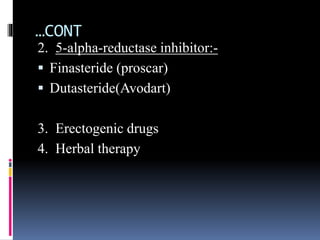
2. 5-alpha-reductase inhibitor:-
 Finasteride (proscar)
 Dutasteride(Avodart)
3. Erectogenic drugs
4. Herbal therapy
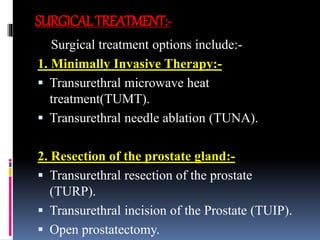
SURGICALTREATMENT:-
Surgical treatment options include:-
1. Minimally Invasive Therapy:-
 Transurethral microwave heat
treatment(TUMT).
 Transurethral needle ablation (TUNA).
2. Resection of the prostate gland:-
 Transurethral resection of the prostate
(TURP).
 Transurethral incision of the Prostate (TUIP).
 Open prostatectomy.
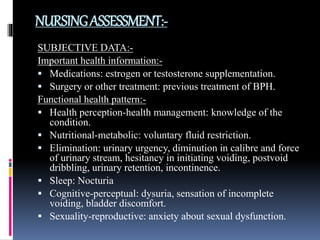
NURSINGASSESSMENT:-
SUBJECTIVE DATA:-
Important health information:-
 Medications: estrogen or testosterone supplementation.
 Surgery or other treatment: previous treatment of BPH.
Functional health pattern:-
 Health perception-health management: knowledge of the
condition.
 Nutritional-metabolic: voluntary fluid restriction.
 Elimination: urinary urgency, diminution in calibre and force
of urinary stream, hesitancy in initiating voiding, postvoid
dribbling, urinary retention, incontinence.
 Sleep: Nocturia
 Cognitive-perceptual: dysuria, sensation of incomplete
voiding, bladder discomfort.
 Sexuality-reproductive: anxiety about sexual dysfunction.
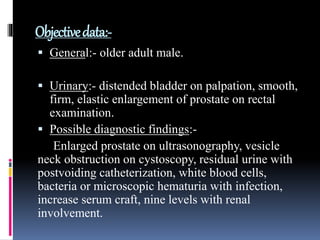
Objectivedata:-
 General:- older adult male.
 Urinary:- distended bladder on palpation, smooth,
firm, elastic enlargement of prostate on rectal
examination.
 Possible diagnostic findings:-
Enlarged prostate on ultrasonography, vesicle
neck obstruction on cystoscopy, residual urine with
postvoiding catheterization, white blood cells,
bacteria or microscopic hematuria with infection,
increase serum craft, nine levels with renal
involvement.
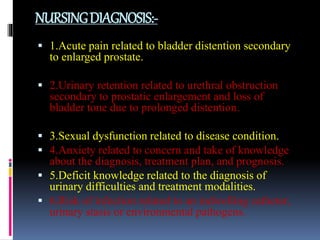
NURSINGDIAGNOSIS:-
 1.Acute pain related to bladder distention secondary
to enlarged prostate.
 2.Urinary retention related to urethral obstruction
secondary to prostatic enlargement and loss of
bladder tone due to prolonged distention.
 3.Sexual dysfunction related to disease condition.
 4.Anxiety related to concern and take of knowledge
about the diagnosis, treatment plan, and prognosis.
 5.Deficit knowledge related to the diagnosis of
urinary difficulties and treatment modalities.
 6.Risk of infection related to an indwelling catheter,
urinary stasis or environmental pathogens.
SUMMARY
CONCLUSION
BPH.pptx

BPH.pptx

  • 1.
    PREPARED BY:- SUBHASHREEMAHAPATRO FACULTY OF KIIT (BENIGN PROSTATIC HYPERPLASIA)
  • 2.
  • 3.
    DEFINITION:-  BPH isa benign enlargement of the prostate gland.
  • 4.
  • 5.
    RISKFACTORS:-  Aging  Obesity(in particular increased waist circumference)  Lack of physical activity  Alcohol consumption  Erectile dysfunction  Smoking  Hypertension  Heart disease  Diabetes  Western diet (high in animal fat and protein and refined carbohydrates low in fiber)  A positive family history of BPH.
  • 6.
    PATHOPHYSIOLOGY:-  BPH developsover a prolonged period, changes in the urinary tract are slow and insidious. BPH is a result of complete interactions involving resistance in the prostatic urethra its mechanical and spastic effects, bladder pressure during voiding, destrusor muscle strength, neurologic functioning, and general physical health. The hypertrophied lobes of the prostate may obstruct the bladder neck or urethra, causing incomplete emptying of the bladder and urinary retention. As a result, a gradual dilation of the ureters (hydroureter) and kidneys ( hydronephrosis) can occur. Urinary retention may result in UTIS because urine these remain in the urinary tract serves as a medium for infective organism.
  • 7.
    CLINICALMANIFESTATIONS:- 1. IRRITATIVE 2.OBSTRUCTIVE SYMPTOMS SYMPTOMS
  • 8.
    Irritative symptoms:-  Nocturia(oftenthe first symptom that the patient notices)  Urinary frequency  Urgency  Dysuria  Bladder pain  Incontinence
  • 9.
    Obstructive symptoms:-  Decreasein the force of the urinary stream.  Difficulty in initiating voiding.  Intermittency (stopping and starting stream several times while voiding).  Dribbling at the end of urination.  Sensation of incomplete bladder emptying.
  • 10.
    some generalized symptoms Fatigue, anorexia, nausea, vomiting and pelvic discomfort.
  • 11.
    Diagnostic evaluation  Digitalrectal examination (DRE)  Urinanalysis with culture  Prostate-specific antigen (PSA)  Serum creatinine  Postvoid residual urine volume  Transrectalultrasound(TRUS)  Uroflowmetry  Cystoscopy
  • 12.
    COMPLICATION:-  Acute urinaryretention.  Urinary tract infection (UTI).  Renal Calculi.  Renal Failure.  Pyelonephritis  Bladder damage.
  • 13.
    MEDICALMANAGEMENT:-  Alpha-adrenergic blockers:-  Alfuzosin(uroxatral)  Terazosin (hytrin)  Doxazosin (Cardura)  Prazosin  Silodosin  Tamsulosin
  • 14.
    …CONT 2. 5-alpha-reductase inhibitor:- Finasteride (proscar)  Dutasteride(Avodart) 3. Erectogenic drugs 4. Herbal therapy
  • 15.
    SURGICALTREATMENT:- Surgical treatment optionsinclude:- 1. Minimally Invasive Therapy:-  Transurethral microwave heat treatment(TUMT).  Transurethral needle ablation (TUNA). 2. Resection of the prostate gland:-  Transurethral resection of the prostate (TURP).  Transurethral incision of the Prostate (TUIP).  Open prostatectomy.
  • 16.
    NURSINGASSESSMENT:- SUBJECTIVE DATA:- Important healthinformation:-  Medications: estrogen or testosterone supplementation.  Surgery or other treatment: previous treatment of BPH. Functional health pattern:-  Health perception-health management: knowledge of the condition.  Nutritional-metabolic: voluntary fluid restriction.  Elimination: urinary urgency, diminution in calibre and force of urinary stream, hesitancy in initiating voiding, postvoid dribbling, urinary retention, incontinence.  Sleep: Nocturia  Cognitive-perceptual: dysuria, sensation of incomplete voiding, bladder discomfort.  Sexuality-reproductive: anxiety about sexual dysfunction.
  • 17.
    Objectivedata:-  General:- olderadult male.  Urinary:- distended bladder on palpation, smooth, firm, elastic enlargement of prostate on rectal examination.  Possible diagnostic findings:- Enlarged prostate on ultrasonography, vesicle neck obstruction on cystoscopy, residual urine with postvoiding catheterization, white blood cells, bacteria or microscopic hematuria with infection, increase serum craft, nine levels with renal involvement.
  • 18.
    NURSINGDIAGNOSIS:-  1.Acute painrelated to bladder distention secondary to enlarged prostate.  2.Urinary retention related to urethral obstruction secondary to prostatic enlargement and loss of bladder tone due to prolonged distention.  3.Sexual dysfunction related to disease condition.  4.Anxiety related to concern and take of knowledge about the diagnosis, treatment plan, and prognosis.  5.Deficit knowledge related to the diagnosis of urinary difficulties and treatment modalities.  6.Risk of infection related to an indwelling catheter, urinary stasis or environmental pathogens.
  • 19.
  • 20.