ASSUMPTIONS:
 Leaders can be made, rather than are
born.
 Successful leadership is based in
definable, learnable behavior
DESCRIPTION:
Behavioral theories of leadership do not
seek inborn traits or capabilities. Rather, they
look at what leaders actually do. If success can
be defined in terms of describable actions.
Then it should be relatively easy for other
people to act in the same way. This is easier to
teach and learn, then to adopt the more
ephemeral “traits” or capabilities
Behavioral is a big leap from Trait
Theory, in that it assumes that leadership
capability can be learned, rather than
being inherent. This opens the floodgates
to leadership potential from those who
will never have the chance.
This theory is relatively easy to
develop, as you simply assess both
leadership, success and the actions of
leaders. It can correlate statistically
significant behaviors with success and
can also identify behaviors which
contribute to failure.
This implies that leaders can be trained
focus on the way of doing things.
 Structure based behavioral theories focus
on the leader instituting structures-task
oriented
 Relationship based behavioral theories –
focus on the development and maintenance
of relationships-process oriented
Associate Theory:
One concept based largely on the
behavioral approach to leadership
effectiveness was the Managerial Grid (or
Leadership Grid), which was developed by
Robert Blake and Jane Mouton.
This model was composed of the different
leadership styles. These styles were relation
between a manager’s concern for people,
concern for production and his motivation.
The motivation dimensions really provides
the underlying motive of the leader behind
a successful leadership style.
1.9 9.9
5.5
1.1 9.1
HIGH.
LEADERSHIP STYLES ASSOCIATED WITH
MANAGERIAL GRID:
 The Indifferent or Impoverished (1.1)
 The Country Club or Accommodating ( 1.9)
 The Statusquo or Middle-of-the-Road (5.5)
 The Dictatorial or Produce, Perish or Control
(9.1)
 The Sound or Team (9.9)
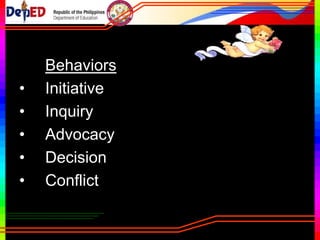
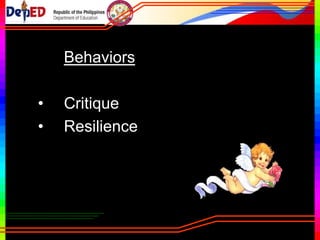
7 KEY BEHAVIORS
ASSOCIATED WITH THE
MANAGERIAL GRID MODEL
Behaviors
 Initiative
 Inquiry
 Advocacy
 Decision
 Conflict
 Critique
 Resilience
Behavior Theories of Leadership
Continuum of Leader Behavior
(Autocratic to Democratic)
BOSS
CENTERED
LEADERSHIP
CONTINUUM
SUBORDINATE
CENTERED
LEADERSHIP
Use of authority by manager <----------------------> Freedom for subordinates
Manager makes
decision and
accounces it
Manager "sells"
decision
Manager presents
ideas and invites
questions
Manager presents
tentative decision
subject to change
Manager presents
problem, get
suggestions, makes
decision
manager defines limits;
asks group to make
decision
Manager permits
subordinate to function
within limits defined by
superior
TELL SELL CONSULT SHARE
Let’s keep in mind that whatever
role each one of has at work or at home,
everyone is an influencer. You are a
leader, even if only of yourself.
Remember, LEADERSHIP is getting
results in a way that inspires trust. It’s
maximizing both your current
contribution and your ability to
contribute in the future by establishing
the trust that makes it possible.
More specifically, it’s about the
13 Behaviors that are common to
high-trust leaders and people
throughout the world. These
behaviors are powerful because…
These 13 Behaviors will
significantly enhance your ability to
establish trust in all relationships –
both personal and professional.
Be honest. Tell the truth. Let people
know where you stand. Use simple
language. Call things what they are.
Demonstrate integrity. Don’t manipulate
people or distort facts. Don’t spin the
truth. Don’t leave false impressions.
Genuinely care for others. Show you
care. Respect the dignity of every person
and every role. Treat everyone with
respect, especially those who can’t do
anything for you. Show kindness in the
little things. Don’t fake caring. Don’t
attempt to be “efficient” with people.
Tell the truth in a way people can
verify. Get real and genuine. Be open and
authentic. Err on the side of disclosure.
Operate on the premise of “What you see
is what you get.” Don’t have hidden
agendas. Don’t hide information.
Make things right when you’re
wrong. Apologize quickly. Make
restitution where possible. Practice
“service recoveries.” Demonstrate
personal humility. Don’t cover things up.
Don’t let pride get in the way of doing the
right thing.
Give credit freely. Acknowledge the
contributions of others. Speak about
people as if they were present. Represent
others who aren’t there to speak for
themselves. Don’t bad-mouth other
behind their backs. Don’t disclose others’
private information.
Establish a track record of results.
Get the right things done. Make things
happen. Accomplish what you’re hired to
do. Be on time and within budget. Don’t
overpromise and under deliver. Don’t
make excuses for not delivering.
Continuously improve. Increase your
Capabilities. Be a constant learner.
Develop feedback systems – both formal
and informal. Act on the feedback you
receive. Thank people for feedback. Don’t
consider yourself above feedback. Don’t
assume today’s knowledge and skills will
be sufficient for tomorrow’s challenges.
Address the tough stuff directly.
Acknowledge the unsaid. Lead out
courageously in conversation. Remove
the “sword from their hands.” Don’t skirt
the real issues. Don’t bury your head in
the sand.
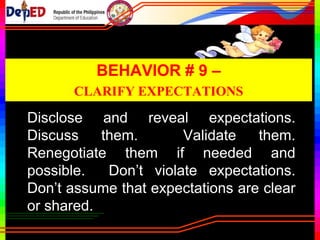
Disclose and reveal expectations.
Discuss them. Validate them.
Renegotiate them if needed and possible.
Don’t violate expectations. Don’t assume
that expectations are clear or shared.
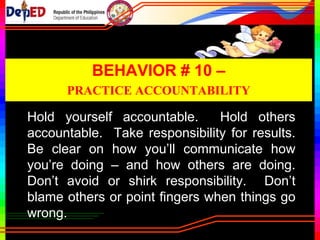
Hold yourself accountable. Hold
others accountable. Take responsibility
for results. Be clear on how you’ll
communicate how you’re doing – and
how others are doing. Don’t avoid or
shirk responsibility. Don’t blame others or
point fingers when things go wrong.
Listen before you speak.
Understand. Diagnose. Listen with your
ears – and your eyes and heart. Find out
what the most important behaviors are to
the people you’re working with. Don’t
assume you know what matters most to
others. Don’t presume you have all the
answers – or all the questions.
Say what you’re going to do. Make
commitments carefully and keep them.
Make keeping commitments the symbol
of your honor. Don’t break confidences.
Don’t attempt to “PR” your way out of a
commitment you’ve broken.
Demonstrate a propensity to trust. Extend
trust abundantly to those who have earned your
trust. Extend conditionally to those who are
earning your trust. Learn how to appropriately
extend trust to others based on the situation,
risk, and credibility (character and competence)
of the people involved. But have a propensity to
trust. Don’t withhold trust because there is risk
involved.
“The call to leadership is
a consistent pattern in the
Bible.”

Behavioral Theory

  • 2.
    ASSUMPTIONS:  Leaders canbe made, rather than are born.  Successful leadership is based in definable, learnable behavior
  • 3.
    DESCRIPTION: Behavioral theories ofleadership do not seek inborn traits or capabilities. Rather, they look at what leaders actually do. If success can be defined in terms of describable actions. Then it should be relatively easy for other people to act in the same way. This is easier to teach and learn, then to adopt the more ephemeral “traits” or capabilities
  • 4.
    Behavioral is abig leap from Trait Theory, in that it assumes that leadership capability can be learned, rather than being inherent. This opens the floodgates to leadership potential from those who will never have the chance.
  • 5.
    This theory isrelatively easy to develop, as you simply assess both leadership, success and the actions of leaders. It can correlate statistically significant behaviors with success and can also identify behaviors which contribute to failure.
  • 6.
    This implies thatleaders can be trained focus on the way of doing things.  Structure based behavioral theories focus on the leader instituting structures-task oriented  Relationship based behavioral theories – focus on the development and maintenance of relationships-process oriented
  • 7.
    Associate Theory: One conceptbased largely on the behavioral approach to leadership effectiveness was the Managerial Grid (or Leadership Grid), which was developed by Robert Blake and Jane Mouton.
  • 8.
    This model wascomposed of the different leadership styles. These styles were relation between a manager’s concern for people, concern for production and his motivation. The motivation dimensions really provides the underlying motive of the leader behind a successful leadership style.
  • 9.
  • 10.
    LEADERSHIP STYLES ASSOCIATEDWITH MANAGERIAL GRID:  The Indifferent or Impoverished (1.1)  The Country Club or Accommodating ( 1.9)  The Statusquo or Middle-of-the-Road (5.5)  The Dictatorial or Produce, Perish or Control (9.1)  The Sound or Team (9.9)
  • 11.
    7 KEY BEHAVIORS ASSOCIATEDWITH THE MANAGERIAL GRID MODEL
  • 12.
    Behaviors  Initiative  Inquiry Advocacy  Decision  Conflict  Critique  Resilience
  • 13.
  • 14.
    Continuum of LeaderBehavior (Autocratic to Democratic) BOSS CENTERED LEADERSHIP CONTINUUM SUBORDINATE CENTERED LEADERSHIP Use of authority by manager <----------------------> Freedom for subordinates Manager makes decision and accounces it Manager "sells" decision Manager presents ideas and invites questions Manager presents tentative decision subject to change Manager presents problem, get suggestions, makes decision manager defines limits; asks group to make decision Manager permits subordinate to function within limits defined by superior TELL SELL CONSULT SHARE
  • 15.
    Let’s keep inmind that whatever role each one of has at work or at home, everyone is an influencer. You are a leader, even if only of yourself. Remember, LEADERSHIP is getting results in a way that inspires trust. It’s maximizing both your current contribution and your ability to contribute in the future by establishing the trust that makes it possible.
  • 16.
    More specifically, it’sabout the 13 Behaviors that are common to high-trust leaders and people throughout the world. These behaviors are powerful because… These 13 Behaviors will significantly enhance your ability to establish trust in all relationships – both personal and professional.
  • 17.
    Be honest. Tellthe truth. Let people know where you stand. Use simple language. Call things what they are. Demonstrate integrity. Don’t manipulate people or distort facts. Don’t spin the truth. Don’t leave false impressions.
  • 18.
    Genuinely care forothers. Show you care. Respect the dignity of every person and every role. Treat everyone with respect, especially those who can’t do anything for you. Show kindness in the little things. Don’t fake caring. Don’t attempt to be “efficient” with people.
  • 19.
    Tell the truthin a way people can verify. Get real and genuine. Be open and authentic. Err on the side of disclosure. Operate on the premise of “What you see is what you get.” Don’t have hidden agendas. Don’t hide information.
  • 20.
    Make things rightwhen you’re wrong. Apologize quickly. Make restitution where possible. Practice “service recoveries.” Demonstrate personal humility. Don’t cover things up. Don’t let pride get in the way of doing the right thing.
  • 21.
    Give credit freely.Acknowledge the contributions of others. Speak about people as if they were present. Represent others who aren’t there to speak for themselves. Don’t bad-mouth other behind their backs. Don’t disclose others’ private information.
  • 22.
    Establish a trackrecord of results. Get the right things done. Make things happen. Accomplish what you’re hired to do. Be on time and within budget. Don’t overpromise and under deliver. Don’t make excuses for not delivering.
  • 23.
    Continuously improve. Increaseyour Capabilities. Be a constant learner. Develop feedback systems – both formal and informal. Act on the feedback you receive. Thank people for feedback. Don’t consider yourself above feedback. Don’t assume today’s knowledge and skills will be sufficient for tomorrow’s challenges.
  • 24.
    Address the toughstuff directly. Acknowledge the unsaid. Lead out courageously in conversation. Remove the “sword from their hands.” Don’t skirt the real issues. Don’t bury your head in the sand.
  • 25.
    Disclose and revealexpectations. Discuss them. Validate them. Renegotiate them if needed and possible. Don’t violate expectations. Don’t assume that expectations are clear or shared.
  • 26.
    Hold yourself accountable.Hold others accountable. Take responsibility for results. Be clear on how you’ll communicate how you’re doing – and how others are doing. Don’t avoid or shirk responsibility. Don’t blame others or point fingers when things go wrong.
  • 27.
    Listen before youspeak. Understand. Diagnose. Listen with your ears – and your eyes and heart. Find out what the most important behaviors are to the people you’re working with. Don’t assume you know what matters most to others. Don’t presume you have all the answers – or all the questions.
  • 28.
    Say what you’regoing to do. Make commitments carefully and keep them. Make keeping commitments the symbol of your honor. Don’t break confidences. Don’t attempt to “PR” your way out of a commitment you’ve broken.
  • 29.
    Demonstrate a propensityto trust. Extend trust abundantly to those who have earned your trust. Extend conditionally to those who are earning your trust. Learn how to appropriately extend trust to others based on the situation, risk, and credibility (character and competence) of the people involved. But have a propensity to trust. Don’t withhold trust because there is risk involved.
  • 30.
    “The call toleadership is a consistent pattern in the Bible.”