What is Economics?
 A social science concerned with using scarce resources
to obtain the maximum satisfaction of the unlimited
material wants of society. (Walstad and Bingham)
 The study of how societies use scarce resources to
produce valuable commodities and distribute them
among different people. (Samuelson and Nordhaus)
 The study of production, distribution, selling and use of
goods and services. (Collin)
 A social science concerned with using scarce resources
to obtain the maximum satisfaction of the unlimited
material wants of society. (McConnel and Brue)
 The study of how people use their limited resources to
try to satisfy unlimited wants. (Parkin and Bade)
Types of Economics System
1. Capitalism – an economic system
characterized by private individuals
owning and operating the majority of
business that produce
Rights of Capitalism
Right to own private property
Right to gain profits
Right to make business decisions
Right of choice
Types of Economics System
2. Communism – A society in which the
Government owns all the nation’s
resource.
All rights stated in the capitalism are not
allowed in communism.
3. Socialism – the government owns and
operates the basic industries. Private
individuals are allowed, however, to own
and operate small business.
4. Mixed Economies – A mixed economy
is one that has elements from more than
one economic system. It contains both
private and state enterprise.
The Economic Resources
1. Land – include land used for agricultural
or industrial purposes as well as natural
resources taken form above or below the
soil.
2. Labor – productive services embodied
in human physical effort, skill, intellectual
powers, and others.
3. Capital – durable goods produced in
order to produce other goods (e.g.
machines)
4. Entrepreneurial Ability – An ability to
decide on and implement the right
combination of the first three factors of
production
Economic Goals
1.
2.
3.
4.
5.
6.
7.
8.

Economic growth
Full employment
Economic efficiency
Price level stability
Economic freedom
An equitable distribution of income
Economic security
Balance of trade
Divisions of Economics
1. Microeconomics – concerned with the
behavior and activities of specific economic
units – individuals, households, firms,
industries and resource owners
2. Macroeconomics – deals with the
behavior of the economy as a whole with
respect to output, income, price level,
foreign trade, unemployment, and other
aggregate economic variables.
Stock and Flow
• Stock – refers to the measure of quantity at
a point of time. (e.g. December 31, 2013)
• Flow – refers to the measure of movement
of quantity over a period of time. (e.g. Per
year)
The Circular Flow of Goods, Services, and
Income

The Production Process
- The process of producing goods and
services involves households and firms in a
circular flow
Land, Labor, Capital
(Economic Resources)

Firms

Households

(Organizers and users of
economic resources)

(Resource Owners)

Goods & Services
(Outputs)
The Circular Flow of Goods, Services, and
Income

The Flow of Goods Among Producing
Firms
- A flow which happen among different
types of business firms:
 Raw Material Producers – firms produce
raw materials such as fish, wood, sugarcane
and others.
 Intermediate Goods Producers – firms
produce goods that are partially processed
and still need further processing before they
can finally consumed (e.g. flour, steel bars)

 Final Good Producers – firms produce
goods that are ready for final consumption
such as RTW clothing, candies, etc.
The Flow of Output between Firms and
Households
Raw Material
Firms

Raw Materials

Intermediate
Good Firms

Intermediate
Goods

Final
Good Firms
Final Goods
HOUSEHOLDS

The Circular Flow of Goods and Income Among
Producers and Households
Economic Resources
Payment

Economic Resources
Payment

Economic Resources
Payment

Final Goods

Payment

Raw Material
Firms

Final
Good Firms
Intermediate
Good Firms
The Circular Flow of Goods, Services, and
Income
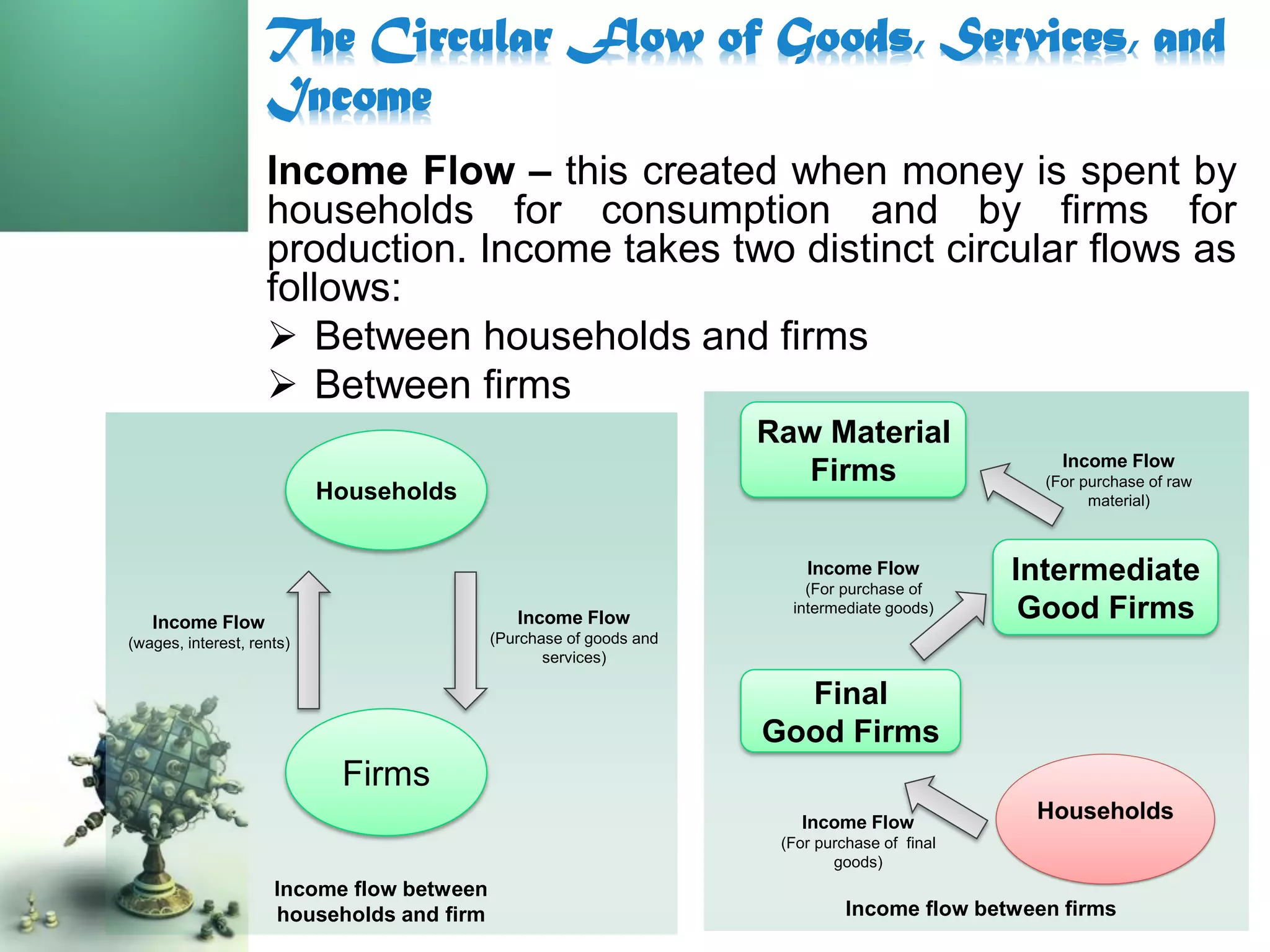
Income Flow – this created when money is spent by
households for consumption and by firms for
production. Income takes two distinct circular flows as
follows:
 Between households and firms
 Between firms
Raw Material
Firms

Households

Income Flow
Income Flow

Income Flow

(For purchase of
intermediate goods)

Income Flow
(For purchase of raw
material)

Intermediate
Good Firms

(Purchase of goods and
services)

(wages, interest, rents)

Final
Good Firms

Firms
Income Flow
(For purchase of final
goods)

Income flow between
households and firm

Income flow between firms
The Circular Flow of Goods, Services, and
Income
Equilibrium– happens when the amount received by
firms from households is equal to the amount
received by households form firms
Disequilibrium – happens when either households or
firms do not spend their income
The Effect of
Reduction of
Purchases

Households

Reduced Income

Reduced Income

(as a result of reduced
purchase of economic
resources)

(as a result of reduced
purchase of goods and
services)

Firms
The Circular Flow of Goods, Services, and
Income
Savings and Investments
Saving – income not spent, or deferred consumption.
Happens when households allocate a part of their
income for future use.
Investments – a way of disposing unsold output.
Investment is the accumulation of newly produced
physical entities, such as factories, machinery,
houses, and goods inventories.

When the savings of households are matched by
investments expenditures of firms, disequilibrium is
negated and the circular flow of income will tend
normalize.
The Circular Flow of Goods, Services, and
Income
CIRCULAR FLOW OF GOODS AND INCOME IN A SIMPLE
ECONOMY WITH SAVING AND INVESTMENT

Firms

Rent
Wages
Interest
Profit

Land
Labor
Capital

Goods
and
Services

Households

Investments
Capital goods

Payments
Sources:
Medina, Roberto G. (2001), Principles of Economics
http://en.wikipedia.org/wiki/Saving

http://en.wikipedia.org/wiki/Investment
IMAGES:
Image 1:
http://www.flightcentre.com.au/sites/flightcentre.com.au/files/styl
es/airline-hero-banner-380x200/http/media.fclmedia.com/globalimages/fc/misc/hero/foreign-currency-australiandollars.jpg?itok=2sJFyW7S
Image 2: http://3.bp.blogspot.com/-YBMPkepfASw/UUl9_ACcsI/AAAAAAAAAr4/XBh46tvlkYE/s320/664378-cash.jpg
Image 3: http://en.wikipedia.org/wiki/File:StockFlow.gif

Economics

  • 2.
    What is Economics? A social science concerned with using scarce resources to obtain the maximum satisfaction of the unlimited material wants of society. (Walstad and Bingham)  The study of how societies use scarce resources to produce valuable commodities and distribute them among different people. (Samuelson and Nordhaus)  The study of production, distribution, selling and use of goods and services. (Collin)  A social science concerned with using scarce resources to obtain the maximum satisfaction of the unlimited material wants of society. (McConnel and Brue)  The study of how people use their limited resources to try to satisfy unlimited wants. (Parkin and Bade)
  • 3.
    Types of EconomicsSystem 1. Capitalism – an economic system characterized by private individuals owning and operating the majority of business that produce Rights of Capitalism Right to own private property Right to gain profits Right to make business decisions Right of choice
  • 4.
    Types of EconomicsSystem 2. Communism – A society in which the Government owns all the nation’s resource. All rights stated in the capitalism are not allowed in communism. 3. Socialism – the government owns and operates the basic industries. Private individuals are allowed, however, to own and operate small business. 4. Mixed Economies – A mixed economy is one that has elements from more than one economic system. It contains both private and state enterprise.
  • 5.
    The Economic Resources 1.Land – include land used for agricultural or industrial purposes as well as natural resources taken form above or below the soil. 2. Labor – productive services embodied in human physical effort, skill, intellectual powers, and others. 3. Capital – durable goods produced in order to produce other goods (e.g. machines) 4. Entrepreneurial Ability – An ability to decide on and implement the right combination of the first three factors of production
  • 6.
    Economic Goals 1. 2. 3. 4. 5. 6. 7. 8. Economic growth Fullemployment Economic efficiency Price level stability Economic freedom An equitable distribution of income Economic security Balance of trade
  • 7.
    Divisions of Economics 1.Microeconomics – concerned with the behavior and activities of specific economic units – individuals, households, firms, industries and resource owners 2. Macroeconomics – deals with the behavior of the economy as a whole with respect to output, income, price level, foreign trade, unemployment, and other aggregate economic variables.
  • 8.
    Stock and Flow •Stock – refers to the measure of quantity at a point of time. (e.g. December 31, 2013) • Flow – refers to the measure of movement of quantity over a period of time. (e.g. Per year)
  • 9.
    The Circular Flowof Goods, Services, and Income The Production Process - The process of producing goods and services involves households and firms in a circular flow Land, Labor, Capital (Economic Resources) Firms Households (Organizers and users of economic resources) (Resource Owners) Goods & Services (Outputs)
  • 10.
    The Circular Flowof Goods, Services, and Income The Flow of Goods Among Producing Firms - A flow which happen among different types of business firms:  Raw Material Producers – firms produce raw materials such as fish, wood, sugarcane and others.  Intermediate Goods Producers – firms produce goods that are partially processed and still need further processing before they can finally consumed (e.g. flour, steel bars)  Final Good Producers – firms produce goods that are ready for final consumption such as RTW clothing, candies, etc.
  • 11.
    The Flow ofOutput between Firms and Households Raw Material Firms Raw Materials Intermediate Good Firms Intermediate Goods Final Good Firms Final Goods
  • 12.
    HOUSEHOLDS The Circular Flowof Goods and Income Among Producers and Households Economic Resources Payment Economic Resources Payment Economic Resources Payment Final Goods Payment Raw Material Firms Final Good Firms Intermediate Good Firms
  • 13.
    The Circular Flowof Goods, Services, and Income Income Flow – this created when money is spent by households for consumption and by firms for production. Income takes two distinct circular flows as follows:  Between households and firms  Between firms Raw Material Firms Households Income Flow Income Flow Income Flow (For purchase of intermediate goods) Income Flow (For purchase of raw material) Intermediate Good Firms (Purchase of goods and services) (wages, interest, rents) Final Good Firms Firms Income Flow (For purchase of final goods) Income flow between households and firm Income flow between firms
  • 14.
    The Circular Flowof Goods, Services, and Income Equilibrium– happens when the amount received by firms from households is equal to the amount received by households form firms Disequilibrium – happens when either households or firms do not spend their income The Effect of Reduction of Purchases Households Reduced Income Reduced Income (as a result of reduced purchase of economic resources) (as a result of reduced purchase of goods and services) Firms
  • 15.
    The Circular Flowof Goods, Services, and Income Savings and Investments Saving – income not spent, or deferred consumption. Happens when households allocate a part of their income for future use. Investments – a way of disposing unsold output. Investment is the accumulation of newly produced physical entities, such as factories, machinery, houses, and goods inventories. When the savings of households are matched by investments expenditures of firms, disequilibrium is negated and the circular flow of income will tend normalize.
  • 16.
    The Circular Flowof Goods, Services, and Income CIRCULAR FLOW OF GOODS AND INCOME IN A SIMPLE ECONOMY WITH SAVING AND INVESTMENT Firms Rent Wages Interest Profit Land Labor Capital Goods and Services Households Investments Capital goods Payments
  • 17.
    Sources: Medina, Roberto G.(2001), Principles of Economics http://en.wikipedia.org/wiki/Saving http://en.wikipedia.org/wiki/Investment IMAGES: Image 1: http://www.flightcentre.com.au/sites/flightcentre.com.au/files/styl es/airline-hero-banner-380x200/http/media.fclmedia.com/globalimages/fc/misc/hero/foreign-currency-australiandollars.jpg?itok=2sJFyW7S Image 2: http://3.bp.blogspot.com/-YBMPkepfASw/UUl9_ACcsI/AAAAAAAAAr4/XBh46tvlkYE/s320/664378-cash.jpg Image 3: http://en.wikipedia.org/wiki/File:StockFlow.gif