Downloaded 1,558 times
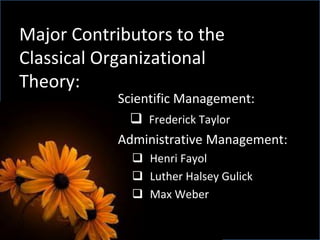
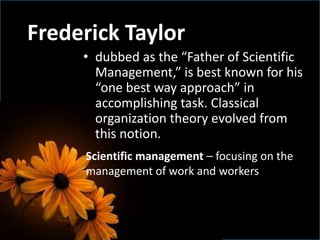





















The document summarizes the key contributors to classical organizational theory, including Frederick Taylor's scientific management theories, Henri Fayol's administrative management principles, Luther Gulick's expansion of Fayol's management functions, and Max Weber's ideal bureaucracy. It discusses some of their major ideas, such as Taylor's time and motion studies, Fayol's 14 management principles, Gulick's addition of budgeting as the 7th management function, and Weber's classification of authority and characteristics of rational-legal authority. The human relations movement emerged from the Hawthorne experiments in the 1920s-1930s, shifting focus to social and psychological factors.


