GENERAL SYSTEMS THEORY Engr. Marvin Darius M. Lagasca Professor: Jo B. Bitonio ME 215 Management of Change & Transition
Ludwig von Bertanlaffy Put forward in 1968 a theory known as General Systems Theory . The theory attempted to provide alternatives to conventional models of organization.
Principles of General Systems Theory Laws that govern  biological  open systems can be applied to systems of any form. Open-Systems Theory Principles Parts that make up the system are  interrelated . Health of overall system is  contingent on subsystem functioning . Open systems import and export material from and to the  environment . Permeable boundaries  (materials can pass through) Relative openness  (system can regulate permeability) Synergy (extra energy causes nonsummativity--whole is greater than sum of parts) Equifinality  vs. “one best way.”
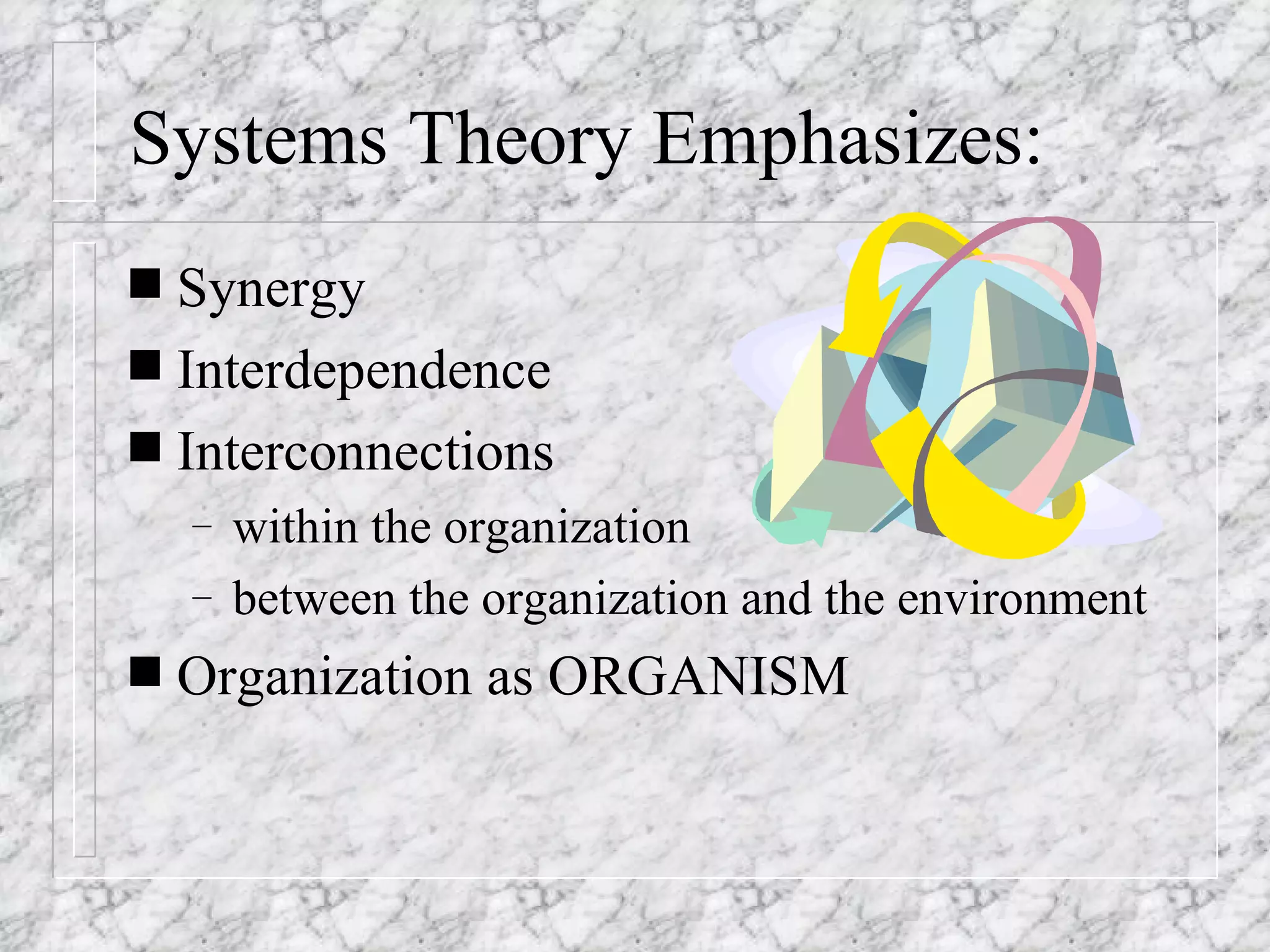
Systems Theory Emphasizes:  Synergy Interdependence Interconnections  within the organization  between the organization and the environment Organization as ORGANISM
General Theoretical Distinctions Previous theories  prescribe  organizational behavior, organizational structure or managerial practice (prediction and control).  MACHINE Systems theory  provides  an analytical framework for viewing an organization in general (description and explanation). ORGANISM
Strengths Recognizes   . . . interdependence of personnel impact of environment on organizational structure and function effect of outside stakeholders on the organization Focuses on environment and how changes can impact the organization Seeks to explain “synergy” & “interdependence” Broadens the theoretical lens for viewing organizational behavior.
Summary Systems Theory is NOT a prescriptive management theory Attempts to widen lens through which we examine and understand organizational behavior Key Concepts Synergy Interdependence Interconnections Organization is treated not as a machine but an organism Organizations cannot separate from their environment Organizational teams or subsystems cannot operate in isolation
Contingency Theory First extension of Systems Theory into Management Practice - CONTINGENCY THEORY There is no one best way to structure and manage organizations. Structure and management are contingent on the nature of the environment in which the organization is situated. Argues for “finding the best communication structure under a given set of environmental circumstances.
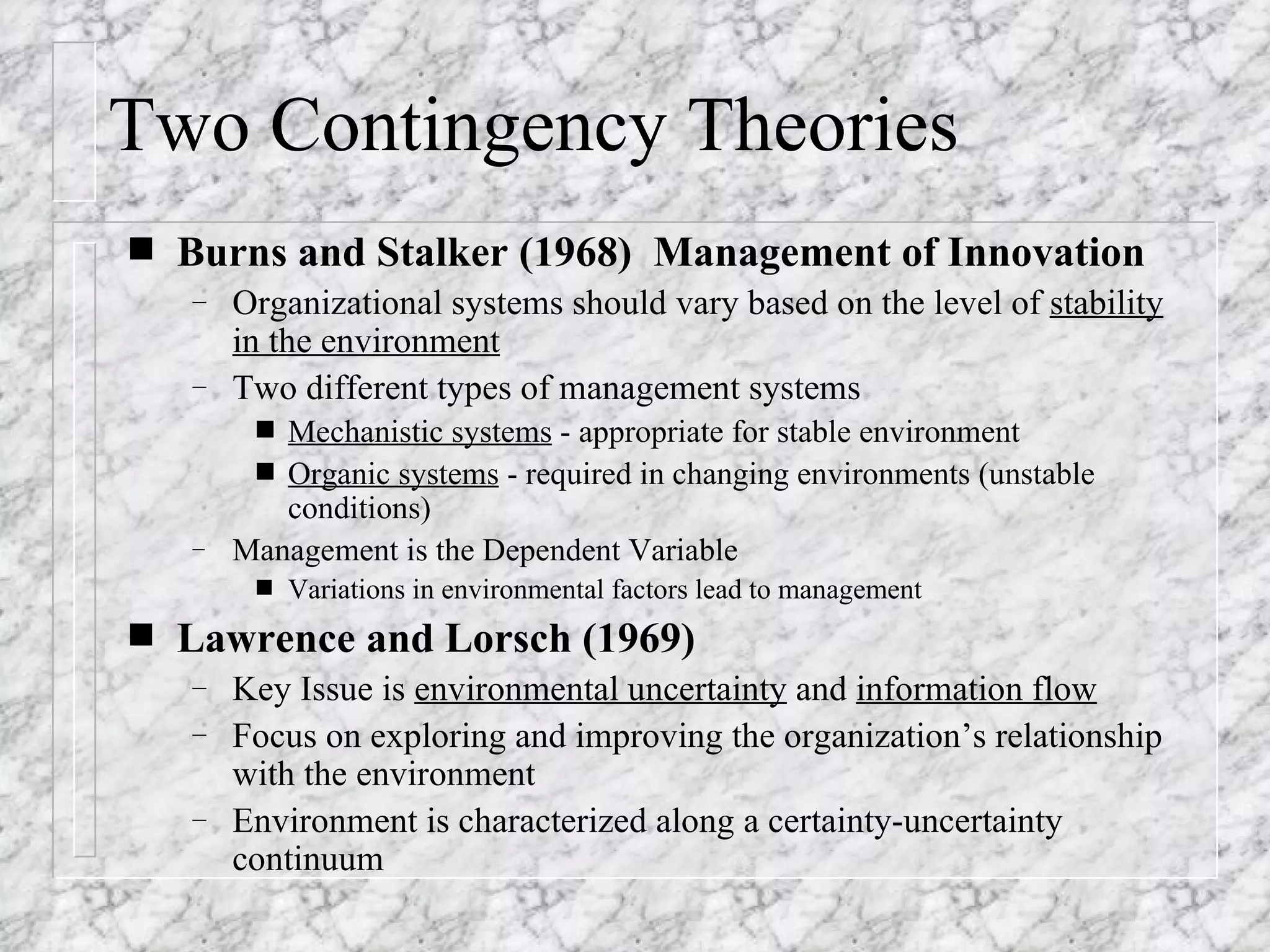
Two Contingency Theories Burns and Stalker (1968)  Management of Innovation Organizational systems should vary based on the level of  stability in the environment Two different types of management systems Mechanistic systems  - appropriate for stable environment Organic systems  - required in changing environments (unstable conditions) Management is the Dependent Variable  Variations in environmental factors lead to management Lawrence and Lorsch (1969) Key Issue is  environmental uncertainty  and  information flow Focus on exploring and improving the organization’s relationship with the environment Environment is characterized along a certainty-uncertainty continuum

Systems theory

  • 1.
    GENERAL SYSTEMS THEORYEngr. Marvin Darius M. Lagasca Professor: Jo B. Bitonio ME 215 Management of Change & Transition
  • 2.
    Ludwig von BertanlaffyPut forward in 1968 a theory known as General Systems Theory . The theory attempted to provide alternatives to conventional models of organization.
  • 3.
    Principles of GeneralSystems Theory Laws that govern biological open systems can be applied to systems of any form. Open-Systems Theory Principles Parts that make up the system are interrelated . Health of overall system is contingent on subsystem functioning . Open systems import and export material from and to the environment . Permeable boundaries (materials can pass through) Relative openness (system can regulate permeability) Synergy (extra energy causes nonsummativity--whole is greater than sum of parts) Equifinality vs. “one best way.”
  • 4.
    Systems Theory Emphasizes: Synergy Interdependence Interconnections within the organization between the organization and the environment Organization as ORGANISM
  • 5.
    General Theoretical DistinctionsPrevious theories prescribe organizational behavior, organizational structure or managerial practice (prediction and control). MACHINE Systems theory provides an analytical framework for viewing an organization in general (description and explanation). ORGANISM
  • 6.
    Strengths Recognizes . . . interdependence of personnel impact of environment on organizational structure and function effect of outside stakeholders on the organization Focuses on environment and how changes can impact the organization Seeks to explain “synergy” & “interdependence” Broadens the theoretical lens for viewing organizational behavior.
  • 7.
    Summary Systems Theoryis NOT a prescriptive management theory Attempts to widen lens through which we examine and understand organizational behavior Key Concepts Synergy Interdependence Interconnections Organization is treated not as a machine but an organism Organizations cannot separate from their environment Organizational teams or subsystems cannot operate in isolation
  • 8.
    Contingency Theory Firstextension of Systems Theory into Management Practice - CONTINGENCY THEORY There is no one best way to structure and manage organizations. Structure and management are contingent on the nature of the environment in which the organization is situated. Argues for “finding the best communication structure under a given set of environmental circumstances.
  • 9.
    Two Contingency TheoriesBurns and Stalker (1968) Management of Innovation Organizational systems should vary based on the level of stability in the environment Two different types of management systems Mechanistic systems - appropriate for stable environment Organic systems - required in changing environments (unstable conditions) Management is the Dependent Variable Variations in environmental factors lead to management Lawrence and Lorsch (1969) Key Issue is environmental uncertainty and information flow Focus on exploring and improving the organization’s relationship with the environment Environment is characterized along a certainty-uncertainty continuum