Leadership Theories
--Behavioral Theory
Presented By;

Hanna Grace G. Olvido, R.N.
September 28, 2013

1
Behavioral Theory
In the behavioural view of leadership, personal traits provide
only foundation for leadership; real leaders are made through
education, training, and life experiences.

Effective Leaders acquire a pattern of learned behaviours.

2
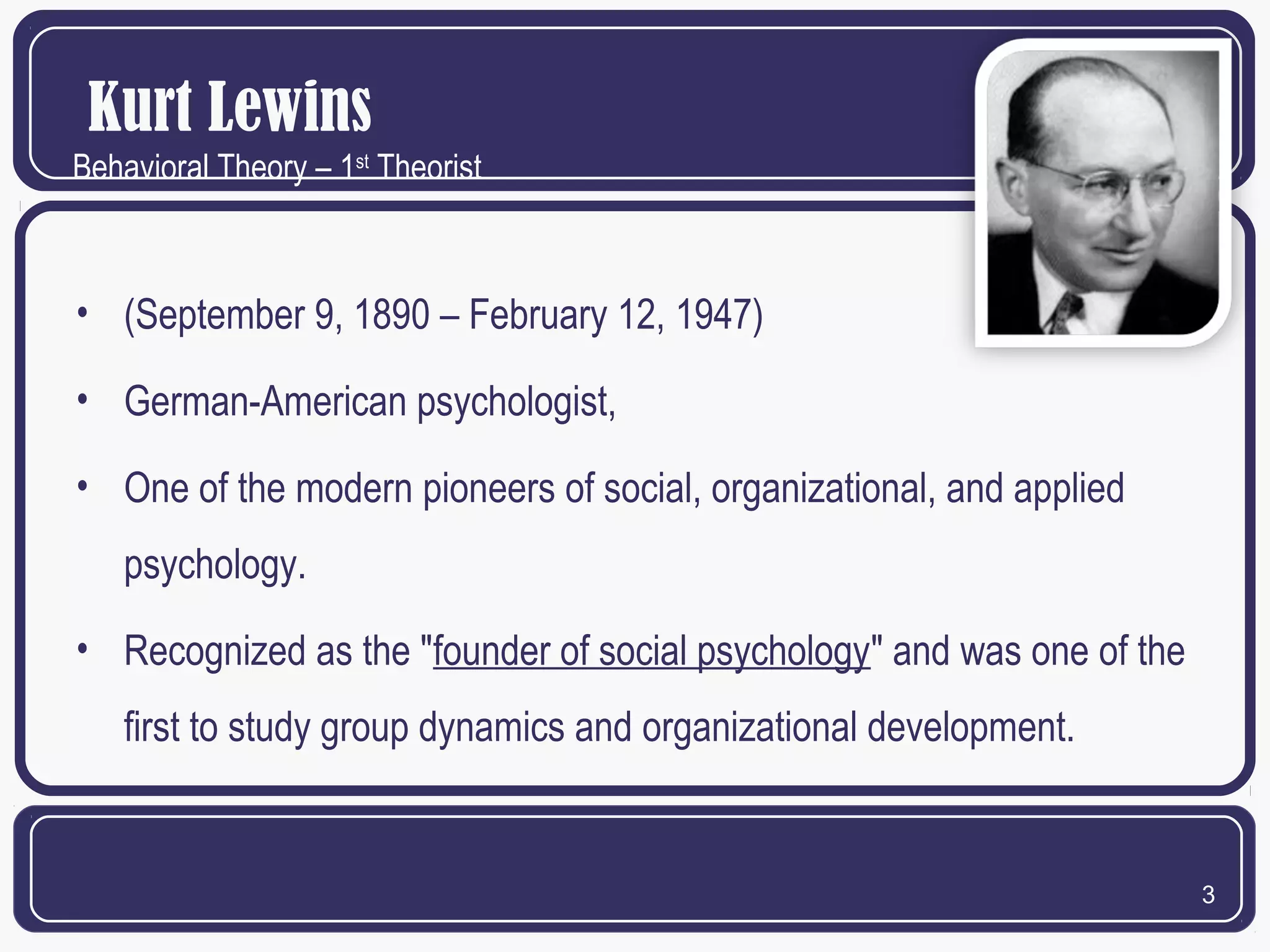
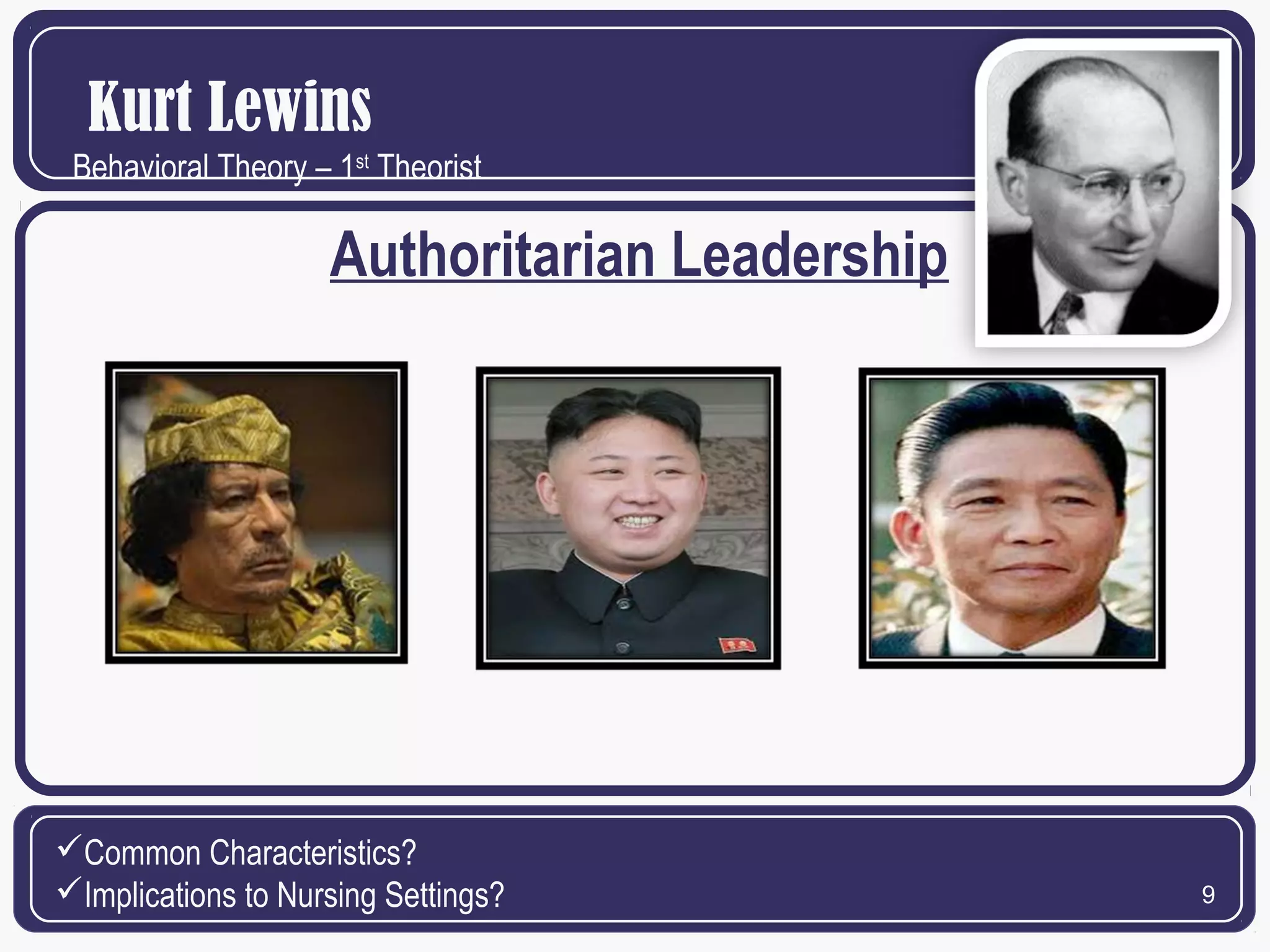
Kurt Lewins
Behavioral Theory – 1st Theorist

• (September 9, 1890 – February 12, 1947)
• German-American psychologist,
• One of the modern pioneers of social, organizational, and applied
psychology.
• Recognized as the "founder of social psychology" and was one of the
first to study group dynamics and organizational development.

3
Kurt Lewins
Behavioral Theory – 1st Theorist

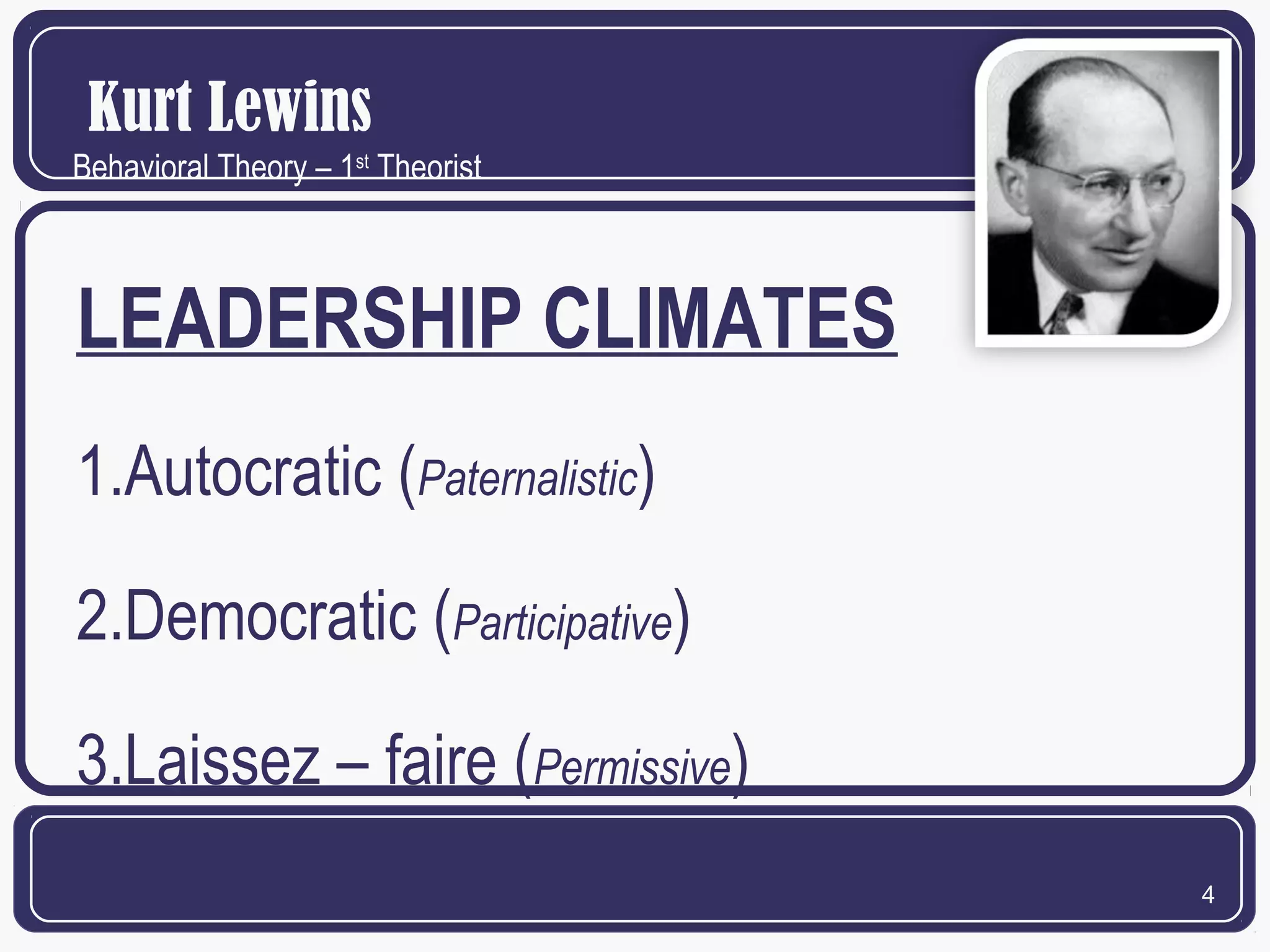
LEADERSHIP CLIMATES
1.Autocratic (Paternalistic)
2.Democratic (Participative)
3.Laissez – faire (Permissive)
4
Kurt Lewins
Behavioral Theory – 1st Theorist

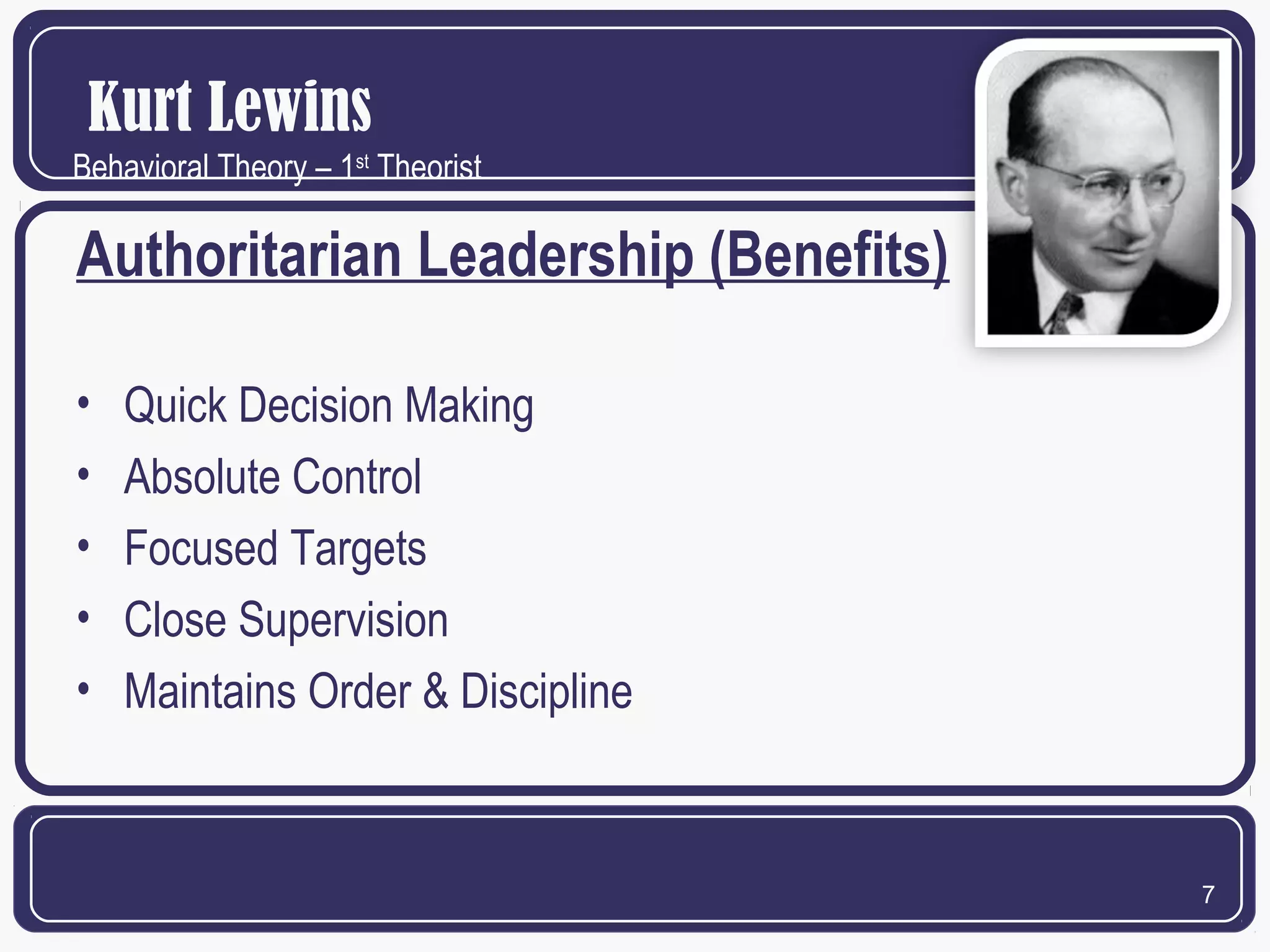
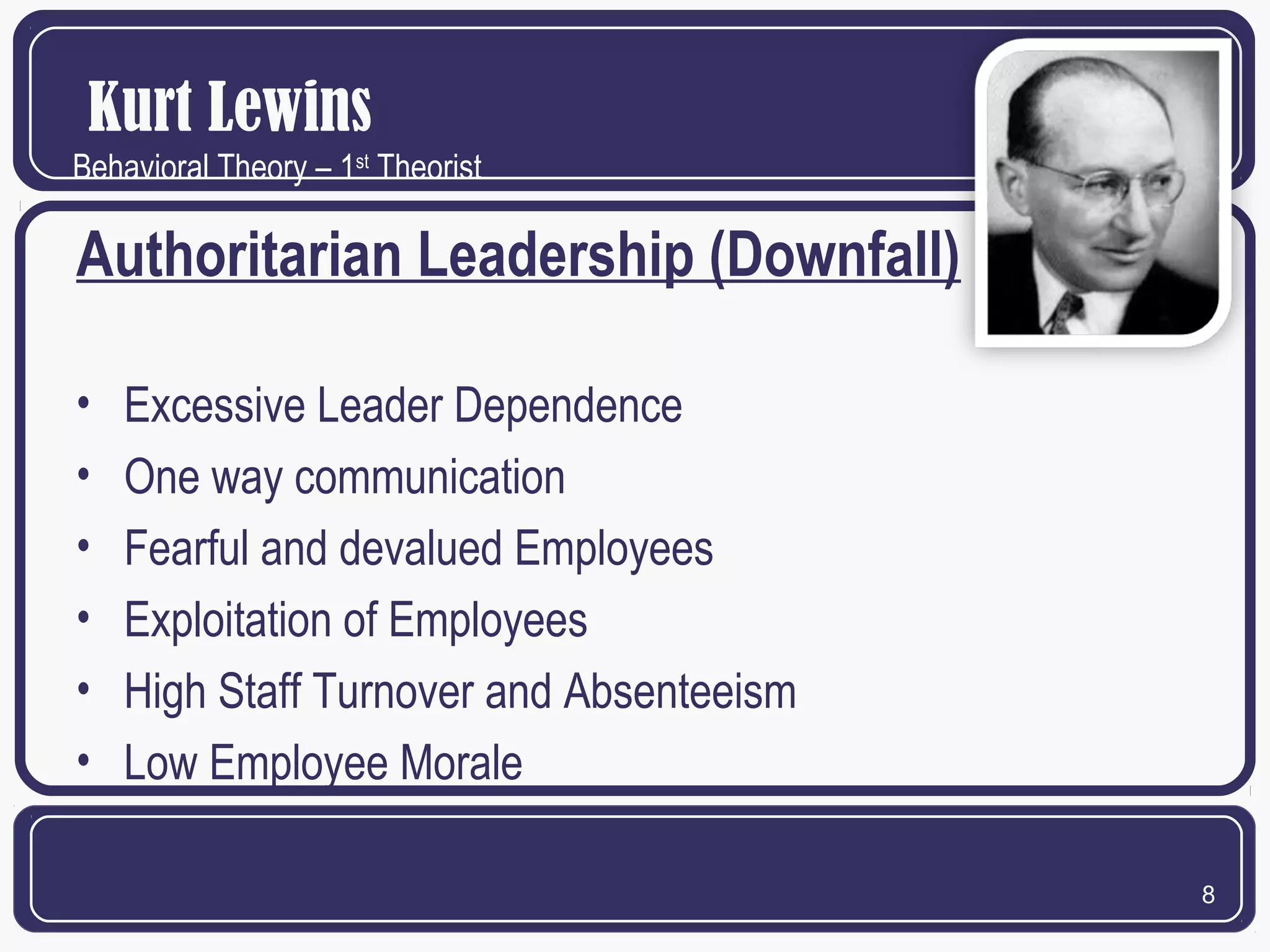
Authoritarian Leadership
Assumes that individuals are motivated by external
forces; therefore, the leader makes all decisions and
directs the followers’ behaviour.

5
Kurt Lewins
Behavioral Theory – 1st Theorist

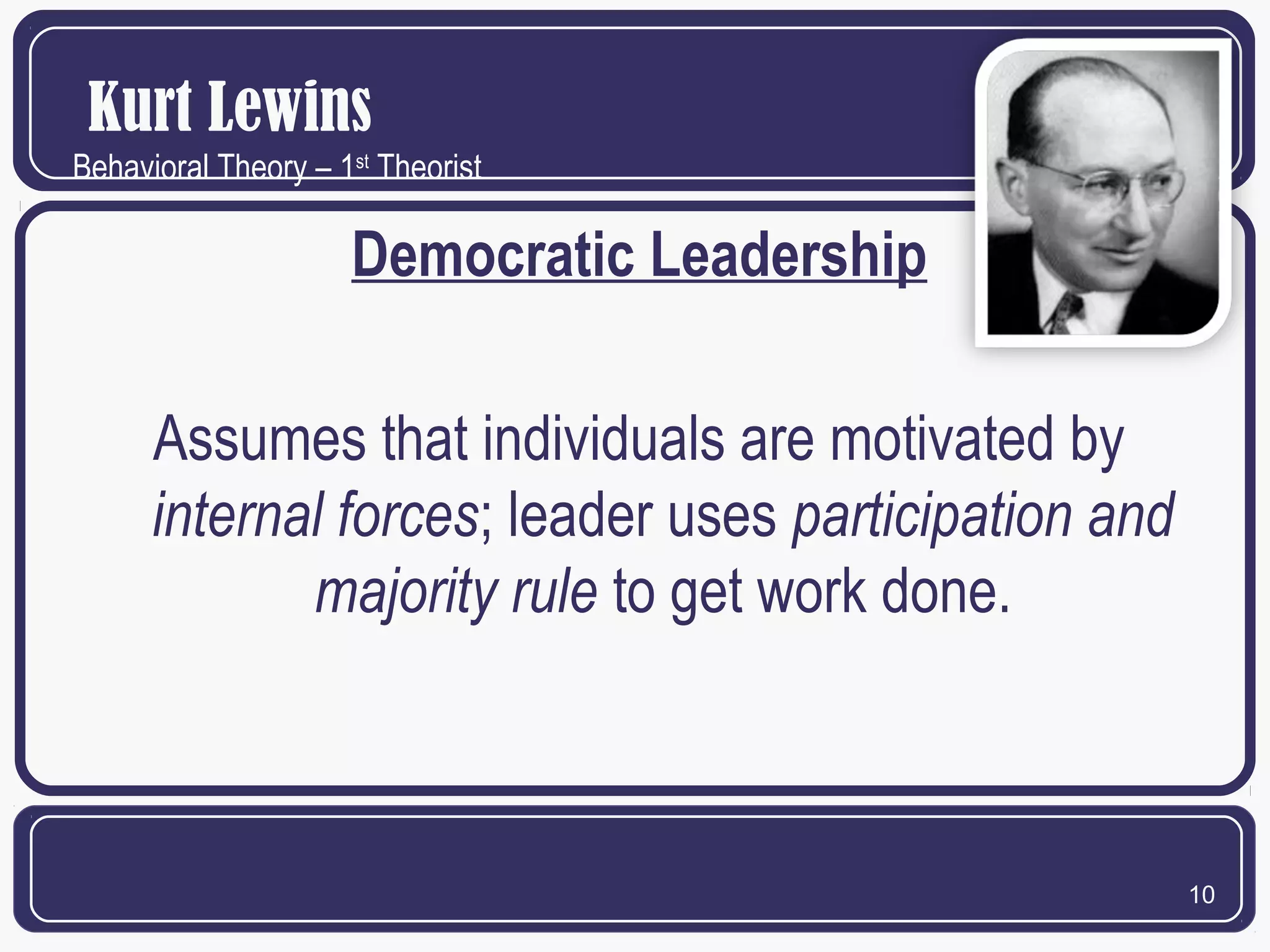
Authoritarian Leadership

6
Kurt Lewins
Behavioral Theory – 1st Theorist

Authoritarian Leadership (Benefits)
•
•
•
•
•

Quick Decision Making
Absolute Control
Focused Targets
Close Supervision
Maintains Order & Discipline

7
Kurt Lewins
Behavioral Theory – 1st Theorist

Authoritarian Leadership (Downfall)
•
•
•
•
•
•

Excessive Leader Dependence
One way communication
Fearful and devalued Employees
Exploitation of Employees
High Staff Turnover and Absenteeism
Low Employee Morale
8
Kurt Lewins
Behavioral Theory – 1st Theorist

Authoritarian Leadership

Common Characteristics?
Implications to Nursing Settings?

9
Kurt Lewins
Behavioral Theory – 1st Theorist

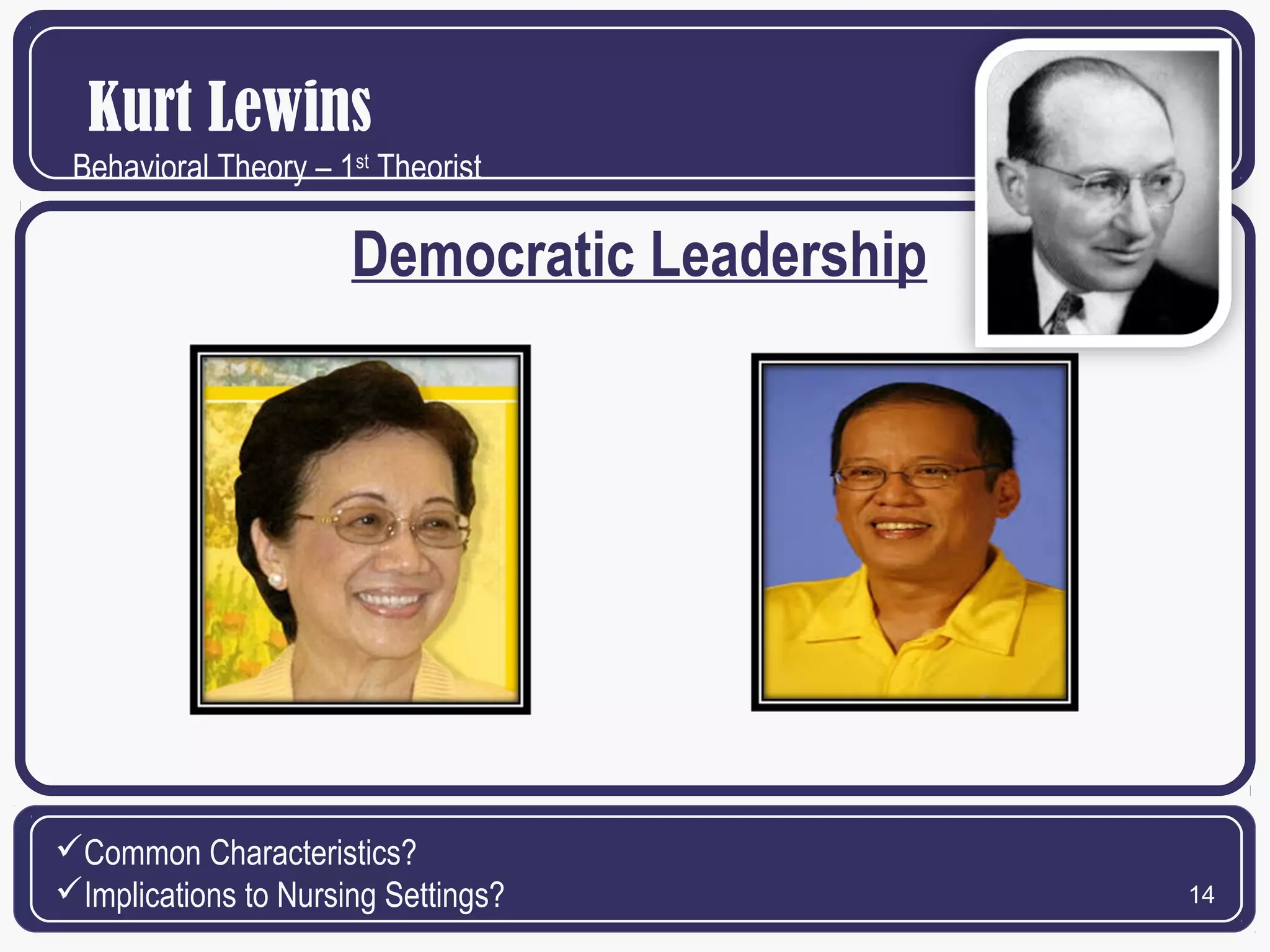
Democratic Leadership
Assumes that individuals are motivated by
internal forces; leader uses participation and
majority rule to get work done.

10
Kurt Lewins
Behavioral Theory – 1st Theorist

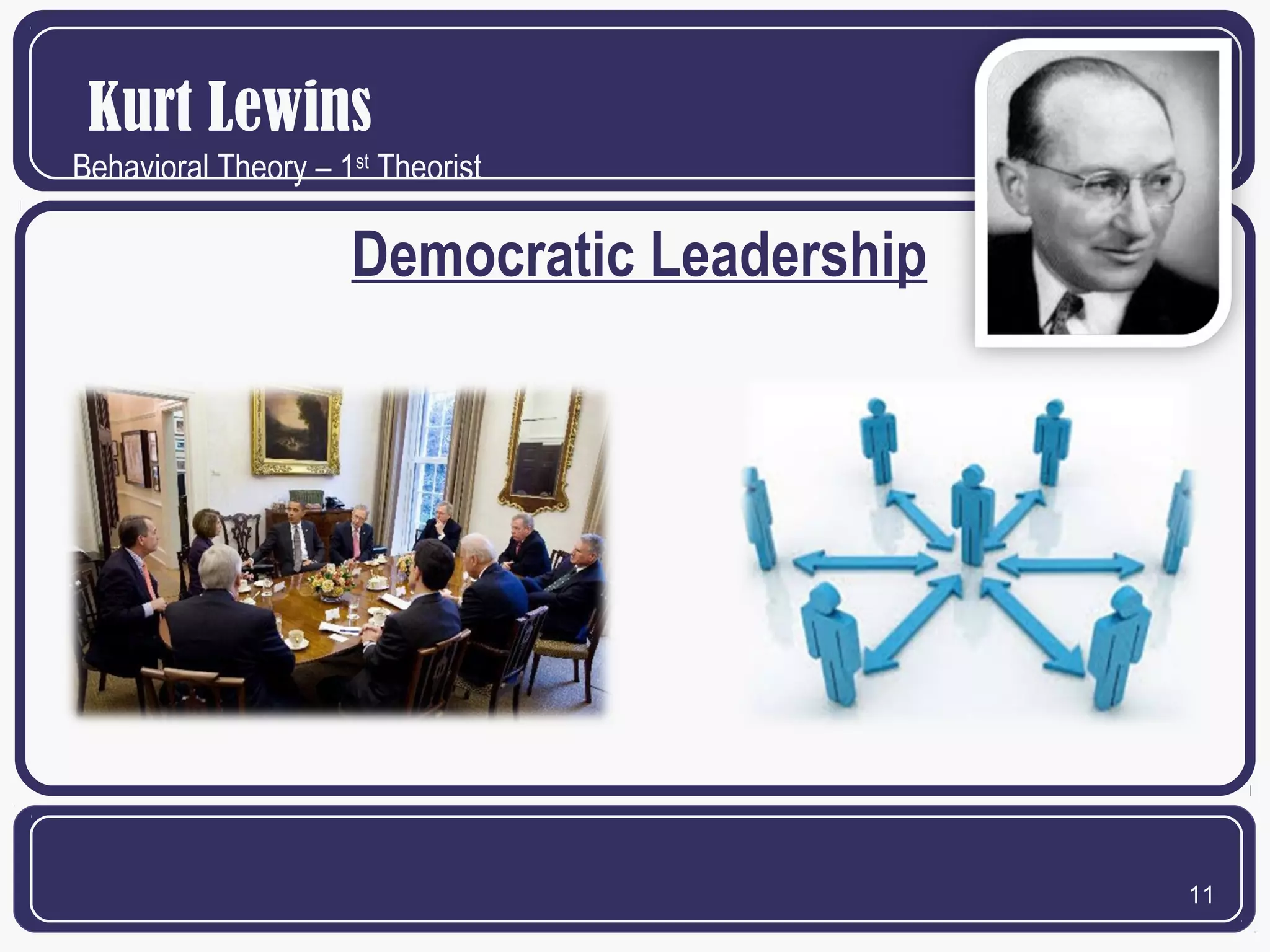
Democratic Leadership

11
Kurt Lewins
Behavioral Theory – 1st Theorist

Democratic Leadership (Benefits)
•
•
•
•
•

Reduced Communication Gap
All ideas are welcome and considered
Positive working environment
Reduced Employee turnover
Leadership skills are developed

12
Kurt Lewins
Behavioral Theory – 1st Theorist

Democratic Leadership (Downfall)
• Managers tend to please the subordinates
• Long process for decision making

13
Kurt Lewins
Behavioral Theory – 1st Theorist

Democratic Leadership

Common Characteristics?
Implications to Nursing Settings?

14
Kurt Lewins
Behavioral Theory – 1st Theorist

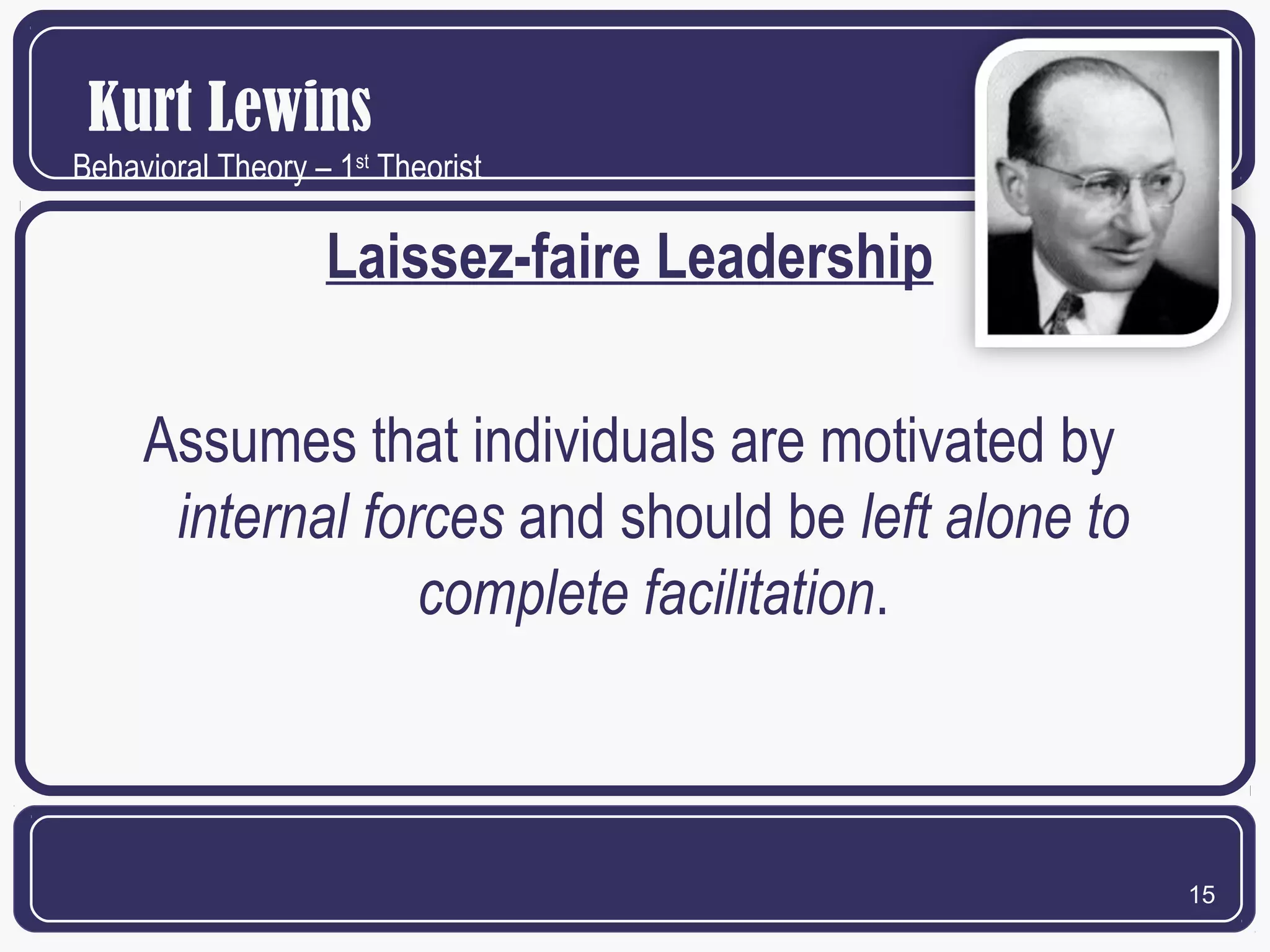
Laissez-faire Leadership
Assumes that individuals are motivated by
internal forces and should be left alone to
complete facilitation.

15
Kurt Lewins
Behavioral Theory – 1st Theorist

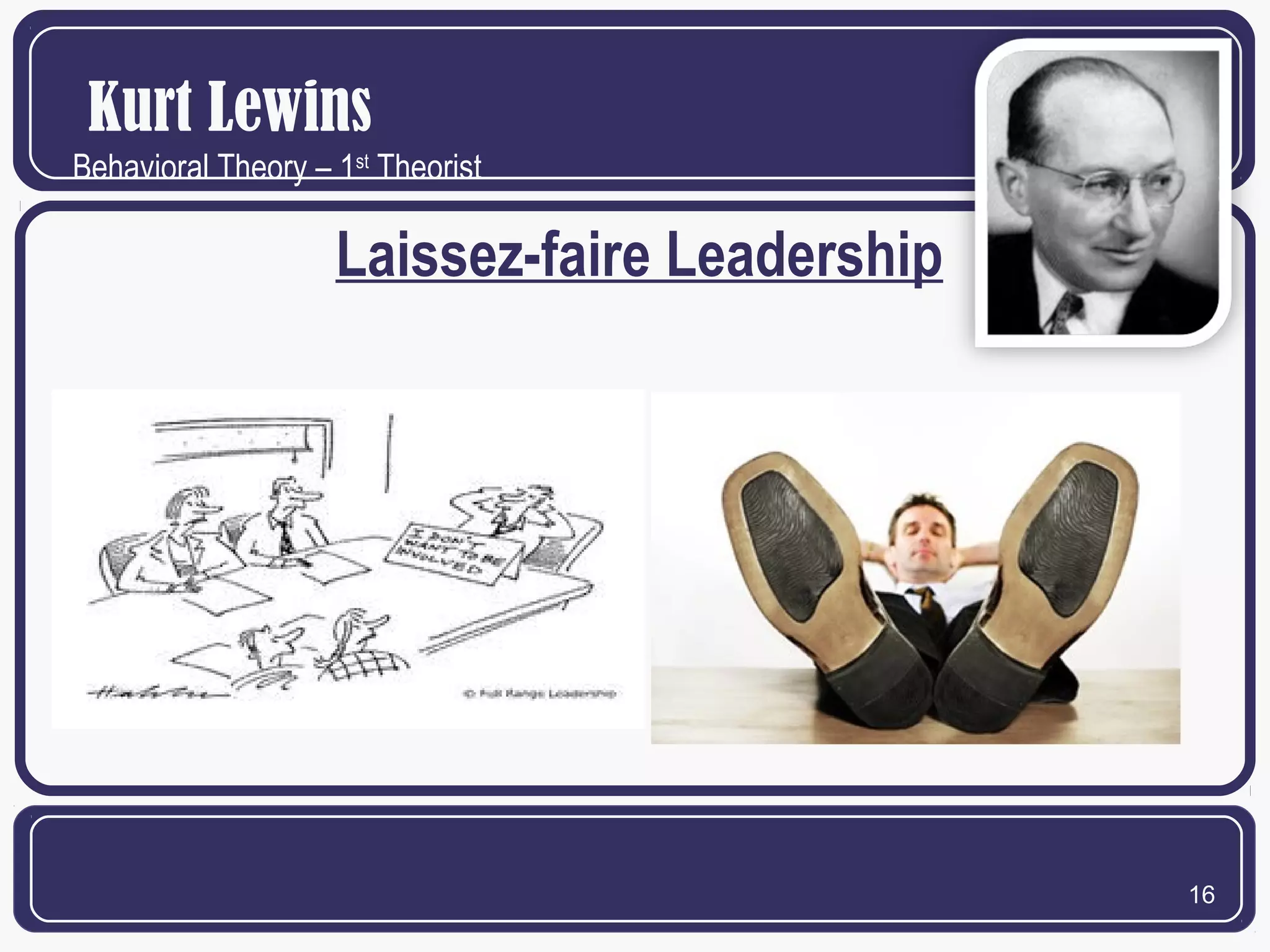
Laissez-faire Leadership

16
Kurt Lewins
Behavioral Theory – 1st Theorist

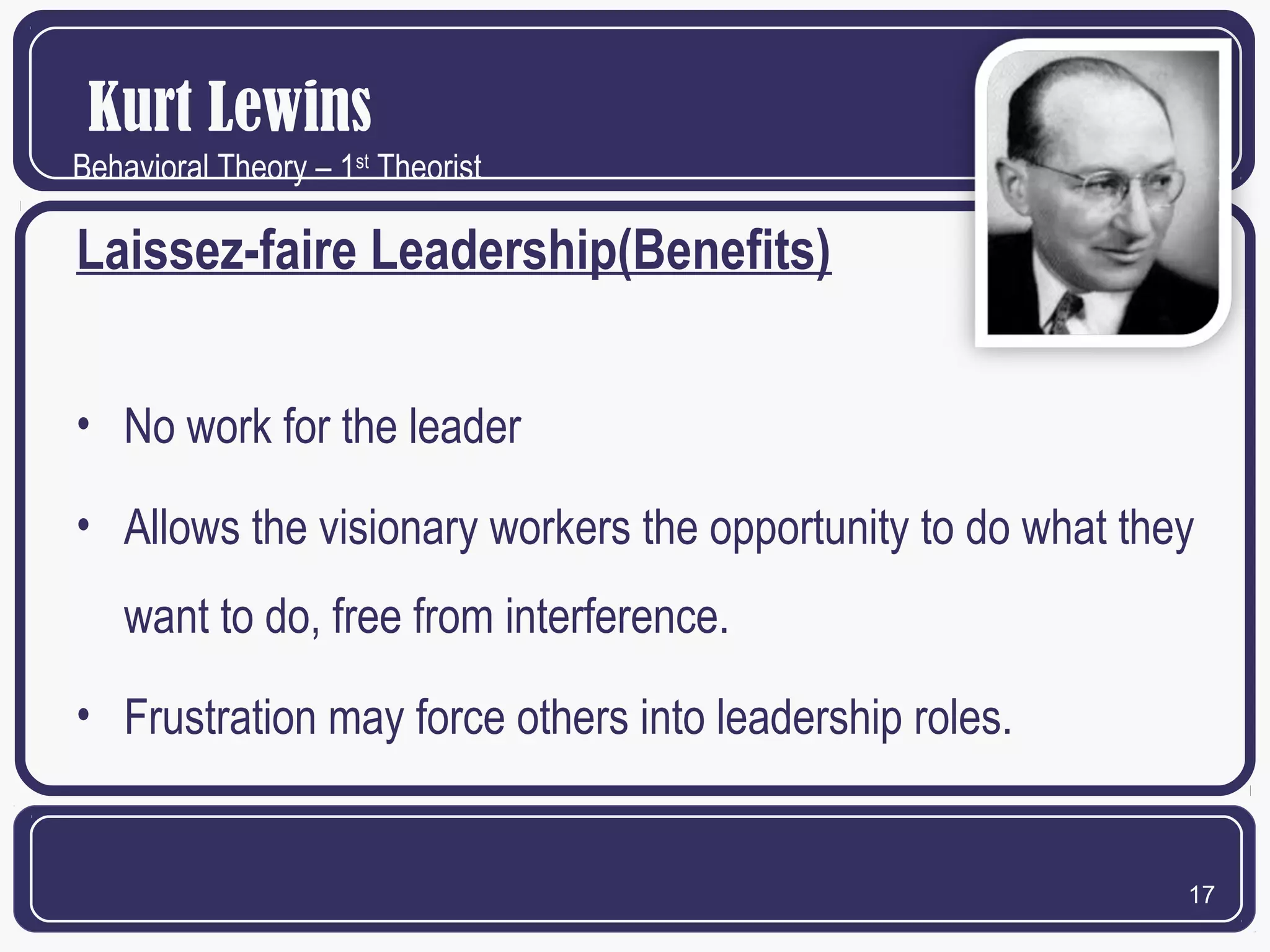
Laissez-faire Leadership(Benefits)
• No work for the leader
• Allows the visionary workers the opportunity to do what they
want to do, free from interference.
• Frustration may force others into leadership roles.

17
Kurt Lewins
Behavioral Theory – 1st Theorist

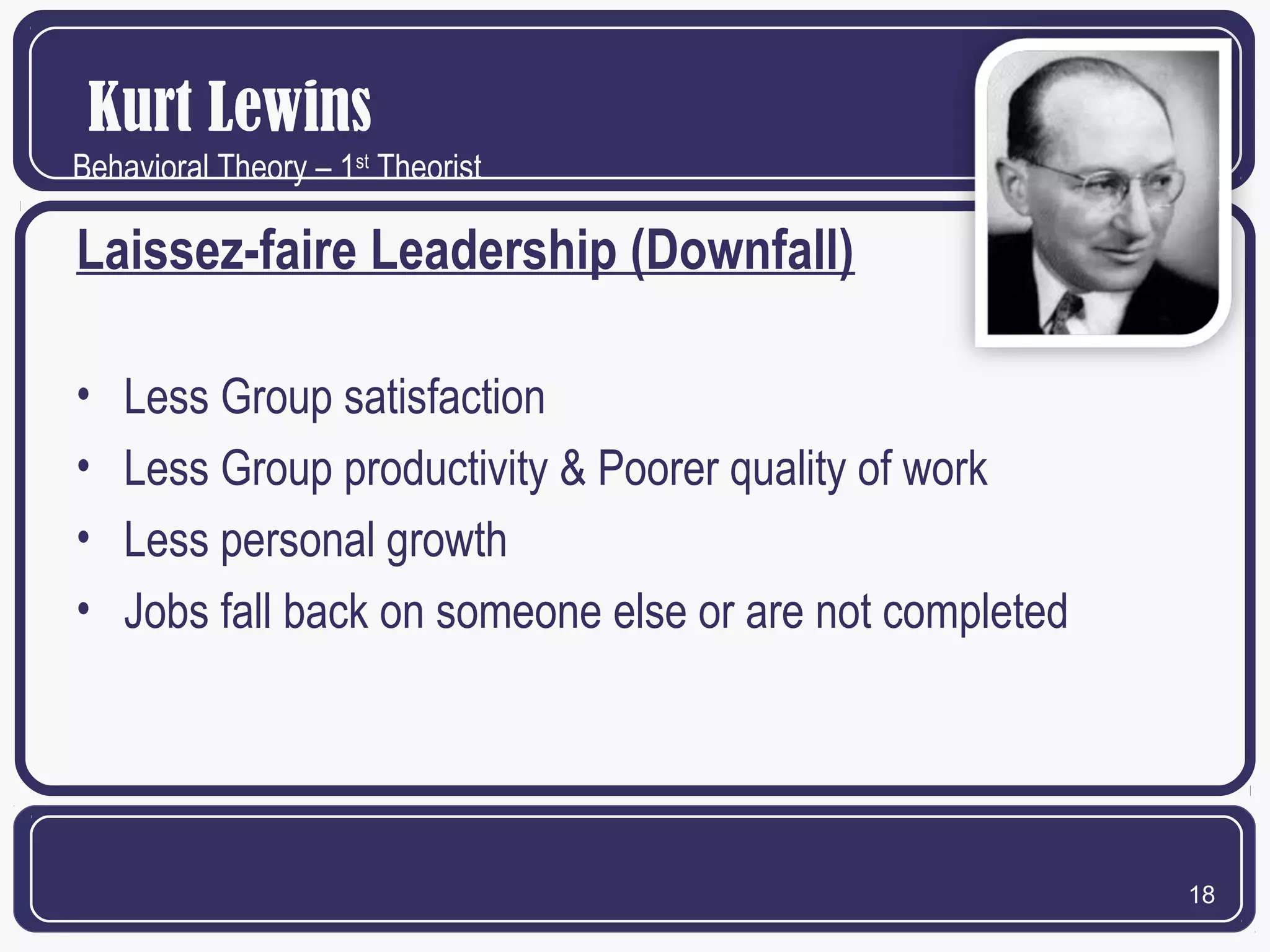
Laissez-faire Leadership (Downfall)
•
•
•
•

Less Group satisfaction
Less Group productivity & Poorer quality of work
Less personal growth
Jobs fall back on someone else or are not completed

18
Kurt Lewins
Behavioral Theory – 1st Theorist

Laissez-faire Leadership

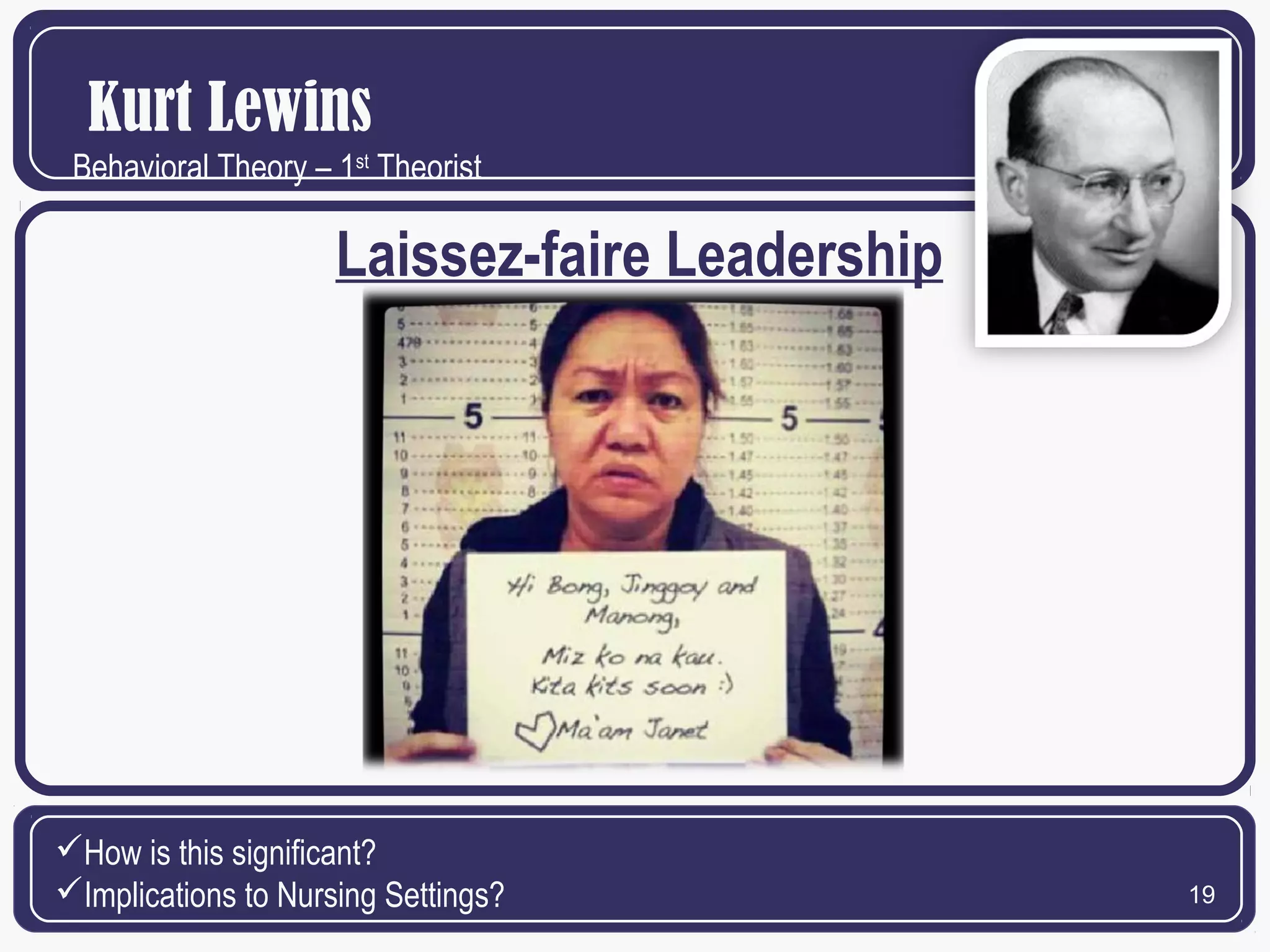
How is this significant?
Implications to Nursing Settings?

19
Jenkins and Henderson
Behavioral Theory – 2nd Theorist

Bureaucrat Leadership
Assumes that individuals are motivated by
external forces; leader trusts neither followers
nor self to make decisions and therefore relies
on organizational policies and rules.

20
Jenkins and Henderson
Behavioral Theory – 2nd Theorist

Bureaucrat Leadership

21
Jenkins and Henderson
Behavioral Theory – 2nd Theorist

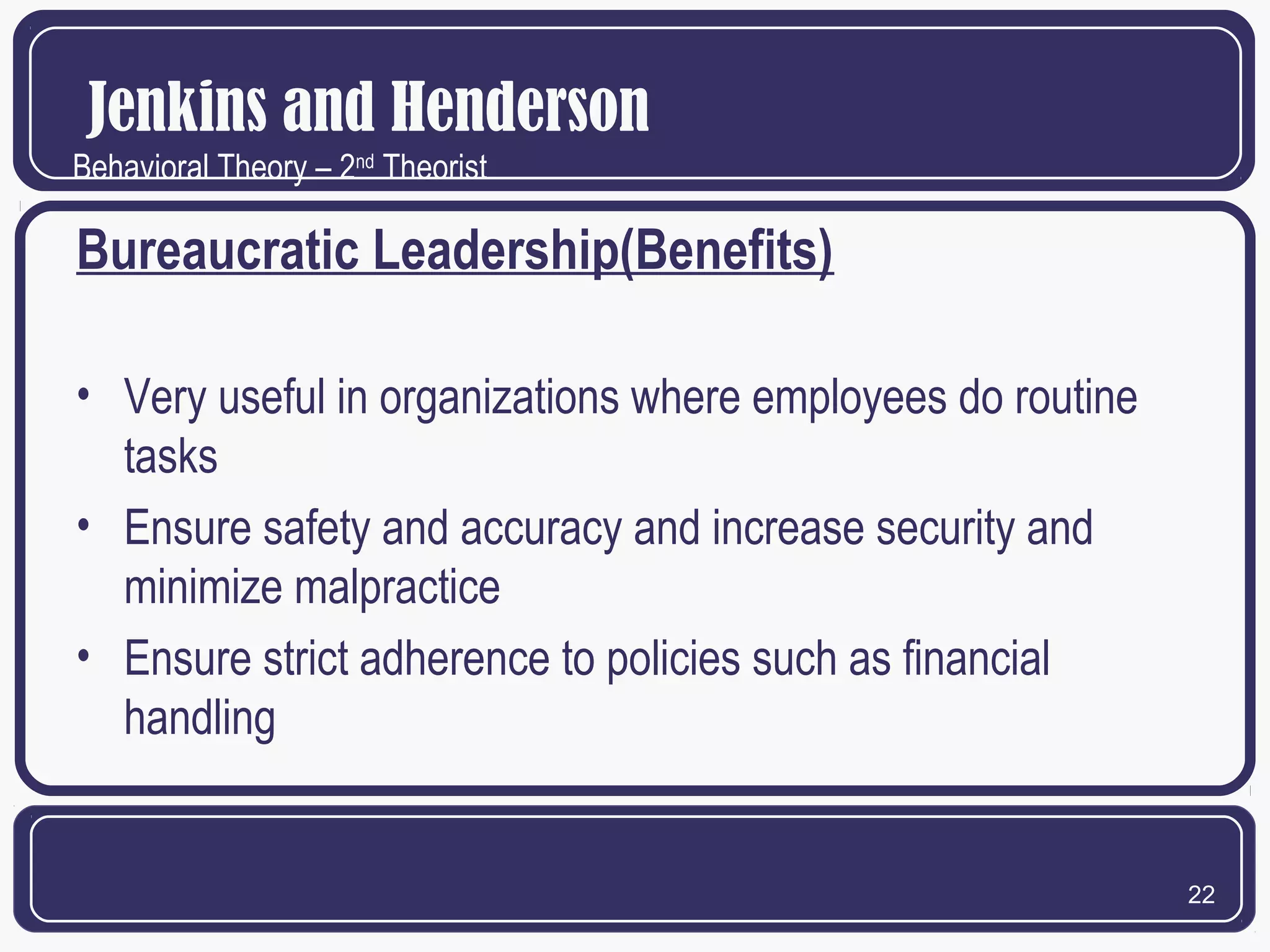
Bureaucratic Leadership(Benefits)
• Very useful in organizations where employees do routine
tasks
• Ensure safety and accuracy and increase security and
minimize malpractice
• Ensure strict adherence to policies such as financial
handling

22
Jenkins and Henderson
Behavioral Theory – 2nd Theorist

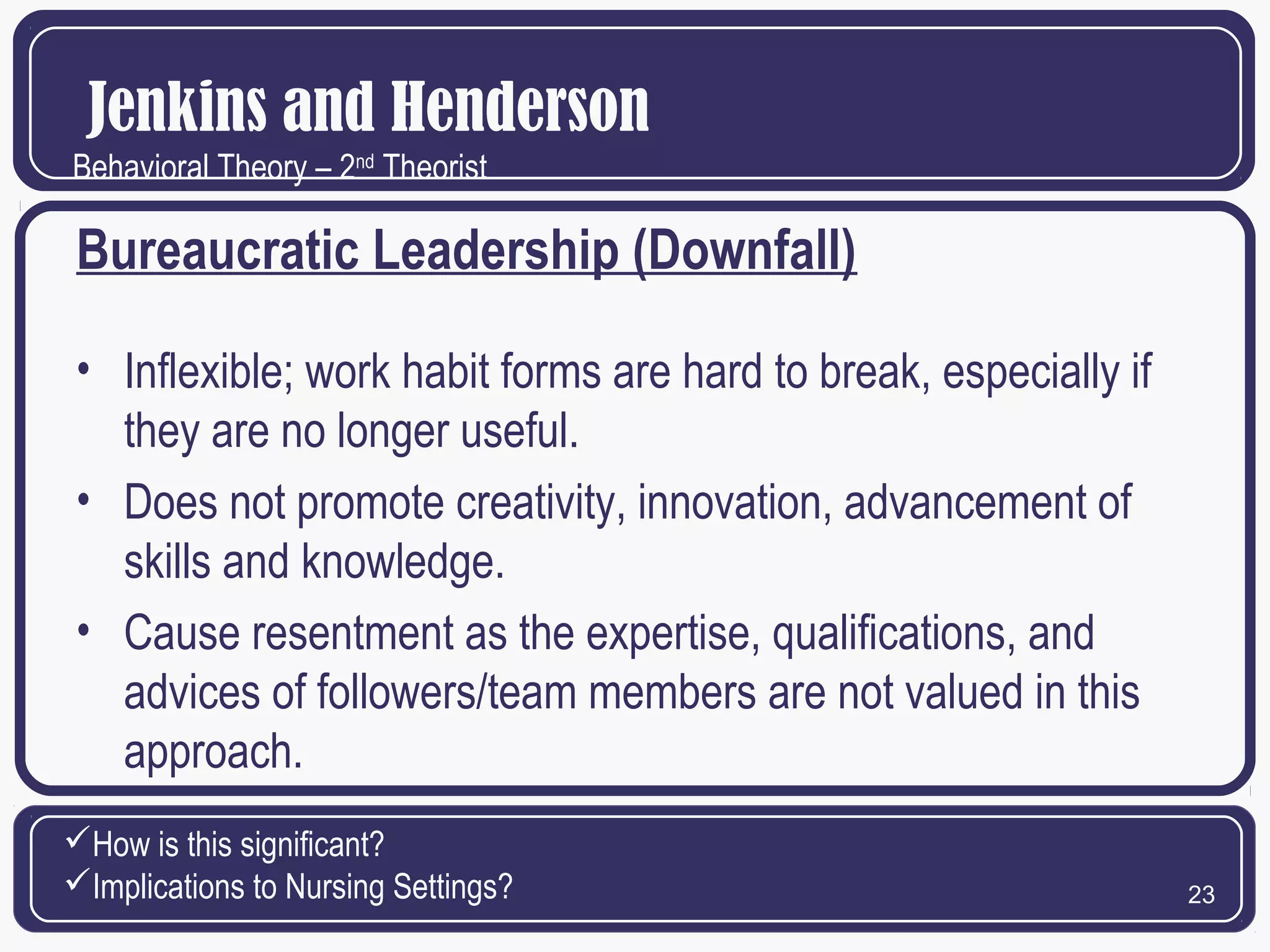
Bureaucratic Leadership (Downfall)
• Inflexible; work habit forms are hard to break, especially if
they are no longer useful.
• Does not promote creativity, innovation, advancement of
skills and knowledge.
• Cause resentment as the expertise, qualifications, and
advices of followers/team members are not valued in this
approach.
How is this significant?
Implications to Nursing Settings?

23
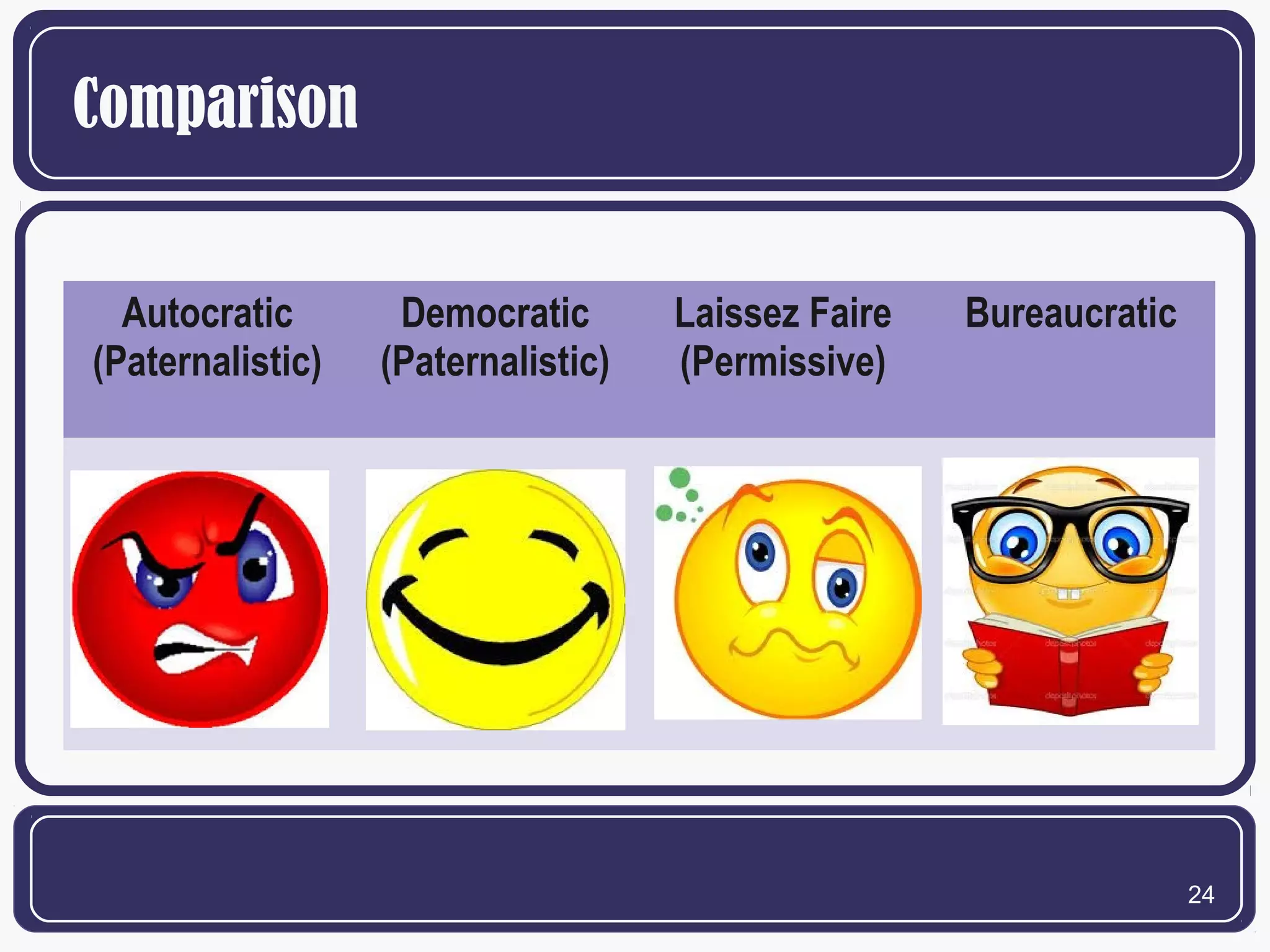
Comparison
Autocratic
(Paternalistic)

Democratic
(Paternalistic)

Laissez Faire
(Permissive)

Bureaucratic

24
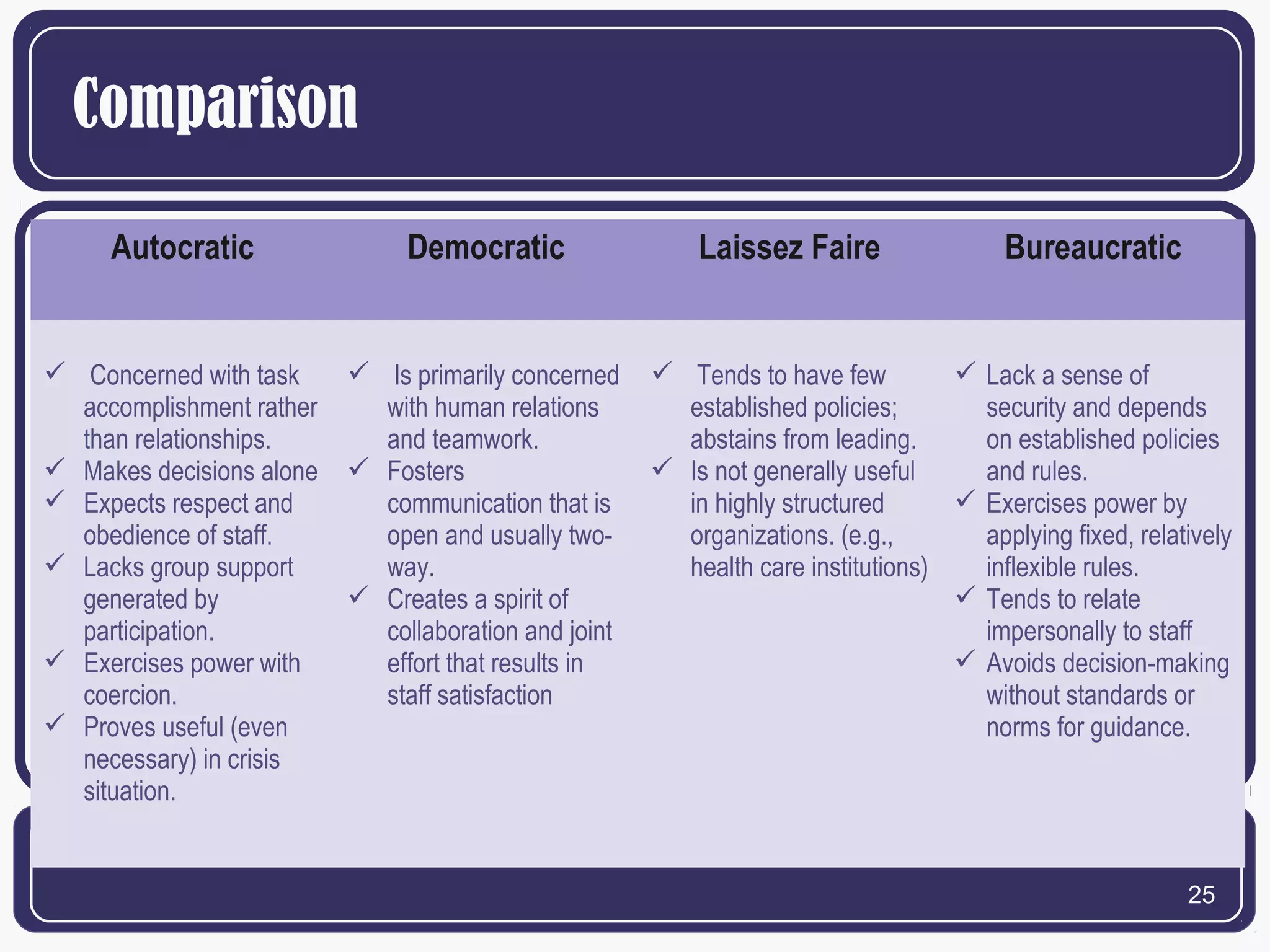
Comparison
Autocratic

Democratic

 Concerned with task
accomplishment rather
than relationships.
 Makes decisions alone
 Expects respect and
obedience of staff.
 Lacks group support
generated by
participation.
 Exercises power with
coercion.
 Proves useful (even
necessary) in crisis
situation.

 Is primarily concerned
with human relations
and teamwork.
 Fosters
communication that is
open and usually twoway.
 Creates a spirit of
collaboration and joint
effort that results in
staff satisfaction

Laissez Faire

Bureaucratic

 Tends to have few
 Lack a sense of
established policies;
security and depends
abstains from leading.
on established policies
 Is not generally useful
and rules.
 Exercises power by
in highly structured
organizations. (e.g.,
applying fixed, relatively
health care institutions)
inflexible rules.
 Tends to relate
impersonally to staff
 Avoids decision-making
without standards or
norms for guidance.

25
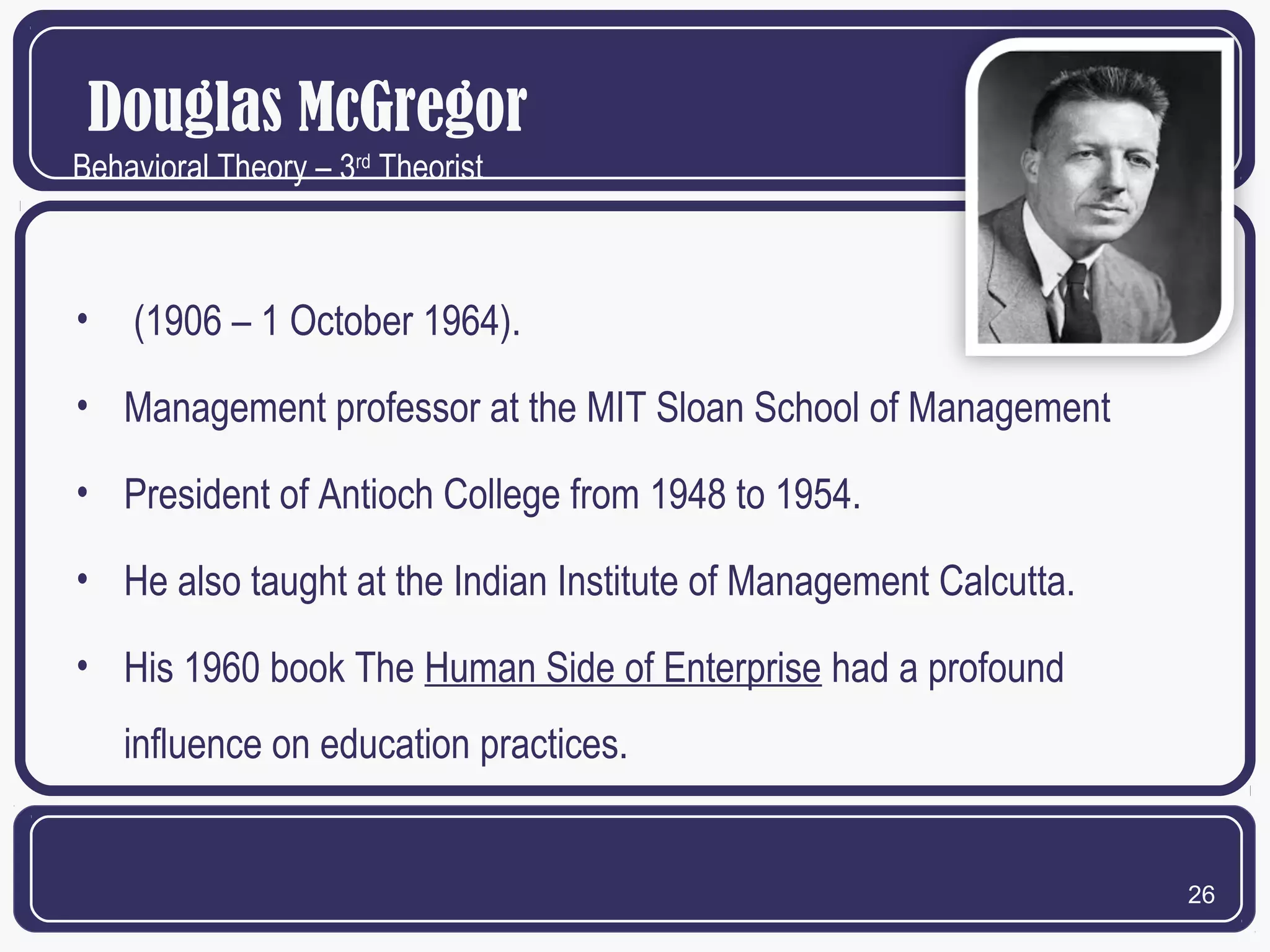
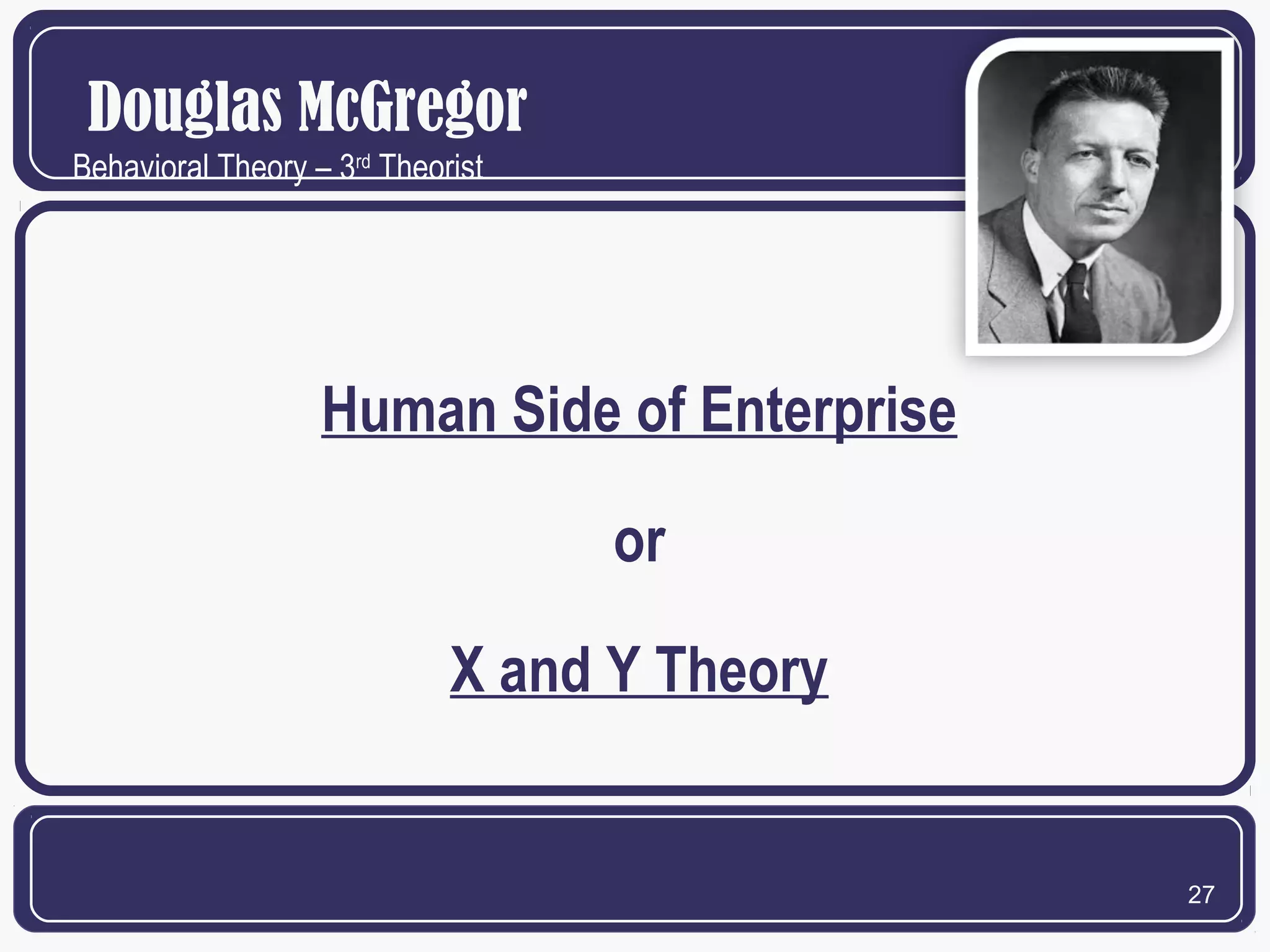
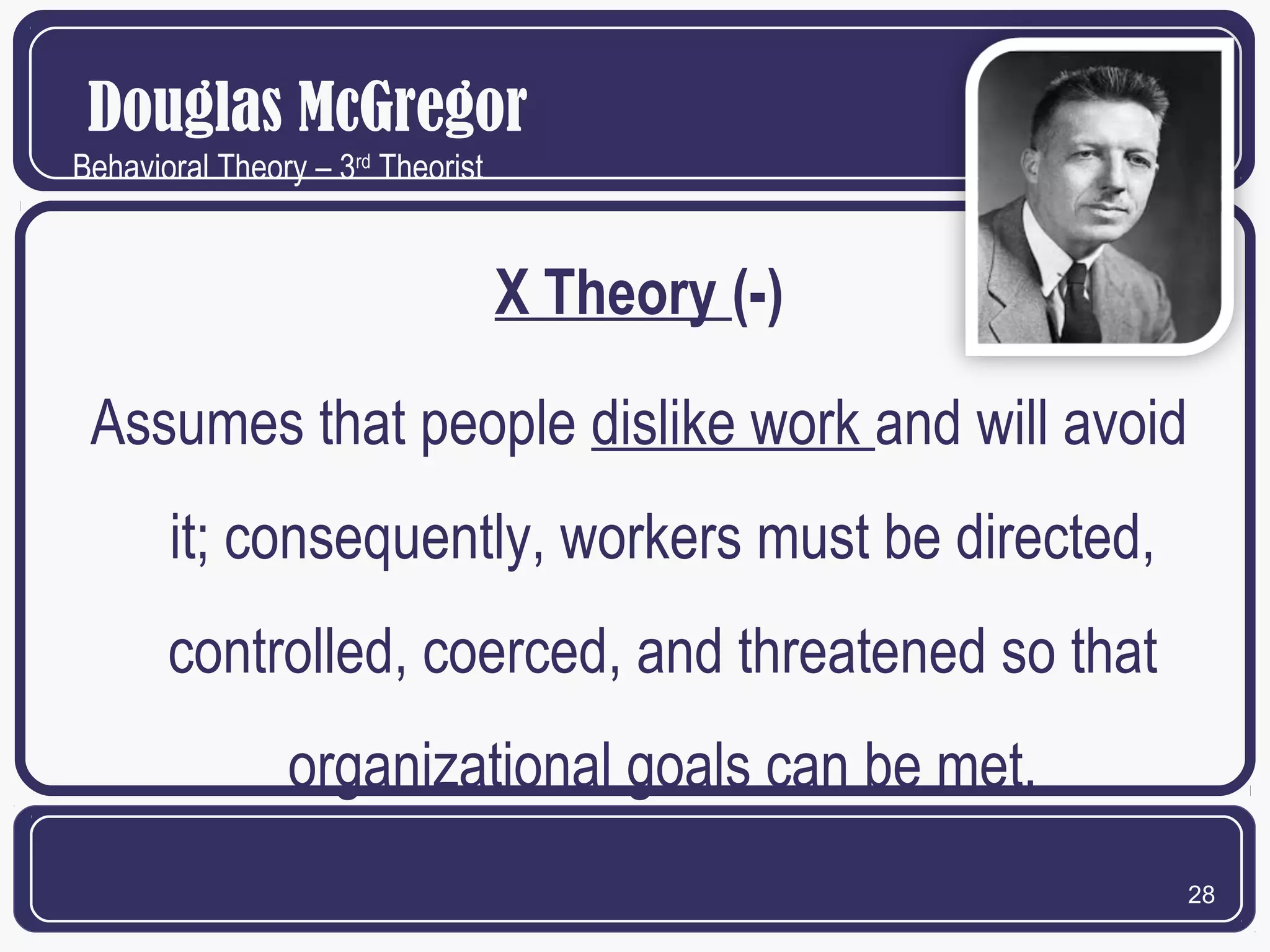
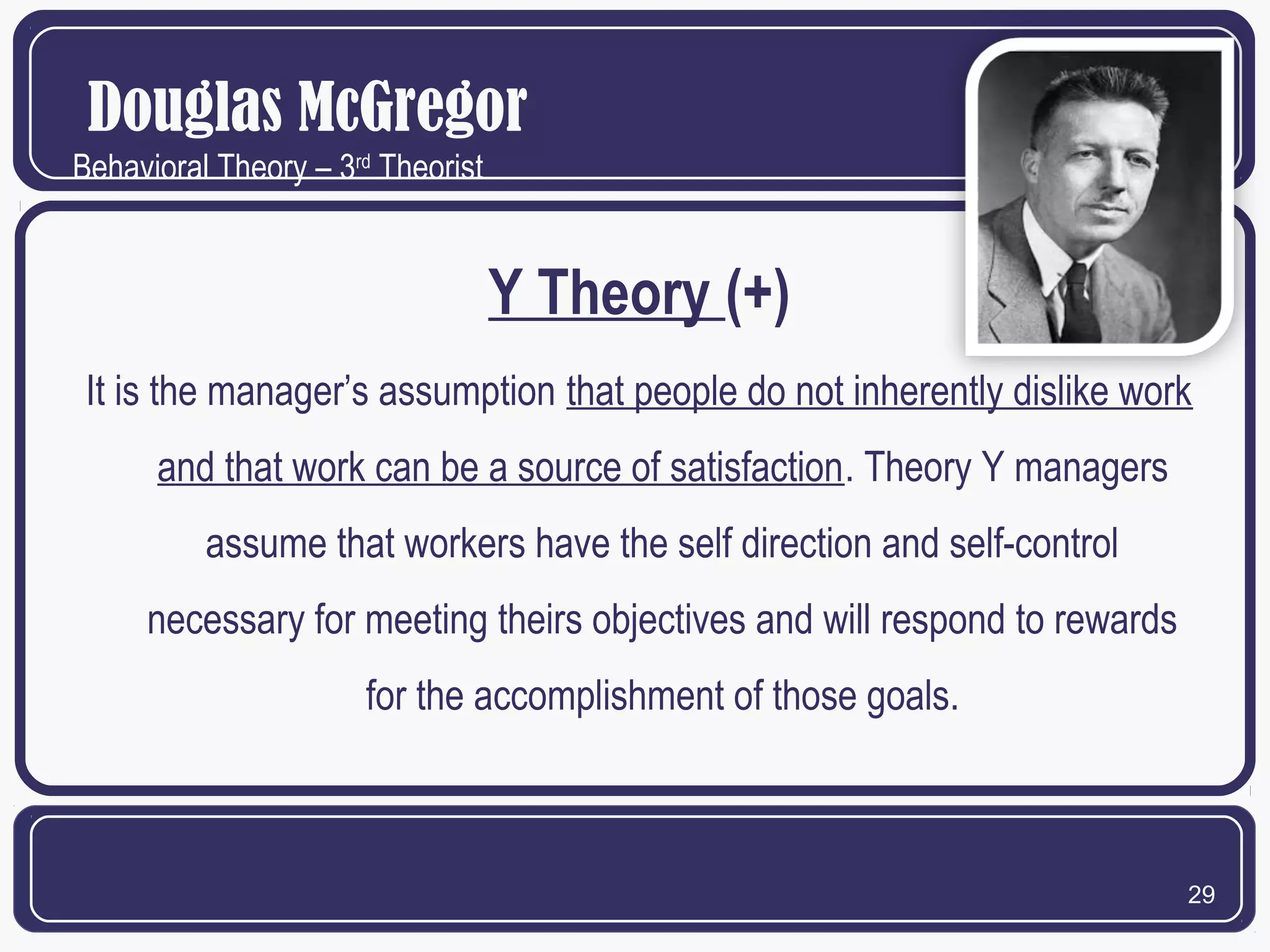
Douglas McGregor
Behavioral Theory – 3rd Theorist

•

(1906 – 1 October 1964).

• Management professor at the MIT Sloan School of Management
• President of Antioch College from 1948 to 1954.
• He also taught at the Indian Institute of Management Calcutta.
• His 1960 book The Human Side of Enterprise had a profound
influence on education practices.

26
Douglas McGregor
Behavioral Theory – 3rd Theorist

Human Side of Enterprise
or
X and Y Theory

27
Douglas McGregor
Behavioral Theory – 3rd Theorist

X Theory (-)
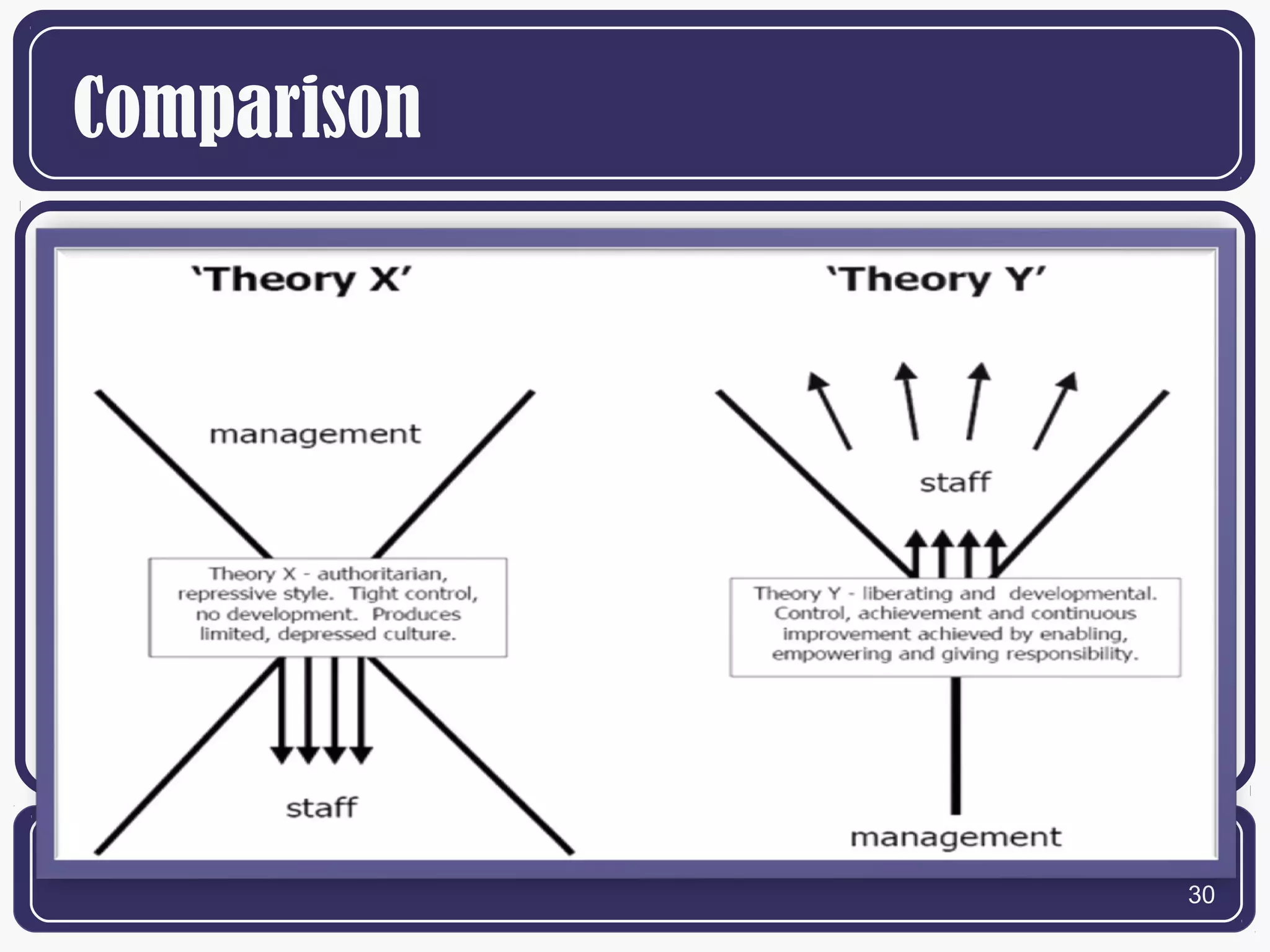
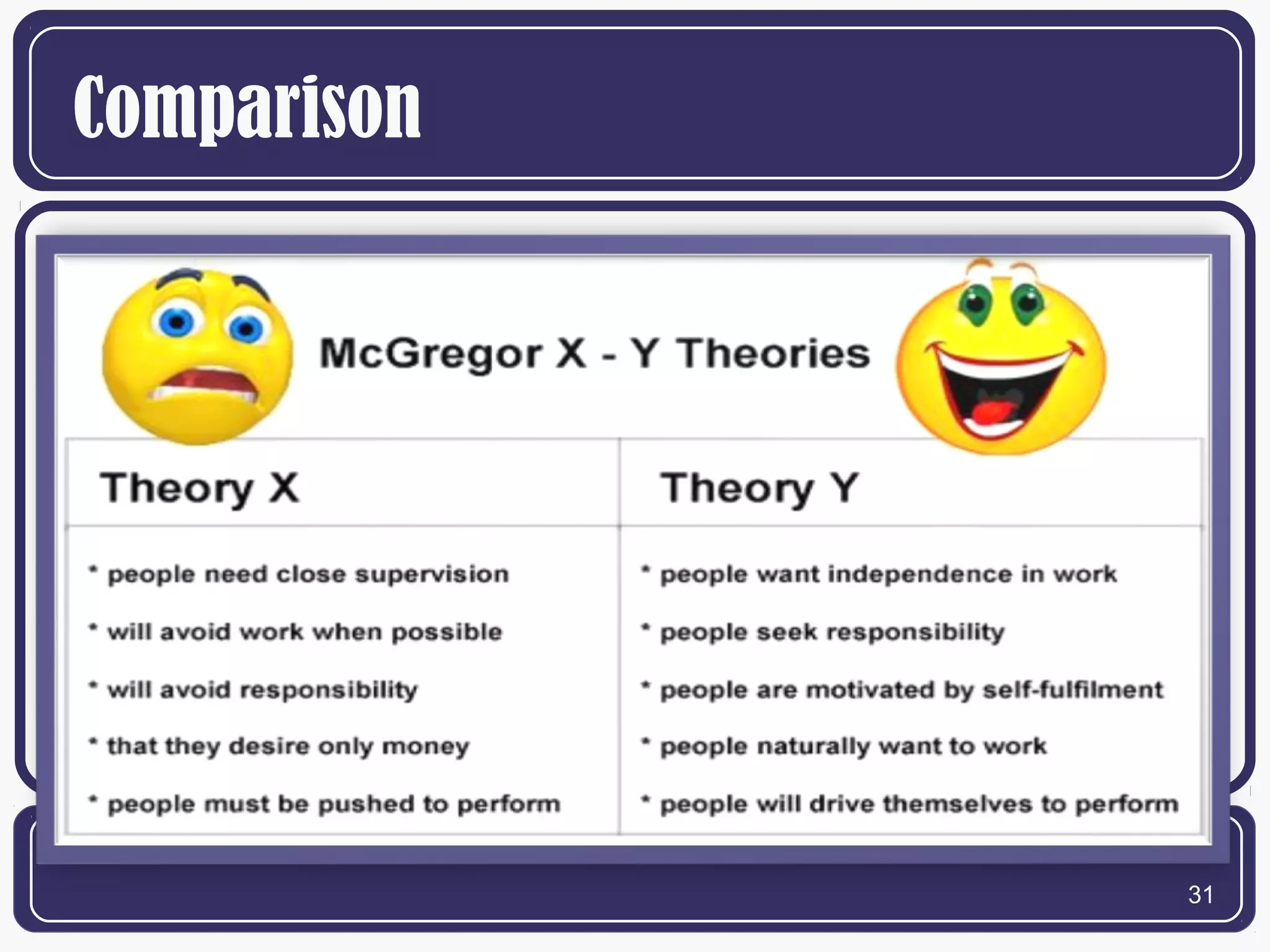
Assumes that people dislike work and will avoid
it; consequently, workers must be directed,
controlled, coerced, and threatened so that
organizational goals can be met.
28
Douglas McGregor
Behavioral Theory – 3rd Theorist

Y Theory (+)
It is the manager’s assumption that people do not inherently dislike work
and that work can be a source of satisfaction. Theory Y managers
assume that workers have the self direction and self-control
necessary for meeting theirs objectives and will respond to rewards
for the accomplishment of those goals.

29
Comparison

30
Comparison

31
"If your actions inspire others to dream more, learn
more, do more and become more, you are a
leader."
--- John Quincy Adams ---

Thank you!

32
--- END ---

Presented By;

Hanna Grace G. Olvido, R.N.
September 28, 2013

33

Behavioral theories

  • 1.
    Leadership Theories --Behavioral Theory PresentedBy; Hanna Grace G. Olvido, R.N. September 28, 2013 1
  • 2.
    Behavioral Theory In thebehavioural view of leadership, personal traits provide only foundation for leadership; real leaders are made through education, training, and life experiences. Effective Leaders acquire a pattern of learned behaviours. 2
  • 3.
    Kurt Lewins Behavioral Theory– 1st Theorist • (September 9, 1890 – February 12, 1947) • German-American psychologist, • One of the modern pioneers of social, organizational, and applied psychology. • Recognized as the "founder of social psychology" and was one of the first to study group dynamics and organizational development. 3
  • 4.
    Kurt Lewins Behavioral Theory– 1st Theorist LEADERSHIP CLIMATES 1.Autocratic (Paternalistic) 2.Democratic (Participative) 3.Laissez – faire (Permissive) 4
  • 5.
    Kurt Lewins Behavioral Theory– 1st Theorist Authoritarian Leadership Assumes that individuals are motivated by external forces; therefore, the leader makes all decisions and directs the followers’ behaviour. 5
  • 6.
    Kurt Lewins Behavioral Theory– 1st Theorist Authoritarian Leadership 6
  • 7.
    Kurt Lewins Behavioral Theory– 1st Theorist Authoritarian Leadership (Benefits) • • • • • Quick Decision Making Absolute Control Focused Targets Close Supervision Maintains Order & Discipline 7
  • 8.
    Kurt Lewins Behavioral Theory– 1st Theorist Authoritarian Leadership (Downfall) • • • • • • Excessive Leader Dependence One way communication Fearful and devalued Employees Exploitation of Employees High Staff Turnover and Absenteeism Low Employee Morale 8
  • 9.
    Kurt Lewins Behavioral Theory– 1st Theorist Authoritarian Leadership Common Characteristics? Implications to Nursing Settings? 9
  • 10.
    Kurt Lewins Behavioral Theory– 1st Theorist Democratic Leadership Assumes that individuals are motivated by internal forces; leader uses participation and majority rule to get work done. 10
  • 11.
    Kurt Lewins Behavioral Theory– 1st Theorist Democratic Leadership 11
  • 12.
    Kurt Lewins Behavioral Theory– 1st Theorist Democratic Leadership (Benefits) • • • • • Reduced Communication Gap All ideas are welcome and considered Positive working environment Reduced Employee turnover Leadership skills are developed 12
  • 13.
    Kurt Lewins Behavioral Theory– 1st Theorist Democratic Leadership (Downfall) • Managers tend to please the subordinates • Long process for decision making 13
  • 14.
    Kurt Lewins Behavioral Theory– 1st Theorist Democratic Leadership Common Characteristics? Implications to Nursing Settings? 14
  • 15.
    Kurt Lewins Behavioral Theory– 1st Theorist Laissez-faire Leadership Assumes that individuals are motivated by internal forces and should be left alone to complete facilitation. 15
  • 16.
    Kurt Lewins Behavioral Theory– 1st Theorist Laissez-faire Leadership 16
  • 17.
    Kurt Lewins Behavioral Theory– 1st Theorist Laissez-faire Leadership(Benefits) • No work for the leader • Allows the visionary workers the opportunity to do what they want to do, free from interference. • Frustration may force others into leadership roles. 17
  • 18.
    Kurt Lewins Behavioral Theory– 1st Theorist Laissez-faire Leadership (Downfall) • • • • Less Group satisfaction Less Group productivity & Poorer quality of work Less personal growth Jobs fall back on someone else or are not completed 18
  • 19.
    Kurt Lewins Behavioral Theory– 1st Theorist Laissez-faire Leadership How is this significant? Implications to Nursing Settings? 19
  • 20.
    Jenkins and Henderson BehavioralTheory – 2nd Theorist Bureaucrat Leadership Assumes that individuals are motivated by external forces; leader trusts neither followers nor self to make decisions and therefore relies on organizational policies and rules. 20
  • 21.
    Jenkins and Henderson BehavioralTheory – 2nd Theorist Bureaucrat Leadership 21
  • 22.
    Jenkins and Henderson BehavioralTheory – 2nd Theorist Bureaucratic Leadership(Benefits) • Very useful in organizations where employees do routine tasks • Ensure safety and accuracy and increase security and minimize malpractice • Ensure strict adherence to policies such as financial handling 22
  • 23.
    Jenkins and Henderson BehavioralTheory – 2nd Theorist Bureaucratic Leadership (Downfall) • Inflexible; work habit forms are hard to break, especially if they are no longer useful. • Does not promote creativity, innovation, advancement of skills and knowledge. • Cause resentment as the expertise, qualifications, and advices of followers/team members are not valued in this approach. How is this significant? Implications to Nursing Settings? 23
  • 24.
  • 25.
    Comparison Autocratic Democratic  Concerned withtask accomplishment rather than relationships.  Makes decisions alone  Expects respect and obedience of staff.  Lacks group support generated by participation.  Exercises power with coercion.  Proves useful (even necessary) in crisis situation.  Is primarily concerned with human relations and teamwork.  Fosters communication that is open and usually twoway.  Creates a spirit of collaboration and joint effort that results in staff satisfaction Laissez Faire Bureaucratic  Tends to have few  Lack a sense of established policies; security and depends abstains from leading. on established policies  Is not generally useful and rules.  Exercises power by in highly structured organizations. (e.g., applying fixed, relatively health care institutions) inflexible rules.  Tends to relate impersonally to staff  Avoids decision-making without standards or norms for guidance. 25
  • 26.
    Douglas McGregor Behavioral Theory– 3rd Theorist • (1906 – 1 October 1964). • Management professor at the MIT Sloan School of Management • President of Antioch College from 1948 to 1954. • He also taught at the Indian Institute of Management Calcutta. • His 1960 book The Human Side of Enterprise had a profound influence on education practices. 26
  • 27.
    Douglas McGregor Behavioral Theory– 3rd Theorist Human Side of Enterprise or X and Y Theory 27
  • 28.
    Douglas McGregor Behavioral Theory– 3rd Theorist X Theory (-) Assumes that people dislike work and will avoid it; consequently, workers must be directed, controlled, coerced, and threatened so that organizational goals can be met. 28
  • 29.
    Douglas McGregor Behavioral Theory– 3rd Theorist Y Theory (+) It is the manager’s assumption that people do not inherently dislike work and that work can be a source of satisfaction. Theory Y managers assume that workers have the self direction and self-control necessary for meeting theirs objectives and will respond to rewards for the accomplishment of those goals. 29
  • 30.
  • 31.
  • 32.
    "If your actionsinspire others to dream more, learn more, do more and become more, you are a leader." --- John Quincy Adams --- Thank you! 32
  • 33.
    --- END --- PresentedBy; Hanna Grace G. Olvido, R.N. September 28, 2013 33