PRESENTATION
ON
“LEADERSHIP & TEAMWORK”
BY
Mr. Harshal dagaji patil
SUBMITTED TO
PROF.MRS. RENUKA S. TURAMBEKAR.
Department of commerce and management,
Shivaji University, Kolhapur.
LEADERSHIP
 Leadership is one of the most important aspect of
management.
 INTRODUCTION
 Leading involves directing, influencing & motivating
employees to perform.
 DEFINITION
2) “The ability to influence a group toward the achievement of goals”
-Robbins & Coulter(1999)
1) The ability to positively influence people and systems to
have a meaningful impact and achieve results.
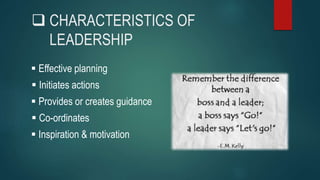
 CHARACTERISTICS OF
LEADERSHIP
 Effective planning
 Inspiration & motivation
 Initiates actions
 Provides or creates guidance
 Co-ordinates
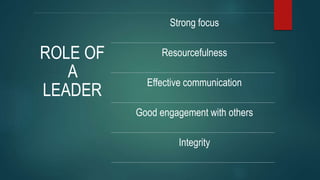
ROLE OF
A
LEADER
Strong focus
Resourcefulness
Effective communication
Good engagement with others
Integrity
 LEADERSHIP STYLES
Individual managers have their own styles of managing, and
within organizations there is often a predominant style of
leadership.
 Autocratic style
 Democratic style
 Laissez-faire
 Autocratic Leadership
 Decisions without consulting employees-dictate employee roles.
 Directive and controlling.
 Suitable for managing less experienced employees.
 Limits employee freedom of expression and participation in the
decision-making.
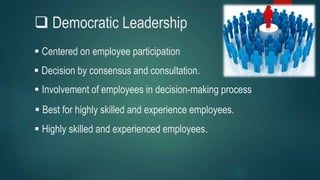
 Democratic Leadership
 Centered on employee participation
 Involvement of employees in decision-making process
 Decision by consensus and consultation.
 Highly skilled and experienced employees.
 Best for highly skilled and experience employees.
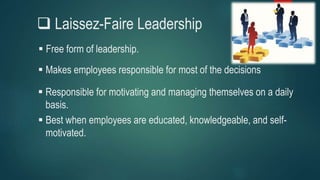
 Laissez-Faire Leadership
 Free form of leadership.
 Responsible for motivating and managing themselves on a daily
basis.
 Makes employees responsible for most of the decisions
 Best when employees are educated, knowledgeable, and self-
motivated.
TEAMWORK
 What is Team work…
 Teamwork is working collaboratively for achieving a
particular goal.
 It is important for colleagues to work in a team and try
their best for the success of a business.
 Characteristics of an Effective Teamwork
In a group of people, the characteristics of the effective teamwork
consist of the willingness to take responsibility and set aside the personal
issues for achieving a common goal.
1)Credibility
2) Sense of Purpose
5) Appreciation
3) Accountability
4) Cooperative Spirit
 Benefits of teamwork
 Builds synergy.
 Promotes trade-off and solves problems.
 Promote creativity.
 Helps both large corporations and small groups.
 Reduces tension and conflicts.
 Enhances success.
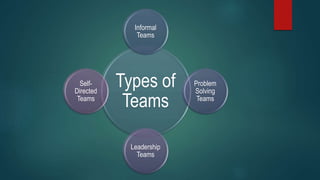
Types of
Teams
Informal
Teams
Problem
Solving
Teams
Leadership
Teams
Self-
Directed
Teams
BIBLIOGRAPHY
 “PRINCIPLE OF MANAGEMENT”
Dr. Omvir Chaudhary.
Dr. Prakash Singh.
 Pdf “PEOPLE , MANAGEMENT AND POLICY”
 www.google.com
 www.studymafia.org
 www.Wikipedia.com

Leadership & teamwork

  • 1.
    PRESENTATION ON “LEADERSHIP & TEAMWORK” BY Mr.Harshal dagaji patil SUBMITTED TO PROF.MRS. RENUKA S. TURAMBEKAR. Department of commerce and management, Shivaji University, Kolhapur.
  • 2.
  • 3.
     Leadership isone of the most important aspect of management.  INTRODUCTION  Leading involves directing, influencing & motivating employees to perform.
  • 4.
     DEFINITION 2) “Theability to influence a group toward the achievement of goals” -Robbins & Coulter(1999) 1) The ability to positively influence people and systems to have a meaningful impact and achieve results.
  • 5.
     CHARACTERISTICS OF LEADERSHIP Effective planning  Inspiration & motivation  Initiates actions  Provides or creates guidance  Co-ordinates
  • 6.
    ROLE OF A LEADER Strong focus Resourcefulness Effectivecommunication Good engagement with others Integrity
  • 7.
     LEADERSHIP STYLES Individualmanagers have their own styles of managing, and within organizations there is often a predominant style of leadership.  Autocratic style  Democratic style  Laissez-faire
  • 8.
     Autocratic Leadership Decisions without consulting employees-dictate employee roles.  Directive and controlling.  Suitable for managing less experienced employees.  Limits employee freedom of expression and participation in the decision-making.
  • 9.
     Democratic Leadership Centered on employee participation  Involvement of employees in decision-making process  Decision by consensus and consultation.  Highly skilled and experienced employees.  Best for highly skilled and experience employees.
  • 10.
     Laissez-Faire Leadership Free form of leadership.  Responsible for motivating and managing themselves on a daily basis.  Makes employees responsible for most of the decisions  Best when employees are educated, knowledgeable, and self- motivated.
  • 11.
  • 12.
     What isTeam work…  Teamwork is working collaboratively for achieving a particular goal.  It is important for colleagues to work in a team and try their best for the success of a business.
  • 13.
     Characteristics ofan Effective Teamwork In a group of people, the characteristics of the effective teamwork consist of the willingness to take responsibility and set aside the personal issues for achieving a common goal. 1)Credibility 2) Sense of Purpose 5) Appreciation 3) Accountability 4) Cooperative Spirit
  • 14.
     Benefits ofteamwork  Builds synergy.  Promotes trade-off and solves problems.  Promote creativity.  Helps both large corporations and small groups.  Reduces tension and conflicts.  Enhances success.
  • 15.
  • 16.
    BIBLIOGRAPHY  “PRINCIPLE OFMANAGEMENT” Dr. Omvir Chaudhary. Dr. Prakash Singh.  Pdf “PEOPLE , MANAGEMENT AND POLICY”  www.google.com  www.studymafia.org  www.Wikipedia.com