Behavior ModificationDecreasing Behavior through Punishment– Ryan Sain
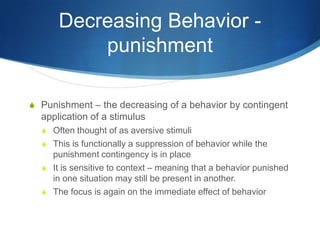
Decreasing Behavior - punishmentPunishment – the decreasing of a behavior by contingent application of a stimulusOften thought of as aversive stimuliThis is functionally a suppression of behavior while the punishment contingency is in placeIt is sensitive to context – meaning that a behavior punished in one situation may still be present in another.The focus is again on the immediate effect of behavior
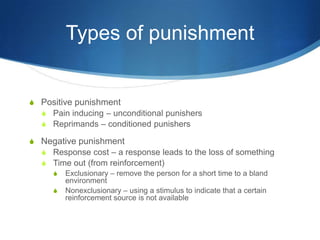
Types of punishmentPositive punishmentPain inducing – unconditional punishersReprimands – conditioned punishersNegative punishmentResponse cost – a response leads to the loss of somethingTime out (from reinforcement)Exclusionary – remove the person for a short time to a bland environmentNonexclusionary – using a stimulus to indicate that a certain reinforcement source is not available
FactorsWhen you punish – reinforce appropriate behavior as wellJust like extinction – or the response will come back once the punisher is removedMaximize the likelihood that this contingency will be implemented (develop strong Sd for appropriate responding)Minimize the Sd for the unwanted behaviorMinimize the Sr for the unwanted behavior
More factorsIntensityUse of an intense punisher is generally more effective – especially in situations where the Sd and Sr for inappropriate responding are still present.However – if you do the previous – then a very weak stimulus will likely be effectiveNever pair the punisher with Sr. Attention is an issue here (negative attention)
Yet moreAdd an SDp – make a rule and make it known.Deliver the punishers immediatelyDo not wait for hours and hours – you may be punishing desirable behavior!For punishment – continuous schedules are best. This is because the converse is true for reinforcement.
EthicsPunishment is controversialIf a non pain inducing alternative is available, use it.Response prevention also prevents appropriate responding – so this is problematicSevere behavioral problems (self injury, health, etc.) are the only times when the use of punishment is acceptable.Time out issues
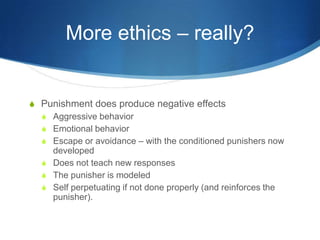
More ethics – really?Punishment does produce negative effectsAggressive behaviorEmotional behaviorEscape or avoidance – with the conditioned punishers now developedDoes not teach new responsesThe punisher is modeledSelf perpetuating if not done properly (and reinforces the punisher).
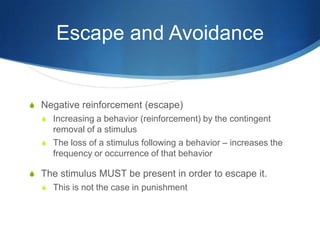
Escape and AvoidanceNegative reinforcement (escape)Increasing a behavior (reinforcement) by the contingent removal of a stimulusThe loss of a stimulus following a behavior – increases the frequency or occurrence of that behaviorThe stimulus MUST be present in order to escape it.This is not the case in punishment
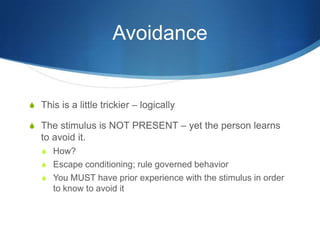
AvoidanceThis is a little trickier – logicallyThe stimulus is NOT PRESENT – yet the person learns to avoid it.How?Escape conditioning; rule governed behaviorYou MUST have prior experience with the stimulus in order to know to avoid it

Behavior mod decreasing behavior

  • 1.
    Behavior ModificationDecreasing Behaviorthrough Punishment– Ryan Sain
  • 2.
    Decreasing Behavior -punishmentPunishment – the decreasing of a behavior by contingent application of a stimulusOften thought of as aversive stimuliThis is functionally a suppression of behavior while the punishment contingency is in placeIt is sensitive to context – meaning that a behavior punished in one situation may still be present in another.The focus is again on the immediate effect of behavior
  • 3.
    Types of punishmentPositivepunishmentPain inducing – unconditional punishersReprimands – conditioned punishersNegative punishmentResponse cost – a response leads to the loss of somethingTime out (from reinforcement)Exclusionary – remove the person for a short time to a bland environmentNonexclusionary – using a stimulus to indicate that a certain reinforcement source is not available
  • 4.
    FactorsWhen you punish– reinforce appropriate behavior as wellJust like extinction – or the response will come back once the punisher is removedMaximize the likelihood that this contingency will be implemented (develop strong Sd for appropriate responding)Minimize the Sd for the unwanted behaviorMinimize the Sr for the unwanted behavior
  • 5.
    More factorsIntensityUse ofan intense punisher is generally more effective – especially in situations where the Sd and Sr for inappropriate responding are still present.However – if you do the previous – then a very weak stimulus will likely be effectiveNever pair the punisher with Sr. Attention is an issue here (negative attention)
  • 6.
    Yet moreAdd anSDp – make a rule and make it known.Deliver the punishers immediatelyDo not wait for hours and hours – you may be punishing desirable behavior!For punishment – continuous schedules are best. This is because the converse is true for reinforcement.
  • 7.
    EthicsPunishment is controversialIfa non pain inducing alternative is available, use it.Response prevention also prevents appropriate responding – so this is problematicSevere behavioral problems (self injury, health, etc.) are the only times when the use of punishment is acceptable.Time out issues
  • 8.
    More ethics –really?Punishment does produce negative effectsAggressive behaviorEmotional behaviorEscape or avoidance – with the conditioned punishers now developedDoes not teach new responsesThe punisher is modeledSelf perpetuating if not done properly (and reinforces the punisher).
  • 9.
    Escape and AvoidanceNegativereinforcement (escape)Increasing a behavior (reinforcement) by the contingent removal of a stimulusThe loss of a stimulus following a behavior – increases the frequency or occurrence of that behaviorThe stimulus MUST be present in order to escape it.This is not the case in punishment
  • 10.
    AvoidanceThis is alittle trickier – logicallyThe stimulus is NOT PRESENT – yet the person learns to avoid it.How?Escape conditioning; rule governed behaviorYou MUST have prior experience with the stimulus in order to know to avoid it