Behavior Modification Techniques
Basic Techniques
 PRINCIPLES
 Reinforcement
 Punishment
 Extinction
Reinforcement
 Occurrence of particular behavior
 Followed by an immediate consequence
 That results in strengthening of behavior
REINFORCERS
 EDIBLE
 ACTIVITY
 TANGIBLE
 SOCIAL
 SENSORY
Conditioned: Conditioned reinforcers are
previously neutral stimuli that acquire
reinforcing value through association with
primary or other conditioned reinforcers.
Unconditioned:Also known as
primary reinforcers, are unlearned.
These are things you need
Praise
Money
Tokens
Food &Water
Oxygen
Sleep
TYPESOFREINFORCERS
Types of Reinforcement
POSITIVE REINFORCEMENT
1. the occurrence of a behavior
2. is followed by the addition of a stimulus (a reinforcer) or an
increase in the intensity of a stimulus,
3. which results in the strengthening of the behavior.
Types of Reinforcement
NEGATIVE REINFORCEMENT
1. the occurrence of a behavior
2. is followed by the removal of a stimulus (an aversive stimulus) or
a decrease in the intensity of a stimulus,
3. which results in the strengthening of the behavior.
MOTIVATION AND ESTABLISHING OPERATIONS
ASK
YOURSELF
IS THE REINFORCER
VALUABLE RIGHT
NOW?
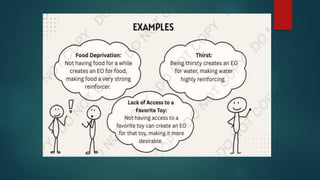
MOTIVATION AND EO IN ABA
An EO increases the value of a reinforcer and increases the
likelihood of the behavior that gets that reinforcer
Its an event that changes an Individual’s motivational state,
making particular stimulus or object a more effective reinforcer
EO VS AO
FEATURE EO
(Establishing)
AO
(Abolishing)
Value of
Reinforcer
Behavior
Increases
More likely
Decreases
Less likely
Factors that influence the effectiveness of
Reinforcement
Immediacy A stimulus is more effective as a reinforcer when it is
delivered immediately after the behavior.
Contingency A stimulus is more effective as a reinforcer when it is
delivered contingent on the behavior.
Motivating operations Establishing operations make a stimulus
more effective as a reinforcer at a particular time. Abolishing
operations make a stimulus less potent as a reinforcer at a particular
time.
Individual differences Reinforcers vary from person to person.
Magnitude Generally, a more intense stimulus is a more effective
reinforcer.
TYPES OF NEGATIVE
REINFORCEMENT
ESCAPE AVOIDANCE
You have to be in something
to get out of it.
(Example: If you are getting
wet in the rain, you go inside,
thereby increasing the
likelihood of you going inside
in the future in rain)
You have not come into
direct contact with the
contingency - maybe in the
past.
(Example: You avoid driving
fast out of fear of getting a
speeding ticket which you
got in the past)
PUNISHMENT
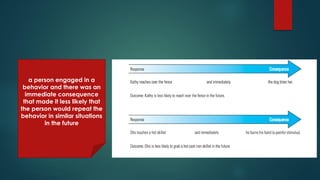
• Otis decided to get up early and make breakfast for his
mom. He put the cast-iron skillet on the stove and turned the
burner on high. Then he mixed a couple of eggs in a bowl
with some milk to make scrambled eggs. After about 5
minutes, he poured the eggs from the bowl into the skillet.
Immediately, the eggs started to burn and smoke rose from
the skillet. Otis grabbed the handle of the skillet to move it off
of the burner. As soon as he touched the handle, pain shot
through his hand; he screamed and dropped the skillet. After
that episode, Otis never again grabbed the handle of a hot
cast-iron skillet. He always used a hot pad to avoid burning
Kathy, a college senior, moved into a
new apartment near campus. On her
way to class, she passed a fenced-in
yard with a big friendly-looking dog.
One day, when the dog was near
the fence, Kathy reached over to pet
the dog. At once, the dog growled,
bared its teeth, and bit her hand.
After this, she never again tried to pet
the dog.
a person engaged in a
behavior and there was an
immediate consequence
that made it less likely that
the person would repeat the
behavior in similar situations
in the future
PUNISHMENT DEFINES AS:
• A particular behavior occurs.
• A consequence immediately follows the behavior.
• As a result, the behavior is less likely to occur again in the
future. (The behavior is weakened.)
• A punisher (also called an aversive stimulus) is a
consequence that makes a particular behavior less likely
to occur in the future
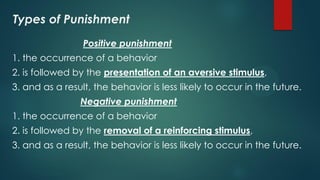
Types of Punishment
Positive punishment
1. the occurrence of a behavior
2. is followed by the presentation of an aversive stimulus,
3. and as a result, the behavior is less likely to occur in the future.
Negative punishment
1. the occurrence of a behavior
2. is followed by the removal of a reinforcing stimulus,
3. and as a result, the behavior is less likely to occur in the future.
During circle time, Ali repeatedly talks out of turn. The
teachers responds by raising her voice and saying,
“Ali, that is not acceptable! After a few days, Ali stops
interrupting
Sara throw her ipad, when she told her screentime is
over. As a consequence, her ipad is taken away for
the rest of the day. Over the next week, Sara stops
throwing it.
EXAMPLES
The Ethics of Punishment
 Informed Consent
 Alternative Treatment
 Recipient Safety
 Problem Severity
 Implementation Guidelines
 Training and Supervision
 Peer Review
 Preventing misuse and overuse
Positive Punishment
Overcorrection, the client is required to engage in an effortful
behavior for and extended period contingent on each instance of
the problem behavior. there are two forms of overcorrection:
positive practice and restitution.
 positive practice, in positive practice, the client has to engage
in correct forms of relevant behavior contingent on an instance
of the problem behavior.
.
 Restitution, restitution is a procedure in which, contingent on
each instance of the problem behavior, the client must correct
the environmental effects of the problem behavior and restore
the environment to a condition better than that which existed
before the problem behavior.
Contingent Exercise
 in the contingent exercise procedure, the client is made to
engage in some form of physical exercise contingent on an
instance of the problem behavior
.
Guided Compliance
in a guided compliance procedure, the person is guided
physically through the requested activity (such as an
educational task) contingent on the occurrence of the problem
behavior.
Physical Restraint
physical restraint is a punishment procedure in which, contingent
on a problem behavior, the change agent holds immobile the
part of the client’s body that is involved in the behavior.
Negative Punishment
Time-out
time-out is defined as the loss of access to positive
reinforcers for a brief period contingent on the problem
behavior. the result is a decrease in the future probability of
the problem behavior
 Exclusionary Time out
 Non Exclusionary Time out
.
Exclusionary. the person is removed from the room (the
reinforcing environment) where the problem behavior occurred
and is taken to another room. this removes the person from all
sources of positive reinforcement.
Non Exclusionary. the person remains in the room while being
removed from access to positive reinforcers.
Considerations in Using Time-Out
 What is the function of the problem behavior?
 Is time-out practical in the given situation?
 Is time-out safe?
 Is the time-out period brief?
 Can escape from time-out be prevented?
 Can interactions be avoided during time-out?
 Is time-out acceptable in the given situation?
Response Cost
It is defined as the removal of a specified amount of a
reinforcer contingent on the occurrence of a problem
behavior
 response cost is a negative punishment procedure when
it results in a decrease in the future probability of the
problem behavior
The Ethics of Punishment (REVISION)
 Informed Consent
 Alternative Treatment
 Recipient Safety
 Problem Severity
 Implementation Guidelines
 Training and Supervision
 Peer Review
 Preventing misuse and overuse
EXTINCTION
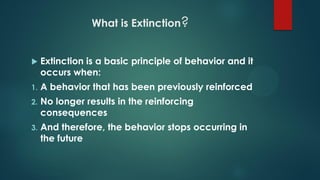
What is Extinction?
 Extinction is a basic principle of behavior and it
occurs when:
1. A behavior that has been previously reinforced
2. No longer results in the reinforcing
consequences
3. And therefore, the behavior stops occurring in
the future
The process of reducing or eliminating a behavior by
withholding the reinforcement that previously
maintained it.
When a behavior is no longer followed by the
reinforcing consequence, it becomes less likely to
occur. Overtime, the behavior may decrease or
disappea altogether
WHAT??
HOW?
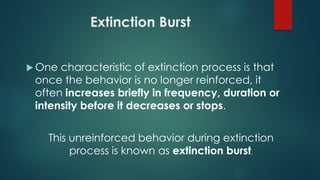
Extinction Burst
 One characteristic of extinction process is that
once the behavior is no longer reinforced, it
often increases briefly in frequency, duration or
intensity before it decreases or stops.
This unreinforced behavior during extinction
process is known as extinction burst.
Misconception of Extinction
“Ignoring the behavior is extinction ??”

Behavior modification technique in autism

  • 1.
  • 2.
    Basic Techniques  PRINCIPLES Reinforcement  Punishment  Extinction
  • 3.
    Reinforcement  Occurrence ofparticular behavior  Followed by an immediate consequence  That results in strengthening of behavior
  • 4.
    REINFORCERS  EDIBLE  ACTIVITY TANGIBLE  SOCIAL  SENSORY
  • 5.
    Conditioned: Conditioned reinforcersare previously neutral stimuli that acquire reinforcing value through association with primary or other conditioned reinforcers. Unconditioned:Also known as primary reinforcers, are unlearned. These are things you need Praise Money Tokens Food &Water Oxygen Sleep TYPESOFREINFORCERS
  • 6.
    Types of Reinforcement POSITIVEREINFORCEMENT 1. the occurrence of a behavior 2. is followed by the addition of a stimulus (a reinforcer) or an increase in the intensity of a stimulus, 3. which results in the strengthening of the behavior.
  • 7.
    Types of Reinforcement NEGATIVEREINFORCEMENT 1. the occurrence of a behavior 2. is followed by the removal of a stimulus (an aversive stimulus) or a decrease in the intensity of a stimulus, 3. which results in the strengthening of the behavior.
  • 11.
    MOTIVATION AND ESTABLISHINGOPERATIONS ASK YOURSELF IS THE REINFORCER VALUABLE RIGHT NOW?
  • 12.
    MOTIVATION AND EOIN ABA An EO increases the value of a reinforcer and increases the likelihood of the behavior that gets that reinforcer Its an event that changes an Individual’s motivational state, making particular stimulus or object a more effective reinforcer
  • 15.
    EO VS AO FEATUREEO (Establishing) AO (Abolishing) Value of Reinforcer Behavior Increases More likely Decreases Less likely
  • 16.
    Factors that influencethe effectiveness of Reinforcement Immediacy A stimulus is more effective as a reinforcer when it is delivered immediately after the behavior. Contingency A stimulus is more effective as a reinforcer when it is delivered contingent on the behavior. Motivating operations Establishing operations make a stimulus more effective as a reinforcer at a particular time. Abolishing operations make a stimulus less potent as a reinforcer at a particular time. Individual differences Reinforcers vary from person to person. Magnitude Generally, a more intense stimulus is a more effective reinforcer.
  • 17.
    TYPES OF NEGATIVE REINFORCEMENT ESCAPEAVOIDANCE You have to be in something to get out of it. (Example: If you are getting wet in the rain, you go inside, thereby increasing the likelihood of you going inside in the future in rain) You have not come into direct contact with the contingency - maybe in the past. (Example: You avoid driving fast out of fear of getting a speeding ticket which you got in the past)
  • 18.
  • 19.
    • Otis decidedto get up early and make breakfast for his mom. He put the cast-iron skillet on the stove and turned the burner on high. Then he mixed a couple of eggs in a bowl with some milk to make scrambled eggs. After about 5 minutes, he poured the eggs from the bowl into the skillet. Immediately, the eggs started to burn and smoke rose from the skillet. Otis grabbed the handle of the skillet to move it off of the burner. As soon as he touched the handle, pain shot through his hand; he screamed and dropped the skillet. After that episode, Otis never again grabbed the handle of a hot cast-iron skillet. He always used a hot pad to avoid burning
  • 20.
    Kathy, a collegesenior, moved into a new apartment near campus. On her way to class, she passed a fenced-in yard with a big friendly-looking dog. One day, when the dog was near the fence, Kathy reached over to pet the dog. At once, the dog growled, bared its teeth, and bit her hand. After this, she never again tried to pet the dog.
  • 21.
    a person engagedin a behavior and there was an immediate consequence that made it less likely that the person would repeat the behavior in similar situations in the future
  • 22.
    PUNISHMENT DEFINES AS: •A particular behavior occurs. • A consequence immediately follows the behavior. • As a result, the behavior is less likely to occur again in the future. (The behavior is weakened.) • A punisher (also called an aversive stimulus) is a consequence that makes a particular behavior less likely to occur in the future
  • 23.
    Types of Punishment Positivepunishment 1. the occurrence of a behavior 2. is followed by the presentation of an aversive stimulus, 3. and as a result, the behavior is less likely to occur in the future. Negative punishment 1. the occurrence of a behavior 2. is followed by the removal of a reinforcing stimulus, 3. and as a result, the behavior is less likely to occur in the future.
  • 28.
    During circle time,Ali repeatedly talks out of turn. The teachers responds by raising her voice and saying, “Ali, that is not acceptable! After a few days, Ali stops interrupting Sara throw her ipad, when she told her screentime is over. As a consequence, her ipad is taken away for the rest of the day. Over the next week, Sara stops throwing it. EXAMPLES
  • 29.
    The Ethics ofPunishment  Informed Consent  Alternative Treatment  Recipient Safety  Problem Severity  Implementation Guidelines  Training and Supervision  Peer Review  Preventing misuse and overuse
  • 30.
    Positive Punishment Overcorrection, theclient is required to engage in an effortful behavior for and extended period contingent on each instance of the problem behavior. there are two forms of overcorrection: positive practice and restitution.  positive practice, in positive practice, the client has to engage in correct forms of relevant behavior contingent on an instance of the problem behavior.
  • 31.
    .  Restitution, restitutionis a procedure in which, contingent on each instance of the problem behavior, the client must correct the environmental effects of the problem behavior and restore the environment to a condition better than that which existed before the problem behavior. Contingent Exercise  in the contingent exercise procedure, the client is made to engage in some form of physical exercise contingent on an instance of the problem behavior
  • 32.
    . Guided Compliance in aguided compliance procedure, the person is guided physically through the requested activity (such as an educational task) contingent on the occurrence of the problem behavior. Physical Restraint physical restraint is a punishment procedure in which, contingent on a problem behavior, the change agent holds immobile the part of the client’s body that is involved in the behavior.
  • 33.
    Negative Punishment Time-out time-out isdefined as the loss of access to positive reinforcers for a brief period contingent on the problem behavior. the result is a decrease in the future probability of the problem behavior  Exclusionary Time out  Non Exclusionary Time out
  • 34.
    . Exclusionary. the personis removed from the room (the reinforcing environment) where the problem behavior occurred and is taken to another room. this removes the person from all sources of positive reinforcement. Non Exclusionary. the person remains in the room while being removed from access to positive reinforcers.
  • 35.
    Considerations in UsingTime-Out  What is the function of the problem behavior?  Is time-out practical in the given situation?  Is time-out safe?  Is the time-out period brief?  Can escape from time-out be prevented?  Can interactions be avoided during time-out?  Is time-out acceptable in the given situation?
  • 36.
    Response Cost It isdefined as the removal of a specified amount of a reinforcer contingent on the occurrence of a problem behavior  response cost is a negative punishment procedure when it results in a decrease in the future probability of the problem behavior
  • 37.
    The Ethics ofPunishment (REVISION)  Informed Consent  Alternative Treatment  Recipient Safety  Problem Severity  Implementation Guidelines  Training and Supervision  Peer Review  Preventing misuse and overuse
  • 39.
  • 40.
    What is Extinction? Extinction is a basic principle of behavior and it occurs when: 1. A behavior that has been previously reinforced 2. No longer results in the reinforcing consequences 3. And therefore, the behavior stops occurring in the future
  • 41.
    The process ofreducing or eliminating a behavior by withholding the reinforcement that previously maintained it. When a behavior is no longer followed by the reinforcing consequence, it becomes less likely to occur. Overtime, the behavior may decrease or disappea altogether WHAT?? HOW?
  • 42.
    Extinction Burst  Onecharacteristic of extinction process is that once the behavior is no longer reinforced, it often increases briefly in frequency, duration or intensity before it decreases or stops. This unreinforced behavior during extinction process is known as extinction burst.
  • 43.
    Misconception of Extinction “Ignoringthe behavior is extinction ??”