



Reward and Punishment
The two types of reinforcement are distinguished as
  being either ‘positive’ or ‘negative’. What do the
  concepts ‘positive’ and ‘negative’ refer to within
  these terms?
Within these terms, ‘positive’ refers to the
addition of something good, whereas
‘negative’ refers to the ‘removal’ of
something bad
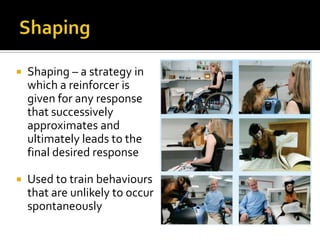
   Shaping – a strategy in
    which a reinforcer is
    given for any response
    that successively
    approximates and
    ultimately leads to the
    final desired response

   Used to train behaviours
    that are unlikely to occur
    spontaneously
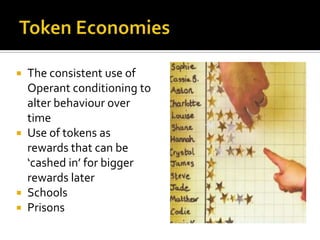
 The consistent use of
  Operant conditioning to
  alter behaviour over
  time
 Use of tokens as
  rewards that can be
  ‘cashed in’ for bigger
  rewards later
 Schools
 Prisons
   Can effect the relationship – The punisher
    may be disliked, or stop speaking to the
    punisher
   Punishment can be perceived as attention
    and have the opposite effect
   Punishment does not teach desirable
    behaviour
   It should be presented immediately following
    this undesirable behavior.
   Punishment should be aimed at behaviour
    and not personality
   Once the punishment has started the
    punisher should not back down.
   Should be combined with positive
    reinforcement

Lesson 9 applications of operant conditioning

  • 1.
  • 2.
    The two typesof reinforcement are distinguished as being either ‘positive’ or ‘negative’. What do the concepts ‘positive’ and ‘negative’ refer to within these terms?
  • 3.
    Within these terms,‘positive’ refers to the addition of something good, whereas ‘negative’ refers to the ‘removal’ of something bad
  • 4.
    Shaping – a strategy in which a reinforcer is given for any response that successively approximates and ultimately leads to the final desired response  Used to train behaviours that are unlikely to occur spontaneously
  • 7.
     The consistentuse of Operant conditioning to alter behaviour over time  Use of tokens as rewards that can be ‘cashed in’ for bigger rewards later  Schools  Prisons
  • 8.
    Can effect the relationship – The punisher may be disliked, or stop speaking to the punisher  Punishment can be perceived as attention and have the opposite effect  Punishment does not teach desirable behaviour
  • 9.
    It should be presented immediately following this undesirable behavior.  Punishment should be aimed at behaviour and not personality  Once the punishment has started the punisher should not back down.  Should be combined with positive reinforcement