write your views :Taking the example of a contemporary workplace, explaining the
utility of reinforcement theory and its importance in building an organizational
culture?
Reinforcement theory of motivation was proposed by BF Skinner and his
associates. It states that individual’s behaviour is a function of its consequences. This
theory focuses totally on what happens to an individual when he takes some action.
Thus, according to Skinner, the external environment of the organization must be
designed effectively and positively so as to motivate the employee. This theory is a
strong tool for analysing controlling mechanism for individual’s behaviour. However, it
does not focus on the causes of individual’s behaviour.
The managers use the following methods for controlling the behaviour
Positive Reinforcement- This implies giving a positive response when an
individual shows positive and required behaviour. If and only if the employees’
behaviour improves, reward can said to be a positive reinforce. Positive
reinforcement stimulates occurrence of a behaviour.
Negative Reinforcement- This implies rewarding an employee by removing
negative / undesirable consequences. Both positive and negative reinforcement
can be used for increasing desirable / required behaviour.
Punishment- punishment means applying undesirable consequence for showing
undesirable behaviour. For instance, Suspending an employee for breaking the
organizational rules. Punishment can be equalized by positive reinforcement from
alternative source.
Extinction- It implies absence of reinforcements. In other words, extinction
implies lowering the probability of undesired behaviour by removing reward for
that kind of behaviour. For instance - if an employee no longer receives praise and
admiration for his good work, he may feel that his behaviour is generating no
fruitful consequence.
So reinforcement theory has its own significance in current organisational
scenarios. Managers who are making attempt to motivate the employees must
ensure that they do not reward all employees simultaneously. They must tell the
employees what they are not doing correct. They must tell the employees how
they can achieve positive reinforcement.
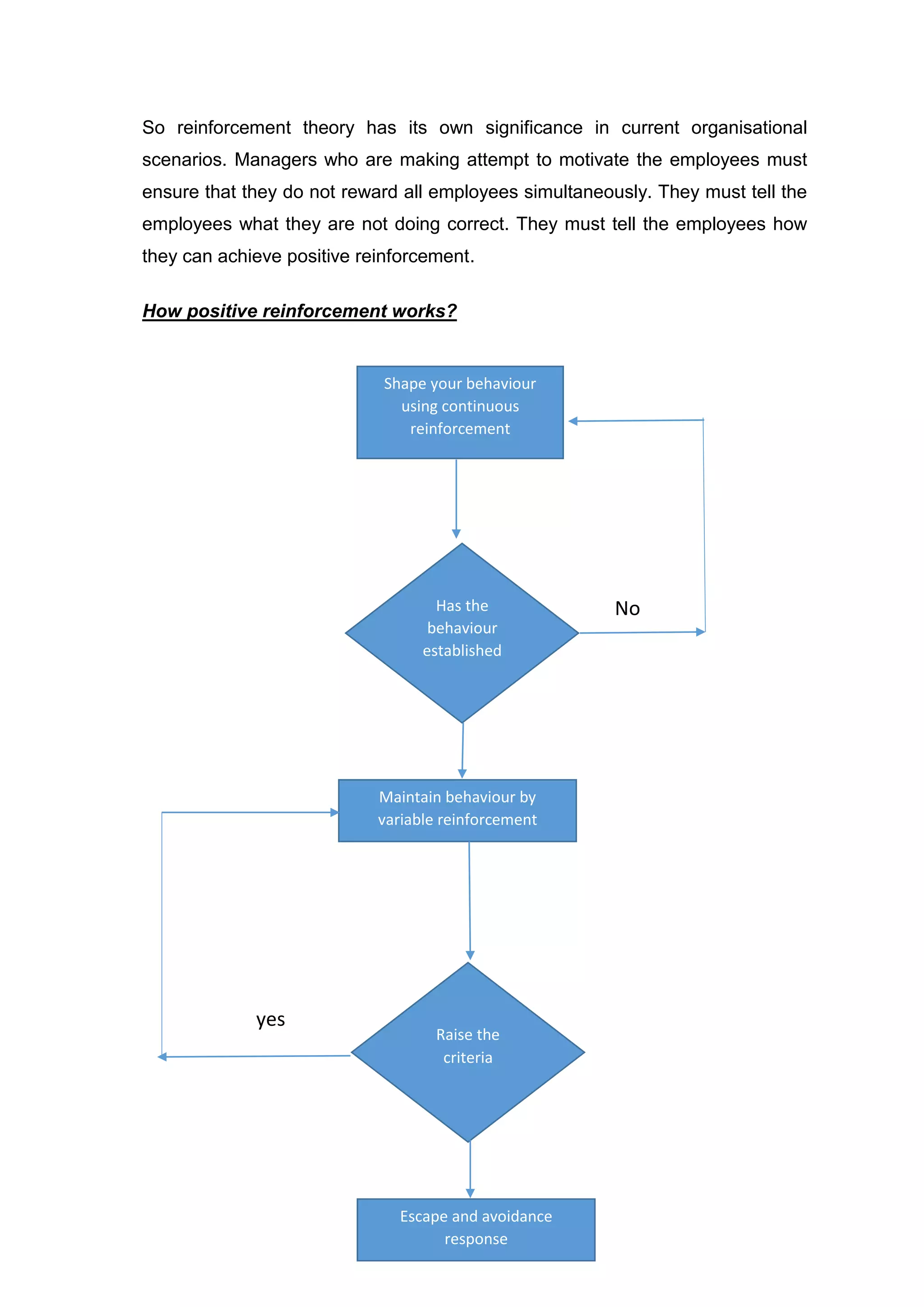
 How positive reinforcement works?
No
yes
Shape your behaviour
using continuous
reinforcement
Has the
behaviour
established
Maintain behaviour by
variable reinforcement
Raise the
criteria
Escape and avoidance
response
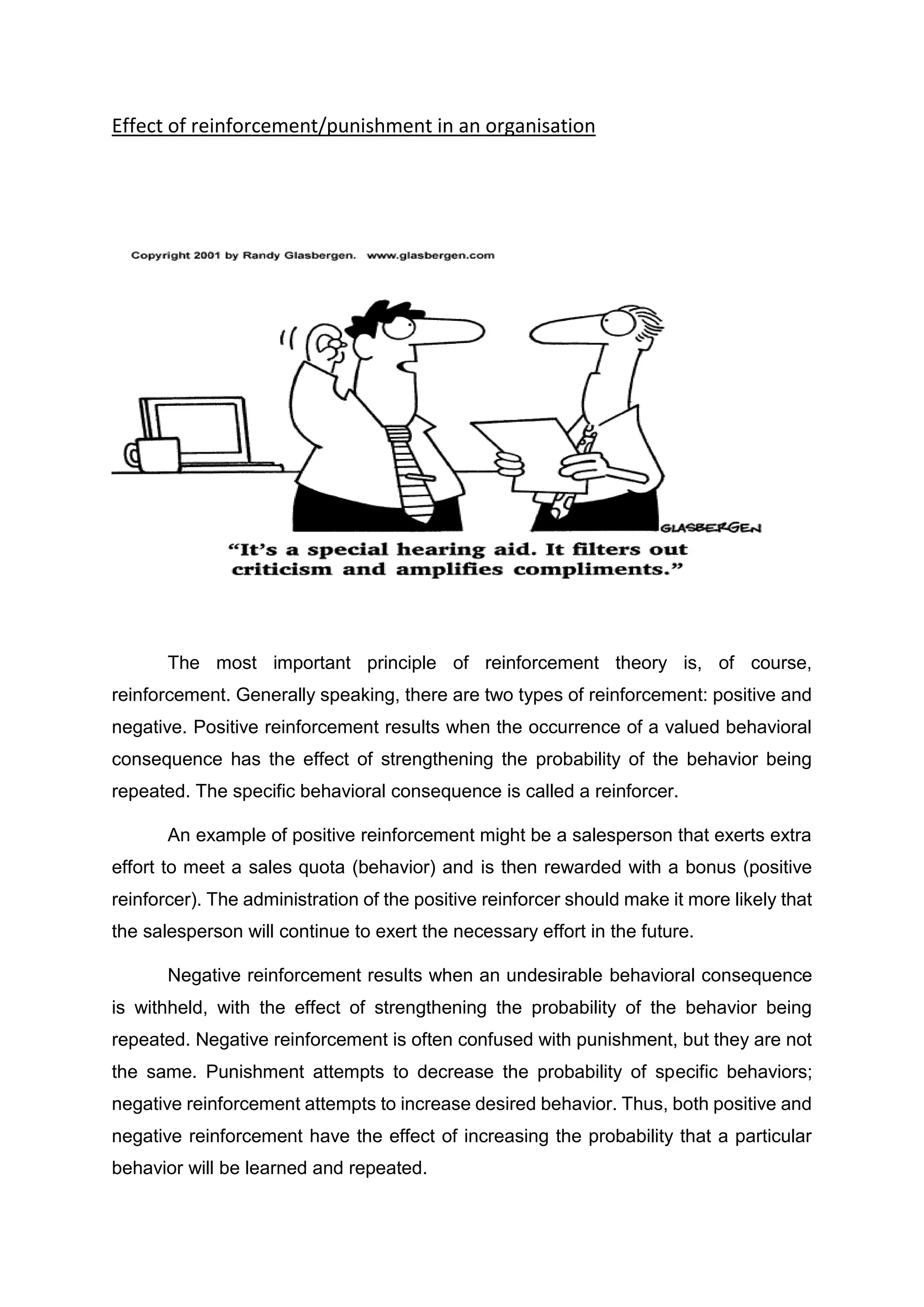
Effect of reinforcement/punishment in an organisation
The most important principle of reinforcement theory is, of course,
reinforcement. Generally speaking, there are two types of reinforcement: positive and
negative. Positive reinforcement results when the occurrence of a valued behavioral
consequence has the effect of strengthening the probability of the behavior being
repeated. The specific behavioral consequence is called a reinforcer.
An example of positive reinforcement might be a salesperson that exerts extra
effort to meet a sales quota (behavior) and is then rewarded with a bonus (positive
reinforcer). The administration of the positive reinforcer should make it more likely that
the salesperson will continue to exert the necessary effort in the future.
Negative reinforcement results when an undesirable behavioral consequence
is withheld, with the effect of strengthening the probability of the behavior being
repeated. Negative reinforcement is often confused with punishment, but they are not
the same. Punishment attempts to decrease the probability of specific behaviors;
negative reinforcement attempts to increase desired behavior. Thus, both positive and
negative reinforcement have the effect of increasing the probability that a particular
behavior will be learned and repeated.
An example of negative reinforcement might be a salesperson that exerts effort
to increase sales in his or her sales territory (behavior), which is followed by a decision
not to reassign the salesperson to an undesirable sales route (negative reinforcer).
The administration of the negative reinforcer should make it more likely that the
salesperson will continue to exert the necessary effort in the future.
Punishment attempts to decrease the probability of specific behaviors being
exhibited. Punishment is the administration of an undesirable behavioral consequence
in order to reduce the occurrence of the unwanted behavior. Punishment is one of the
more commonly used reinforcement-theory strategies, but many learning experts
suggest that it should be used only if positive and negative reinforcement cannot be
used or have previously failed, because of the potentially negative side effects of
punishment.
An example of punishment might be demoting an employee who does not meet
performance goals or suspending an employee without pay for violating work rules.
Extinction is similar to punishment in that its purpose is to reduce unwanted
behavior. The process of extinction begins when a valued behavioral consequence is
withheld in order to decrease the probability that a learned behavior will continue. Over
time, this is likely to result in the ceasing of that behavior. Extinction may alternately
serve to reduce a wanted behavior, such as when a positive reinforcer is no longer
offered when a desirable behavior occurs.
For example, if an employee is continually praised for the promptness in which
he completes his work for several months, but receives no praise in subsequent
months for such behavior, his desirable behaviors may diminish. Thus, to avoid
unwanted extinction, managers may have to continue to offer positive behavioral
consequences.Many organisations today ,tries all types mentioned above for
motivating and increasing productivity.

Reinforcement theory of motivation -proposed by bf skinner

  • 1.
    write your views:Taking the example of a contemporary workplace, explaining the utility of reinforcement theory and its importance in building an organizational culture? Reinforcement theory of motivation was proposed by BF Skinner and his associates. It states that individual’s behaviour is a function of its consequences. This theory focuses totally on what happens to an individual when he takes some action. Thus, according to Skinner, the external environment of the organization must be designed effectively and positively so as to motivate the employee. This theory is a strong tool for analysing controlling mechanism for individual’s behaviour. However, it does not focus on the causes of individual’s behaviour. The managers use the following methods for controlling the behaviour Positive Reinforcement- This implies giving a positive response when an individual shows positive and required behaviour. If and only if the employees’ behaviour improves, reward can said to be a positive reinforce. Positive reinforcement stimulates occurrence of a behaviour. Negative Reinforcement- This implies rewarding an employee by removing negative / undesirable consequences. Both positive and negative reinforcement can be used for increasing desirable / required behaviour. Punishment- punishment means applying undesirable consequence for showing undesirable behaviour. For instance, Suspending an employee for breaking the organizational rules. Punishment can be equalized by positive reinforcement from alternative source. Extinction- It implies absence of reinforcements. In other words, extinction implies lowering the probability of undesired behaviour by removing reward for that kind of behaviour. For instance - if an employee no longer receives praise and admiration for his good work, he may feel that his behaviour is generating no fruitful consequence.
  • 2.
    So reinforcement theoryhas its own significance in current organisational scenarios. Managers who are making attempt to motivate the employees must ensure that they do not reward all employees simultaneously. They must tell the employees what they are not doing correct. They must tell the employees how they can achieve positive reinforcement.  How positive reinforcement works? No yes Shape your behaviour using continuous reinforcement Has the behaviour established Maintain behaviour by variable reinforcement Raise the criteria Escape and avoidance response
  • 3.
    Effect of reinforcement/punishmentin an organisation The most important principle of reinforcement theory is, of course, reinforcement. Generally speaking, there are two types of reinforcement: positive and negative. Positive reinforcement results when the occurrence of a valued behavioral consequence has the effect of strengthening the probability of the behavior being repeated. The specific behavioral consequence is called a reinforcer. An example of positive reinforcement might be a salesperson that exerts extra effort to meet a sales quota (behavior) and is then rewarded with a bonus (positive reinforcer). The administration of the positive reinforcer should make it more likely that the salesperson will continue to exert the necessary effort in the future. Negative reinforcement results when an undesirable behavioral consequence is withheld, with the effect of strengthening the probability of the behavior being repeated. Negative reinforcement is often confused with punishment, but they are not the same. Punishment attempts to decrease the probability of specific behaviors; negative reinforcement attempts to increase desired behavior. Thus, both positive and negative reinforcement have the effect of increasing the probability that a particular behavior will be learned and repeated.
  • 4.
    An example ofnegative reinforcement might be a salesperson that exerts effort to increase sales in his or her sales territory (behavior), which is followed by a decision not to reassign the salesperson to an undesirable sales route (negative reinforcer). The administration of the negative reinforcer should make it more likely that the salesperson will continue to exert the necessary effort in the future. Punishment attempts to decrease the probability of specific behaviors being exhibited. Punishment is the administration of an undesirable behavioral consequence in order to reduce the occurrence of the unwanted behavior. Punishment is one of the more commonly used reinforcement-theory strategies, but many learning experts suggest that it should be used only if positive and negative reinforcement cannot be used or have previously failed, because of the potentially negative side effects of punishment. An example of punishment might be demoting an employee who does not meet performance goals or suspending an employee without pay for violating work rules. Extinction is similar to punishment in that its purpose is to reduce unwanted behavior. The process of extinction begins when a valued behavioral consequence is withheld in order to decrease the probability that a learned behavior will continue. Over time, this is likely to result in the ceasing of that behavior. Extinction may alternately serve to reduce a wanted behavior, such as when a positive reinforcer is no longer offered when a desirable behavior occurs. For example, if an employee is continually praised for the promptness in which he completes his work for several months, but receives no praise in subsequent months for such behavior, his desirable behaviors may diminish. Thus, to avoid unwanted extinction, managers may have to continue to offer positive behavioral consequences.Many organisations today ,tries all types mentioned above for motivating and increasing productivity.