Developmental Research 
Methods 
Topic 9: Within Groups Designs 
10/1/2014 CEDP321 Ryan Sain, Ph.D. 1
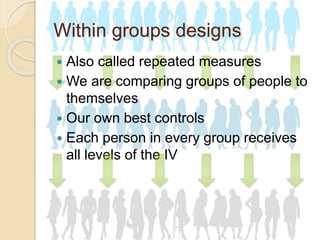
Within groups designs 
 Also called repeated measures 
 We are comparing groups of people to 
themselves 
 Our own best controls 
 Each person in every group receives 
all levels of the IV
Advantages 
 All groups are 
equal at the 
beginning of the 
study 
 Fewer 
participants 
 Very sensitive to 
changes 
(statistically) 
◦ Within subject 
variance is going 
to be low (error 
variance)
Disadvantages 
 Carryover effects 
◦ Seeing a picture vs. not seeing one 
◦ Permanent change – cannot study in a within 
subjects design 
◦ Clinical treatments 
 Drug trials 
 Psychotherapy 
 Sensitive to time variables (practice, 
fatigue, order of IV) 
◦ Order effects and practice effects
Counterbalancing 
 Complete 
counterbalancing 
◦ Each condition must 
occur with the same 
frequency 
◦ Each condition must 
precede and follow 
all conditions an 
equal number of 
times 
 Controls for time 
and order effects 
 5!
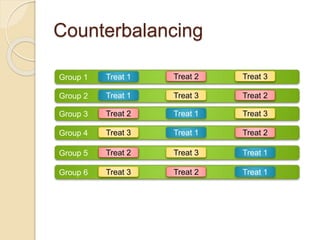
Counterbalancing 
Group 1 Treat 1 Treat 2 Treat 3 
Group 2 Treat 1 Treat 3 Treat 2 
Group 3 Treat 2 Treat 1 Treat 3 
Group 4 Treat 3 Treat 1 Treat 2 
Group 5 Treat 2 Treat 3 Treat 1 
Group 6 Treat 3 Treat 2 Treat 1
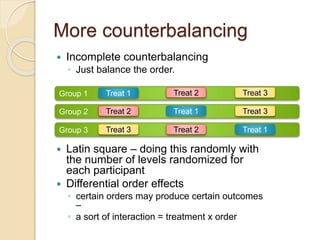
More counterbalancing 
 Incomplete counterbalancing 
◦ Just balance the order. 
Group 1 Treat 1 Treat 2 Treat 3 
Group 2 Treat 2 Treat 1 Treat 3 
Group 3 Treat 3 Treat 2 Treat 1 
 Latin square – doing this randomly with 
the number of levels randomized for 
each participant 
 Differential order effects 
◦ certain orders may produce certain outcomes 
– 
◦ a sort of interaction = treatment x order
Mixed designs 
 Using 
between 
groups and 
within groups 
logic 
 Measures change over time within a 
group and compares a factor 
between groups as well 
◦ 2(between factor) x 3 (within factor - 
often a time variable)
Mixed Designs cont. 
 Rule out carryover effects 
◦ (using the between groups part) 
 High levels of control of a within 
design. 
 Main effects 
◦ Time 
◦ Other IV 
 Interactions 
◦ Time x IV
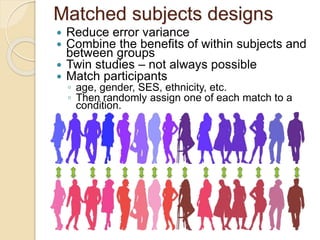
Matched subjects designs 
 Reduce error variance 
 Combine the benefits of within subjects and 
between groups 
 Twin studies – not always possible 
 Match participants 
◦ age, gender, SES, ethnicity, etc. 
◦ Then randomly assign one of each match to a 
condition.
Matching - types 
 Use a matched group 
as a control group 
◦ Random assignment 
and equal groups. 
 Use a matched group 
as an experiment in 
unto itself 
◦ Two groups matched 
◦ Each group has both 
males and females – 
treat as normal. 
 Compare males treatment 
to males control, etc
Credits 
 www.sxc.hu 
◦ Mixing table 1 - hovard 
◦ Mixing table 2 - riverstorm 
◦ People – biewoef 
◦ Yin Yang - hisks 
◦ Orchids – flajs01 
◦ Drugs - alaasafei 
 Scrum – www.blackfire.net

Psyc 321_09 within groups

  • 1.
    Developmental Research Methods Topic 9: Within Groups Designs 10/1/2014 CEDP321 Ryan Sain, Ph.D. 1
  • 2.
    Within groups designs  Also called repeated measures  We are comparing groups of people to themselves  Our own best controls  Each person in every group receives all levels of the IV
  • 3.
    Advantages  Allgroups are equal at the beginning of the study  Fewer participants  Very sensitive to changes (statistically) ◦ Within subject variance is going to be low (error variance)
  • 4.
    Disadvantages  Carryovereffects ◦ Seeing a picture vs. not seeing one ◦ Permanent change – cannot study in a within subjects design ◦ Clinical treatments  Drug trials  Psychotherapy  Sensitive to time variables (practice, fatigue, order of IV) ◦ Order effects and practice effects
  • 5.
    Counterbalancing  Complete counterbalancing ◦ Each condition must occur with the same frequency ◦ Each condition must precede and follow all conditions an equal number of times  Controls for time and order effects  5!
  • 6.
    Counterbalancing Group 1Treat 1 Treat 2 Treat 3 Group 2 Treat 1 Treat 3 Treat 2 Group 3 Treat 2 Treat 1 Treat 3 Group 4 Treat 3 Treat 1 Treat 2 Group 5 Treat 2 Treat 3 Treat 1 Group 6 Treat 3 Treat 2 Treat 1
  • 7.
    More counterbalancing Incomplete counterbalancing ◦ Just balance the order. Group 1 Treat 1 Treat 2 Treat 3 Group 2 Treat 2 Treat 1 Treat 3 Group 3 Treat 3 Treat 2 Treat 1  Latin square – doing this randomly with the number of levels randomized for each participant  Differential order effects ◦ certain orders may produce certain outcomes – ◦ a sort of interaction = treatment x order
  • 8.
    Mixed designs Using between groups and within groups logic  Measures change over time within a group and compares a factor between groups as well ◦ 2(between factor) x 3 (within factor - often a time variable)
  • 9.
    Mixed Designs cont.  Rule out carryover effects ◦ (using the between groups part)  High levels of control of a within design.  Main effects ◦ Time ◦ Other IV  Interactions ◦ Time x IV
  • 10.
    Matched subjects designs  Reduce error variance  Combine the benefits of within subjects and between groups  Twin studies – not always possible  Match participants ◦ age, gender, SES, ethnicity, etc. ◦ Then randomly assign one of each match to a condition.
  • 11.
    Matching - types  Use a matched group as a control group ◦ Random assignment and equal groups.  Use a matched group as an experiment in unto itself ◦ Two groups matched ◦ Each group has both males and females – treat as normal.  Compare males treatment to males control, etc
  • 12.
    Credits  www.sxc.hu ◦ Mixing table 1 - hovard ◦ Mixing table 2 - riverstorm ◦ People – biewoef ◦ Yin Yang - hisks ◦ Orchids – flajs01 ◦ Drugs - alaasafei  Scrum – www.blackfire.net