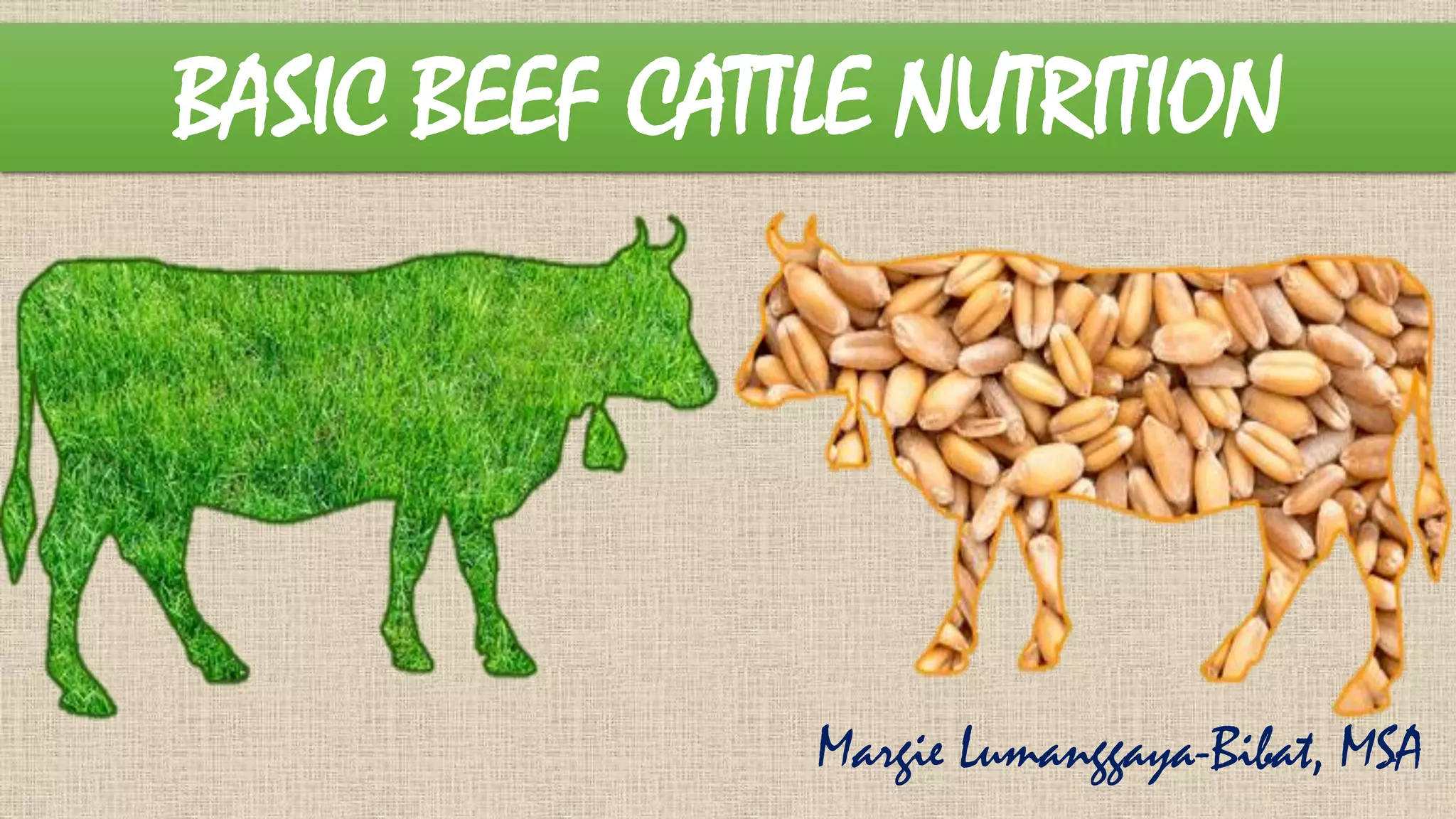
BASIC BEEF CATTLE NUTRITION
Margie Lumanggaya-Bibat, MSA
MLBibat2020 2
MLBibat2020 3
MLBibat2020 4
MLBibat2020 5
MLBibat2020 6
Why cows chewing their cud?
MLBibat2020 7
MLBibat2020 8
MLBibat2020 9
MLBibat2020 10
MLBibat2020 11
MLBibat2020 12
Cattle Eating Habit
MLBibat2020 13
What is Nutrition?
• Nutrition is the science of dealing with the utilization of
food by the body processes which transforms food into
body tissues and energy.
MLBibat2020 14
Utilization
Nutrients are utilized by the animals for:
Maintenance
Growth
Production
Reproduction
Health control
MLBibat2020 15
Importance
• To obtain and utilize surplus or unusable feed stuffs
• And convert them to desirable products such as meat,
milk, eggs, fiber and work.
MLBibat2020 16
What is Nutrient?
• A single class of food or group of like foods that aids in
the support of life and makes it possible for animals to
grow or provide energy for physiological processes.
MLBibat2020 17
Digestible Nutrient
• The portion of the nutrient which may be broken down
(digested) and absorbed and used by the body.
MLBibat2020 18
Feed Composition
• Feedstuff
composition, such as
water, carbohydrate,
protein, and fat,
helps determine how
cattle perform.
MLBibat2020 19
Fig. 1 feed components
What nutrients does a cow needs?
•Water
•Protein
•Carbohydrates
•Lipids/Fats
•Minerals
•Vitamins
MLBibat2020 20
ENERGY
(calories)
Factors affecting nutrients requirements
 Age
 Size
 Breed (Brahman influence, maternal)
 Stage of production (growing, gestating, lactating)
 Level of Production (milk, growth rate)
 Environment
 Thermal stress (insulation)
MLBibat2020 21
Nutrients and Their functions
 Water
 the most important nutrient needed for all
animals.
 makes up more than one-half of most
animals’ bodies.
 It forms the basis of fluids in the body and is
essential for processes such as digestion,
blood circulation, and waste elimination.
 helps dissolve nutrients and also regulates
body temperature through perspiration and
evaporation.
 can be obtained from feed sources such as
forage.
 Beef cattle: 7-12 gallons per head
MLBibat2020 22
MLBibat2020 23
Water requirements for CATTLE
 as weight increase, the amount of water needed also increases.
 Following are some thumb rules on water intake that may be
helpful.
 Daily water intake may vary from 3 to 30 gallons per day
depending on age, body size (weight), stage of production,
and the environment (mainly air temperature).
 As a rule of thumb, consumption will range from 1 gallon per
100 pounds of body weight during cold weather to nearly 2
gallons per 100 pounds of body during the hottest weather.
 Lactating cows require nearly twice as much water compared
to dry cows.
 Clean fresh water free of manure, dirt, and other debris is
important.
Nutrients and Their functions
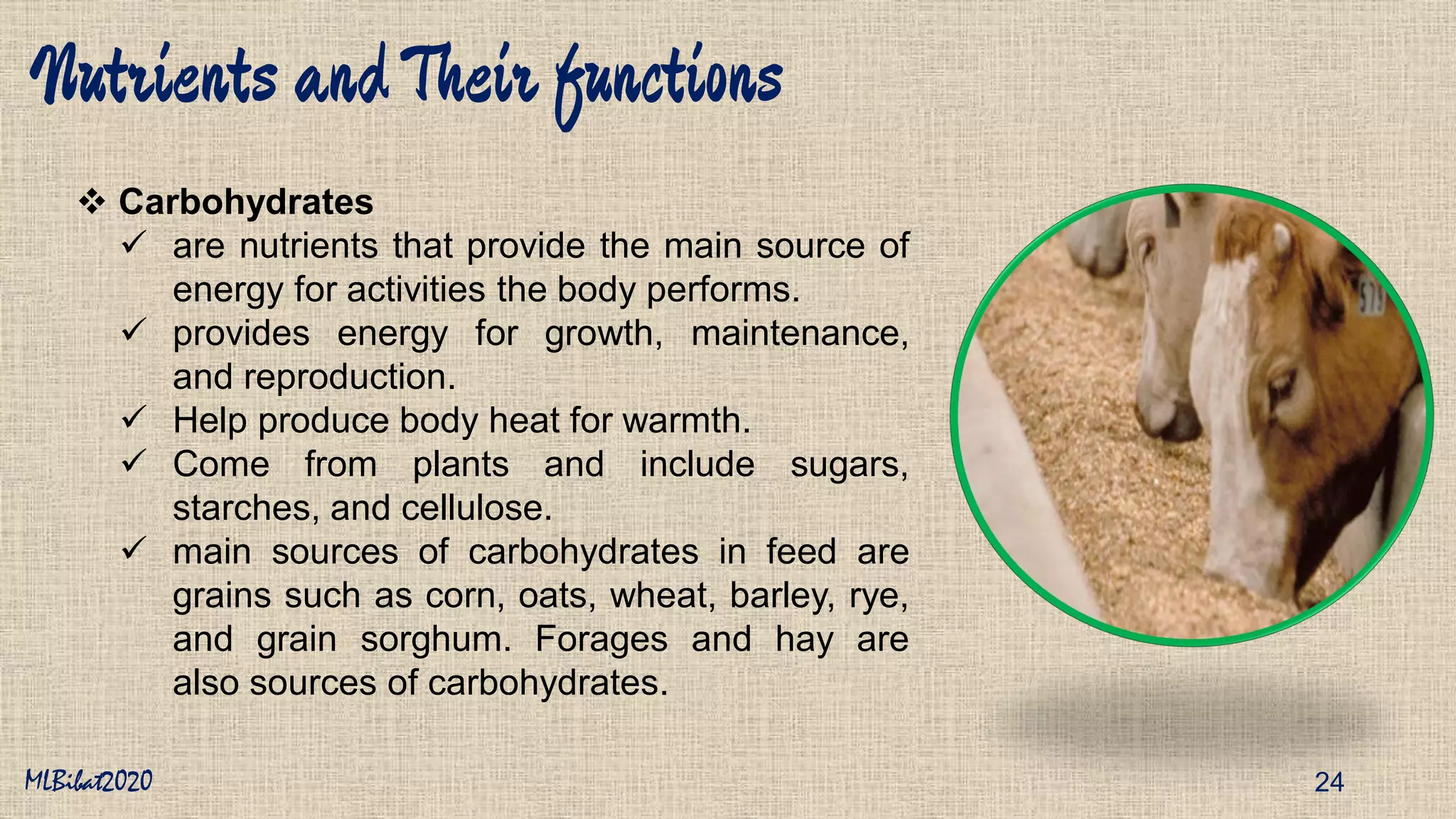
 Carbohydrates
 are nutrients that provide the main source of
energy for activities the body performs.
 provides energy for growth, maintenance,
and reproduction.
 Help produce body heat for warmth.
 Come from plants and include sugars,
starches, and cellulose.
 main sources of carbohydrates in feed are
grains such as corn, oats, wheat, barley, rye,
and grain sorghum. Forages and hay are
also sources of carbohydrates.
MLBibat2020 24
Nutrients and Their functions
 Protein
 is made up of amino acids that are necessary for healthy animals.
• Amino acids are the building blocks of protein and are used for the
formation of tissues and muscle production.
 is needed for healthy growth, reproduction, and maintenance.
 can be obtained from both plant and animal sources.
 often the most expensive ingredient in feed.
• Crude protein refers to the total amount of protein in a feed while
digestible protein is the protein that can be digested and used by an
animal.
MLBibat2020 25
 Plant proteins are more common in livestock feeds and include
soybean, cottonseed, linseed, peanut, and sunflower seed
meals.
 can be obtained from legume hays such as alfalfa or clover.
• Legumes are plants that produce or fix their own nitrogen.
 Sources of animal protein include tankage, fish meal, meat
scraps, and milk products.
 Animals need different amounts of protein, depending the on
needs. For example, young, growing animals need more protein
than older animals.
MLBibat2020 26
Sources of Protein
 Lipids/Fats
fats are needed in small amounts they are a necessary part of
the diet.
provide energy and store excess energy.
help produce body heat and carry fat-soluble vitamins in the
body.
• Many sources of proteins are also sources of fats.
Fats are found in both plants and animals.
• Plant fats include oils that are within seeds, which are the
main source of fats in agricultural feeds.
MLBibat2020 27
Nutrients and Their functions
 Lipids/Fats
fats are needed in small amounts they are a necessary part of
the diet.
provide energy and store excess energy.
help produce body heat and carry fat-soluble vitamins in the
body.
• Many sources of proteins are also sources of fats.
Fats are found in both plants and animals.
• Plant fats include oils that are within seeds, which are the
main source of fats in agricultural feeds.
MLBibat2020 28
Nutrients and Their functions
• Minerals
 Primarily found in bones and teeth
 Important in blood for the carrying of oxygen
 Regulates heartbeat with potassium, sodium and calcium
 macrominerals
 microminerals
MLBibat2020 29
Nutrients and Their functions
 Macrominerals
• are needed in larger amounts by the body
• calcium, phosphorus, sodium, chlorine, magnesium, and
potassium.
• They are required at comparatively high levels described as
per cent of diet or grams per day.
MLBibat2020 30
Nutrients and Their functions
 Microminerals
 They are required only in very small amounts.
 Some minerals fed in excess amounts may cause a
deficiency in others
 Iron, Zinc, Copper, Manganese, Cobalt, Iodine,
Molybdenum, Selenium, Fluorine
MLBibat2020 31
Nutrients and Their functions
• Vitamins
 Are only needed in small amounts
 Are essential for life and health
 Provide a defense against disease, promote
growth and reproduction
 Contribute to the general health of the animal
 Vit. A, B, C, D, K, E etc
MLBibat2020 32
Nutrients and Their functions
Feed Resources
MLBibat2020 33
FEED RESOURCES
Crop
Residues
Feed
Additives
Grazing
Areas
Fodders
By-
Products
Grains/Oil
seeds
Feed Classifications
1. Roughages
2. Concentrates
3. Supplements
MLBibat2020 34
Common feeds for Ruminants
Forages
 is the natural cheapest
feeds for ruminants and
includes
MLBibat2020 35
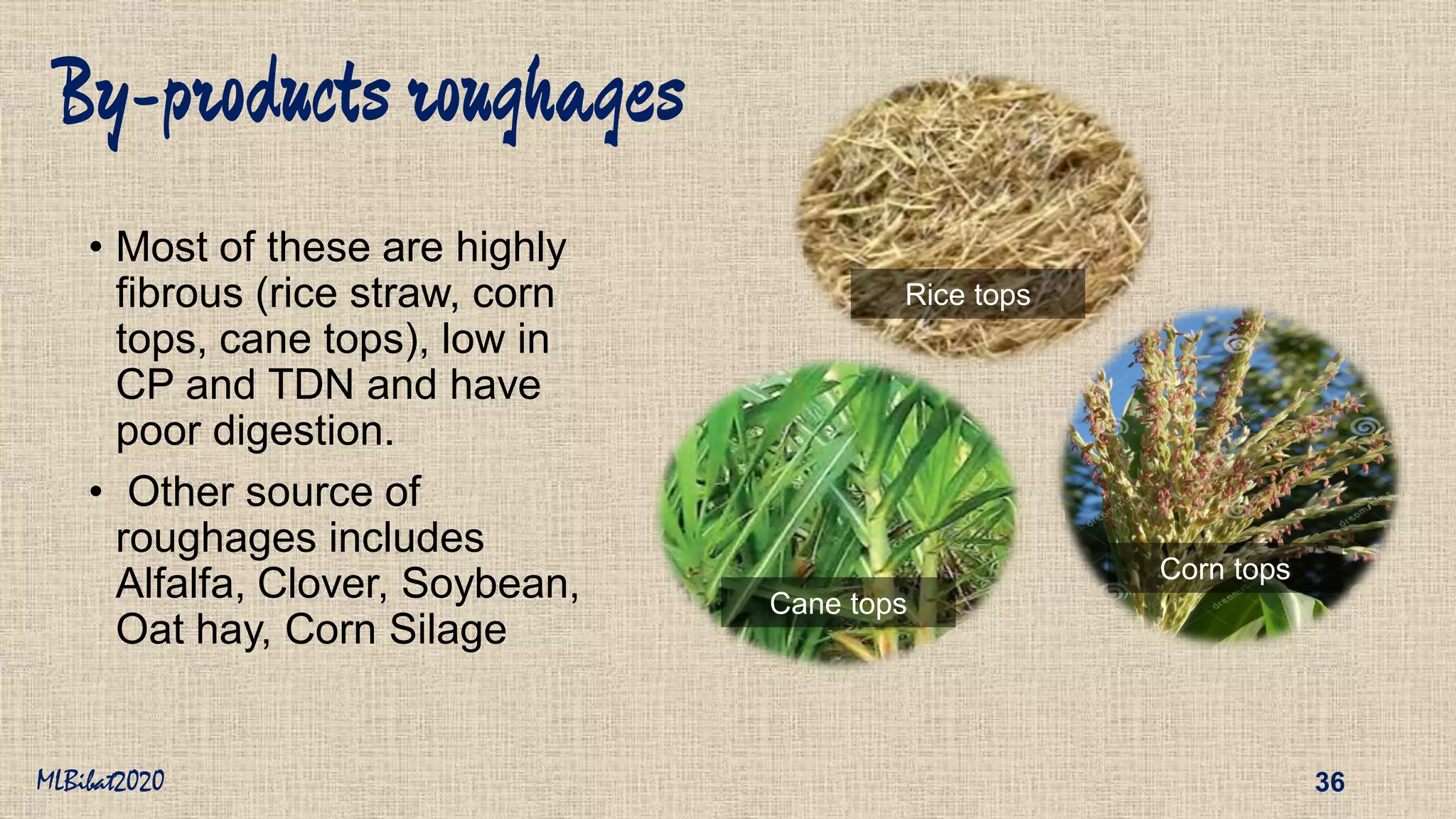
By-products roughages
• Most of these are highly
fibrous (rice straw, corn
tops, cane tops), low in
CP and TDN and have
poor digestion.
• Other source of
roughages includes
Alfalfa, Clover, Soybean,
Oat hay, Corn Silage
MLBibat2020 36
Rice tops
Cane tops
Corn tops
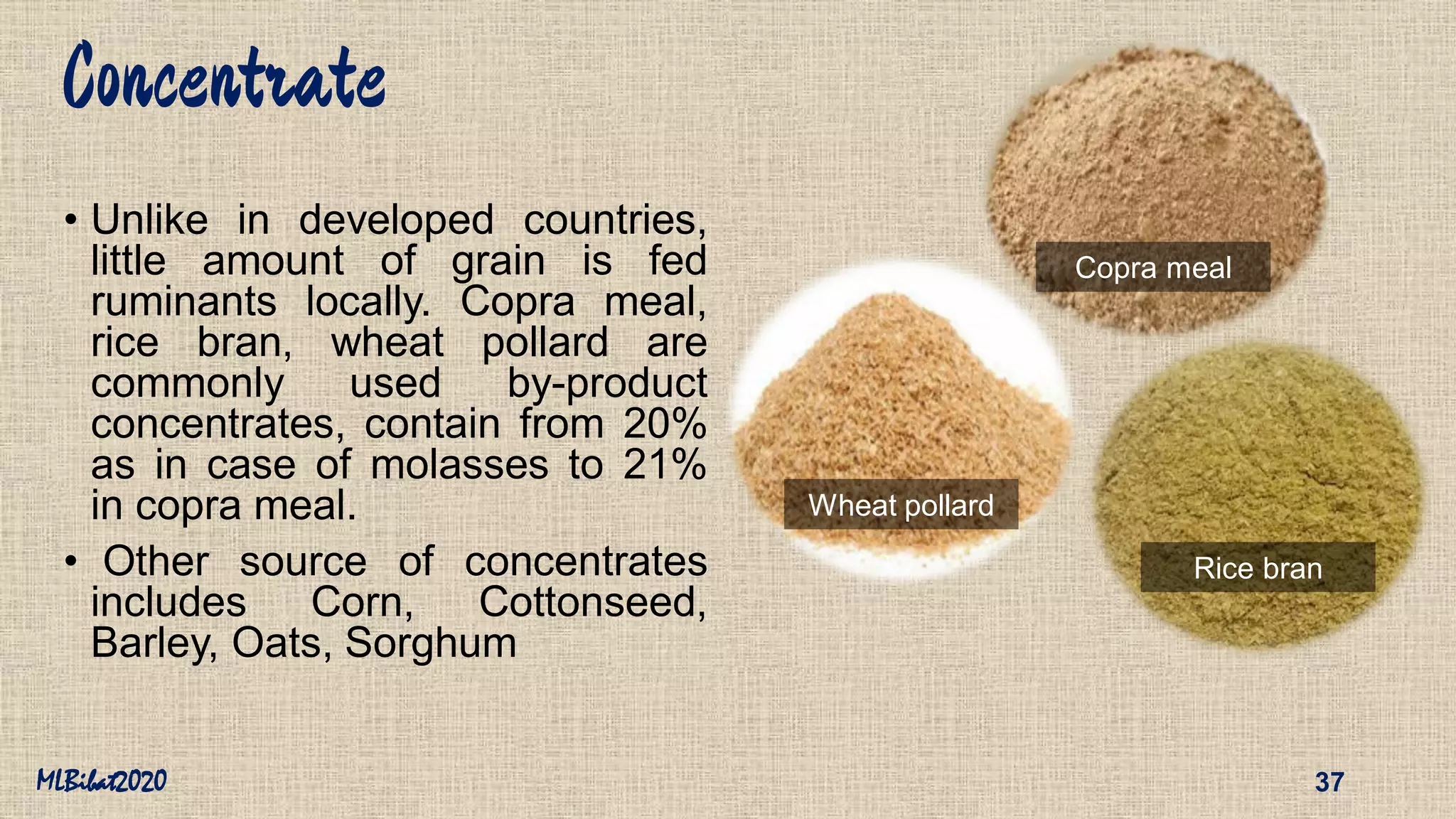
Concentrate
• Unlike in developed countries,
little amount of grain is fed
ruminants locally. Copra meal,
rice bran, wheat pollard are
commonly used by-product
concentrates, contain from 20%
as in case of molasses to 21%
in copra meal.
• Other source of concentrates
includes Corn, Cottonseed,
Barley, Oats, Sorghum
MLBibat2020 37
Copra meal
Wheat pollard
Rice bran
Use of Urea in Ruminant ration
• Urea has long used as partial protein
source ruminants in other countries.
• The following guidelines are
recommended for safe use of urea.
a. 1% of the ration (DM basis)
b. 2.3% of the concentrate mixture,
(air-dry basis) or
c. 25.30% of the total dietary protein
MLBibat2020 38
Feeding Management
 An Art that need to know;
• Requirements of the animal according to milk yield &
lactation stages
• Nutrient composition of available feeds and
• How to combine different feeds to match the animal
requirements
 Should be
• Balanced approach
• Cost effective
• Sustainable
MLBibat2020 39
Improvement in Utilization of Feed Resources
MLBibat2020 40
Feeding Beef Cattle at different life stages
(Start from Pregnancy to End of Lactation Period)
• Calf Nutrition
Calves are born as
monogastric animals (simple
stomach)
So offer feed that must be
easy to digest (high quality
digestable proteins, energy,
vitamins and minerals)
MLBibat2020 41
Calf Nutrition
• Energy is important first two
weeks because can not digest
starch, sugar or unsaturated fats.
• Colostrum feed at first feeding to
get higher amounts of protein,
minerals, immunoglobulins, and
antibodies. Lines to walls of
digestive tract to protect against
diseases.
MLBibat2020 42
• Grains (Dry Matter)
stimulate production of
VFAs in rumen
• (acetic, propionic, butyric)
• Digestive system develops
from 2 weeks until 4-6
months and calf evolves
into ruminant
MLBibat2020 43
Calf Nutrition
Heifer Nutrition
• Nutrition is important at this time
because reproduction depends on
sound, healthy animals.
• If underfed, diseased or have
parasites then puberty is delayed.
Low energy will lead to ovarian
inactivity. Low protein will cause
irregular or silent heats.
• 30-40% of adult weight at breeding
age (13-15 months)
MLBibat2020 44
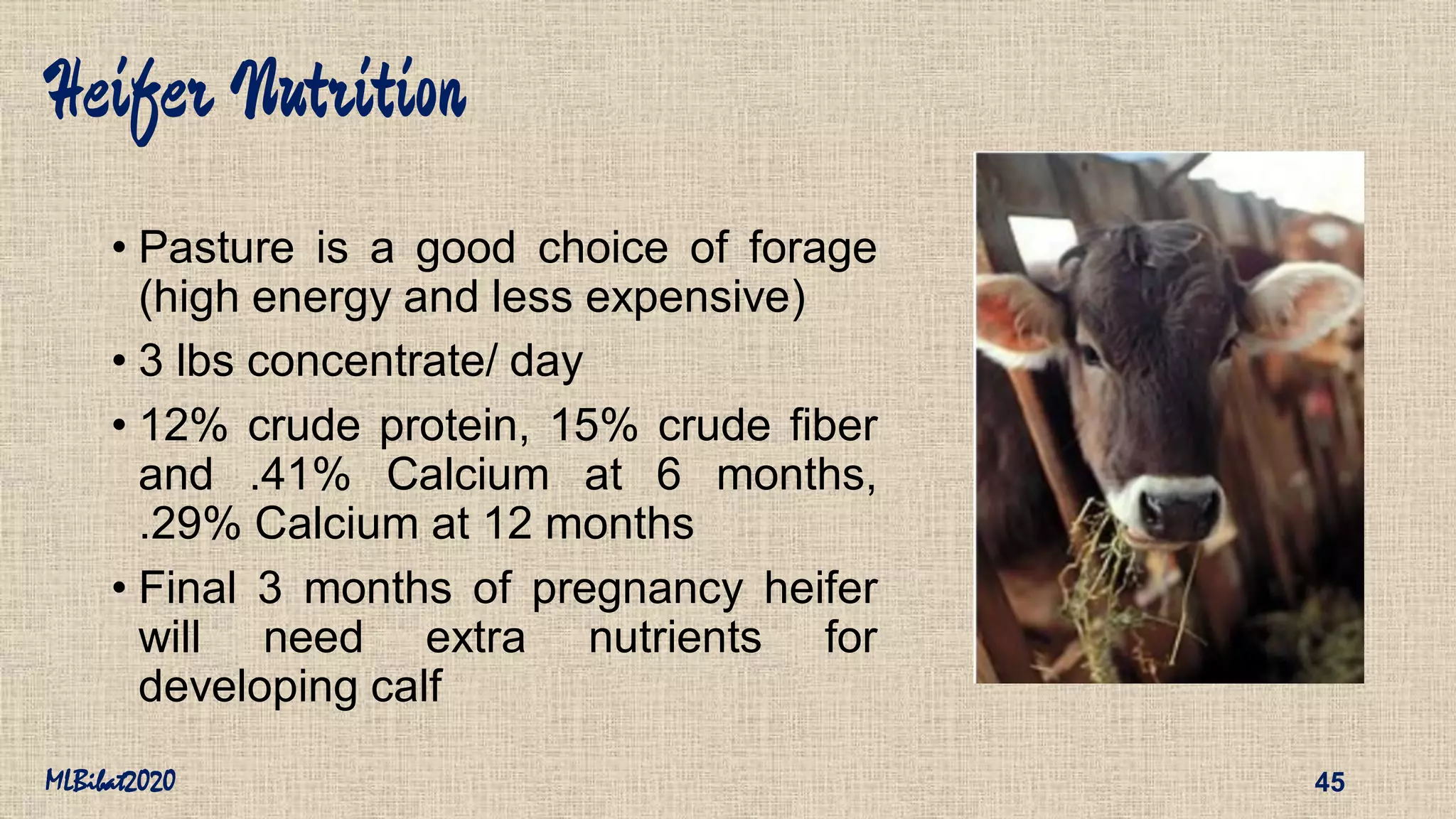
• Pasture is a good choice of forage
(high energy and less expensive)
• 3 lbs concentrate/ day
• 12% crude protein, 15% crude fiber
and .41% Calcium at 6 months,
.29% Calcium at 12 months
• Final 3 months of pregnancy heifer
will need extra nutrients for
developing calf
MLBibat2020 45
Heifer Nutrition
Dry Cow Nutrition
• Low energy diet (less expensive)
• Pasture often used
• Important for successful lactation to follow
• Restore body energy and nutrient reserves
• Want to maintain 3+ to 4- body condition score
MLBibat2020 46
Feeding in Pregnancy (Last 2 months)
For;
 Rapid growing foetus
 Develop body reserves for use in subsequent lactation
How;
 Give rest if in milk (forced drying)
 Feed concentrate 2 kg/day + good quality fodder, restrict
straw
MLBibat2020 47
Close-up cows
• Move cows and heifers to
close-up pen at 2 weeks
before calving
• High dry matter intake to gain
nutrients for cow and calf to
reduce metabolic problems
MLBibat2020 48
• Start grain feeding
• Increase CP to 15%
• Limit added fat 100 gm/d
• Low energy with adequate levels of minerals vitamins and
protein and watch forage levels (<50% DM)
• Decrease metabolic problems and maintain condition while not
lactating
• Decrease Calcium to begin to use stored Ca to prepare for
lactation changes
MLBibat2020 49
Close-up cows
Early lactation (First 60 days)
• Most critical period
• Period of peak milk yield
• Higher the peak yield more will be the milk yield
throughout lactation until drying off.
• Good quality forage
• Maintain healthy level of fiber
• Avoid high starch level
• Undegradeable protein & digestible fiber
MLBibat2020 50
Lactating Cows
• Highest energy diet (most
expensive)
• Supports not only growth,
reproduction and maintenance
but also production
• Free feed at all times to
increase and support
production
MLBibat2020 51
Consequences of Feed Restriction in early
lactation as a traditional practice
• Low peak milk production & total lactation yield
• Drastic body weight losses in high potential cows
leading to;
• Metabolic diseases ( milk fever, acetonaemia, red water
disease etc)
• Delayed estrus resumption
• Long dry period
MLBibat2020 52
Suggestions
• Select & mix different ingredients on basis of nutritional
profile for making concentrate mixture (change from
cakes to meals, e.g. SBM)
• Always add minerals especially take care of Calcium &
Phosphorus ratio in the rations
• Plan your feeding program to raise the peak milk yield
• Never restrict feed & water soon after parturition
MLBibat2020 53
Suggestions
• Avoid large fluctuation in green fodder supply through
hay and silage making
• Make best use of local feed resources with relevant
supplementation & conservation
• Improve feeding value of straw through urea treatment
for fodder scarcity period
• Use feed additives to boost milk production.
MLBibat2020 54
REFERENCE:
• Pressery, January 7, 2019, Why should I buy “grass-fed beef”?, Retrieved from
https://www.pressery.com/blog/2019/1/4/why-should-i-buy-grass-fed-beef.
• Courtney Horvath, Oct. 22, 2018, Ruminant Digestive System, Retrieved
fromhttps://prezi.com/p/wdycmkcnsbtp/ruminant-digestive-system/
• De Laval Milk production, March 18, 2007, Cow comfort: 11) Drinking, Retrieved from
http://www.milkproduction.com/Library/Scientific-articles/Housing/Cow-comfort-11/
• Dr. Rick Rasby, July 19, 2016, How much water do cows drink per day?, Retrieved from
https://beef.unl.edu/amountwatercowsdrink#:~:text=As%20a%20rule%20of%20thumb,water%20compared%20to%20dr
y%20cows.
• Hobby Farm, All Hay Is Not Equal: Choose Your Livestock’s Carefully, Retrieved from https://www.hobbyfarms.com/all-
hay-is-not-equal-choose-your-livestocks-carefully/
• Dreamstime, 2020, Corn Tops Tasles, Retrieved from https://www.dreamstime.com/stock-photo-corn-tops-tasles-stalks-
blowing-breeze-image97924036
• Dairy Knowledge Portal, Sugarcane tops, Retrieved from https://www.dairyknowledge.in/article/sugarcane-tops
• Mawahab, 2018, Effect of Roughage Feed on Cattle Body Weight Gain, Retrieved from
https://steemit.com/steemstem/@mawahab/effect-of-roughage-feed-on-cattle-body-weight-gain
• Agri-Food and Biosciences Institute,
https://www.google.com/url?sa=i&url=https%3A%2F%2Fwww.afbini.gov.uk%2Fnews%2Fconcentrate-feeding-dry-
period-has-no-effect-performance-and-health-next-
lactation&psig=AOvVaw1DfOJ_POn8hwv5yy4lJUOk&ust=1599392237230000&source=images&cd=vfe&ved=0CA0Qjh
xqFwoTCOCPpMf20esCFQAAAAAdAAAAABAD
MLBibat2020 55
REFERENCE:
• Roxanne Dickerson, Nutrient Requirements of Beef Cattle - MP 391 Overview, Retrieved from
https://slideplayer.com/slide/8361258/
• Dr.Ashraf Sahibzada, Apr 1, 2010, Using urea in straw part-2 Dr.Ashraf Sahibzada, Retrieved from
https://www.youtube.com/watch?v=V6Z8C8AUQJ8
• Polifar Group Limited, 2013, Cattle Use Urea 46% Feed Additives, Retrieved from
https://polifarfeedadditive.en.made-in-china.com/product/zjvmuJNwSXWO/China-Cattle-Use-Urea-46-Feed-
Additives.html
• West Grains Trading, 2013, Wheat Pollard, Retrieved from http://westgrains.ph/product/wheat-pollard/
• Alibaba.com, 2012, Grade 1 Rice Bran for sale , Retrieved from https://www.alibaba.com/product-
detail/Grade-1-Rice-Bran-for-sale_50047503282.html
• Jos Livestock PTY ltd., http://www.josephlivestocksptyltd.com/product/philippines-copra-filipino-copra-
manufacturers-made-in-philippines/
• Alamy, 26 July 2016, Close View Of Growing Up Young Stalk's Tops Of Corn Maize Plant On The Agricultural
Field In Spring Summer - Image ID: GYFKTG, Retrieved from https://www.alamy.com/stock-photo-close-view-
of-growing-up-young-stalks-tops-of-corn-maize-plant-on-120202784.html
• https://www.google.com/url?sa=i&url=https%3A%2F%2Faces.nmsu.edu%2Fpubs%2F_circulars%2FCR571%2
F&psig=AOvVaw10dZbkwuqgytnBdizcdpS-
&ust=1599392614657000&source=images&cd=vfe&ved=0CAMQjB1qFwoTCIDs8JP40esCFQAAAAAdAAAAAB
AD
• Marcy Ward, Beef Cattle Supplement Delivery Systems, Retrieved from
https://aces.nmsu.edu/pubs/_circulars/CR571/
• Road to discovery, August 8, 2012, Turning into a Cow?, Retrieved from
https://kushsrivastava.com/2012/08/08/turning-into-a-cow/
MLBibat2020 56
Thank You
MLBibat2020 57

Beef cattle nutrition

  • 1.
    BASIC BEEF CATTLENUTRITION Margie Lumanggaya-Bibat, MSA
  • 2.
  • 3.
  • 4.
  • 5.
  • 6.
  • 7.
    Why cows chewingtheir cud? MLBibat2020 7
  • 8.
  • 9.
  • 10.
  • 11.
  • 12.
  • 13.
  • 14.
    What is Nutrition? •Nutrition is the science of dealing with the utilization of food by the body processes which transforms food into body tissues and energy. MLBibat2020 14
  • 15.
    Utilization Nutrients are utilizedby the animals for: Maintenance Growth Production Reproduction Health control MLBibat2020 15
  • 16.
    Importance • To obtainand utilize surplus or unusable feed stuffs • And convert them to desirable products such as meat, milk, eggs, fiber and work. MLBibat2020 16
  • 17.
    What is Nutrient? •A single class of food or group of like foods that aids in the support of life and makes it possible for animals to grow or provide energy for physiological processes. MLBibat2020 17
  • 18.
    Digestible Nutrient • Theportion of the nutrient which may be broken down (digested) and absorbed and used by the body. MLBibat2020 18
  • 19.
    Feed Composition • Feedstuff composition,such as water, carbohydrate, protein, and fat, helps determine how cattle perform. MLBibat2020 19 Fig. 1 feed components
  • 20.
    What nutrients doesa cow needs? •Water •Protein •Carbohydrates •Lipids/Fats •Minerals •Vitamins MLBibat2020 20 ENERGY (calories)
  • 21.
    Factors affecting nutrientsrequirements  Age  Size  Breed (Brahman influence, maternal)  Stage of production (growing, gestating, lactating)  Level of Production (milk, growth rate)  Environment  Thermal stress (insulation) MLBibat2020 21
  • 22.
    Nutrients and Theirfunctions  Water  the most important nutrient needed for all animals.  makes up more than one-half of most animals’ bodies.  It forms the basis of fluids in the body and is essential for processes such as digestion, blood circulation, and waste elimination.  helps dissolve nutrients and also regulates body temperature through perspiration and evaporation.  can be obtained from feed sources such as forage.  Beef cattle: 7-12 gallons per head MLBibat2020 22
  • 23.
    MLBibat2020 23 Water requirementsfor CATTLE  as weight increase, the amount of water needed also increases.  Following are some thumb rules on water intake that may be helpful.  Daily water intake may vary from 3 to 30 gallons per day depending on age, body size (weight), stage of production, and the environment (mainly air temperature).  As a rule of thumb, consumption will range from 1 gallon per 100 pounds of body weight during cold weather to nearly 2 gallons per 100 pounds of body during the hottest weather.  Lactating cows require nearly twice as much water compared to dry cows.  Clean fresh water free of manure, dirt, and other debris is important.
  • 24.
    Nutrients and Theirfunctions  Carbohydrates  are nutrients that provide the main source of energy for activities the body performs.  provides energy for growth, maintenance, and reproduction.  Help produce body heat for warmth.  Come from plants and include sugars, starches, and cellulose.  main sources of carbohydrates in feed are grains such as corn, oats, wheat, barley, rye, and grain sorghum. Forages and hay are also sources of carbohydrates. MLBibat2020 24
  • 25.
    Nutrients and Theirfunctions  Protein  is made up of amino acids that are necessary for healthy animals. • Amino acids are the building blocks of protein and are used for the formation of tissues and muscle production.  is needed for healthy growth, reproduction, and maintenance.  can be obtained from both plant and animal sources.  often the most expensive ingredient in feed. • Crude protein refers to the total amount of protein in a feed while digestible protein is the protein that can be digested and used by an animal. MLBibat2020 25
  • 26.
     Plant proteinsare more common in livestock feeds and include soybean, cottonseed, linseed, peanut, and sunflower seed meals.  can be obtained from legume hays such as alfalfa or clover. • Legumes are plants that produce or fix their own nitrogen.  Sources of animal protein include tankage, fish meal, meat scraps, and milk products.  Animals need different amounts of protein, depending the on needs. For example, young, growing animals need more protein than older animals. MLBibat2020 26 Sources of Protein
  • 27.
     Lipids/Fats fats areneeded in small amounts they are a necessary part of the diet. provide energy and store excess energy. help produce body heat and carry fat-soluble vitamins in the body. • Many sources of proteins are also sources of fats. Fats are found in both plants and animals. • Plant fats include oils that are within seeds, which are the main source of fats in agricultural feeds. MLBibat2020 27 Nutrients and Their functions
  • 28.
     Lipids/Fats fats areneeded in small amounts they are a necessary part of the diet. provide energy and store excess energy. help produce body heat and carry fat-soluble vitamins in the body. • Many sources of proteins are also sources of fats. Fats are found in both plants and animals. • Plant fats include oils that are within seeds, which are the main source of fats in agricultural feeds. MLBibat2020 28 Nutrients and Their functions
  • 29.
    • Minerals  Primarilyfound in bones and teeth  Important in blood for the carrying of oxygen  Regulates heartbeat with potassium, sodium and calcium  macrominerals  microminerals MLBibat2020 29 Nutrients and Their functions
  • 30.
     Macrominerals • areneeded in larger amounts by the body • calcium, phosphorus, sodium, chlorine, magnesium, and potassium. • They are required at comparatively high levels described as per cent of diet or grams per day. MLBibat2020 30 Nutrients and Their functions
  • 31.
     Microminerals  Theyare required only in very small amounts.  Some minerals fed in excess amounts may cause a deficiency in others  Iron, Zinc, Copper, Manganese, Cobalt, Iodine, Molybdenum, Selenium, Fluorine MLBibat2020 31 Nutrients and Their functions
  • 32.
    • Vitamins  Areonly needed in small amounts  Are essential for life and health  Provide a defense against disease, promote growth and reproduction  Contribute to the general health of the animal  Vit. A, B, C, D, K, E etc MLBibat2020 32 Nutrients and Their functions
  • 33.
    Feed Resources MLBibat2020 33 FEEDRESOURCES Crop Residues Feed Additives Grazing Areas Fodders By- Products Grains/Oil seeds
  • 34.
    Feed Classifications 1. Roughages 2.Concentrates 3. Supplements MLBibat2020 34
  • 35.
    Common feeds forRuminants Forages  is the natural cheapest feeds for ruminants and includes MLBibat2020 35
  • 36.
    By-products roughages • Mostof these are highly fibrous (rice straw, corn tops, cane tops), low in CP and TDN and have poor digestion. • Other source of roughages includes Alfalfa, Clover, Soybean, Oat hay, Corn Silage MLBibat2020 36 Rice tops Cane tops Corn tops
  • 37.
    Concentrate • Unlike indeveloped countries, little amount of grain is fed ruminants locally. Copra meal, rice bran, wheat pollard are commonly used by-product concentrates, contain from 20% as in case of molasses to 21% in copra meal. • Other source of concentrates includes Corn, Cottonseed, Barley, Oats, Sorghum MLBibat2020 37 Copra meal Wheat pollard Rice bran
  • 38.
    Use of Ureain Ruminant ration • Urea has long used as partial protein source ruminants in other countries. • The following guidelines are recommended for safe use of urea. a. 1% of the ration (DM basis) b. 2.3% of the concentrate mixture, (air-dry basis) or c. 25.30% of the total dietary protein MLBibat2020 38
  • 39.
    Feeding Management  AnArt that need to know; • Requirements of the animal according to milk yield & lactation stages • Nutrient composition of available feeds and • How to combine different feeds to match the animal requirements  Should be • Balanced approach • Cost effective • Sustainable MLBibat2020 39
  • 40.
    Improvement in Utilizationof Feed Resources MLBibat2020 40
  • 41.
    Feeding Beef Cattleat different life stages (Start from Pregnancy to End of Lactation Period) • Calf Nutrition Calves are born as monogastric animals (simple stomach) So offer feed that must be easy to digest (high quality digestable proteins, energy, vitamins and minerals) MLBibat2020 41
  • 42.
    Calf Nutrition • Energyis important first two weeks because can not digest starch, sugar or unsaturated fats. • Colostrum feed at first feeding to get higher amounts of protein, minerals, immunoglobulins, and antibodies. Lines to walls of digestive tract to protect against diseases. MLBibat2020 42
  • 43.
    • Grains (DryMatter) stimulate production of VFAs in rumen • (acetic, propionic, butyric) • Digestive system develops from 2 weeks until 4-6 months and calf evolves into ruminant MLBibat2020 43 Calf Nutrition
  • 44.
    Heifer Nutrition • Nutritionis important at this time because reproduction depends on sound, healthy animals. • If underfed, diseased or have parasites then puberty is delayed. Low energy will lead to ovarian inactivity. Low protein will cause irregular or silent heats. • 30-40% of adult weight at breeding age (13-15 months) MLBibat2020 44
  • 45.
    • Pasture isa good choice of forage (high energy and less expensive) • 3 lbs concentrate/ day • 12% crude protein, 15% crude fiber and .41% Calcium at 6 months, .29% Calcium at 12 months • Final 3 months of pregnancy heifer will need extra nutrients for developing calf MLBibat2020 45 Heifer Nutrition
  • 46.
    Dry Cow Nutrition •Low energy diet (less expensive) • Pasture often used • Important for successful lactation to follow • Restore body energy and nutrient reserves • Want to maintain 3+ to 4- body condition score MLBibat2020 46
  • 47.
    Feeding in Pregnancy(Last 2 months) For;  Rapid growing foetus  Develop body reserves for use in subsequent lactation How;  Give rest if in milk (forced drying)  Feed concentrate 2 kg/day + good quality fodder, restrict straw MLBibat2020 47
  • 48.
    Close-up cows • Movecows and heifers to close-up pen at 2 weeks before calving • High dry matter intake to gain nutrients for cow and calf to reduce metabolic problems MLBibat2020 48
  • 49.
    • Start grainfeeding • Increase CP to 15% • Limit added fat 100 gm/d • Low energy with adequate levels of minerals vitamins and protein and watch forage levels (<50% DM) • Decrease metabolic problems and maintain condition while not lactating • Decrease Calcium to begin to use stored Ca to prepare for lactation changes MLBibat2020 49 Close-up cows
  • 50.
    Early lactation (First60 days) • Most critical period • Period of peak milk yield • Higher the peak yield more will be the milk yield throughout lactation until drying off. • Good quality forage • Maintain healthy level of fiber • Avoid high starch level • Undegradeable protein & digestible fiber MLBibat2020 50
  • 51.
    Lactating Cows • Highestenergy diet (most expensive) • Supports not only growth, reproduction and maintenance but also production • Free feed at all times to increase and support production MLBibat2020 51
  • 52.
    Consequences of FeedRestriction in early lactation as a traditional practice • Low peak milk production & total lactation yield • Drastic body weight losses in high potential cows leading to; • Metabolic diseases ( milk fever, acetonaemia, red water disease etc) • Delayed estrus resumption • Long dry period MLBibat2020 52
  • 53.
    Suggestions • Select &mix different ingredients on basis of nutritional profile for making concentrate mixture (change from cakes to meals, e.g. SBM) • Always add minerals especially take care of Calcium & Phosphorus ratio in the rations • Plan your feeding program to raise the peak milk yield • Never restrict feed & water soon after parturition MLBibat2020 53
  • 54.
    Suggestions • Avoid largefluctuation in green fodder supply through hay and silage making • Make best use of local feed resources with relevant supplementation & conservation • Improve feeding value of straw through urea treatment for fodder scarcity period • Use feed additives to boost milk production. MLBibat2020 54
  • 55.
    REFERENCE: • Pressery, January7, 2019, Why should I buy “grass-fed beef”?, Retrieved from https://www.pressery.com/blog/2019/1/4/why-should-i-buy-grass-fed-beef. • Courtney Horvath, Oct. 22, 2018, Ruminant Digestive System, Retrieved fromhttps://prezi.com/p/wdycmkcnsbtp/ruminant-digestive-system/ • De Laval Milk production, March 18, 2007, Cow comfort: 11) Drinking, Retrieved from http://www.milkproduction.com/Library/Scientific-articles/Housing/Cow-comfort-11/ • Dr. Rick Rasby, July 19, 2016, How much water do cows drink per day?, Retrieved from https://beef.unl.edu/amountwatercowsdrink#:~:text=As%20a%20rule%20of%20thumb,water%20compared%20to%20dr y%20cows. • Hobby Farm, All Hay Is Not Equal: Choose Your Livestock’s Carefully, Retrieved from https://www.hobbyfarms.com/all- hay-is-not-equal-choose-your-livestocks-carefully/ • Dreamstime, 2020, Corn Tops Tasles, Retrieved from https://www.dreamstime.com/stock-photo-corn-tops-tasles-stalks- blowing-breeze-image97924036 • Dairy Knowledge Portal, Sugarcane tops, Retrieved from https://www.dairyknowledge.in/article/sugarcane-tops • Mawahab, 2018, Effect of Roughage Feed on Cattle Body Weight Gain, Retrieved from https://steemit.com/steemstem/@mawahab/effect-of-roughage-feed-on-cattle-body-weight-gain • Agri-Food and Biosciences Institute, https://www.google.com/url?sa=i&url=https%3A%2F%2Fwww.afbini.gov.uk%2Fnews%2Fconcentrate-feeding-dry- period-has-no-effect-performance-and-health-next- lactation&psig=AOvVaw1DfOJ_POn8hwv5yy4lJUOk&ust=1599392237230000&source=images&cd=vfe&ved=0CA0Qjh xqFwoTCOCPpMf20esCFQAAAAAdAAAAABAD MLBibat2020 55
  • 56.
    REFERENCE: • Roxanne Dickerson,Nutrient Requirements of Beef Cattle - MP 391 Overview, Retrieved from https://slideplayer.com/slide/8361258/ • Dr.Ashraf Sahibzada, Apr 1, 2010, Using urea in straw part-2 Dr.Ashraf Sahibzada, Retrieved from https://www.youtube.com/watch?v=V6Z8C8AUQJ8 • Polifar Group Limited, 2013, Cattle Use Urea 46% Feed Additives, Retrieved from https://polifarfeedadditive.en.made-in-china.com/product/zjvmuJNwSXWO/China-Cattle-Use-Urea-46-Feed- Additives.html • West Grains Trading, 2013, Wheat Pollard, Retrieved from http://westgrains.ph/product/wheat-pollard/ • Alibaba.com, 2012, Grade 1 Rice Bran for sale , Retrieved from https://www.alibaba.com/product- detail/Grade-1-Rice-Bran-for-sale_50047503282.html • Jos Livestock PTY ltd., http://www.josephlivestocksptyltd.com/product/philippines-copra-filipino-copra- manufacturers-made-in-philippines/ • Alamy, 26 July 2016, Close View Of Growing Up Young Stalk's Tops Of Corn Maize Plant On The Agricultural Field In Spring Summer - Image ID: GYFKTG, Retrieved from https://www.alamy.com/stock-photo-close-view- of-growing-up-young-stalks-tops-of-corn-maize-plant-on-120202784.html • https://www.google.com/url?sa=i&url=https%3A%2F%2Faces.nmsu.edu%2Fpubs%2F_circulars%2FCR571%2 F&psig=AOvVaw10dZbkwuqgytnBdizcdpS- &ust=1599392614657000&source=images&cd=vfe&ved=0CAMQjB1qFwoTCIDs8JP40esCFQAAAAAdAAAAAB AD • Marcy Ward, Beef Cattle Supplement Delivery Systems, Retrieved from https://aces.nmsu.edu/pubs/_circulars/CR571/ • Road to discovery, August 8, 2012, Turning into a Cow?, Retrieved from https://kushsrivastava.com/2012/08/08/turning-into-a-cow/ MLBibat2020 56
  • 57.