Judging Live BirdsJudging Live Birds
Created by Connie PageCreated by Connie Page
Emanuel County Extension AgentEmanuel County Extension Agent
P.O. Box 770P.O. Box 770
129 N. Anderson Drive129 N. Anderson Drive
Swainsboro, GA 30401Swainsboro, GA 30401
478478--237237--1226 FAX 4781226 FAX 478--237237--84518451
conniep@uga.educonniep@uga.edu
April, 2006April, 2006
Judging Live BirdsJudging Live Birds
Judged on past egg productionJudged on past egg production
PersistencyPersistency Longest period of productionLongest period of production
Pigment Loss = amount of yellow coloringPigment Loss = amount of yellow coloring
Molt = replacement of feathersMolt = replacement of feathers
IntenstityIntenstity Current rate of productionCurrent rate of production
Handling QualitiesHandling Qualities –– softness and pliability ofsoftness and pliability of
abdomenabdomen
Abdominal CapacityAbdominal Capacity –– width and depth of abdomenwidth and depth of abdomen
Health and VigorHealth and Vigor -- shape and brightness of theshape and brightness of the
eye, proportional shape of the head and the conditioneye, proportional shape of the head and the condition
of the comb and wattlesof the comb and wattles
Judging Live BirdsJudging Live Birds -- PigmentPigment
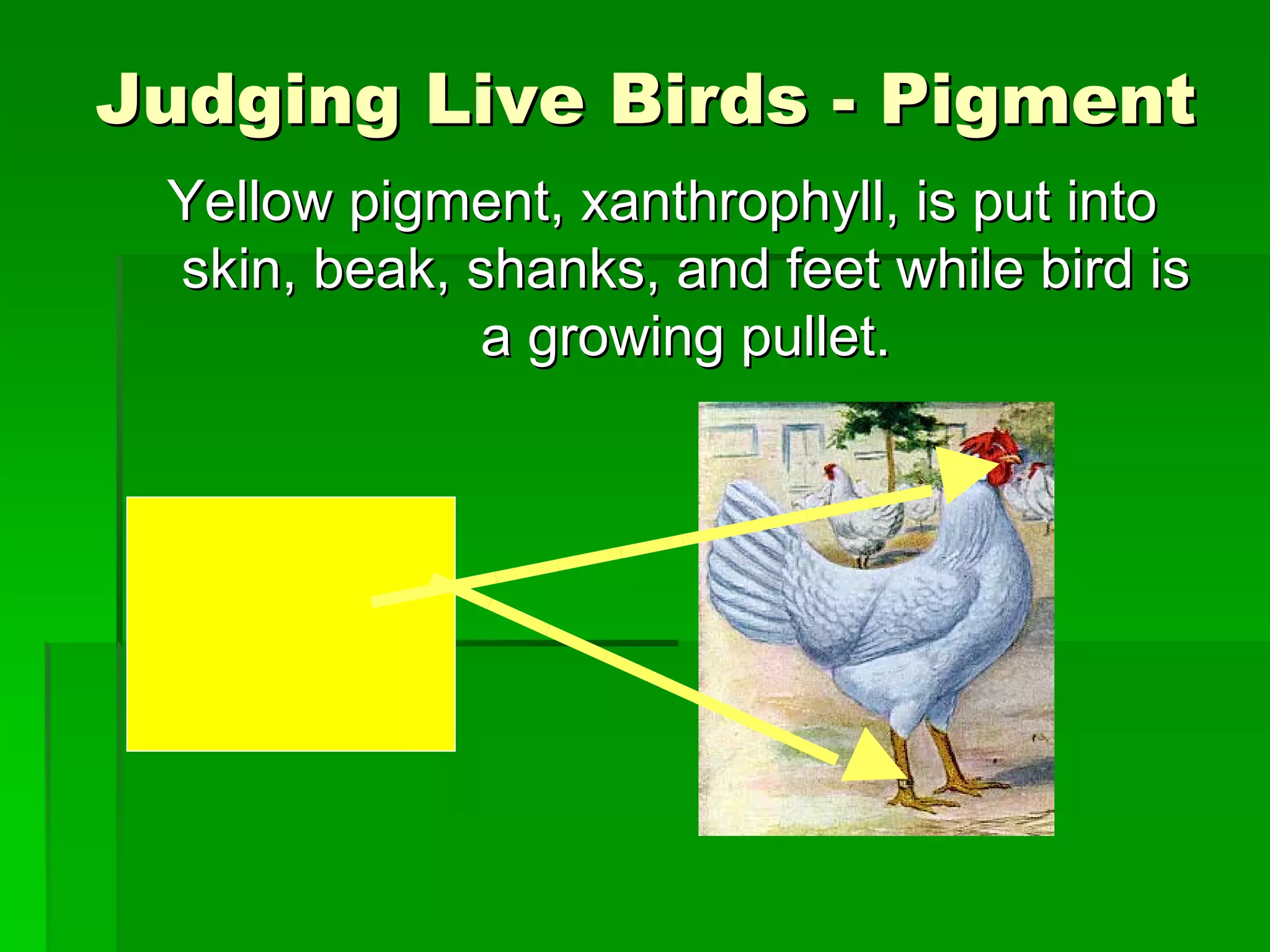
Yellow pigment,Yellow pigment, xanthrophyllxanthrophyll, is put into, is put into
skin, beak, shanks, and feet while bird isskin, beak, shanks, and feet while bird is
a growing pullet.a growing pullet.
▬▬▬▬▬▬▬▬▬►
▬▬▬▬▬▬▬►
Judging Live BirdsJudging Live Birds -- PigmentPigment
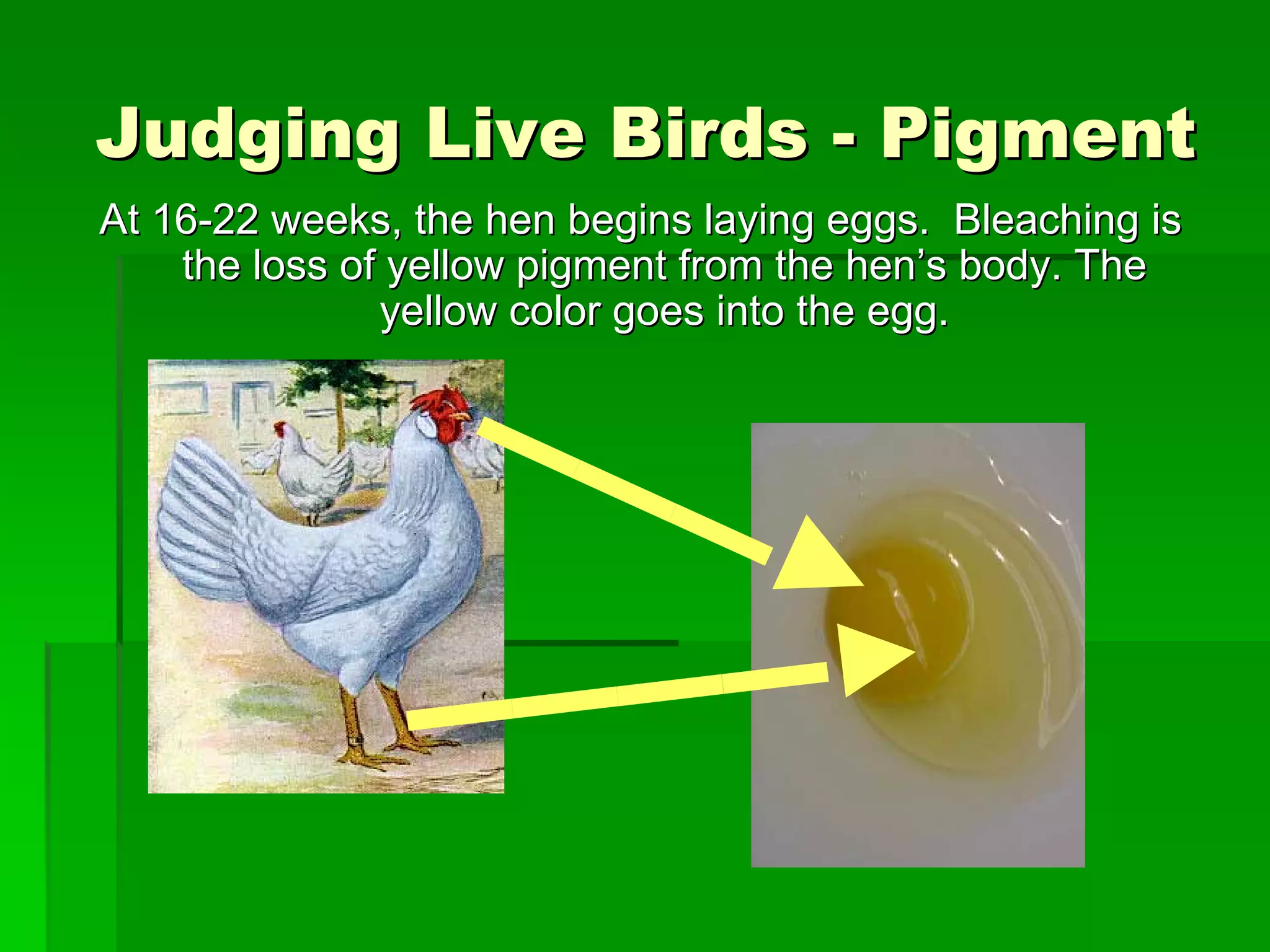
At 16At 16--22 weeks, the hen begins laying eggs. Bleaching is22 weeks, the hen begins laying eggs. Bleaching is
the loss of yellow pigment from the henthe loss of yellow pigment from the hen’’s body. Thes body. The
yellow color goes into the egg.yellow color goes into the egg.
▬▬▬
▬▬▬▬►
PartsParts
of theof the
HenHen
toes
Live BirdsLive Birds –– BleachingBleaching
 The pigment leaves in order:The pigment leaves in order:
VentVent
EyeringEyering
EarlobeEarlobe
Beak (base to tip)Beak (base to tip)
ShanksShanks
Top of Feet & ToesTop of Feet & Toes
Live BirdsLive Birds –– BleachingBleaching
mnemonic = memory devicemnemonic = memory device
vveryery eearlyarly eeveryoneveryone bbutut ssusieusie ttalkedalked
vvent,ent, eeyeringyering,, eearlobe,arlobe, bbeak,eak, sshanks,hanks, ttoesoes
PartsParts
of theof the
HenHen
toes
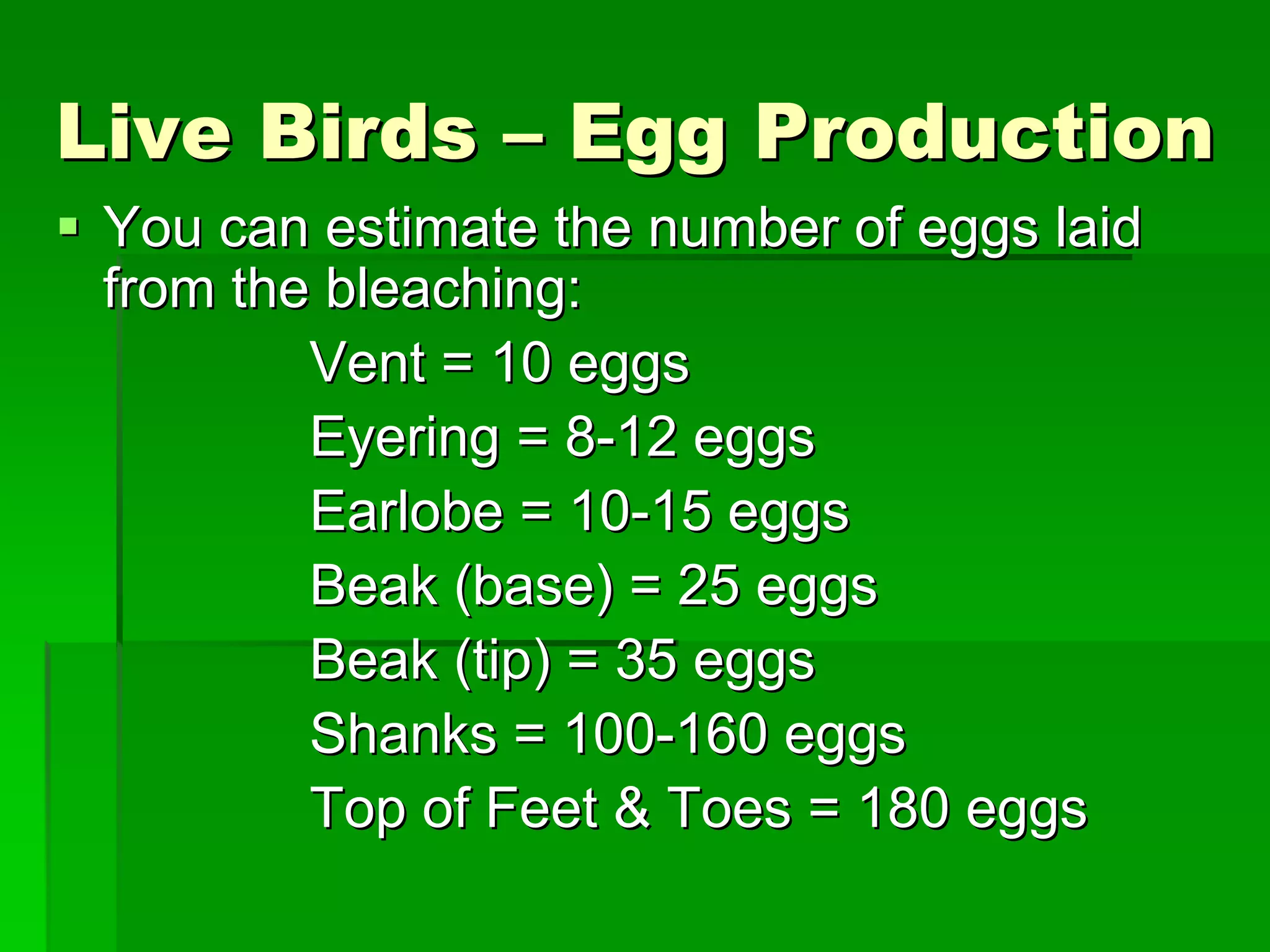
Live BirdsLive Birds –– Egg ProductionEgg Production
 You can estimate the number of eggs laidYou can estimate the number of eggs laid
from the bleaching:from the bleaching:
Vent = 10 eggsVent = 10 eggs
EyeringEyering = 8= 8--12 eggs12 eggs
Earlobe = 10Earlobe = 10--15 eggs15 eggs
Beak (base) = 25 eggsBeak (base) = 25 eggs
Beak (tip) = 35 eggsBeak (tip) = 35 eggs
Shanks = 100Shanks = 100--160 eggs160 eggs
Top of Feet & Toes = 180 eggsTop of Feet & Toes = 180 eggs
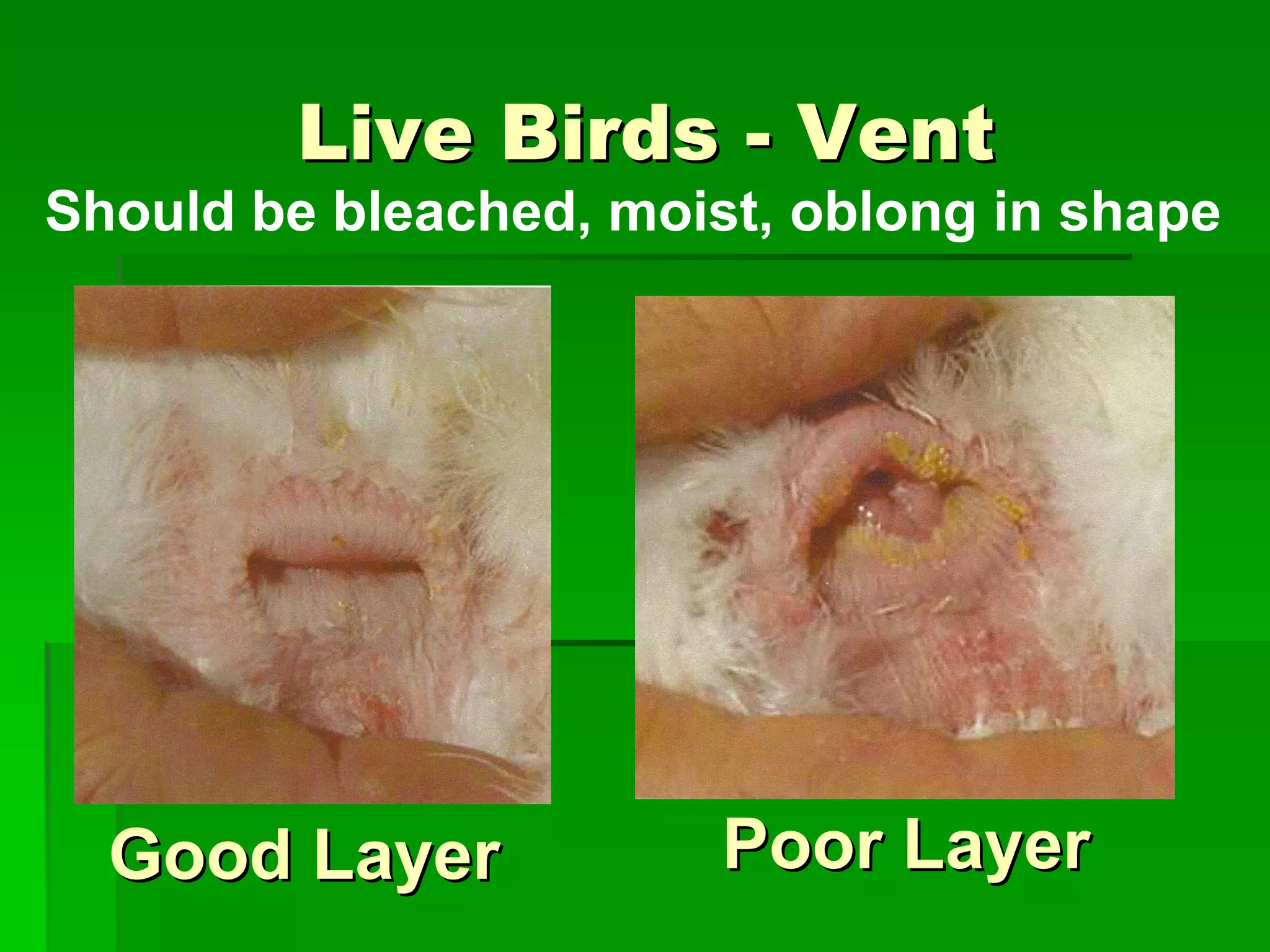
Live BirdsLive Birds -- VentVent
Should be bleached, moist, oblong in shape
Good LayerGood Layer Poor LayerPoor Layer
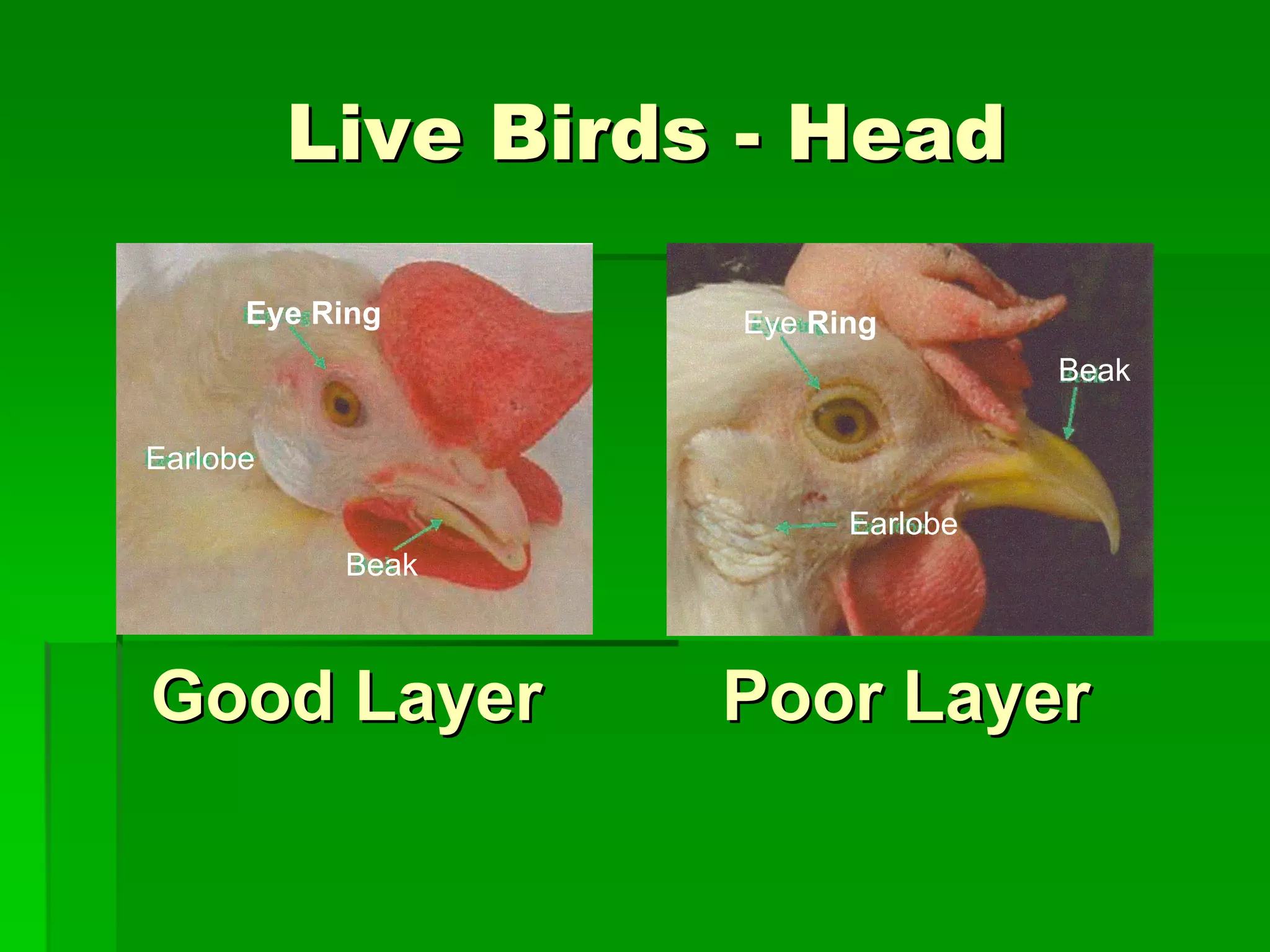
Live BirdsLive Birds -- HeadHead
Eye Ring
Earlobe
Beak
Eye Ring
Earlobe
Beak
Good LayerGood Layer Poor LayerPoor Layer
Live BirdsLive Birds -- MoltMolt
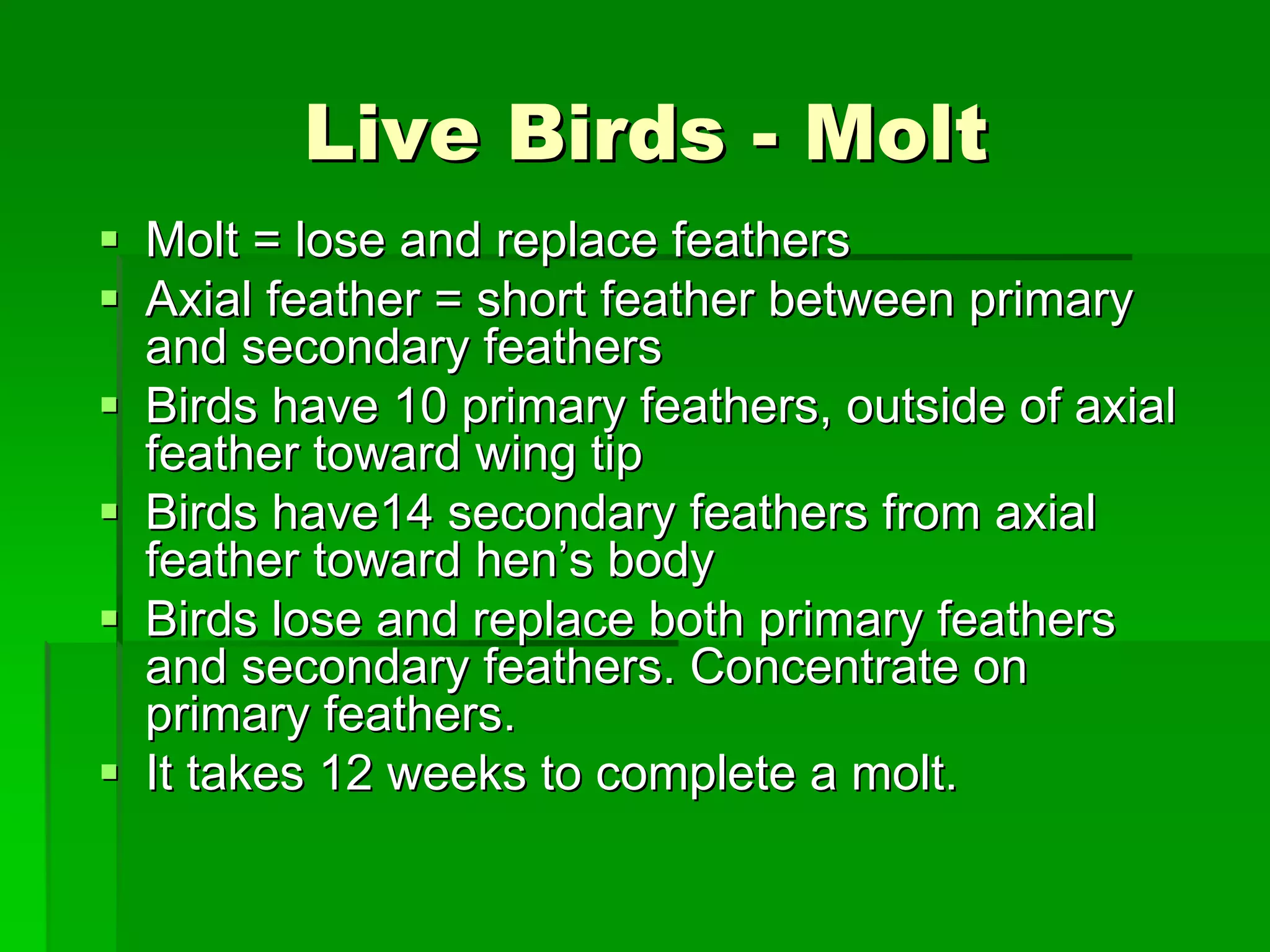
 Molt = lose and replace feathersMolt = lose and replace feathers
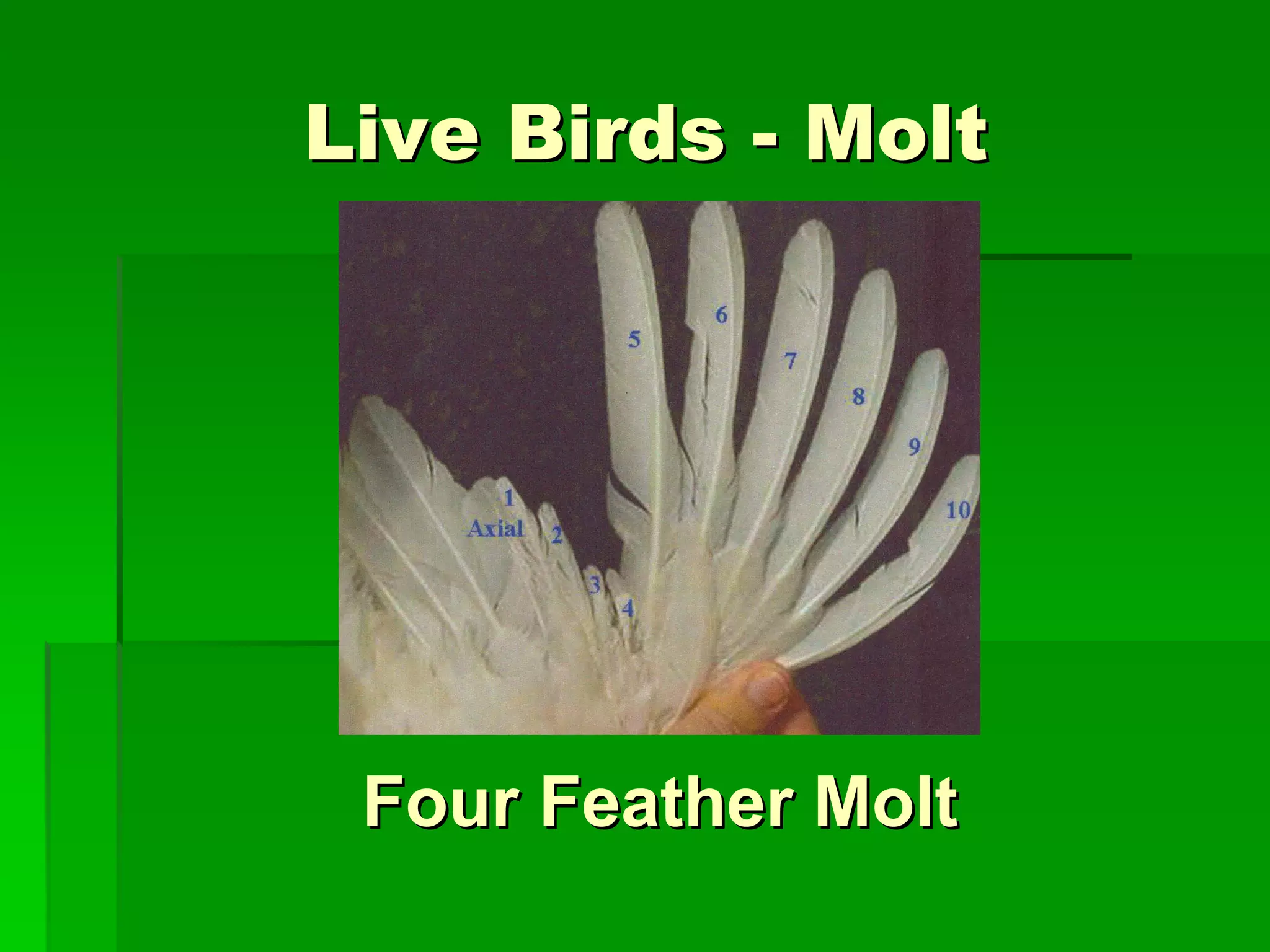
 Axial feather = short feather between primaryAxial feather = short feather between primary
and secondary feathersand secondary feathers
 Birds have 10 primary feathers, outside of axialBirds have 10 primary feathers, outside of axial
feather toward wing tipfeather toward wing tip
 Birds have14 secondary feathers from axialBirds have14 secondary feathers from axial
feather toward henfeather toward hen’’s bodys body
 Birds lose and replace both primary feathersBirds lose and replace both primary feathers
and secondary feathers. Concentrate onand secondary feathers. Concentrate on
primary feathers.primary feathers.
 It takes 12 weeks to complete a molt.It takes 12 weeks to complete a molt.
Live BirdsLive Birds -- MoltMolt
Birds molt from
axial feather to
wing tip.
To check for molt,
spread out
wing feathers.
Live BirdsLive Birds -- MoltMolt
One Feather MoltOne Feather Molt
Live BirdsLive Birds -- MoltMolt
Four Feather MoltFour Feather Molt
Live BirdsLive Birds –– Regaining ColorRegaining Color
 Pigment (color) returns in the same orderPigment (color) returns in the same order
that it left.that it left.
 Always check vent and head for signs ofAlways check vent and head for signs of
returning color.returning color.
 Hens that have yellow pigment in theHens that have yellow pigment in the
vent and head are poor layers.vent and head are poor layers.
Live BirdsLive Birds –– Close PigmentClose Pigment
 If hens have similar bleaching thenIf hens have similar bleaching then
consider:consider:
Handling QualitiesHandling Qualities
Handling qualities refers to the condition of the pubicHandling qualities refers to the condition of the pubic
bones and abdomen.bones and abdomen.
SkeletonSkeleton
of theof the
HenHen
Live BirdsLive Birds --
Handling QualitiesHandling Qualities
Good: Thin and pliable pubic
bones, lean skin and soft
abdomen
Poor: Thick pubic bones, thick
skin, hard abdomen (means
fat in the abdomen)
Live BirdsLive Birds ––
Checking Handling QualitiesChecking Handling Qualities
 Gently feel the pubic bones for sharpness andGently feel the pubic bones for sharpness and
flexibility.flexibility.
 Take a pinch of skin just below the pubic bone.Take a pinch of skin just below the pubic bone.
 Roll this skin gently between your thumb and finger toRoll this skin gently between your thumb and finger to
feel its thinness.feel its thinness.
 Feel the softness or hardness of the abdomen:Feel the softness or hardness of the abdomen:
 Softness means a lack of fat (and a good layer)Softness means a lack of fat (and a good layer)
 Hardness means the presence of fat (and a poorer layer)Hardness means the presence of fat (and a poorer layer)
Live BirdsLive Birds -- PracticePractice
Handling Qualities
Thickness of Pubic Bones
Thinness of Skin
The bird on the left has
thinner pubic bones indicating
higher handling qualities.
The bird on the left has
thinner skin indicating
better handling qualities.
Live BirdsLive Birds ––
Abdominal CapacityAbdominal Capacity
 Use your fingers to check distanceUse your fingers to check distance
between pubic bones = widthbetween pubic bones = width
Pubic Bones
This hen has a
three-finger spread
between pubic bones.
Live BirdsLive Birds ––
Abdominal CapacityAbdominal Capacity
 Use your fingers to check distance betweenUse your fingers to check distance between
pubic bones and keel bone = depth.pubic bones and keel bone = depth.
Pubic Bones
This hen has a
four-finger spread
between pubic bones
and keel bone.
Keel Bone
Live BirdsLive Birds ––
Abdominal CapacityAbdominal Capacity
Comparison ofComparison of WidthWidth = Space between= Space between pubic bonespubic bones
3-finger = Excellent Layer 2-finger = Fair Layer
Live BirdsLive Birds ––
Abdominal CapacityAbdominal Capacity
Comparison ofComparison of DepthDepth = Space between= Space between pubic bones and keelpubic bones and keel
4-finger = Excellent Layer 3-finger = Fair Layer
Live BirdsLive Birds –– Health & VigorHealth & Vigor
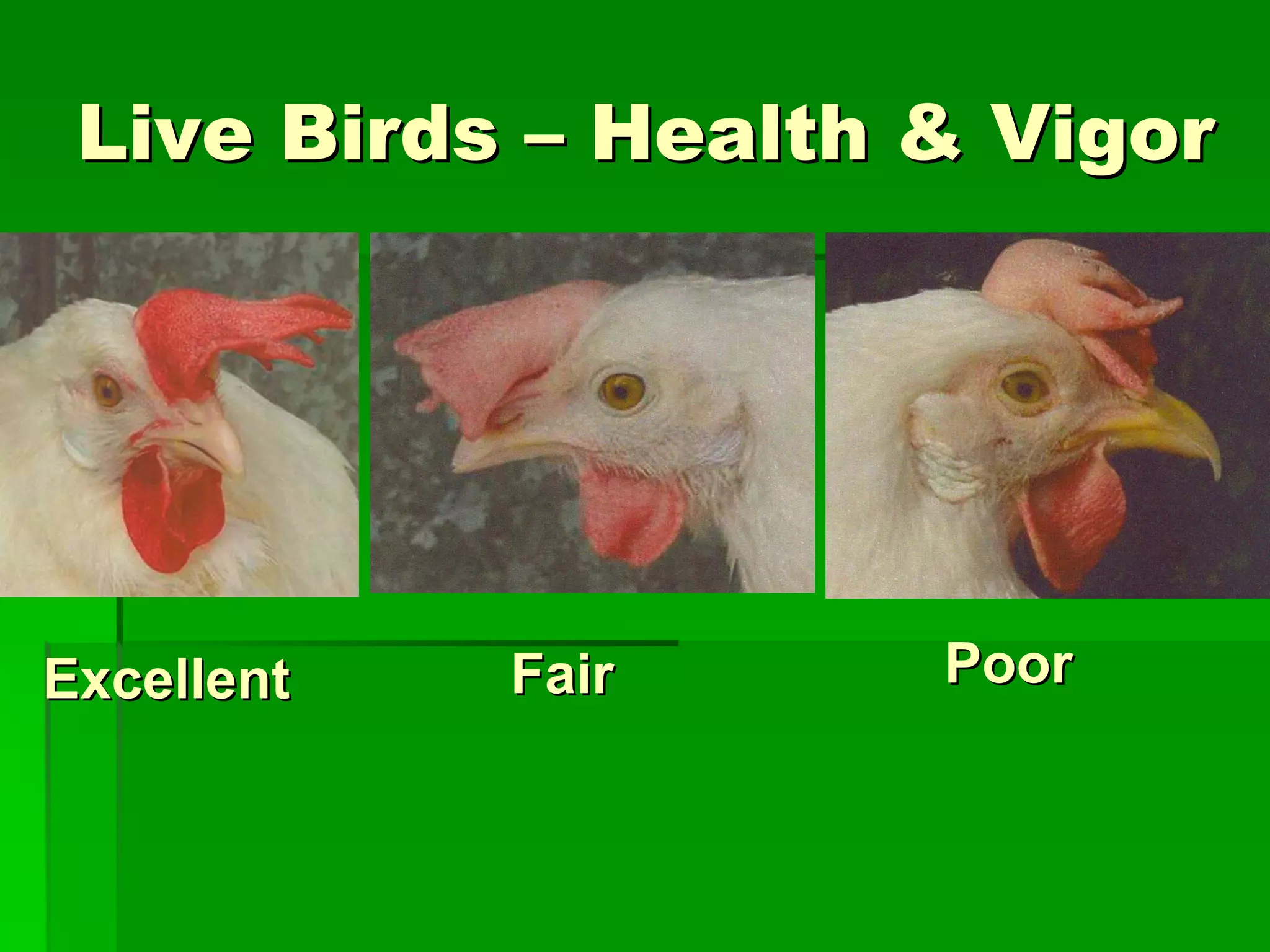
 HeadHead –– Broad; Somewhat flat on top; WideBroad; Somewhat flat on top; Wide
between eyesbetween eyes
 FaceFace –– CleanClean--cut; Smooth; Wrinklecut; Smooth; Wrinkle--freefree
 CombComb –– Bright red; Smooth; WaxyBright red; Smooth; Waxy
 EyesEyes –– Large and bright; Reddish color; RoundLarge and bright; Reddish color; Round
pupilspupils
Live BirdsLive Birds –– Health & VigorHealth & Vigor
ExcellentExcellent FairFair PoorPoor
Live BirdLive Bird –– Placing ClassPlacing Class
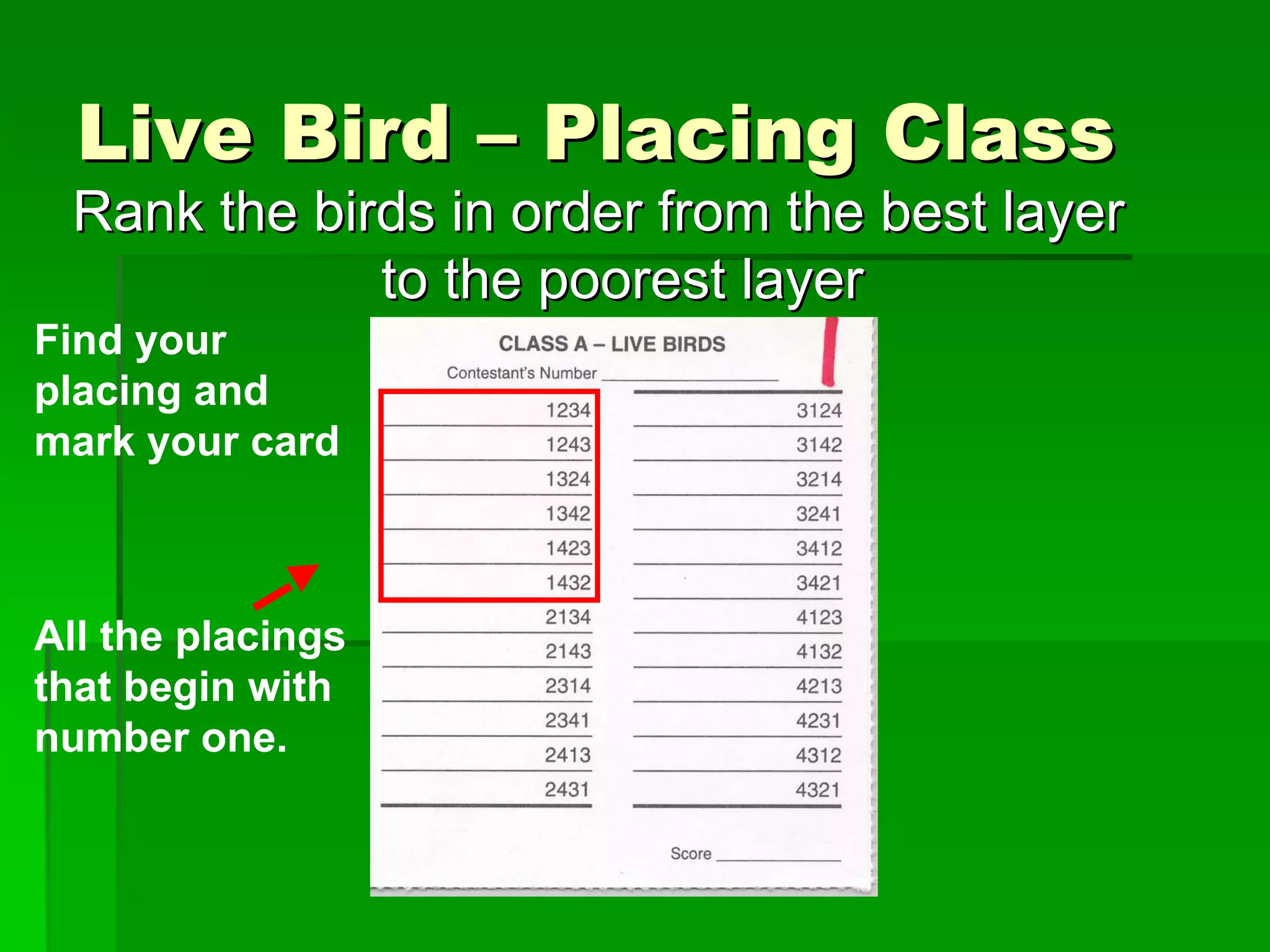
Rank the birds in order from the best layerRank the birds in order from the best layer
to the poorest layerto the poorest layer
Find your
placing and
mark your card
All the placings
that begin with
number one.
▬
►
Live BirdLive Bird –– Placing ClassPlacing Class
Rank the birds in order from the best layerRank the birds in order from the best layer
to the poorest layerto the poorest layer
Find your
placing and
mark your card
All the placings
that begin with
number two. ▬
►
Live BirdLive Bird –– Placing ClassPlacing Class
Rank the birds in order from the best layerRank the birds in order from the best layer
to the poorest layerto the poorest layer
Find your
placing and
mark your card
All the placings
that begin with
number three.
◄
▬
Live BirdLive Bird –– Placing ClassPlacing Class
Rank the birds in order from the best layerRank the birds in order from the best layer
to the poorest layerto the poorest layer
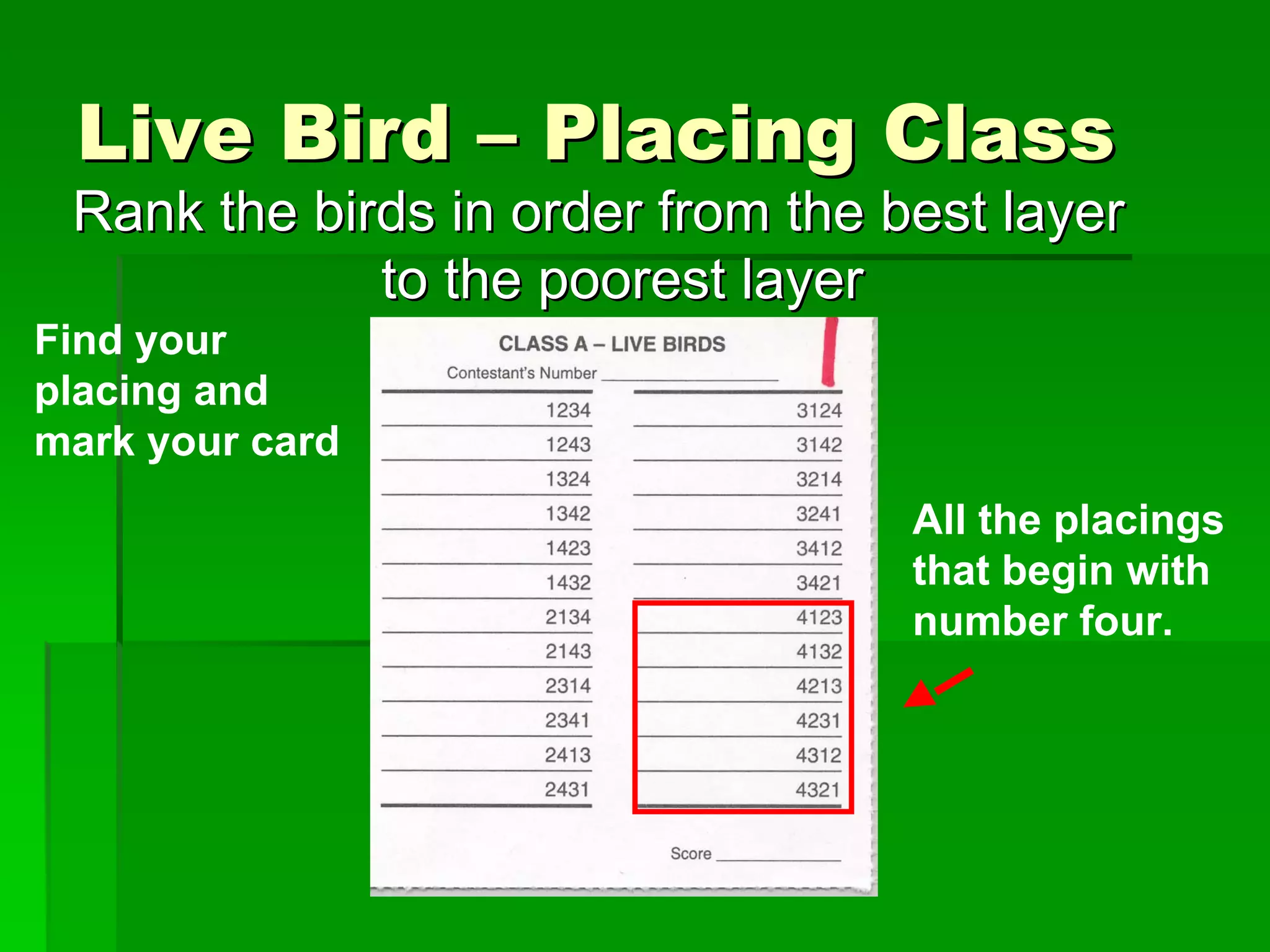
Find your
placing and
mark your card
All the placings
that begin with
number four.
◄
▬
Live BirdsLive Birds -- PracticePractice
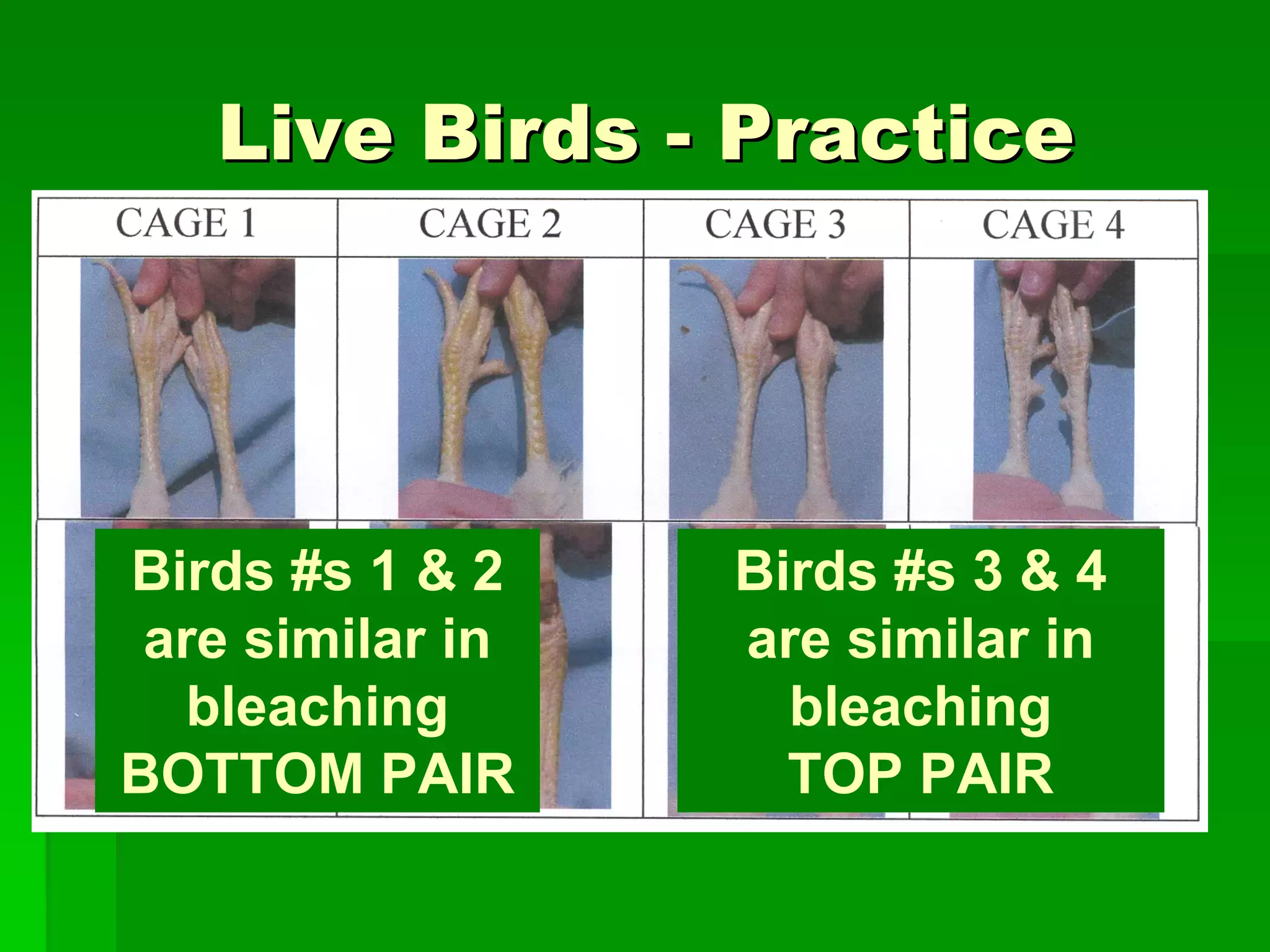
Bird # 3 is most
Bleached
TOP BIRD
Bird # 4 is least
Bleached
BOTTOM BIRD
Bird # 2 has more
Pigment than
Bird # 1
1 over 2
Live BirdsLive Birds -- PracticePractice
 Bird #3 is an easy top. She is the mostBird #3 is an easy top. She is the most
bleached in the class.bleached in the class.
 Bird #4 is an easy bottom. She is the mostBird #4 is an easy bottom. She is the most
yellow bird in the class.yellow bird in the class.
 Bird #1 and bird #2 are close. But if you lookBird #1 and bird #2 are close. But if you look
carefully, #1 is more bleached (less yellow)carefully, #1 is more bleached (less yellow)
than #2.than #2.
33 –– 11 –– 22 –– 44Placing:
Live BirdLive Bird –– Placing ClassPlacing Class
Rank the birds in order from the best layerRank the birds in order from the best layer
to the poorest layerto the poorest layer
Find your
placing and
mark your card
All the placings
that begin with
number three.
◄
▬
Live BirdLive Bird –– Placing ClassPlacing Class
Rank the birds in order from the best layerRank the birds in order from the best layer
to the poorest layerto the poorest layer
Find your
placing and
mark your card
X
Be sure your
“X” fits inside
the lines
beside the
placing you
choose
Live BirdsLive Birds -- PracticePractice
Birds #s 3 & 4
are similar in
bleaching
TOP PAIR
Birds #s 1 & 2
are similar in
bleaching
BOTTOM PAIR
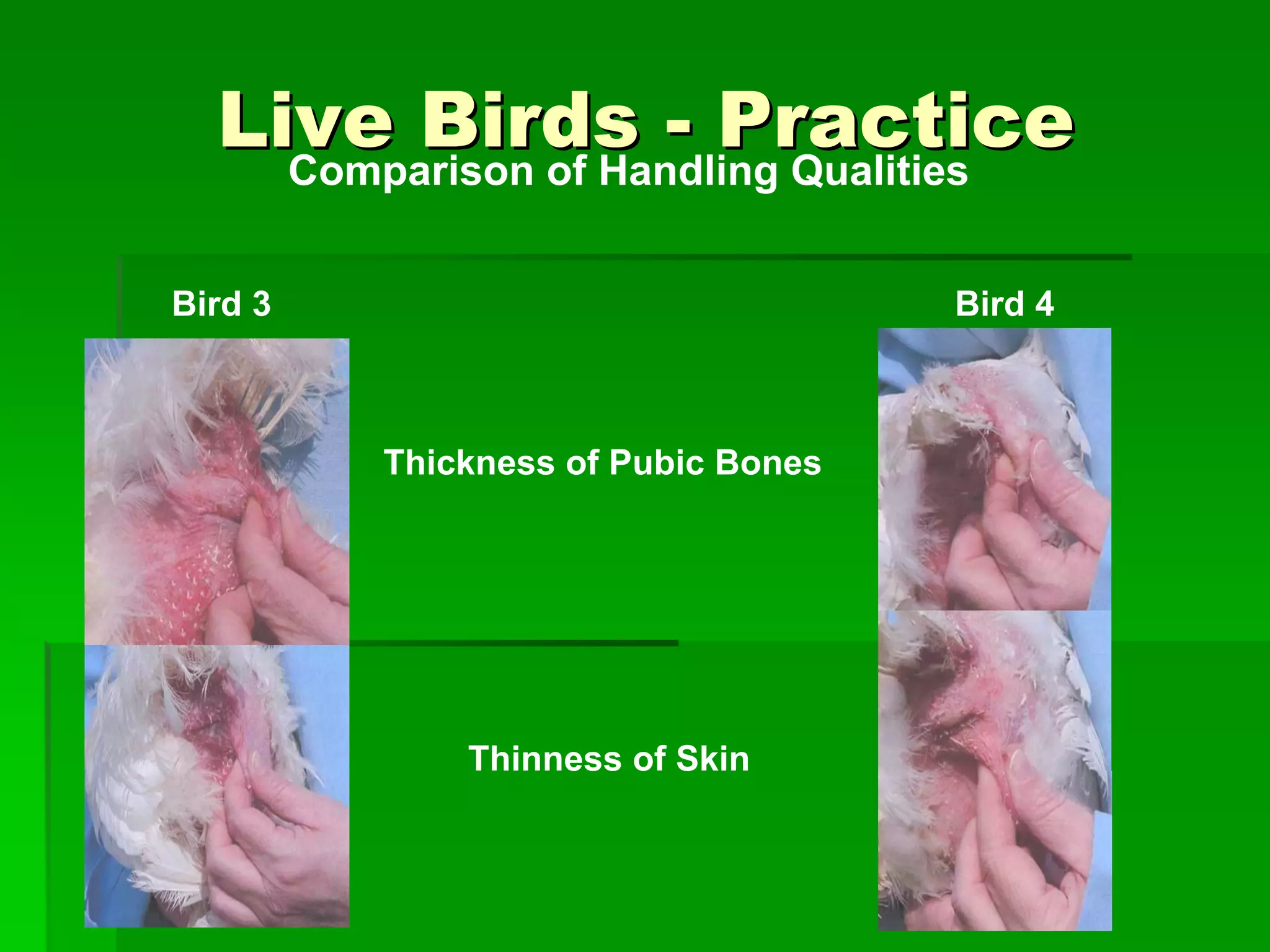
Live BirdsLive Birds -- PracticePracticeComparison of Handling Qualities
Bird 3 Bird 4
Thickness of Pubic Bones
Thinness of Skin
Live BirdsLive Birds -- PracticePractice
The class can be placed on pigmentation.The class can be placed on pigmentation.
Two birds (# 3 & #4) are more bleached, andTwo birds (# 3 & #4) are more bleached, and
have less pigment. 3 has better handlinghave less pigment. 3 has better handling
qualities. The top pair is 3 over 4.qualities. The top pair is 3 over 4.
Two birds (#1 & #2) are less bleached, andTwo birds (#1 & #2) are less bleached, and
have more pigment. 2 is more yellow than 1.have more pigment. 2 is more yellow than 1.
In the bottom pair 1 goes over 2.In the bottom pair 1 goes over 2.
Placing :Placing : 3 – 4 – 1 – 2
Live BirdLive Bird –– Placing ClassPlacing Class
Rank the birds in order from the best layerRank the birds in order from the best layer
to the poorest layerto the poorest layer
Find your
placing and
mark your card
All the placings
that begin with
number three.
◄
▬
Live BirdLive Bird –– Placing ClassPlacing Class
Rank the birds in order from the best layerRank the birds in order from the best layer
to the poorest layerto the poorest layer
Find your
placing and
mark your card
X
Be sure your
“X” fits inside
the lines
beside the
placing you
choose
Live BirdsLive Birds -- ReasonsReasons
 You will give one set of reasons at theYou will give one set of reasons at the
Area Contest on Class BArea Contest on Class B –– Live Birds.Live Birds.
 At the State Contest there will be twoAt the State Contest there will be two
sets of Oral Reasons.sets of Oral Reasons.
 Reasons for your placing are given inReasons for your placing are given in
front of an adult judge.front of an adult judge.
 Sound convincing, confident, and sure ofSound convincing, confident, and sure of
yourself.yourself.
Live BirdsLive Birds –– Taking NotesTaking Notes
Take notes on the class for which you willTake notes on the class for which you will
give oral reasonsgive oral reasons
Live BirdsLive Birds –– Oral ReasonsOral Reasons
 Organize your placing into pairsOrganize your placing into pairs
 If your placing is 1If your placing is 1--22--33--44
Top pair = 1 / 2Top pair = 1 / 2
Middle pair = 2 / 3Middle pair = 2 / 3
Bottom pair = 3 / 4Bottom pair = 3 / 4
 Use standard reason formatUse standard reason format
Live BirdsLive Birds –– Oral ReasonsOral Reasons
 I placed this class of White Leghorn hens,I placed this class of White Leghorn hens,
11--22--33--4.4.
 In the top pair, I placed 1 over 2 because . .In the top pair, I placed 1 over 2 because . .
 In the middle pair, I placed 2 over 3In the middle pair, I placed 2 over 3
because . . .because . . .
 In the bottom pair, I placed 3 over 4In the bottom pair, I placed 3 over 4
because . . .because . . .
 For these reasons, I placed this class ofFor these reasons, I placed this class of
White Leghorn hen 1White Leghorn hen 1--22--33--4.4.
Good afternoon. I am contestant # 261.
Practice WebsitePractice Website
http://www.animal.ufl.edu/Youth/poultry/past_production/pastprodlist.htm
 www.animal.ufl.eduwww.animal.ufl.edu
 Click on Youth Poultry JudgingClick on Youth Poultry Judging
 Click on Show Me HowClick on Show Me How
 Click on Go to Main Practice MenuClick on Go to Main Practice Menu
 Click on Past Egg ProductionClick on Past Egg Production
Live BirdsLive Birds -- CreditsCredits
http://http://www.ansi.okstate.edu/poultry/index.htmwww.ansi.okstate.edu/poultry/index.htm
http://http://www.animal.ufl.edu/Youth/poultry/showme.htmwww.animal.ufl.edu/Youth/poultry/showme.htm

Judging of poultry

  • 1.
    Judging Live BirdsJudgingLive Birds Created by Connie PageCreated by Connie Page Emanuel County Extension AgentEmanuel County Extension Agent P.O. Box 770P.O. Box 770 129 N. Anderson Drive129 N. Anderson Drive Swainsboro, GA 30401Swainsboro, GA 30401 478478--237237--1226 FAX 4781226 FAX 478--237237--84518451 conniep@uga.educonniep@uga.edu April, 2006April, 2006
  • 2.
    Judging Live BirdsJudgingLive Birds Judged on past egg productionJudged on past egg production PersistencyPersistency Longest period of productionLongest period of production Pigment Loss = amount of yellow coloringPigment Loss = amount of yellow coloring Molt = replacement of feathersMolt = replacement of feathers IntenstityIntenstity Current rate of productionCurrent rate of production Handling QualitiesHandling Qualities –– softness and pliability ofsoftness and pliability of abdomenabdomen Abdominal CapacityAbdominal Capacity –– width and depth of abdomenwidth and depth of abdomen Health and VigorHealth and Vigor -- shape and brightness of theshape and brightness of the eye, proportional shape of the head and the conditioneye, proportional shape of the head and the condition of the comb and wattlesof the comb and wattles
  • 3.
    Judging Live BirdsJudgingLive Birds -- PigmentPigment Yellow pigment,Yellow pigment, xanthrophyllxanthrophyll, is put into, is put into skin, beak, shanks, and feet while bird isskin, beak, shanks, and feet while bird is a growing pullet.a growing pullet. ▬▬▬▬▬▬▬▬▬► ▬▬▬▬▬▬▬►
  • 4.
    Judging Live BirdsJudgingLive Birds -- PigmentPigment At 16At 16--22 weeks, the hen begins laying eggs. Bleaching is22 weeks, the hen begins laying eggs. Bleaching is the loss of yellow pigment from the henthe loss of yellow pigment from the hen’’s body. Thes body. The yellow color goes into the egg.yellow color goes into the egg. ▬▬▬ ▬▬▬▬►
  • 5.
  • 6.
    Live BirdsLive Birds–– BleachingBleaching  The pigment leaves in order:The pigment leaves in order: VentVent EyeringEyering EarlobeEarlobe Beak (base to tip)Beak (base to tip) ShanksShanks Top of Feet & ToesTop of Feet & Toes
  • 7.
    Live BirdsLive Birds–– BleachingBleaching mnemonic = memory devicemnemonic = memory device vveryery eearlyarly eeveryoneveryone bbutut ssusieusie ttalkedalked vvent,ent, eeyeringyering,, eearlobe,arlobe, bbeak,eak, sshanks,hanks, ttoesoes
  • 8.
  • 9.
    Live BirdsLive Birds–– Egg ProductionEgg Production  You can estimate the number of eggs laidYou can estimate the number of eggs laid from the bleaching:from the bleaching: Vent = 10 eggsVent = 10 eggs EyeringEyering = 8= 8--12 eggs12 eggs Earlobe = 10Earlobe = 10--15 eggs15 eggs Beak (base) = 25 eggsBeak (base) = 25 eggs Beak (tip) = 35 eggsBeak (tip) = 35 eggs Shanks = 100Shanks = 100--160 eggs160 eggs Top of Feet & Toes = 180 eggsTop of Feet & Toes = 180 eggs
  • 10.
    Live BirdsLive Birds-- VentVent Should be bleached, moist, oblong in shape Good LayerGood Layer Poor LayerPoor Layer
  • 11.
    Live BirdsLive Birds-- HeadHead Eye Ring Earlobe Beak Eye Ring Earlobe Beak Good LayerGood Layer Poor LayerPoor Layer
  • 12.
    Live BirdsLive Birds-- MoltMolt  Molt = lose and replace feathersMolt = lose and replace feathers  Axial feather = short feather between primaryAxial feather = short feather between primary and secondary feathersand secondary feathers  Birds have 10 primary feathers, outside of axialBirds have 10 primary feathers, outside of axial feather toward wing tipfeather toward wing tip  Birds have14 secondary feathers from axialBirds have14 secondary feathers from axial feather toward henfeather toward hen’’s bodys body  Birds lose and replace both primary feathersBirds lose and replace both primary feathers and secondary feathers. Concentrate onand secondary feathers. Concentrate on primary feathers.primary feathers.  It takes 12 weeks to complete a molt.It takes 12 weeks to complete a molt.
  • 13.
    Live BirdsLive Birds-- MoltMolt Birds molt from axial feather to wing tip. To check for molt, spread out wing feathers.
  • 14.
    Live BirdsLive Birds-- MoltMolt One Feather MoltOne Feather Molt
  • 15.
    Live BirdsLive Birds-- MoltMolt Four Feather MoltFour Feather Molt
  • 16.
    Live BirdsLive Birds–– Regaining ColorRegaining Color  Pigment (color) returns in the same orderPigment (color) returns in the same order that it left.that it left.  Always check vent and head for signs ofAlways check vent and head for signs of returning color.returning color.  Hens that have yellow pigment in theHens that have yellow pigment in the vent and head are poor layers.vent and head are poor layers.
  • 17.
    Live BirdsLive Birds–– Close PigmentClose Pigment  If hens have similar bleaching thenIf hens have similar bleaching then consider:consider: Handling QualitiesHandling Qualities Handling qualities refers to the condition of the pubicHandling qualities refers to the condition of the pubic bones and abdomen.bones and abdomen.
  • 18.
  • 19.
    Live BirdsLive Birds-- Handling QualitiesHandling Qualities Good: Thin and pliable pubic bones, lean skin and soft abdomen Poor: Thick pubic bones, thick skin, hard abdomen (means fat in the abdomen)
  • 20.
    Live BirdsLive Birds–– Checking Handling QualitiesChecking Handling Qualities  Gently feel the pubic bones for sharpness andGently feel the pubic bones for sharpness and flexibility.flexibility.  Take a pinch of skin just below the pubic bone.Take a pinch of skin just below the pubic bone.  Roll this skin gently between your thumb and finger toRoll this skin gently between your thumb and finger to feel its thinness.feel its thinness.  Feel the softness or hardness of the abdomen:Feel the softness or hardness of the abdomen:  Softness means a lack of fat (and a good layer)Softness means a lack of fat (and a good layer)  Hardness means the presence of fat (and a poorer layer)Hardness means the presence of fat (and a poorer layer)
  • 21.
    Live BirdsLive Birds-- PracticePractice Handling Qualities Thickness of Pubic Bones Thinness of Skin The bird on the left has thinner pubic bones indicating higher handling qualities. The bird on the left has thinner skin indicating better handling qualities.
  • 22.
    Live BirdsLive Birds–– Abdominal CapacityAbdominal Capacity  Use your fingers to check distanceUse your fingers to check distance between pubic bones = widthbetween pubic bones = width Pubic Bones This hen has a three-finger spread between pubic bones.
  • 23.
    Live BirdsLive Birds–– Abdominal CapacityAbdominal Capacity  Use your fingers to check distance betweenUse your fingers to check distance between pubic bones and keel bone = depth.pubic bones and keel bone = depth. Pubic Bones This hen has a four-finger spread between pubic bones and keel bone. Keel Bone
  • 24.
    Live BirdsLive Birds–– Abdominal CapacityAbdominal Capacity Comparison ofComparison of WidthWidth = Space between= Space between pubic bonespubic bones 3-finger = Excellent Layer 2-finger = Fair Layer
  • 25.
    Live BirdsLive Birds–– Abdominal CapacityAbdominal Capacity Comparison ofComparison of DepthDepth = Space between= Space between pubic bones and keelpubic bones and keel 4-finger = Excellent Layer 3-finger = Fair Layer
  • 26.
    Live BirdsLive Birds–– Health & VigorHealth & Vigor  HeadHead –– Broad; Somewhat flat on top; WideBroad; Somewhat flat on top; Wide between eyesbetween eyes  FaceFace –– CleanClean--cut; Smooth; Wrinklecut; Smooth; Wrinkle--freefree  CombComb –– Bright red; Smooth; WaxyBright red; Smooth; Waxy  EyesEyes –– Large and bright; Reddish color; RoundLarge and bright; Reddish color; Round pupilspupils
  • 27.
    Live BirdsLive Birds–– Health & VigorHealth & Vigor ExcellentExcellent FairFair PoorPoor
  • 28.
    Live BirdLive Bird–– Placing ClassPlacing Class Rank the birds in order from the best layerRank the birds in order from the best layer to the poorest layerto the poorest layer Find your placing and mark your card All the placings that begin with number one. ▬ ►
  • 29.
    Live BirdLive Bird–– Placing ClassPlacing Class Rank the birds in order from the best layerRank the birds in order from the best layer to the poorest layerto the poorest layer Find your placing and mark your card All the placings that begin with number two. ▬ ►
  • 30.
    Live BirdLive Bird–– Placing ClassPlacing Class Rank the birds in order from the best layerRank the birds in order from the best layer to the poorest layerto the poorest layer Find your placing and mark your card All the placings that begin with number three. ◄ ▬
  • 31.
    Live BirdLive Bird–– Placing ClassPlacing Class Rank the birds in order from the best layerRank the birds in order from the best layer to the poorest layerto the poorest layer Find your placing and mark your card All the placings that begin with number four. ◄ ▬
  • 32.
    Live BirdsLive Birds-- PracticePractice Bird # 3 is most Bleached TOP BIRD Bird # 4 is least Bleached BOTTOM BIRD Bird # 2 has more Pigment than Bird # 1 1 over 2
  • 33.
    Live BirdsLive Birds-- PracticePractice  Bird #3 is an easy top. She is the mostBird #3 is an easy top. She is the most bleached in the class.bleached in the class.  Bird #4 is an easy bottom. She is the mostBird #4 is an easy bottom. She is the most yellow bird in the class.yellow bird in the class.  Bird #1 and bird #2 are close. But if you lookBird #1 and bird #2 are close. But if you look carefully, #1 is more bleached (less yellow)carefully, #1 is more bleached (less yellow) than #2.than #2. 33 –– 11 –– 22 –– 44Placing:
  • 34.
    Live BirdLive Bird–– Placing ClassPlacing Class Rank the birds in order from the best layerRank the birds in order from the best layer to the poorest layerto the poorest layer Find your placing and mark your card All the placings that begin with number three. ◄ ▬
  • 35.
    Live BirdLive Bird–– Placing ClassPlacing Class Rank the birds in order from the best layerRank the birds in order from the best layer to the poorest layerto the poorest layer Find your placing and mark your card X Be sure your “X” fits inside the lines beside the placing you choose
  • 36.
    Live BirdsLive Birds-- PracticePractice Birds #s 3 & 4 are similar in bleaching TOP PAIR Birds #s 1 & 2 are similar in bleaching BOTTOM PAIR
  • 37.
    Live BirdsLive Birds-- PracticePracticeComparison of Handling Qualities Bird 3 Bird 4 Thickness of Pubic Bones Thinness of Skin
  • 38.
    Live BirdsLive Birds-- PracticePractice The class can be placed on pigmentation.The class can be placed on pigmentation. Two birds (# 3 & #4) are more bleached, andTwo birds (# 3 & #4) are more bleached, and have less pigment. 3 has better handlinghave less pigment. 3 has better handling qualities. The top pair is 3 over 4.qualities. The top pair is 3 over 4. Two birds (#1 & #2) are less bleached, andTwo birds (#1 & #2) are less bleached, and have more pigment. 2 is more yellow than 1.have more pigment. 2 is more yellow than 1. In the bottom pair 1 goes over 2.In the bottom pair 1 goes over 2. Placing :Placing : 3 – 4 – 1 – 2
  • 39.
    Live BirdLive Bird–– Placing ClassPlacing Class Rank the birds in order from the best layerRank the birds in order from the best layer to the poorest layerto the poorest layer Find your placing and mark your card All the placings that begin with number three. ◄ ▬
  • 40.
    Live BirdLive Bird–– Placing ClassPlacing Class Rank the birds in order from the best layerRank the birds in order from the best layer to the poorest layerto the poorest layer Find your placing and mark your card X Be sure your “X” fits inside the lines beside the placing you choose
  • 41.
    Live BirdsLive Birds-- ReasonsReasons  You will give one set of reasons at theYou will give one set of reasons at the Area Contest on Class BArea Contest on Class B –– Live Birds.Live Birds.  At the State Contest there will be twoAt the State Contest there will be two sets of Oral Reasons.sets of Oral Reasons.  Reasons for your placing are given inReasons for your placing are given in front of an adult judge.front of an adult judge.  Sound convincing, confident, and sure ofSound convincing, confident, and sure of yourself.yourself.
  • 42.
    Live BirdsLive Birds–– Taking NotesTaking Notes Take notes on the class for which you willTake notes on the class for which you will give oral reasonsgive oral reasons
  • 43.
    Live BirdsLive Birds–– Oral ReasonsOral Reasons  Organize your placing into pairsOrganize your placing into pairs  If your placing is 1If your placing is 1--22--33--44 Top pair = 1 / 2Top pair = 1 / 2 Middle pair = 2 / 3Middle pair = 2 / 3 Bottom pair = 3 / 4Bottom pair = 3 / 4  Use standard reason formatUse standard reason format
  • 44.
    Live BirdsLive Birds–– Oral ReasonsOral Reasons  I placed this class of White Leghorn hens,I placed this class of White Leghorn hens, 11--22--33--4.4.  In the top pair, I placed 1 over 2 because . .In the top pair, I placed 1 over 2 because . .  In the middle pair, I placed 2 over 3In the middle pair, I placed 2 over 3 because . . .because . . .  In the bottom pair, I placed 3 over 4In the bottom pair, I placed 3 over 4 because . . .because . . .  For these reasons, I placed this class ofFor these reasons, I placed this class of White Leghorn hen 1White Leghorn hen 1--22--33--4.4. Good afternoon. I am contestant # 261.
  • 45.
    Practice WebsitePractice Website http://www.animal.ufl.edu/Youth/poultry/past_production/pastprodlist.htm www.animal.ufl.eduwww.animal.ufl.edu  Click on Youth Poultry JudgingClick on Youth Poultry Judging  Click on Show Me HowClick on Show Me How  Click on Go to Main Practice MenuClick on Go to Main Practice Menu  Click on Past Egg ProductionClick on Past Egg Production
  • 46.
    Live BirdsLive Birds-- CreditsCredits http://http://www.ansi.okstate.edu/poultry/index.htmwww.ansi.okstate.edu/poultry/index.htm http://http://www.animal.ufl.edu/Youth/poultry/showme.htmwww.animal.ufl.edu/Youth/poultry/showme.htm