Margie Lumanggaya-Bibat,MSA
Prior to Pregnancy
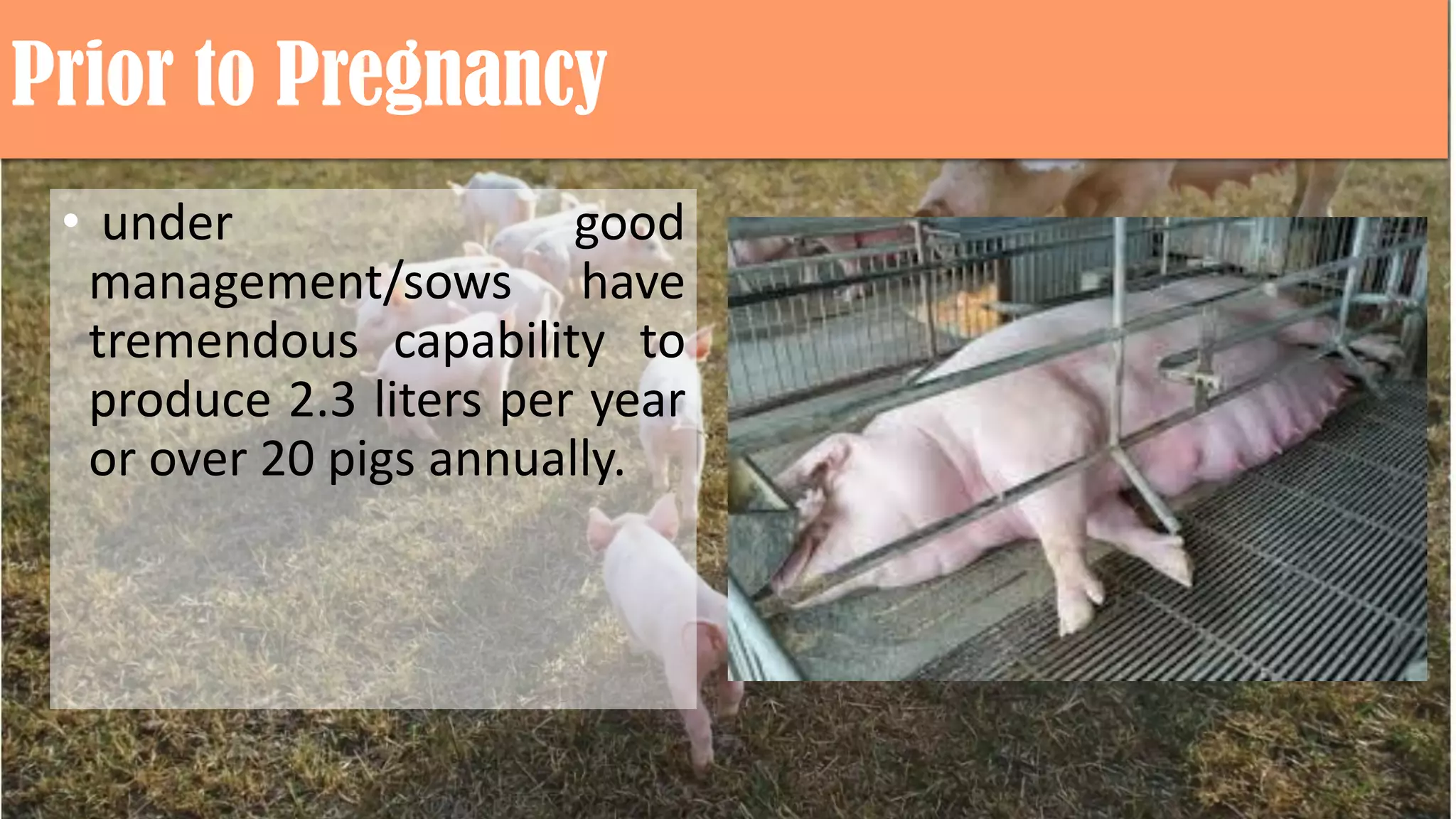
• under good
management/sows have
tremendous capability to
produce 2.3 liters per year
or over 20 pigs annually.
Raising and Selecting Replacement Gilts
• a steady supply of
replacement gilts is required
to replace sows, which die or
are culled because of poor
performance.
• plan to replace 40 to 55
percent of your herd
annually, if your herd age is
five litters or less.
Management of the developing GILTS
• raise potentials gilt replacement in all female group in
dry, well-ventilated pens that provide 0.56 to 0.74 m2
of floor space per animal.
Pre-Service Management of Replacement of GILT
A. Flushing
• increasing the daily feed intake of gilts by 0.5 kg to
1.0 kg for 10 to 14 days before service should
increase. The number of eggs ovulated if they were
limit fed per kg per day before flushing.
• A better practice is to self-feed the gilts with a
14% protein gestation ration throughout the pre-
service period.
Pre-Service Management of Replacement of GILT
B. Recommendations at First Breeding
• breed gilt at eight months and at 110-120 kg.
• Gilts should have their first litter at one-year age.
• It is further recommended that gilt be bred on the
second heat cycles when the animal is standing
heat.
Management at Breeding time
Developing a Breeding Schedule
• Determine adequate boar power by considering the
number of services required per week, not the
number of sows and boar.
• Each sow should be served twice. Boars that serve
twice in a day with a day rest between breeding, an
allowance should be made for one boar a sow during
the week.
Mating System
•Mating system vary as to amount of labor involved,
ease of obtaining accurate breeding records and
facility requirements.
1. Artificial Insemination
2. Hand Mating
 this is preferred mating system.
 the operator checks for heat and takes the
female in heat to the boar.
Advantages of Hand mating
• The operator knows for certain that the females were bred
• Accurate breeding dates can be recorded.
• The operator can accurately check for return to heat
• Boar use is regulated
• Anestrus problems can be determined earlier
• A more accurate sire breeding performance can be
calculated.
• Fewer boars are required for the same number of females.
Note: the main disadvantages are that more labor and
closer observation are required.
Mating System
3. Pen-mating – a boar runs with a group of females
• although less labor intensive more boar can handle
8 to 10 females in a 21-day breeding period.
• a young boar (8 to 12 months) can effectively
service from four to six sows in the same period.
Note: the main disadvantage of pen-mating is that
record of breeding dates, boar services rate and
female return to heat dates are often unknown
expert when the headsman observes a mating.
Heat Detection
• Proper and accurate heat detection is important for a
successful mating system.
A. Physical Signs
 vulva maybe swollen and red
 clear viscous vaginal discharges
 restless and grunting
 mounting behavior
 frequent attempts to urinate with little or not
discharge
Heat Detection
B. Techniques
Haunch-Pressure Test: the operator should approach the sow
from behind and rub her sides and thigh.
Riding-the-back-test: this technique is applied by riding or
merely pressing the back of the animal.
Semen-on-the-snout test: this test is particularly important in
artificial insemination although it can be applied in natural
breeding.
Teaser boar: Allowing a boar but preferably one that has been
vasectomized to mount the sow.
Sound Test: use of chomping sounds of the boar.
The Estrus cycle ranges from 17 to 24 days, with an
average of 21 days. Estrus cycle is continuously
manifested by the individual unless interrupted by
pregnancy.
Estrous = cycle
Estrus = phase in the estrous cycle when a female is
sexually receptive, “in heat”.
Management during GESTATION
•The normal gestation length of the swine is 114 days
with a range of 109 to 119 days. Or simply put, 3
months, 3 weeks and 3 days.
Housing and Environment
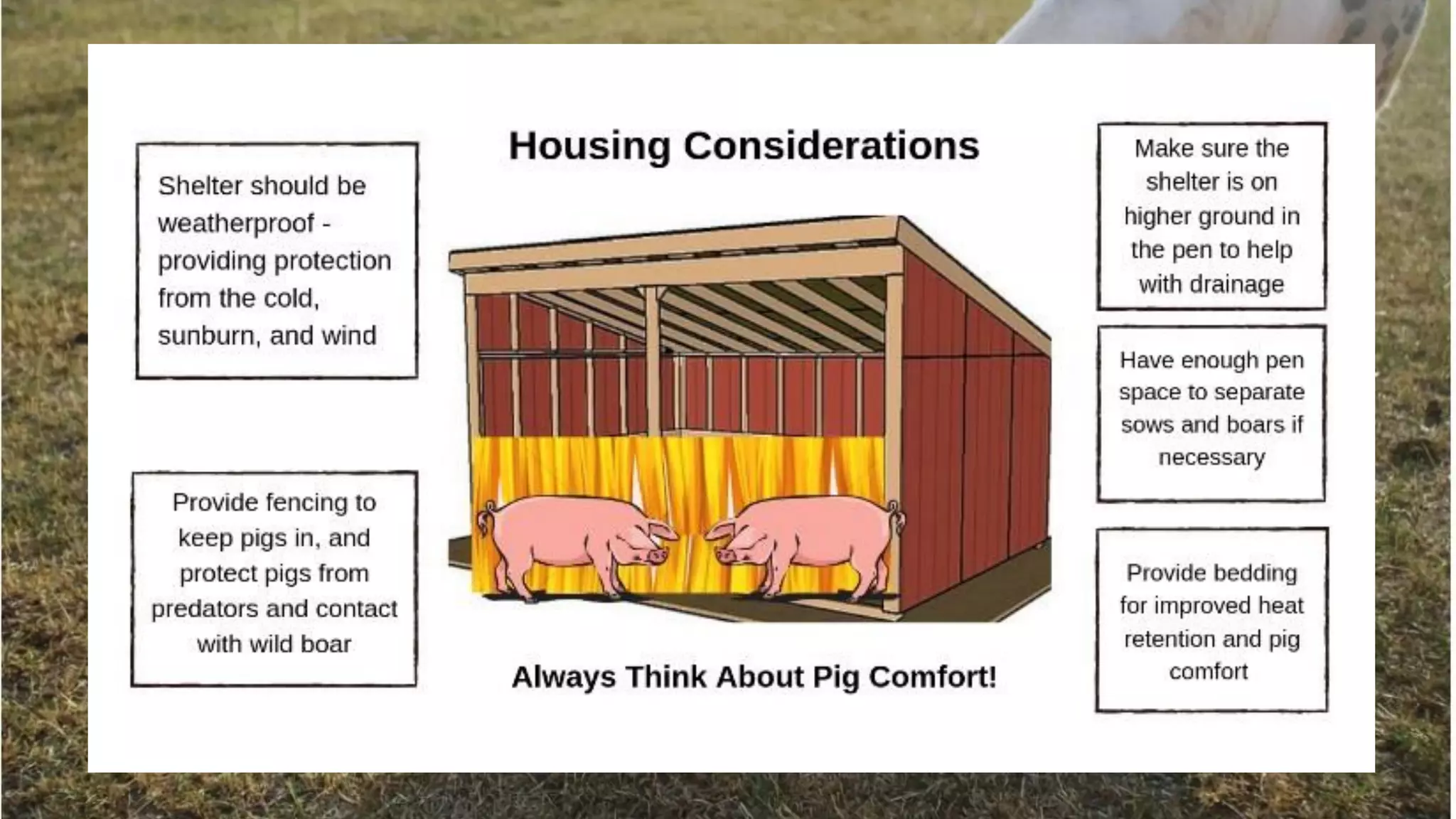
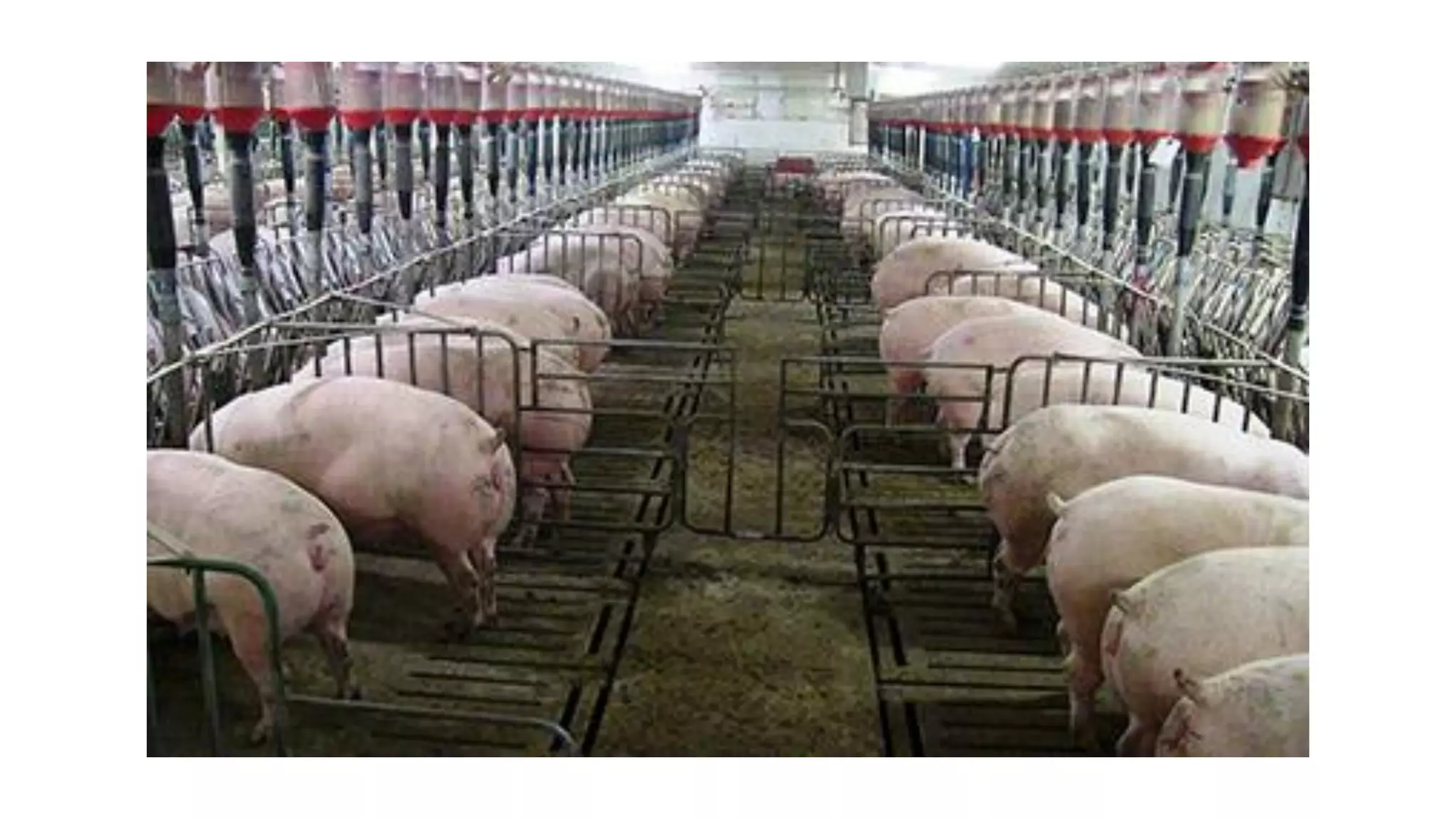
• Be careful when mixing gilts with mature sows and keep group
size at no more than five or six per pen.
• Avoid any stress-producing situation, especially during the first
three weeks after breeding.
• When gestating stalls are used, partially slatted floors behind
the sow are recommended to ensure a dry area for the sow
and to reduce cleaning time
• The edges of the stats should be rounded to avoid damage to
feet or teats.
• In a penning station, allow about 1.85 m2 per bred sow or gilt.
• Stall measurement of about 0.5x2.13 m are recommended.
Feeding Level
•Normally, 1.8 to 2.3 kg of balanced 14 percent crude
protein ration will meet the daily nutrient
requirements and free of heavy parasite infestation.
Feeding in the Sow in the Late pregnancy
• The growth of the developing embryos increases rapidly in
the final third of pregnancy.
• Also at this time, the transfer of nutrients from the dam to
the fetus increases gradually and retention in the uterus
and mammary glands develop accordingly.
The greater demand for feed in the last trimester of
pregnancy can be satisfied by increasing the level of feeding
to at least 15 percent level of 2.0 kg for primigestation and
light multigestation sows, and 10% for the fully grown or
heavy multigestation sows.
Management during the FARROWING
• Farrowing period and the first weeks of lactation are
critical in swine production.
Basic Farrowing
• Continues farrowing: sows to farrow are see through
facility in a continues flow with no break for total room
sanitation.
• All in, All out batch farrowing system: groups of sows due
to farrow during the week are brought into individual
rooms over a short time period.
Management during the FARROWING
• Farrowing period and the first weeks of lactation are
critical in swine production.
Pre-Farrowing Operations
• Preparing the Farrowing Quarters: Thoroughly clean the
whole farrowing room or area.
• Wash Sow: Before placing the sow in the farrowing unit,
thoroughly wash her with a mild soap solution and rinse
with warm water.
Management during the FARROWING
Pre-Farrowing Operations
• Transferring Sows: to acquaint sows with their new
surroundings, place them in the farrowing until 5 to 7 days
before expected date of farrowing.
• Parasite Control: Deworm sows 10 to 14 days before
transferring them to the farrowing stalls.
• Feeding the sow Prior to farrowing: Constipation of the
sow at farrowing is a condition which needs to be kept
under control. Constipation can be avoided or corrected by
feeding the sow a bulky or laxative diet one week before
she is due to farrow.
FARROWING
A. Signs of farrowing
 she is restless, nervous and often bites the wall or stall
partition
 she starts built a nest
 there is distinct swelling of the mammary apparatus.
 there is slackening of the abdominal wall.
 Milk let – down: the presence of milk when the tests
are stripped indicates that the sow will farrow within 24
hours.
FARROWING
B. Supervised farrowing
 The need for an attendant: the care and attention given
to the piglets from the time they are farrowed until they
weaned are very important. An attendant should be
presented to assists the newly born pigs and the sow if
necessary.
Reasons:
• reduced stillborn pigs prevent predators
• minimize crushing avoid cannibalism
• prevent starvation minimize dystocia
(difficulty in giving birth
Causes of Difficulty on Birth
• lack of uterine intetia – 37%
• fetal impression – 35.5%
• obstruction of the birth canal – 13.0%
• deviation of the uterus – 9.5%
• Hysteria – 3%
• Oversized fetus – 4%
Management after FARROWING
Average Daily Gain
ADG = Final weight – initial weight
Number of feeding days
Feed Efficiency (Feed Conversion Ratio)
FE = Amount of feed consumed
Gain in weight
Lower FE, better performance
Health Care
• Inspect the sow’s mammary apparatus for congestion,
inflammation, laceration and other forms of injuries. If
these are presented watch out for MMA syndrome.
• Metritis (Inflammation or infection of the uterus)
• Mesatitis (Inflammation of the udder)
• Agalactica (Inadequate supply of milk)
Immediately after weaning the multiparous sows should
be vaccinated against hog cholera at least twice a year.
Feeding during LACTATION
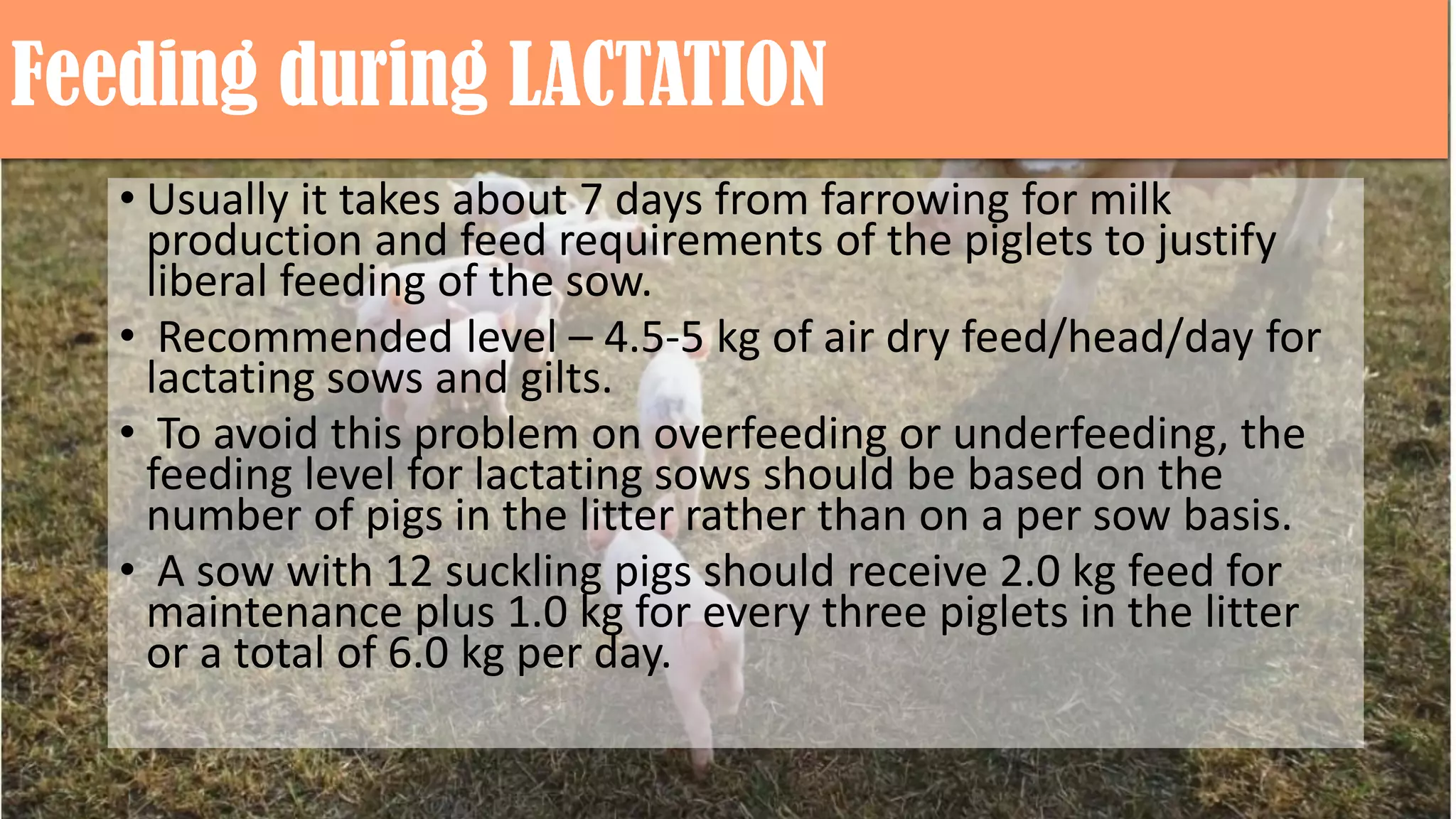
• Usually it takes about 7 days from farrowing for milk
production and feed requirements of the piglets to justify
liberal feeding of the sow.
• Recommended level – 4.5-5 kg of air dry feed/head/day for
lactating sows and gilts.
• To avoid this problem on overfeeding or underfeeding, the
feeding level for lactating sows should be based on the
number of pigs in the litter rather than on a per sow basis.
• A sow with 12 suckling pigs should receive 2.0 kg feed for
maintenance plus 1.0 kg for every three piglets in the litter
or a total of 6.0 kg per day.
REFERENCES:
• Green Empire Licensure Examination Reviewer
• https://www.pig333.com/articles/preparing-the-gilts-
production_13428/
• https://www.youtube.com/watch?v=Co5EGCPMT8A
• https://www.albertapork.com/our-producer-
services/quality-assurance-and-animal-care/small-
scale-production/
• https://www.youtube.com/watch?v=CfmsgC87GQA
Care and management sow and gilts

Care and management sow and gilts

  • 1.
  • 2.
    Prior to Pregnancy •under good management/sows have tremendous capability to produce 2.3 liters per year or over 20 pigs annually.
  • 3.
    Raising and SelectingReplacement Gilts • a steady supply of replacement gilts is required to replace sows, which die or are culled because of poor performance. • plan to replace 40 to 55 percent of your herd annually, if your herd age is five litters or less.
  • 4.
    Management of thedeveloping GILTS • raise potentials gilt replacement in all female group in dry, well-ventilated pens that provide 0.56 to 0.74 m2 of floor space per animal.
  • 5.
    Pre-Service Management ofReplacement of GILT A. Flushing • increasing the daily feed intake of gilts by 0.5 kg to 1.0 kg for 10 to 14 days before service should increase. The number of eggs ovulated if they were limit fed per kg per day before flushing. • A better practice is to self-feed the gilts with a 14% protein gestation ration throughout the pre- service period.
  • 6.
    Pre-Service Management ofReplacement of GILT B. Recommendations at First Breeding • breed gilt at eight months and at 110-120 kg. • Gilts should have their first litter at one-year age. • It is further recommended that gilt be bred on the second heat cycles when the animal is standing heat.
  • 7.
    Management at Breedingtime Developing a Breeding Schedule • Determine adequate boar power by considering the number of services required per week, not the number of sows and boar. • Each sow should be served twice. Boars that serve twice in a day with a day rest between breeding, an allowance should be made for one boar a sow during the week.
  • 8.
    Mating System •Mating systemvary as to amount of labor involved, ease of obtaining accurate breeding records and facility requirements. 1. Artificial Insemination 2. Hand Mating  this is preferred mating system.  the operator checks for heat and takes the female in heat to the boar.
  • 10.
    Advantages of Handmating • The operator knows for certain that the females were bred • Accurate breeding dates can be recorded. • The operator can accurately check for return to heat • Boar use is regulated • Anestrus problems can be determined earlier • A more accurate sire breeding performance can be calculated. • Fewer boars are required for the same number of females. Note: the main disadvantages are that more labor and closer observation are required.
  • 11.
    Mating System 3. Pen-mating– a boar runs with a group of females • although less labor intensive more boar can handle 8 to 10 females in a 21-day breeding period. • a young boar (8 to 12 months) can effectively service from four to six sows in the same period. Note: the main disadvantage of pen-mating is that record of breeding dates, boar services rate and female return to heat dates are often unknown expert when the headsman observes a mating.
  • 12.
    Heat Detection • Properand accurate heat detection is important for a successful mating system. A. Physical Signs  vulva maybe swollen and red  clear viscous vaginal discharges  restless and grunting  mounting behavior  frequent attempts to urinate with little or not discharge
  • 13.
    Heat Detection B. Techniques Haunch-PressureTest: the operator should approach the sow from behind and rub her sides and thigh. Riding-the-back-test: this technique is applied by riding or merely pressing the back of the animal. Semen-on-the-snout test: this test is particularly important in artificial insemination although it can be applied in natural breeding. Teaser boar: Allowing a boar but preferably one that has been vasectomized to mount the sow. Sound Test: use of chomping sounds of the boar.
  • 14.
    The Estrus cycleranges from 17 to 24 days, with an average of 21 days. Estrus cycle is continuously manifested by the individual unless interrupted by pregnancy. Estrous = cycle Estrus = phase in the estrous cycle when a female is sexually receptive, “in heat”.
  • 16.
    Management during GESTATION •Thenormal gestation length of the swine is 114 days with a range of 109 to 119 days. Or simply put, 3 months, 3 weeks and 3 days.
  • 17.
    Housing and Environment •Be careful when mixing gilts with mature sows and keep group size at no more than five or six per pen. • Avoid any stress-producing situation, especially during the first three weeks after breeding. • When gestating stalls are used, partially slatted floors behind the sow are recommended to ensure a dry area for the sow and to reduce cleaning time • The edges of the stats should be rounded to avoid damage to feet or teats. • In a penning station, allow about 1.85 m2 per bred sow or gilt. • Stall measurement of about 0.5x2.13 m are recommended.
  • 20.
    Feeding Level •Normally, 1.8to 2.3 kg of balanced 14 percent crude protein ration will meet the daily nutrient requirements and free of heavy parasite infestation.
  • 21.
    Feeding in theSow in the Late pregnancy • The growth of the developing embryos increases rapidly in the final third of pregnancy. • Also at this time, the transfer of nutrients from the dam to the fetus increases gradually and retention in the uterus and mammary glands develop accordingly. The greater demand for feed in the last trimester of pregnancy can be satisfied by increasing the level of feeding to at least 15 percent level of 2.0 kg for primigestation and light multigestation sows, and 10% for the fully grown or heavy multigestation sows.
  • 22.
    Management during theFARROWING • Farrowing period and the first weeks of lactation are critical in swine production. Basic Farrowing • Continues farrowing: sows to farrow are see through facility in a continues flow with no break for total room sanitation. • All in, All out batch farrowing system: groups of sows due to farrow during the week are brought into individual rooms over a short time period.
  • 23.
    Management during theFARROWING • Farrowing period and the first weeks of lactation are critical in swine production. Pre-Farrowing Operations • Preparing the Farrowing Quarters: Thoroughly clean the whole farrowing room or area. • Wash Sow: Before placing the sow in the farrowing unit, thoroughly wash her with a mild soap solution and rinse with warm water.
  • 24.
    Management during theFARROWING Pre-Farrowing Operations • Transferring Sows: to acquaint sows with their new surroundings, place them in the farrowing until 5 to 7 days before expected date of farrowing. • Parasite Control: Deworm sows 10 to 14 days before transferring them to the farrowing stalls. • Feeding the sow Prior to farrowing: Constipation of the sow at farrowing is a condition which needs to be kept under control. Constipation can be avoided or corrected by feeding the sow a bulky or laxative diet one week before she is due to farrow.
  • 25.
    FARROWING A. Signs offarrowing  she is restless, nervous and often bites the wall or stall partition  she starts built a nest  there is distinct swelling of the mammary apparatus.  there is slackening of the abdominal wall.  Milk let – down: the presence of milk when the tests are stripped indicates that the sow will farrow within 24 hours.
  • 26.
    FARROWING B. Supervised farrowing The need for an attendant: the care and attention given to the piglets from the time they are farrowed until they weaned are very important. An attendant should be presented to assists the newly born pigs and the sow if necessary. Reasons: • reduced stillborn pigs prevent predators • minimize crushing avoid cannibalism • prevent starvation minimize dystocia (difficulty in giving birth
  • 27.
    Causes of Difficultyon Birth • lack of uterine intetia – 37% • fetal impression – 35.5% • obstruction of the birth canal – 13.0% • deviation of the uterus – 9.5% • Hysteria – 3% • Oversized fetus – 4%
  • 28.
    Management after FARROWING AverageDaily Gain ADG = Final weight – initial weight Number of feeding days Feed Efficiency (Feed Conversion Ratio) FE = Amount of feed consumed Gain in weight Lower FE, better performance
  • 29.
    Health Care • Inspectthe sow’s mammary apparatus for congestion, inflammation, laceration and other forms of injuries. If these are presented watch out for MMA syndrome. • Metritis (Inflammation or infection of the uterus) • Mesatitis (Inflammation of the udder) • Agalactica (Inadequate supply of milk) Immediately after weaning the multiparous sows should be vaccinated against hog cholera at least twice a year.
  • 30.
    Feeding during LACTATION •Usually it takes about 7 days from farrowing for milk production and feed requirements of the piglets to justify liberal feeding of the sow. • Recommended level – 4.5-5 kg of air dry feed/head/day for lactating sows and gilts. • To avoid this problem on overfeeding or underfeeding, the feeding level for lactating sows should be based on the number of pigs in the litter rather than on a per sow basis. • A sow with 12 suckling pigs should receive 2.0 kg feed for maintenance plus 1.0 kg for every three piglets in the litter or a total of 6.0 kg per day.
  • 32.
    REFERENCES: • Green EmpireLicensure Examination Reviewer • https://www.pig333.com/articles/preparing-the-gilts- production_13428/ • https://www.youtube.com/watch?v=Co5EGCPMT8A • https://www.albertapork.com/our-producer- services/quality-assurance-and-animal-care/small- scale-production/ • https://www.youtube.com/watch?v=CfmsgC87GQA