
POULTRY PRODUCTION
Management
Margie Lumanggaya-Bibat, MSA
Poultry
REPRODUCTION SYSTEM
MLBibat2020
2
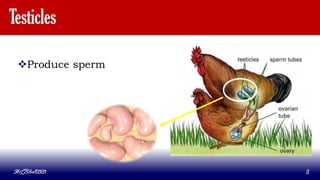
Testicles
Produce sperm
MLBibat2020 3
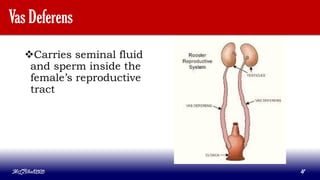
Vas Deferens
Carries seminal fluid
and sperm inside the
female’s reproductive
tract
MLBibat2020 4
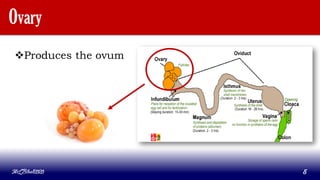
Ovary
Produces the ovum
MLBibat2020 5
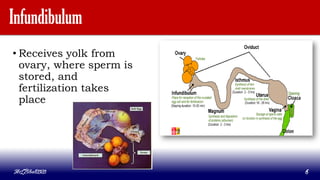
Infundibulum
• Receives yolk from
ovary, where sperm is
stored, and
fertilization takes
place
MLBibat2020 6
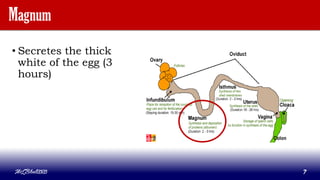
Magnum
• Secretes the thick
white of the egg (3
hours)
MLBibat2020 7
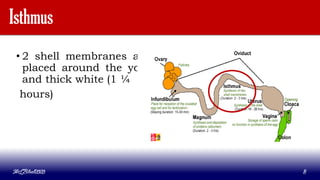
Isthmus
• 2 shell membranes are
placed around the yolk
and thick white (1 ¼
hours)
MLBibat2020 8
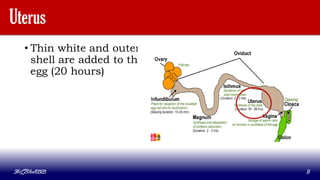
Uterus
• Thin white and outer
shell are added to the
egg (20 hours)
MLBibat2020 9
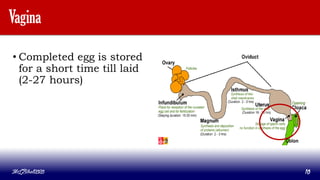
Vagina
• Completed egg is stored
for a short time till laid
(2-27 hours)
MLBibat2020 10
Environmental requirements to
hatch chicken eggs
MLBibat2020 11
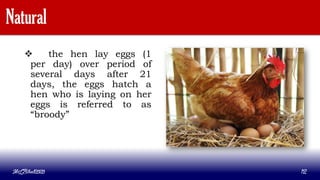
Natural
 the hen lay eggs (1
per day) over period of
several days after 21
days, the eggs hatch a
hen who is laying on her
eggs is referred to as
“broody”
MLBibat2020 12
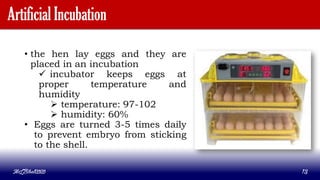
Artificial Incubation
• the hen lay eggs and they are
placed in an incubation
 incubator keeps eggs at
proper temperature and
humidity
 temperature: 97-102
 humidity: 60%
• Eggs are turned 3-5 times daily
to prevent embryo from sticking
to the shell.
MLBibat2020 13
Selection of
Hatching Eggs
MLBibat2020 14
Grading Exterior Quality
1-Cleanliness – shell should be free of debts or
organic matter
2-Shape – small end and large end. Not round or
oblong
3-Soundness-no cracks
4-size-not very small nor extremely large
MLBibat2020 15
Grading Interior Quality
1-Air cell
2-Viscosity of Albumen (white)
3-Check for abnormalities (Blood/Meat Spots,
cracks or leaks in shell)
MLBibat2020 16
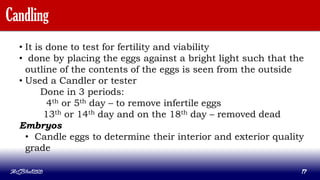
Candling
• It is done to test for fertility and viability
• done by placing the eggs against a bright light such that the
outline of the contents of the eggs is seen from the outside
• Used a Candler or tester
Done in 3 periods:
4th or 5th day – to remove infertile eggs
13th or 14th day and on the 18th day – removed dead
Embryos
• Candle eggs to determine their interior and exterior quality
grade
MLBibat2020 17
Brooding
MANAGEMENT
MLBibat2020 18
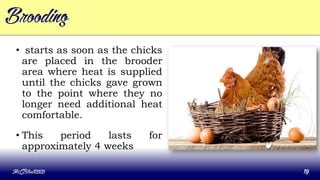
Brooding
• starts as soon as the chicks
are placed in the brooder
area where heat is supplied
until the chicks gave grown
to the point where they no
longer need additional heat
comfortable.
• This period lasts for
approximately 4 weeks
MLBibat2020 19
Types of Brooder
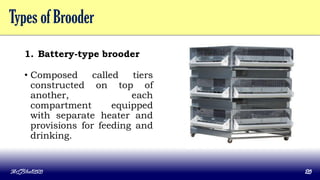
1. Battery-type brooder
• Composed called tiers
constructed on top of
another, each
compartment equipped
with separate heater and
provisions for feeding and
drinking.
MLBibat2020 20
Types of Brooder
2. Cage Brooder
• Can be evaluated slatted-
floor or litter-floor type with
capacity varying from few to
several hundreds
MLBibat2020 21
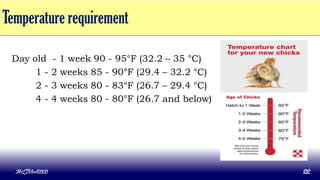
Temperature requirement
Day old - 1 week 90 - 95°F (32.2 – 35 °C)
1 - 2 weeks 85 - 90°F (29.4 – 32.2 °C)
2 - 3 weeks 80 - 83°F (26.7 – 29.4 °C)
4 - 4 weeks 80 - 80°F (26.7 and below)
MLBibat2020 22
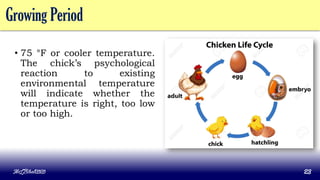
Growing Period
• 75 °F or cooler temperature.
The chick’s psychological
reaction to existing
environmental temperature
will indicate whether the
temperature is right, too low
or too high.
MLBibat2020 23
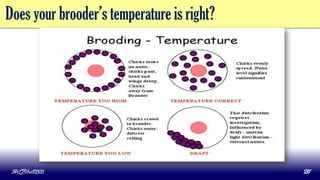
Does your brooder’s temperature is right?
MLBibat2020 24
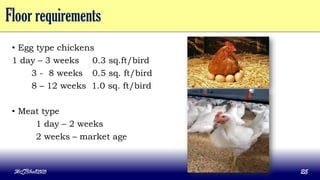
Floor requirements
• Egg type chickens
1 day – 3 weeks 0.3 sq.ft/bird
3 - 8 weeks 0.5 sq. ft/bird
8 – 12 weeks 1.0 sq. ft/bird
• Meat type
1 day – 2 weeks
2 weeks – market age
MLBibat2020 25
Sources of heat for brooders
• Electricity
• LPG (liquefied petroleum gas)
• Infrared lamp
• Charcoal
MLBibat2020 26
House features
• Construction materials
 Bamboo slats, nipa shingles, coco lumber
 GI sheets, aluminum sheet, wood, welded wire,
plastic nets
• Shape
 long and narrow with east-west orientation
• Width
 10 to 12 meters
• Height
 floor height (1.8 m or 5.9 ft.)
 floor to ceiling (2.4 m or 8 ft.)
MLBibat2020 27
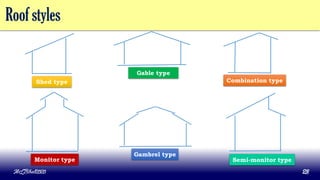
Roof styles
MLBibat2020 28
Shed type Combination type
Gable type
Monitor type Semi-monitor type
Gambrel type
Light requirement
• light management is very important in the
development of new layers.
• The correct light to dark ratio in the rearing house
will influence the production of larger eggs.
• During the first few days of brooding, lighting the
chicks throughout the night (24 hours light) is
favorable for growth because there is eating time if
food is available.
• The light in the brooder will encourage the birds to
keep close to source of heat, feed and water.
MLBibat2020 29
One cardinal rule
• Never increase light
growing period and
never decrease light
during the laying
period.
MLBibat2020 30
• Increasing day length (light) during the growing
period of birds will hasten their sexual maturity,
which will result, to production of more pullet
eggs (small eggs), layers are prone to prolapsed
and shorter egg production cycle.
• Under local conditions where there is only slight
variation day length, it is recommended day must
not exceed 11-12 hours during the growing stage
(4-16 weeks) of the developing pullet.
MLBibat2020 31
Feeds, Feeding and Watering
• the availability of drinking water to the chicks
must be emphasized.
• the addition of 5-10% of sugar in the drinking
water can be done for the first 6-8 hours during
the arrival of the day-old chick (DOC).
• Supplementation of water-soluble vitamin-
mineral antibiotic preparation can give the chicks
a good start too.
MLBibat2020 32
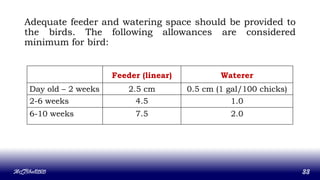
Adequate feeder and watering space should be provided to
the birds. The following allowances are considered
minimum for bird:
MLBibat2020 33
Feeder (linear) Waterer
Day old – 2 weeks 2.5 cm 0.5 cm (1 gal/100 chicks)
2-6 weeks 4.5 1.0
6-10 weeks 7.5 2.0
Vaccination, Medication and Debeaking
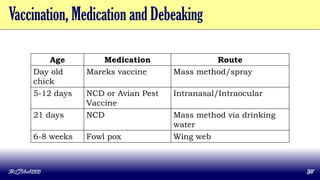
Age Medication Route
Day old
chick
Mareks vaccine Mass method/spray
5-12 days NCD or Avian Pest
Vaccine
Intranasal/Intraocular
21 days NCD Mass method via drinking
water
6-8 weeks Fowl pox Wing web
MLBibat2020 34
Cannibalism among growing chickens
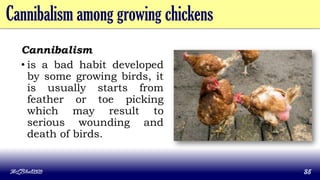
Cannibalism
• is a bad habit developed
by some growing birds, it
is usually starts from
feather or toe picking
which may result to
serious wounding and
death of birds.
MLBibat2020 35
The possible causes of cannibalism are:
1) Imbalanced ration – a high energy diet with low
protein leads to this problem.
2) Overcoming and insufficiency of feeding and
drinking space
3) Extended period without feed and water
4) Poor ventilation
5) Excessive heat and too much light
6) It may also be a strain characteristics
MLBibat2020 36
Factor affecting length of brooding period
• Weather/climatic conditions – longer during
cold and rainy months, shorter during dry and
warm months.
• Rate of feathering – shorter for fast feathering
breeds/varieties/strains, longer for slow
feathering: can be due to genetic make-up or
nutrition of the birds.
MLBibat2020 37
Growing
MANAGEMENT
MLBibat2020 38
System of Rearing
• Range System
• Semi-confinement system
• Complete-confinement
MLBibat2020 39
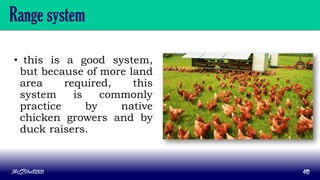
Range system
• this is a good system,
but because of more land
area required, this
system is commonly
practice by native
chicken growers and by
duck raisers.
MLBibat2020 40
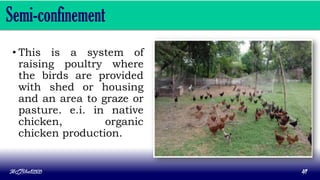
Semi-confinement
• This is a system of
raising poultry where
the birds are provided
with shed or housing
and an area to graze or
pasture. e.i. in native
chicken, organic
chicken production.
MLBibat2020 41
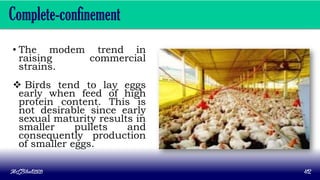
Complete-confinement
• The modem trend in
raising commercial
strains.
 Birds tend to lay eggs
early when feed of high
protein content. This is
not desirable since early
sexual maturity results in
smaller pullets and
consequently production
of smaller eggs.
MLBibat2020 42
Rearing of Pullets
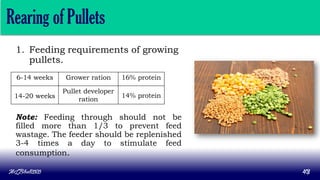
1. Feeding requirements of growing
pullets.
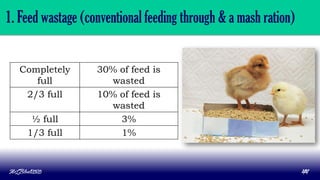
Note: Feeding through should not be
filled more than 1/3 to prevent feed
wastage. The feeder should be replenished
3-4 times a day to stimulate feed
consumption.
MLBibat2020 43
6-14 weeks Grower ration 16% protein
14-20 weeks
Pullet developer
ration
14% protein
1. Feed wastage (conventional feeding through & a mash ration)
Completely
full
30% of feed is
wasted
2/3 full 10% of feed is
wasted
½ full 3%
1/3 full 1%
MLBibat2020 44
• Change in appearance of the secondary
sexual characters.
 Comb and wattles begin to
increase in size and the color
becomes red.
 Pullets become friendly and cackle
 Pullets instinctively looks for nest
 Pullets become docile (easily
manage) and gregarious (sociable)
 The vent and abdomen become
enlarge.
MLBibat2020 45
2. Signs of Sexual maturity
Note: the surest sign of sexual
maturity is the laying of the 1st
egg.
Layer Flock
MANAGEMENT
MLBibat2020 46
• Range system
• Semi-confinement
• Complete confinement
Please see slide 40-42 for the definition
MLBibat2020 47
Systems of rearing of layer flocks
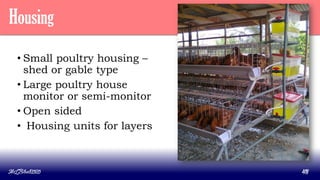
Housing
• Small poultry housing –
shed or gable type
• Large poultry house
monitor or semi-monitor
• Open sided
• Housing units for layers
MLBibat2020 48
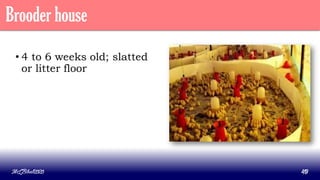
Brooder house
• 4 to 6 weeks old; slatted
or litter floor
MLBibat2020 49
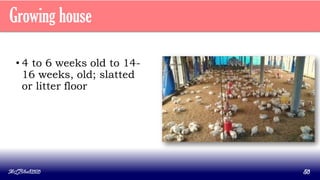
Growing house
• 4 to 6 weeks old to 14-
16 weeks, old; slatted
or litter floor
MLBibat2020 50
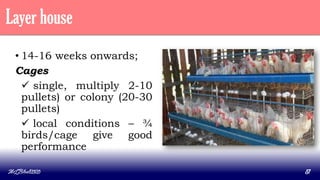
Layer house
• 14-16 weeks onwards;
Cages
 single, multiply 2-10
pullets) or colony (20-30
pullets)
 local conditions – ¾
birds/cage give good
performance
MLBibat2020 51
Daily routine of work in the layer house
A. Feeding
• Layers must be fed a
dietary composition
referred to as layer ration
or breeder ration.
• layer ration will
generally contain a 15-
18% protein level
MLBibat2020 52
• Day-old six weeks old – chicks starter mash (20% CP)
• Six to twelve weeks old – grower feeds; 16% CP
• Twelve to 18 weeks old – developer feeds; 14% CP
• 18 to 42 weeks old – layer 1 feed; 18% CP
• 42 weeks to culling – layer 2 feeds; 17% CP
Note: Mature laying hens will consume about as low as
90 grams to as high as 140 grams a day.
One year consumption varies from 40 to 42 kilos per
layer
MLBibat2020 53
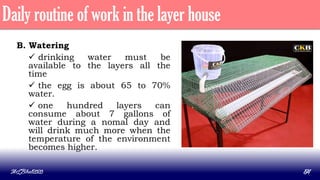
B. Watering
 drinking water must be
available to the layers all the
time
 the egg is about 65 to 70%
water.
 one hundred layers can
consume about 7 gallons of
water during a nomal day and
will drink much more when the
temperature of the environment
becomes higher.
MLBibat2020 54
Daily routine of work in the layer house
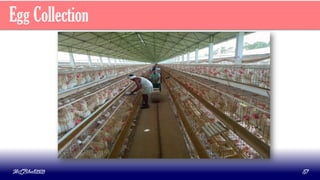
C. Egg collection
 they are capable of laying one a day but it is
next to impossible to realize one-egg-one-day
for long period of time.
 they are expected to skip some days in egg
production.
 Oviposition ( the act of egg laying) takes
place normally as early as 7:00 am as late as
4:00 pm
MLBibat2020 55
Daily routine of work in the layer house
MLBibat2020 56
Daily routine of work in the layer house
C. Egg collection
 majority of hens lay their egg b/w 10:00 am to
2:00 pm
 the concentration of egg laying takes place
before noon as a common observation.
* Egg must be collected in wire baskets to provide
good air circulation
Egg Collection
MLBibat2020 57
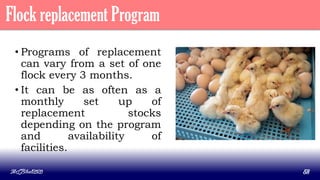
Flock replacement Program
• Programs of replacement
can vary from a set of one
flock every 3 months.
• It can be as often as a
monthly set up of
replacement stocks
depending on the program
and availability of
facilities.
MLBibat2020 58
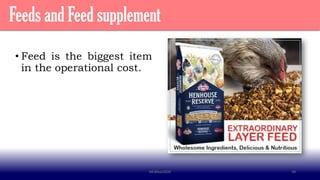
Feeds and Feed supplement
• Feed is the biggest item
in the operational cost.
MLBibat2020 59
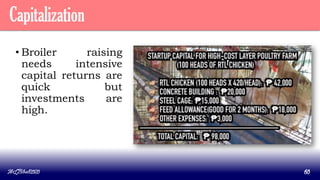
Capitalization
• Broiler raising
needs intensive
capital returns are
quick but
investments are
high.
MLBibat2020 60
REFERENCES
• Green Empire Licensure Examination Reviewer for
Agriculturist
• http://www.clovegarden.com/ingred/bd_chknutz.html
• https://www.vcbio.science.ru.nl/en/virtuallessons/embryolo
gy/chicken/
• https://www.mdpi.com/2306-7381/4/4/66/htm
• https://theconversation.com/curious-kids-why-do-hens-still-
lay-eggs-when-they-dont-have-a-mate-104077
• https://www.backyardchickencoops.com.au/blogs/learning-
centre/how-to-deal-with-a-broody-hen
• https://www.strombergschickens.com/category/battery-
brooders
MLBibat2020 61
• https://www.galleon.ph/appliances-c863/farm-ranch-
c13436/chicken-amp-quail-brooder-chick-cage-poultry-
p39016238
• https://www.purinamills.com/chicken-
feed/education/detail/caring-for-baby-chicks-what-to-do-
once-they-arrive
• https://www.123rf.com/photo_105060293_stock-vector-
science-chicken-life-cycle-vector-illustration.html
• https://www.scielo.br/scielo.php?pid=S1516-
635X2019000200341&script=sci_arttext
• https://www.pakissan.com/2017/02/04/poultry-housing-
systems/
• https://www.theprairiehomestead.com/2016/06/homemade-
chicken-feed-recipe.html
MLBibat2020 62
REFERENCES
• https://www.storey.com/article/chick-care-feeding-watering-
dos-donts/
• https://www.freedomrangerhatchery.com/blog/choosing-the-
right-chickens-to-start-your-flock/
• https://www.bigstockphoto.com/image-264235351/stock-
photo-%28noise-and-blur-some-chicken%29
• https://poultryfeedformulation.com/how-to-choose-the-best-
chicken-breeds-for-your-poultry-business/
• http://thepoultryguide.com/poultry-farming-in-china/
• https://www.chinachickencage.com/chicken-
cage/341.html?1548828248=
MLBibat2020 63
REFERENCES
• https://www.youtube.com/watch?v=7MlitVqKquQ
• https://www.google.com/url?sa=i&url=https%3A%2F%2Fm.youtube.c
om%2Fwatch%3Fv%3DOuInNjPnnWM&psig
• https://www.thehappychickencoop.com/chicken-diseases/
• https://silverlakefarms.com/how-many-eggs-does-a-chicken-lay-in-a-
year/
• https://www.pinterest.ph/pin/162270392793726201/
MLBibat2020 64
REFERENCES
Thank You
MLBibat2020 65
STUDENT LEARNING ACTIVITIES
• Situational Analysis
Mr. Albu’s farm is situated in a hilly terrain about 3.2
kilometers from the town proper. He has about 15 head of
ready-to-lay native and Hampshire hens. 3 roosters and
around 2 dozens of chicks. The old poultry house made of
nipa built about 6 years ago showed signs of being toppled
down.
Five kilometers to the east of the farm is a hill where
cogon grass grows abundantly and a friend nearby has a half
hectare of mature bamboo. On the other hand, hardware
stores in town sell G.I. sheets and cement for construction
purposes.
MLBibat2020 66
Mr Albu has a hard time deciding whether to use G.I.
sheets and lumber in repairing his old poultry house or avail of
the free cogon and buy a number of bamboo from his friend.
Furthermore, Mr.Abu also had no plans of increasing the
number of his stock but is instead content of maintaining the
status quo.
Questions:
1. What will you suggest to Mr. Albu regarding his plans of
repairing his poultry house?
2. What equipment are needed in different poultry enterprises?
3. What are the factors to consider in putting up buildings for
poultry?
MLBibat2020 67
STUDENT LEARNING ACTIVITIES