Chapter 5
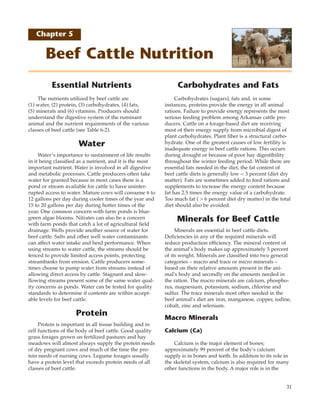
Beef Cattle Nutrition

Essential Nutrients
The nutrients utilized by beef cattle are
(1) water, (2) protein, (3) carbohydrates, (4) fats,
(5) minerals and (6) vitamins. Producers should
understand the digestive system of the ruminant
animal and the nutrient requirements of the various
classes of beef cattle (see Table 6-2).
Water
Water’s importance to sustainment of life results
in it being classified as a nutrient, and it is the most
important nutrient. Water is involved in all digestive
and metabolic processes. Cattle producers often take
water for granted because in most cases there is a
pond or stream available for cattle to have uninter-
rupted access to water. Mature cows will consume 6 to
12 gallons per day during cooler times of the year and
15 to 20 gallons per day during hotter times of the
year. One common concern with farm ponds is blue-
green algae blooms. Nitrates can also be a concern
with farm ponds that catch a lot of agricultural field
drainage. Wells provide another source of water for
beef cattle. Salts and other well water contaminants
can affect water intake and herd performance. When
using streams to water cattle, the streams should be
fenced to provide limited access points, protecting
streambanks from erosion. Cattle producers some-
times choose to pump water from streams instead of
allowing direct access by cattle. Stagnant and slow-
flowing streams present some of the same water qual-
ity concerns as ponds. Water can be tested for quality
standards to determine if contents are within accept-
able levels for beef cattle.
Protein
Protein is important in all tissue building and in
cell functions of the body of beef cattle. Good quality
grass forages grown on fertilized pastures and hay
meadows will almost always supply the protein needs
of dry pregnant cows and much of the time the pro-
tein needs of nursing cows. Legume forages usually
have a protein level that exceeds protein needs of all
classes of beef cattle.
Carbohydrates and Fats
Carbohydrates (sugars), fats and, in some
instances, proteins provide the energy in all animal
rations. Failure to provide energy represents the most
serious feeding problem among Arkansas cattle pro-
ducers. Cattle on a forage-based diet are receiving
most of their energy supply from microbial digest of
plant carbohydrates. Plant fiber is a structural carbo-
hydrate. One of the greatest causes of low fertility is
inadequate energy in beef cattle rations. This occurs
during drought or because of poor hay digestibility
throughout the winter feeding period. While there are
essential fats needed in the diet, the fat content of
beef cattle diets is generally low < 3 percent (diet dry
matter). Fats are sometimes added to feed rations and
supplements to increase the energy content because
fat has 2.5 times the energy value of a carbohydrate.
Too much fat ( > 6 percent diet dry matter) in the total
diet should also be avoided.
Minerals for Beef Cattle
Minerals are essential in beef cattle diets.
Deficiencies in any of the required minerals will
reduce production efficiency. The mineral content of
the animal’s body makes up approximately 5 percent
of its weight. Minerals are classified into two general
categories – macro and trace or micro minerals –
based on their relative amounts present in the ani-
mal’s body and secondly on the amounts needed in
the ration. The macro minerals are calcium, phospho-
rus, magnesium, potassium, sodium, chlorine and
sulfur. The trace minerals most often needed in the
beef animal’s diet are iron, manganese, copper, iodine,
cobalt, zinc and selenium.
 
Macro Minerals
Calcium (Ca)
Calcium is the major element of bones;
approximately 99 percent of the body’s calcium
supply is in bones and teeth. In addition to its role in
the skeletal system, calcium is also required for many
other functions in the body. A major role is in the
31
muscle contraction process. Calcium is usually present
in adequate amounts in forage and is quite high in
legume plants; however, calcium may be limited in
feedlot rations as grains and most by-product feed-
stuffs are low in calcium.
 
Phosphorus (P)
Approximately 80 percent of the body’s supply of
phosphorus is in the skeleton and teeth. In addition to
its obvious role in these areas, phosphorus has been
shown to be very important in absorption and trans-
port of various compounds within the body. It is also
involved in energy transfer. Because of this, phospho-
rus may be viewed as the most versatile mineral ele-
ment. A phosphorus deficiency is often characterized
by poor reproductive performance in beef cows.
Grains are considered to be moderate to high in phos-
phorus while forages usually contain low to moderate
amounts. Supplementation of phosphorus is often
needed in a grazing situation. The level of phosphorus
supplementation will be dependent upon forage
species and soil fertility. A forage test can help deter-
mine phosphorus supplementation needs. Certain
minerals must be kept in proper ratio to one another
in the ration because their roles in metabolism and
body functions are interrelated. For this reason, a Ca:P
ratio of 1:1 to 5:1 should normally be maintained.
Magnesium (Mg)
Magnesium is closely associated with calcium and
phosphorus in its distribution and metabolism in the
animal’s body. Under normal conditions, Mg is not a
problem; however, the condition “grass tetany” is
related to Mg deficiency. This is most likely to occur
with mature beef cows grazing lush spring pasture.
When there is risk of tetany, cattle producers will
often feed a high magnesium mineral. Feeding a high
magnesium mineral should start at least one month in
advance of the period tetany is most likely to occur.
Mineral mixes designed to help prevent grass tetany
usually contain 10 percent magnesium. In some situa-
tions, a custom feed mix may need to be formulated
to provide greater levels of magnesium than that
available in common mineral mixes.
Potassium (K)
Potassium is usually found in the intracellular
(within the cell) fluids. It functions primarily to main-
tain osmotic pressure within the cell, maintain proper
pH and the transfer of nutrients across the cell wall.
Forages usually contain excessive amounts of this
mineral, thus grazing cattle are not usually supple-
mented with K.
Sodium (Na) and Chlorine (Cl) (Salt)
Sodium (Na) and Chlorine (Cl), more commonly
known as salt, are used in the body to regulate
osmotic pressure in cells and contribute to buffering
systems. Sodium is also essential in the transmission
of nerve impulses. Cattle will normally consume more
than their requirements if given free access to either
loose salt or blocks. Since the storage of these two
elements in the body is rather limited, a regular
supply should be self-fed.
Salt is sometimes used as an intake limiter for a
self-feeding ration. In this situation, an abundant sup-
ply of fresh water is a must to prevent salt toxicity.
Trace Minerals
The level of trace minerals in the basic diet is
ignored many times in ration formulations and 100
percent of the animal’s requirements are added. This
is done because of the tremendous variability that
exists in the trace mineral composition of feeds and
the minimal cost involved in adding these elements to
the ration. Iodine, copper and selenium are all defi-
cient in many soils of the United States. Cobalt may
need to be supplied because of its role in the forma-
tion of vitamin B12 by rumen microorganisms.
Copper has been shown to be deficient in the coastal
plains region where heavy stocking rates and high
nitrogen fertilization have occurred. Arkansas forages
can be marginal in copper, and there are several
copper antagonist, including sulfur, molybdenum and
iron, that affect copper’s absorption. Supplementing
copper is recommended. Selenium deficiencies have
been found in fescue pastures in north Arkansas.
Trace mineral supplements are categorized as two
types: inorganic and organic. The common inorganics
include sulfates, oxides and chlorides. The bioavail-
ability of these are generally good with the exception
of copper and iron oxide. Copper oxide should be
avoided in free-choice mineral supplements. Organic
forms include elements bound to simple amino acids
or more complex organic structures. Organics often
have a greater bioavailability than inorganics; how-
ever, in mineral supplements they are seldom used as
the sole source of a trace mineral.
Vitamins for Beef Cattle
Pasture and average to excellent quality
roughages usually contain sufficient quantities of
32
the vitamins needed by beef cattle to support body
maintenance, production and reproduction. Beef
cattle may need vitamins A, D and E supplementation
where the forage supply consists of crop residue,
over-mature or weather-damaged hay or dry
winter forage.
Vitamins are classified as fat soluble or water
soluble. The water soluble vitamins include vitamin
C and the B vitamins. B vitamins are produced by
microbes during rumen fermentation and are seldom
deficient in beef cattle. Vitamin C is only needed in
the diets of humans, monkeys and guinea pigs.
The fat soluble vitamins include vitamins A, D, E
and K. Vitamin K is synthesized in the rumen under
most feeding conditions. Thus, the animal has little
need for supplemental K. Vitamins A, D and E are
routinely included in mineral mixes.
Vitamin A
Vitamin A is strictly a product of animal
metabolism. Its counterpart in plants is known as
carotene. The beef animal transforms carotene into
vitamin A. Cattle store vitamin A and carotene in the
liver and body fat during periods of abundant intake.
These periods occur when animals are grazing green
forage. The stored reserves may be adequate to meet
the animal’s needs for two to four months. Vitamin A
deficiencies may cause night blindness, watery eyes
and, in pregnant animals, abortions. Weak calves,
retained placentas and rebreeding problems may also
occur. If animals are on a prolonged diet of bleached
or weathered roughage, vitamin A stores may be
depleted from the body. This vitamin may be pro-
vided to the cow herd by injection, added to the min-
eral mix or in their regular ration. Pregnant cows that
are being fed low-carotene feeds should receive the
equivalent of 30,000 international units (IUs) of
vitamin A daily while lactating cows should receive
45,000 IUs.
Vitamin D
Beef cattle usually receive adequate amounts of
this vitamin by exposure to direct sunlight or through
consuming sun-cured forages. Vitamins D and E are
usually included with vitamin A supplements or injec-
tion solutions administered to cattle. Only cattle kept
indoors and not fed sun-cured hay are likely to show
symptoms of vitamin D deficiency.
Vitamin E
Under most conditions, natural feedstuffs supply
the requirements of vitamin E. Cereal grains, grain
forages and good quality hay are all excellent sources
of this vitamin. Vitamin E is usually added to mineral-
vitamin supplements because of its antioxidant prop-
erties which facilitate the uptake and storage of
Vitamin A.
Balancing Rations
Several terms used in balancing beef cattle
rations are:
Diet – The feed an animal receives in a 24-hour
period.
Ration – The feed an animal receives in a 24-hour
period.
Balanced Ration – A ration that furnishes the nutri-
ents needed in the proper amounts to allow the
individual to perform a certain function such as
maintenance, growth, gestation or lactation.
Dry Matter (DM) – The feed remaining after all water
is removed. Dry matter averages about 35 percent
in silages, 90 percent in No. 2 corn and 90 percent
in hay.
Supplement – A concentrate feed added to a ration to
provide one or more nutrients not adequately
supplied by the usual feed.
Nutrient – Any feed component or group of feed com-
ponents of similar chemical composition that aid
in the support of animal life. Protein, carbohy-
drates, fat, minerals and vitamins are examples.
Carbohydrate, fat and excess protein are all used
in the animal body as energy.
Total Digestible Nutrients (TDN) – A term used as a
measure of energy (caloric content of feedstuffs).
On an as-fed basis, grains usually contain 65 to 80
percent TDN, hays usually 50 percent and less,
and silages about 20 percent.
Crude Protein – The crude protein content of a feed is
determined by analyzing the feed for nitrogen.
Protein in a feed contains approximately 16 per-
cent nitrogen; therefore, multiplying N by 6.25
gives the total protein content of the feed.
33
Since purchased feeds are usually expensive,
home-raised forages should supply the major source
of nutrients needed by beef cattle. Purchased supple-
ments, whether for energy or protein, should be fed
only to supply those nutrients not furnished by home-
grown forages. Forage and grain diets almost always
need to be supplemented with minerals for maximum
production.
To formulate a balanced ration, you should know
(1) the nutrient requirements of the beef cattle to be
fed and (2) the nutritive value of feedstuffs available.
Table 6-2 gives a partial listing of the National
Research Council’s (NRC) nutrient requirements of
beef cattle.
Average composition values of Arkansas-
produced feeds are presented in Table 6-3. While the
average nutritive content of many feedstuffs is
known, the nutritive content of roughages is highly
variable. Therefore, it is very important to have an
analysis conducted on these feeds to determine their
exact nutrient content so that rations may be balanced
accurately. An analysis is inexpensive and often
prevents expensive mistakes in underfeeding or
overfeeding. DON’T GUESS – FORAGE TEST.
To formulate a ration for a 1,100-pound mature,
lactating beef cow (2 months since calving, 20 pounds
peak milk), first list (as shown in Table 5-1) the nutri-
ent requirements of this class of cattle from Table 6-2.
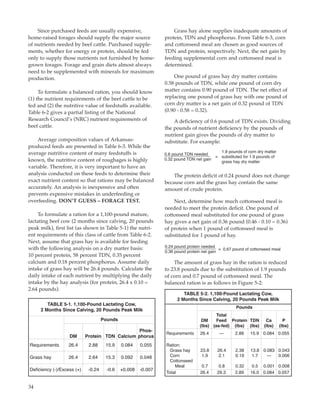
Next, assume that grass hay is available for feeding
with the following analysis on a dry matter basis:
10 percent protein, 58 percent TDN, 0.35 percent
calcium and 0.18 percent phosphorus. Assume daily
intake of grass hay will be 26.4 pounds. Calculate the
daily intake of each nutrient by multiplying the daily
intake by the hay analysis (for protein, 26.4 x 0.10 =
2.64 pounds).
Grass hay alone supplies inadequate amounts of
protein, TDN and phosphorus. From Table 6-3, corn
and cottonseed meal are chosen as good sources of
TDN and protein, respectively. Next, the net gain by
feeding supplemental corn and cottonseed meal is
determined.
One pound of grass hay dry matter contains
0.58 pounds of TDN, while one pound of corn dry
matter contains 0.90 pound of TDN. The net effect of
replacing one pound of grass hay with one pound of
corn dry matter is a net gain of 0.32 pound of TDN
(0.90 - 0.58 = 0.32).
A deficiency of 0.6 pound of TDN exists. Dividing
the pounds of nutrient deficiency by the pounds of
nutrient gain gives the pounds of dry matter to
substitute. For example:
1.9 pounds of corn dry matter
0.6 pound TDN needed
= substituted for 1.9 pounds of
0.32 pound TDN net gain
grass hay dry matter
The protein deficit of 0.24 pound does not change
because corn and the grass hay contain the same
amount of crude protein.
Next, determine how much cottonseed meal is
needed to meet the protein deficit. One pound of
cottonseed meal substituted for one pound of grass
hay gives a net gain of 0.36 pound (0.46 - 0.10 = 0.36)
of protein when 1 pound of cottonseed meal is
substituted for 1 pound of hay.
0.24 pound protein needed
= 0.67 pound of cottonseed meal
0.36 pound protein net gain
The amount of grass hay in the ration is reduced
to 23.8 pounds due to the substitution of 1.9 pounds
of corn and 0.7 pound of cottonseed meal. The
balanced ration is as follows in Figure 5-2:
TABLE 5­1. 1,100­Pound Lactating Cow,
2 Months Since Calving, 20 Pounds Peak Milk
Pounds
DM Protein TDN Calcium
Phos­
phorus
Requirements 26.4 2.88 15.9 0.084 0.055
Grass hay 26.4 2.64 15.3 0.092 0.048
Deficiency (-)/Excess (+) -0.24 -0.6 +0.008 -0.007
TABLE 5­2. 1,100­Pound Lactating Cow,
2 Months Since Calving, 20 Pounds Peak Milk
Pounds
DM
(lbs)
Total
Feed
(as­fed)
Protein
(lbs)
TDN
(lbs)
Ca
(lbs)
P
(lbs)
Requirements 26.4 --- 2.88 15.9 0.084 0.055
Ration:
Grass hay
Corn
Cottonseed
Meal
23.8
1.9
0.7
26.4
2.1
0.8
2.38
0.19
0.32
13.8
1.7
0.5
0.083
---
0.001
0.043
0.006
0.008
Total 26.4 29.3 2.89 16.0 0.084 0.057
34
The total feed (as-fed) is determined by dividing
the pounds of feed (dry matter basis) by the percent
dry matter in the feed (for grass hay with 90 percent
dry matter, 23.8 divided by 0.90 = 26.4).
Grass hay fed alone was deficient in phosphorus,
but supplemental corn and cottonseed meal elimi-
nated the phosphorus deficiency. If phosphorus
deficiency was a problem, dicalcium phosphate or
another feed with a high phosphorus level could be
used to meet the animal’s requirement. If only calcium
was deficient, limestone could be used. The same
procedure used to determine protein and TDN needs
would be used to determine calcium or phosphorus
needs.
A mineral-vitamin supplement should be
provided with the ration above to supply adequate
amounts of all required minerals, including salt, trace
minerals and also vitamin A.
When purchasing nutrients to balance a ration,
always purchase the feed that provides the least cost
per pound of nutrient needed. For example, if energy
is a limiting factor in your ration, then supplement
the ration with a high-energy feed. Refer to Table 6-3
(Composition of Feeds) for the TDN level of various
feeds and calculate what each unit of TDN costs by
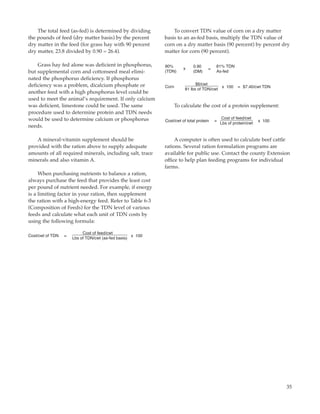
using the following formula:
Cost of feed/cwt
Cost/cwt of TDN = x 100
Lbs of TDN/cwt (as-fed basis)
To convert TDN value of corn on a dry matter
basis to an as-fed basis, multiply the TDN value of
corn on a dry matter basis (90 percent) by percent dry
matter for corn (90 percent).
90% 0.90 81% TDN
x =
(TDN) (DM) As-fed
$6/cwt
Corn x 100 = $7.40/cwt TDN
81 lbs of TDN/cwt
To calculate the cost of a protein supplement:
Cost of feed/cwt
Cost/cwt of total protein = x 100
Lbs of protein/cwt
A computer is often used to calculate beef cattle
rations. Several ration formulation programs are
available for public use. Contact the county Extension
office to help plan feeding programs for individual
farms.
35

Beef Cattle Nutrition

  • 1.
    Chapter 5 Beef Cattle Nutrition Essential Nutrients The nutrients utilizedby beef cattle are (1) water, (2) protein, (3) carbohydrates, (4) fats, (5) minerals and (6) vitamins. Producers should understand the digestive system of the ruminant animal and the nutrient requirements of the various classes of beef cattle (see Table 6-2). Water Water’s importance to sustainment of life results in it being classified as a nutrient, and it is the most important nutrient. Water is involved in all digestive and metabolic processes. Cattle producers often take water for granted because in most cases there is a pond or stream available for cattle to have uninter- rupted access to water. Mature cows will consume 6 to 12 gallons per day during cooler times of the year and 15 to 20 gallons per day during hotter times of the year. One common concern with farm ponds is blue- green algae blooms. Nitrates can also be a concern with farm ponds that catch a lot of agricultural field drainage. Wells provide another source of water for beef cattle. Salts and other well water contaminants can affect water intake and herd performance. When using streams to water cattle, the streams should be fenced to provide limited access points, protecting streambanks from erosion. Cattle producers some- times choose to pump water from streams instead of allowing direct access by cattle. Stagnant and slow- flowing streams present some of the same water qual- ity concerns as ponds. Water can be tested for quality standards to determine if contents are within accept- able levels for beef cattle. Protein Protein is important in all tissue building and in cell functions of the body of beef cattle. Good quality grass forages grown on fertilized pastures and hay meadows will almost always supply the protein needs of dry pregnant cows and much of the time the pro- tein needs of nursing cows. Legume forages usually have a protein level that exceeds protein needs of all classes of beef cattle. Carbohydrates and Fats Carbohydrates (sugars), fats and, in some instances, proteins provide the energy in all animal rations. Failure to provide energy represents the most serious feeding problem among Arkansas cattle pro- ducers. Cattle on a forage-based diet are receiving most of their energy supply from microbial digest of plant carbohydrates. Plant fiber is a structural carbo- hydrate. One of the greatest causes of low fertility is inadequate energy in beef cattle rations. This occurs during drought or because of poor hay digestibility throughout the winter feeding period. While there are essential fats needed in the diet, the fat content of beef cattle diets is generally low < 3 percent (diet dry matter). Fats are sometimes added to feed rations and supplements to increase the energy content because fat has 2.5 times the energy value of a carbohydrate. Too much fat ( > 6 percent diet dry matter) in the total diet should also be avoided. Minerals for Beef Cattle Minerals are essential in beef cattle diets. Deficiencies in any of the required minerals will reduce production efficiency. The mineral content of the animal’s body makes up approximately 5 percent of its weight. Minerals are classified into two general categories – macro and trace or micro minerals – based on their relative amounts present in the ani- mal’s body and secondly on the amounts needed in the ration. The macro minerals are calcium, phospho- rus, magnesium, potassium, sodium, chlorine and sulfur. The trace minerals most often needed in the beef animal’s diet are iron, manganese, copper, iodine, cobalt, zinc and selenium.   Macro Minerals Calcium (Ca) Calcium is the major element of bones; approximately 99 percent of the body’s calcium supply is in bones and teeth. In addition to its role in the skeletal system, calcium is also required for many other functions in the body. A major role is in the 31
  • 2.
    muscle contraction process.Calcium is usually present in adequate amounts in forage and is quite high in legume plants; however, calcium may be limited in feedlot rations as grains and most by-product feed- stuffs are low in calcium.   Phosphorus (P) Approximately 80 percent of the body’s supply of phosphorus is in the skeleton and teeth. In addition to its obvious role in these areas, phosphorus has been shown to be very important in absorption and trans- port of various compounds within the body. It is also involved in energy transfer. Because of this, phospho- rus may be viewed as the most versatile mineral ele- ment. A phosphorus deficiency is often characterized by poor reproductive performance in beef cows. Grains are considered to be moderate to high in phos- phorus while forages usually contain low to moderate amounts. Supplementation of phosphorus is often needed in a grazing situation. The level of phosphorus supplementation will be dependent upon forage species and soil fertility. A forage test can help deter- mine phosphorus supplementation needs. Certain minerals must be kept in proper ratio to one another in the ration because their roles in metabolism and body functions are interrelated. For this reason, a Ca:P ratio of 1:1 to 5:1 should normally be maintained. Magnesium (Mg) Magnesium is closely associated with calcium and phosphorus in its distribution and metabolism in the animal’s body. Under normal conditions, Mg is not a problem; however, the condition “grass tetany” is related to Mg deficiency. This is most likely to occur with mature beef cows grazing lush spring pasture. When there is risk of tetany, cattle producers will often feed a high magnesium mineral. Feeding a high magnesium mineral should start at least one month in advance of the period tetany is most likely to occur. Mineral mixes designed to help prevent grass tetany usually contain 10 percent magnesium. In some situa- tions, a custom feed mix may need to be formulated to provide greater levels of magnesium than that available in common mineral mixes. Potassium (K) Potassium is usually found in the intracellular (within the cell) fluids. It functions primarily to main- tain osmotic pressure within the cell, maintain proper pH and the transfer of nutrients across the cell wall. Forages usually contain excessive amounts of this mineral, thus grazing cattle are not usually supple- mented with K. Sodium (Na) and Chlorine (Cl) (Salt) Sodium (Na) and Chlorine (Cl), more commonly known as salt, are used in the body to regulate osmotic pressure in cells and contribute to buffering systems. Sodium is also essential in the transmission of nerve impulses. Cattle will normally consume more than their requirements if given free access to either loose salt or blocks. Since the storage of these two elements in the body is rather limited, a regular supply should be self-fed. Salt is sometimes used as an intake limiter for a self-feeding ration. In this situation, an abundant sup- ply of fresh water is a must to prevent salt toxicity. Trace Minerals The level of trace minerals in the basic diet is ignored many times in ration formulations and 100 percent of the animal’s requirements are added. This is done because of the tremendous variability that exists in the trace mineral composition of feeds and the minimal cost involved in adding these elements to the ration. Iodine, copper and selenium are all defi- cient in many soils of the United States. Cobalt may need to be supplied because of its role in the forma- tion of vitamin B12 by rumen microorganisms. Copper has been shown to be deficient in the coastal plains region where heavy stocking rates and high nitrogen fertilization have occurred. Arkansas forages can be marginal in copper, and there are several copper antagonist, including sulfur, molybdenum and iron, that affect copper’s absorption. Supplementing copper is recommended. Selenium deficiencies have been found in fescue pastures in north Arkansas. Trace mineral supplements are categorized as two types: inorganic and organic. The common inorganics include sulfates, oxides and chlorides. The bioavail- ability of these are generally good with the exception of copper and iron oxide. Copper oxide should be avoided in free-choice mineral supplements. Organic forms include elements bound to simple amino acids or more complex organic structures. Organics often have a greater bioavailability than inorganics; how- ever, in mineral supplements they are seldom used as the sole source of a trace mineral. Vitamins for Beef Cattle Pasture and average to excellent quality roughages usually contain sufficient quantities of 32
  • 3.
    the vitamins neededby beef cattle to support body maintenance, production and reproduction. Beef cattle may need vitamins A, D and E supplementation where the forage supply consists of crop residue, over-mature or weather-damaged hay or dry winter forage. Vitamins are classified as fat soluble or water soluble. The water soluble vitamins include vitamin C and the B vitamins. B vitamins are produced by microbes during rumen fermentation and are seldom deficient in beef cattle. Vitamin C is only needed in the diets of humans, monkeys and guinea pigs. The fat soluble vitamins include vitamins A, D, E and K. Vitamin K is synthesized in the rumen under most feeding conditions. Thus, the animal has little need for supplemental K. Vitamins A, D and E are routinely included in mineral mixes. Vitamin A Vitamin A is strictly a product of animal metabolism. Its counterpart in plants is known as carotene. The beef animal transforms carotene into vitamin A. Cattle store vitamin A and carotene in the liver and body fat during periods of abundant intake. These periods occur when animals are grazing green forage. The stored reserves may be adequate to meet the animal’s needs for two to four months. Vitamin A deficiencies may cause night blindness, watery eyes and, in pregnant animals, abortions. Weak calves, retained placentas and rebreeding problems may also occur. If animals are on a prolonged diet of bleached or weathered roughage, vitamin A stores may be depleted from the body. This vitamin may be pro- vided to the cow herd by injection, added to the min- eral mix or in their regular ration. Pregnant cows that are being fed low-carotene feeds should receive the equivalent of 30,000 international units (IUs) of vitamin A daily while lactating cows should receive 45,000 IUs. Vitamin D Beef cattle usually receive adequate amounts of this vitamin by exposure to direct sunlight or through consuming sun-cured forages. Vitamins D and E are usually included with vitamin A supplements or injec- tion solutions administered to cattle. Only cattle kept indoors and not fed sun-cured hay are likely to show symptoms of vitamin D deficiency. Vitamin E Under most conditions, natural feedstuffs supply the requirements of vitamin E. Cereal grains, grain forages and good quality hay are all excellent sources of this vitamin. Vitamin E is usually added to mineral- vitamin supplements because of its antioxidant prop- erties which facilitate the uptake and storage of Vitamin A. Balancing Rations Several terms used in balancing beef cattle rations are: Diet – The feed an animal receives in a 24-hour period. Ration – The feed an animal receives in a 24-hour period. Balanced Ration – A ration that furnishes the nutri- ents needed in the proper amounts to allow the individual to perform a certain function such as maintenance, growth, gestation or lactation. Dry Matter (DM) – The feed remaining after all water is removed. Dry matter averages about 35 percent in silages, 90 percent in No. 2 corn and 90 percent in hay. Supplement – A concentrate feed added to a ration to provide one or more nutrients not adequately supplied by the usual feed. Nutrient – Any feed component or group of feed com- ponents of similar chemical composition that aid in the support of animal life. Protein, carbohy- drates, fat, minerals and vitamins are examples. Carbohydrate, fat and excess protein are all used in the animal body as energy. Total Digestible Nutrients (TDN) – A term used as a measure of energy (caloric content of feedstuffs). On an as-fed basis, grains usually contain 65 to 80 percent TDN, hays usually 50 percent and less, and silages about 20 percent. Crude Protein – The crude protein content of a feed is determined by analyzing the feed for nitrogen. Protein in a feed contains approximately 16 per- cent nitrogen; therefore, multiplying N by 6.25 gives the total protein content of the feed. 33
  • 4.
    Since purchased feedsare usually expensive, home-raised forages should supply the major source of nutrients needed by beef cattle. Purchased supple- ments, whether for energy or protein, should be fed only to supply those nutrients not furnished by home- grown forages. Forage and grain diets almost always need to be supplemented with minerals for maximum production. To formulate a balanced ration, you should know (1) the nutrient requirements of the beef cattle to be fed and (2) the nutritive value of feedstuffs available. Table 6-2 gives a partial listing of the National Research Council’s (NRC) nutrient requirements of beef cattle. Average composition values of Arkansas- produced feeds are presented in Table 6-3. While the average nutritive content of many feedstuffs is known, the nutritive content of roughages is highly variable. Therefore, it is very important to have an analysis conducted on these feeds to determine their exact nutrient content so that rations may be balanced accurately. An analysis is inexpensive and often prevents expensive mistakes in underfeeding or overfeeding. DON’T GUESS – FORAGE TEST. To formulate a ration for a 1,100-pound mature, lactating beef cow (2 months since calving, 20 pounds peak milk), first list (as shown in Table 5-1) the nutri- ent requirements of this class of cattle from Table 6-2. Next, assume that grass hay is available for feeding with the following analysis on a dry matter basis: 10 percent protein, 58 percent TDN, 0.35 percent calcium and 0.18 percent phosphorus. Assume daily intake of grass hay will be 26.4 pounds. Calculate the daily intake of each nutrient by multiplying the daily intake by the hay analysis (for protein, 26.4 x 0.10 = 2.64 pounds). Grass hay alone supplies inadequate amounts of protein, TDN and phosphorus. From Table 6-3, corn and cottonseed meal are chosen as good sources of TDN and protein, respectively. Next, the net gain by feeding supplemental corn and cottonseed meal is determined. One pound of grass hay dry matter contains 0.58 pounds of TDN, while one pound of corn dry matter contains 0.90 pound of TDN. The net effect of replacing one pound of grass hay with one pound of corn dry matter is a net gain of 0.32 pound of TDN (0.90 - 0.58 = 0.32). A deficiency of 0.6 pound of TDN exists. Dividing the pounds of nutrient deficiency by the pounds of nutrient gain gives the pounds of dry matter to substitute. For example: 1.9 pounds of corn dry matter 0.6 pound TDN needed = substituted for 1.9 pounds of 0.32 pound TDN net gain grass hay dry matter The protein deficit of 0.24 pound does not change because corn and the grass hay contain the same amount of crude protein. Next, determine how much cottonseed meal is needed to meet the protein deficit. One pound of cottonseed meal substituted for one pound of grass hay gives a net gain of 0.36 pound (0.46 - 0.10 = 0.36) of protein when 1 pound of cottonseed meal is substituted for 1 pound of hay. 0.24 pound protein needed = 0.67 pound of cottonseed meal 0.36 pound protein net gain The amount of grass hay in the ration is reduced to 23.8 pounds due to the substitution of 1.9 pounds of corn and 0.7 pound of cottonseed meal. The balanced ration is as follows in Figure 5-2: TABLE 5­1. 1,100­Pound Lactating Cow, 2 Months Since Calving, 20 Pounds Peak Milk Pounds DM Protein TDN Calcium Phos­ phorus Requirements 26.4 2.88 15.9 0.084 0.055 Grass hay 26.4 2.64 15.3 0.092 0.048 Deficiency (-)/Excess (+) -0.24 -0.6 +0.008 -0.007 TABLE 5­2. 1,100­Pound Lactating Cow, 2 Months Since Calving, 20 Pounds Peak Milk Pounds DM (lbs) Total Feed (as­fed) Protein (lbs) TDN (lbs) Ca (lbs) P (lbs) Requirements 26.4 --- 2.88 15.9 0.084 0.055 Ration: Grass hay Corn Cottonseed Meal 23.8 1.9 0.7 26.4 2.1 0.8 2.38 0.19 0.32 13.8 1.7 0.5 0.083 --- 0.001 0.043 0.006 0.008 Total 26.4 29.3 2.89 16.0 0.084 0.057 34
  • 5.
    The total feed(as-fed) is determined by dividing the pounds of feed (dry matter basis) by the percent dry matter in the feed (for grass hay with 90 percent dry matter, 23.8 divided by 0.90 = 26.4). Grass hay fed alone was deficient in phosphorus, but supplemental corn and cottonseed meal elimi- nated the phosphorus deficiency. If phosphorus deficiency was a problem, dicalcium phosphate or another feed with a high phosphorus level could be used to meet the animal’s requirement. If only calcium was deficient, limestone could be used. The same procedure used to determine protein and TDN needs would be used to determine calcium or phosphorus needs. A mineral-vitamin supplement should be provided with the ration above to supply adequate amounts of all required minerals, including salt, trace minerals and also vitamin A. When purchasing nutrients to balance a ration, always purchase the feed that provides the least cost per pound of nutrient needed. For example, if energy is a limiting factor in your ration, then supplement the ration with a high-energy feed. Refer to Table 6-3 (Composition of Feeds) for the TDN level of various feeds and calculate what each unit of TDN costs by using the following formula: Cost of feed/cwt Cost/cwt of TDN = x 100 Lbs of TDN/cwt (as-fed basis) To convert TDN value of corn on a dry matter basis to an as-fed basis, multiply the TDN value of corn on a dry matter basis (90 percent) by percent dry matter for corn (90 percent). 90% 0.90 81% TDN x = (TDN) (DM) As-fed $6/cwt Corn x 100 = $7.40/cwt TDN 81 lbs of TDN/cwt To calculate the cost of a protein supplement: Cost of feed/cwt Cost/cwt of total protein = x 100 Lbs of protein/cwt A computer is often used to calculate beef cattle rations. Several ration formulation programs are available for public use. Contact the county Extension office to help plan feeding programs for individual farms. 35