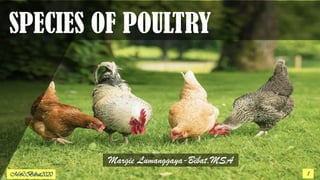
SPECIES OF POULTRY
Margie Lumanggaya-Bibat,MSA
MLBibat2020 1
Poultry
• popular because they are fast multipliers
• quick growers, more efficient feed converters
• chicken most popular poultry species
• duck 2nd most popular (for balut, salted and century
eggs)
• quail 3rd most popular (for its eggs)
MLBibat2020 2
Orders
1. Galliformes – don’t have true
phallus (copulatory organ),
v-shaped breast
1. Anseriformes – have true
phallus, v-shaped breast
2. Struthioformes – have flat breast
3. Columbiformes – secrete “milk”
MLBibat2020 3
COMMON NAME SCIENTIFIC NAME EGG WEIGHT (G) INCUBATION (DAYS)
1. Chicken Gallus gallus 58 21
2. Ducks
Mallard
pekin(meat)
Mallard (egg)
Muscovy (meat)
Anas plathyrhynchos
Anas plathyrhynchos
Carina moscata
80-83
60
70
28
28
35-37
3. Turkey Meleagris gallocapa 85 28
4. Quail Coturnix coturnix 12 16-18
5. Pigeon Columbia livia 17 18
6. Geese Cygnopsis cygonoides 200 30-31
7. Swan Olar columbianos 285 35
8. Ostrich Struthio australs 1400 42
9. Peafowl Pavo cristatus 95 28
10. Pheasant Phasianus colchicus 32 23-24
11. Guinea fowl Numida meleagris 40 28
P
O
U
L
T
R
Y
S
p
e
c
i
e
s
MLBibat2020 4
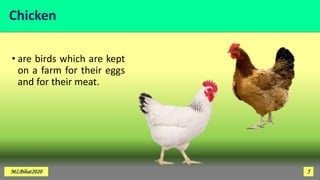
Chicken
• are birds which are kept
on a farm for their eggs
and for their meat.
MLBibat2020 5
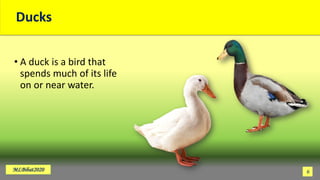
Ducks
• A duck is a bird that
spends much of its life
on or near water.
MLBibat2020 6
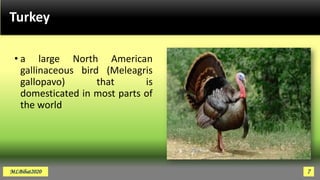
Turkey
• a large North American
gallinaceous bird (Meleagris
gallopavo) that is
domesticated in most parts of
the world
MLBibat2020 7
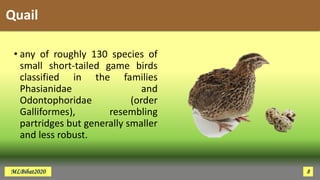
Quail
• any of roughly 130 species of
small short-tailed game birds
classified in the families
Phasianidae and
Odontophoridae (order
Galliformes), resembling
partridges but generally smaller
and less robust.
MLBibat2020 8
Pigeon
• any of several hundred
species of birds constituting
the family Columbidae
(order Columbiformes).
Smaller forms are usually
called doves, larger forms
pigeons. An exception is the
white domestic pigeon, the
symbol known as the “dove
of peace.”
MLBibat2020 9
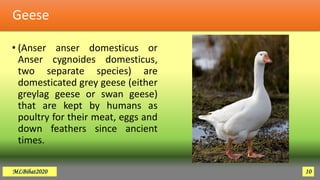
Geese
• (Anser anser domesticus or
Anser cygnoides domesticus,
two separate species) are
domesticated grey geese (either
greylag geese or swan geese)
that are kept by humans as
poultry for their meat, eggs and
down feathers since ancient
times.
MLBibat2020 10
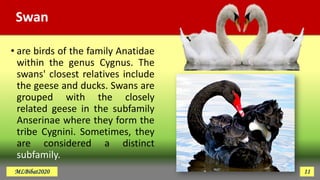
Swan
• are birds of the family Anatidae
within the genus Cygnus. The
swans' closest relatives include
the geese and ducks. Swans are
grouped with the closely
related geese in the subfamily
Anserinae where they form the
tribe Cygnini. Sometimes, they
are considered a distinct
subfamily.
MLBibat2020 11
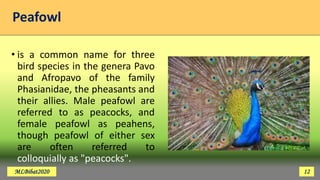
Peafowl
• is a common name for three
bird species in the genera Pavo
and Afropavo of the family
Phasianidae, the pheasants and
their allies. Male peafowl are
referred to as peacocks, and
female peafowl as peahens,
though peafowl of either sex
are often referred to
colloquially as "peacocks".
MLBibat2020 12
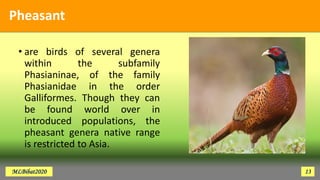
Pheasant
• are birds of several genera
within the subfamily
Phasianinae, of the family
Phasianidae in the order
Galliformes. Though they can
be found world over in
introduced populations, the
pheasant genera native range
is restricted to Asia.
MLBibat2020 13
Guinea Fowl
• often referred to as guineas, are
gamebirds that are increasingly
popular among keepers of small
and backyard flocks. Guineas are
vigorous, hardy, and largely
disease-free birds. There are
many reasons people raise
guinea fowl. The birds sound an
alarm whenever anything
unusual occurs on the farm.
MLBibat2020 14
The Chicken:
Classes,Breeds&Varieties
MLBibat2020 15
• The exact ancestry of the present-day chicken is not known
Common origin of the chicken breeds and varieties:
1. Red jungle fowl (Sci. name: Gallus gallus) a native of South
Asia.
2. Gallus sonneti(gray jungle fowl)
3. Gallus lafayetti (Ceylonese jungle fowl)
4. Gallus varius (Javan jungle fowl)
The origin of the Chicken
MLBibat2020 16
• Hen of the wild jungle fowl is
0.9 kg in weight and lays only a
few eggs.
• Modern hens weighs 1.5 to 2.0
kg at 6 weeks of age and lays as
much 320 eggs
Development of Modern Breeds and Varieties
MLBibat2020 17
1. Genetic Mutation
 some changes in the genetic
make-up of certain individuals
due to factors that are within as
well as factors that surrounds the
subject.
 the change have been
transmitted to generation to
generation with the possibility of
being modified from time to time
as more factors and more
individuals interact with each
other.
What brought the change?
MLBibat2020 18
2. Selection
a. natural selection (survival of the fittest)
1. climatic differences
2. differences in nutrition
b. artificial selection – the interference of man in achieving
certain goals and personal ideas – for example.
1. for meat
2. for eggs
3. for fighting cocks
4. for fancy feathers
What brought the change?
MLBibat2020 19
• Breed – a group of chicken (fowls) possessing certain confrontation or
shape of the body that distinguishes them from other chickens.
• Variety – a group of chicken within the breed which possesses the
same plumage color and type of comb.
Example:
Classification of Breeds and Varieties of Chicken
Breeds Variety
Leghorn White, single comb
Brown, Rose comb
Plymouth rock White barried
MLBibat2020 20
• Strain – agroup of chickens within a variety of breed
which has under constant specific section of certain
traits by a speched breeder for periods of about 5 to
8 years.
•Line crosses
•Line crosses of family lines
Classification of Breeds and Varieties of Chicken
MLBibat2020 21
Breeds of chicken can be classified its utility. This is based on the
purpose for which the breed or variety is most sufficient.
1. Egg class
the breed belonging to this class is characterized by their
comparatively small size.
 they lay large white shelled eggs, very active and
nervous in temperament.
 they are non-sitters
 examples: leghorn, minorcas, anconas
and mikawa.
MLBibat2020 22
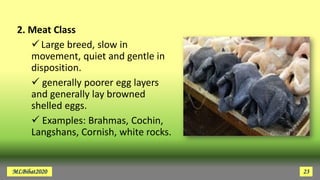
2. Meat Class
Large breed, slow in
movement, quiet and gentle in
disposition.
 generally poorer egg layers
and generally lay browned
shelled eggs.
 Examples: Brahmas, Cochin,
Langshans, Cornish, white rocks.
MLBibat2020 23
3. General purpose class
breeds of chicken in this class
are medium sized, good layers
and the young are fast growers
 they are not as nervous as
the egg class but much more
active than the meat class.
 Examples: new Hampshire,
rhode island red, Plymouth
rock, Lancaster, Nagoya,
cantonese
MLBibat2020 24
White and Black Paroakan
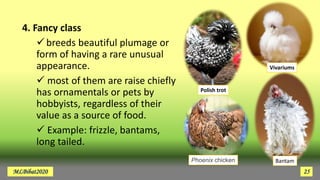
4. Fancy class
breeds beautiful plumage or
form of having a rare unusual
appearance.
 most of them are raise chiefly
has ornamentals or pets by
hobbyists, regardless of their
value as a source of food.
 Example: frizzle, bantams,
long tailed.
MLBibat2020 25
Vivariums
Polish trot
Bantam
Phoenix chicken
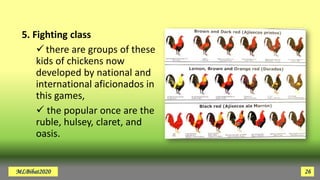
5. Fighting class
there are groups of these
kids of chickens now
developed by national and
international aficionados in
this games,
 the popular once are the
ruble, hulsey, claret, and
oasis.
MLBibat2020 26
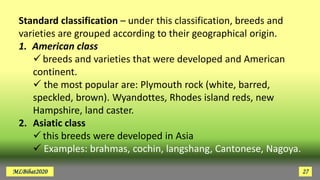
Standard classification – under this classification, breeds and
varieties are grouped according to their geographical origin.
1. American class
breeds and varieties that were developed and American
continent.
 the most popular are: Plymouth rock (white, barred,
speckled, brown). Wyandottes, Rhodes island reds, new
Hampshire, land caster.
2. Asiatic class
this breeds were developed in Asia
 Examples: brahmas, cochin, langshang, Cantonese, Nagoya.
MLBibat2020 27
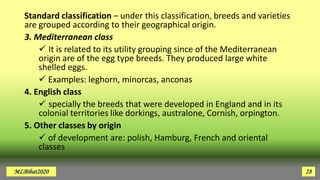
Standard classification – under this classification, breeds and varieties
are grouped according to their geographical origin.
3. Mediterranean class
 It is related to its utility grouping since of the Mediterranean
origin are of the egg type breeds. They produced large white
shelled eggs.
 Examples: leghorn, minorcas, anconas
4. English class
 specially the breeds that were developed in England and in its
colonial territories like dorkings, australone, Cornish, orpington.
5. Other classes by origin
 of development are: polish, Hamburg, French and oriental
classes
MLBibat2020 28
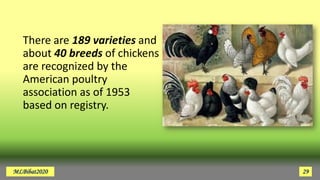
There are 189 varieties and
about 40 breeds of chickens
are recognized by the
American poultry
association as of 1953
based on registry.
MLBibat2020 29
Specialized Fields in POULTRY PRODUCTION
1. Breeding farm
 it is the system of researching or discovering the best
combination of genes of parent stocks that will be the source of
commercial chicks for the poultry producer.
 the existing “strains” or probably across of various lines now
available to a commercial poultry raiser is a product of very long
studies by the geneticist.
 there is no true commercial poultry breeding farm existing in the
Philippines of 2003.
 Poultry breeding farms in the country are franchised breeder
farms from other international breeders.
MLBibat2020 30
2. Egg Farm
 egg production is the older scheme of poultry production engaged
in by many research.
 two phases of operations:
• the 1st phase can be strictly for raising pullets.
• the 2nd phase is the keeping of layers per se when they are on
the stage of egg production.
 All female type chicks are obtained from the reputable hatchery
for this kind of stock.
Specialized Fields in POULTRY PRODUCTION
MLBibat2020 31
Specialized Fields in POULTRY PRODUCTION
2. Broiler Farm
 It is the most recent specialized field in the Philippines.
 this is the growing of meat type chicken essentially for meat
production
 stocks used for this purpose are so-called broiler-type chicks which
are known for the fast growth, meaty conformation and good feed
conservation.
 broiler chicks are grown for a period of only about 6 to 7 weeks.
 both male and female chicks are utilized for growing broilers.
However, the males grow faster than females.
MLBibat2020 32
REFERENCE
• Poultry manual, 2020, Chicken Breeds in the Philippines and Choosing the
Right One, Retrieved from https://poultrymanual.com/poultry-philippines-
chicken-breeds
• Green Emphire Licensure Examination Reviewer for Agriculturist
• https://en.wikipedia.org/wiki/Junglefowl
• https://www.pinterest.ph/pin/113153009366381382/
• https://en.wikipedia.org/wiki/Orpington_chicken
• https://www.google.com/url?sa=i&url=https%3A%2F%2Fwww.freegreatpic
ture.com%2Feggs-or-related%2Fegg-class-1244&psig
• https://www.google.com/url?sa=i&url=https%3A%2F%2Fmodernfarmer.co
m%2F2014%2F10%2Fsilkies%2F&psig
• https://www.google.com/url?sa=i&url=https%3A%2F%2Fwww.irishtimes.c
om%2Fbusiness%2Finnovation%2Fcould-water-be-the-fuel-of-the-future-
1.3059240&psig=
MLBibat2020 33
• http://weknowyourdreams.com/duck.html
• https://www.google.com/url?sa=t&rct=j&q=&esrc=s&source=web&cd=&cad=rja&u
act=8&ved=2ahUKEwjOl-
WqstTsAhWMHHAKHa2CD1AQFjALegQIBhAC&url=https%3A%2F%2Fwww.merriam-
• https://www.google.com/url?sa=i&url=http%3A%2F%2Fdreamstop.com%2Fturkey-
bird-dream-meaning-interpretations%2F&psig=
• https://www.google.com/url?sa=i&url=https%3A%2F%2Fchickens.fandom.com%2F
wiki%2FHen&psig=AOvVaw3LovT7iFxeYl4zgnjN3JHo&ust=1603881784651000&sour
ce=images&cd=vfe&ved=0CA0QjhxqFwoTCMDBnbjL1OwCFQAAAAAdAAAAABAD
• https://www.google.com/url?sa=t&rct=j&q=&esrc=s&source=web&cd=&cad=rja&u
act=8&ved=2ahUKEwiGlPL8zNTsAhXcyIsBHcMEDJsQFjAHegQIARAC&url=https%3A%
2F%2Fwww.britannica.com%2Fanimal%2Fquail%23%3A~%3Atext%3DQuail%252C%
2520any%2520of%2520roughly%2520130%2Cgenerally%2520smaller%2520and%2
520less%2520robust.&usg=AOvVaw37lrsRdkaDdk8u3xApYmE
MLBibat2020 34
REFERENCE
• https://www.google.com/url?sa=i&url=https%3A%2F%2Fwww.tasteatlas.com%
2Fwood-pigeon&psig=AOvVaw2WLdSngxathBFiHD6b5Gd-
&ust=1603882499195000&source=images&cd=vfe&ved=0CA0QjhxqFwoTCMj1
sZnO1OwCFQAAAAAdAAAAABAD
• https://www.britannica.com/animal/pigeon
• https://en.wikipedia.org/wiki/Domestic_goose
• https://www.google.com/url?sa=i&url=https%3A%2F%2Fawildaffairswans.com
%2F&psig=AOvVaw2H_PBZkvPYD_tNKkZ_LuMd&ust=1603883784165000&sou
rce=images&cd=vfe&ved=0CA0QjhxqFwoTCPDl--3S1OwCFQAAAAAdAAAAABA9
• https://www.google.com/url?sa=i&url=https%3A%2F%2Fwww.thetimes.co.uk
%2Farticle%2Funder-fire-shoots-insist-pheasant-is-not-for-rich-tastes-
dqhtpvw2k&psig=AOvVaw1voFnBFcQ2Jome6vqdgSrj&ust=1603885105125000
&source=images&cd=vfe&ved=0CA0QjhxqFwoTCJD6zOHX1OwCFQAAAAAdAA
AAABAI
MLBibat2020 35
REFERENCE
MLBibat2020 36