



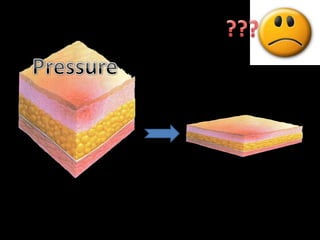
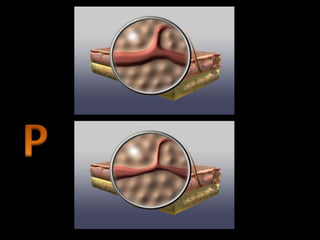
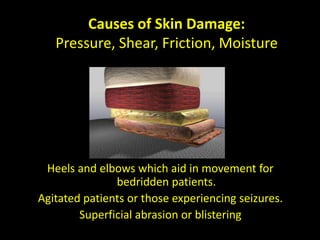

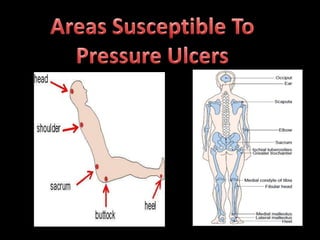
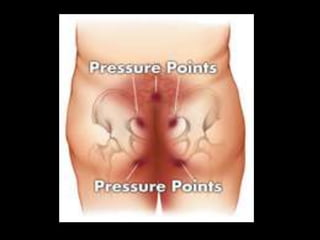



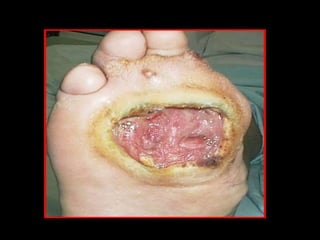











Causes of Skin Damage:
   Pressure, Shear, Friction, Moisture


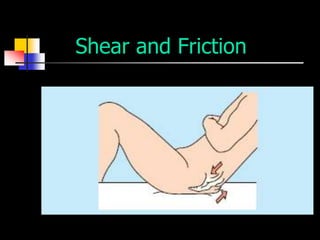
              Examples of Friction:
 Heels and elbows which aid in movement for
                bedridden patients.
Agitated patients or those experiencing seizures.
        Superficial abrasion or blistering
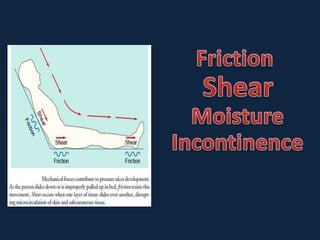
Shear and Friction
Causes of Skin Damage


         Moisture:
             .
Shear

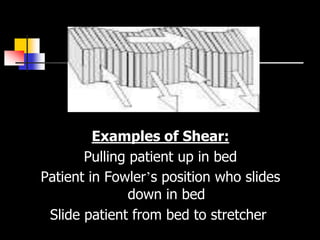
Shear is the interaction of gravity and friction causing
          twisting or kinking of blood vessels.


Shear occurs when the skeleton moves, but the skin
        remains fixed to an external surface.
Examples of Shear:
       Pulling patient up in bed
Patient in Fowler’s position who slides
               down in bed
 Slide patient from bed to stretcher.
Friction
Friction contributes to pressure ulcer formation
      by damaging the skin at the epidermal-
   dermal interface, the basement membrane.

  Friction ulcers are generally superficial and
     easily reversed, unless the cause is not
                     removed.
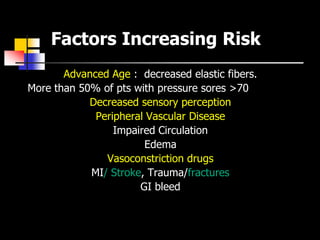
Factors Increasing Risk
       Advanced Age : decreased elastic fibers.
More than 50% of pts with pressure sores >70
            Decreased sensory perception
             Peripheral Vascular Disease
                 Impaired Circulation
                       Edema
               Vasoconstriction drugs
            MI/ Stroke, Trauma/fractures
                      GI bleed
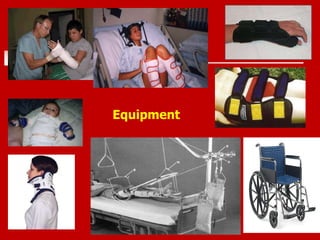
Equipment
Factors Increasing Risk


                  Equipment: pneumoboots
   Spinal Cord injury: (Braces and stabilizing equipment)
                   Neurological disorders
                 Chronic medical conditions:
                    diabetes, COPD, CHF
                  History of pressure ulcers
If have stage I, 10X greater risk of developing higher stage
                      Preterm neonates
               Obesity/ Thin: 30 >BMI< 19
Factors Increasing Risk

 Critical Lab: Prealbumin level
   (reflects Visceral Protein Stores)


   Mild depletion = 10-15
  Moderate depletion = 5-10
   Severe depletion = < 5
Highest risk factors
   >70 years                 stroke
   impaired mobility         pneumonia
   current smoking           CHF
   low BMI                   fever
   altered mental state      sepsis
   urinary and fecal         hypotension
    incontinence              dry and scaly skin
   malnutrition              history of pressure
   restraints                 ulcers
   cancer                    anemia
   diabetes                  lymphopenia
                              hypoalbuminemia
ALL patients require a
R. A at Admission & every 24 hours.
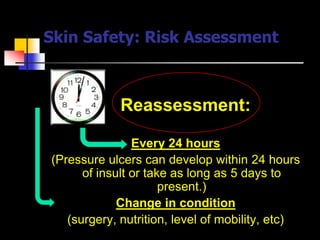
Skin Safety: Risk Assessment


             Reassessment:

                Every 24 hours
(Pressure ulcers can develop within 24 hours
      of insult or take as long as 5 days to
                      present.)
             Change in condition
   (surgery, nutrition, level of mobility, etc)
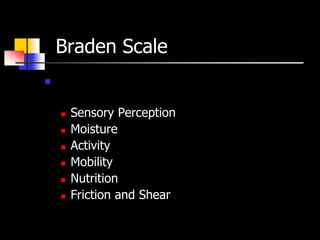
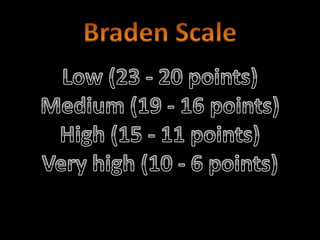
Braden Scale
   The Braden score is the total of the
    subcategory scores.
       Sensory Perception
       Moisture
       Activity
       Mobility
       Nutrition
       Friction and Shear
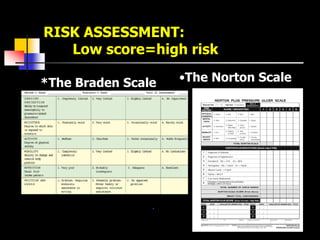
RISK ASSESSMENT:
   Low score=high risk

*The Braden Scale   •The Norton Scale


                
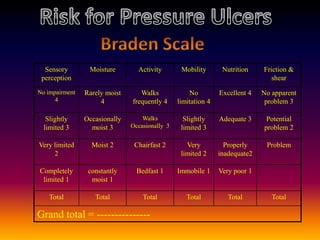
Sensory        Moisture        Activity        Mobility       Nutrition    Friction &
 perception                                                                     shear
No impairment   Rarely moist      Walks             No         Excellent 4   No apparent
      4              4         frequently 4     limitation 4                  problem 3

   Slightly     Occasionally       Walks          Slightly     Adequate 3     Potential
  limited 3       moist 3      Occasionally 3    limited 3                   problem 2

Very limited      Moist 2       Chairfast 2        Very          Properly     Problem
     2                                           limited 2     inadequate2

Completely       constantly      Bedfast 1      Immobile 1     Very poor 1
 limited 1        moist 1

    Total          Total           Total           Total          Total         Total

Grand total = ---------------
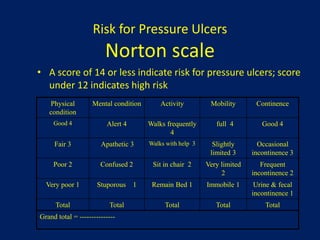
Risk for Pressure Ulcers
                         Norton scale
• A score of 14 or less indicate risk for pressure ulcers; score
  under 12 indicates high risk
   Physical         Mental condition       Activity         Mobility       Continence
   condition
     Good 4              Alert 4       Walks frequently       full 4         Good 4
                                              4
     Fair 3            Apathetic 3     Walks with help 3     Slightly       Occasional
                                                            limited 3     incontinence 3
     Poor 2            Confused 2       Sit in chair 2     Very limited      Frequent
                                                                2         incontinence 2
  Very poor 1         Stuporous 1       Remain Bed 1       Immobile 1      Urine & fecal
                                                                          incontinence 1
      Total               Total             Total             Total           Total
Grand total = ---------------
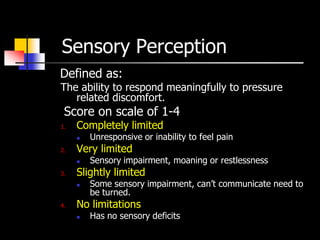
Sensory Perception
Defined as:
The ability to respond meaningfully to pressure
   related discomfort.
 Score on scale of 1-4
1.   Completely limited
        Unresponsive or inability to feel pain
2.   Very limited
        Sensory impairment, moaning or restlessness
3.   Slightly limited
        Some sensory impairment, can’t communicate need to
         be turned.
4.   No limitations
        Has no sensory deficits
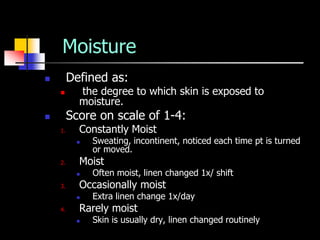
Moisture
        Defined as:
          the degree to which skin is exposed to
           moisture.
        Score on scale of 1-4:
    1.     Constantly Moist
             Sweating, incontinent, noticed each time pt is turned
              or moved.
    2.     Moist
             Often moist, linen changed 1x/ shift
    3.     Occasionally moist
             Extra linen change 1x/day
    4.     Rarely moist
             Skin is usually dry, linen changed routinely
Friction & Shear
        Score on scale of 1-3
    1.     Problem
             Requires max assist for moving
             Sliding against sheets is impossible
             Frequently slides down in bed
             Agitation leads to almost constant friction
    2.     Potential Problem
             Requires minimal assist for moving
             Skin slides to some extent on sheets
             Occasionally slides down in bed or chair
    3.     No apparent problem
             Moves independently
             Lifts up completely during move
             Maintains good position in bed or chair
Activity
        Defined as:
             the degree of physical activity.
        Score on scale of 1-4:
    1.     Bed fast
               Confined to the bed
    2.     Chair fast
               Ability to walk is almost non-existent, must be assisted
                into chair.
    3.     Walks occasionally
               Short distances, infrequent, most of time in bed or
                chair.
    4.     Walks frequently
               Walks outside of room 2x/day
               Walks inside of room q 2 hours.
Nutrition
        Defined as “usual food intake pattern.”
        Score on scale of 1-4
    1.     Very poor
              Never eats complete meal
              Takes fluid poorly
              NPO/ IV fluids only >5 days
    2.     Probably inadequate
              Rarely eats a complete meal
              Occasionally will take supplement
    3.     Adequate
              Eats ½ of most meals
              Will take supplement if miss meals
              On TPN or adequate tube feedings
    4.     Excellent
              Eats every meal
              Does not require supplements
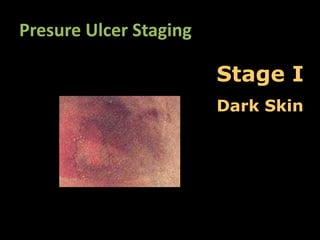
Presure Ulcer Staging

                        Stage I
                        Dark Skin
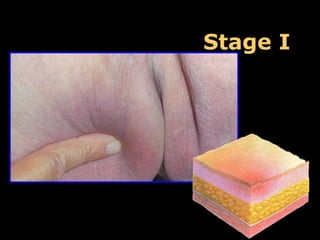
Pressure Ulcer Staging
                         Stage I
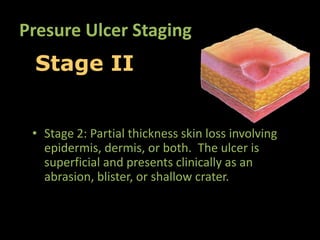
Presure Ulcer Staging
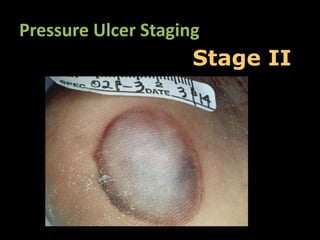
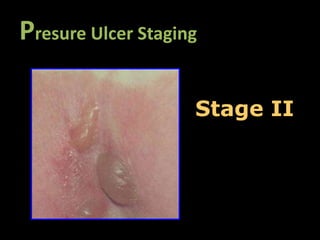
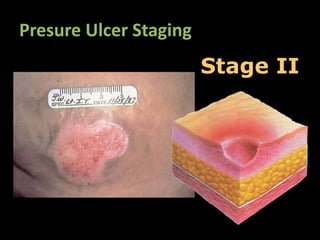
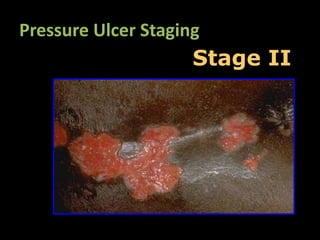
 Stage II


 • Stage 2: Partial thickness skin loss involving
   epidermis, dermis, or both. The ulcer is
   superficial and presents clinically as an
   abrasion, blister, or shallow crater.
Pressure Ulcer Staging
                     Stage II
Presure Ulcer Staging

                    Stage II
Presure Ulcer Staging
                        Stage II
Pressure Ulcer Staging
                     Stage II
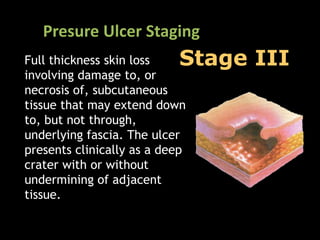
PrPresure Ulcer Stagingessure Ulcer
Staging skin loss
Full thickness      Stage III
involving damage to, or
necrosis of, subcutaneous
tissue that may extend down
to, but not through,
underlying fascia. The ulcer
presents clinically as a deep
crater with or without
undermining of adjacent
tissue.
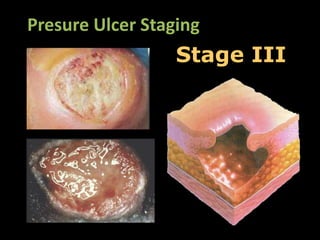
Presure Ulcer Staging
                  Stage III
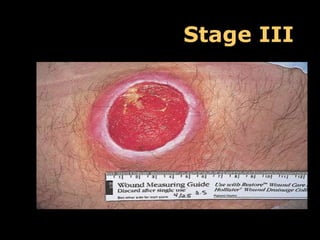
Stage III
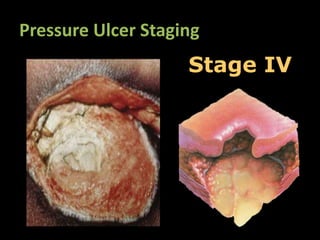
Pressure Ulcer Staging
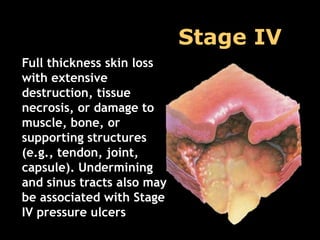
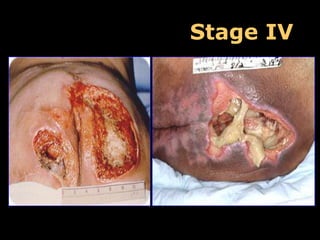
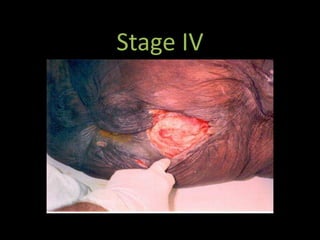
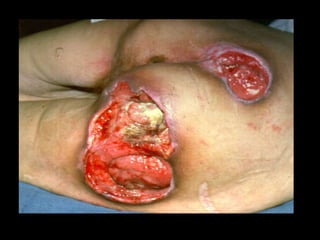
                    Stage IV
Full thickness skin loss
with extensive
destruction, tissue
necrosis, or damage to
muscle, bone, or
supporting structures
(e.g., tendon, joint,
capsule). Undermining
and sinus tracts also may
be associated with Stage
IV pressure ulcers
Pressure Ulcer Staging
                    Stage IV
Pressure Ulcer Staging tage IV
                     S
Stage IV
Stage IV
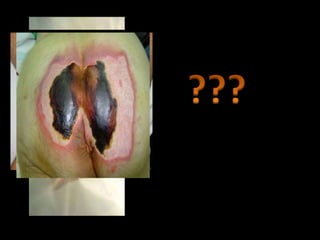
Unstageable/Unclassified:
The top layer of the sore is covered by
dead tissue, which may have a yellow, tan,
gray, green, or brown color. It may also
look like a scab. The dead tissue or scab
covers a deeper, more serious wound and
needs to be removed to be evaluated.
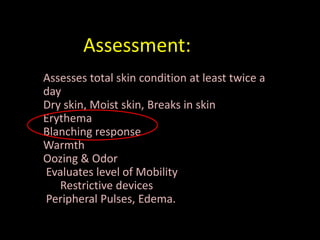
Assessment:
Assesses total skin condition at least twice a
day
Dry skin, Moist skin, Breaks in skin
Erythema
Blanching response
Warmth
Oozing & Odor
Evaluates level of Mobility
   Restrictive devices
Peripheral Pulses, Edema.
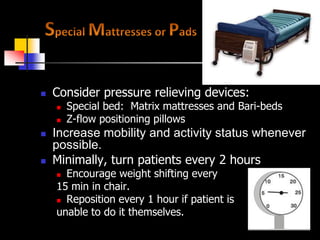
Minimize pressure for All patients
   Consider pressure relieving devices:
       Special bed: Matrix mattresses and Bari-beds
       Z-flow positioning pillows
   Increase mobility and activity status whenever
    possible.
   Minimally, turn patients every 2 hours
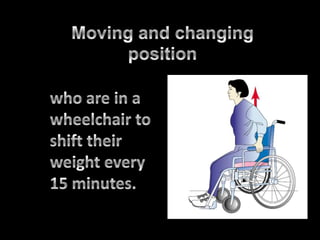
     Encourage weight shifting every
    15 min in chair.
     Reposition every 1 hour if patient is

    unable to do it themselves.
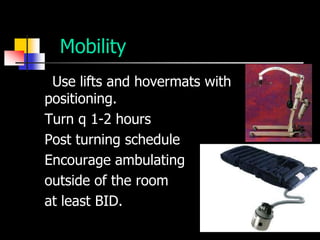
Mobility
*Use lifts and hovermats with
positioning.
Turn q 1-2 hours
Post turning schedule
Encourage ambulating
outside of the room
at least BID.
Moving and changing
       position
• Help persons
• Skin Care
• Skin inspection daily at end of the shift, Look closely at
  bony areas for redness or temperature changes.
• Wash skin with warm (not hot) water and use a mild
  soap. This will reduce irritation and dryness.
• Apply lotion to keep the skin from Drying Out.
• Gently Massaging intact skin may help with
  circulation and comfort. Avoid massaging bony
  areas.
• Keep clothes and bed sheets dry. Protect the skin
  from sweat and urine.
• Minimizing Friction and Shearing is also
  important through Proper Repositioning,
  Transferring, and Turning techniques.
  Bed Sheets & Blankets are Dry and
  Wrinkle-Free (smooth).
• Malnutrition should be treated
• Active and Passive range-of-motion
Moving and changing position
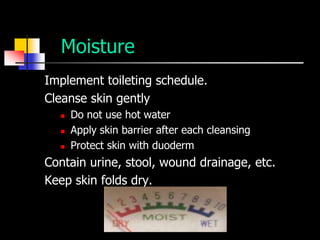
Moisture
Implement toileting schedule.
Cleanse skin gently
     Do not use hot water
     Apply skin barrier after each cleansing
     Protect skin with duoderm
Contain urine, stool, wound drainage, etc.
Keep skin folds dry.
Friction & Shear
   Use transfer devices
   Use minimum of 2 people + draw sheet
    to pull pt up in bed.
   Don’t drag the patient
   Keep HOB at or < 30 degrees
   Use trapeze
   Pad skin surfaces (duoderm)
    (elbows/heels)
Do not raise the head of the bed too high. .
 Cause skin damage to the lower back and
 buttocks areas.
Use a bed sheet or other device to help
 move the person.
Do not allow the person to lie or sit on a
 pressure ulcer. Move and change the
 person’s position regularly.
Reassessment:
   Re-inspect and palpate ALL patients
    every 8- 24 hours.
   Re-inspect when transferring between
    units.
   Re-inspect after long procedures, ie:
    dialysis, MRI’s, etc.
Pressure Ulcers are “mostly” Preventable
                                           causes
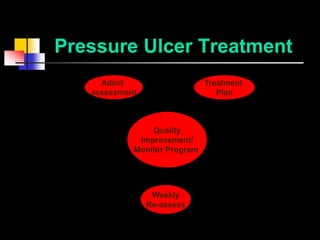
Pressure Ulcer Treatment
     Admit                    Treatment
   assessment                    Plan


                Quality
             Improvement/
            Monitor Program


                 Weekly
                Re-assess
Surgical intervention

   Débridement
    Incision and drainage
    Bone resection
   Skin grafting.
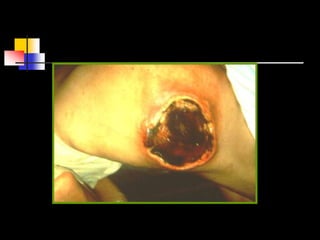
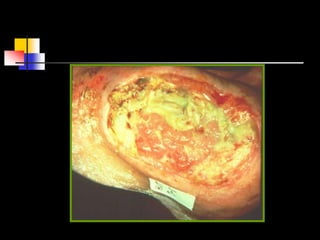
   Measure wounds upon admission and
    weekly (or with significant changes).

   Note the location, size, depth, color of
    wound bed and surrounding tissue and
           describe the drainage.
Size:
 Measure length, width and depth of
                wound.
 Measuring tools are available in unit
              storerooms.
   Describe wound as a clock with
patient’s head at 12:00 and their feet at
     6:00 to promote consistency in
              descriptions.
Types of debridement
• Autolytic – (Occlusive Dressings) the body
  heals itself
• Mechanical – using gauzes
• Enzymatic – chemical enzymes
  (Collagenase, Papain, )
• Sharps – scalpel, laser, surgery
• Biosurgical – maggots, leeches
79
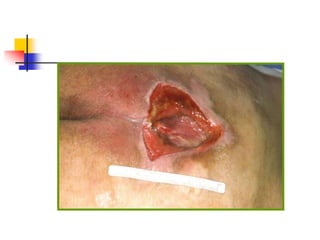
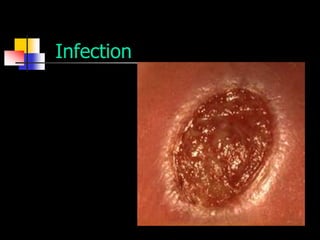
Infection
Signs of Infection
•   Delayed Healing
•   Change in Exudate
•   Change in Pain
•   Change in Granulation Tissue
•   Change in Smell
•   Change in Size
•   Fever
•   Leukocytosis
Topical Dressings
• Occlusive Dressings
• Divided into polymer films, polymer foams,
  hydrogels, hydrocolloids, alginates, and
  biomembranes.
• Dressings left in place until fluid leaks from
  the sides (3 days to 3 weeks)
Products

•   Hydrophyllic
•   Hydrogel
•   Alginate
•   Foam
•   Accuzyme
•   panafil
Transparent Film
•   Autolytic debridement
•   Partial thickness wounds
•   *Stage I or II pressure ulcers
•   Superficial burns
Hydrocolloids (Autolytic)
•   Primary or secondary dressing
•   *Partial and full thickness wounds
•   Pressure ulcers
•   *Necrotic wounds
•   Granular wounds preventative dressing
•   Used as a secondary dressing or under
    compression
Hydrogels
•   Stage 2 to stage 4 pressure ulcers
•   Partial and full thickness
•   *Painful wounds
•   Skin tears
•   Minor burns
•   *Necrotic wounds
Collagens
•   *Infected Wounds
•   Tunneling Wounds
•   Surgical Wounds
•   Can be used with other topical agents
•   *Not for necrotic wounds
Negative Pressure Therapy
• VAC Device
• For Nonhealing wounds and fecal
  incontinence
• Removes Interstitial Fluid from the
  wound
Antimicrobial Dressings
• Infected Wounds
• Controls bacteria bioburden
• Effective against a broadspectrum of
  microorganisms
• IODOSORB
• AQUACEL
• IODOFLEX
Saline –soaked Gauze
            Dressings
• Saline soaked and not allowed to dry
• Similar to occlusive dressings
• However, Time intensive for nursing
• *Used for Partial and full thickness wounds
• Draining wounds
• Wounds requiring debridement packing,
Or management of tunnels, tracts or dead space
• Surgical incisions/Burns/pressure ulcers
FOAM
• Nonocclusive absorptive wound dressing
• Partial and full thickness
  wounds…minimal to heavy drainage
• Stage II to IV press. Ulcers
• *Infected and non-infected
Skin Safety Team
   Team Members:
   Physicians
   Administrative sponsor
   Clinical Educators
   Nutrition
   Director of PT/OT
   Nursing Managers
   Nursing Head Nurses
   Performance Improvement
   Respiratory Therapy
   Many staff nurses
   Ad hoc: Product manager
   Ad hoc: Electronic Medical Records staff member
Bed sore stages
Bed sore stages

Bed sore stages

  • 8.
    Causes of SkinDamage: Pressure, Shear, Friction, Moisture Examples of Friction: Heels and elbows which aid in movement for bedridden patients. Agitated patients or those experiencing seizures. Superficial abrasion or blistering
  • 9.
  • 10.
    Causes of SkinDamage Moisture: .
  • 11.
    Shear Shear is theinteraction of gravity and friction causing twisting or kinking of blood vessels. Shear occurs when the skeleton moves, but the skin remains fixed to an external surface.
  • 12.
    Examples of Shear: Pulling patient up in bed Patient in Fowler’s position who slides down in bed Slide patient from bed to stretcher.
  • 13.
    Friction Friction contributes topressure ulcer formation by damaging the skin at the epidermal- dermal interface, the basement membrane. Friction ulcers are generally superficial and easily reversed, unless the cause is not removed.
  • 17.
    Factors Increasing Risk Advanced Age : decreased elastic fibers. More than 50% of pts with pressure sores >70 Decreased sensory perception Peripheral Vascular Disease Impaired Circulation Edema Vasoconstriction drugs MI/ Stroke, Trauma/fractures GI bleed
  • 18.
  • 19.
    Factors Increasing Risk Equipment: pneumoboots Spinal Cord injury: (Braces and stabilizing equipment) Neurological disorders Chronic medical conditions: diabetes, COPD, CHF History of pressure ulcers If have stage I, 10X greater risk of developing higher stage Preterm neonates Obesity/ Thin: 30 >BMI< 19
  • 20.
    Factors Increasing Risk Critical Lab: Prealbumin level (reflects Visceral Protein Stores) Mild depletion = 10-15 Moderate depletion = 5-10 Severe depletion = < 5
  • 21.
    Highest risk factors  >70 years  stroke  impaired mobility  pneumonia  current smoking  CHF  low BMI  fever  altered mental state  sepsis  urinary and fecal  hypotension incontinence  dry and scaly skin  malnutrition  history of pressure  restraints ulcers  cancer  anemia  diabetes  lymphopenia  hypoalbuminemia
  • 22.
    ALL patients requirea R. A at Admission & every 24 hours.
  • 23.
    Skin Safety: RiskAssessment Reassessment: Every 24 hours (Pressure ulcers can develop within 24 hours of insult or take as long as 5 days to present.) Change in condition (surgery, nutrition, level of mobility, etc)
  • 24.
    Braden Scale  The Braden score is the total of the subcategory scores.  Sensory Perception  Moisture  Activity  Mobility  Nutrition  Friction and Shear
  • 25.
    RISK ASSESSMENT: Low score=high risk *The Braden Scale •The Norton Scale 
  • 26.
    Sensory Moisture Activity Mobility Nutrition Friction & perception shear No impairment Rarely moist Walks No Excellent 4 No apparent 4 4 frequently 4 limitation 4 problem 3 Slightly Occasionally Walks Slightly Adequate 3 Potential limited 3 moist 3 Occasionally 3 limited 3 problem 2 Very limited Moist 2 Chairfast 2 Very Properly Problem 2 limited 2 inadequate2 Completely constantly Bedfast 1 Immobile 1 Very poor 1 limited 1 moist 1 Total Total Total Total Total Total Grand total = ---------------
  • 28.
    Risk for PressureUlcers Norton scale • A score of 14 or less indicate risk for pressure ulcers; score under 12 indicates high risk Physical Mental condition Activity Mobility Continence condition Good 4 Alert 4 Walks frequently full 4 Good 4 4 Fair 3 Apathetic 3 Walks with help 3 Slightly Occasional limited 3 incontinence 3 Poor 2 Confused 2 Sit in chair 2 Very limited Frequent 2 incontinence 2 Very poor 1 Stuporous 1 Remain Bed 1 Immobile 1 Urine & fecal incontinence 1 Total Total Total Total Total Grand total = ---------------
  • 29.
    Sensory Perception Defined as: Theability to respond meaningfully to pressure related discomfort. Score on scale of 1-4 1. Completely limited  Unresponsive or inability to feel pain 2. Very limited  Sensory impairment, moaning or restlessness 3. Slightly limited  Some sensory impairment, can’t communicate need to be turned. 4. No limitations  Has no sensory deficits
  • 30.
    Moisture  Defined as:  the degree to which skin is exposed to moisture.  Score on scale of 1-4: 1. Constantly Moist  Sweating, incontinent, noticed each time pt is turned or moved. 2. Moist  Often moist, linen changed 1x/ shift 3. Occasionally moist  Extra linen change 1x/day 4. Rarely moist  Skin is usually dry, linen changed routinely
  • 31.
    Friction & Shear  Score on scale of 1-3 1. Problem  Requires max assist for moving  Sliding against sheets is impossible  Frequently slides down in bed  Agitation leads to almost constant friction 2. Potential Problem  Requires minimal assist for moving  Skin slides to some extent on sheets  Occasionally slides down in bed or chair 3. No apparent problem  Moves independently  Lifts up completely during move  Maintains good position in bed or chair
  • 32.
    Activity  Defined as:  the degree of physical activity.  Score on scale of 1-4: 1. Bed fast  Confined to the bed 2. Chair fast  Ability to walk is almost non-existent, must be assisted into chair. 3. Walks occasionally  Short distances, infrequent, most of time in bed or chair. 4. Walks frequently  Walks outside of room 2x/day  Walks inside of room q 2 hours.
  • 33.
    Nutrition  Defined as “usual food intake pattern.”  Score on scale of 1-4 1. Very poor  Never eats complete meal  Takes fluid poorly  NPO/ IV fluids only >5 days 2. Probably inadequate  Rarely eats a complete meal  Occasionally will take supplement 3. Adequate  Eats ½ of most meals  Will take supplement if miss meals  On TPN or adequate tube feedings 4. Excellent  Eats every meal  Does not require supplements
  • 38.
    Presure Ulcer Staging Stage I Dark Skin
  • 39.
  • 40.
    Presure Ulcer Staging Stage II • Stage 2: Partial thickness skin loss involving epidermis, dermis, or both. The ulcer is superficial and presents clinically as an abrasion, blister, or shallow crater.
  • 41.
  • 42.
  • 43.
  • 44.
  • 45.
    PrPresure Ulcer StagingessureUlcer Staging skin loss Full thickness Stage III involving damage to, or necrosis of, subcutaneous tissue that may extend down to, but not through, underlying fascia. The ulcer presents clinically as a deep crater with or without undermining of adjacent tissue.
  • 46.
  • 47.
  • 48.
    Pressure Ulcer Staging Stage IV Full thickness skin loss with extensive destruction, tissue necrosis, or damage to muscle, bone, or supporting structures (e.g., tendon, joint, capsule). Undermining and sinus tracts also may be associated with Stage IV pressure ulcers
  • 49.
  • 50.
  • 51.
  • 52.
  • 53.
    Unstageable/Unclassified: The top layerof the sore is covered by dead tissue, which may have a yellow, tan, gray, green, or brown color. It may also look like a scab. The dead tissue or scab covers a deeper, more serious wound and needs to be removed to be evaluated.
  • 58.
    Assessment: Assesses total skincondition at least twice a day Dry skin, Moist skin, Breaks in skin Erythema Blanching response Warmth Oozing & Odor Evaluates level of Mobility Restrictive devices Peripheral Pulses, Edema.
  • 60.
    Minimize pressure forAll patients  Consider pressure relieving devices:  Special bed: Matrix mattresses and Bari-beds  Z-flow positioning pillows  Increase mobility and activity status whenever possible.  Minimally, turn patients every 2 hours  Encourage weight shifting every 15 min in chair.  Reposition every 1 hour if patient is unable to do it themselves.
  • 61.
    Mobility *Use lifts andhovermats with positioning. Turn q 1-2 hours Post turning schedule Encourage ambulating outside of the room at least BID.
  • 62.
    Moving and changing position • Help persons
  • 63.
    • Skin Care •Skin inspection daily at end of the shift, Look closely at bony areas for redness or temperature changes. • Wash skin with warm (not hot) water and use a mild soap. This will reduce irritation and dryness. • Apply lotion to keep the skin from Drying Out. • Gently Massaging intact skin may help with circulation and comfort. Avoid massaging bony areas. • Keep clothes and bed sheets dry. Protect the skin from sweat and urine.
  • 64.
    • Minimizing Frictionand Shearing is also important through Proper Repositioning, Transferring, and Turning techniques. Bed Sheets & Blankets are Dry and Wrinkle-Free (smooth). • Malnutrition should be treated • Active and Passive range-of-motion
  • 65.
  • 66.
    Moisture Implement toileting schedule. Cleanseskin gently  Do not use hot water  Apply skin barrier after each cleansing  Protect skin with duoderm Contain urine, stool, wound drainage, etc. Keep skin folds dry.
  • 67.
    Friction & Shear  Use transfer devices  Use minimum of 2 people + draw sheet to pull pt up in bed.  Don’t drag the patient  Keep HOB at or < 30 degrees  Use trapeze  Pad skin surfaces (duoderm) (elbows/heels)
  • 69.
    Do not raisethe head of the bed too high. . Cause skin damage to the lower back and buttocks areas. Use a bed sheet or other device to help move the person. Do not allow the person to lie or sit on a pressure ulcer. Move and change the person’s position regularly.
  • 70.
    Reassessment:  Re-inspect and palpate ALL patients every 8- 24 hours.  Re-inspect when transferring between units.  Re-inspect after long procedures, ie: dialysis, MRI’s, etc.
  • 71.
    Pressure Ulcers are“mostly” Preventable causes
  • 73.
    Pressure Ulcer Treatment Admit Treatment assessment Plan Quality Improvement/ Monitor Program Weekly Re-assess
  • 74.
    Surgical intervention  Débridement  Incision and drainage  Bone resection  Skin grafting.
  • 75.
    Measure wounds upon admission and weekly (or with significant changes).  Note the location, size, depth, color of wound bed and surrounding tissue and describe the drainage.
  • 76.
    Size:  Measure length,width and depth of wound.  Measuring tools are available in unit storerooms.  Describe wound as a clock with patient’s head at 12:00 and their feet at 6:00 to promote consistency in descriptions.
  • 77.
    Types of debridement •Autolytic – (Occlusive Dressings) the body heals itself • Mechanical – using gauzes • Enzymatic – chemical enzymes (Collagenase, Papain, ) • Sharps – scalpel, laser, surgery • Biosurgical – maggots, leeches
  • 79.
  • 81.
  • 82.
    Signs of Infection • Delayed Healing • Change in Exudate • Change in Pain • Change in Granulation Tissue • Change in Smell • Change in Size • Fever • Leukocytosis
  • 83.
    Topical Dressings • OcclusiveDressings • Divided into polymer films, polymer foams, hydrogels, hydrocolloids, alginates, and biomembranes. • Dressings left in place until fluid leaks from the sides (3 days to 3 weeks)
  • 84.
    Products • Hydrophyllic • Hydrogel • Alginate • Foam • Accuzyme • panafil
  • 85.
    Transparent Film • Autolytic debridement • Partial thickness wounds • *Stage I or II pressure ulcers • Superficial burns
  • 86.
    Hydrocolloids (Autolytic) • Primary or secondary dressing • *Partial and full thickness wounds • Pressure ulcers • *Necrotic wounds • Granular wounds preventative dressing • Used as a secondary dressing or under compression
  • 87.
    Hydrogels • Stage 2 to stage 4 pressure ulcers • Partial and full thickness • *Painful wounds • Skin tears • Minor burns • *Necrotic wounds
  • 88.
    Collagens • *Infected Wounds • Tunneling Wounds • Surgical Wounds • Can be used with other topical agents • *Not for necrotic wounds
  • 89.
    Negative Pressure Therapy •VAC Device • For Nonhealing wounds and fecal incontinence • Removes Interstitial Fluid from the wound
  • 90.
    Antimicrobial Dressings • InfectedWounds • Controls bacteria bioburden • Effective against a broadspectrum of microorganisms • IODOSORB • AQUACEL • IODOFLEX
  • 91.
    Saline –soaked Gauze Dressings • Saline soaked and not allowed to dry • Similar to occlusive dressings • However, Time intensive for nursing • *Used for Partial and full thickness wounds • Draining wounds • Wounds requiring debridement packing, Or management of tunnels, tracts or dead space • Surgical incisions/Burns/pressure ulcers
  • 92.
    FOAM • Nonocclusive absorptivewound dressing • Partial and full thickness wounds…minimal to heavy drainage • Stage II to IV press. Ulcers • *Infected and non-infected
  • 93.
    Skin Safety Team  Team Members:  Physicians  Administrative sponsor  Clinical Educators  Nutrition  Director of PT/OT  Nursing Managers  Nursing Head Nurses  Performance Improvement  Respiratory Therapy  Many staff nurses  Ad hoc: Product manager  Ad hoc: Electronic Medical Records staff member