Introduction
Purpose
Articles required
Procedure
Care of the dead and dying is one of the most
complex and challenging responsibilities of the
nurse. The attitude of the nurse about death and
dying affect their ability to provide care.
Dead body care should be carried according to
hospital policy. Because care may be influenced by
religious law, it should be taken into consideration.
Care can be delegated immediately except for
organ donation and autopsy request.
 To release the dead body to
the relatives with respect and
dignity
 To maintain hygiene
 Bath towels
 Wash clothes
 Shroud
 Kit with name tags
 Bed linen
 Documentation forms
 Cotton swabs
 comb
 Physician and other designated health care
providers certify death, document time of
death, action taken.
 Physician request an autopsy in case
necessary
 Validates state for organ donation. Maintain
sensitivity to personal, religious and cultural
beliefs
 Provide sensitive and dignified nursing care to
the client and family
 Note if you need to collect any specimen.
 Ask if the family wishes to participate in the
preparation of the body.
 Ask about family request for body preparation
such as wearing of special clothing, shaving of
beard in male according to cultural practices.
 All the equipment, soiled linen and supplies
should be removed from the bedside.
 Some agencies require that all tubes in the
body remain in place; in other agencies tubes
may be cut to within 25 cm (1 inch) of the
skin and taped in place; in others all the
tubes may be removed.
 Body should be placed in supine position
with arms on either side, palms down or
across the abdomen.
 One pillow is placed under the head and
shoulders to prevent blood from discoloring
the face.
 The eyelids are closed and held in place for few
seconds so that they remain closed.
 Dentures are usually inserted to help give the
face a natural appearance. Then the mouth is
closed
 Soiled part of the body are washed, however,
complete bath is not necessary
 Absorbent are placed under the buttocks to take
of any feces and urine released because of the
relaxation of the sphincter muscles.
 Clean gown placed on the client, hair brushed
and combed.
 All jewelry should be removed except for those
which family wishes to keep.
 The top bed linen are adjusted neatly to cover
the client to the shoulders.
 Cotton swabs are kept in nose and ears.
 Soft lighting and chairs are provided for the
family.
 Offer family member to view the body.
Encourage to say goodbye in their own way.
 Provide privacy
 After body viewed by family, the deceased
identification tag is applied. Body wrapped in shroud.
Identification tag should be applied in shroud.
 Then body is taken to morgue
 Nurses have to handle the deceased with dignity and
label the corpse appropriately
 Nurses provide support and reinforce explanation to
grieving family members who often need clarification
of what they are told during the request process
 If life support is being continued for organ donation
even though the client with brain death has been
declared legally dead, they need to be explained that
life supports only preserving vital organs.
 Take consent from family members for
autopsy in case when death is due to foul play,
homicide, suicide, accidental cases e.g.
trauma, crashes, fall, poisoning, death within
24 hours of hospital admission
:
 Documentation of death for legal record. Follow
agency policy and protocol.
Documentation should include the following
 Time and date of death and all action taken to
respond the impending death
 Name and designation of health care provider
certifying death, persons notified of death
 Request for organ donation
 Special preparation of the body
 Medical tubes and lines left inside the body
 Personal articles given to the family with
description, date time and given to whom.
 Location of identification tag.
 Time of body transfer and destination
 Any other relevant information or family
request that help clarify special circumstances
 Send the patient’s file to billing counter for
account clearance.
 In case of medico-legal cases, notify it to
concerned/ legal authorities before handing
over to the relatives or sending it to mortuary.
 The patient’s body may have to be placed in the
hospital morgue refrigerator if mortuary
arrangements were not made before patient’s
death.
 If patient died of communicable disease the body
may require special handling to prevent spread of
disease.
 After removing dead body from ward clean the
bed and room thoroughly and disinfect all the
articles used and replace it in proper place.
 I have the right to be treated as a living human
being until I die.
 I have the right to maintain a sense of
hopefulness, however changing its focus may be.
 I have the right to be cared for those who can
maintain a sense of hopefulness, however
changing this might be
 I have the right to express my feelings and
emotions about my approaching death in my own
way.
 I have the right to participate in decisions
concerning my care.
 I have the right to expect continuing medical and
nursing attention even though ”cure” goals must
be changed to “comfort” goals
 I have the right not to die alone.
 I have the right to be free from pain.
 I have the right to have my questions
answered honestly.
 I have the right not to be deceived.
 I have the right to have help from and for my
family in accepting my death.
 I have the right to die in peace and dignity.
 I have the right to retain my individuality and
not to be judged for my decisions, which may
be contrary to beliefs of others.
 I have the right to discuss and enlarge my
religious and/ or spiritual experiences, whatever
these may mean to others.
 I have the right to expect that the sanctity of the
human body will be respected after death.
 I have the right to be cared for by caring,
sensitive, knowledgeable people who will attempt
to understand my needs and will be able to gain
some satisfaction in helping me face my death.
Source: Reprinted with permission from Barbus,
A.J. (19750). The Dying Patient’s Bill of Rights.
American Journal of Nursing, 75 (1),99
 Provide support and care by listening to the
family’s expression of grief, loss and
hopelessness
 Help in their grieving process. Allow them to
take time to accept sudden and unexpected
death
 The nurse can attend funeral if she has been
the caregiver of the patient p call or make a
follow up call to the patient’s family.
Caring for other patients
 The care of other patients should not be left
out
 Routine care provided to them should not be
interfered by the process
 Provide emotional support and help to cope
with their illness and time of crisis if they
were having close relationship with the
deceased patient.
x
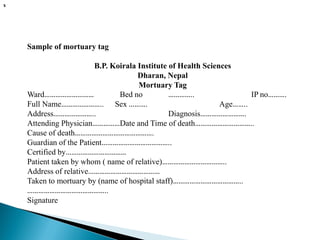
Sample of mortuary tag
B.P. Koirala Institute of Health Sciences
Dharan, Nepal
Mortuary Tag
Ward……………………… Bed no ………….. IP no……….
Full Name………………….. Sex ………. Age……..
Address………………….. Diagnosis…………………….
Attending Physician……………Date and Time of death…………………………..
Cause of death…………………………………….
Guardian of the Patient………………………………..
Certified by……………………………
Patient taken by whom ( name of relative)……………………………..
Address of relative…………………………………
Taken to mortuary by (name of hospital staff)………………………………..
……………………………………..
Signature
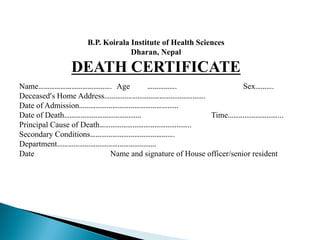
B.P. Koirala Institute of Health Sciences
Dharan, Nepal
DEATH CERTIFICATE
Name…………………………………. Age ……………. Sex……….
Deceased’s Home Address……………………………………………….
Date of Admission………………………………………………
Date of Death…………………………………… Time………………………...
Principal Cause of Death…………………………………………..
Secondary Conditions……………………………………….
Department………………………………………………
Date Name and signature of House officer/senior resident
6. dead body care pp

6. dead body care pp

  • 2.
  • 3.
    Care of thedead and dying is one of the most complex and challenging responsibilities of the nurse. The attitude of the nurse about death and dying affect their ability to provide care. Dead body care should be carried according to hospital policy. Because care may be influenced by religious law, it should be taken into consideration. Care can be delegated immediately except for organ donation and autopsy request.
  • 4.
     To releasethe dead body to the relatives with respect and dignity  To maintain hygiene
  • 5.
     Bath towels Wash clothes  Shroud  Kit with name tags  Bed linen  Documentation forms  Cotton swabs  comb
  • 6.
     Physician andother designated health care providers certify death, document time of death, action taken.  Physician request an autopsy in case necessary  Validates state for organ donation. Maintain sensitivity to personal, religious and cultural beliefs
  • 7.
     Provide sensitiveand dignified nursing care to the client and family  Note if you need to collect any specimen.  Ask if the family wishes to participate in the preparation of the body.  Ask about family request for body preparation such as wearing of special clothing, shaving of beard in male according to cultural practices.  All the equipment, soiled linen and supplies should be removed from the bedside.
  • 8.
     Some agenciesrequire that all tubes in the body remain in place; in other agencies tubes may be cut to within 25 cm (1 inch) of the skin and taped in place; in others all the tubes may be removed.  Body should be placed in supine position with arms on either side, palms down or across the abdomen.  One pillow is placed under the head and shoulders to prevent blood from discoloring the face.
  • 9.
     The eyelidsare closed and held in place for few seconds so that they remain closed.  Dentures are usually inserted to help give the face a natural appearance. Then the mouth is closed  Soiled part of the body are washed, however, complete bath is not necessary  Absorbent are placed under the buttocks to take of any feces and urine released because of the relaxation of the sphincter muscles.  Clean gown placed on the client, hair brushed and combed.
  • 10.
     All jewelryshould be removed except for those which family wishes to keep.  The top bed linen are adjusted neatly to cover the client to the shoulders.  Cotton swabs are kept in nose and ears.  Soft lighting and chairs are provided for the family.  Offer family member to view the body. Encourage to say goodbye in their own way.  Provide privacy
  • 11.
     After bodyviewed by family, the deceased identification tag is applied. Body wrapped in shroud. Identification tag should be applied in shroud.  Then body is taken to morgue  Nurses have to handle the deceased with dignity and label the corpse appropriately  Nurses provide support and reinforce explanation to grieving family members who often need clarification of what they are told during the request process  If life support is being continued for organ donation even though the client with brain death has been declared legally dead, they need to be explained that life supports only preserving vital organs.
  • 12.
     Take consentfrom family members for autopsy in case when death is due to foul play, homicide, suicide, accidental cases e.g. trauma, crashes, fall, poisoning, death within 24 hours of hospital admission :
  • 13.
     Documentation ofdeath for legal record. Follow agency policy and protocol. Documentation should include the following  Time and date of death and all action taken to respond the impending death  Name and designation of health care provider certifying death, persons notified of death  Request for organ donation  Special preparation of the body  Medical tubes and lines left inside the body
  • 14.
     Personal articlesgiven to the family with description, date time and given to whom.  Location of identification tag.  Time of body transfer and destination  Any other relevant information or family request that help clarify special circumstances  Send the patient’s file to billing counter for account clearance.  In case of medico-legal cases, notify it to concerned/ legal authorities before handing over to the relatives or sending it to mortuary.
  • 15.
     The patient’sbody may have to be placed in the hospital morgue refrigerator if mortuary arrangements were not made before patient’s death.  If patient died of communicable disease the body may require special handling to prevent spread of disease.  After removing dead body from ward clean the bed and room thoroughly and disinfect all the articles used and replace it in proper place.
  • 16.
     I havethe right to be treated as a living human being until I die.  I have the right to maintain a sense of hopefulness, however changing its focus may be.  I have the right to be cared for those who can maintain a sense of hopefulness, however changing this might be  I have the right to express my feelings and emotions about my approaching death in my own way.  I have the right to participate in decisions concerning my care.  I have the right to expect continuing medical and nursing attention even though ”cure” goals must be changed to “comfort” goals
  • 17.
     I havethe right not to die alone.  I have the right to be free from pain.  I have the right to have my questions answered honestly.  I have the right not to be deceived.  I have the right to have help from and for my family in accepting my death.  I have the right to die in peace and dignity.  I have the right to retain my individuality and not to be judged for my decisions, which may be contrary to beliefs of others.
  • 18.
     I havethe right to discuss and enlarge my religious and/ or spiritual experiences, whatever these may mean to others.  I have the right to expect that the sanctity of the human body will be respected after death.  I have the right to be cared for by caring, sensitive, knowledgeable people who will attempt to understand my needs and will be able to gain some satisfaction in helping me face my death. Source: Reprinted with permission from Barbus, A.J. (19750). The Dying Patient’s Bill of Rights. American Journal of Nursing, 75 (1),99
  • 19.
     Provide supportand care by listening to the family’s expression of grief, loss and hopelessness  Help in their grieving process. Allow them to take time to accept sudden and unexpected death  The nurse can attend funeral if she has been the caregiver of the patient p call or make a follow up call to the patient’s family.
  • 20.
    Caring for otherpatients  The care of other patients should not be left out  Routine care provided to them should not be interfered by the process  Provide emotional support and help to cope with their illness and time of crisis if they were having close relationship with the deceased patient.
  • 21.
    x Sample of mortuarytag B.P. Koirala Institute of Health Sciences Dharan, Nepal Mortuary Tag Ward……………………… Bed no ………….. IP no………. Full Name………………….. Sex ………. Age…….. Address………………….. Diagnosis……………………. Attending Physician……………Date and Time of death………………………….. Cause of death……………………………………. Guardian of the Patient……………………………….. Certified by…………………………… Patient taken by whom ( name of relative)…………………………….. Address of relative………………………………… Taken to mortuary by (name of hospital staff)……………………………….. …………………………………….. Signature
  • 22.
    B.P. Koirala Instituteof Health Sciences Dharan, Nepal DEATH CERTIFICATE Name…………………………………. Age ……………. Sex………. Deceased’s Home Address………………………………………………. Date of Admission……………………………………………… Date of Death…………………………………… Time………………………... Principal Cause of Death………………………………………….. Secondary Conditions………………………………………. Department……………………………………………… Date Name and signature of House officer/senior resident