
DEATH
Death is not an event , it is a process.
Death means absence of life or it is the loss of vital organs or processes that keep a
living thing alive.
Definitions
Death is defined as,
1. “Cessation of heart-lung function or of whole brain function or of higher brain
function”
2. “Either irreversible cessation of circulatory and respiratory functions or
irreversible cessation of all functions of the entire brain , including the brain
stem”
CLINICAL SIGNS OF DEATH
In 1968, the World Medical Assembly adopted the following guidelines for physicians as indications of death:
• Total lack of response to external stimuli
• No muscular movements , especially breathing
• Absence of all reflexes
• Flat encephalogram(EEG)
OTHER SIGNS INCLUDE
• Absence of pulse, heart beat and respiration
• Pupils of the eyes becomes fixed/dilated & nonreactive to light
• Pallor/cyanosis of the skin(due to lack of O2 in the blood)
• Red blood cells rolling to a stop or forming rouleaux in the retinal vessels(seen via an ophthalmoscope)
• Rigor mortis
• Algor mortis
• Livor mortis
• Autolysis(decomposition)
Rigor Mortis (cadaveric rigidity)
• Rigor mortis is the stiffening of the body that occurs 2-4 hours after the
death. It is due to the lack of ATP , which is not synthesized in the body
after death. Which causes muscles to contract (hard and dense) which in
turn immobilize the joints.
• It starts in the involuntary muscles(heart, bladder etc.), then progress to
voluntary muscles like head, neck, trunk and extremities. The arms and
legs cannot be bent or straightened while rigor mortis present unless the
tendons are torn.
• Rigor mortis is most intense 24 hrs after death and disappears
completely(secondary relaxation) in the same sequence 3-4 days after
the death because of autolysis muscle tissues.
Algor Mortis(cooling of the corpse)
• Algor mortis is the gradual decrease of the body temperature after death. When
blood circulation terminates and hypothalamus ceases to function, body
temperature falls down.
• The body temperature decreases about 1 degree celsius per hour during the first 6
hours after death and then the cooling rate slows down about 1 degree per 1.5-2
hours of the post-mortem period.
• Simultaneously, the skin loses its elasticity and can easily be broken when removing
dressings and adhesive tape.
Livor Mortis(death spots/post-mortem hypostasis)
Livor mortis is the purplish red or bluish discoloration of the body occurs with in 30
minutes to 1 hour after death. After blood circulation stops ,RBC broken down,
releasing haemoglobin and due to effect of gravity blood begins to
accumulate/settled in the lowest body parts(dependent areas). As a result the
discoloration(death spots)begins to appear.
Autolysis(decomposition)
• Autolysis is the destruction (self digestion)of the body tissues
through the action of its own enzymes or due to the action of the
bacterias present in the body(putrefaction), which occurs after death.
• The hotter the temperature, the more rapid the changes
• Time required – It commences 3-4 hours after death , up to 2-3 days
and sometimes longer.
• Changes in the putrefaction- color changes, development of foul
smelling gases, pressure effects of gases, appearance of maggots etc
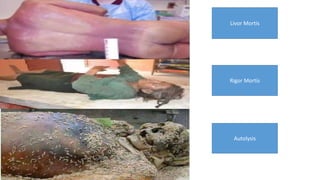
Autolysis
Rigor Mortis
Livor Mortis
(CARE OF THE BODY AFTER DEATH/LAST OFFICE OF THE DEATH)
DEATH CARE
Care of the dead and dying is one of the most complex and challenging
responsibilities of the nurse. The attitude of the nurse about death and dying
affect their ability to provide care. Dead body care should be carried
according to hospital policy.It is a process that demonstrates respect for the
deceased and is focused on respecting their religious and cultural beliefs, as
well as health and safety and legal requirements.
DEFINITION
Death care means “care given to the body within 30-45 minutes after death
following the declaration of death by the physician”
PURPOSES
• To maintain normal body alignment before rigor mortis sets in.
• To reduce mental distress of family.
• To facilitate transportation to mortuary/ residence.
• To make the body looks natural and beautiful as possible.
• To release the dead body to the relatives with respect and dignity
• To protect other patients from unpleasant sights and sounds which
could frighten them.
Caring of the body after death
• After the physician has pronounced death and legally documented the death in
the medical record, care of the body is usually performed by the nurse. Nurses
should handle the deceased with dignity.
• Autopsy consent may be requested and obtained from family members if
required (if the death is due to any foul play like homicide, suicide, accident cases
etc.)
• If the patient is to be an organ donor, arrangements will be made
immediately(Give proper explanation to the family regarding why the life support
is being continued for organ donation)
• Inform the patient’s relatives/next of kin about the patient’s death. The family
often wishes to view the body before final preparations are made. They may be
allowed and if the patients had any valuables, they are handed over to the
relatives.
• Ask if the relatives wish to see the chaplain or an appropriate religious leaders to
the person’s faith or ethnic origins that need to be attended immediately.
ARTICLES
A Tray lined with towel contains,
• Long artery forceps
• Tilley forceps ( For nasal packing)
• Bandage
• Absorbent and non absorbent cotton.
• Patient’s clothes.
• Long Mackintosh
• Perineal pads
• Shroud/ body bag/ sheet.
• Clean gloves
• Articles for cleaning/shaving / bathing the body.
• Identification tags/mortuary tag
PRE PROCEDURE CARE
1. Assess for presence of family or significant others and whether they
have been informed of the patient’s death.
2. Ask if they wish to view the body. Observe their response and allow
them to clarify the doubts. Allow the patient’s relatives to involve in the
care if they desires .
2. Assess patient’s religious and cultural practices.
3. Determine if patient was on isolation. Take Precautions for
preventing spread of infectious disease.
4. Close room door or draw bedside curtains.
PROCEDURE
Steps Rationale
1. Wash hands and wear protective devices.
2. Identify the body according to agency policy.
3. Remove backrest, extra pillows and gently put patient in supine
position with the head elevated on one pillow /folded towel.
Position-supine with arms at side, palms down or arm across the
abdomen. Do not place hands one on top of the other. Because
bottom hand will become discoloured.
4. Gently place nurse’s fingers over the closed eyelid, for a few seconds
or Close eyes by keeping wet cotton balls on eyelids.
5. Insert dentures in to mouth if applicable. If mouth fails to close,
place a rolled towel under the chin. Apply jaw bandage.
6. Remove all bottles, bags, tubes, IV lines etc. Aspirate the gastric
content through NG tube( if ryles tube is present).Urinary catheter is
removed after the urine completely drained out.(Some agencies
require that all tubes in the body remain in place; in other agencies
tubes may be cut to within 25 cm (1 inch) of the skin and taped in
places)
Reduce transmission of microorganisms
To prevent post-mortem hypostasis of
blood.
For a natural appearance.
Maintain normal facial impression
Steps Rationale
7. Remove soiled dressing in the wound and replace with clean gauze
dressing.
8. Sponge/clean the patient (soiled part of the body). Brush and comb hair
9. Plug body orifices such as nose, mouth,urethra,vagina and rectum with
absorbent cotton followed by non-absorbent cotton. Ears to be plugged
only if there is CSF leakage.
10. Fold hands as in praying position and tie thumb together.
11. Straighten legs, bring feet together and tie big toe.
12. Place an absorbent pad/diaper/perineal pad under the patient’s buttocks.
13. Provide clean clothes.
14. Take care of valuables and personal belongings by handing over to
members of the family and get signed by the name and relationship.
15. Allow members of the family to see the patient and remain in the room
and remember that the body still dear to someone.
Relaxation of sphincter muscles after
death may cause release of urine,
faces and body fluids.
To maintain naturality.
To avoid soiling of clothings.
Prevents loss of valuables
Maintains dignity and respect for the
patient and family.
Steps Rationale
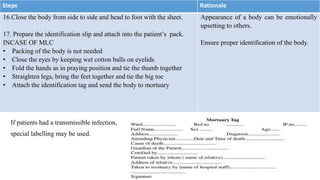
16.Close the body from side to side and head to foot with the sheet.
17. Prepare the identification slip and attach into the patient’s pack.
INCASE OF MLC
• Packing of the body is not needed
• Close the eyes by keeping wet cotton balls on eyelids
• Fold the hands as in praying position and tie the thumb together
• Straighten legs, bring the feet together and tie the big toe
• Attach the identification tag and send the body to mortuary
Appearance of a body can be emotionally
upsetting to others.
Ensure proper identification of the body.
If patients had a transmissible infection,
special labelling may be used.
POST PROCEDURE CARE
• Send the patient’s file to billing counter for account clearance
• Arrange for transportation of the body to the mortuary /residence.
• Carefully transfer the body to a stretcher keeping the body aligned. covered
with clean sheet.
• Remove remaining items and linen from the patient’s room, wash hands
• Record date and time of death, complete the nurse’s record, death register
and forms
• Room should be fumigated after the transfer of body.
• Hand over the body to the responsible person. In case of MLC, police
clearance should be done or notify the death to concerned legal authorities
before handing over the body to relatives or sending to the mortuary.
Care of the unit after death
• Terminal cleaning of a unit should be done when the patient is discharged,
transferred or dies. This type of cleaning includes more activity than the daily
(concurrent)cleaning of the area.
• After a patient dies and before admitting another patient, the room is cleaned and
aired.
• Windows & doors are opened. The doors, windows, furniture& light shades are
washed and cleaned.
• All articles used by the patient should be taken to the utility room, washed,
cleaned, sterilized if necessary or disinfected by chemicals. These are rearranged
and kept ready for the next patient
• All unwanted things are discarded. Used linens are sent to laundry
• Mattress, pillows, blankets etc. should be exposed to the sunlight and then the bed
is remade with fresh linen
• If the room was used for a patient with communicable disease, it should be
fumigated with the articles used by the patient.
Death & Care of dead  body