MEDICAL ASEPSIS
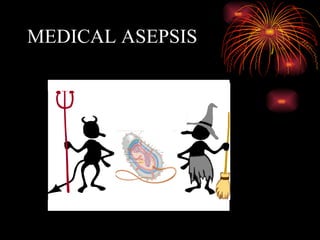
MEDICAL ASEPSIS All practices intended to confine a specific microorganism to a specific area, limiting their number, growth,  and transmission.  (Clean/ dirty/ contaminated) Procedures used to protect the client and his environment from the transmission of disease producing organisms that can transmit from one to the other
METHODS OF MEDICAL ASEPSIS Isolation precautions Hand washing Use of gown, mask, gloves, glasses Use of disposables, clean surfaces Concurrent and terminal disinfection Control and teaching of visitors/ relatives Developing staff health and hygiene and education Preventive vaccination, inoculation and medicines Use of labour saving and efficient devices for aseptic practices
ISOLATION PRECAUTIONS Isolation – Measures to prevent the spread of infections or potentially infectious organisms to health personnel, client and visitors Barrier technique (Reverse isolation) - Measures to protect highly susceptible (compromised) clients from infection
ISOLATION SYSTEMS USED IN HEALTH CARE AGENCIES  Centers for Disease Control & prevention (CDC)  precaution – involves procedures for - Category specific Isolation (CSI) precaution Disease specific isolation (DSI) precaution Universal precaution Body Substance Isolation (BSI) system
CDC ISOLATION PRECAUTIONS… Category Specific Isolation- Based on 7 categories- 1.  Strict Isolation  2.  Contact Isolation 3.  Respiratory Isolation  4.  TB Isolation 5.  Enteric precautions 6.  Drainage/ secretions precautions 7.  Blood/ body fluid precautions
CDC ISOLATION PRECAUTIONS… Disease Specific Isolation – According to specific disease conditions Universal Precautions – Blood and body fluid precautions.  Decrease the risk of transmitting unidentified pathogens Hepatitis B, C, and HIV Does not apply to feces, nasal secretions, sputum, sweat, tears, urine, vomitus unless they contain visible blood Used in conjunction with CSI & DSI
BODY SUBSTANCE ISOLATION Includes all body parts and secretions and excretions Does not include clients with airborne diseases Follows hand washing, gloving, gowning, wearing masks, eye wear, hair and shoe covers Adheres to needle destruction and disposal and proper disposal of waste
IMPLEMENTING ISOLATION PRECAUTIONS A nursing responsibility Based on comprehensive assessment of the client Status of client’s defense system Client's ability to implement isolation  precautions Source and mode o transmission of infectious  agent Follow specific precautions during therapies for client’s benefit Decision made on the method of isolation precaution
HAND WASHING Cut nails short, remove all jewelry, check for breaks/ cuts in the skin  Turn on the water, adjust the flow Wet hands thoroughly under running water, apply soap Hold hands lower than the elbows Thoroughly wash and rinse the hands Use firm rubbing and circular movements the palm, back and wrist of each hand.  Interlace fingers and thumbs and move the hands back and forth ---for 10seconds Turn off the water Dry hands thoroughly with a paper towel
USE OF FACE MASKS To reduce risk of transmission by droplet contact, air borne routes and splatters of body substances To be worn by – Those close to the client (in measles, mumps, Ac resp diseases) – large particle aerosols travel short distances (1 m of 3 ft) All persons entering the room ( in Pulm TB)- small particle aerosols remain suspended in the air, and thus travel great distances Masks –  Should have good filtration effectiveness and fit - Do not carry them in the pocket or around the neck - Do not use them outside the unit - Use fresh mask each time (Disposable and non disposable masks) - Disinfect / Sterilize before next use
USE OF FACE MASKS.. Keep in a clean container near hand washing facility Mask should cover mouth and nose A secure fit prevents escape of exhaled air and fogging of eye glasses Fit the upper edges of the mask under the frame of eye glasses Avoid talking, sneezing, coughing Use only once, and not after it gets moist When removing mask first untie the lower strings Discard disposable mask in a waste container Wash hands
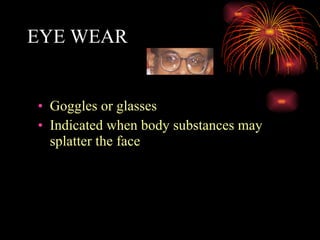
EYE WEAR Goggles or glasses Indicated when body substances may splatter the face
WEARING OF GOWN Clean or disposable gowns or plastic gowns – to protect nurse’s uniform Best – The fresh gown/ discard technique For repeated use – Provide a stand to hang on.  Follow method to hang the gown Remove watch & jewelry Follow method to don a clean gown Follow precautions to remove a soiled gown and discard in proper container
WEARING OF GLOVE To protect the hands To protect the client Use clean gloves for medical asepsis No special technique while wearing clean gloves Pull up the gloves to cover the wrist/ sleeves of the gown Wash gloved hand before removing No special precautions to remove gloves If soiled, then follow precautions to remove them
OTHER ISOLATION PRECAUTIONS Client placement – Special rooms.  Avoid transportation to other rooms Care of soiled equipment and supplies- disposal, cleaning, disinfecting, sterilizing Bagging – Follow colour coding  Linen – Least handling of soiled linen Lab specimens –Leak proof containers with secure lid.  Prevent outside contamination Needles and sharps – Avoid recapping.  Puncture resistant container
SUPPORTING DEFENSES OF A SUSCEPTIBLE HOST Susceptibility – The degree to which an individual can be affected.  It can be reduced by – Hygiene – Mental and physical Immunizations Nutrition Fluid Rest & sleep Relief from Stress
INFECTION CONTROL FOR HEALTH CARE WORKERS Occupational exposure from – Puncture wounds Skin contact Mucus membrane contact Precautions with medical asepsis – Use appropriate personal protective equipment Avoid carelessness in the clinical area Good nutrition Immunization Rest & sleep
SPECIAL POINTS IN MEDICAL ASEPTIC METHOD Follow proper technique for admitting patients – Use of gown, mask, gloves, glasses, clean surfaces, stock supplies .. Concurrent disinfection Terminal disinfection Control and teaching of visitors & relatives Staff health & hygiene & health education Vaccinations & medications to prevent infections Use of labour saving devices and more efficient methods for aseptic practices
Thank You

Medical Asepsis

  • 1.
  • 2.
    MEDICAL ASEPSIS Allpractices intended to confine a specific microorganism to a specific area, limiting their number, growth, and transmission. (Clean/ dirty/ contaminated) Procedures used to protect the client and his environment from the transmission of disease producing organisms that can transmit from one to the other
  • 3.
    METHODS OF MEDICALASEPSIS Isolation precautions Hand washing Use of gown, mask, gloves, glasses Use of disposables, clean surfaces Concurrent and terminal disinfection Control and teaching of visitors/ relatives Developing staff health and hygiene and education Preventive vaccination, inoculation and medicines Use of labour saving and efficient devices for aseptic practices
  • 4.
    ISOLATION PRECAUTIONS Isolation– Measures to prevent the spread of infections or potentially infectious organisms to health personnel, client and visitors Barrier technique (Reverse isolation) - Measures to protect highly susceptible (compromised) clients from infection
  • 5.
    ISOLATION SYSTEMS USEDIN HEALTH CARE AGENCIES Centers for Disease Control & prevention (CDC) precaution – involves procedures for - Category specific Isolation (CSI) precaution Disease specific isolation (DSI) precaution Universal precaution Body Substance Isolation (BSI) system
  • 6.
    CDC ISOLATION PRECAUTIONS…Category Specific Isolation- Based on 7 categories- 1. Strict Isolation 2. Contact Isolation 3. Respiratory Isolation 4. TB Isolation 5. Enteric precautions 6. Drainage/ secretions precautions 7. Blood/ body fluid precautions
  • 7.
    CDC ISOLATION PRECAUTIONS…Disease Specific Isolation – According to specific disease conditions Universal Precautions – Blood and body fluid precautions. Decrease the risk of transmitting unidentified pathogens Hepatitis B, C, and HIV Does not apply to feces, nasal secretions, sputum, sweat, tears, urine, vomitus unless they contain visible blood Used in conjunction with CSI & DSI
  • 8.
    BODY SUBSTANCE ISOLATIONIncludes all body parts and secretions and excretions Does not include clients with airborne diseases Follows hand washing, gloving, gowning, wearing masks, eye wear, hair and shoe covers Adheres to needle destruction and disposal and proper disposal of waste
  • 9.
    IMPLEMENTING ISOLATION PRECAUTIONSA nursing responsibility Based on comprehensive assessment of the client Status of client’s defense system Client's ability to implement isolation precautions Source and mode o transmission of infectious agent Follow specific precautions during therapies for client’s benefit Decision made on the method of isolation precaution
  • 10.
    HAND WASHING Cutnails short, remove all jewelry, check for breaks/ cuts in the skin Turn on the water, adjust the flow Wet hands thoroughly under running water, apply soap Hold hands lower than the elbows Thoroughly wash and rinse the hands Use firm rubbing and circular movements the palm, back and wrist of each hand. Interlace fingers and thumbs and move the hands back and forth ---for 10seconds Turn off the water Dry hands thoroughly with a paper towel
  • 11.
    USE OF FACEMASKS To reduce risk of transmission by droplet contact, air borne routes and splatters of body substances To be worn by – Those close to the client (in measles, mumps, Ac resp diseases) – large particle aerosols travel short distances (1 m of 3 ft) All persons entering the room ( in Pulm TB)- small particle aerosols remain suspended in the air, and thus travel great distances Masks – Should have good filtration effectiveness and fit - Do not carry them in the pocket or around the neck - Do not use them outside the unit - Use fresh mask each time (Disposable and non disposable masks) - Disinfect / Sterilize before next use
  • 12.
    USE OF FACEMASKS.. Keep in a clean container near hand washing facility Mask should cover mouth and nose A secure fit prevents escape of exhaled air and fogging of eye glasses Fit the upper edges of the mask under the frame of eye glasses Avoid talking, sneezing, coughing Use only once, and not after it gets moist When removing mask first untie the lower strings Discard disposable mask in a waste container Wash hands
  • 13.
    EYE WEAR Gogglesor glasses Indicated when body substances may splatter the face
  • 14.
    WEARING OF GOWNClean or disposable gowns or plastic gowns – to protect nurse’s uniform Best – The fresh gown/ discard technique For repeated use – Provide a stand to hang on. Follow method to hang the gown Remove watch & jewelry Follow method to don a clean gown Follow precautions to remove a soiled gown and discard in proper container
  • 15.
    WEARING OF GLOVETo protect the hands To protect the client Use clean gloves for medical asepsis No special technique while wearing clean gloves Pull up the gloves to cover the wrist/ sleeves of the gown Wash gloved hand before removing No special precautions to remove gloves If soiled, then follow precautions to remove them
  • 16.
    OTHER ISOLATION PRECAUTIONSClient placement – Special rooms. Avoid transportation to other rooms Care of soiled equipment and supplies- disposal, cleaning, disinfecting, sterilizing Bagging – Follow colour coding Linen – Least handling of soiled linen Lab specimens –Leak proof containers with secure lid. Prevent outside contamination Needles and sharps – Avoid recapping. Puncture resistant container
  • 17.
    SUPPORTING DEFENSES OFA SUSCEPTIBLE HOST Susceptibility – The degree to which an individual can be affected. It can be reduced by – Hygiene – Mental and physical Immunizations Nutrition Fluid Rest & sleep Relief from Stress
  • 18.
    INFECTION CONTROL FORHEALTH CARE WORKERS Occupational exposure from – Puncture wounds Skin contact Mucus membrane contact Precautions with medical asepsis – Use appropriate personal protective equipment Avoid carelessness in the clinical area Good nutrition Immunization Rest & sleep
  • 19.
    SPECIAL POINTS INMEDICAL ASEPTIC METHOD Follow proper technique for admitting patients – Use of gown, mask, gloves, glasses, clean surfaces, stock supplies .. Concurrent disinfection Terminal disinfection Control and teaching of visitors & relatives Staff health & hygiene & health education Vaccinations & medications to prevent infections Use of labour saving devices and more efficient methods for aseptic practices
  • 20.