Bed
Sores...
Bed Sores
• Decubitus ulcers or pressure ulcers
• It is an ulceration in the skin that is caused by
prolonged pressure on a bony or weight
bearing part of the body.
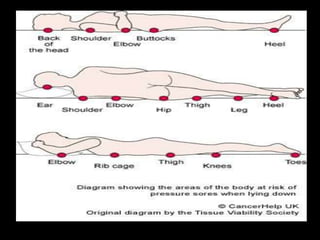
Most Common Areas
• Sacrum
• Elbow
• Knee
• Ankle
Risk Factors
• Unrelieved pressure
• Friction
• Humidity
• Shearing forces
• Temperature
• Age
• Continence
• Medication
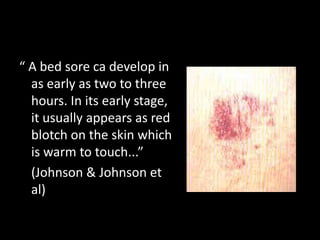
“ A bed sore ca develop in
as early as two to three
hours. In its early stage,
it usually appears as red
blotch on the skin which
is warm to touch...”
(Johnson & Johnson et
al)
Causes
Bedsores are accepted to be caused by three
different tissue forces:
• Pressure
There is compression of tissues. It leads to
decreased tissue perfusion, ischemia occurs
leading to tissue necrosis if left untreated
Causes
• Shear force
The force created when the skin of a patient
stays in one place as the deep fascia and
skeletal muscle slide down with gravity. This
can also lead to ischemia and tissue necrosis.
• Friction
It causes shedding of layers of epidermis.
Aggravating Factors
• Excess moisture
• Age
• Nutrition
• Vascular Diseases
• Diabetes mellitus
• Smoking
• Temperature: cutaneous metabolic demand rises
by 13% for every 1°C rise in cutaneous
temperature
National Pressure Ulcer Advisory Panel Classification
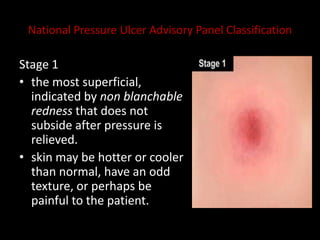
Stage 1
• the most superficial,
indicated by non blanchable
redness that does not
subside after pressure is
relieved.
• skin may be hotter or cooler
than normal, have an odd
texture, or perhaps be
painful to the patient.
National Pressure Ulcer Advisory Panel Classification
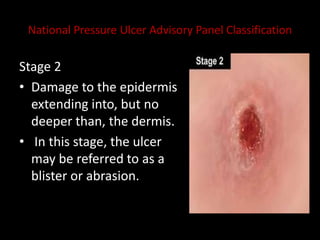
Stage 2
• Damage to the epidermis
extending into, but no
deeper than, the dermis.
• In this stage, the ulcer
may be referred to as a
blister or abrasion.
National Pressure Ulcer Advisory Panel Classification
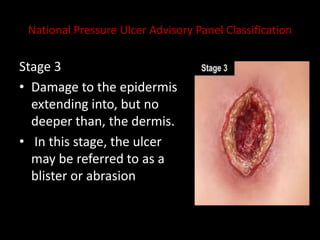
Stage 3
• Damage to the epidermis
extending into, but no
deeper than, the dermis.
• In this stage, the ulcer
may be referred to as a
blister or abrasion
National Pressure Ulcer Advisory Panel Classification
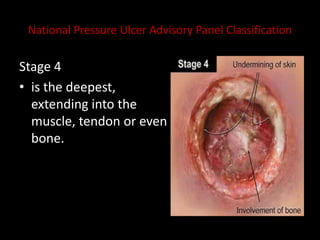
Stage 4
• is the deepest,
extending into the
muscle, tendon or even
bone.
National Pressure Ulcer Advisory Panel Classification
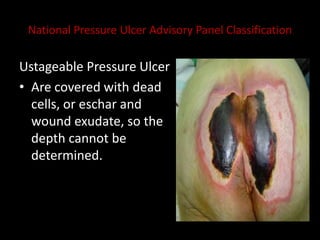
Ustageable Pressure Ulcer
• Are covered with dead
cells, or eschar and
wound exudate, so the
depth cannot be
determined.
Braden Scale for Predicting Pressure Ulcer Risk
Six Criteria:
• Sensory Perception
• Moisture
• Activity
• Mobility
• Nutrition
• Friction and Shear
Braden Scale for Predicting Pressure Ulcer Risk
• Each category is rated on a scale of 1 to 4,
excluding the 'friction and shear' category
which is rated on a 1-3 scale.
• A score of 23 means there is no risk for
developing a pressure ulcer while the lowest
possible score of 6 points represents the
severest risk for developing a pressure ulcer
Treatment
Proper Care:
• The most important care for a patient with
bedsores is the relief of pressure.
• Once a bedsore is found, pressure should
immediately be lifted from the area and the
patient turned at least every two hours to
avoid aggravating the wound.
Treatment
Debridement
• Autolytic debridement - the use of moist
dressings to promote autolysis with the body's
own enzymes.
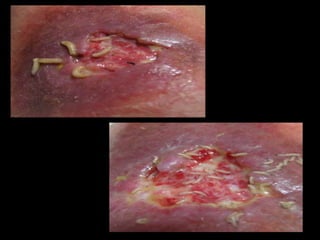
• Biological debridement, or maggot
debridement therapy, is the use of medical
maggots to feed on necrotic tissue and
therefore clean the wound of excess bacteria.
Treatment
• Chemical debridement, or enzymatic
debridement- the use of prescribed enzymes
that promote the removal of necrotic tissue.
• Mechanical debridement - the use of outside
force to remove dead tissue.
Treatment
• Sharp debridement - the removal of necrotic
tissue with a scalpel or similar instrument.
• Surgical debridement
• Ultrasound-assisted wound therapy- the use
of ultrasound waves to separate necrotic and
healthy tissue.
Treatment
• Nutrition
• Infection control
• Education of caregivers
• Wound intervention
Bed Sores: Classification and Management

Bed Sores: Classification and Management

  • 1.
  • 2.
    Bed Sores • Decubitusulcers or pressure ulcers • It is an ulceration in the skin that is caused by prolonged pressure on a bony or weight bearing part of the body.
  • 3.
    Most Common Areas •Sacrum • Elbow • Knee • Ankle
  • 5.
    Risk Factors • Unrelievedpressure • Friction • Humidity • Shearing forces • Temperature • Age • Continence • Medication
  • 6.
    “ A bedsore ca develop in as early as two to three hours. In its early stage, it usually appears as red blotch on the skin which is warm to touch...” (Johnson & Johnson et al)
  • 7.
    Causes Bedsores are acceptedto be caused by three different tissue forces: • Pressure There is compression of tissues. It leads to decreased tissue perfusion, ischemia occurs leading to tissue necrosis if left untreated
  • 8.
    Causes • Shear force Theforce created when the skin of a patient stays in one place as the deep fascia and skeletal muscle slide down with gravity. This can also lead to ischemia and tissue necrosis. • Friction It causes shedding of layers of epidermis.
  • 9.
    Aggravating Factors • Excessmoisture • Age • Nutrition • Vascular Diseases • Diabetes mellitus • Smoking • Temperature: cutaneous metabolic demand rises by 13% for every 1°C rise in cutaneous temperature
  • 10.
    National Pressure UlcerAdvisory Panel Classification Stage 1 • the most superficial, indicated by non blanchable redness that does not subside after pressure is relieved. • skin may be hotter or cooler than normal, have an odd texture, or perhaps be painful to the patient.
  • 11.
    National Pressure UlcerAdvisory Panel Classification Stage 2 • Damage to the epidermis extending into, but no deeper than, the dermis. • In this stage, the ulcer may be referred to as a blister or abrasion.
  • 12.
    National Pressure UlcerAdvisory Panel Classification Stage 3 • Damage to the epidermis extending into, but no deeper than, the dermis. • In this stage, the ulcer may be referred to as a blister or abrasion
  • 13.
    National Pressure UlcerAdvisory Panel Classification Stage 4 • is the deepest, extending into the muscle, tendon or even bone.
  • 14.
    National Pressure UlcerAdvisory Panel Classification Ustageable Pressure Ulcer • Are covered with dead cells, or eschar and wound exudate, so the depth cannot be determined.
  • 15.
    Braden Scale forPredicting Pressure Ulcer Risk Six Criteria: • Sensory Perception • Moisture • Activity • Mobility • Nutrition • Friction and Shear
  • 16.
    Braden Scale forPredicting Pressure Ulcer Risk • Each category is rated on a scale of 1 to 4, excluding the 'friction and shear' category which is rated on a 1-3 scale. • A score of 23 means there is no risk for developing a pressure ulcer while the lowest possible score of 6 points represents the severest risk for developing a pressure ulcer
  • 17.
    Treatment Proper Care: • Themost important care for a patient with bedsores is the relief of pressure. • Once a bedsore is found, pressure should immediately be lifted from the area and the patient turned at least every two hours to avoid aggravating the wound.
  • 18.
    Treatment Debridement • Autolytic debridement- the use of moist dressings to promote autolysis with the body's own enzymes. • Biological debridement, or maggot debridement therapy, is the use of medical maggots to feed on necrotic tissue and therefore clean the wound of excess bacteria.
  • 20.
    Treatment • Chemical debridement,or enzymatic debridement- the use of prescribed enzymes that promote the removal of necrotic tissue. • Mechanical debridement - the use of outside force to remove dead tissue.
  • 21.
    Treatment • Sharp debridement- the removal of necrotic tissue with a scalpel or similar instrument. • Surgical debridement • Ultrasound-assisted wound therapy- the use of ultrasound waves to separate necrotic and healthy tissue.
  • 22.
    Treatment • Nutrition • Infectioncontrol • Education of caregivers • Wound intervention