PRESSURE ULCERS


  WHY AND HOW
DEFINITION
 “A pressure ulcer is localized injury to the skin
 and/or underlying tissue usually over a bony
 prominence, as a result of pressure, or pressure
 in combination with shear. A number of
 contributing or confounding factors are also
 associated with pressure ulcers; the significance
 of these factors is yet to be elucidated”
  NPUAP/EPUAP 2009


 Decubitus ulcer is NOT synonymous with
 pressure ulcer as decubitus implies lying
 position or bed confined.
MAGNITUDE OF THE PROBLEM
 NYSDOH    “War on the Sore” 2007
 NYS overall nursing home PU prevalence is
  9.1% (5% target). Ranks #32 in nation.
 1999 study of 42,817 pts in acute care facilities
  across U.S. showed PU prevalence of 14.8%,
  with nosocomial PU rate of 7.1%
  (Amlung, et al; 1999)
 1999  analysis reported $2.2 – $3.6 billion dollar
  cost associated with1.6 million PU’s annually.
  (Beckrich,Aranovich; 1999)
PRESSURE ULCERS AND LITIGATION
 Perceived by public (and advertised by lawyers) as
  poor quality care, ie, PU = Negligence!
 1987 OBRA legislation stated “a resident who enters
  a facility without a pressure sore does not develop
  pressure sores unless the individual’s clinical
  condition demonstrates that they were unavoidable”
  (Meehan and Hill; 2001)
 Avoidability and preventability are key!
 Based on initial risk evaluation, and documentation
 Most common reason for nursing home lawsuits!
PATHOPHYSIOLOGY
 Old  Hypothesis: Pressure on trapped soft
  tissues exceeds mean capillary pressure leading
  to ischemia and necrosis.
 Now Understood: First evidence of damage in
  subcutaneous tissue with epidermis showing no
  signs of necrosis until quite late.
 Epidermal cells more able to withstand lack of
  oxygen than metabolically more active tissues.
 Final pathway to PU is hypoxia/ischemia
 The skin is an organ; it can fail like other organs!
  Witkowski and Parish; 1982
THERMODYNAMICS, METABOLISM AND
          PRESSURE
 Thermodynamic     factors in skin/surface interface
 As temperature increases, skin becomes more
  metabolically active and 02 demands increase
 With increased pressure, metabolic demands
  not able to be met and skin becomes hypoxic
 Hypoxic skin more susceptible to breakdown
 Adding friction and shear to already fragile skin
  is “perfect storm”
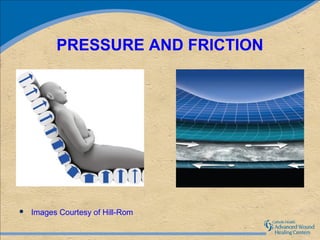
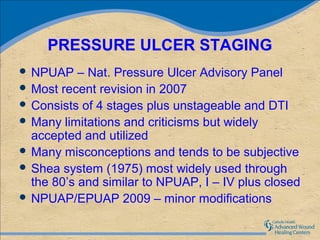
THE 4 FORCES
 Pressure:    Force applied to soft tissue between
  hard surface and bony prominence
 Friction: Resistance of one body sliding or
  rolling over another
 Shear: Contiguous tissues sliding relative to
  each other parallel to their plane of contact
 Strain: Tissue deformation in response to
  pressure
PRESSURE AND FRICTION


   Images Courtesy of Hill-Rom
PRESSURE ULCER STAGING
 NPUAP    – Nat. Pressure Ulcer Advisory Panel
 Most recent revision in 2007
 Consists of 4 stages plus unstageable and DTI
 Many limitations and criticisms but widely
  accepted and utilized
 Many misconceptions and tends to be subjective
 Shea system (1975) most widely used through
  the 80’s and similar to NPUAP, I – IV plus closed
 NPUAP/EPUAP 2009 – minor modifications
2009 NPUAP – EPUAP GUIDELINES
 More information and discussion – doesn’t really
  change what we do
 Agreement on same 4 stages + DTI and Unstag.
 More discussion around:

    Holistic patient assessment
    Changing assessment = changing treatment
    Use of validated tool, ie, PUSH for progress
    Assessment and management of malnutrition
    Assessment and management of pain
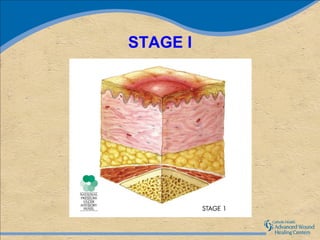
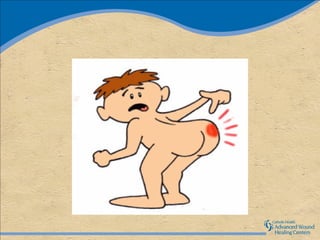
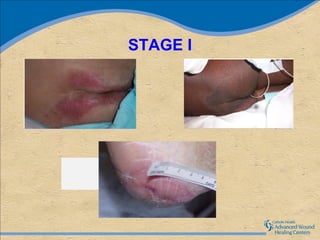
STAGE 1
 Viewed   by NPUAP as sign of risk
 “Intact skin with non-blanchable erythema of a
  localized area, usually over a bony prominence”
 Darkly pigmented skin may simply demonstrate
  color change compared to surrounding tissue
 May be painful, soft, firm, warmer or cooler than
  surrounding area
 BEWARE: Do not confuse with deep tissue
  injury !
STAGE I
STAGE I
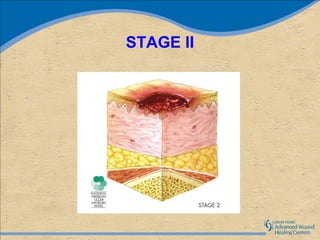
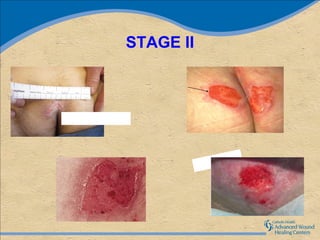
STAGE II
 Updated    definition to clarify for pressure ulcers
 “Partial thickness loss of dermis presenting as a
  shallow open ulcer with a red or pink wound bed,
  without slough. May also present as an intact or
  open/ruptured serum-filled blister”
 Blood blisters indicate damage deeper than
  dermis and are not stage II
 Should not be used to describe skin tears, tape
  burns, maceration, dermatitis or denudement
STAGE II
STAGE II
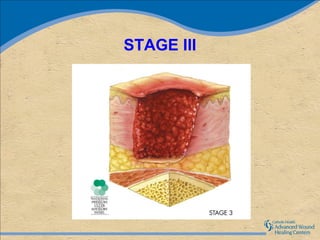
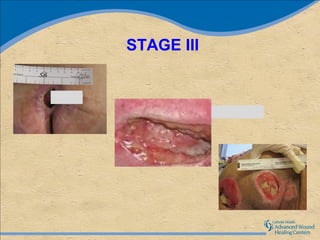
STAGE III
 Goal   of update was to address variations in
  appearances of stage III PU’s
 “Full thickness tissue loss. Subcutaneous fat
  may be visible but bone, tendon or muscle are
  not exposed. Slough may be present but does
  not obscure depth of tissue loss. May include
  undermining and tunneling”
 Depth of stage III varies by anatomic location
STAGE III
STAGE III
STAGE IV
 Very  little revision for 2007
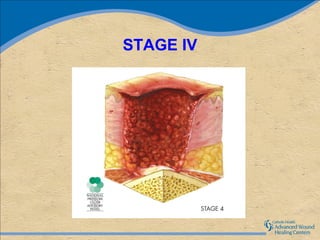
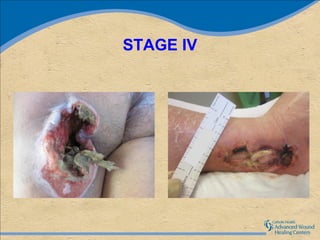
 “Full thickness tissue loss with exposed bone,
  tendon or muscle. Slough or eschar may be
  present on some parts of the wound bed. Often
  include undermining and/or tunneling”
 Depth varies according to anatomic location
 Exposed bone/tendon usually directly visible
  and/or palpable
STAGE IV
STAGE IV
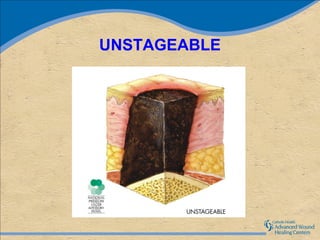
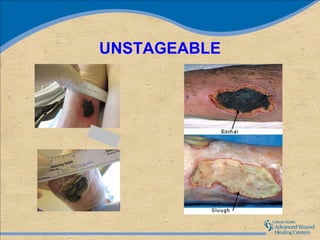
UNSTAGEABLE
 Goal   of revision to reduce tendency to classify
  any ulcer with necrotic tissue as unstageable,
  when the depth of the ulcer can be seen.
 “Full thickness tissue loss in which the base of
  the ulcer is covered by slough (yellow, tan, gray,
  green or brown) and/or eschar (tan, brown or
  black) in the wound bed”
 If portion of base is visible – it is stageable.
 Wounds obscured by appliances, dressings, etc
  are NOT unstageable. Move the stuff and look!
UNSTAGEABLE
UNSTAGEABLE
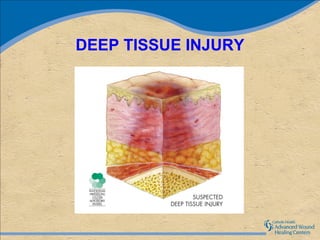
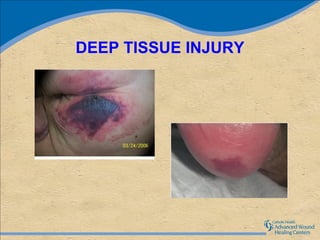
DEEP TISSUE INJURY
 Newest    PU in updated staging system
 “purple or maroon localized area of discolored
  intact skin or blood filled blister due to damage
  of underlying soft tissue from pressure and/or
  shear”
 Difficult to detect in dark skinned individuals
 Commonly mistaken as stage I
 May evolve rapidly in spite of optimal care as
  damage already done
DEEP TISSUE INJURY
DEEP TISSUE INJURY
TARGET LOCATIONS
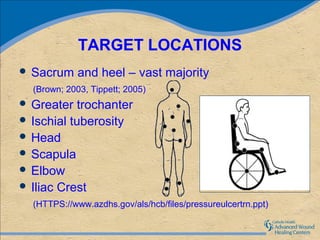
 Sacrum     and heel – vast majority
  (Brown; 2003, Tippett; 2005)
 Greater  trochanter
 Ischial tuberosity
 Head
 Scapula
 Elbow
 Iliac Crest
  (HTTPS://www.azdhs.gov/als/hcb/files/pressureulcertrn.ppt)
PREDICTING RISK
 BRADEN         SCALE: 6 parameter instrument
   1)   Sensation
   2)   Activity
   3)   Mobility
   4)   Moisture
   5)   Friction
   6)   Nutrition
High Risk: 18 or less in elderly or darkly pigmented skin
           16 or less in other adults
   (http://www.bradenscale.com)
PREDICTING RISK
 BRADEN       Q SCALE: 7 parameter for Peds
   1)   Mobility
   2)   Activity
   3)   Sensory Perception
   4)   Moisture
   5)   Friction-Shear
   6)   Nutrition
   7)   Tissue Perfusion and Oxygenation
High Risk: 16 or less (7 for modified Braden Q)
   (HTTP://www.nichq.org/pdf/PUBradenQScale.xls)
TREATMENT OBJECTIVES
 Identificationof problem
 Debridement of necrotic tissue
 Moist wound care without maceration
 Control of infection/bioburden
 Management of pain
 Pressure redistribution/Offloading


 Choice of wound care products is individual
  preference as long as above objectives met.
PRESSURE REDISTRIBUTION
GROUP 1 SUPPORT SURFACES
 Pressure overlay, foam, air, water and gel pressure
  mattresses
 Covered if patient meets following criteria:
    1)   Completely immobile (cannot move w/o assistance) or
    2)   Limited mobility PLUS numbers 4-7 or
    3)   Any stage pressure ulcer on trunk or pelvis PLUS 4-7 or
    4)   Impaired nutritional status
    5)   Fecal or urinary incontinence
    6)   Altered sensory perception
    7)   Compromised circulatory status
GROUP II SUPPORT SURFACES
 Powered,  advanced pressure reducing
  mattresses and overlays. Low air loss,
  microclimate management, air fluidized therapy
 Covered if patient meets following criteria:
  1)  Multiple stage II ulcers on trunk or pelvis AND
  2)  Pt has been on comprehensive PU treatment program for past
      month including Group I surface and ulcers are same or
  worsened or
  3) Large or multiple Stage III or IV PU’s on trunk or pelvis OR
  4) Recent myocutaneous flap or skin graft for PU on trunk or
      pelvis (60 d) AND
  5) Pt has been on a group II or III surface immediately prior to
      discharge from hospital or SNF (within 30 days)
AVAILABLE PROTOCOLS
   AHCPR (Agency for Healthcare Policy and Research.
    Now known as AHRQ (Agency for Healthcare Research
    and Quality).
   AHCPR Clinical Practice Guideline #3: Pressure Ulcers
    in Adults: Prediction and Prevention.
    (AHCPR #92-0047: May 1992)
   AHCPR Clinical Practice Guideline #15: Treatment of
    pressure Ulcers. (AHCPR #95-0652, Dec 1994).
   WOCN Guideline for Prevention and Management of
    Pressure Ulcers, 2003
     (www.ahrq.gov/news/pcubcat/c_clin.htm#clin014)
     (www.wocn.org)
COMMON SENSE !
   Document complete initial skin evaluation on day of
    admission wherever you are (ED, OR, ICU etc)
   Complete and document initial risk stratification/score
   Develop and follow your protocol
   Implement, monitor & document turning and positioning
   Monitor, manage and document incontinence
   Use good quality moist wound care
   Document daily skin sheets on nurses notes
   Document wounds completely in terms of size, depth,
    drainage, slough/eschar, odor etc
   Document wound treatments and changes in treatments
   “Common sense is not so common” - Voltaire
FUTURE FOCUS AREAS
 Nutritionassessment and management
 Pain assessment and management
 Proper choice of support surfaces
 Prevention
THANK YOU !

Pressure ulcers, why and how

  • 1.
    PRESSURE ULCERS WHY AND HOW
  • 2.
    DEFINITION  “A pressureulcer is localized injury to the skin and/or underlying tissue usually over a bony prominence, as a result of pressure, or pressure in combination with shear. A number of contributing or confounding factors are also associated with pressure ulcers; the significance of these factors is yet to be elucidated” NPUAP/EPUAP 2009  Decubitus ulcer is NOT synonymous with pressure ulcer as decubitus implies lying position or bed confined.
  • 3.
    MAGNITUDE OF THEPROBLEM  NYSDOH “War on the Sore” 2007  NYS overall nursing home PU prevalence is 9.1% (5% target). Ranks #32 in nation.  1999 study of 42,817 pts in acute care facilities across U.S. showed PU prevalence of 14.8%, with nosocomial PU rate of 7.1% (Amlung, et al; 1999)  1999 analysis reported $2.2 – $3.6 billion dollar cost associated with1.6 million PU’s annually. (Beckrich,Aranovich; 1999)
  • 4.
    PRESSURE ULCERS ANDLITIGATION  Perceived by public (and advertised by lawyers) as poor quality care, ie, PU = Negligence!  1987 OBRA legislation stated “a resident who enters a facility without a pressure sore does not develop pressure sores unless the individual’s clinical condition demonstrates that they were unavoidable” (Meehan and Hill; 2001)  Avoidability and preventability are key!  Based on initial risk evaluation, and documentation  Most common reason for nursing home lawsuits!
  • 6.
    PATHOPHYSIOLOGY  Old Hypothesis: Pressure on trapped soft tissues exceeds mean capillary pressure leading to ischemia and necrosis.  Now Understood: First evidence of damage in subcutaneous tissue with epidermis showing no signs of necrosis until quite late.  Epidermal cells more able to withstand lack of oxygen than metabolically more active tissues.  Final pathway to PU is hypoxia/ischemia  The skin is an organ; it can fail like other organs! Witkowski and Parish; 1982
  • 7.
    THERMODYNAMICS, METABOLISM AND PRESSURE  Thermodynamic factors in skin/surface interface  As temperature increases, skin becomes more metabolically active and 02 demands increase  With increased pressure, metabolic demands not able to be met and skin becomes hypoxic  Hypoxic skin more susceptible to breakdown  Adding friction and shear to already fragile skin is “perfect storm”
  • 8.
    THE 4 FORCES Pressure: Force applied to soft tissue between hard surface and bony prominence  Friction: Resistance of one body sliding or rolling over another  Shear: Contiguous tissues sliding relative to each other parallel to their plane of contact  Strain: Tissue deformation in response to pressure
  • 9.
    PRESSURE AND FRICTION  Images Courtesy of Hill-Rom
  • 10.
    PRESSURE ULCER STAGING NPUAP – Nat. Pressure Ulcer Advisory Panel  Most recent revision in 2007  Consists of 4 stages plus unstageable and DTI  Many limitations and criticisms but widely accepted and utilized  Many misconceptions and tends to be subjective  Shea system (1975) most widely used through the 80’s and similar to NPUAP, I – IV plus closed  NPUAP/EPUAP 2009 – minor modifications
  • 11.
    2009 NPUAP –EPUAP GUIDELINES  More information and discussion – doesn’t really change what we do  Agreement on same 4 stages + DTI and Unstag.  More discussion around: Holistic patient assessment Changing assessment = changing treatment Use of validated tool, ie, PUSH for progress Assessment and management of malnutrition Assessment and management of pain
  • 12.
    STAGE 1  Viewed by NPUAP as sign of risk  “Intact skin with non-blanchable erythema of a localized area, usually over a bony prominence”  Darkly pigmented skin may simply demonstrate color change compared to surrounding tissue  May be painful, soft, firm, warmer or cooler than surrounding area  BEWARE: Do not confuse with deep tissue injury !
  • 13.
  • 15.
  • 16.
    STAGE II  Updated definition to clarify for pressure ulcers  “Partial thickness loss of dermis presenting as a shallow open ulcer with a red or pink wound bed, without slough. May also present as an intact or open/ruptured serum-filled blister”  Blood blisters indicate damage deeper than dermis and are not stage II  Should not be used to describe skin tears, tape burns, maceration, dermatitis or denudement
  • 17.
  • 18.
  • 19.
    STAGE III  Goal of update was to address variations in appearances of stage III PU’s  “Full thickness tissue loss. Subcutaneous fat may be visible but bone, tendon or muscle are not exposed. Slough may be present but does not obscure depth of tissue loss. May include undermining and tunneling”  Depth of stage III varies by anatomic location
  • 20.
  • 21.
  • 22.
    STAGE IV  Very little revision for 2007  “Full thickness tissue loss with exposed bone, tendon or muscle. Slough or eschar may be present on some parts of the wound bed. Often include undermining and/or tunneling”  Depth varies according to anatomic location  Exposed bone/tendon usually directly visible and/or palpable
  • 23.
  • 24.
  • 25.
    UNSTAGEABLE  Goal of revision to reduce tendency to classify any ulcer with necrotic tissue as unstageable, when the depth of the ulcer can be seen.  “Full thickness tissue loss in which the base of the ulcer is covered by slough (yellow, tan, gray, green or brown) and/or eschar (tan, brown or black) in the wound bed”  If portion of base is visible – it is stageable.  Wounds obscured by appliances, dressings, etc are NOT unstageable. Move the stuff and look!
  • 26.
  • 27.
  • 28.
    DEEP TISSUE INJURY Newest PU in updated staging system  “purple or maroon localized area of discolored intact skin or blood filled blister due to damage of underlying soft tissue from pressure and/or shear”  Difficult to detect in dark skinned individuals  Commonly mistaken as stage I  May evolve rapidly in spite of optimal care as damage already done
  • 29.
  • 30.
  • 31.
    TARGET LOCATIONS  Sacrum and heel – vast majority (Brown; 2003, Tippett; 2005)  Greater trochanter  Ischial tuberosity  Head  Scapula  Elbow  Iliac Crest (HTTPS://www.azdhs.gov/als/hcb/files/pressureulcertrn.ppt)
  • 32.
    PREDICTING RISK  BRADEN SCALE: 6 parameter instrument 1) Sensation 2) Activity 3) Mobility 4) Moisture 5) Friction 6) Nutrition High Risk: 18 or less in elderly or darkly pigmented skin 16 or less in other adults (http://www.bradenscale.com)
  • 33.
    PREDICTING RISK  BRADEN Q SCALE: 7 parameter for Peds 1) Mobility 2) Activity 3) Sensory Perception 4) Moisture 5) Friction-Shear 6) Nutrition 7) Tissue Perfusion and Oxygenation High Risk: 16 or less (7 for modified Braden Q) (HTTP://www.nichq.org/pdf/PUBradenQScale.xls)
  • 34.
    TREATMENT OBJECTIVES  Identificationofproblem  Debridement of necrotic tissue  Moist wound care without maceration  Control of infection/bioburden  Management of pain  Pressure redistribution/Offloading  Choice of wound care products is individual preference as long as above objectives met.
  • 35.
  • 36.
    GROUP 1 SUPPORTSURFACES  Pressure overlay, foam, air, water and gel pressure mattresses  Covered if patient meets following criteria: 1) Completely immobile (cannot move w/o assistance) or 2) Limited mobility PLUS numbers 4-7 or 3) Any stage pressure ulcer on trunk or pelvis PLUS 4-7 or 4) Impaired nutritional status 5) Fecal or urinary incontinence 6) Altered sensory perception 7) Compromised circulatory status
  • 37.
    GROUP II SUPPORTSURFACES  Powered, advanced pressure reducing mattresses and overlays. Low air loss, microclimate management, air fluidized therapy  Covered if patient meets following criteria: 1) Multiple stage II ulcers on trunk or pelvis AND 2) Pt has been on comprehensive PU treatment program for past month including Group I surface and ulcers are same or worsened or 3) Large or multiple Stage III or IV PU’s on trunk or pelvis OR 4) Recent myocutaneous flap or skin graft for PU on trunk or pelvis (60 d) AND 5) Pt has been on a group II or III surface immediately prior to discharge from hospital or SNF (within 30 days)
  • 38.
    AVAILABLE PROTOCOLS  AHCPR (Agency for Healthcare Policy and Research. Now known as AHRQ (Agency for Healthcare Research and Quality).  AHCPR Clinical Practice Guideline #3: Pressure Ulcers in Adults: Prediction and Prevention. (AHCPR #92-0047: May 1992)  AHCPR Clinical Practice Guideline #15: Treatment of pressure Ulcers. (AHCPR #95-0652, Dec 1994).  WOCN Guideline for Prevention and Management of Pressure Ulcers, 2003 (www.ahrq.gov/news/pcubcat/c_clin.htm#clin014) (www.wocn.org)
  • 39.
    COMMON SENSE !  Document complete initial skin evaluation on day of admission wherever you are (ED, OR, ICU etc)  Complete and document initial risk stratification/score  Develop and follow your protocol  Implement, monitor & document turning and positioning  Monitor, manage and document incontinence  Use good quality moist wound care  Document daily skin sheets on nurses notes  Document wounds completely in terms of size, depth, drainage, slough/eschar, odor etc  Document wound treatments and changes in treatments  “Common sense is not so common” - Voltaire
  • 40.
    FUTURE FOCUS AREAS Nutritionassessment and management  Pain assessment and management  Proper choice of support surfaces  Prevention
  • 41.