RISK IDENTIFICATION, PREVENTION
AND MANAGEMENT OF
PRESSURE ULCERS
- PRAKASH S
SPECIFIC OBJECTIVES
• INTRODUCTION
• RISK FACTORS
• SYMPTOMS
• NURSING ASSESSMENT
• NURSING CARE AND PREVENTION
Purpose
To ensure that the nurses meets best practice standards for the
prevention and management of pressure ulcers
Scope
This is applicable to all doctors, nurses , nursing Aide, and all other staff
working in a clinical setting, caring for patients with, or at risk of
pressure ulcers
Overview: Bedsore
Bedsores are ulcers that develop in areas of the body due to
prolonged pressure on the skin.
They are common in bedridden people who are immobile or unable
to feel pain.
Main symptoms include unusual changes to skin color or texture.
The degree of damage to the skin and tissues varies and severe cases
may involve muscles.
Bedsores can be prevented by regularly examining the skin, especially
bony prominences.
• A bedsore is an ulcer in the outer layer of the skin (epidermis) and the
underlying tissue (dermis) due to prolonged pressure. It can occur to
anyone, but is most common in bedridden people or those who use
wheelchairs for long periods.
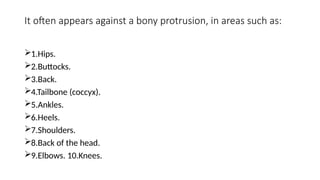
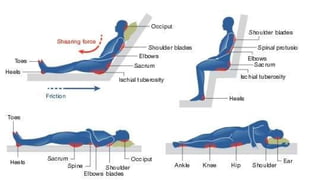
It often appears against a bony protrusion, in areas such as:
1.Hips.
2.Buttocks.
3.Back.
4.Tailbone (coccyx).
5.Ankles.
6.Heels.
7.Shoulders.
8.Back of the head.
9.Elbows. 10.Knees.
Risk Factors
Bed or chair-bound ·
Advanced age (>65 years) ·
Unable to move body or parts of body without help ·
Chronic conditions, such as diabetes or vascular disease, which
affect perfusion (blood circulation) ·
Mental disability from conditions such as dementia ·
History of previous ulcer ·
Urinary and/or fecal incontinence ·
Inadequate/poor nutrition and/or dehydration · Diastolic pressure
Procedure
1. All patients admitted in the hospital shall be assessed for presence of
pressure ulcer or risk for pressure ulcer development as part of initial
nursing assessment.
2. Following this reassessment will be done every shift handover, when their
condition changes, and on transfer or discharge.
3. The assessment will be documented in the nurses initial assessment
record/ nursing care plan/ Position chart and communicated as part of the
nursing handover.
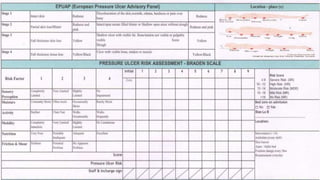
4. All Pressure ulcer shall be graded using the EPUAP(European Pressure
Ulcer Advisory Panel) Pressure ulcer grading chart at the time of initial
assessment and documented in the initial assessment form.
1. The cause of the pressure ulcer should be identified and where
possible to be removed or reduced.
2. Patients, care givers and relatives must be made aware of the
reason for the assessment and intervention
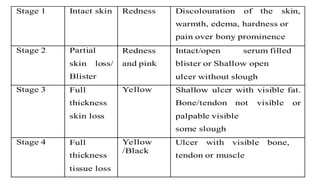
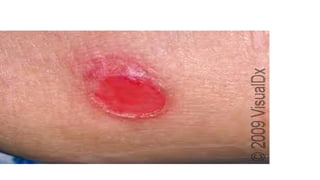
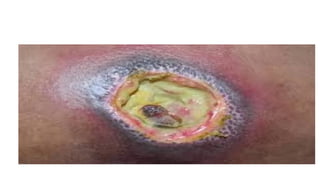
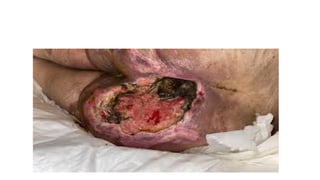
The Pressure ulcer is classified as per the
EPUAP as follows
Stage 1 Intact skin Redness Discolouration of the skin,
warmth, edema, hardness or
pain over bony prominence
Stage 2 Partial
skin loss/
Blister
Redness
and pink
Intact/open serum filled
blister or Shallow open
ulcer without slough
Stage 3 Full
thickness
skin loss
Yellow Shallow ulcer with visible fat.
Bone/tendon not visible or
palpable visible
some slough
Stage 4 Full
thickness
tissue loss
Yellow
/Black
Ulcer with visible bone,
tendon or muscle
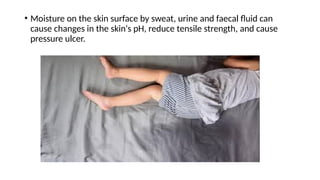
• Moisture on the skin surface by sweat, urine and faecal fluid can
cause changes in the skin‘s pH, reduce tensile strength, and cause
pressure ulcer.
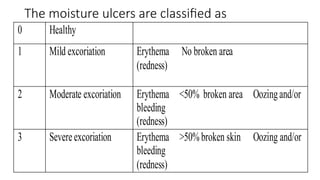
The moisture ulcers are classified as
0 Healthy
1 Mild excoriation Erythema
(redness)
No broken area
2 Moderate excoriation Erythema
bleeding
(redness)
<50% broken area Oozingand/or
3 Severeexcoriation Erythema
bleeding
(redness)
>50%broken skin Oozing and/or
The patient at risk for developing pressure
ulcer are
1. High risk patients
2. Braden Score 12 or less than 12 during assessment or reassessment.
Braden Scale
On admission, all in patients shall be assessed for risk to develop
pressure ulcer using Pressure Ulcer – Risk Assessment form ( Braden
Scale)
A complete head to toe skin assessment is performed for any
potential and actual compromise in skin integrity.
The patients are assessed on the six
parameters –
1. Sensory Perception
2. Moisture, Activity
3. Mobility
4. Nutrition
5. Friction
6. Shear
Sensory perception:
Measures the patient’s ability to detect/sense pain and respond to
discomfort or pain that is related to pressure on parts of their body.
Moisture:
The parameter assesses the degree of moisture the skin is exposed to.
Excessive and continuous skin moisture pose a risk to compromise the
integrity of the skin, It causes skin tissue to become macerated and
therefore be at risk for epidermal erosion.
Activity:
The parameter looks at a patient’s level of physical activity since very
little or no activity can cause atrophy of muscles and breakdown of
tissue.
Mobility:
The parameter looks at the capability of a patient to adjust their body
position independently. This assesses the physical competency to move
and can involve the client’s willingness to move.
Friction and Shear:
The parameter assesses the amount of assistance a client needs to
move and the degree of sliding on beds or chairs that they
experience.
The sliding motion can cause shear which means the skin and bone
are moving in opposite directions causing breakdown of cell
membranes and capillaries.
The Braden scale for predicting pressure ulcer risk
Sensory Perception – ability to respond meaningfully to pressure-
related discomfort (1–4)
Moisture – degree to which skin is exposed to moisture (1–4)
 Activity –degree of physical activity (1–4)
Mobility – ability to change and control body position (1–4)
 Nutrition – usual food intake pattern (1–4)
Friction and Shear – amount of assistance needed to move, degree
of sliding in bed and/or chair (1–3)
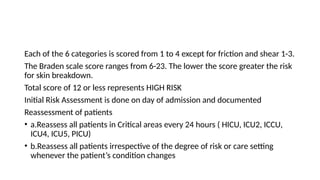
Each of the 6 categories is scored from 1 to 4 except for friction and shear 1-3.
The Braden scale score ranges from 6-23. The lower the score greater the risk
for skin breakdown.
Total score of 12 or less represents HIGH RISK
Initial Risk Assessment is done on day of admission and documented
Reassessment of patients
• a.Reassess all patients in Critical areas every 24 hours ( HICU, ICU2, ICCU,
ICU4, ICU5, PICU)
• b.Reassess all patients irrespective of the degree of risk or care setting
whenever the patient’s condition changes
Reassessment of patients
Reassess all patients in Critical areas every 24 hours ( HICU, ICU2,
ICCU, ICU4, ICU5, PICU)
Reassess all patients irrespective of the degree of risk or care setting
whenever the patient’s condition changes
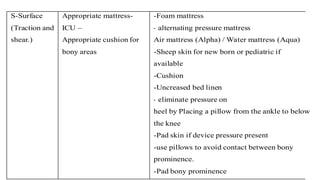
SSKIN Bundle
The pressure ulcer prevention bundle shall be implemented
immediately.
The SSKIN Bundle is used to plan prevention plan
S-Surface
(Traction and
shear.)
Appropriate mattress-
ICU –
Appropriate cushion for
bony areas
-Foam mattress
- alternating pressure mattress
Air mattress (Alpha) / Water mattress (Aqua)
-Sheep skin for new born or pediatric if
available
-Cushion
-Uncreased bed linen
- eliminate pressure on
heel by Placing a pillow from the ankle to below
the knee
-Pad skin if device pressure present
-use pillows to avoid contact between bony
prominence.
-Pad bony prominence
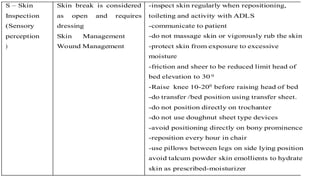
S – Skin
Inspection
(Sensory
perception
)
Skin break is considered
as open and requires
dressing
Skin Management
Wound Management
-inspect skin regularly when repositioning,
toileting and activity with ADLS
-communicate to patient
-do not massage skin or vigorously rub the skin
-protect skin from exposure to excessive
moisture
-friction and sheer to be reduced limit head of
bed elevation to 30 0
-Raise knee 10-200
before raising head of bed
-do transfer /bed position using transfer sheet.
-do not position directly on trochanter
-do not use doughnut sheet type devices
-avoid positioning directly on bony prominence
-reposition every hour in chair
-use pillows between legs on side lying position
avoid talcum powder skin emollients to hydrate
skin as prescribed-moisturizer
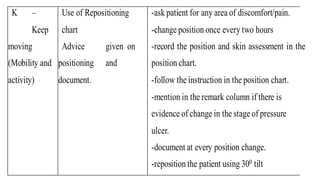
K –
Keep
moving
(Mobility and
activity)
Use of Repositioning
chart
Advice given on
positioning and
document.
-ask patient for any area of discomfort/pain.
-change position once every two hours
-record the position and skin assessment in the
position chart.
-follow the instruction in the position chart.
-mention in the remark column if there is
evidence of change in the stage of pressure
ulcer.
-document at every position change.
-reposition the patient using 300 tilt
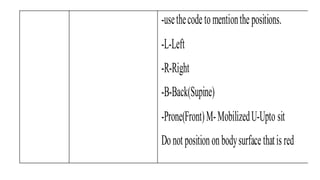
-usethecodetomentionthepositions.
-L-Left
-R-Right
-B-Back(Supine)
-Prone(Front)M-MobilizedU-Upto sit
Donot positiononbodysurfacethatisred
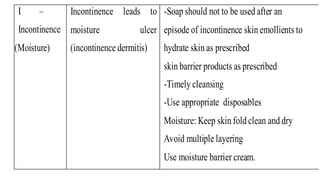
I –
Incontinence
(Moisture)
Incontinence leads to
moisture ulcer
(incontinence dermitis)
-Soap should not to be used after an
episode of incontinence skin emollients to
hydrate skin as prescribed
skin barrier products as prescribed
-Timely cleansing
-Use appropriate disposables
Moisture: Keep skin fold clean and dry
Avoid multiple layering
Use moisture barrier cream.
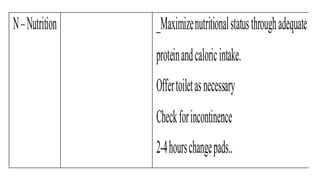
N–Nutrition _Maximizenutritionalstatusthroughadequate
proteinandcaloricintake.
Offertoiletasnecessary
Checkforincontinence
2-4hourschangepads..
TREATMENT:
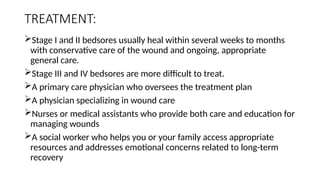
Stage I and II bedsores usually heal within several weeks to months
with conservative care of the wound and ongoing, appropriate
general care.
Stage III and IV bedsores are more difficult to treat.
A primary care physician who oversees the treatment plan
A physician specializing in wound care
Nurses or medical assistants who provide both care and education for
managing wounds
A social worker who helps you or your family access appropriate
resources and addresses emotional concerns related to long-term
recovery
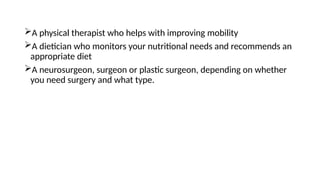
A physical therapist who helps with improving mobility
A dietician who monitors your nutritional needs and recommends an
appropriate diet
A neurosurgeon, surgeon or plastic surgeon, depending on whether
you need surgery and what type.
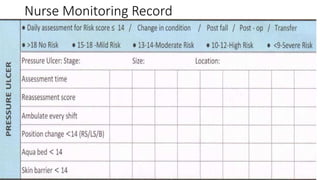
Nurse Monitoring Record
Nurses role
Nursing Assessment
Appropriate grading system – EPUAP
Documentation
Incident reporting
Patient and family education
Pressure ulcers treatment goal
1. Treat underlying pathology
2. Supplement Adequate nutrition
3. Wound care -
Dry wound - hydrate it
Wet wound - absorb it
Shallow wound - cover it
Deep wound - fill it / cover it
Prevention of pressure ulcers
Schedule regular repositioning and turning for bed and chair-
bound patients ·
Utilize support surfaces on bed and chairs ·
Position with pillows or wedges between bony prominences ·
Elevate heels off bed ·
Gently cleanse skin at each time of soiling & apply protective
moisture barrier ointment to the affected area ·
 Offer active or passive range of motion exercises ·
Use lift sheets or lift equipment to reposition or transfer patient ·
Refer to dietitian for nutritional assessment and interventions ·
Report weight loss, poor appetite or gastrointestinal changes that
interfere with eating ·

PRESSURE ULSERS.pptx.....................

  • 1.
    RISK IDENTIFICATION, PREVENTION ANDMANAGEMENT OF PRESSURE ULCERS - PRAKASH S
  • 2.
    SPECIFIC OBJECTIVES • INTRODUCTION •RISK FACTORS • SYMPTOMS • NURSING ASSESSMENT • NURSING CARE AND PREVENTION
  • 3.
    Purpose To ensure thatthe nurses meets best practice standards for the prevention and management of pressure ulcers
  • 4.
    Scope This is applicableto all doctors, nurses , nursing Aide, and all other staff working in a clinical setting, caring for patients with, or at risk of pressure ulcers
  • 5.
    Overview: Bedsore Bedsores areulcers that develop in areas of the body due to prolonged pressure on the skin. They are common in bedridden people who are immobile or unable to feel pain. Main symptoms include unusual changes to skin color or texture. The degree of damage to the skin and tissues varies and severe cases may involve muscles. Bedsores can be prevented by regularly examining the skin, especially bony prominences.
  • 6.
    • A bedsoreis an ulcer in the outer layer of the skin (epidermis) and the underlying tissue (dermis) due to prolonged pressure. It can occur to anyone, but is most common in bedridden people or those who use wheelchairs for long periods.
  • 7.
    It often appearsagainst a bony protrusion, in areas such as: 1.Hips. 2.Buttocks. 3.Back. 4.Tailbone (coccyx). 5.Ankles. 6.Heels. 7.Shoulders. 8.Back of the head. 9.Elbows. 10.Knees.
  • 9.
    Risk Factors Bed orchair-bound · Advanced age (>65 years) · Unable to move body or parts of body without help · Chronic conditions, such as diabetes or vascular disease, which affect perfusion (blood circulation) · Mental disability from conditions such as dementia · History of previous ulcer · Urinary and/or fecal incontinence · Inadequate/poor nutrition and/or dehydration · Diastolic pressure
  • 10.
    Procedure 1. All patientsadmitted in the hospital shall be assessed for presence of pressure ulcer or risk for pressure ulcer development as part of initial nursing assessment. 2. Following this reassessment will be done every shift handover, when their condition changes, and on transfer or discharge. 3. The assessment will be documented in the nurses initial assessment record/ nursing care plan/ Position chart and communicated as part of the nursing handover. 4. All Pressure ulcer shall be graded using the EPUAP(European Pressure Ulcer Advisory Panel) Pressure ulcer grading chart at the time of initial assessment and documented in the initial assessment form.
  • 11.
    1. The causeof the pressure ulcer should be identified and where possible to be removed or reduced. 2. Patients, care givers and relatives must be made aware of the reason for the assessment and intervention
  • 12.
    The Pressure ulceris classified as per the EPUAP as follows
  • 13.
    Stage 1 Intactskin Redness Discolouration of the skin, warmth, edema, hardness or pain over bony prominence Stage 2 Partial skin loss/ Blister Redness and pink Intact/open serum filled blister or Shallow open ulcer without slough Stage 3 Full thickness skin loss Yellow Shallow ulcer with visible fat. Bone/tendon not visible or palpable visible some slough Stage 4 Full thickness tissue loss Yellow /Black Ulcer with visible bone, tendon or muscle
  • 17.
    • Moisture onthe skin surface by sweat, urine and faecal fluid can cause changes in the skin‘s pH, reduce tensile strength, and cause pressure ulcer.
  • 18.
    The moisture ulcersare classified as 0 Healthy 1 Mild excoriation Erythema (redness) No broken area 2 Moderate excoriation Erythema bleeding (redness) <50% broken area Oozingand/or 3 Severeexcoriation Erythema bleeding (redness) >50%broken skin Oozing and/or
  • 19.
    The patient atrisk for developing pressure ulcer are 1. High risk patients 2. Braden Score 12 or less than 12 during assessment or reassessment.
  • 20.
    Braden Scale On admission,all in patients shall be assessed for risk to develop pressure ulcer using Pressure Ulcer – Risk Assessment form ( Braden Scale) A complete head to toe skin assessment is performed for any potential and actual compromise in skin integrity.
  • 21.
    The patients areassessed on the six parameters – 1. Sensory Perception 2. Moisture, Activity 3. Mobility 4. Nutrition 5. Friction 6. Shear
  • 22.
    Sensory perception: Measures thepatient’s ability to detect/sense pain and respond to discomfort or pain that is related to pressure on parts of their body. Moisture: The parameter assesses the degree of moisture the skin is exposed to. Excessive and continuous skin moisture pose a risk to compromise the integrity of the skin, It causes skin tissue to become macerated and therefore be at risk for epidermal erosion.
  • 23.
    Activity: The parameter looksat a patient’s level of physical activity since very little or no activity can cause atrophy of muscles and breakdown of tissue. Mobility: The parameter looks at the capability of a patient to adjust their body position independently. This assesses the physical competency to move and can involve the client’s willingness to move.
  • 24.
    Friction and Shear: Theparameter assesses the amount of assistance a client needs to move and the degree of sliding on beds or chairs that they experience. The sliding motion can cause shear which means the skin and bone are moving in opposite directions causing breakdown of cell membranes and capillaries.
  • 25.
    The Braden scalefor predicting pressure ulcer risk Sensory Perception – ability to respond meaningfully to pressure- related discomfort (1–4) Moisture – degree to which skin is exposed to moisture (1–4)  Activity –degree of physical activity (1–4) Mobility – ability to change and control body position (1–4)  Nutrition – usual food intake pattern (1–4) Friction and Shear – amount of assistance needed to move, degree of sliding in bed and/or chair (1–3)
  • 27.
    Each of the6 categories is scored from 1 to 4 except for friction and shear 1-3. The Braden scale score ranges from 6-23. The lower the score greater the risk for skin breakdown. Total score of 12 or less represents HIGH RISK Initial Risk Assessment is done on day of admission and documented Reassessment of patients • a.Reassess all patients in Critical areas every 24 hours ( HICU, ICU2, ICCU, ICU4, ICU5, PICU) • b.Reassess all patients irrespective of the degree of risk or care setting whenever the patient’s condition changes
  • 28.
    Reassessment of patients Reassessall patients in Critical areas every 24 hours ( HICU, ICU2, ICCU, ICU4, ICU5, PICU) Reassess all patients irrespective of the degree of risk or care setting whenever the patient’s condition changes
  • 29.
    SSKIN Bundle The pressureulcer prevention bundle shall be implemented immediately. The SSKIN Bundle is used to plan prevention plan
  • 30.
    S-Surface (Traction and shear.) Appropriate mattress- ICU– Appropriate cushion for bony areas -Foam mattress - alternating pressure mattress Air mattress (Alpha) / Water mattress (Aqua) -Sheep skin for new born or pediatric if available -Cushion -Uncreased bed linen - eliminate pressure on heel by Placing a pillow from the ankle to below the knee -Pad skin if device pressure present -use pillows to avoid contact between bony prominence. -Pad bony prominence
  • 31.
    S – Skin Inspection (Sensory perception ) Skinbreak is considered as open and requires dressing Skin Management Wound Management -inspect skin regularly when repositioning, toileting and activity with ADLS -communicate to patient -do not massage skin or vigorously rub the skin -protect skin from exposure to excessive moisture -friction and sheer to be reduced limit head of bed elevation to 30 0 -Raise knee 10-200 before raising head of bed -do transfer /bed position using transfer sheet. -do not position directly on trochanter -do not use doughnut sheet type devices -avoid positioning directly on bony prominence -reposition every hour in chair -use pillows between legs on side lying position avoid talcum powder skin emollients to hydrate skin as prescribed-moisturizer
  • 32.
    K – Keep moving (Mobility and activity) Useof Repositioning chart Advice given on positioning and document. -ask patient for any area of discomfort/pain. -change position once every two hours -record the position and skin assessment in the position chart. -follow the instruction in the position chart. -mention in the remark column if there is evidence of change in the stage of pressure ulcer. -document at every position change. -reposition the patient using 300 tilt
  • 33.
  • 34.
    I – Incontinence (Moisture) Incontinence leadsto moisture ulcer (incontinence dermitis) -Soap should not to be used after an episode of incontinence skin emollients to hydrate skin as prescribed skin barrier products as prescribed -Timely cleansing -Use appropriate disposables Moisture: Keep skin fold clean and dry Avoid multiple layering Use moisture barrier cream.
  • 35.
  • 36.
    TREATMENT: Stage I andII bedsores usually heal within several weeks to months with conservative care of the wound and ongoing, appropriate general care. Stage III and IV bedsores are more difficult to treat. A primary care physician who oversees the treatment plan A physician specializing in wound care Nurses or medical assistants who provide both care and education for managing wounds A social worker who helps you or your family access appropriate resources and addresses emotional concerns related to long-term recovery
  • 37.
    A physical therapistwho helps with improving mobility A dietician who monitors your nutritional needs and recommends an appropriate diet A neurosurgeon, surgeon or plastic surgeon, depending on whether you need surgery and what type.
  • 38.
  • 39.
    Nurses role Nursing Assessment Appropriategrading system – EPUAP Documentation Incident reporting Patient and family education
  • 40.
    Pressure ulcers treatmentgoal 1. Treat underlying pathology 2. Supplement Adequate nutrition 3. Wound care - Dry wound - hydrate it Wet wound - absorb it Shallow wound - cover it Deep wound - fill it / cover it
  • 41.
    Prevention of pressureulcers Schedule regular repositioning and turning for bed and chair- bound patients · Utilize support surfaces on bed and chairs · Position with pillows or wedges between bony prominences · Elevate heels off bed · Gently cleanse skin at each time of soiling & apply protective moisture barrier ointment to the affected area ·
  • 42.
     Offer activeor passive range of motion exercises · Use lift sheets or lift equipment to reposition or transfer patient · Refer to dietitian for nutritional assessment and interventions · Report weight loss, poor appetite or gastrointestinal changes that interfere with eating ·