


PREPARED BY:-
Mr. Karm P. Balar
Asst. Professor
CED, SURAT
Content
What is Demolition?
Planning
Types of structural demolition
Methods Of Demolition
Precautions Before and During Demolition
2
What is Demolition?
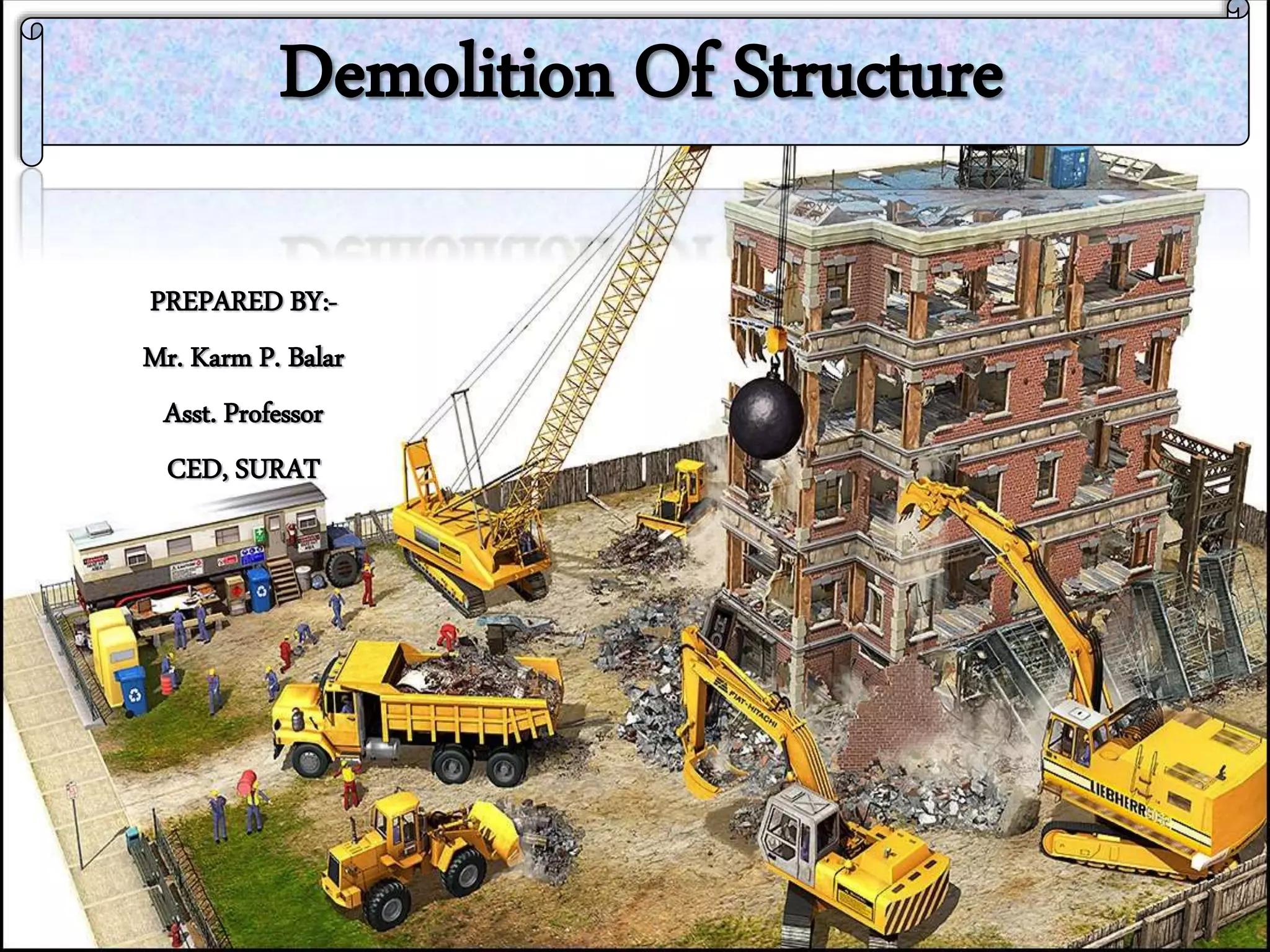
• Demolition means dismantling, razing, destroying or
wrecking any building or structure or any part thereof by
pre-planned and controlled methods.
• Demolition methods can vary depending on the area where
it will be held on, time available, the building material, the
purpose of the demolition and the way that debris is going
to be disposed.
3
History
• the first true "explosive" was black powder, which was
developed around the 13th century.
• The first recorded use of black powder for demolition
appears to have occurred in the early 1600s, for rock
blasting.
• Black powder was put to use in the tin mines of England,
and Switzerland adopted blasting technology for road
construction.
• Throughout the 1930s, structural explosive demolition was
overseen by engineers working directly for large dynamite
manufacturers.
S
E
Q
U
E
N
C
E
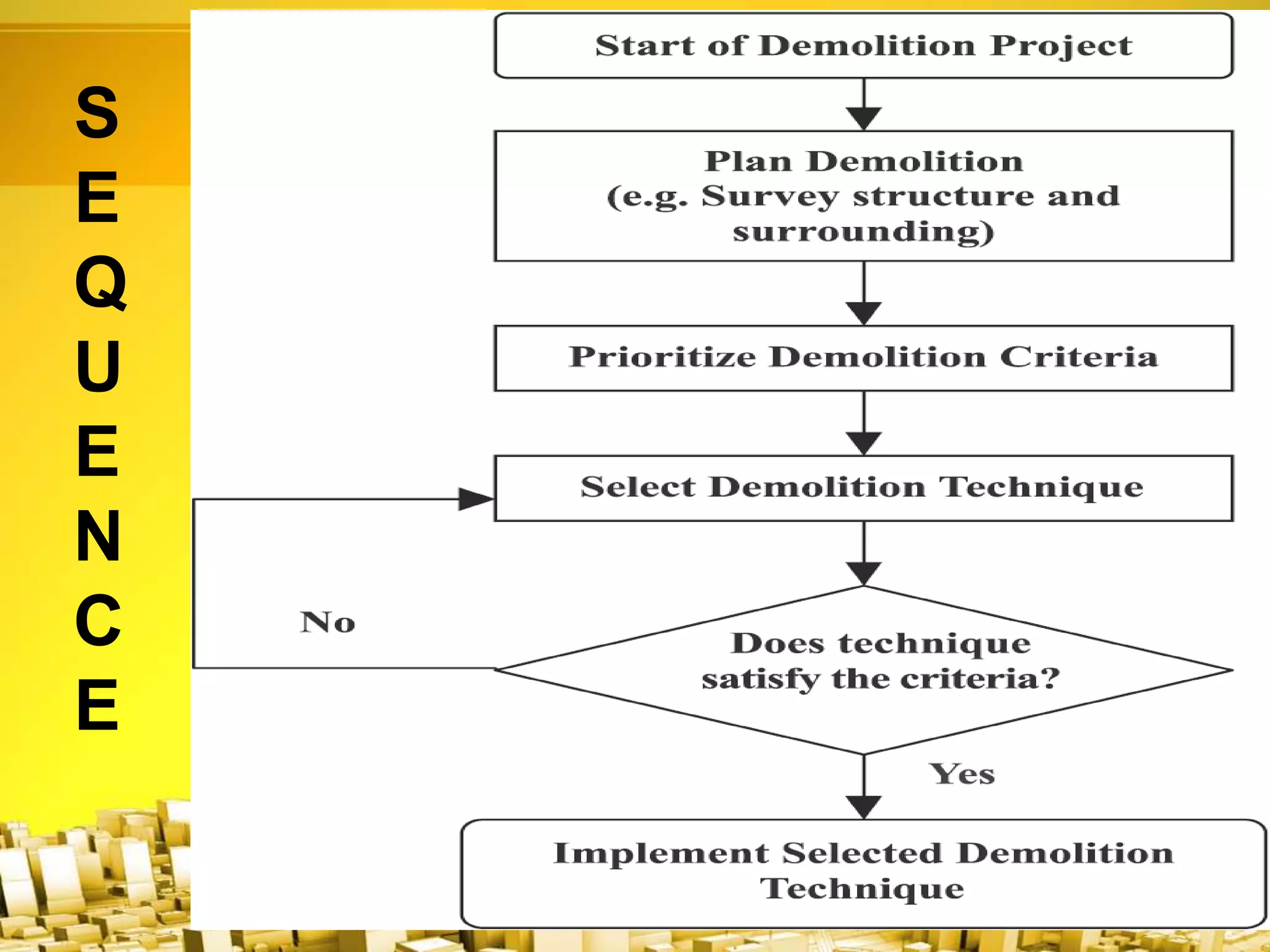
Planning
• Before beginning the actual work of demolition a structure, a
careful study shall be made of the structure which is to be
pulled down and also of all its surroundings.
6
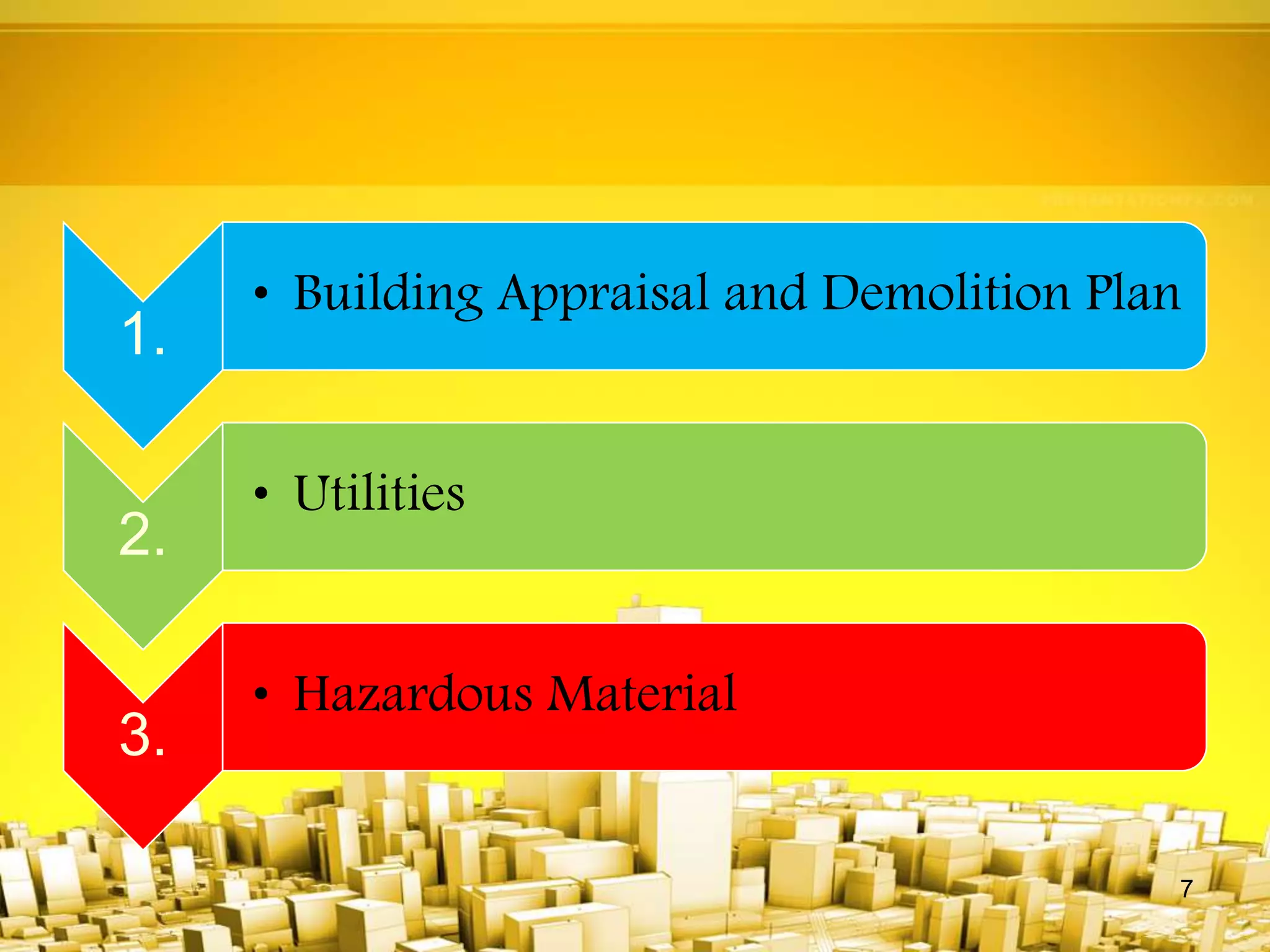
1.
• Building Appraisal and Demolition Plan
2.
• Utilities
3.
• Hazardous Material
7
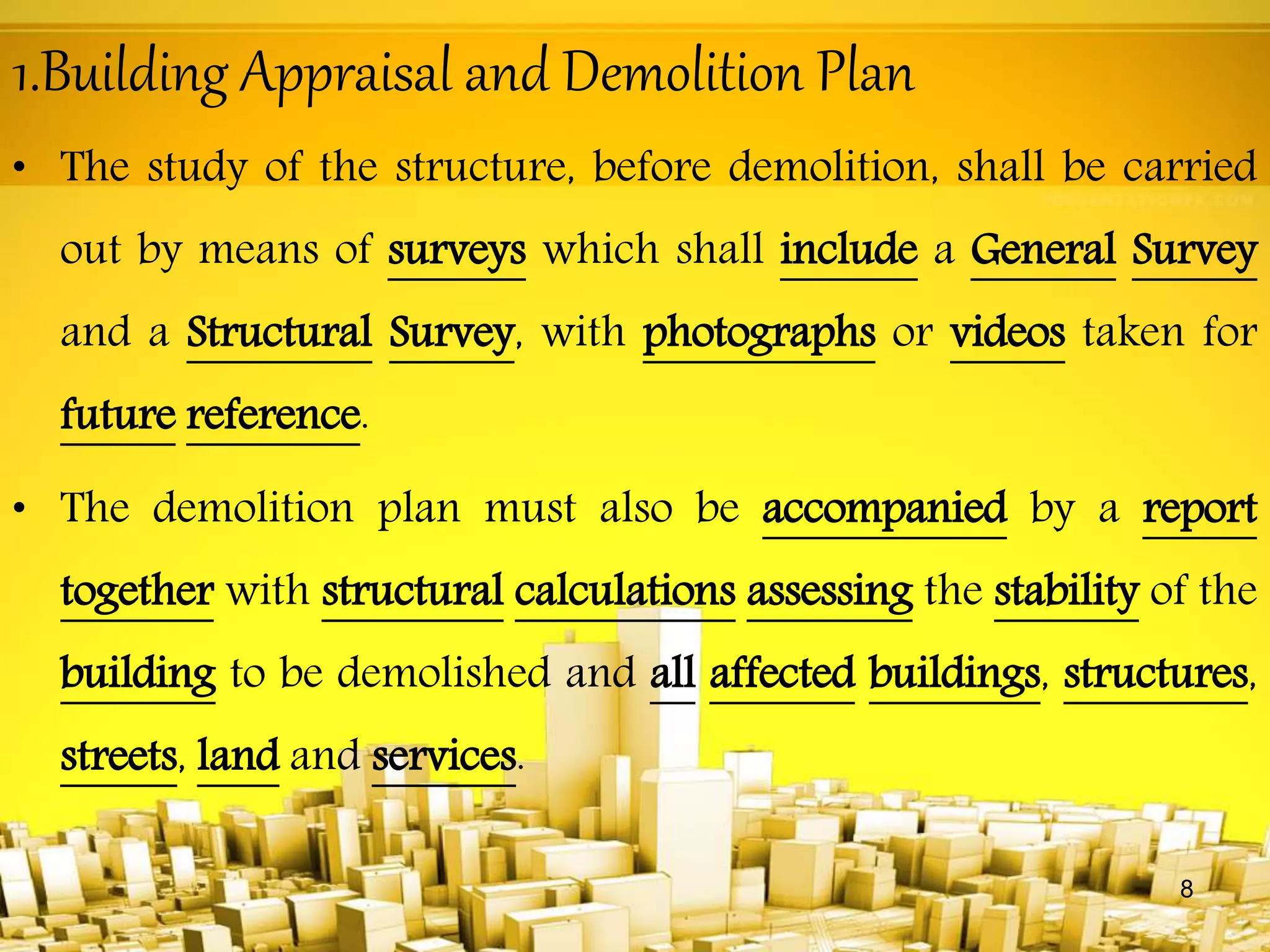
1.Building Appraisal and Demolition Plan
• The study of the structure, before demolition, shall be carried
out by means of surveys which shall include a General Survey
and a Structural Survey, with photographs or videos taken for
future reference.
• The demolition plan must also be accompanied by a report
together with structural calculations assessing the stability of the
building to be demolished and all affected buildings, structures,
streets, land and services.
8
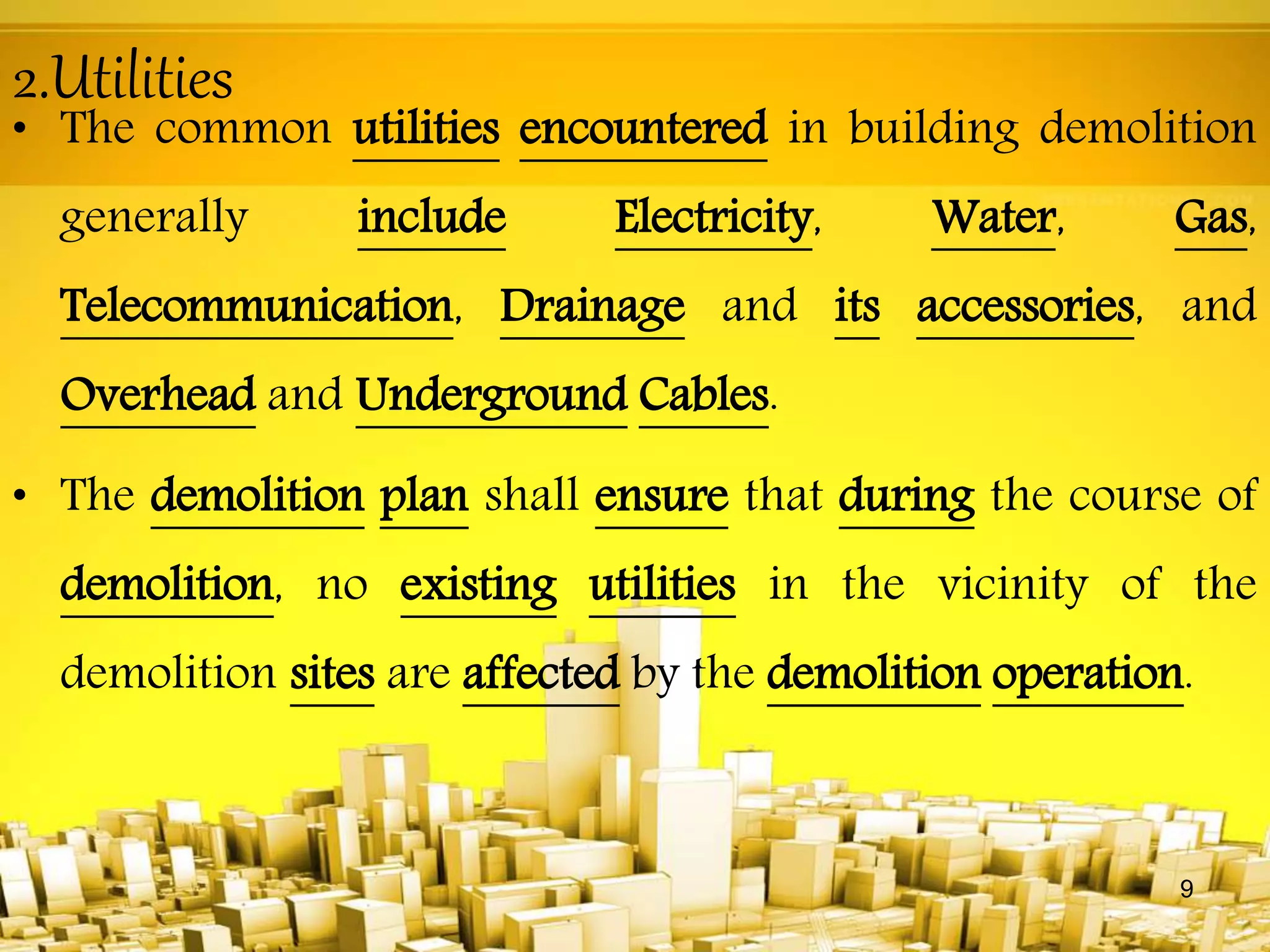
2.Utilities
• The common utilities encountered in building demolition
generally include Electricity, Water, Gas,
Telecommunication, Drainage and its accessories, and
Overhead and Underground Cables.
• The demolition plan shall ensure that during the course of
demolition, no existing utilities in the vicinity of the
demolition sites are affected by the demolition operation.
9
3.Hazardous Material
• If hazardous materials, such as asbestos containing
materials, petroleum contamination and radioactive
contamination, exist in the building, further investigation
and removal of such hazardous material or contamination
by specialist shall be considered.
10
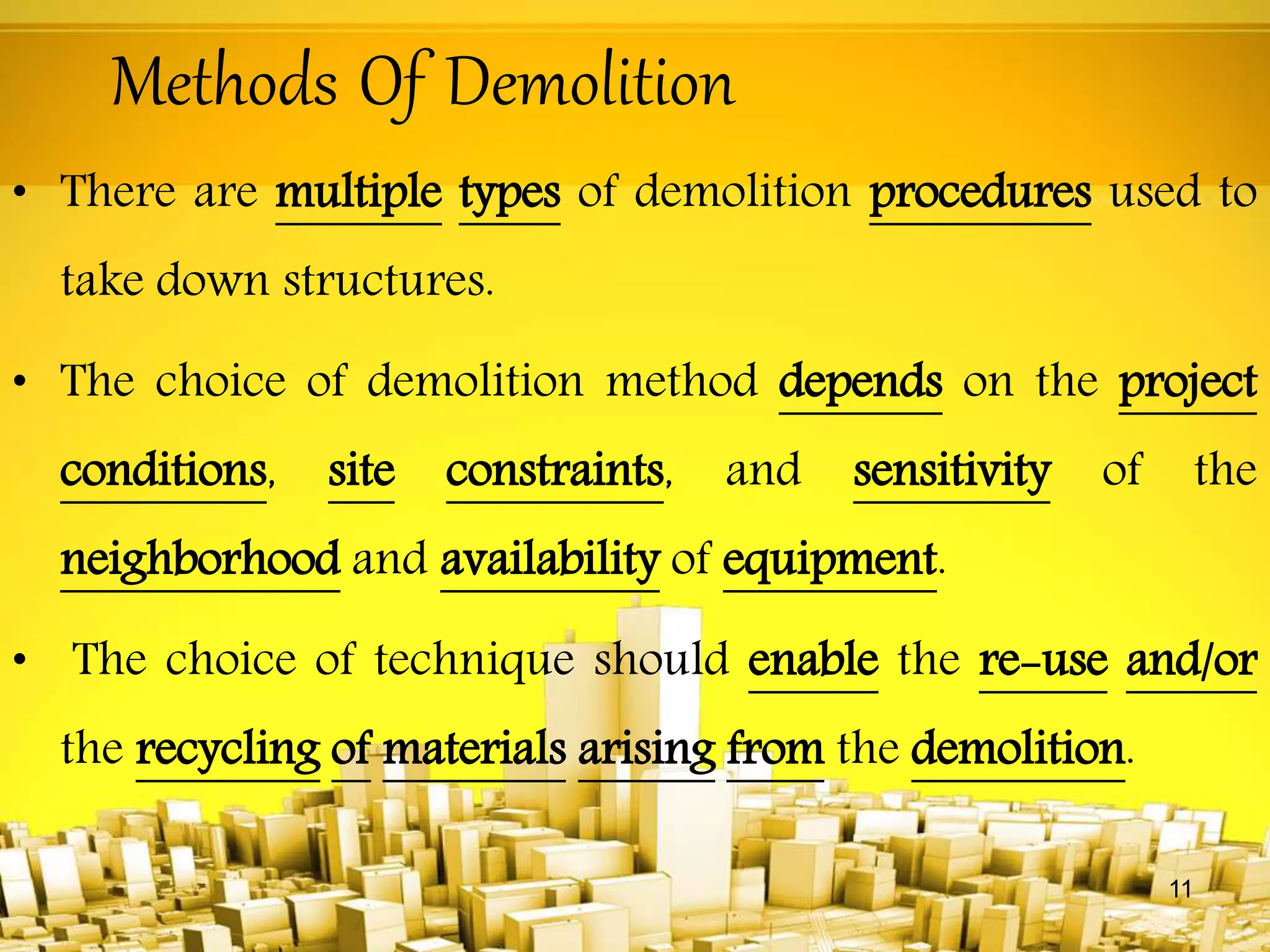
Methods Of Demolition
• There are multiple types of demolition procedures used to
take down structures.
• The choice of demolition method depends on the project
conditions, site constraints, and sensitivity of the
neighborhood and availability of equipment.
• The choice of technique should enable the re-use and/or
the recycling of materials arising from the demolition.
11
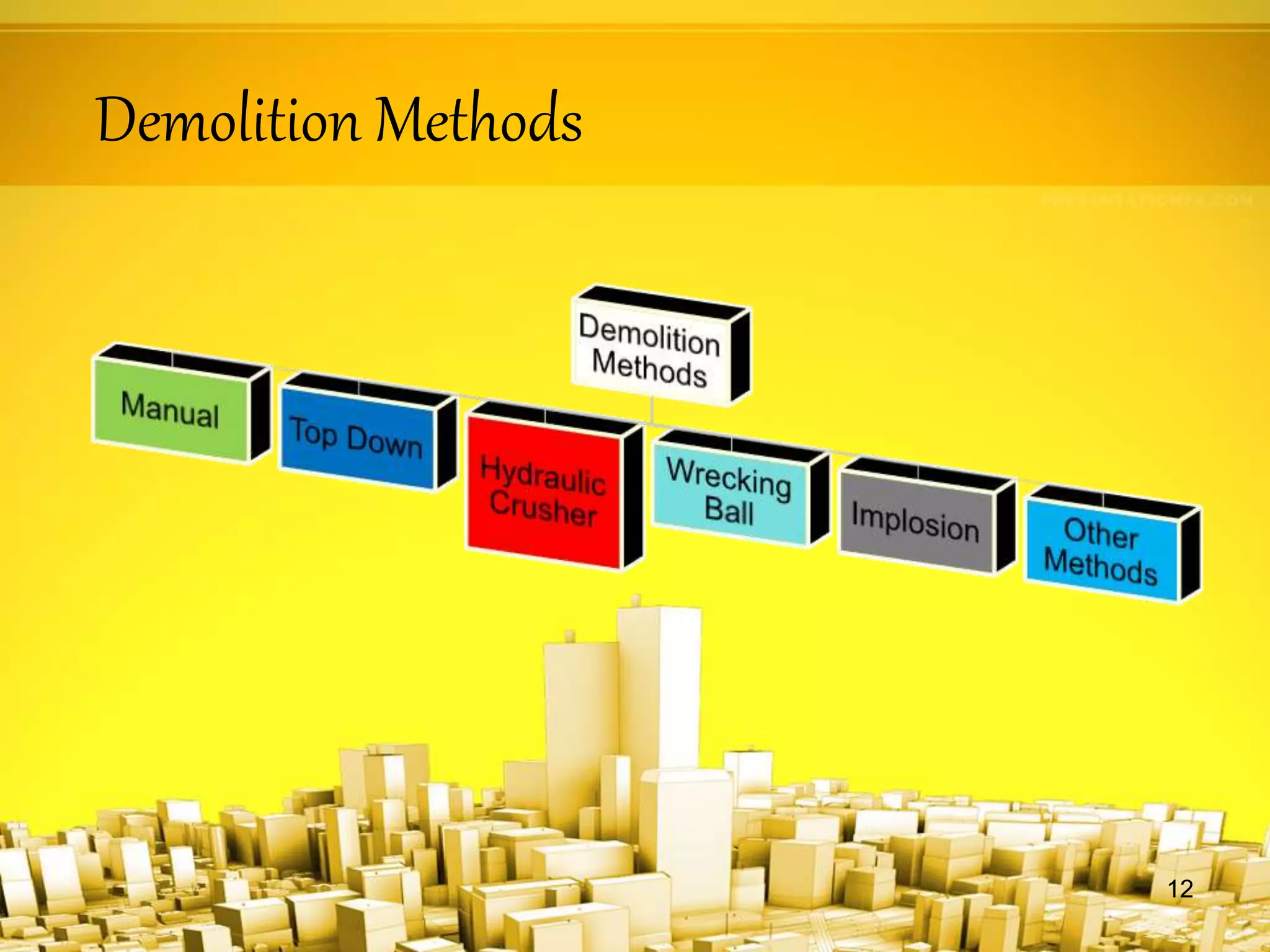
Demolition Methods
12
Manual Method
• carried out as top down, in general, from the roof to
ground.
• sequence of demolition may vary, depending on site
conditions and structural elements to be demolished.
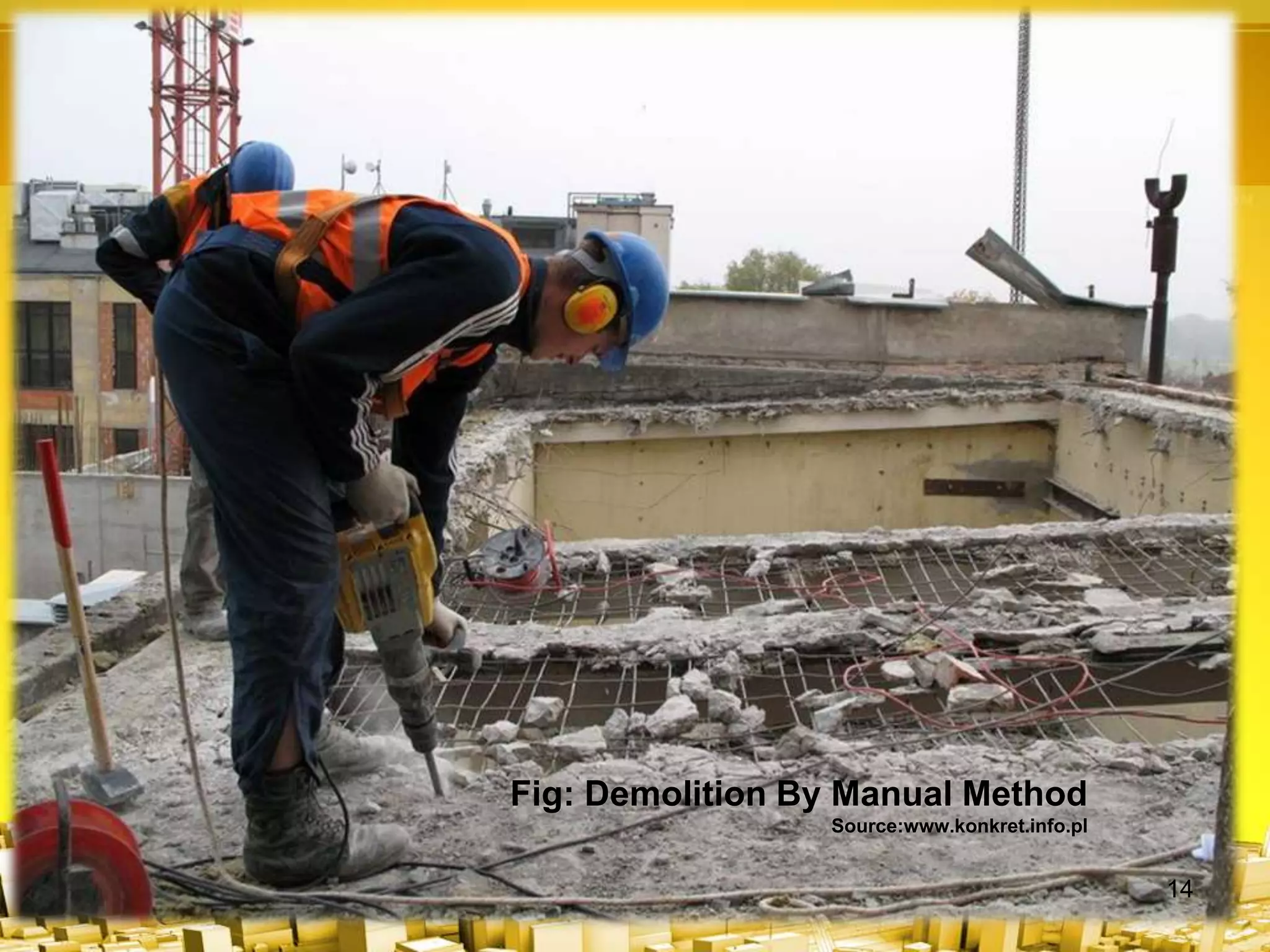
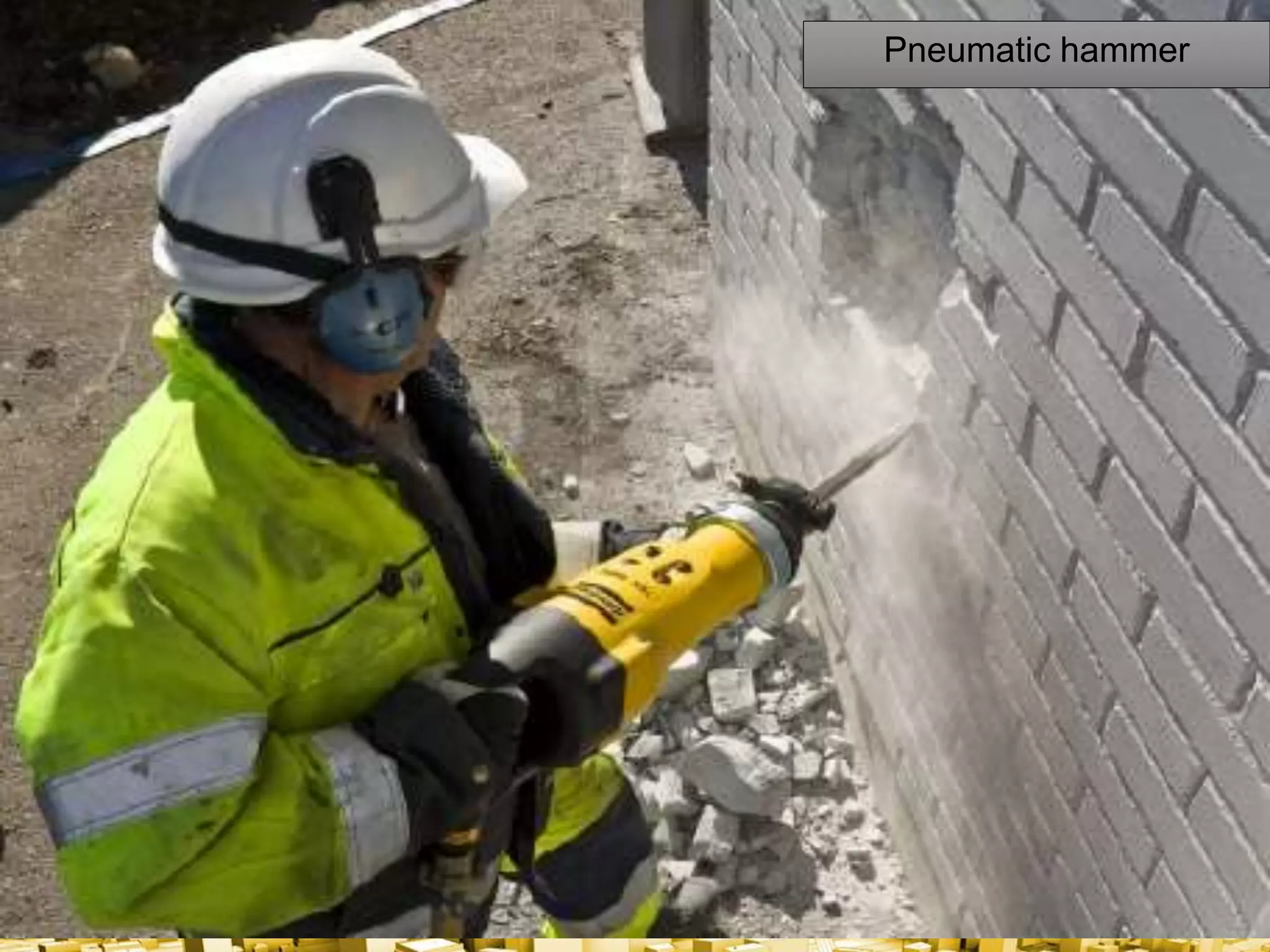
• For RCC buildings, jack hammers used to break down the
concrete.
13
Fig: Demolition By Manual Method
Source:www.konkret.info.pl
14
15
Pneumatic hammer
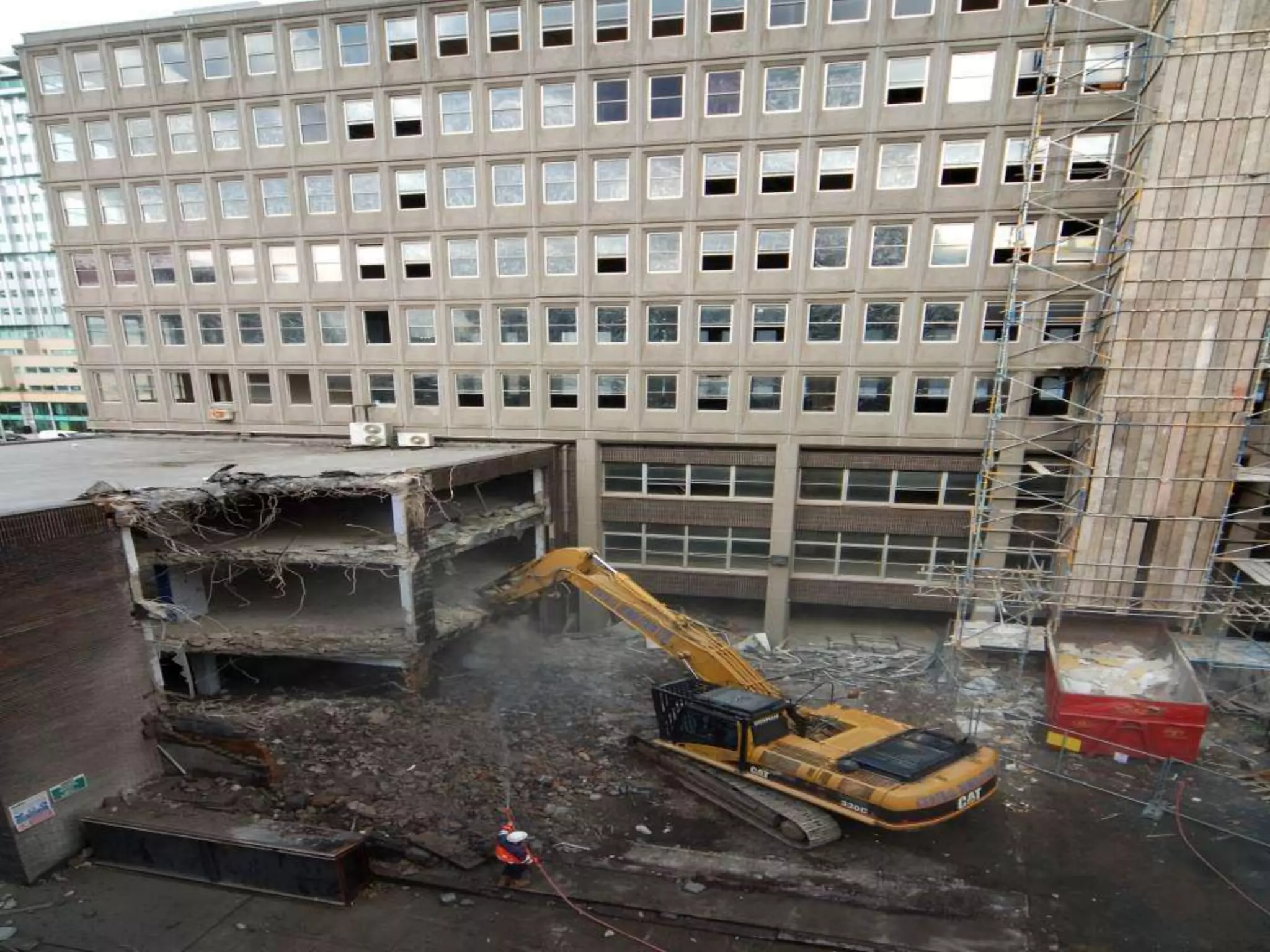
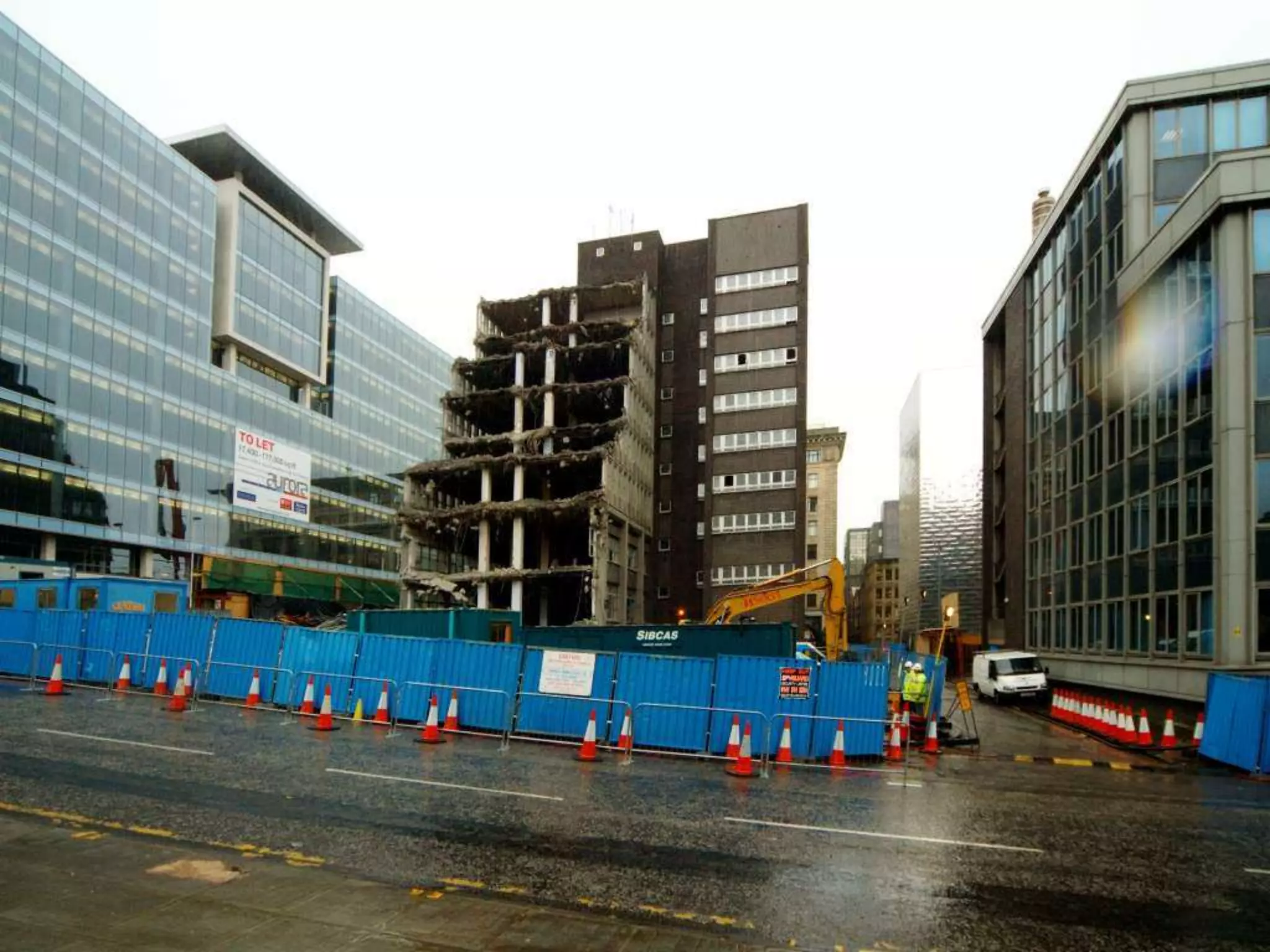
Top Down — By Machines
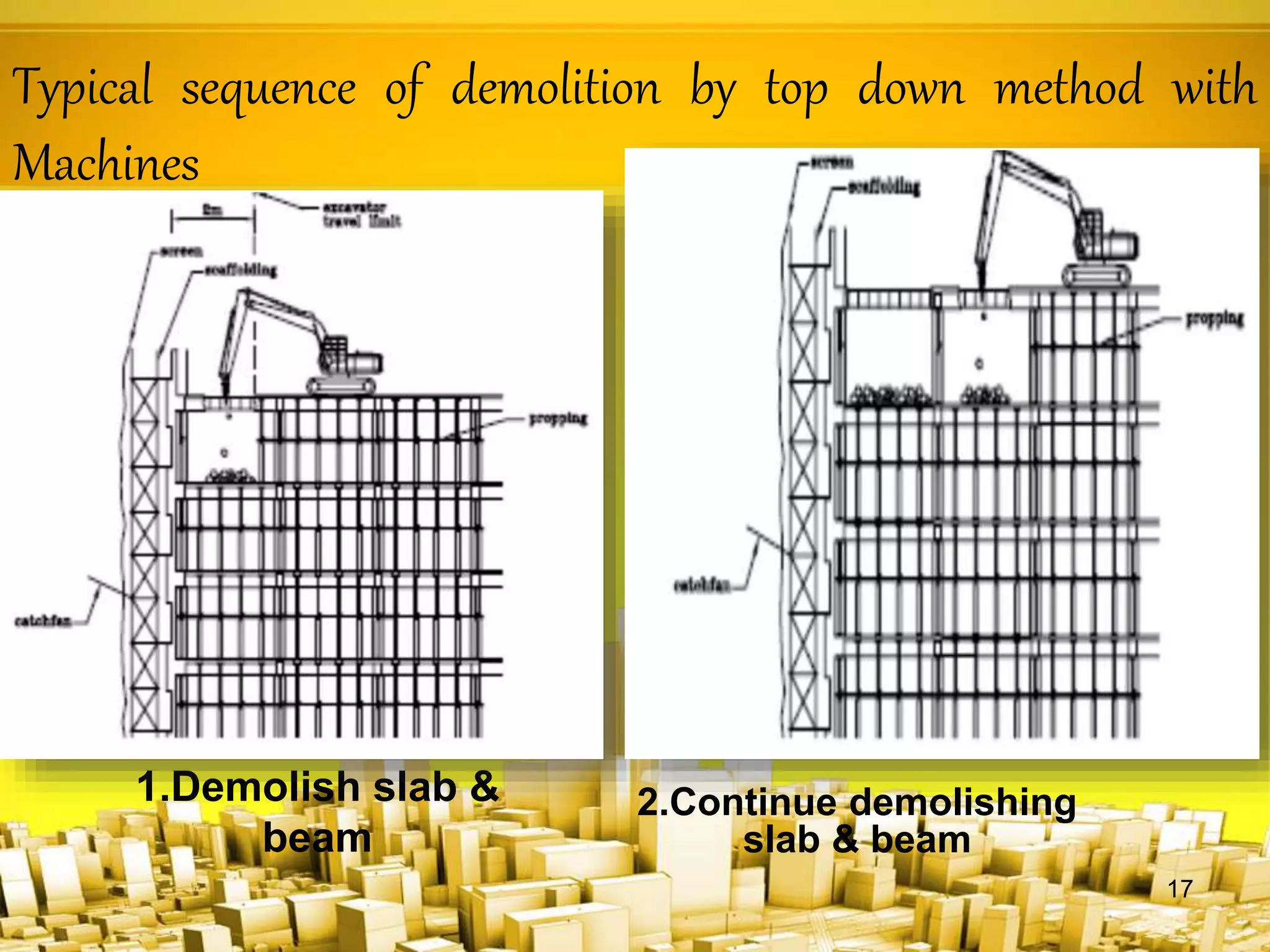
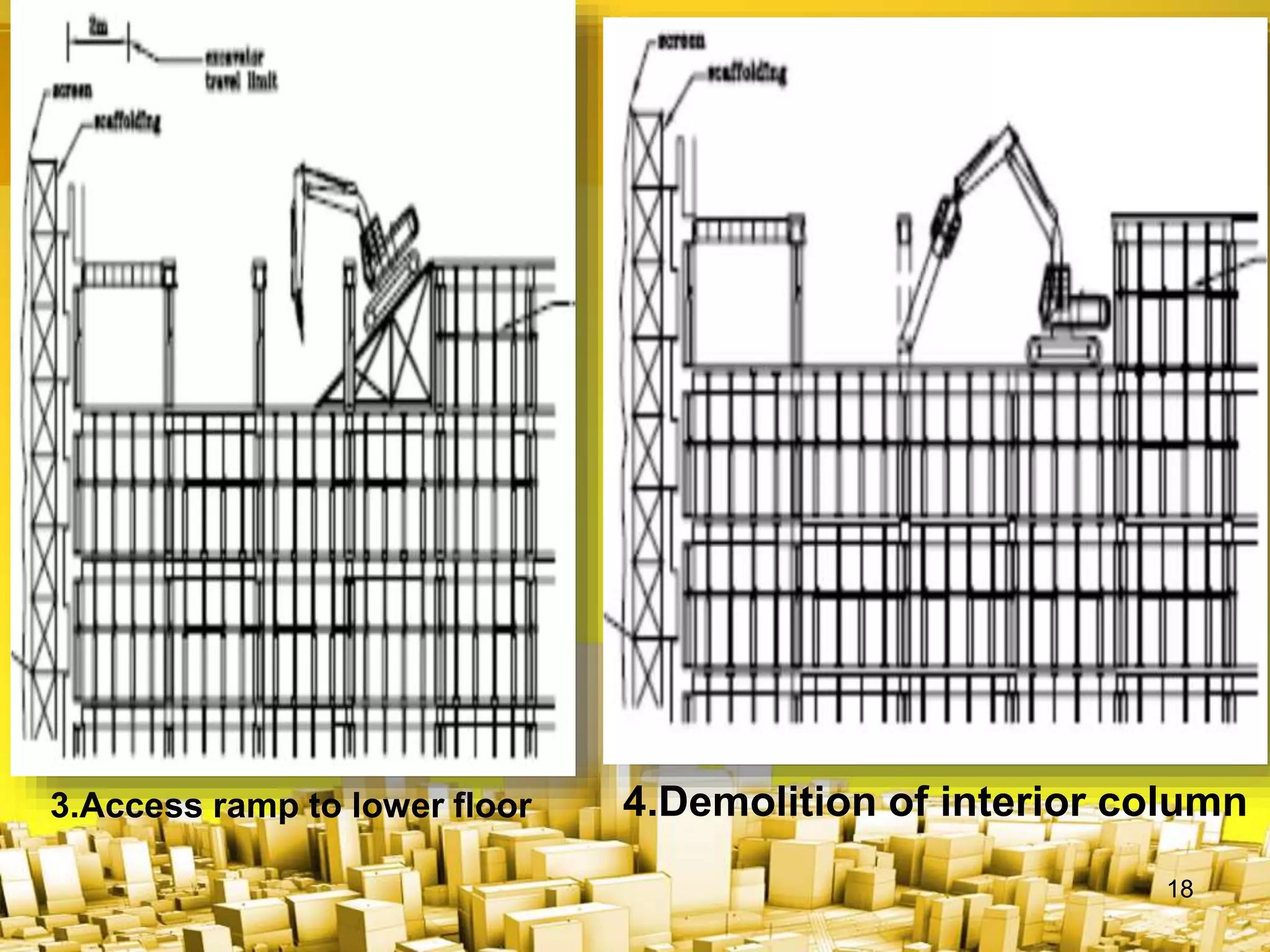
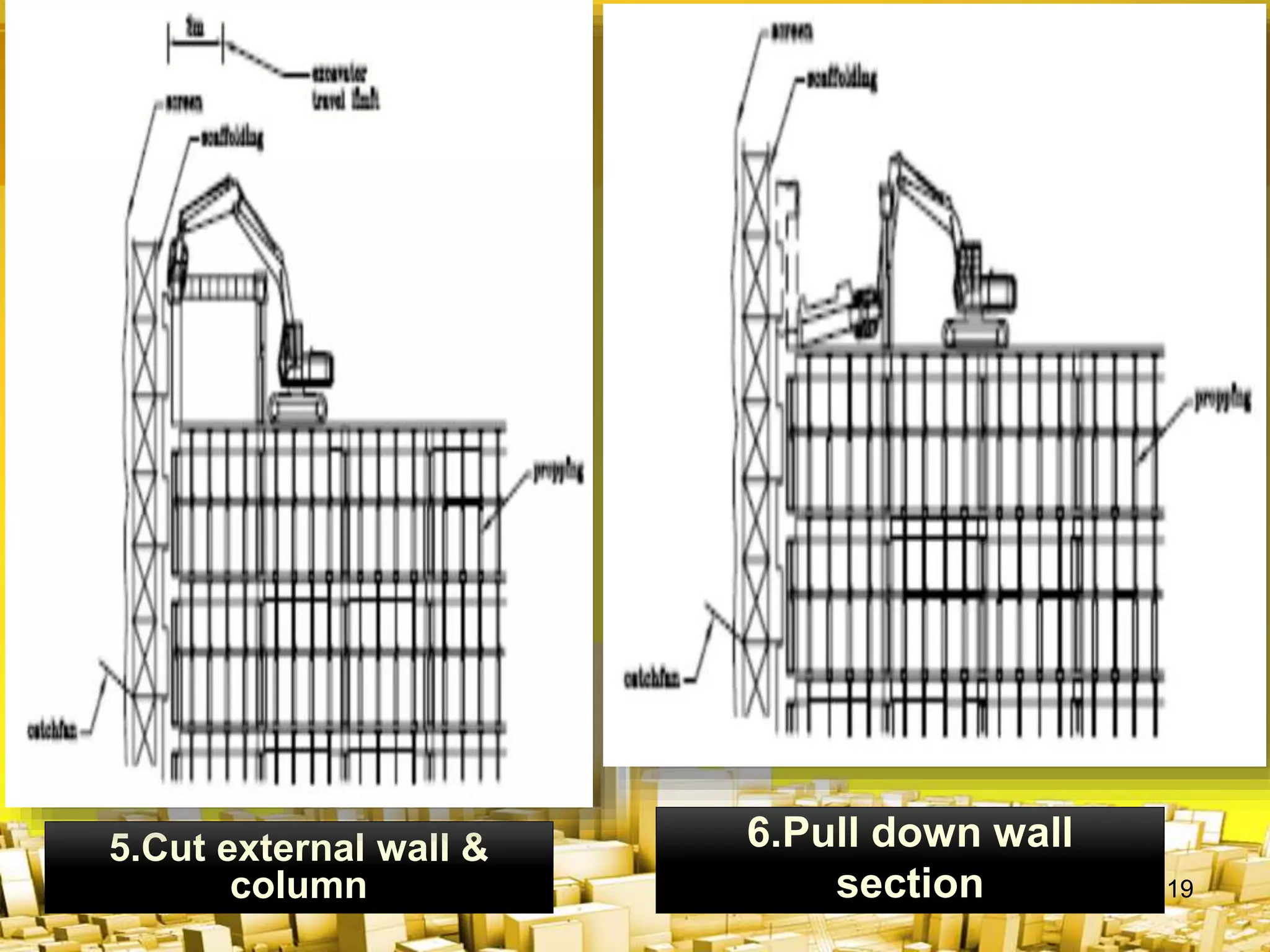
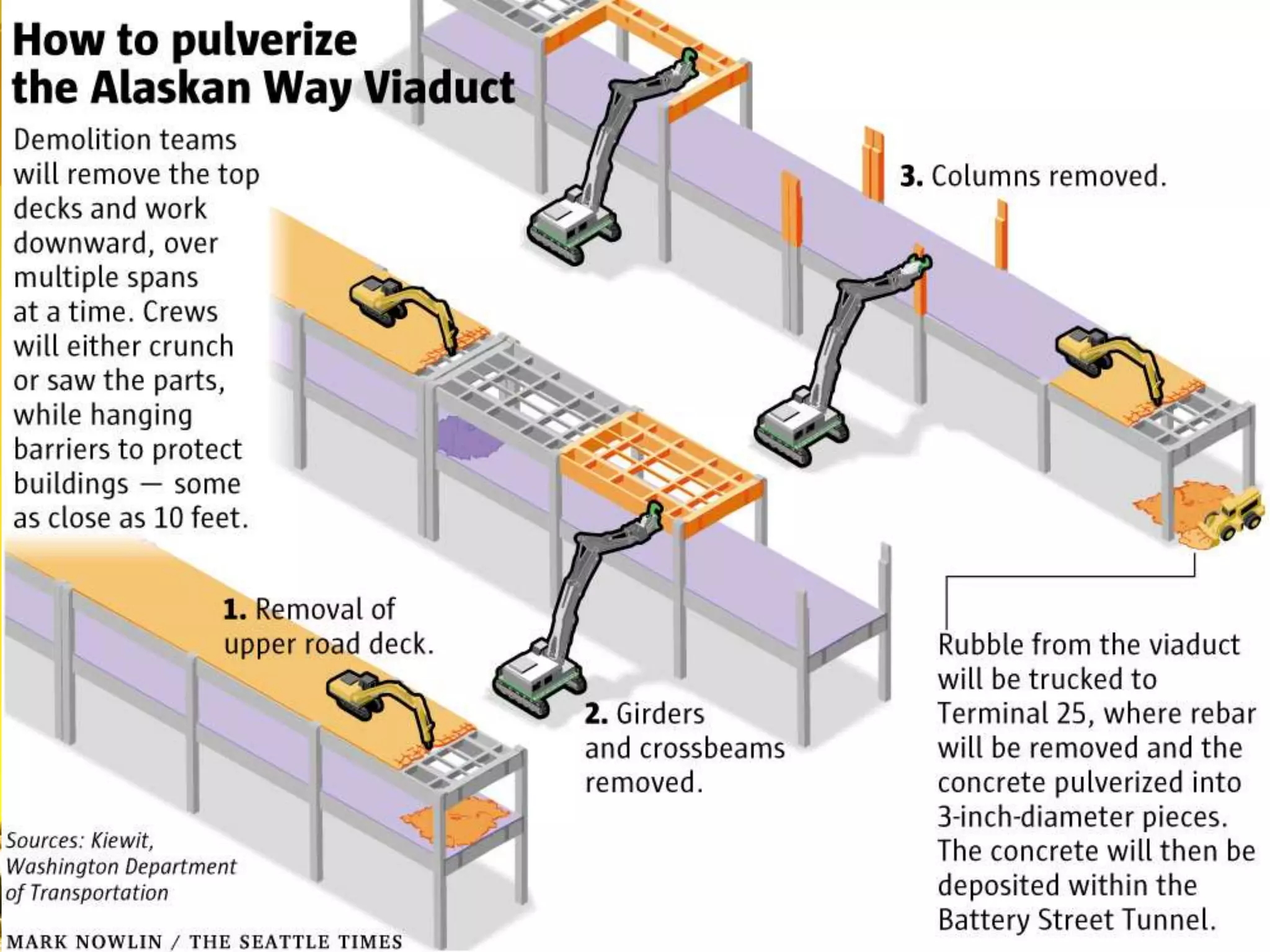
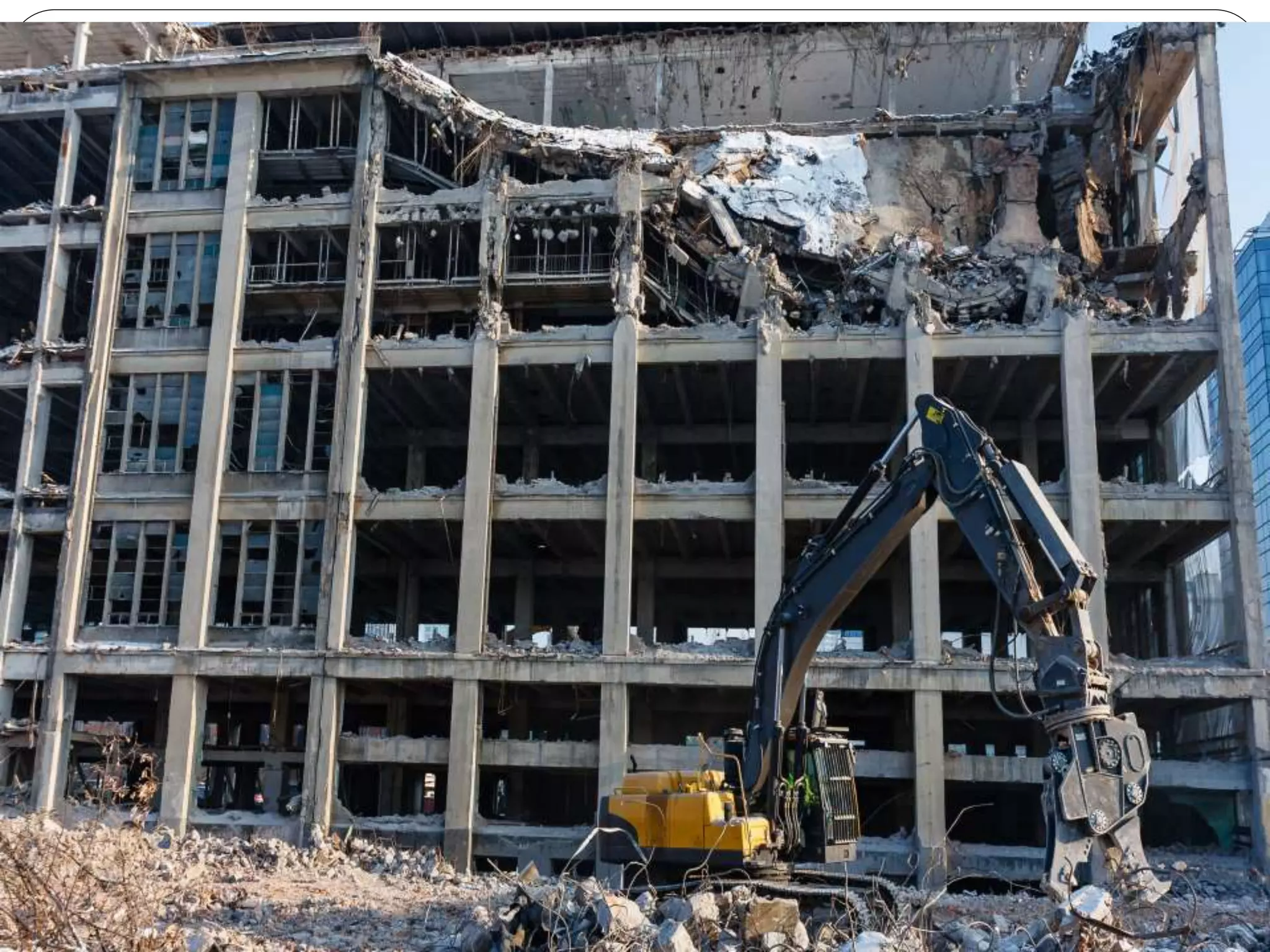
• same as the top down manual method, except that most of
the demolition is done by Machines.
• The demolition begins with the lifting of the mechanical
plant on to the building top floor.
• Step by step demolish building component starting from
slab, beam, column etc.
16
Typical sequence of demolition by top down method with
Machines
1.Demolish slab &
beam
2.Continue demolishing
slab & beam
17
3.Access ramp to lower floor 4.Demolition of interior column
18
5.Cut external wall &
column
6.Pull down wall
section 19
20
21
22
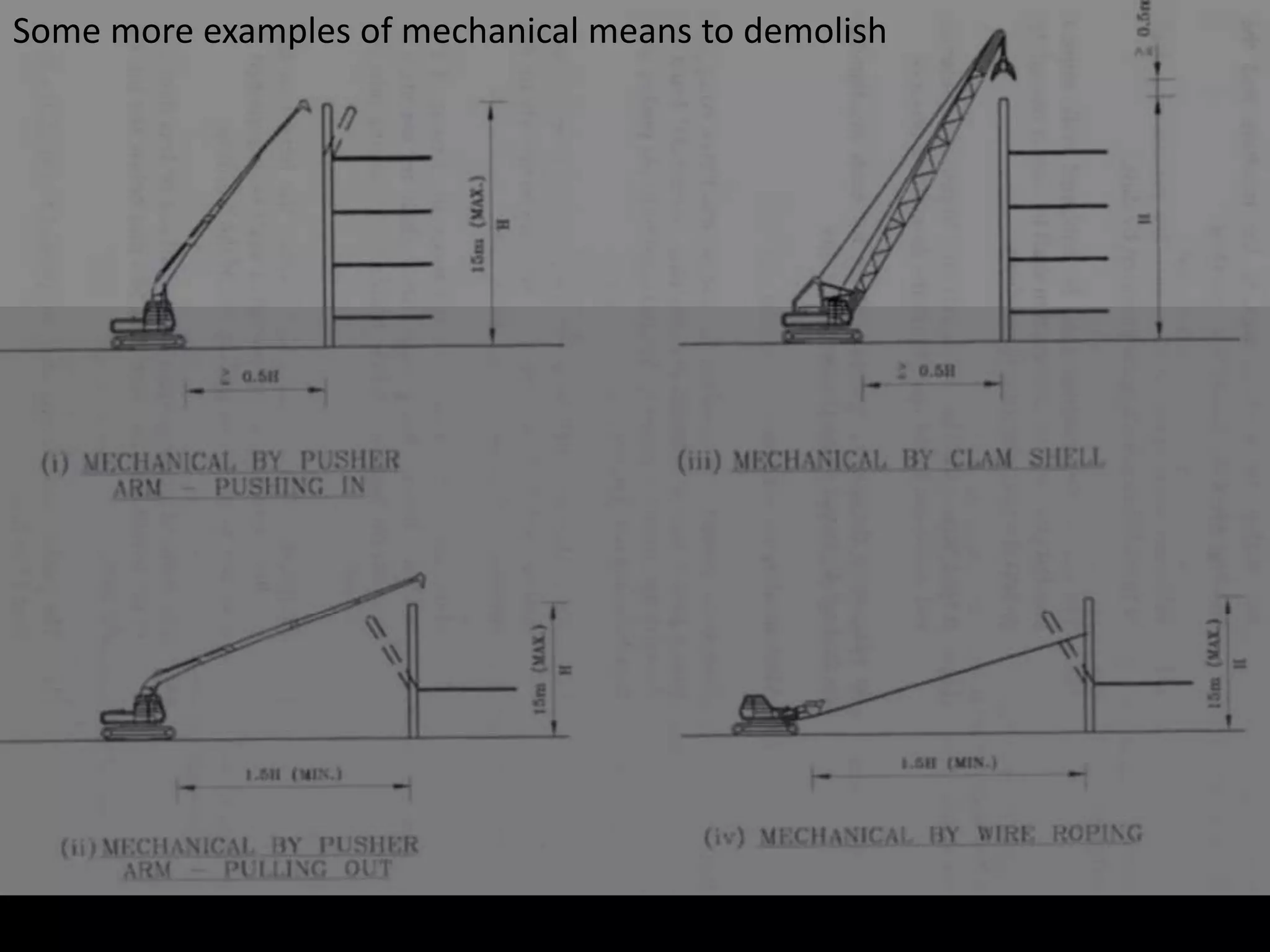
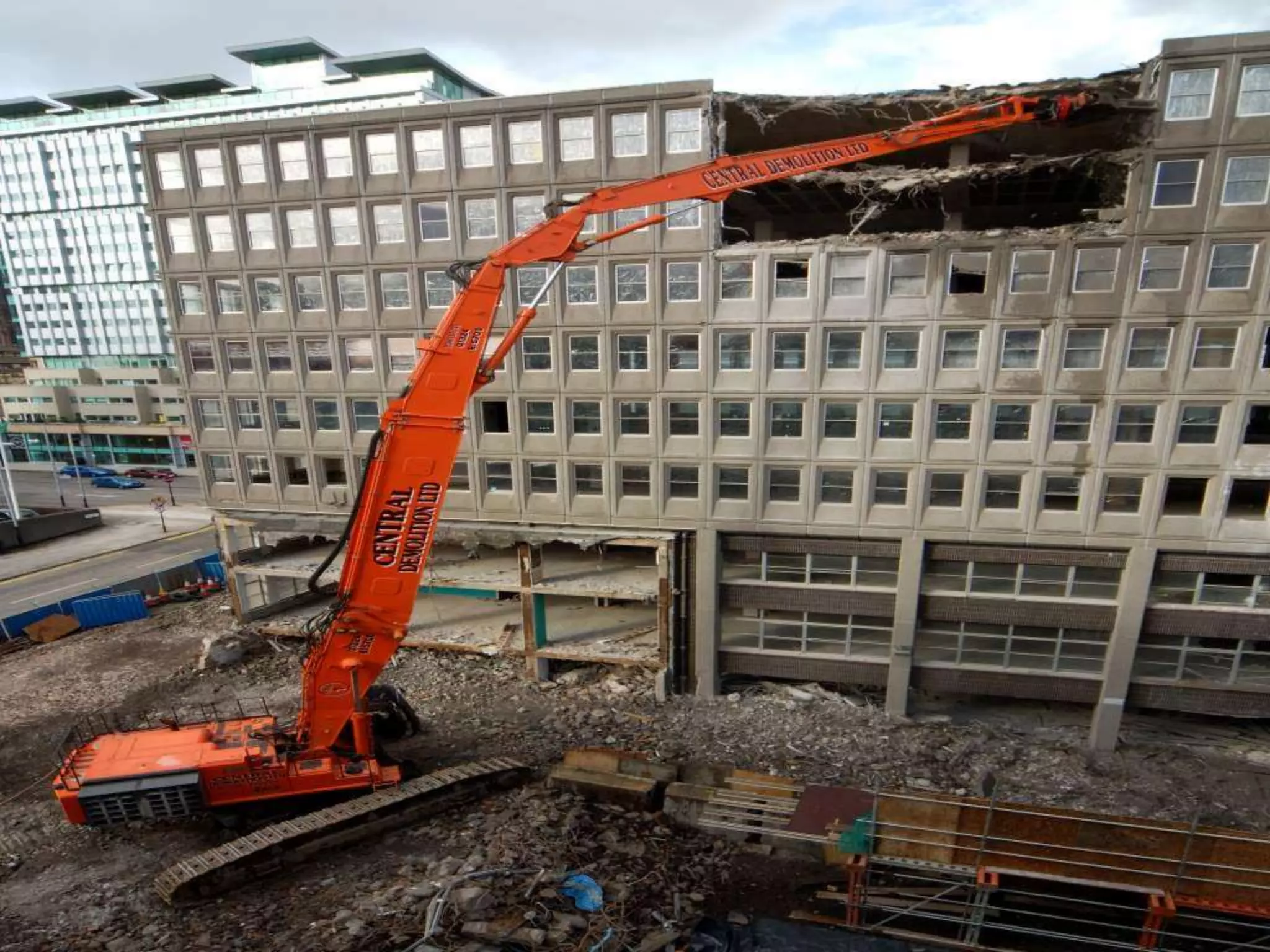
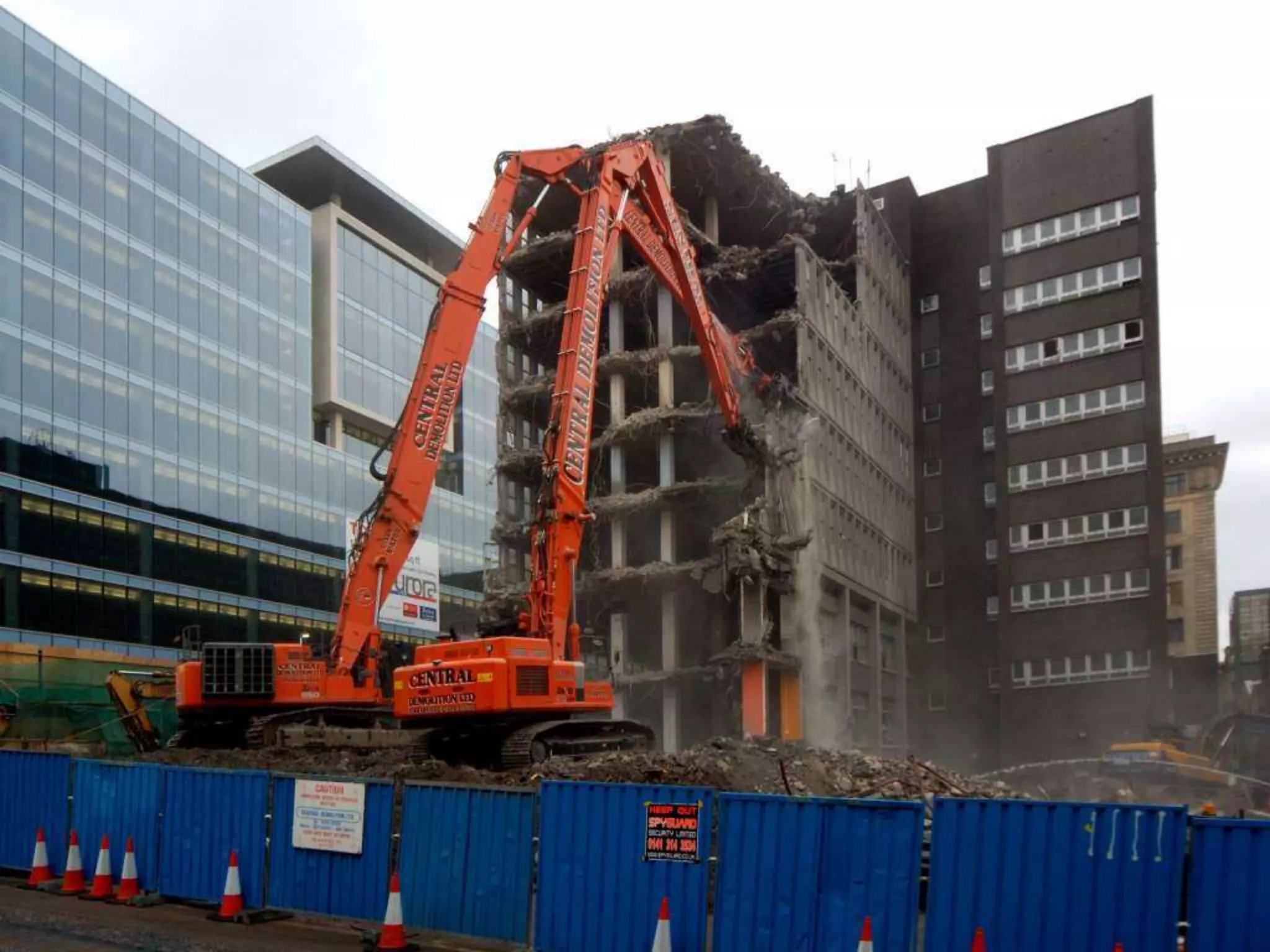
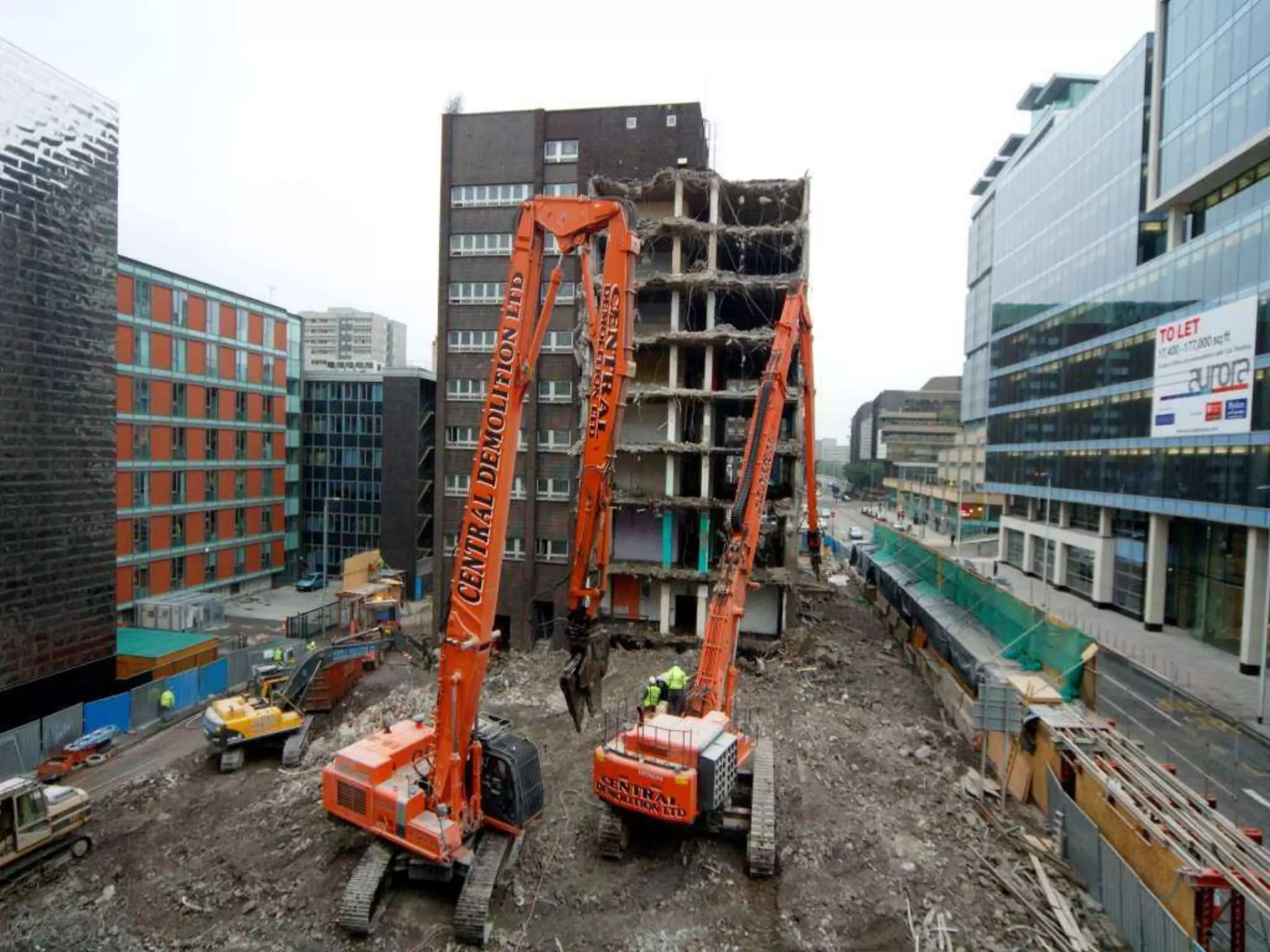
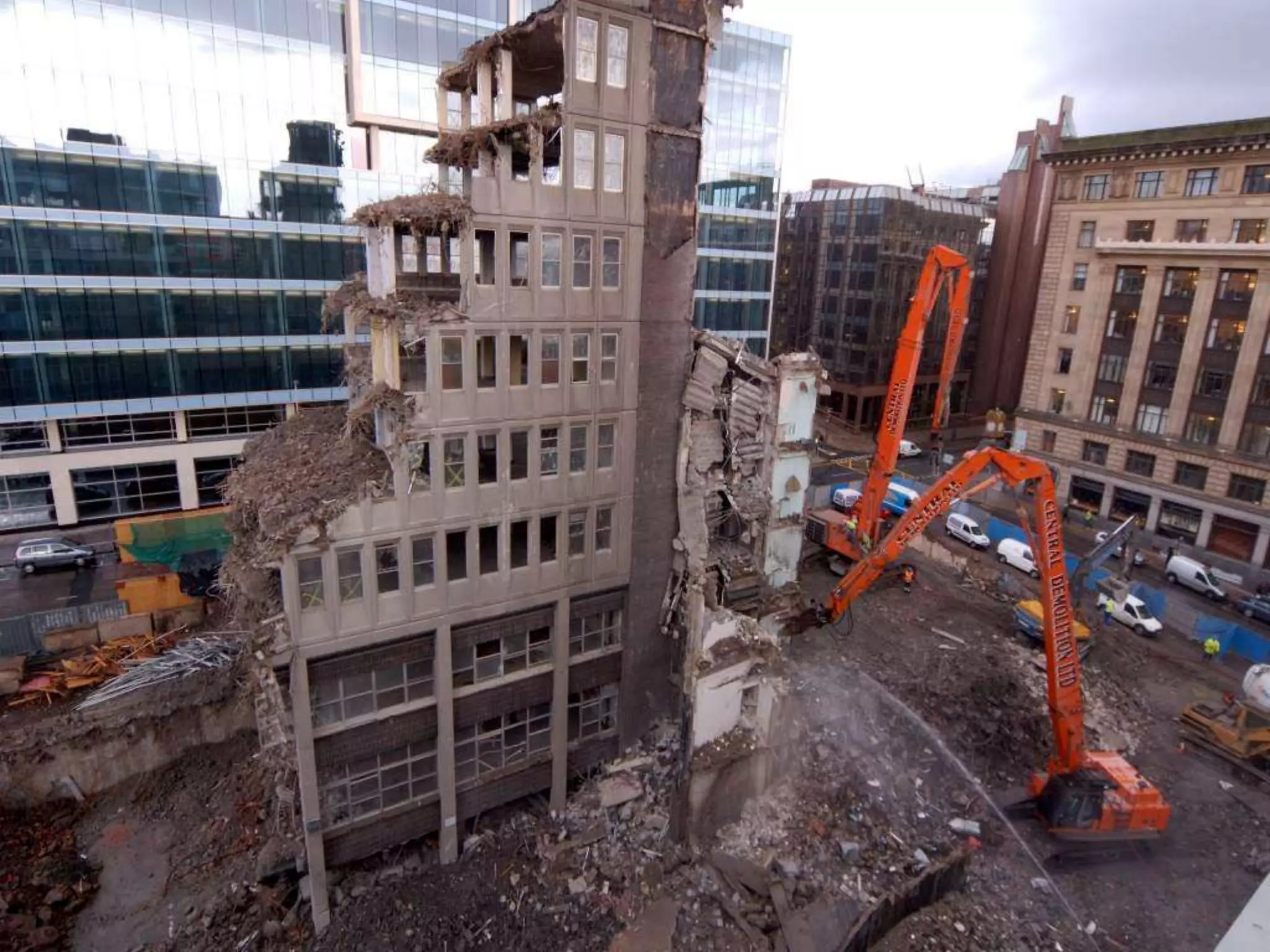
Some more examples of mechanical means to demolish
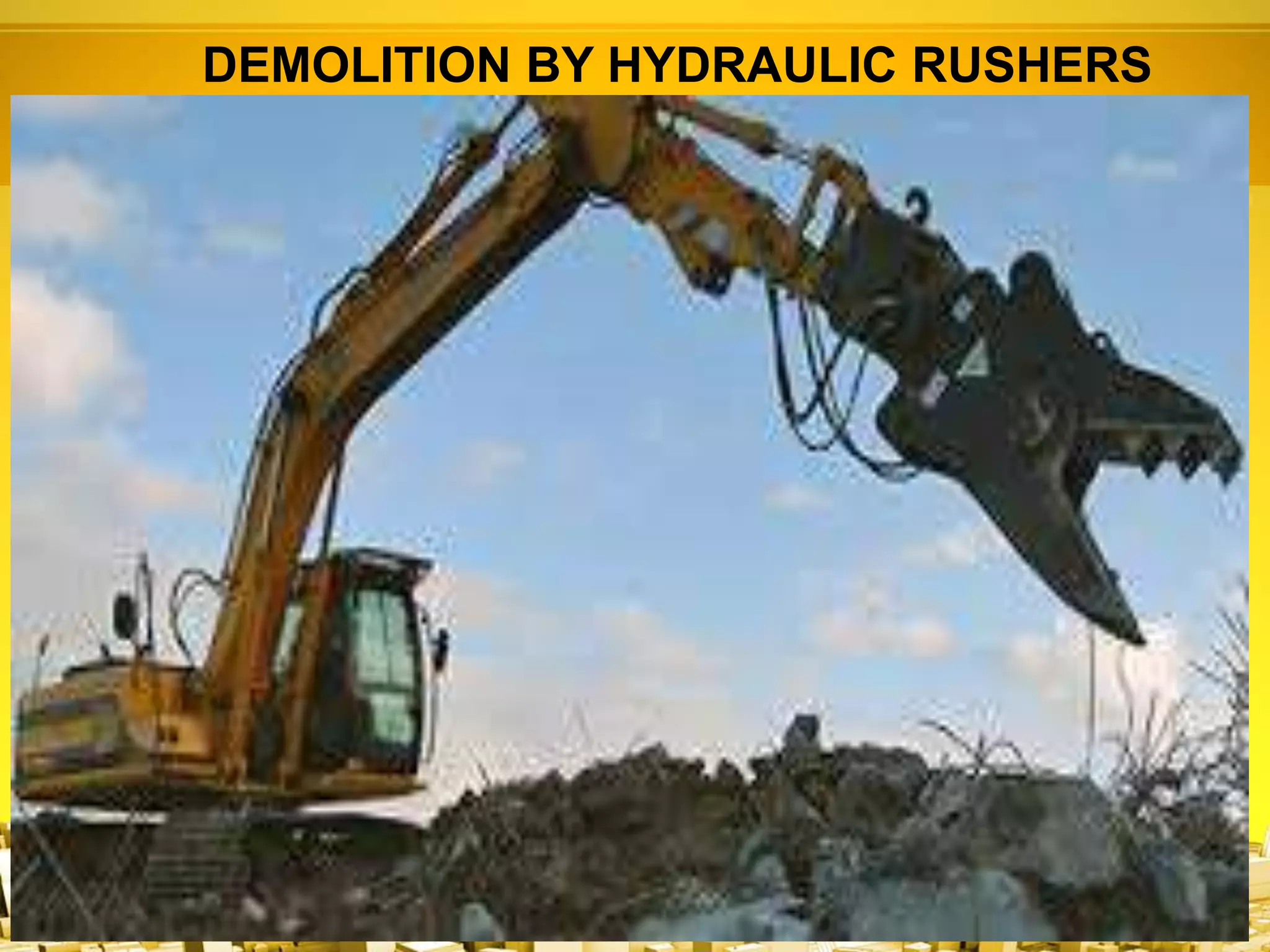
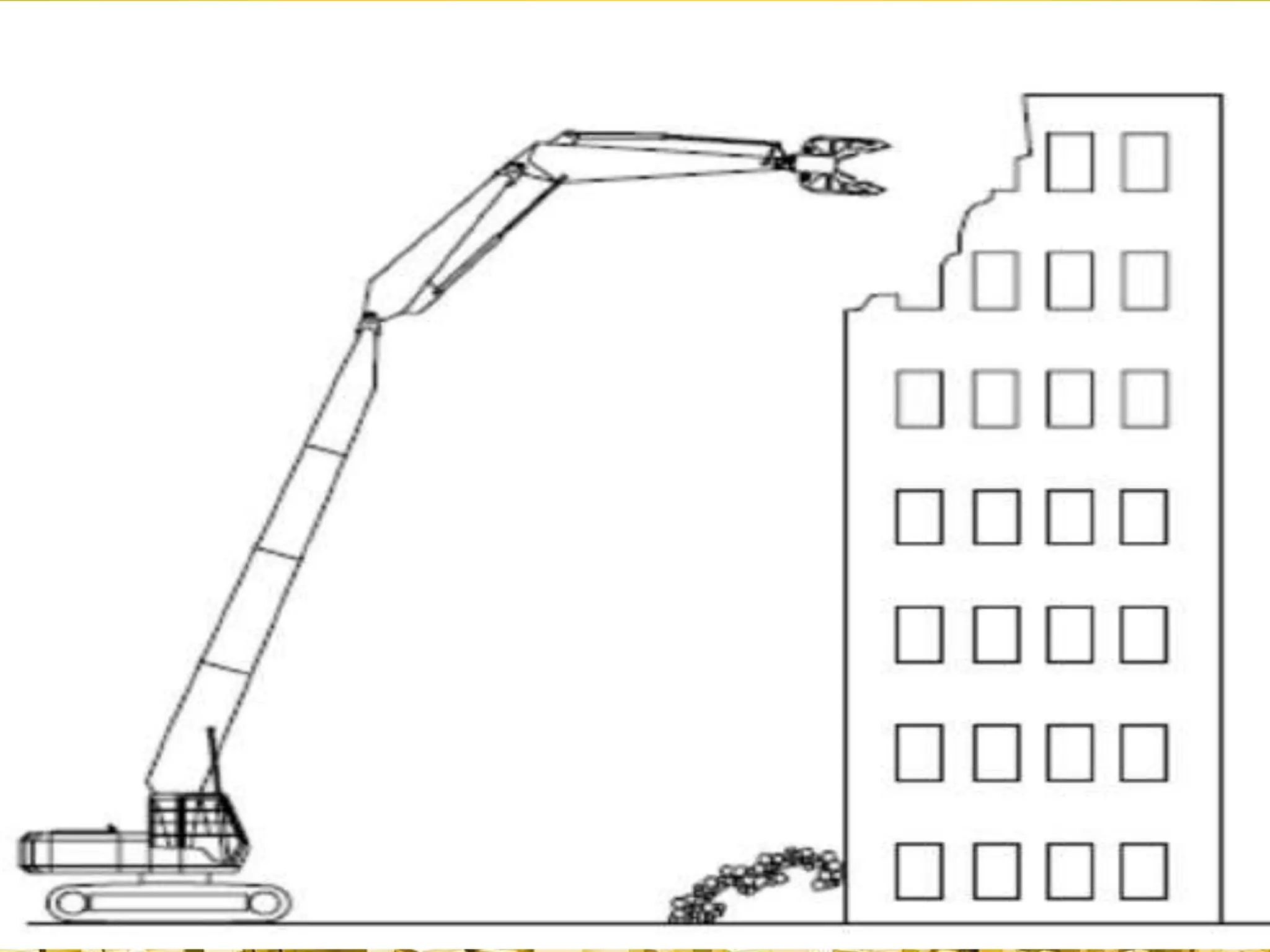
Hydraulic Crusher
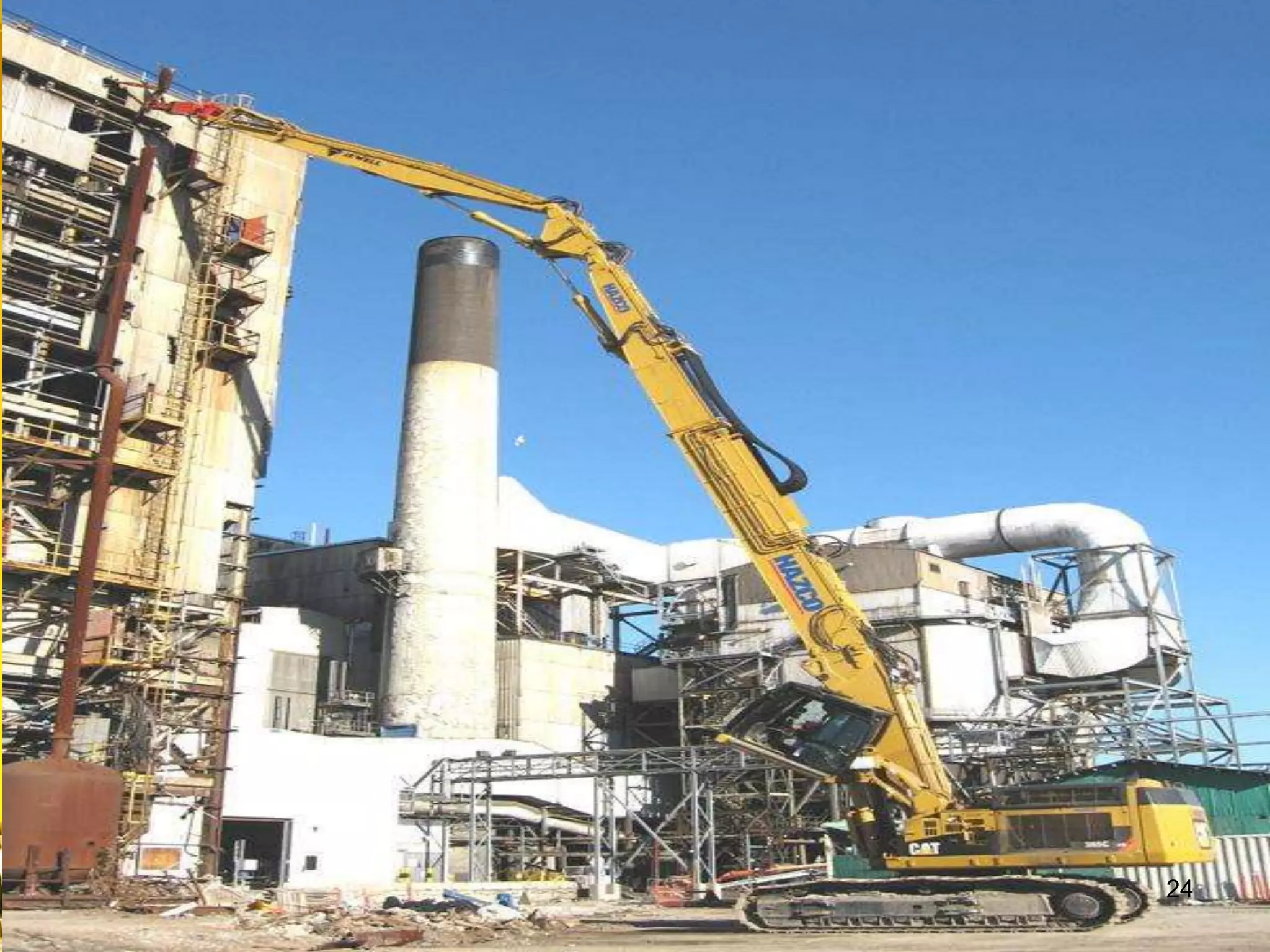
• The crusher attachment breaks the concrete and the
reinforcement by the hydraulic thrust through the long
boom arm system.
• The hydraulic crusher can be operated from the ground
outside the building.
• This method is also suitable for dangerous buildings, silos
and other industrial facilities.
23
Fig: Hydraulic Crusher with Long Boom Arm
Source: www.jewellattachments.com
24
DEMOLITION BY HYDRAULIC RUSHERS
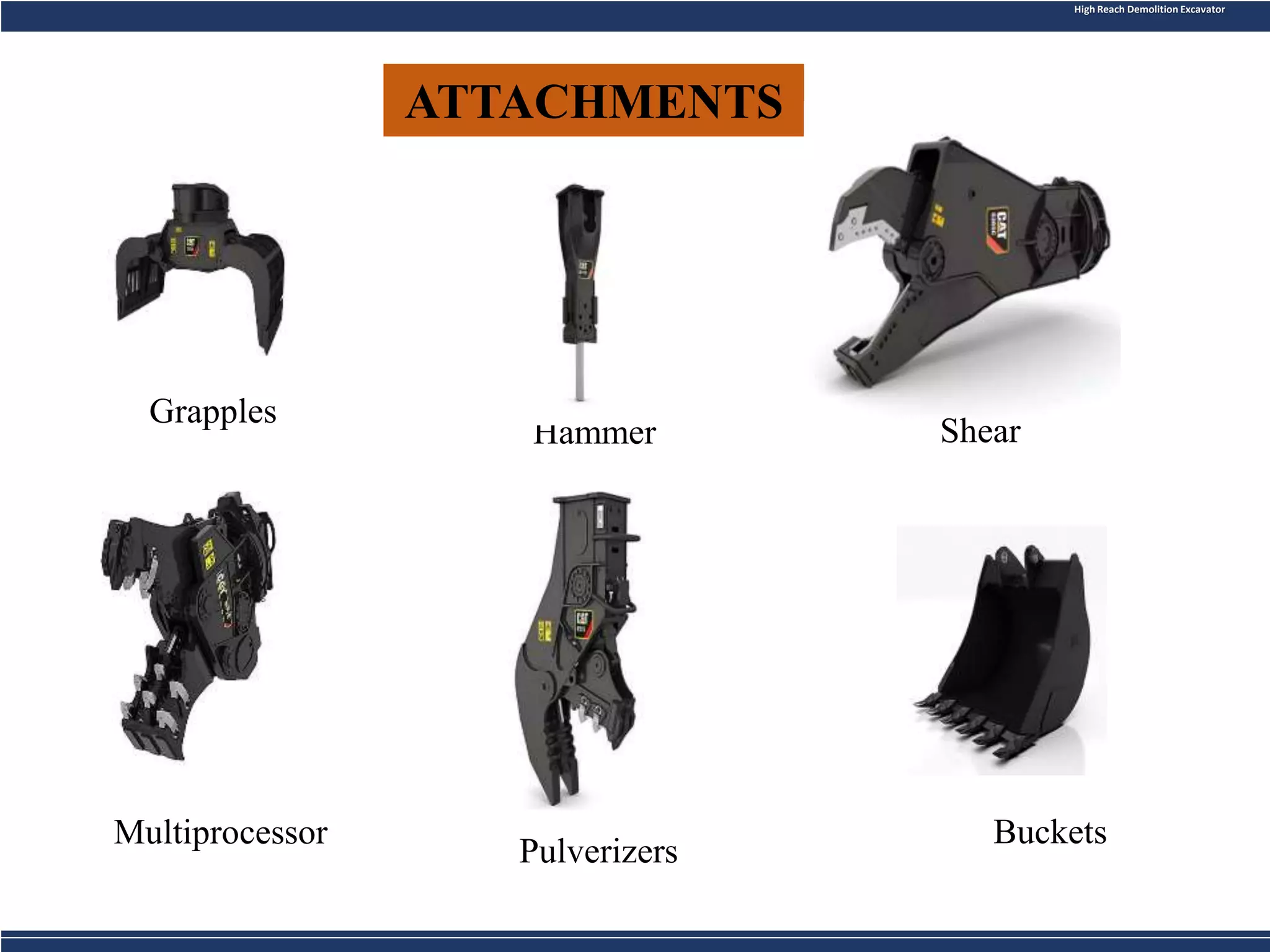
High Reach Demolition Excavator
Hammer
ATTACHMENTS
Grapples
Multiprocessor
Pulverizers
Buckets
Shear
Wrecking Ball
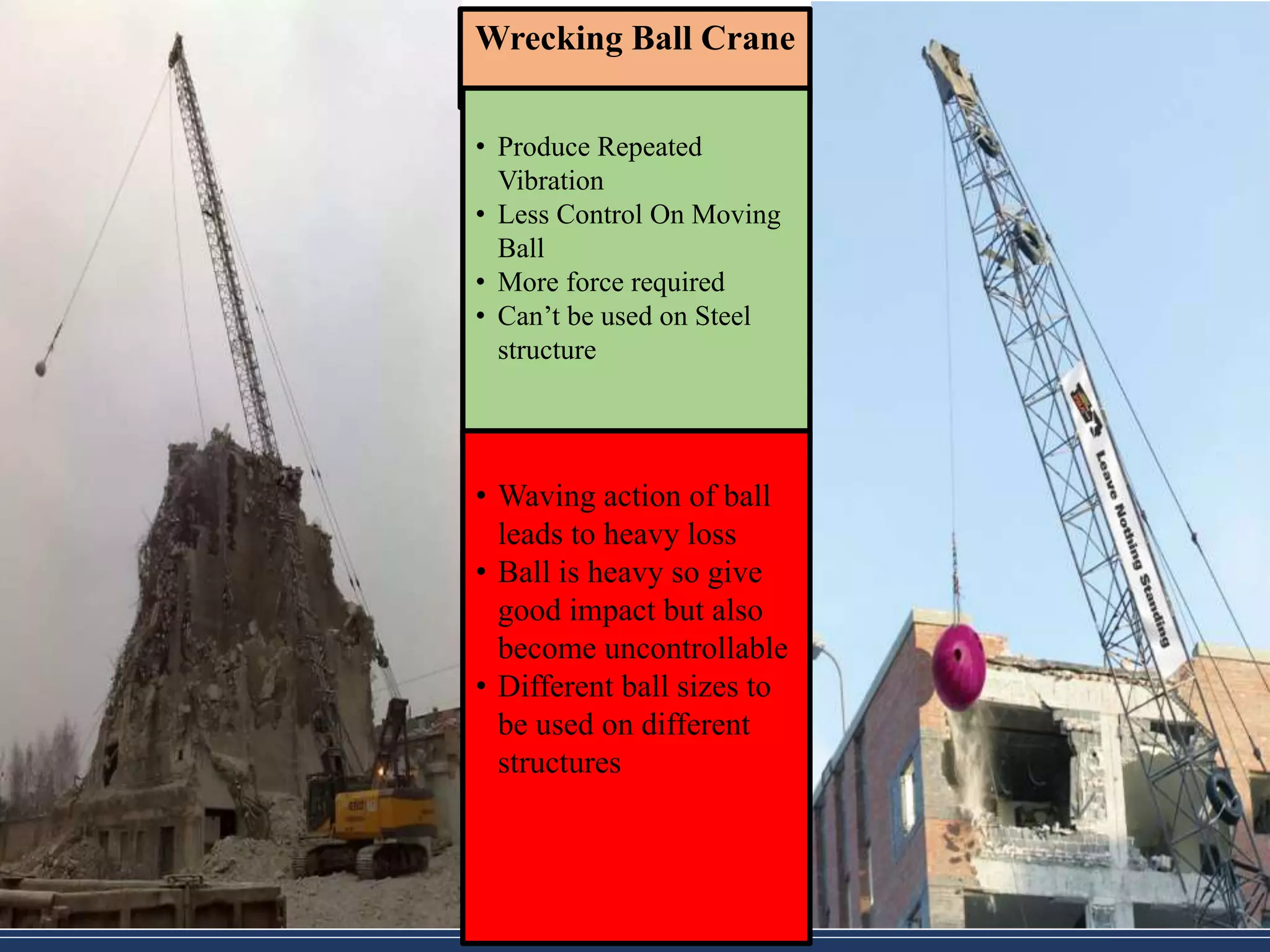
• The wrecking ball application consists of a crane
equipped with a steel ball.
• The destruction of the building is by the impact
energy of the steel ball suspended from the crawler
crane.
• The wrecking ball operates outside the building.
• This method is suitable for silos and other industrial
facilities.
• However, the operation requires substantial clear
space. 29
Wrecking Ball Crane
• Produce Repeated
Vibration
• Less Control On Moving
Ball
• More force required
• Can’t be used on Steel
structure
• Waving action of ball
leads to heavy loss
• Ball is heavy so give
good impact but also
become uncontrollable
• Different ball sizes to
be used on different
structures
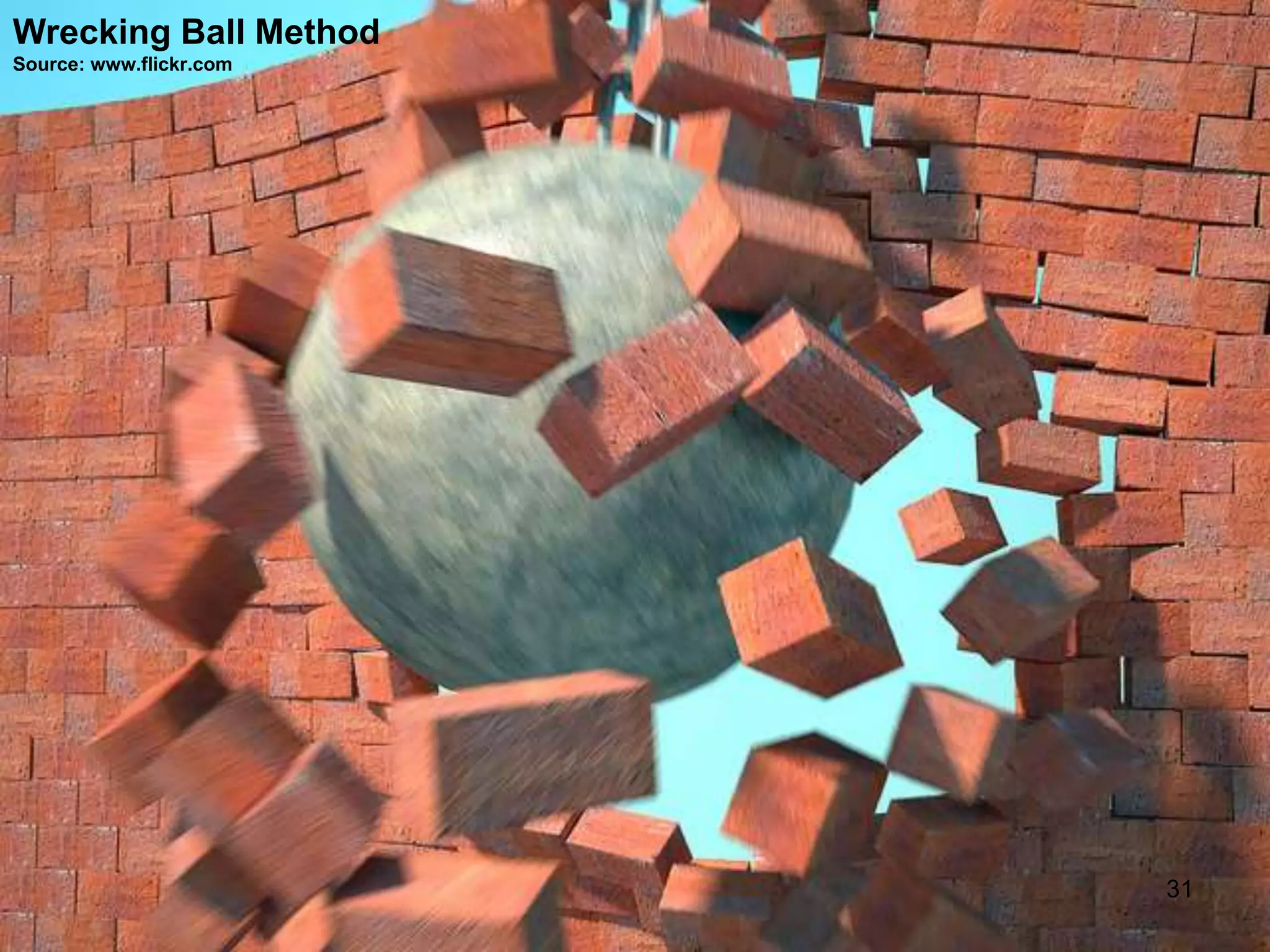
Wrecking Ball Method
Source: www.flickr.com
31
32
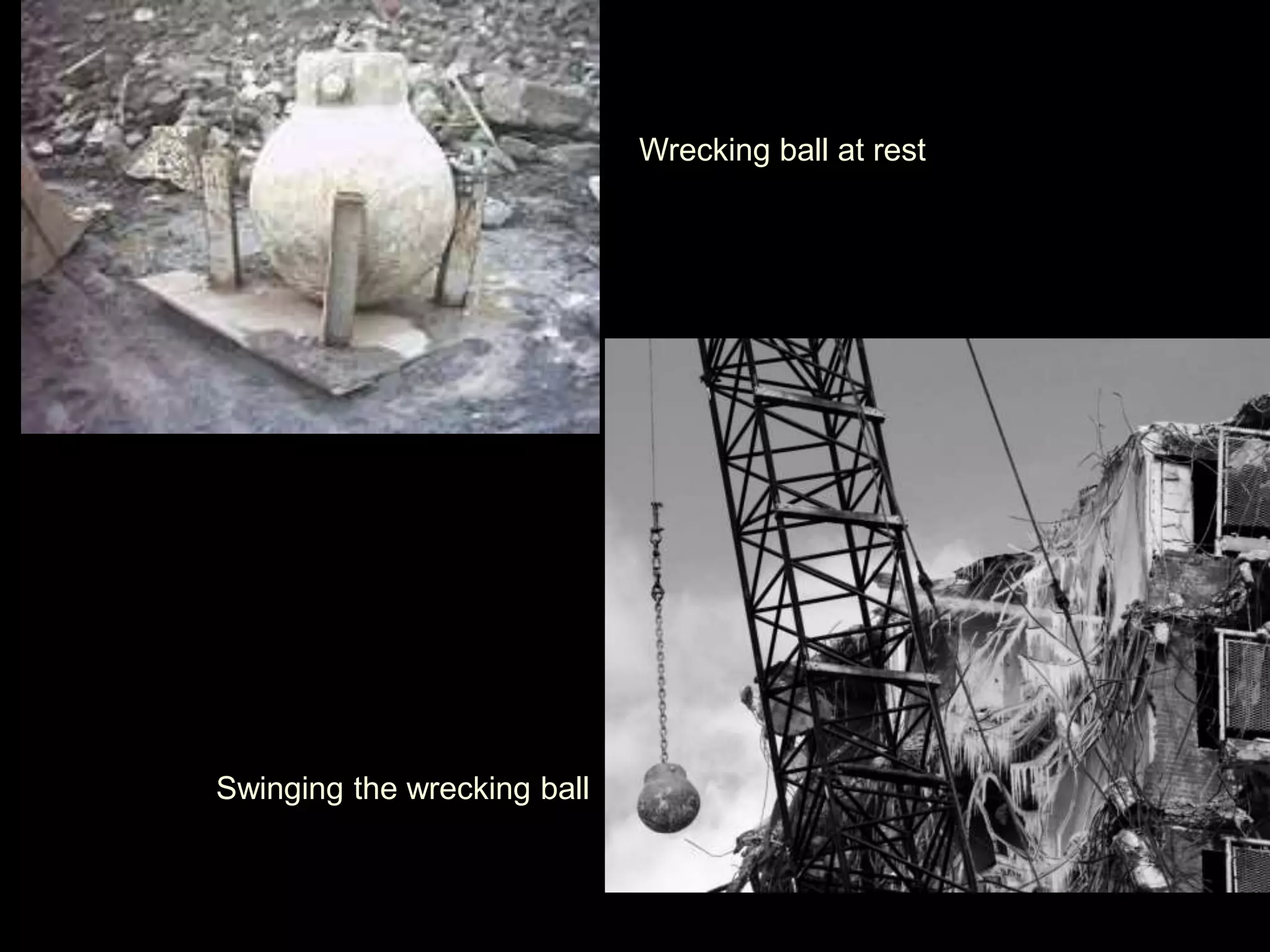
Wrecking ball at rest
Swinging the wrecking ball
33
34
35
Explosive Demolition
• High Risk Factor
• Time Taken
• Produce Distortion
• Expensive
• Chances of error
• Need of experts
• Error may leads to
• No demolition
• Loss of life's
• Quick
Demolition
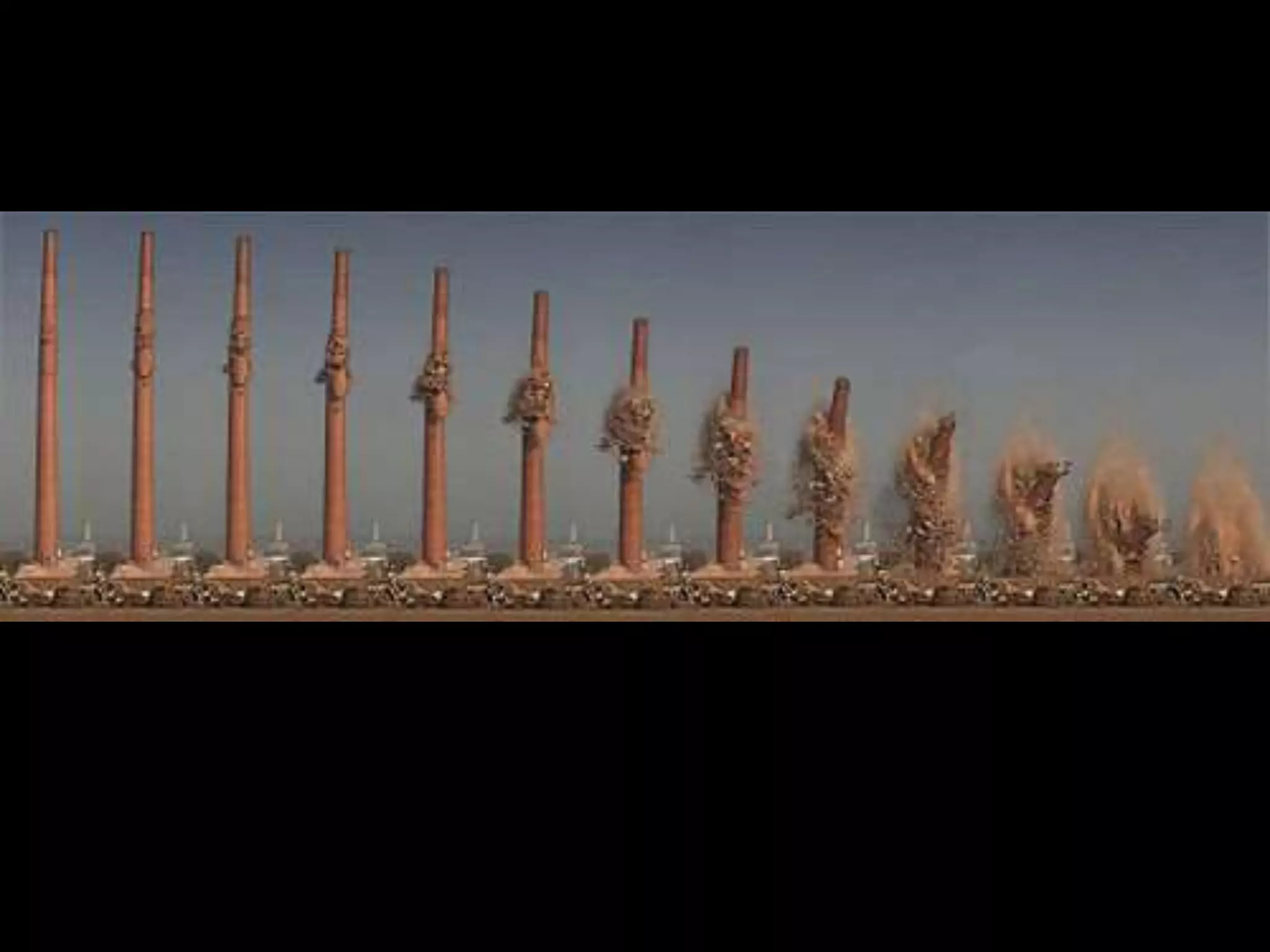
Implosion
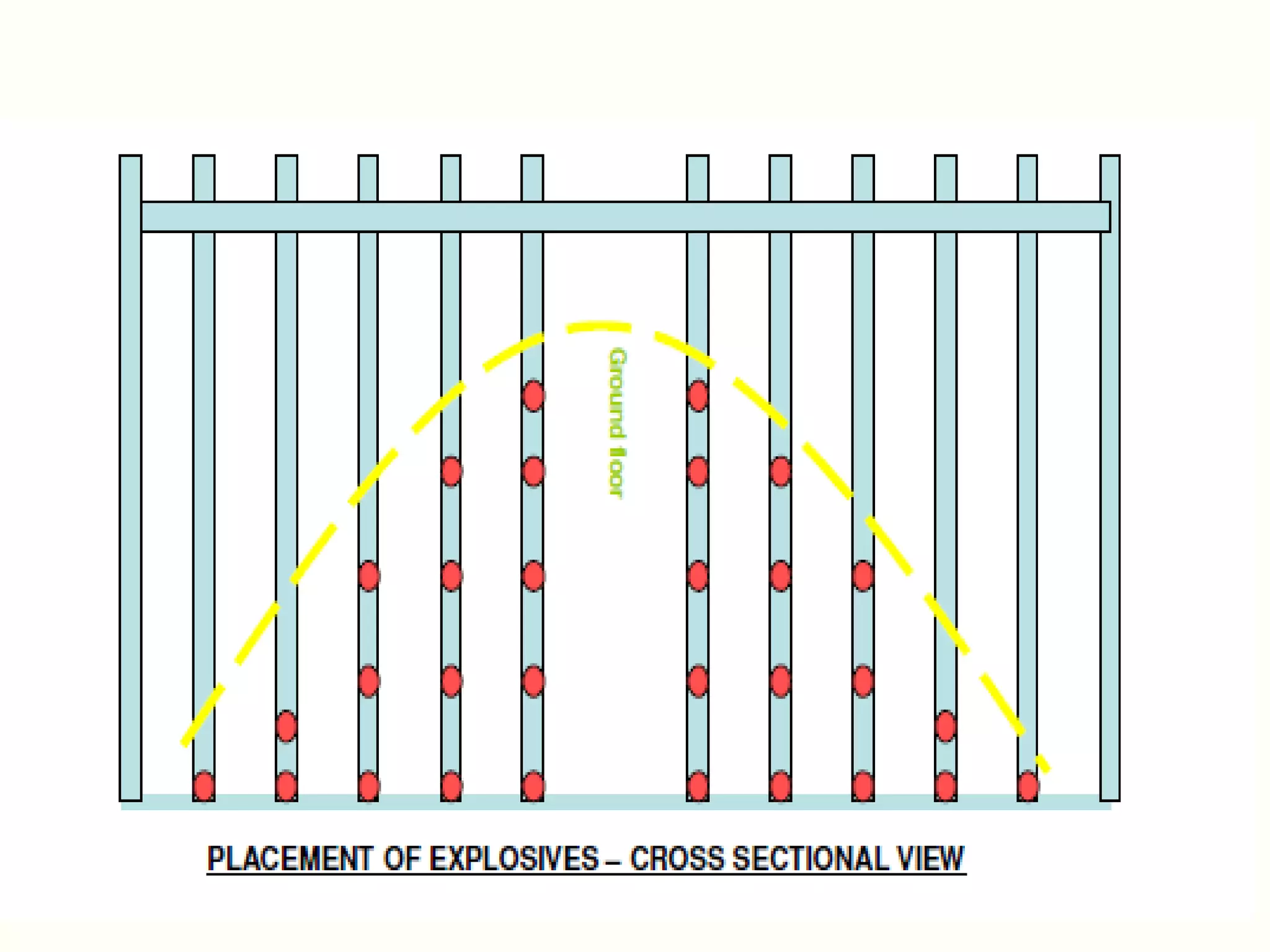
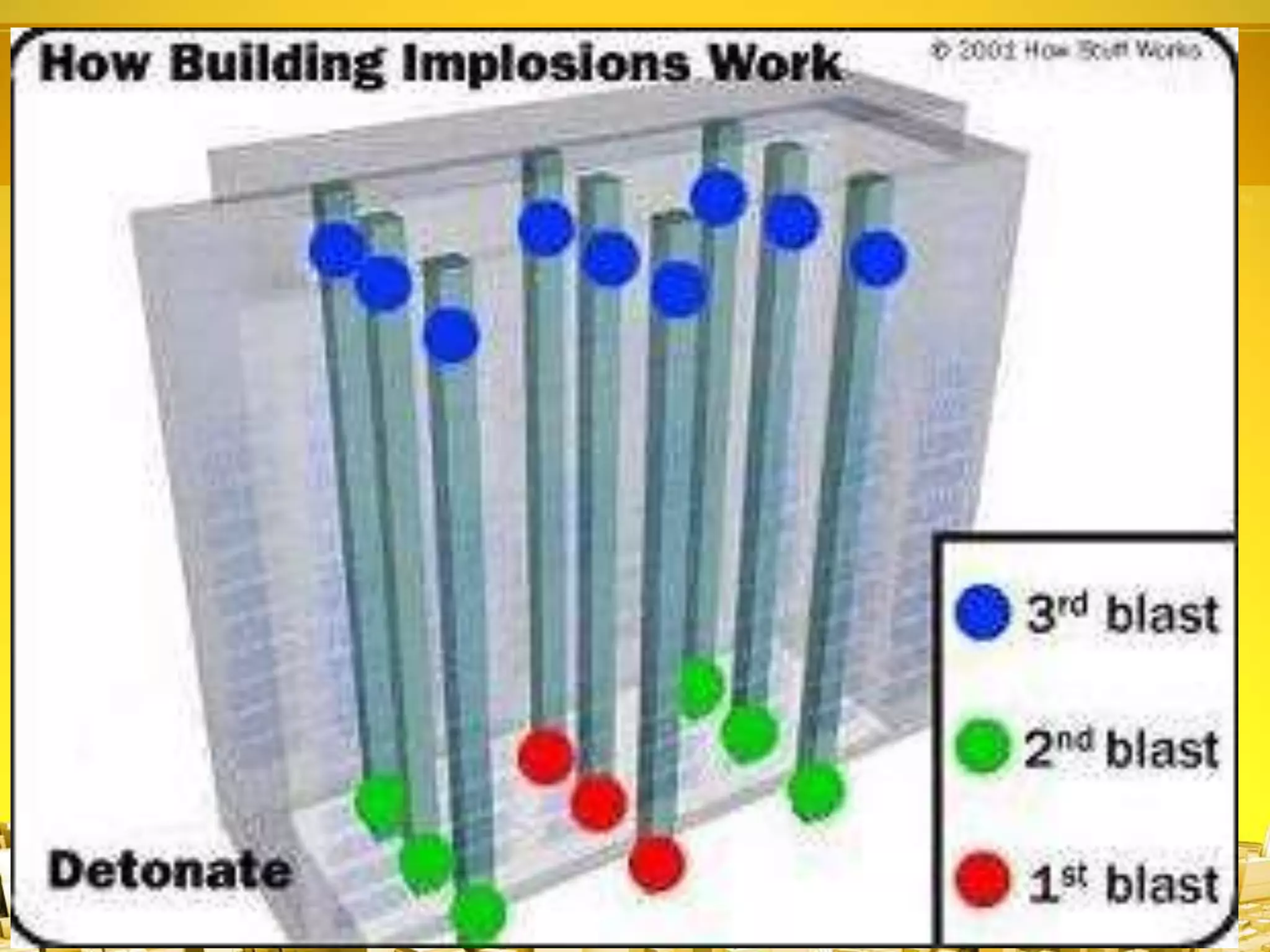
• Implosion is the strategic placing of explosive material and
timing of its detonation so that a structure collapses on
itself in a matter of seconds, minimizing the physical
damage to its immediate surroundings.
• In this technique weakens or removes critical supports so
that the building can no longer withstand the force of
gravity and falls under its own weight.
• The explosives are just the trigger for the demolition. It's
gravity that brings the building down.
37
• For buildings with a steel support structure, blasters
typically use the specialized explosive material cyclo-
tri-methylene-tri-nitramine, called RDX for short.
• RDX-based explosive compounds expand at a very high
rate of speed, 8,230 meters per second.
38
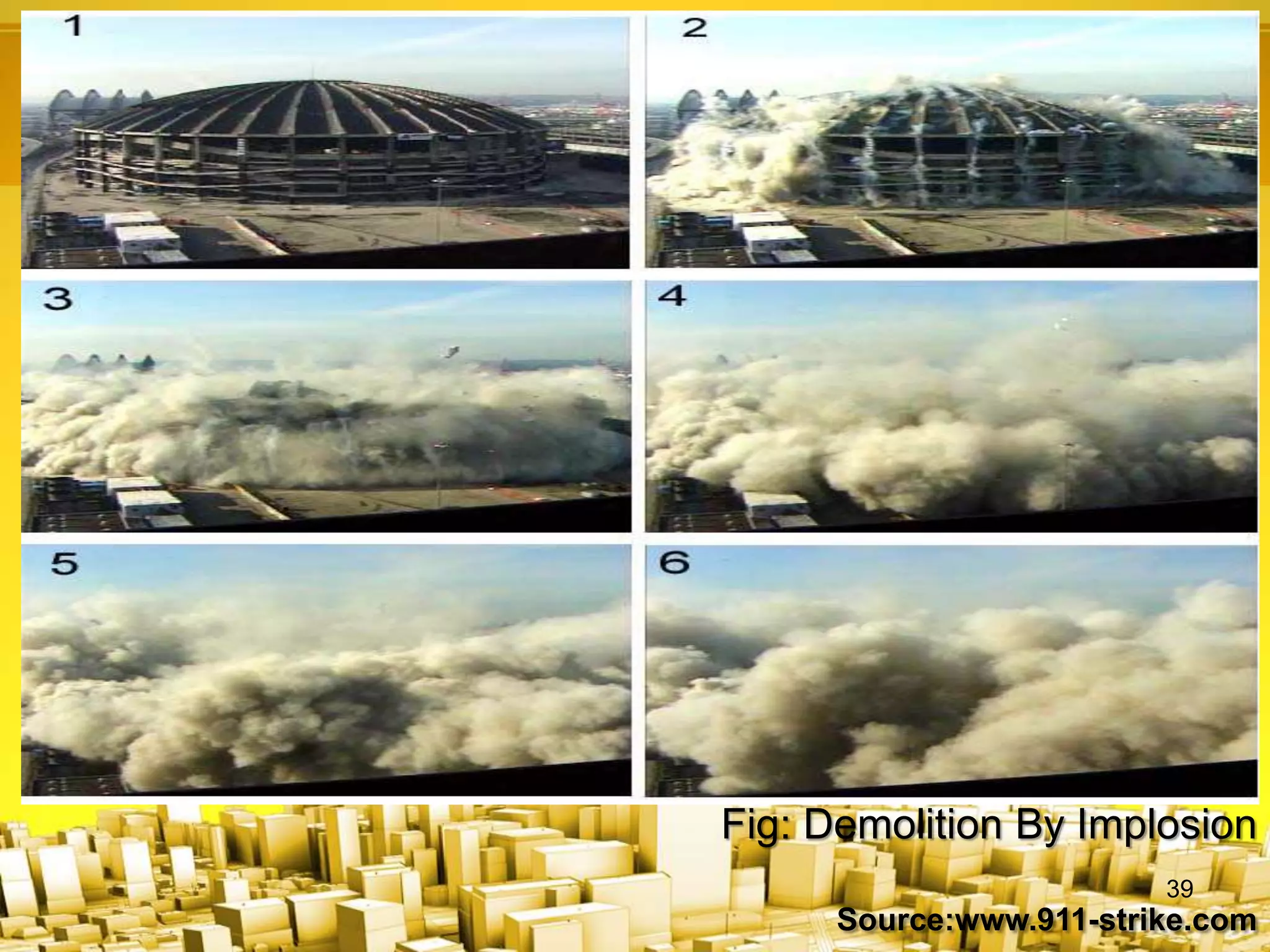
Fig: Demolition By Implosion
Source:www.911-strike.com
39
40
41
Process of Implosion
USING IMPLOSION (EXPLOSION)
43
DEMOLITION BY ONE LEVEL AT A TIME
44
Other Methods
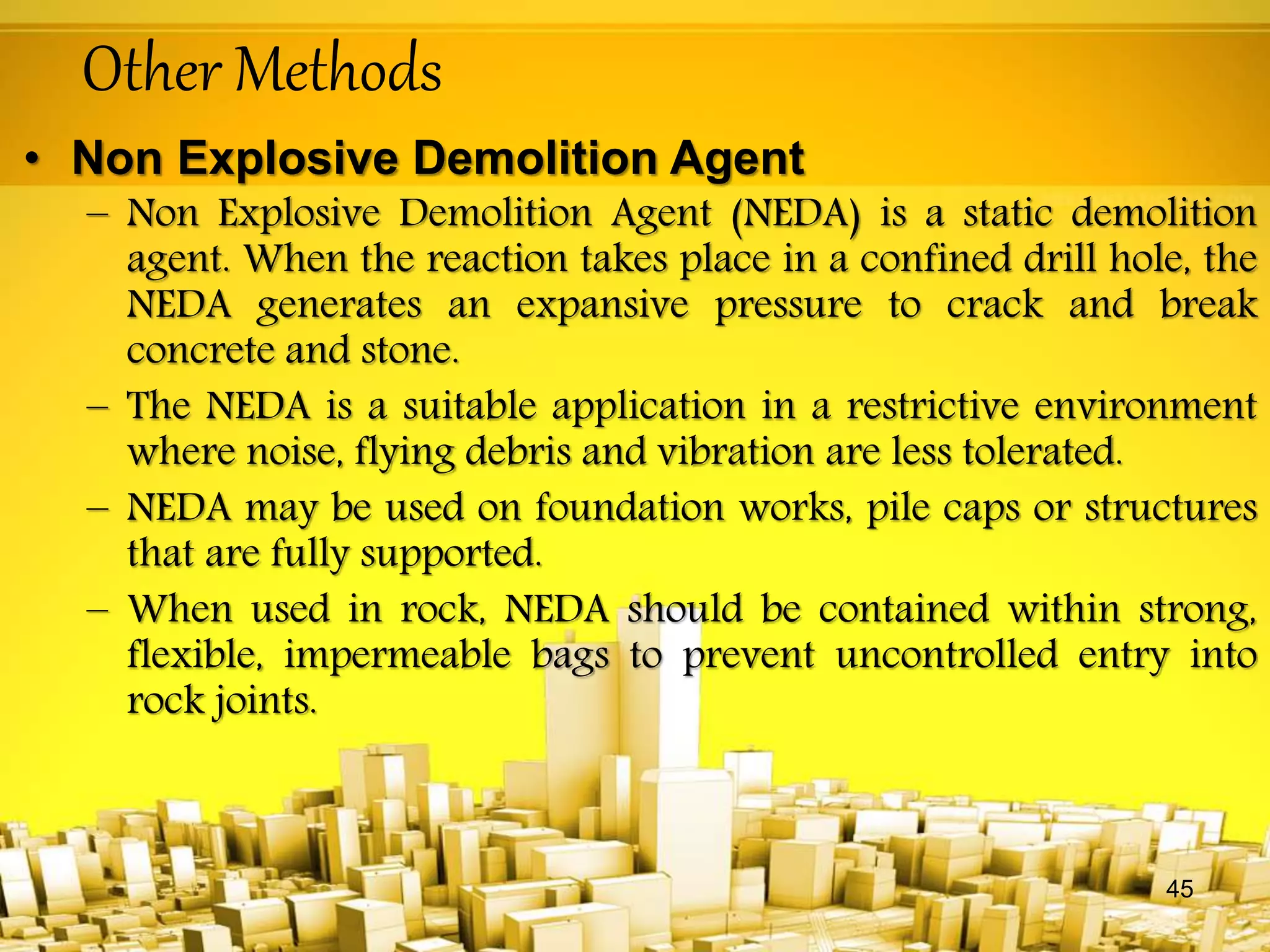
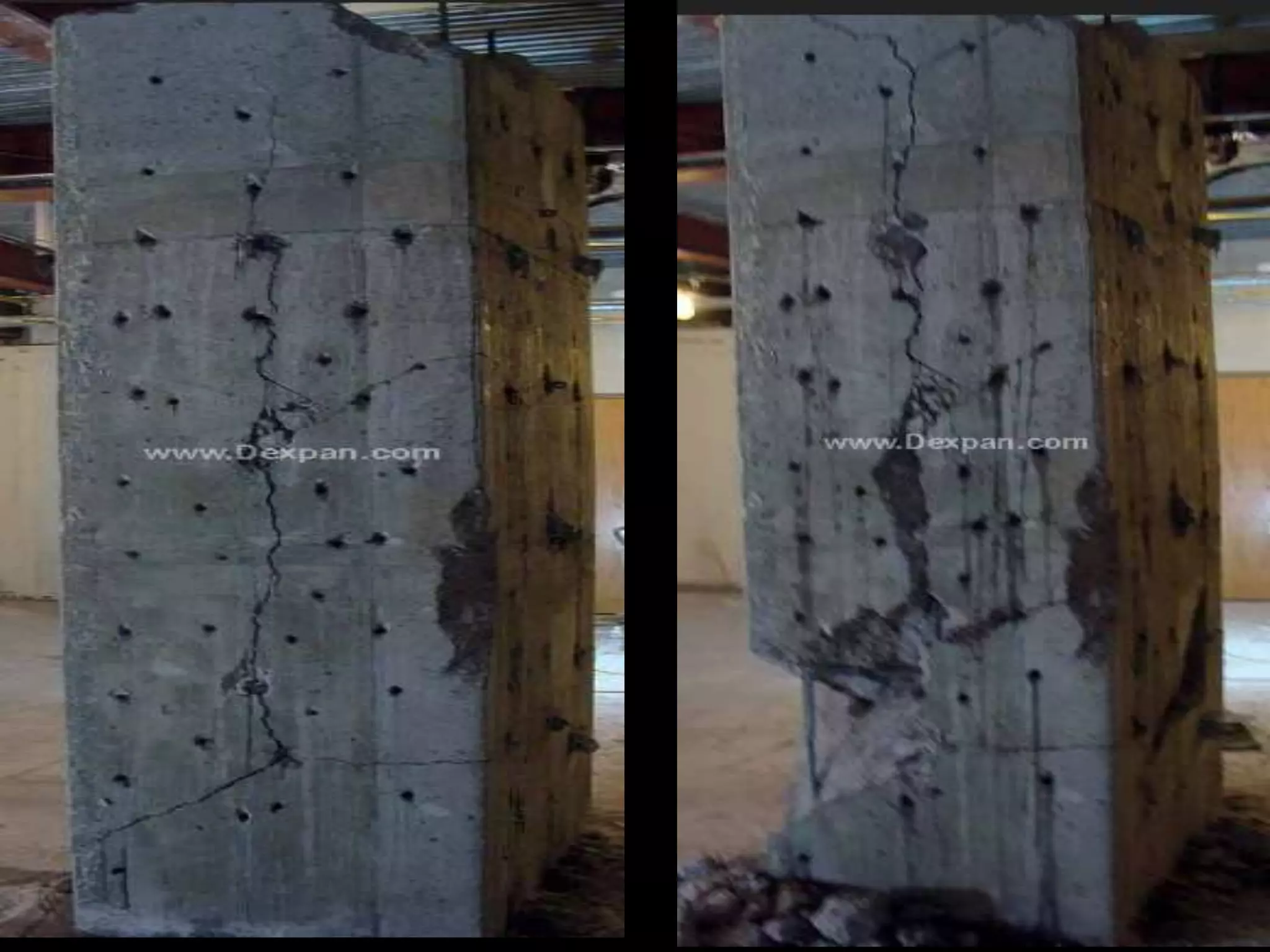
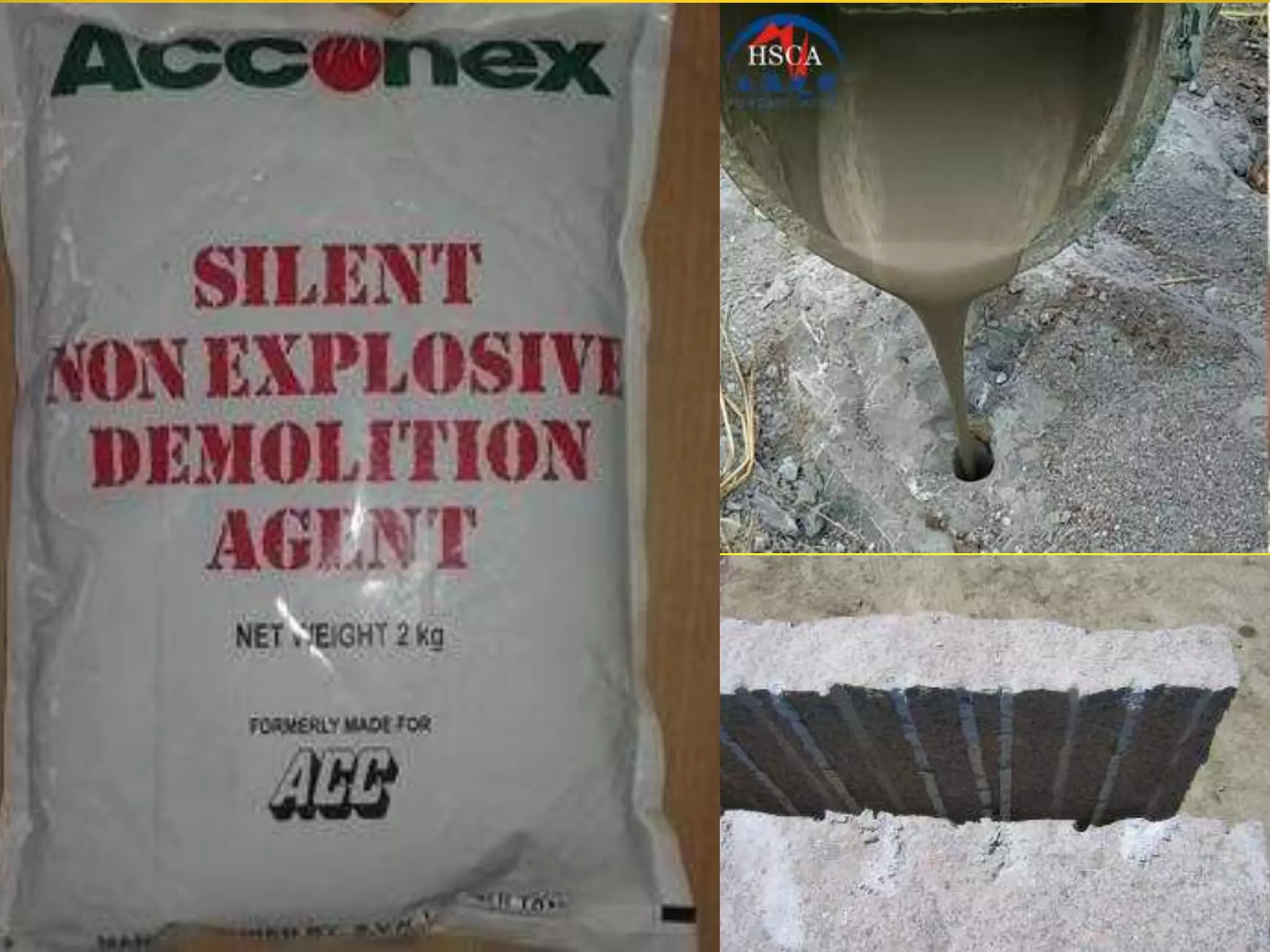
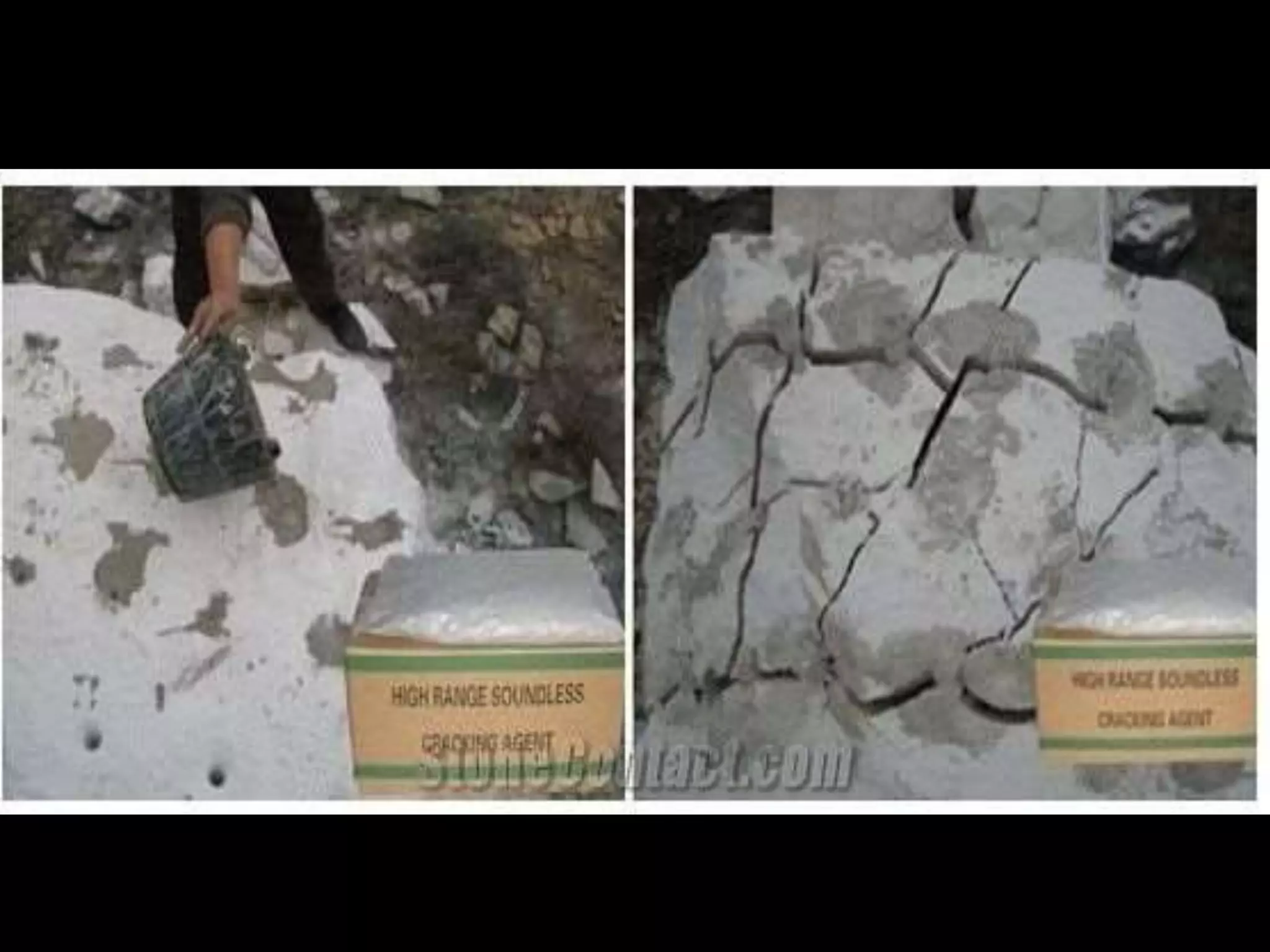
• Non Explosive Demolition Agent
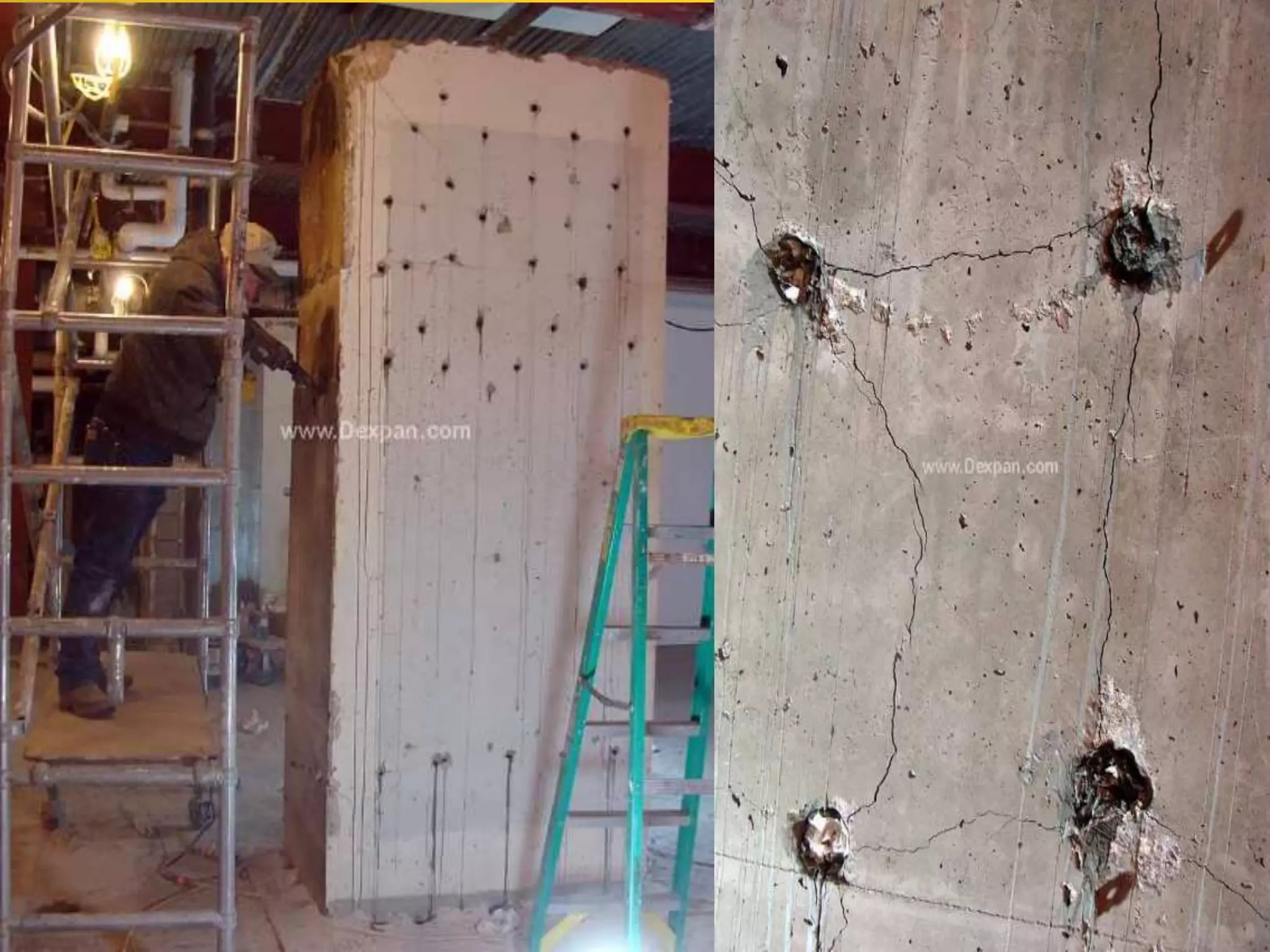
– Non Explosive Demolition Agent (NEDA) is a static demolition
agent. When the reaction takes place in a confined drill hole, the
NEDA generates an expansive pressure to crack and break
concrete and stone.
– The NEDA is a suitable application in a restrictive environment
where noise, flying debris and vibration are less tolerated.
– NEDA may be used on foundation works, pile caps or structures
that are fully supported.
– When used in rock, NEDA should be contained within strong,
flexible, impermeable bags to prevent uncontrolled entry into
rock joints.
45
46
47
48
49
50
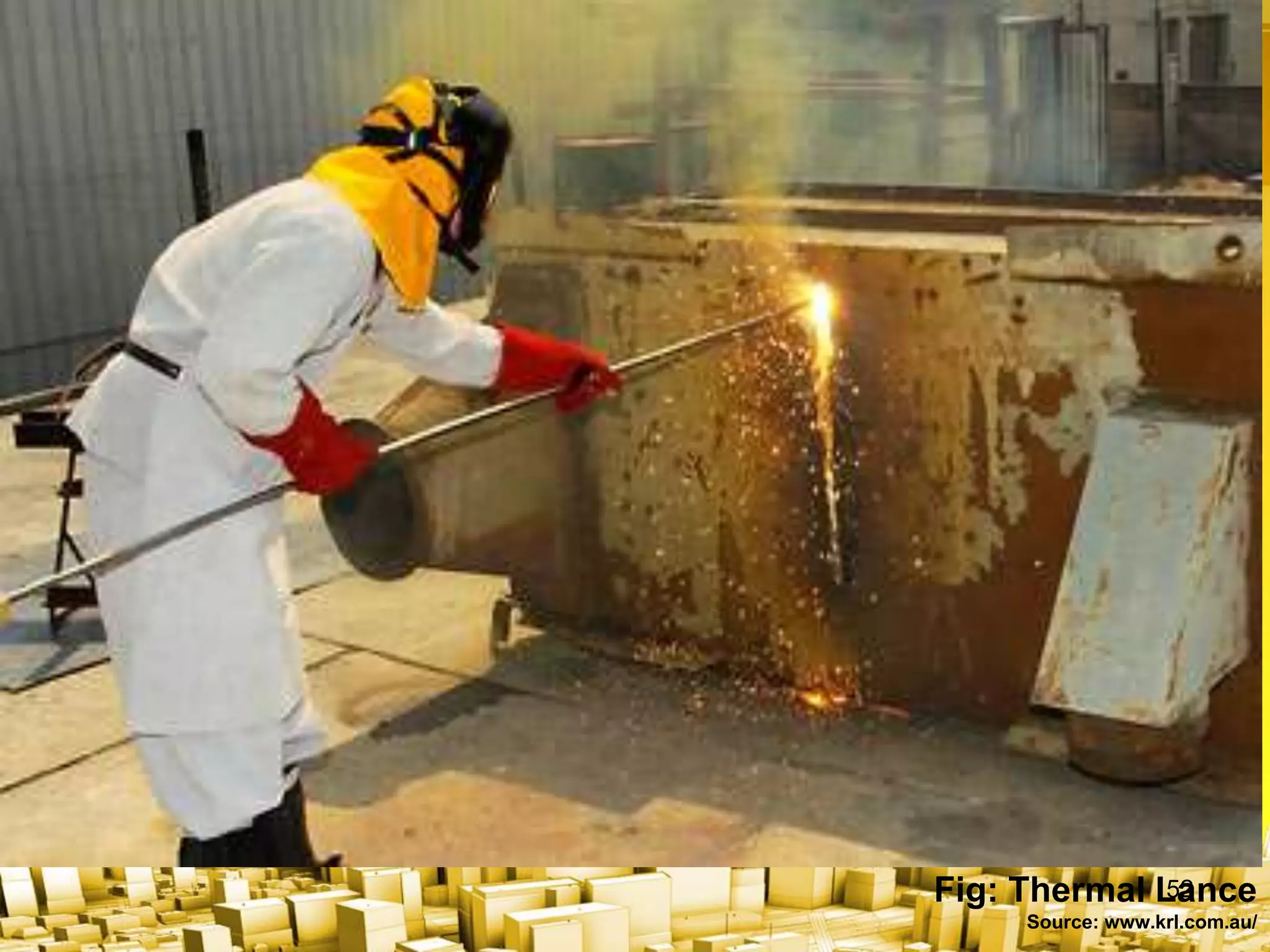
Thermal Lance
• Cutting of reinforced concrete by thermal lance involves very
high temperature up to 2,000 - 4,000°C.
51
Fig: Thermal Lance
Source: www.krl.com.au/
52
SAFETY PRECAUTIONS
 Demolition
 Dismantling
.
Precautions Before and During Demolition
• Precautions before and during demolition shall be as
follows:
– The demolition shall not be start until precautionary measures
have been inspected and approved.
– It is advisable to inform adjoining neighbors prior to the
demolition so that they may close windows or take other
measures.
– all electric cables or apparatus which are liable to be a source of
danger, other than a cable or apparatus used for the demolition
works shall be disconnected.
54
–During the progress, the work shall be under the continuous
supervision of the demolisher or often experienced foreman.
–demolition shall be executed storey by storey commencing at the roof
and working downward.
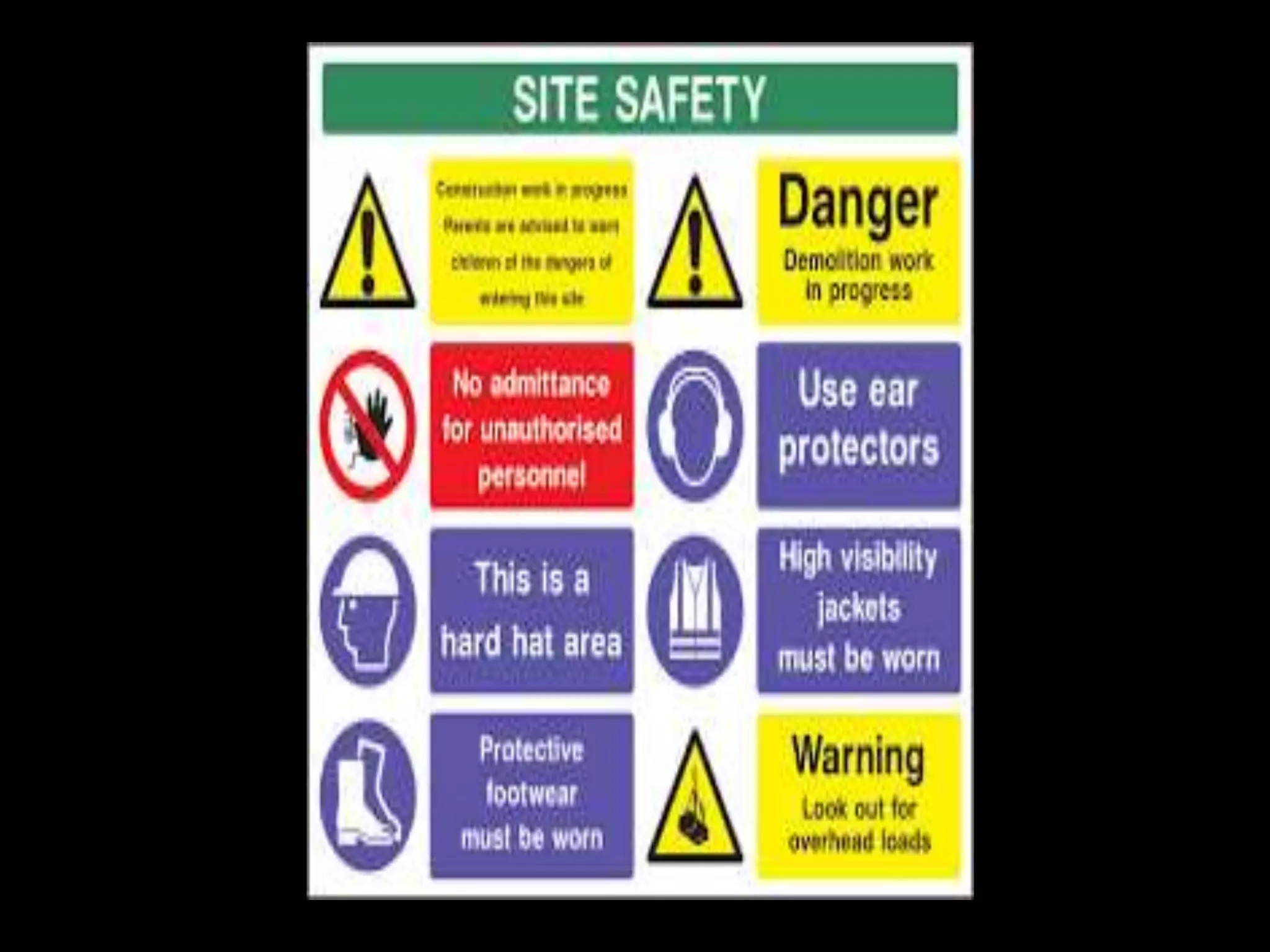
–Notices lettered displaying the words “WARNING DEMOLITION IN
PROGRESS” to be fixed to the hoarding or security fence.
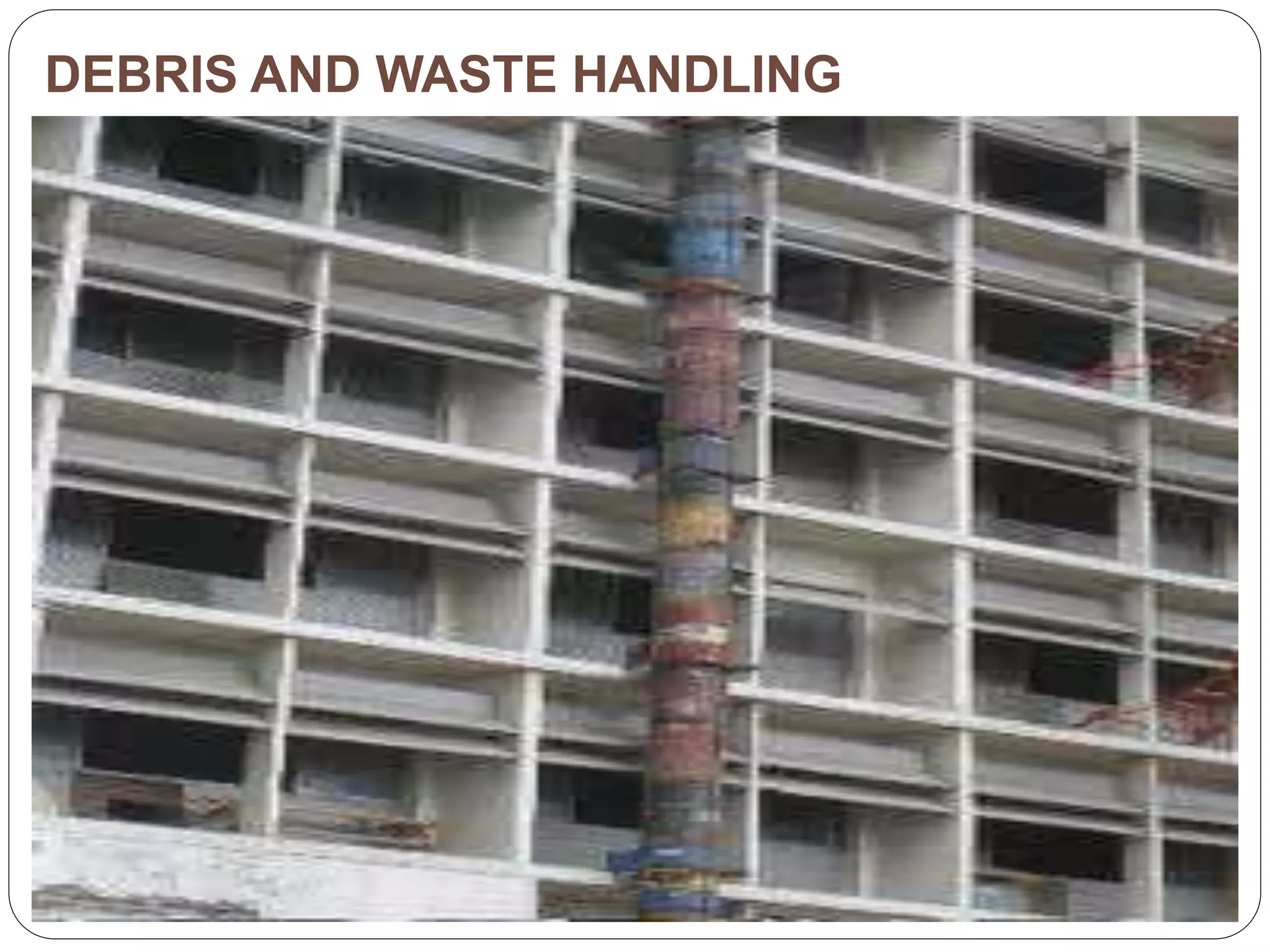
–Dust creating material, unless thoroughly dampened shall not be
thrown or dropped from the building but shall be lowered by hoisting
apparatus or removed by material.
55
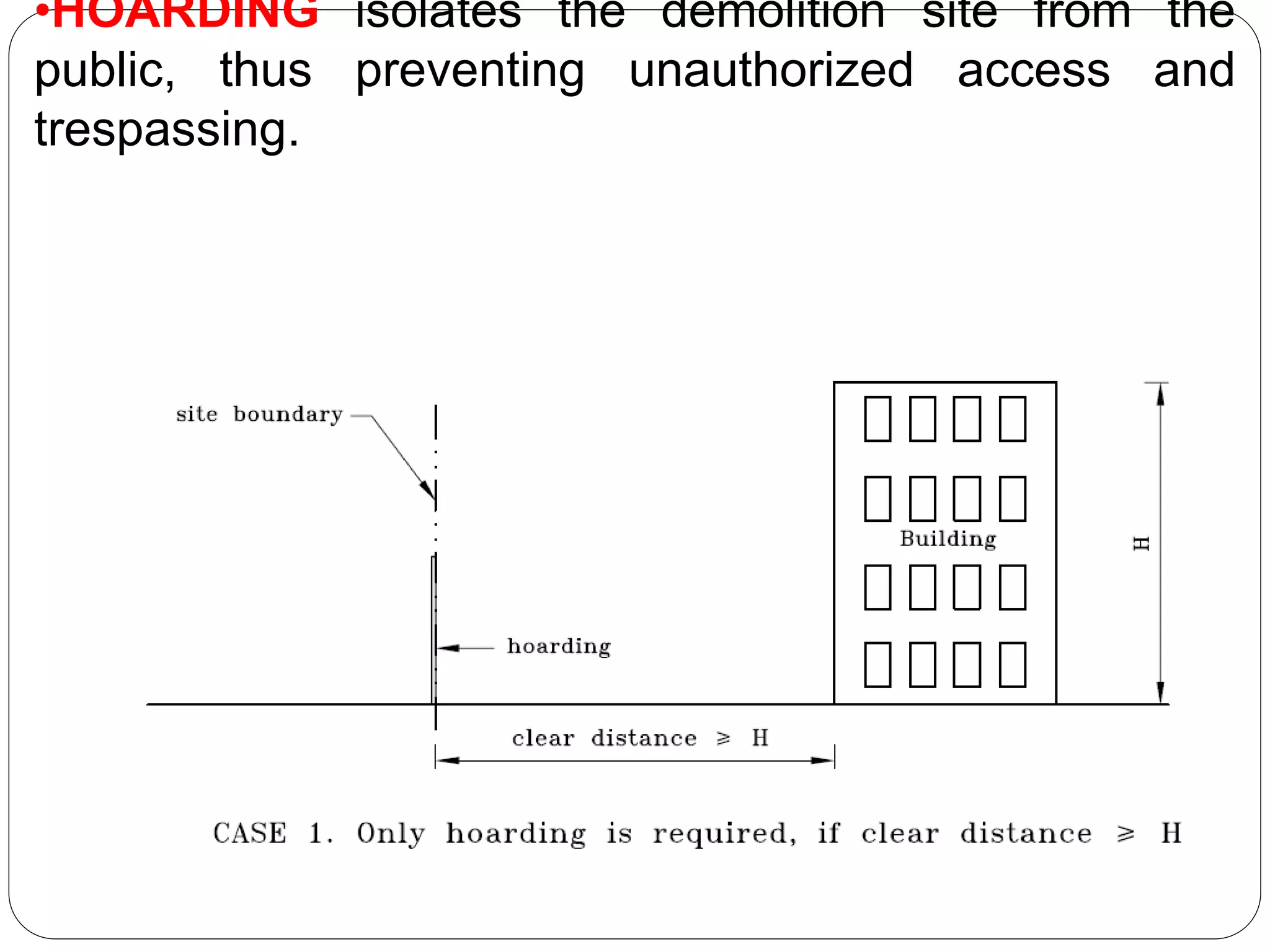
•HOARDING isolates the demolition site from the
public, thus preventing unauthorized access and
trespassing.
 WALKWAYS:
Walkways shall be provided for the use of
the workmen who shall be instructed to use them
and all such walkways shall be kept adequately
lighted, free from debris and other materials.
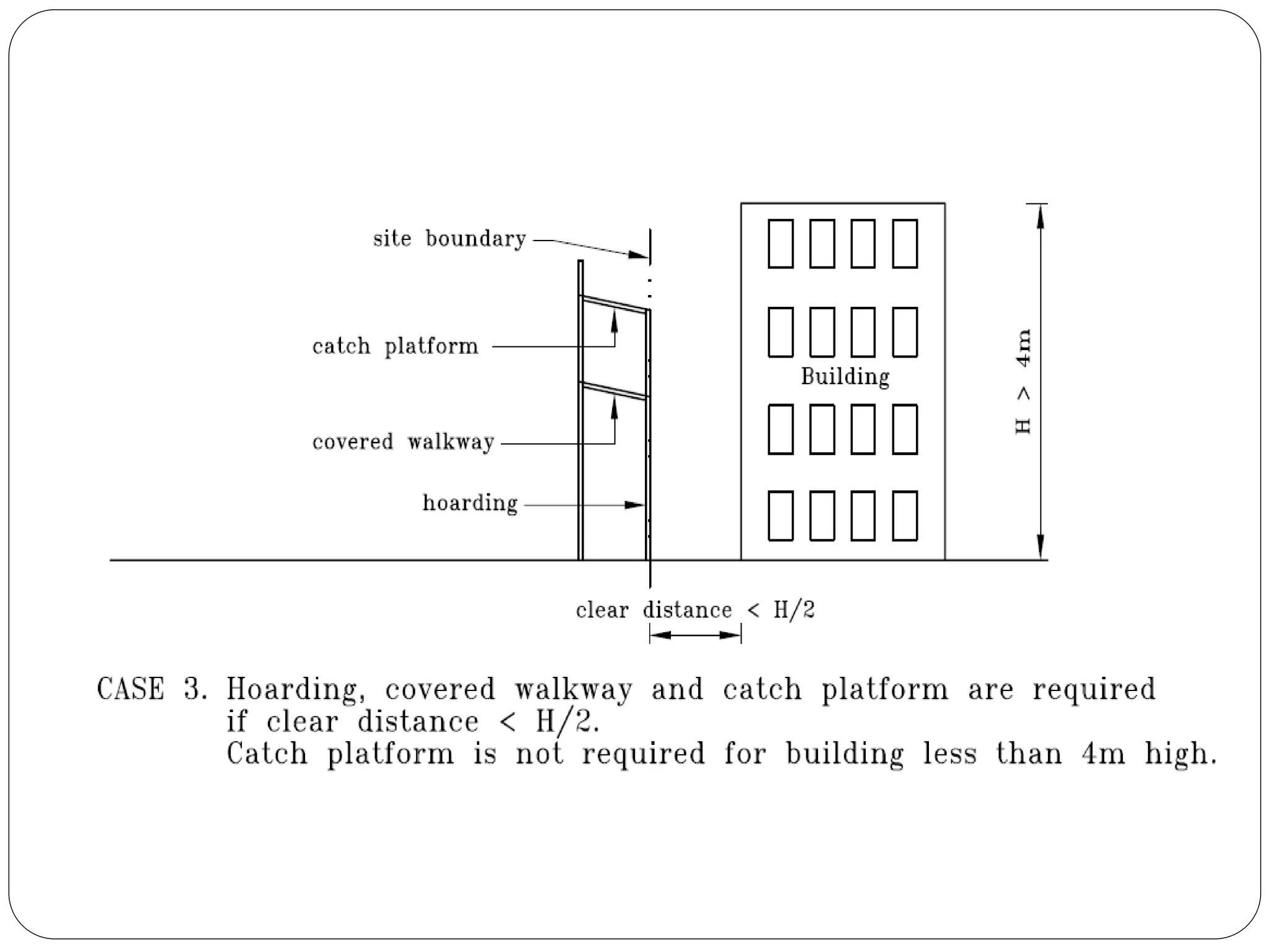
 CATCH PLATFORMS
In demolition of exterior wall of multi-
storeyed structure, catch platform of heavy
planking shall be provided to prevent injuries to
the worker working below and to the public,
when the external walls are more than 20 m in
height.
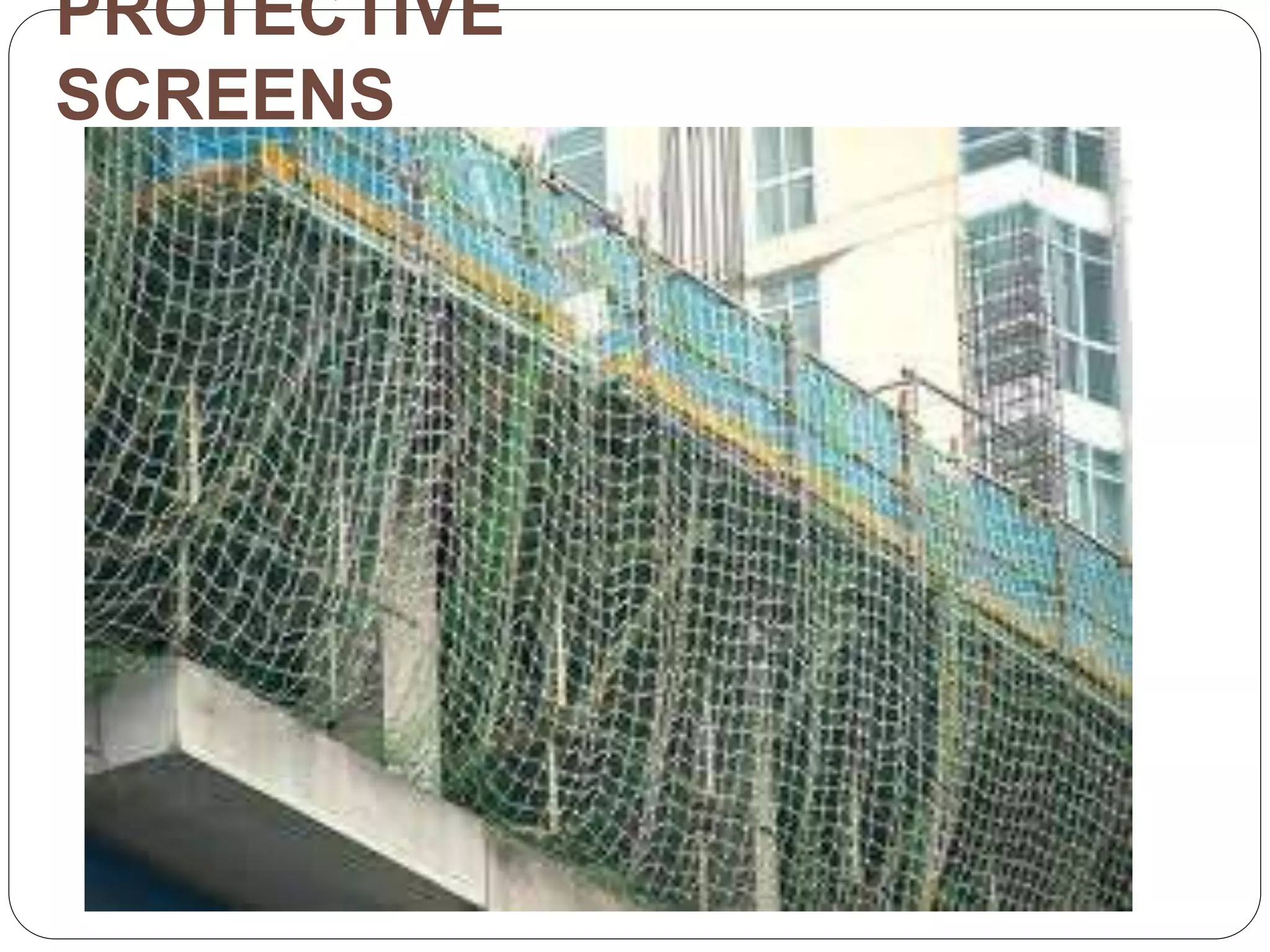
PROTECTIVE
SCREENS
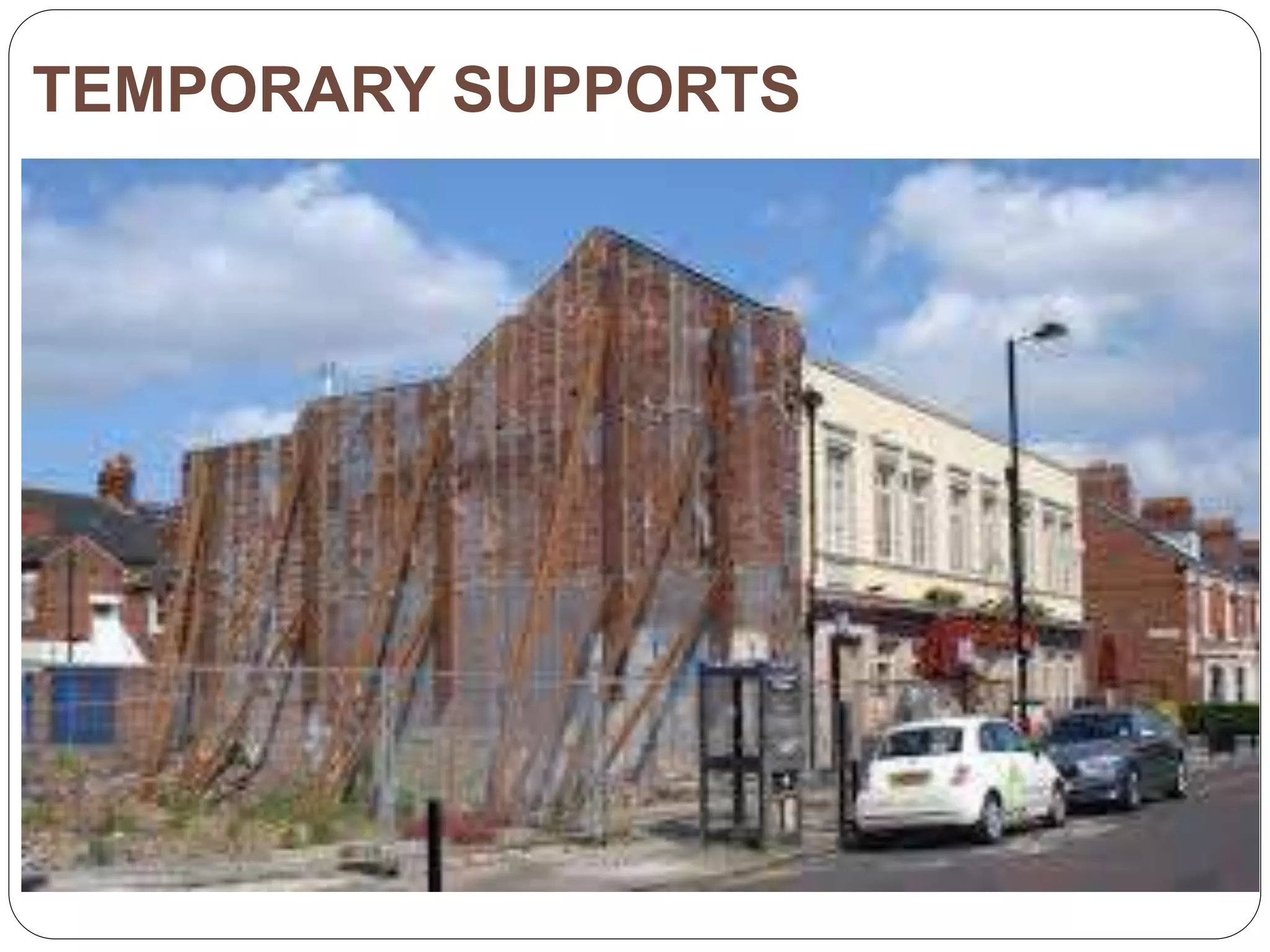
TEMPORARY SUPPORTS
‘
TRAINING AND COMMUNICATION
 Demolition workers.
 plant or equipment operators
 working at heights
 working in confined spaces
 working with lifting appliances
 use of personal protective equipment
 handling of chemicals
 health hazards in demolition works
 safe operating zones.
EQUIPMENT
MAINTENANCE
ELECTRICAL
SAFETY
FIRE SAFETY
DEBRIS AND WASTE HANDLING
WIRE SAW CUTTING
83
DIAMOND CORE STITCHING DRILLING
84
85

BCT Mod 4 demolition of structure

  • 1.
    PREPARED BY:- Mr. KarmP. Balar Asst. Professor CED, SURAT
  • 2.
    Content What is Demolition? Planning Typesof structural demolition Methods Of Demolition Precautions Before and During Demolition 2
  • 3.
    What is Demolition? •Demolition means dismantling, razing, destroying or wrecking any building or structure or any part thereof by pre-planned and controlled methods. • Demolition methods can vary depending on the area where it will be held on, time available, the building material, the purpose of the demolition and the way that debris is going to be disposed. 3
  • 4.
    History • the firsttrue "explosive" was black powder, which was developed around the 13th century. • The first recorded use of black powder for demolition appears to have occurred in the early 1600s, for rock blasting. • Black powder was put to use in the tin mines of England, and Switzerland adopted blasting technology for road construction. • Throughout the 1930s, structural explosive demolition was overseen by engineers working directly for large dynamite manufacturers.
  • 5.
  • 6.
    Planning • Before beginningthe actual work of demolition a structure, a careful study shall be made of the structure which is to be pulled down and also of all its surroundings. 6
  • 7.
    1. • Building Appraisaland Demolition Plan 2. • Utilities 3. • Hazardous Material 7
  • 8.
    1.Building Appraisal andDemolition Plan • The study of the structure, before demolition, shall be carried out by means of surveys which shall include a General Survey and a Structural Survey, with photographs or videos taken for future reference. • The demolition plan must also be accompanied by a report together with structural calculations assessing the stability of the building to be demolished and all affected buildings, structures, streets, land and services. 8
  • 9.
    2.Utilities • The commonutilities encountered in building demolition generally include Electricity, Water, Gas, Telecommunication, Drainage and its accessories, and Overhead and Underground Cables. • The demolition plan shall ensure that during the course of demolition, no existing utilities in the vicinity of the demolition sites are affected by the demolition operation. 9
  • 10.
    3.Hazardous Material • Ifhazardous materials, such as asbestos containing materials, petroleum contamination and radioactive contamination, exist in the building, further investigation and removal of such hazardous material or contamination by specialist shall be considered. 10
  • 11.
    Methods Of Demolition •There are multiple types of demolition procedures used to take down structures. • The choice of demolition method depends on the project conditions, site constraints, and sensitivity of the neighborhood and availability of equipment. • The choice of technique should enable the re-use and/or the recycling of materials arising from the demolition. 11
  • 12.
  • 13.
    Manual Method • carriedout as top down, in general, from the roof to ground. • sequence of demolition may vary, depending on site conditions and structural elements to be demolished. • For RCC buildings, jack hammers used to break down the concrete. 13
  • 14.
    Fig: Demolition ByManual Method Source:www.konkret.info.pl 14
  • 15.
  • 16.
    Top Down —By Machines • same as the top down manual method, except that most of the demolition is done by Machines. • The demolition begins with the lifting of the mechanical plant on to the building top floor. • Step by step demolish building component starting from slab, beam, column etc. 16
  • 17.
    Typical sequence ofdemolition by top down method with Machines 1.Demolish slab & beam 2.Continue demolishing slab & beam 17
  • 18.
    3.Access ramp tolower floor 4.Demolition of interior column 18
  • 19.
    5.Cut external wall& column 6.Pull down wall section 19
  • 20.
  • 21.
  • 22.
    22 Some more examplesof mechanical means to demolish
  • 23.
    Hydraulic Crusher • Thecrusher attachment breaks the concrete and the reinforcement by the hydraulic thrust through the long boom arm system. • The hydraulic crusher can be operated from the ground outside the building. • This method is also suitable for dangerous buildings, silos and other industrial facilities. 23
  • 24.
    Fig: Hydraulic Crusherwith Long Boom Arm Source: www.jewellattachments.com 24
  • 25.
  • 28.
    High Reach DemolitionExcavator Hammer ATTACHMENTS Grapples Multiprocessor Pulverizers Buckets Shear
  • 29.
    Wrecking Ball • Thewrecking ball application consists of a crane equipped with a steel ball. • The destruction of the building is by the impact energy of the steel ball suspended from the crawler crane. • The wrecking ball operates outside the building. • This method is suitable for silos and other industrial facilities. • However, the operation requires substantial clear space. 29
  • 30.
    Wrecking Ball Crane •Produce Repeated Vibration • Less Control On Moving Ball • More force required • Can’t be used on Steel structure • Waving action of ball leads to heavy loss • Ball is heavy so give good impact but also become uncontrollable • Different ball sizes to be used on different structures
  • 31.
  • 32.
    32 Wrecking ball atrest Swinging the wrecking ball
  • 33.
  • 34.
  • 35.
  • 36.
    Explosive Demolition • HighRisk Factor • Time Taken • Produce Distortion • Expensive • Chances of error • Need of experts • Error may leads to • No demolition • Loss of life's • Quick Demolition
  • 37.
    Implosion • Implosion isthe strategic placing of explosive material and timing of its detonation so that a structure collapses on itself in a matter of seconds, minimizing the physical damage to its immediate surroundings. • In this technique weakens or removes critical supports so that the building can no longer withstand the force of gravity and falls under its own weight. • The explosives are just the trigger for the demolition. It's gravity that brings the building down. 37
  • 38.
    • For buildingswith a steel support structure, blasters typically use the specialized explosive material cyclo- tri-methylene-tri-nitramine, called RDX for short. • RDX-based explosive compounds expand at a very high rate of speed, 8,230 meters per second. 38
  • 39.
    Fig: Demolition ByImplosion Source:www.911-strike.com 39
  • 40.
  • 41.
  • 42.
  • 43.
  • 44.
    DEMOLITION BY ONELEVEL AT A TIME 44
  • 45.
    Other Methods • NonExplosive Demolition Agent – Non Explosive Demolition Agent (NEDA) is a static demolition agent. When the reaction takes place in a confined drill hole, the NEDA generates an expansive pressure to crack and break concrete and stone. – The NEDA is a suitable application in a restrictive environment where noise, flying debris and vibration are less tolerated. – NEDA may be used on foundation works, pile caps or structures that are fully supported. – When used in rock, NEDA should be contained within strong, flexible, impermeable bags to prevent uncontrolled entry into rock joints. 45
  • 46.
  • 47.
  • 48.
  • 49.
  • 50.
  • 51.
    Thermal Lance • Cuttingof reinforced concrete by thermal lance involves very high temperature up to 2,000 - 4,000°C. 51
  • 52.
    Fig: Thermal Lance Source:www.krl.com.au/ 52
  • 53.
  • 54.
    Precautions Before andDuring Demolition • Precautions before and during demolition shall be as follows: – The demolition shall not be start until precautionary measures have been inspected and approved. – It is advisable to inform adjoining neighbors prior to the demolition so that they may close windows or take other measures. – all electric cables or apparatus which are liable to be a source of danger, other than a cable or apparatus used for the demolition works shall be disconnected. 54
  • 55.
    –During the progress,the work shall be under the continuous supervision of the demolisher or often experienced foreman. –demolition shall be executed storey by storey commencing at the roof and working downward. –Notices lettered displaying the words “WARNING DEMOLITION IN PROGRESS” to be fixed to the hoarding or security fence. –Dust creating material, unless thoroughly dampened shall not be thrown or dropped from the building but shall be lowered by hoisting apparatus or removed by material. 55
  • 56.
    •HOARDING isolates thedemolition site from the public, thus preventing unauthorized access and trespassing.
  • 57.
     WALKWAYS: Walkways shallbe provided for the use of the workmen who shall be instructed to use them and all such walkways shall be kept adequately lighted, free from debris and other materials.  CATCH PLATFORMS In demolition of exterior wall of multi- storeyed structure, catch platform of heavy planking shall be provided to prevent injuries to the worker working below and to the public, when the external walls are more than 20 m in height.
  • 60.
  • 61.
  • 62.
    ‘ TRAINING AND COMMUNICATION Demolition workers.  plant or equipment operators  working at heights  working in confined spaces  working with lifting appliances  use of personal protective equipment  handling of chemicals  health hazards in demolition works  safe operating zones.
  • 63.
  • 64.
  • 65.
  • 67.
  • 83.
  • 84.
  • 85.