DINAKER DIXIT
USN:3NA13CV407
Asst Prof. RAJMOHAN.B
Dept of civil Engineering
NET’S
NAVODAYA INSTITUTE OF TECHNOLOGY
RAICHUR-584103
By
I. Introduction
II. Objectives
III. Steps before Demolition
IV. Methods of Demolition
V. Conclusion
VI. Reference
 We know every structure is designed for a life period.
 The existence of the structure after the service life period is
very dangerous to its occupants and surrounding buildings .
 Demolition is bringing down the building and other
structures safely.
 The demolition of structure with the help of explosives is
called as implosion.
 The main objective for demolition may be the age of the
structure.
 Methods of demolition depends upon the type of structure,
height and surrounding structures.
 Old and damaged buildings ( due to earthquake & other various
reasons) which are prone to fall down completely or partially
must be demolished before any fatal accident.
 Demolition is the process of tearing down or falling down of a
building after its life period with the help of some equipments
or any other method
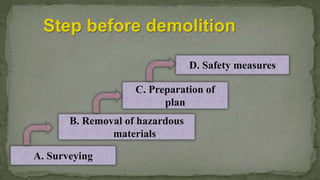
A. Surveying
B. Removal of hazardous
materials
C. Preparation of
plan
D. Safety measures
Step before demolition
 Surveying means study of different parameters of the structure
and its surroundings.
 There are two types of surveying are mainly conducted. They
are
A. Building surveying
B. Structural surveying
SURVEYING
BUILDING
SURVEYING
RECORD
DRAWING
SURVEY ITEMS
HAZARDOUS
MATERIALS
STRUCTURAL
SURVEYING
SPECIAL
STRUCTERS
INVESTIGATION
& TESTING
Asbestos containing material
 In case when asbestos containing
material are discovered, specialist
contractor shall be employed to be
removed such material. The asbestos
waste should be handled, stored and
disposed off as a chemical waste.
Soil contamination material
In case when soil
contamination material is
present, specialist shall be
employed to prepare soil
contamination test proposal and
submit such proposal to the
Environmental Protection
Department.
 The location of the building to be demolished
 A layout plan of all floors of the building to be demolished
 The structural support systems
 A temporary parking layout for mobile machines and trucks
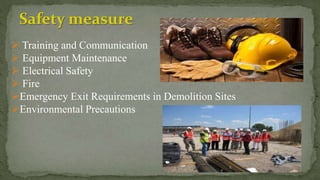
Safety measure
 Training and Communication
 Equipment Maintenance
 Electrical Safety
 Fire
Emergency Exit Requirements in Demolition Sites
Environmental Precautions
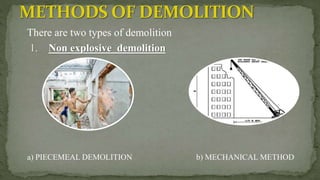
There are two types of demolition
1. Non explosive demolition
a) PIECEMEAL DEMOLITION b) MECHANICAL METHOD
2. Explosive demolition.
Blasting machine Blasting cap
RDX-based explosive compounds expand
at a very high rate of
speed, up to 27,000 feet per second (8,230
meters per second)
• A sledge hammer, equipment used for removing a
stone wall or a single column.
It consists of a long stem with a metallic head.
• It is used to give impacts on the surfaces and that
cause the demolition of structure.
• It cannot be used for removal of large buildings.
a) PIECEMEAL DEMOLITION
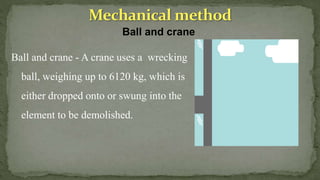
Ball and crane
Ball and crane - A crane uses a wrecking
ball, weighing up to 6120 kg, which is
either dropped onto or swung into the
element to be demolished.
Hydraulic excavators may be used to topple one-or two-story
buildings by an undermining process. The undermining process
means, erode the base or foundation, i.e., dig or excavate the
foundation so as to make it collapse
The basic idea of explosive demolition
is quite simple.
If we remove the support structure of a
building at a certain point, the section
of the building above the point will fall
down on the part of the building below
that point.
There are mainly two ways to implode
a building,
1. felling like a tree
2. falling into its own footprint
Explosives
Felling like a tree
In this the blasting crew will be able to tumble the building over on one side, into
a parking lot other open area. This sort of blast is the easiest to execute, and it
is generally the safest way to go. Tipping a building over is something like felling
a tree. For example to topple the building to the north, the blasters explosives on
the north side of the building first , in the same way you would chop into a tree
from the north side if you wanted it to fall in that direction . Blasters may also
secure steel cables to support columns in the building, so that they are pulled a
certain way as they crumble.
Falling into its own footprint
Sometimes, though, a building is surrounded by structures that must be preserved.
In this case, the blasters proceed with a true implosion, demolishing the building so
that it collapses straight down into its own footprints
Test Blast:
Before carrying out the actual blasting, a test blast, in
ordered to know the efficiency of explosive &
detonators.
Demolition method applied in a structure depends upon various
factors such as site condition, type of structures, age of building,
height of building and economy and most important its location with
presence of its surrounding with its structural stability. Controlled
demolition of building is necessary to ensure safety of both the
workers and the surroundings so as to cause least amount of injuries
and accidents.
 Code of practice for demolition of buildings by Building
Departments of Hong Kong in 2004.
 Prof. Chimay Anumba, Dr. Barbara Marino, Prof. Arie
Gottfried, Health and safety in refurbishment involving and
structural instability .(Research 204)
 Tom Harris, An article on How Building Implosions work.
Techniques for Demolition of Structure

Techniques for Demolition of Structure

  • 1.
    DINAKER DIXIT USN:3NA13CV407 Asst Prof.RAJMOHAN.B Dept of civil Engineering NET’S NAVODAYA INSTITUTE OF TECHNOLOGY RAICHUR-584103 By
  • 2.
    I. Introduction II. Objectives III.Steps before Demolition IV. Methods of Demolition V. Conclusion VI. Reference
  • 3.
     We knowevery structure is designed for a life period.  The existence of the structure after the service life period is very dangerous to its occupants and surrounding buildings .  Demolition is bringing down the building and other structures safely.  The demolition of structure with the help of explosives is called as implosion.
  • 4.
     The mainobjective for demolition may be the age of the structure.  Methods of demolition depends upon the type of structure, height and surrounding structures.  Old and damaged buildings ( due to earthquake & other various reasons) which are prone to fall down completely or partially must be demolished before any fatal accident.  Demolition is the process of tearing down or falling down of a building after its life period with the help of some equipments or any other method
  • 5.
    A. Surveying B. Removalof hazardous materials C. Preparation of plan D. Safety measures Step before demolition
  • 6.
     Surveying meansstudy of different parameters of the structure and its surroundings.  There are two types of surveying are mainly conducted. They are A. Building surveying B. Structural surveying
  • 7.
  • 8.
    Asbestos containing material In case when asbestos containing material are discovered, specialist contractor shall be employed to be removed such material. The asbestos waste should be handled, stored and disposed off as a chemical waste.
  • 9.
    Soil contamination material Incase when soil contamination material is present, specialist shall be employed to prepare soil contamination test proposal and submit such proposal to the Environmental Protection Department.
  • 10.
     The locationof the building to be demolished  A layout plan of all floors of the building to be demolished  The structural support systems  A temporary parking layout for mobile machines and trucks
  • 11.
    Safety measure  Trainingand Communication  Equipment Maintenance  Electrical Safety  Fire Emergency Exit Requirements in Demolition Sites Environmental Precautions
  • 12.
    There are twotypes of demolition 1. Non explosive demolition a) PIECEMEAL DEMOLITION b) MECHANICAL METHOD
  • 13.
    2. Explosive demolition. Blastingmachine Blasting cap RDX-based explosive compounds expand at a very high rate of speed, up to 27,000 feet per second (8,230 meters per second)
  • 14.
    • A sledgehammer, equipment used for removing a stone wall or a single column. It consists of a long stem with a metallic head. • It is used to give impacts on the surfaces and that cause the demolition of structure. • It cannot be used for removal of large buildings. a) PIECEMEAL DEMOLITION
  • 15.
    Ball and crane Balland crane - A crane uses a wrecking ball, weighing up to 6120 kg, which is either dropped onto or swung into the element to be demolished.
  • 16.
    Hydraulic excavators maybe used to topple one-or two-story buildings by an undermining process. The undermining process means, erode the base or foundation, i.e., dig or excavate the foundation so as to make it collapse
  • 17.
    The basic ideaof explosive demolition is quite simple. If we remove the support structure of a building at a certain point, the section of the building above the point will fall down on the part of the building below that point. There are mainly two ways to implode a building, 1. felling like a tree 2. falling into its own footprint Explosives
  • 18.
    Felling like atree In this the blasting crew will be able to tumble the building over on one side, into a parking lot other open area. This sort of blast is the easiest to execute, and it is generally the safest way to go. Tipping a building over is something like felling a tree. For example to topple the building to the north, the blasters explosives on the north side of the building first , in the same way you would chop into a tree from the north side if you wanted it to fall in that direction . Blasters may also secure steel cables to support columns in the building, so that they are pulled a certain way as they crumble.
  • 19.
    Falling into itsown footprint Sometimes, though, a building is surrounded by structures that must be preserved. In this case, the blasters proceed with a true implosion, demolishing the building so that it collapses straight down into its own footprints
  • 23.
    Test Blast: Before carryingout the actual blasting, a test blast, in ordered to know the efficiency of explosive & detonators.
  • 24.
    Demolition method appliedin a structure depends upon various factors such as site condition, type of structures, age of building, height of building and economy and most important its location with presence of its surrounding with its structural stability. Controlled demolition of building is necessary to ensure safety of both the workers and the surroundings so as to cause least amount of injuries and accidents.
  • 25.
     Code ofpractice for demolition of buildings by Building Departments of Hong Kong in 2004.  Prof. Chimay Anumba, Dr. Barbara Marino, Prof. Arie Gottfried, Health and safety in refurbishment involving and structural instability .(Research 204)  Tom Harris, An article on How Building Implosions work.