
DEMOLITION OF BUILDING
PRESENTED BY:AGLAIA
1
INTRODUCTION
• We know every structure is designed for a life period.
• The existence of the structure after the service life period is
very dangerous to its occupants and surrounding buildings.
• The building act usually contains provisions that enable local
authorities to control demolition works for the protection of
public safety and to ensure adjoining premises and the site are
made good on completion of the demolition. 2
3
DEMOLITION
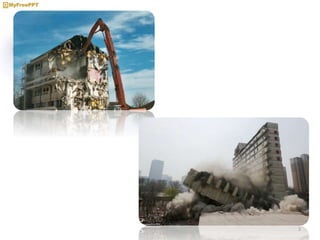
• It is the process of tearing down or falling down of a
building after its life period with the help of some
equipments or any other method.
• When explosives are used for this then the
demolition process are called as an implosion.
4
METHODS OF
DEMOLITION
There are two types of demolition
1. Non explosive demolition
2. Explosive demolition
5
NON EXPLOSIVE
DEMOLITION
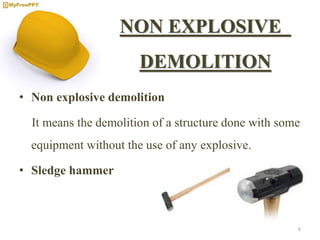
• Non explosive demolition
It means the demolition of a structure done with some
equipment without the use of any explosive.
• Sledge hammer
6
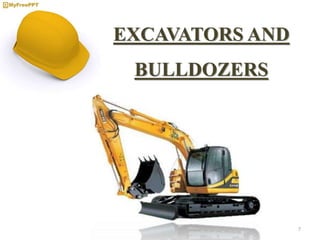
EXCAVATORS AND
BULLDOZERS
7
EXPLOSIVE DEMOLITION
• The basic idea of explosive demolition is quite
simple.
• If we remove the support structure of a building at a
certain point, the section of the building above the
point will fall down on the part of the building below
that point.
8
CONCLUSION
• Type of demolition method depends upon various factors
such as site condition, type of structures, age of building,
height of building and economy.
• Anyway controlled demolition of building is necessary to
ensure safety.
• Explosive demolition is the preferred method for safely and
efficiently demolishing the larger structures. 9
REFERENCE
• "HD_20h_20070822_chunk_2 - Vidéo Dailymotion".
Dailymotion.com. 23 August 2007. Retrieved 6 May 2012.
• "Kajima Demolition Tech". Popular Science. December
2008. Retrieved 18 November 2008.
• Hall, David (2006). Fred. Bantam Press. pp. 66–
68. ISBN 0-593-05664-7.
• Cultice, Curtice (1997). "Blasting a path to world
markets“. BNET Business Network. Retrieved 19
May 2008.
10
• Bohart, Maura (26 September 2007). "Demolition Eliminates
Final Remnant of Charlotte Hornets“. Construction Equipment
Guide. Retrieved 19 May 2008.
• "J.L. Hudson Department Store". Controlled Demolition, Inc.
• "Taisei Corporation's Tecorep reducing CO2 emissions by
85%“. Archived from the original on 15 April 2016.
Retrieved 26 August 2017. 11
THE END!!
For more…. Mail to aglaiaconnect2018@gmail.com

Demolition of building

  • 1.
  • 2.
    INTRODUCTION • We knowevery structure is designed for a life period. • The existence of the structure after the service life period is very dangerous to its occupants and surrounding buildings. • The building act usually contains provisions that enable local authorities to control demolition works for the protection of public safety and to ensure adjoining premises and the site are made good on completion of the demolition. 2
  • 3.
  • 4.
    DEMOLITION • It isthe process of tearing down or falling down of a building after its life period with the help of some equipments or any other method. • When explosives are used for this then the demolition process are called as an implosion. 4
  • 5.
    METHODS OF DEMOLITION There aretwo types of demolition 1. Non explosive demolition 2. Explosive demolition 5
  • 6.
    NON EXPLOSIVE DEMOLITION • Nonexplosive demolition It means the demolition of a structure done with some equipment without the use of any explosive. • Sledge hammer 6
  • 7.
  • 8.
    EXPLOSIVE DEMOLITION • Thebasic idea of explosive demolition is quite simple. • If we remove the support structure of a building at a certain point, the section of the building above the point will fall down on the part of the building below that point. 8
  • 9.
    CONCLUSION • Type ofdemolition method depends upon various factors such as site condition, type of structures, age of building, height of building and economy. • Anyway controlled demolition of building is necessary to ensure safety. • Explosive demolition is the preferred method for safely and efficiently demolishing the larger structures. 9
  • 10.
    REFERENCE • "HD_20h_20070822_chunk_2 -Vidéo Dailymotion". Dailymotion.com. 23 August 2007. Retrieved 6 May 2012. • "Kajima Demolition Tech". Popular Science. December 2008. Retrieved 18 November 2008. • Hall, David (2006). Fred. Bantam Press. pp. 66– 68. ISBN 0-593-05664-7. • Cultice, Curtice (1997). "Blasting a path to world markets“. BNET Business Network. Retrieved 19 May 2008. 10
  • 11.
    • Bohart, Maura(26 September 2007). "Demolition Eliminates Final Remnant of Charlotte Hornets“. Construction Equipment Guide. Retrieved 19 May 2008. • "J.L. Hudson Department Store". Controlled Demolition, Inc. • "Taisei Corporation's Tecorep reducing CO2 emissions by 85%“. Archived from the original on 15 April 2016. Retrieved 26 August 2017. 11
  • 12.
    THE END!! For more….Mail to aglaiaconnect2018@gmail.com