Demolition Of Building
By – Dhiraj Solanki , Amit Chaugule
Sanket Sagar, Tejas Kawale,
Koustubh Satalkar
INDEX
1. Introduction
2. Objective
3. Method of demolition
4. Deconstruction
5. Steps before demolition
6. Steps after demolition
7. conclusion
8. Reference
Introduction
 We know that every structure is designed for a life period.
 The existence of the structure after the service life period is very dangerous to its occupant and
surrounding building.
 Demolition is the process of tearing down or falling down of a building after its life period with the
help of some equipment or any other method.
 When explosive are used for this then demolition process are called as implosion.
Objective
 Old and damaged building (due to earthquake and other various reasons) which are prone to fall
down completely or partially must be demolished before any fatal accident.
 When the important structural components like beams and columns become absolutely insufficient
for service then there is no option other than demolishing the building.
 When a new structure need to be constructed on the site, the old structure is demolished.
 For safety of neighbouring area, a deteriorated building is often demolished.
Method of demolition
NON-
EXPLOSIVE
DEMOLITION
MECHANICAL
METHOD
EXPLOSIVE
DEMOLITION
Mechanical Demolition
A jackhammer is a pneumatic or electro-
mechanical tool that combines
a hammer directly with a chisel.
Jack Hammer
Mechanical method
 Ball and crane - A crane uses a wrecking ball, weighing up to 6120 kg, which is either dropped
onto or swung into the element to be demolished.
Ball and crane
Mechanical method
Hydraulic breaker
 A hydraulic breaker is a powerful
percussion hammer fitted to an excavator for
demolishing concrete structures or rocks. It is
powered by an auxiliary hydraulic system.
Explosive demolition
 The basic idea of explosive demolition is quite simple.
 If we remove the support structure of a building at a certain point, the section of the building
above the point will fall down on the part of the building below that point.
Blasting machine blasting cap or electrical detonator
RDX-based explosive compounds expand at a
very high rate of
speed, up to 27,000 feet per second (8,230
meters per second)
Explosive demolition
Advantage of explosive demolition
Explosive demolition
 Less expensive.
 No ground vibrations.
 Quickest method.
 Suitable for multi-storey / high piers, cabins, distressed piers etc.
Building implosion
Building implosion
Concrete columns Steel columns
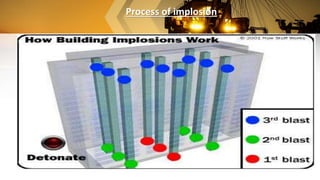
Process of implosion
Placing of explosive
Non Explosive Demolition
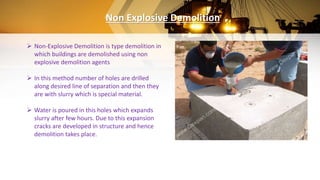
 Non-Explosive Demolition is type demolition in
which buildings are demolished using non
explosive demolition agents
 In this method number of holes are drilled
along desired line of separation and then they
are with slurry which is special material.
 Water is poured in this holes which expands
slurry after few hours. Due to this expansion
cracks are developed in structure and hence
demolition takes place.
Non-Explosive Demolition Agents
 Non-explosive demolition agents are commercial that
are an alternative to explosives and gas pressure
blasting products in demolition, mining, and quarrying.
 Non-explosive demolition agents offer many advantages
including that they are silent and do not produce
vibration the way a conventional explosive would.
 In some applications conventional explosives are more
economical than non-explosive demolition agents. In
many countries these are available without restriction,
unlike explosives which are highly regulated.
 These agents are much safer than explosives, but they
have to be used as directed to avoid steam
explosions during the first few hours after being placed.
Deconstruction
 Deconstruction is the selective dismantlement
of building components, specifically for re-
use, repurposing, recycling, and waste
management
 It differs from demolition where a site is
cleared of its building by the most expedient
means. Deconstruction has also been defined
as “construction in reverse”.
 The process of dismantling structures is an
ancient activity that has been revived by the
growing field of sustainable, green method of
building.
 Deconstruction focuses on giving the materials
within a building a new life once the building
as a whole can no longer continue.
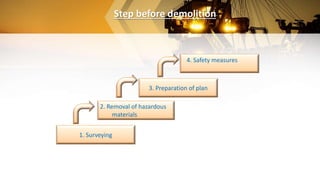
Step before demolition
1. Surveying
2. Removal of hazardous
materials
3. Preparation of plan
4. Safety measures
Surveying
The building should cover the following :-
 The construction material.
 Adjoining pedestrians and vehicular traffic condition.
 The sensitivity of neighbourhood with respect to noise,
dust, vibration and traffic impact.
 Available site to demolition.
 Record drawing.
Removal of hazardous material
 Asbestos containing material – in case when asbestos containing material are discovered,
specialist contractor shall be employed to be removed such material. The asbestos waste should
be handled, stored and disposed off as a chemical waste.
 Soil contamination material – in case when soil contamination material is present, specialist shall
be employed to prepare soil contamination test proposal and submit such proposal to the
Environmental Protection Department.
Asbestos material soil contamination
Removal of hazardous material
Preparation of plan
 The Location of building to be demolished.
 A layout plan of all floors of the building to be demolished.
 The structural support system.
 A plan showing the procedure for the demolition of building.
 In the case when powered mechanical plants and equipment are used, a plan showing the route of
movement of powered mechanical plants and equipment.
Safety measure
 Training and communication - Demolition workers,
including plant or equipment operators, shall go through
proper job safety training and be informed of the
potential hazards by attending training sessions as well
as on-the-job training.
 Equipment maintenance - All equipment shall
be tested and examined before use. They shall
be properly stored and maintained. The
equipment shall be inspected daily and results
of the inspection shall be recorded
accordingly.
 Properly marked with exit signs.
Safety measure
 Fire - All flammable goods shall be removed from site
unless they are necessary for the works involved. Any
remaining flammable goods shall be stored in proper
storage facilities. All furniture, timber, doors, etc. shall be
removed before any welding work is performed. Fire
fighting appliances shall be provided and maintained in
working conditions
Safety measure
Steps after demolition
1. AFTER DEMOLITION PROJECT: It involves the entire plan
on how the demolition site is to be excavated, salvaged and
reused in an economical way for reconstruction.
2. HAULING and SALVAGE COMPANIES: In hauling and salvaging the products which do not get
damaged completely are removed i.e. they are salvaged for their further usage or resale. Hauling
involves transporting a part of the structure which can be entirely used as a whole. Eg: Wood, Steel
frames, Glass , etc.
3. DISPOSAL:
4. NEW CONSTRUCTION PROJECT:
Conclusion
 It can be concluded that demolishing/imploding the building structure will prove very useful,
economical and quickest for reconstruction.
 Type of demolition method depends upon various factors such as site condition, type of structures,
age of building, height of building and economy.
 Explosive demolition is the preferred method for safely and efficiently demolishing the larger
structures.
 Development in techniques allows rapid demolition with no harm to the environment.
Reference
 www.google.com
 www.Wikipedia.com
 www.implosionworld.com
 www.demolitionforum.com
 www.demolition.us
 http://demolition.venturestreet.com/cost
Demolition pptx

Demolition pptx

  • 1.
    Demolition Of Building By– Dhiraj Solanki , Amit Chaugule Sanket Sagar, Tejas Kawale, Koustubh Satalkar
  • 2.
    INDEX 1. Introduction 2. Objective 3.Method of demolition 4. Deconstruction 5. Steps before demolition 6. Steps after demolition 7. conclusion 8. Reference
  • 3.
    Introduction  We knowthat every structure is designed for a life period.  The existence of the structure after the service life period is very dangerous to its occupant and surrounding building.  Demolition is the process of tearing down or falling down of a building after its life period with the help of some equipment or any other method.  When explosive are used for this then demolition process are called as implosion.
  • 4.
    Objective  Old anddamaged building (due to earthquake and other various reasons) which are prone to fall down completely or partially must be demolished before any fatal accident.  When the important structural components like beams and columns become absolutely insufficient for service then there is no option other than demolishing the building.  When a new structure need to be constructed on the site, the old structure is demolished.  For safety of neighbouring area, a deteriorated building is often demolished.
  • 5.
  • 6.
    Mechanical Demolition A jackhammeris a pneumatic or electro- mechanical tool that combines a hammer directly with a chisel. Jack Hammer
  • 7.
    Mechanical method  Balland crane - A crane uses a wrecking ball, weighing up to 6120 kg, which is either dropped onto or swung into the element to be demolished. Ball and crane
  • 8.
    Mechanical method Hydraulic breaker A hydraulic breaker is a powerful percussion hammer fitted to an excavator for demolishing concrete structures or rocks. It is powered by an auxiliary hydraulic system.
  • 9.
    Explosive demolition  Thebasic idea of explosive demolition is quite simple.  If we remove the support structure of a building at a certain point, the section of the building above the point will fall down on the part of the building below that point.
  • 10.
    Blasting machine blastingcap or electrical detonator RDX-based explosive compounds expand at a very high rate of speed, up to 27,000 feet per second (8,230 meters per second) Explosive demolition
  • 11.
    Advantage of explosivedemolition Explosive demolition  Less expensive.  No ground vibrations.  Quickest method.  Suitable for multi-storey / high piers, cabins, distressed piers etc.
  • 12.
  • 13.
  • 14.
  • 15.
  • 16.
    Non Explosive Demolition Non-Explosive Demolition is type demolition in which buildings are demolished using non explosive demolition agents  In this method number of holes are drilled along desired line of separation and then they are with slurry which is special material.  Water is poured in this holes which expands slurry after few hours. Due to this expansion cracks are developed in structure and hence demolition takes place.
  • 17.
    Non-Explosive Demolition Agents Non-explosive demolition agents are commercial that are an alternative to explosives and gas pressure blasting products in demolition, mining, and quarrying.  Non-explosive demolition agents offer many advantages including that they are silent and do not produce vibration the way a conventional explosive would.  In some applications conventional explosives are more economical than non-explosive demolition agents. In many countries these are available without restriction, unlike explosives which are highly regulated.  These agents are much safer than explosives, but they have to be used as directed to avoid steam explosions during the first few hours after being placed.
  • 18.
    Deconstruction  Deconstruction isthe selective dismantlement of building components, specifically for re- use, repurposing, recycling, and waste management  It differs from demolition where a site is cleared of its building by the most expedient means. Deconstruction has also been defined as “construction in reverse”.  The process of dismantling structures is an ancient activity that has been revived by the growing field of sustainable, green method of building.  Deconstruction focuses on giving the materials within a building a new life once the building as a whole can no longer continue.
  • 19.
    Step before demolition 1.Surveying 2. Removal of hazardous materials 3. Preparation of plan 4. Safety measures
  • 20.
    Surveying The building shouldcover the following :-  The construction material.  Adjoining pedestrians and vehicular traffic condition.  The sensitivity of neighbourhood with respect to noise, dust, vibration and traffic impact.  Available site to demolition.  Record drawing.
  • 21.
    Removal of hazardousmaterial  Asbestos containing material – in case when asbestos containing material are discovered, specialist contractor shall be employed to be removed such material. The asbestos waste should be handled, stored and disposed off as a chemical waste.  Soil contamination material – in case when soil contamination material is present, specialist shall be employed to prepare soil contamination test proposal and submit such proposal to the Environmental Protection Department.
  • 22.
    Asbestos material soilcontamination Removal of hazardous material
  • 23.
    Preparation of plan The Location of building to be demolished.  A layout plan of all floors of the building to be demolished.  The structural support system.  A plan showing the procedure for the demolition of building.  In the case when powered mechanical plants and equipment are used, a plan showing the route of movement of powered mechanical plants and equipment.
  • 24.
    Safety measure  Trainingand communication - Demolition workers, including plant or equipment operators, shall go through proper job safety training and be informed of the potential hazards by attending training sessions as well as on-the-job training.
  • 25.
     Equipment maintenance- All equipment shall be tested and examined before use. They shall be properly stored and maintained. The equipment shall be inspected daily and results of the inspection shall be recorded accordingly.  Properly marked with exit signs. Safety measure
  • 26.
     Fire -All flammable goods shall be removed from site unless they are necessary for the works involved. Any remaining flammable goods shall be stored in proper storage facilities. All furniture, timber, doors, etc. shall be removed before any welding work is performed. Fire fighting appliances shall be provided and maintained in working conditions Safety measure
  • 27.
  • 28.
    1. AFTER DEMOLITIONPROJECT: It involves the entire plan on how the demolition site is to be excavated, salvaged and reused in an economical way for reconstruction.
  • 29.
    2. HAULING andSALVAGE COMPANIES: In hauling and salvaging the products which do not get damaged completely are removed i.e. they are salvaged for their further usage or resale. Hauling involves transporting a part of the structure which can be entirely used as a whole. Eg: Wood, Steel frames, Glass , etc.
  • 30.
  • 32.
  • 33.
    Conclusion  It canbe concluded that demolishing/imploding the building structure will prove very useful, economical and quickest for reconstruction.  Type of demolition method depends upon various factors such as site condition, type of structures, age of building, height of building and economy.  Explosive demolition is the preferred method for safely and efficiently demolishing the larger structures.  Development in techniques allows rapid demolition with no harm to the environment.
  • 34.
    Reference  www.google.com  www.Wikipedia.com www.implosionworld.com  www.demolitionforum.com  www.demolition.us  http://demolition.venturestreet.com/cost