Demolition of
Structures.
1
By: Chintan Varia
Pratik Sureja
Akshay Kasundra
Why DEMOLITION is DANGEROUS?
 Demolition work is one if the most dangerous operations in
construction.
 REASONS/CAUSES:
1. Easy to cause injury to human workers due to the difficulty of
accessing into or working inside a building which is under
construction.
2. Falling of smaller objects or debris from the demolishing
building.
3. Falling of Partially demolished structure.
4. Collapse of unstable structure due to original structure being
disturbed.
2
Why DEMOLITION is DANGEROUS?
5. Collapse of heavy demolition equipment due to inadequate
support of the partially demolished structure.
6. Collapse of the partially demolished structure due to the
accommodation of large amount of un-cleared debris.
7. Congested site environment that easily cause damage to
human workers, or to the third parties and their properties
that are situated nearby the demolition site.
3
DEMOLITION PLAN
 Forming part of the submission information, the DEMOLITION Plan should
include:
a) A set of drawings showing:
the location of the building to be demolished other
existing structures and facilities in vicinity.
b) Proposed method of DEMOLITION.
c) Proposed shoring and precautionary measures for the adjacent
buildings.
d) Proposed shoring and protection for the building to be demolished
4
DEMOLITION PLAN
e) Proposed methods of handling and disposing of the demolished
materials.
f) Proposed sequence of carrying out work.
g) Detail of equipment used, with methods of raising, lowering or
supporting the equipment.
h) Structural calculation to justify the proposal.
i) Proposed arrangements for site supervision.
5
6
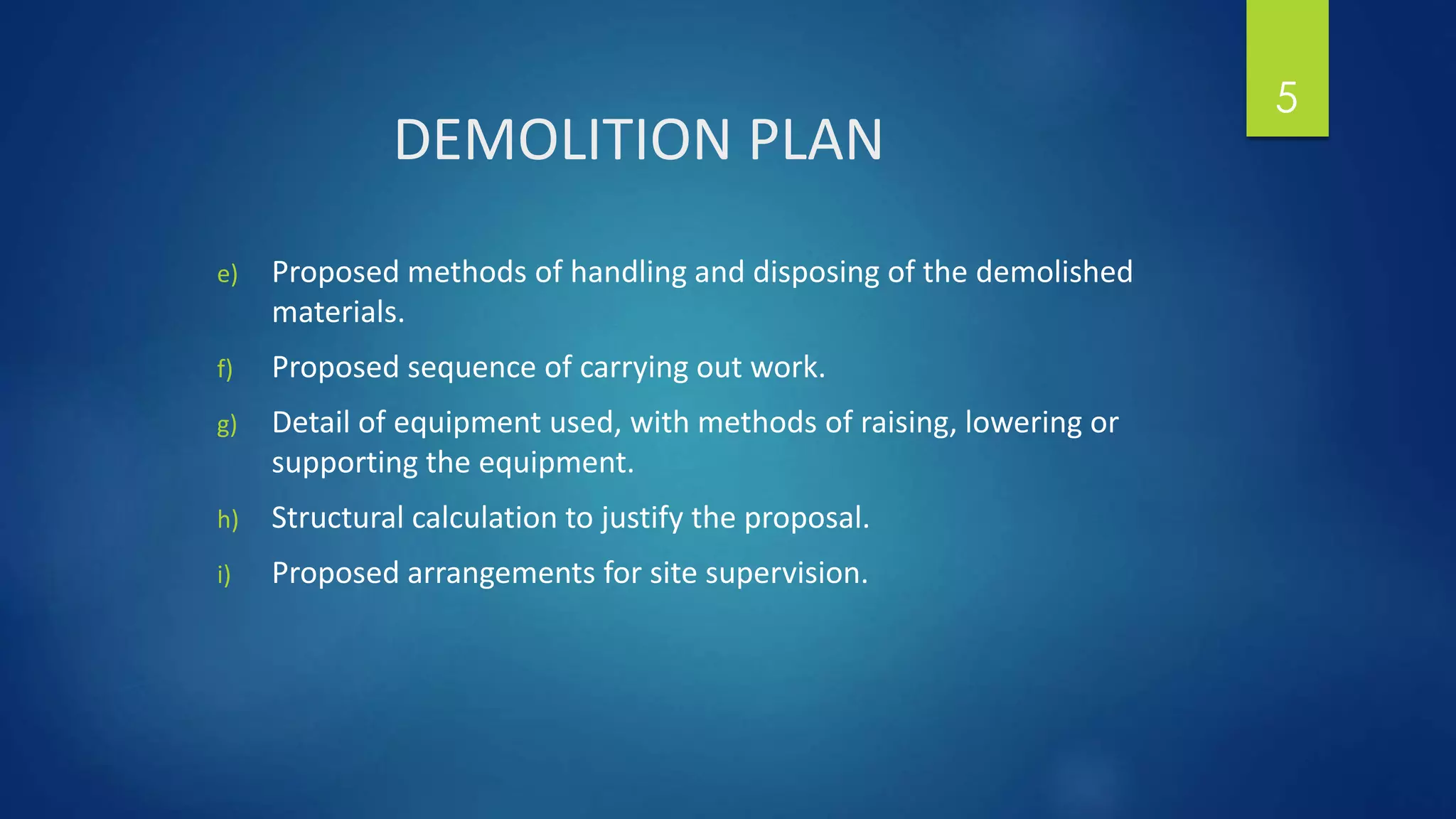
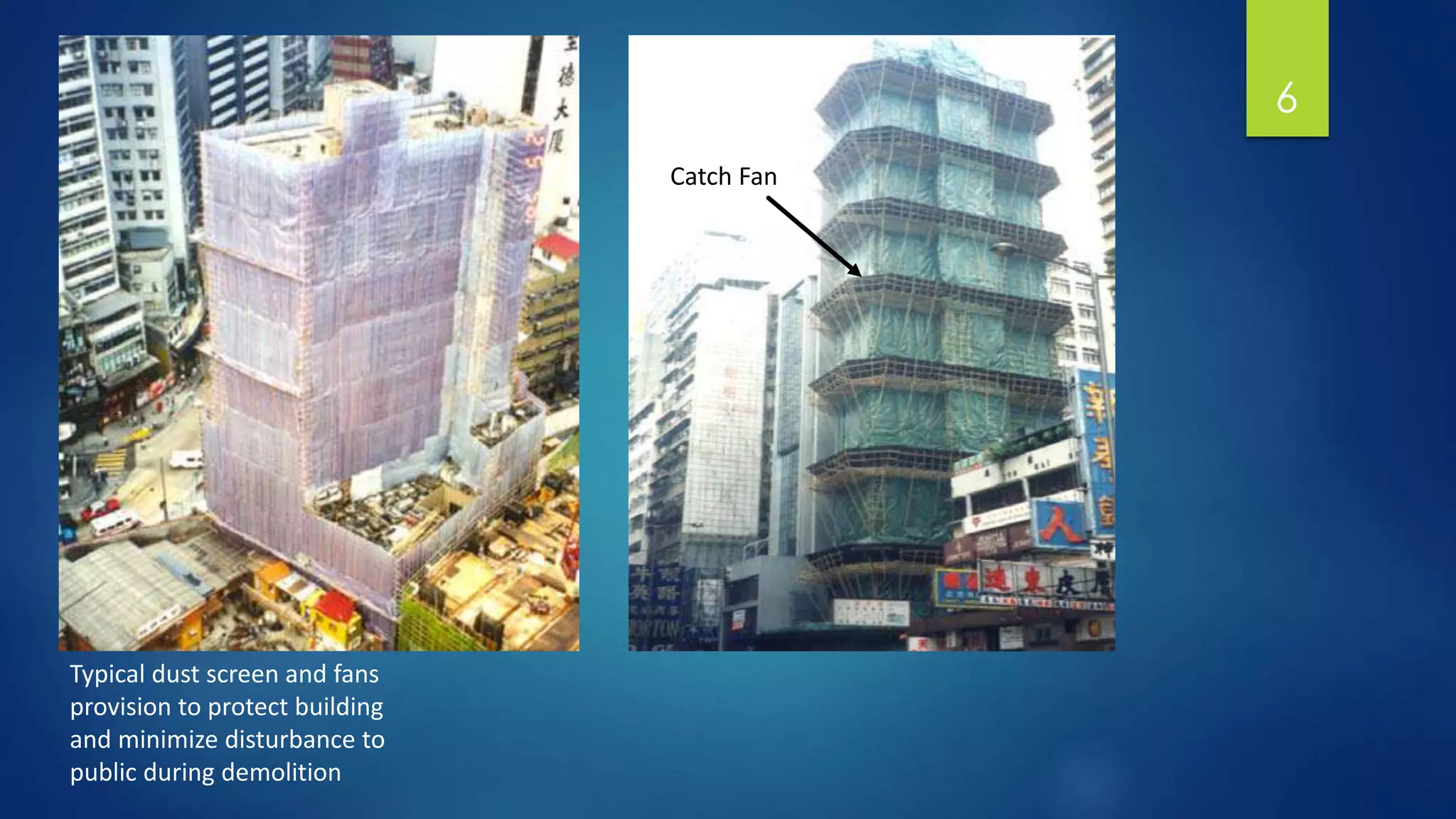
Catch Fan
Typical dust screen and fans
provision to protect building
and minimize disturbance to
public during demolition
7
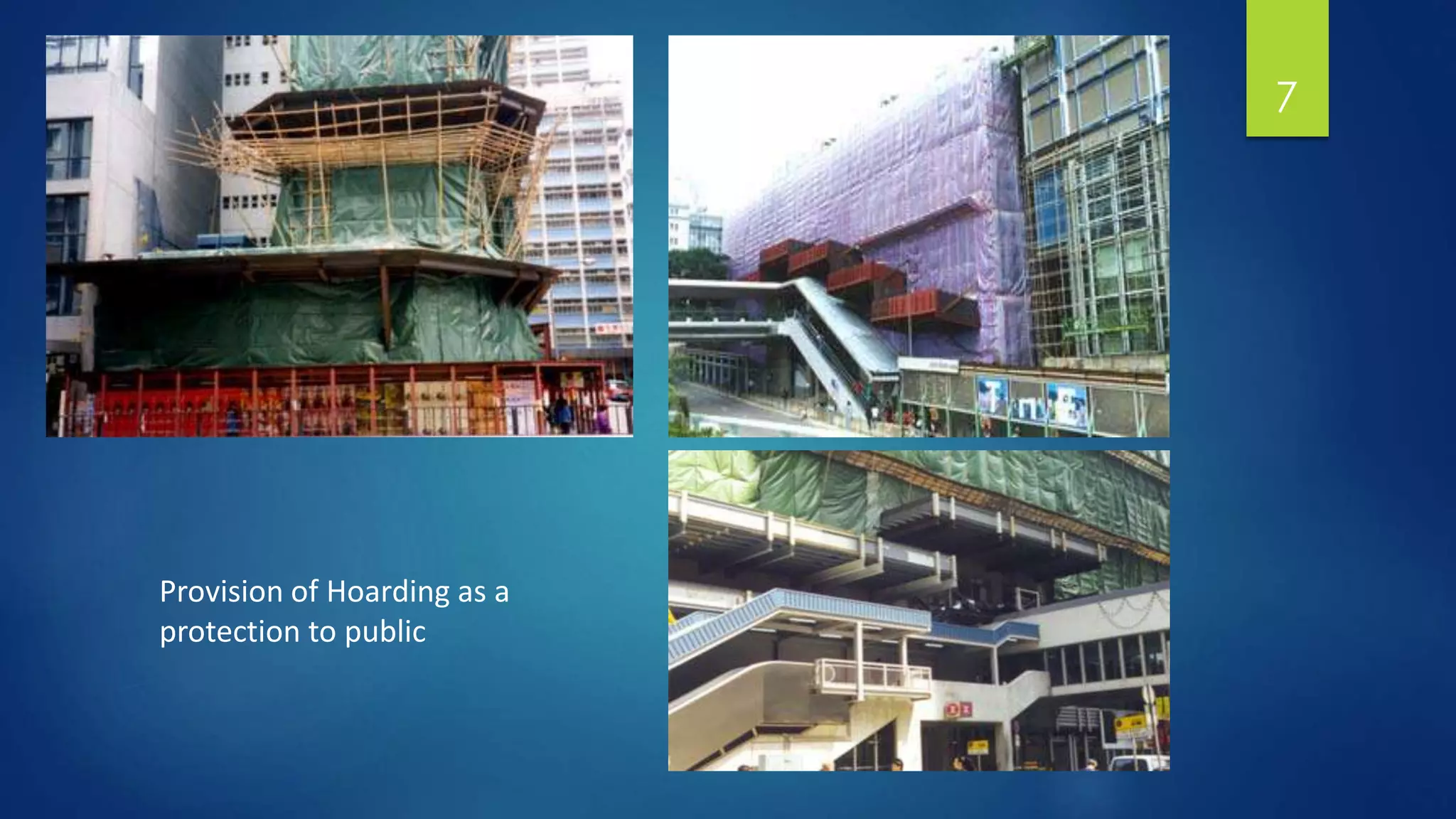
Provision of Hoarding as a
protection to public
8
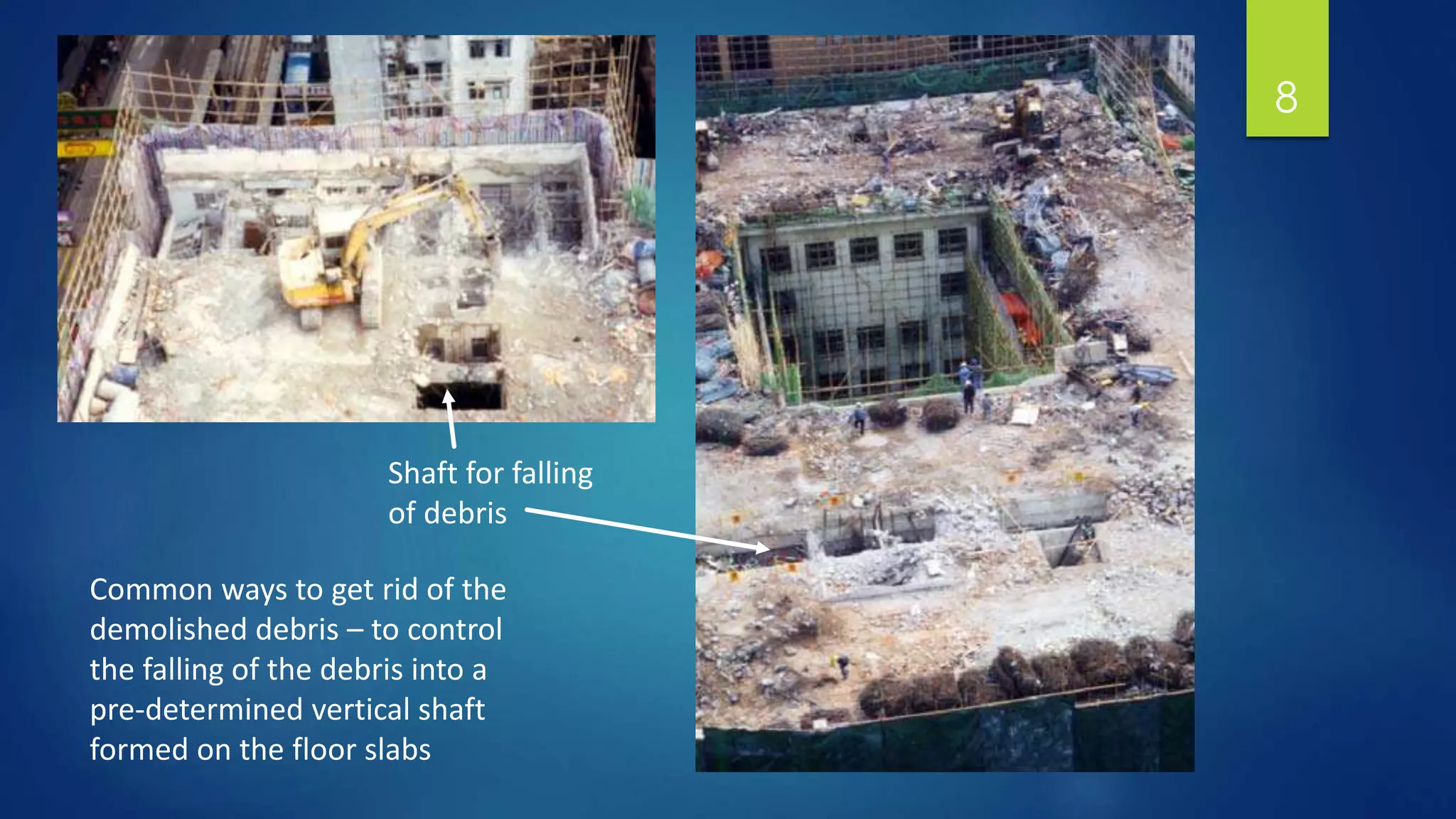
Shaft for falling
of debris
Common ways to get rid of the
demolished debris – to control
the falling of the debris into a
pre-determined vertical shaft
formed on the floor slabs
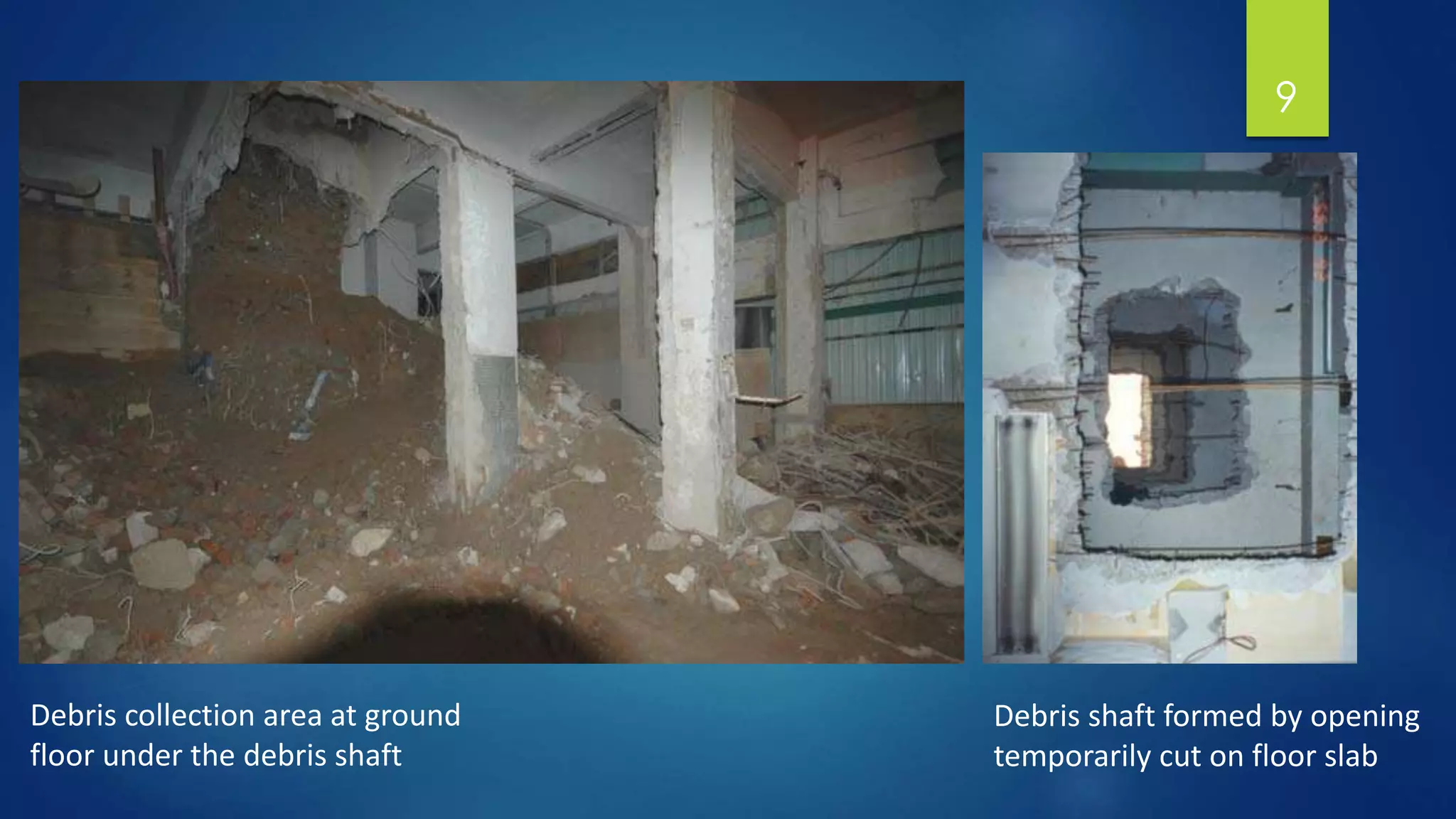
9
Debris shaft formed by opening
temporarily cut on floor slab
Debris collection area at ground
floor under the debris shaft
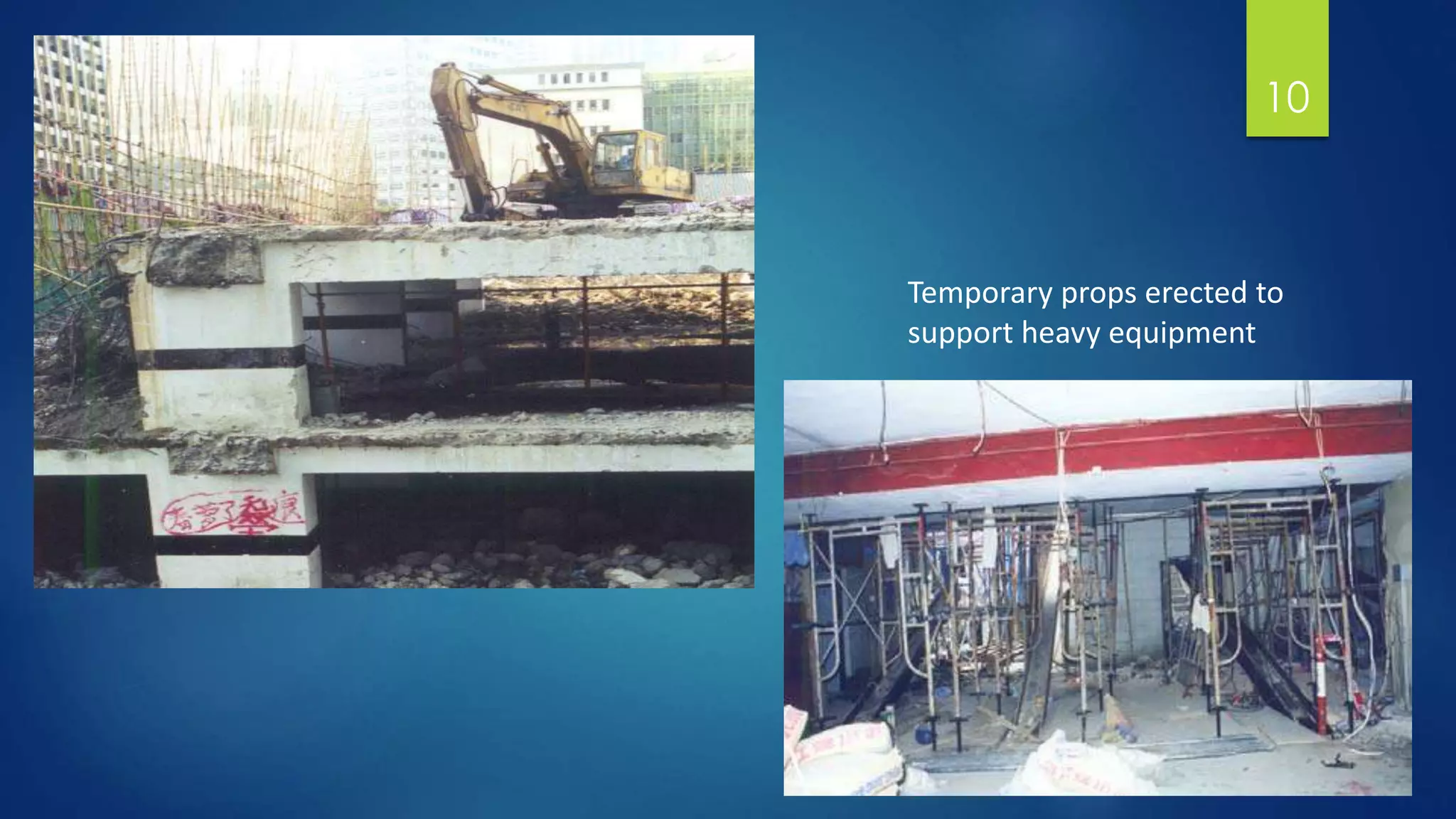
10
Temporary props erected to
support heavy equipment
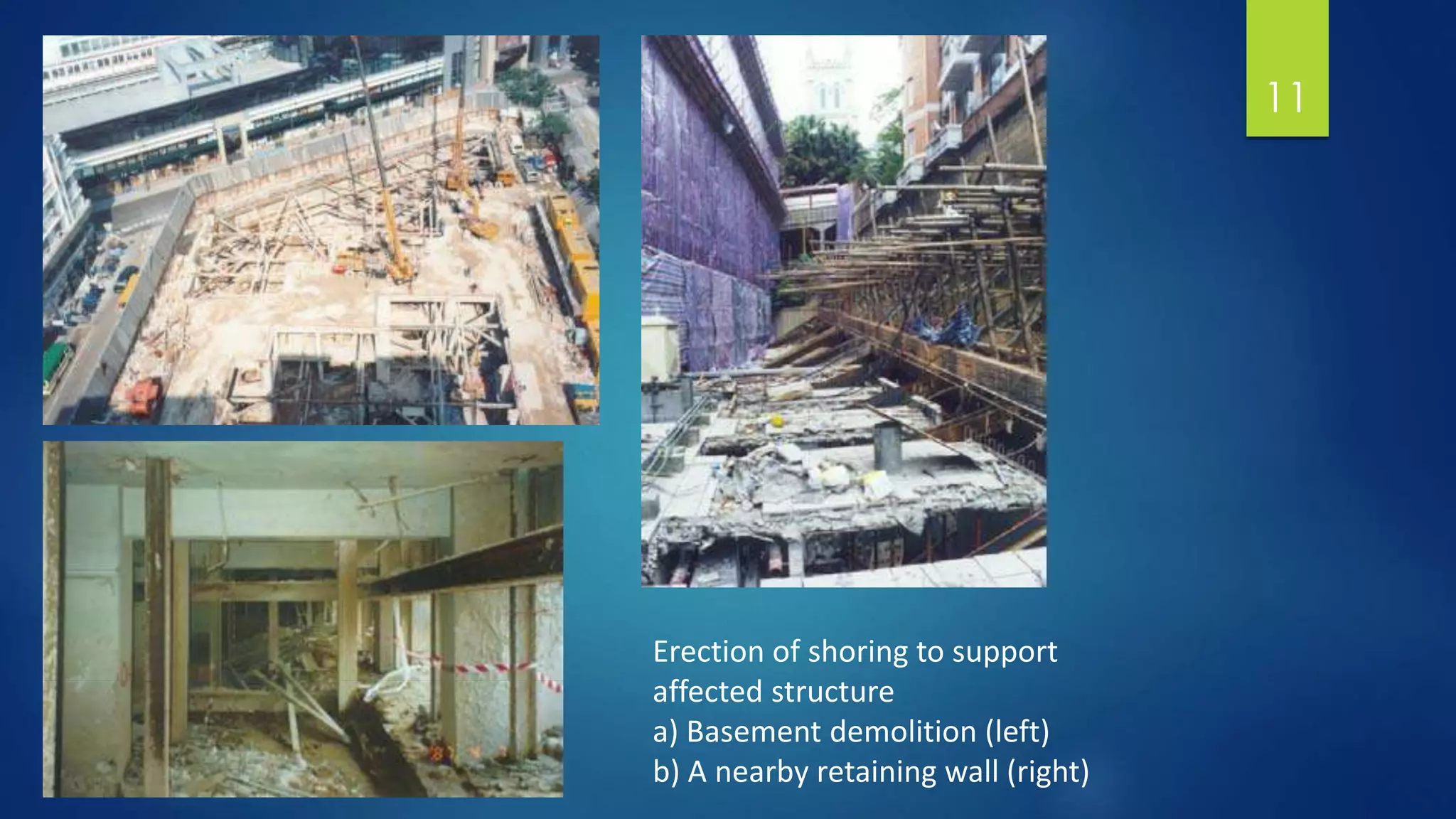
11
Erection of shoring to support
affected structure
a) Basement demolition (left)
b) A nearby retaining wall (right)
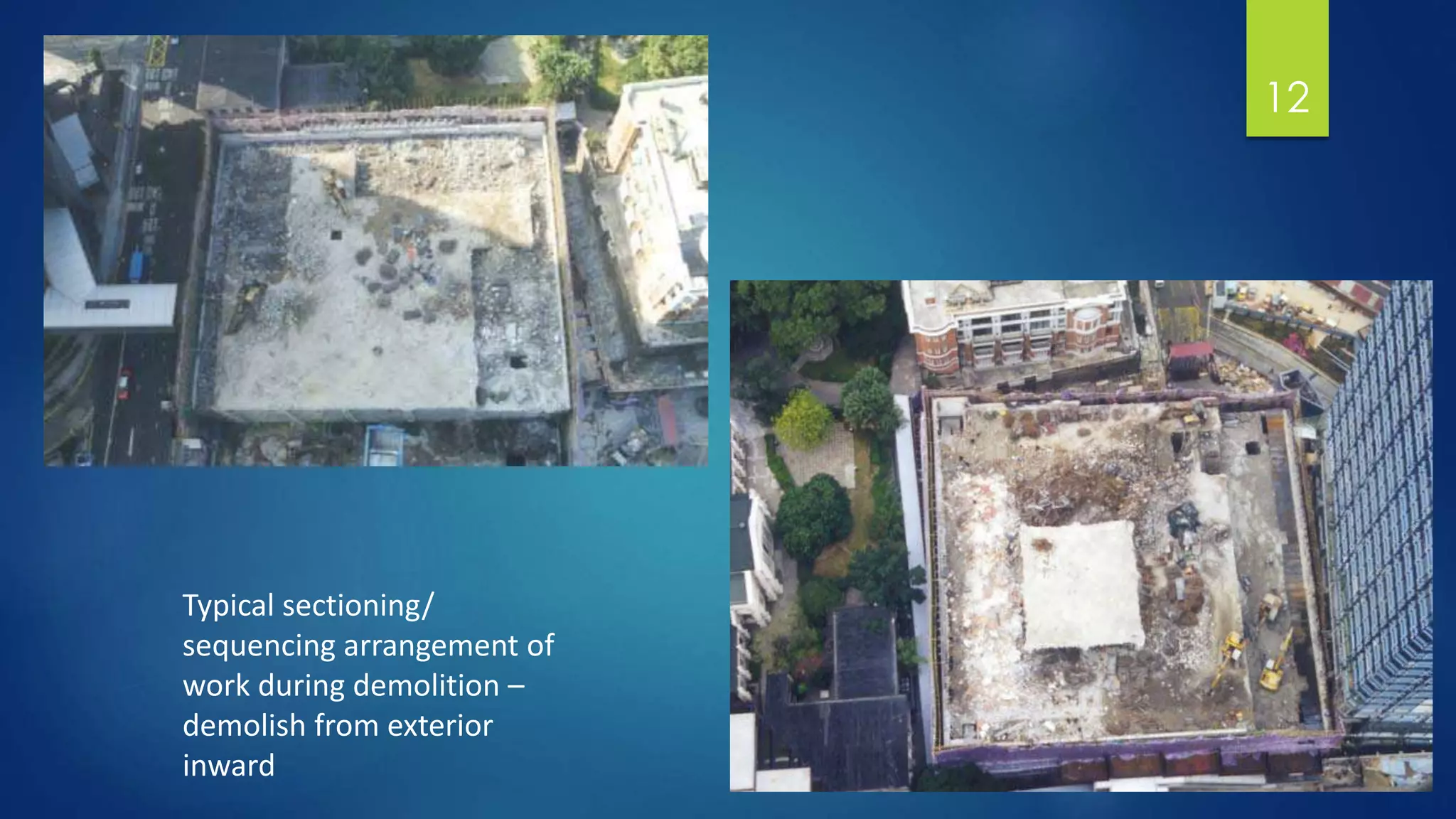
12
Typical sectioning/
sequencing arrangement of
work during demolition –
demolish from exterior
inward
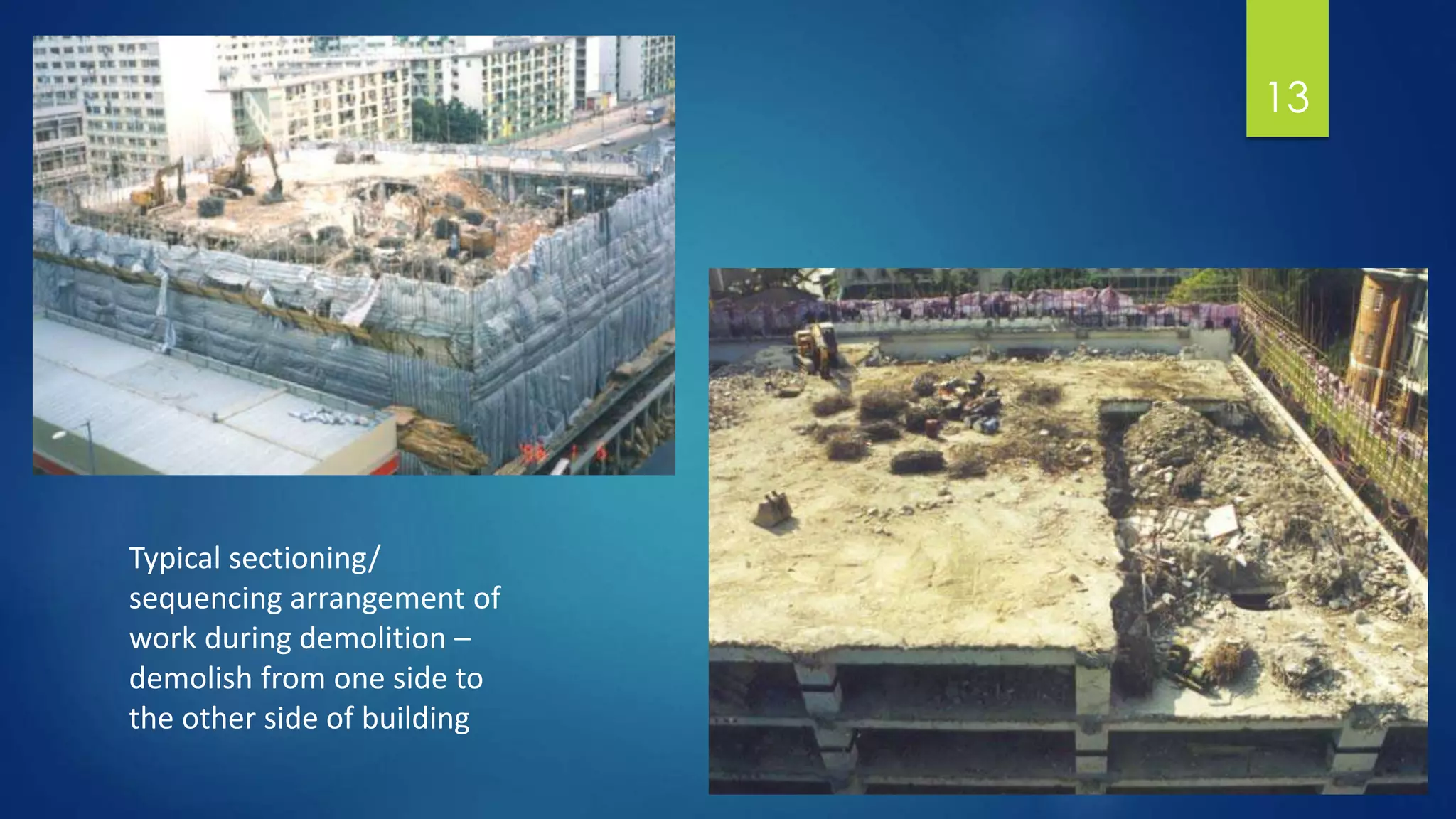
13
Typical sectioning/
sequencing arrangement of
work during demolition –
demolish from one side to
the other side of building
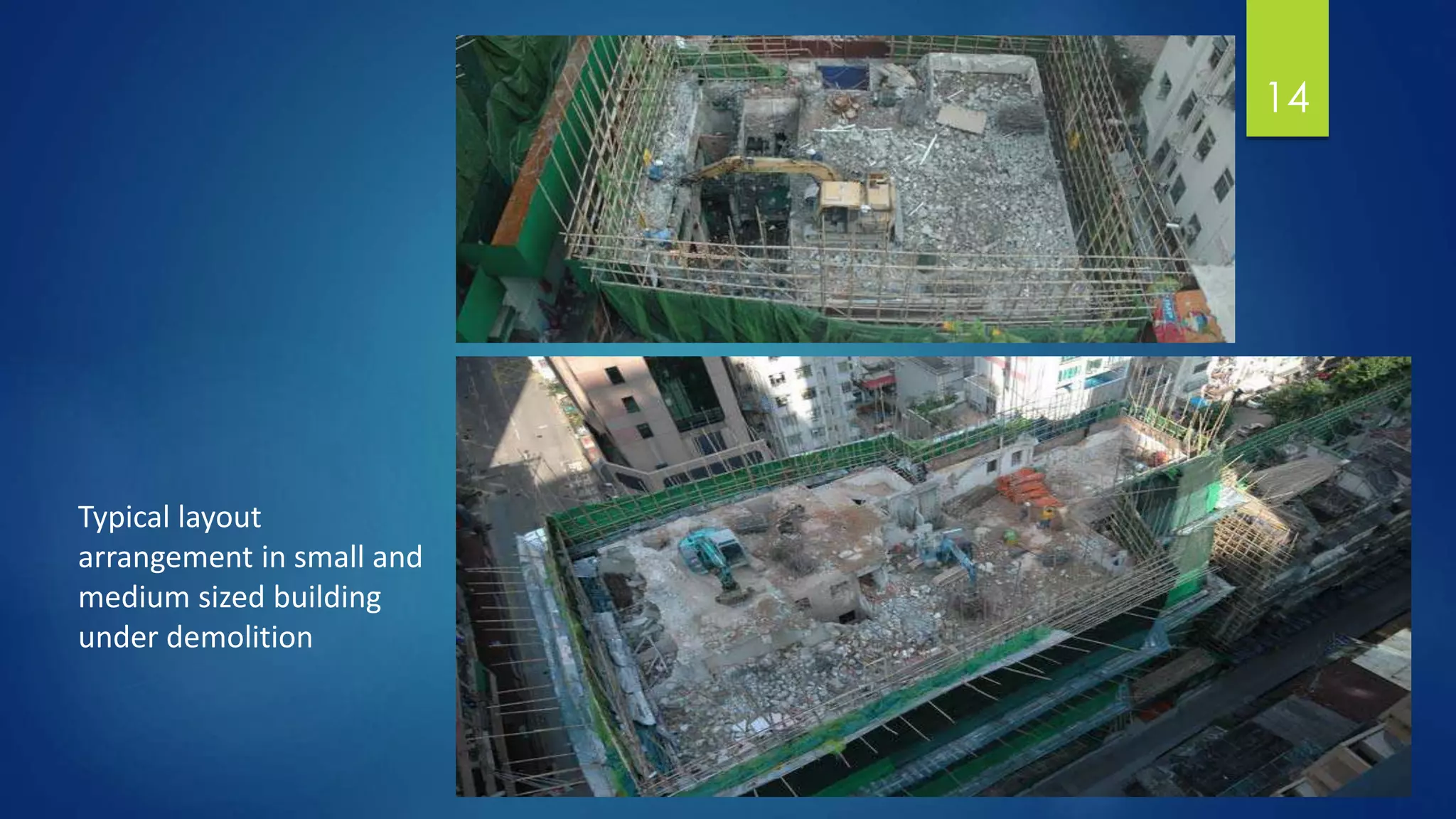
14
Typical layout
arrangement in small and
medium sized building
under demolition
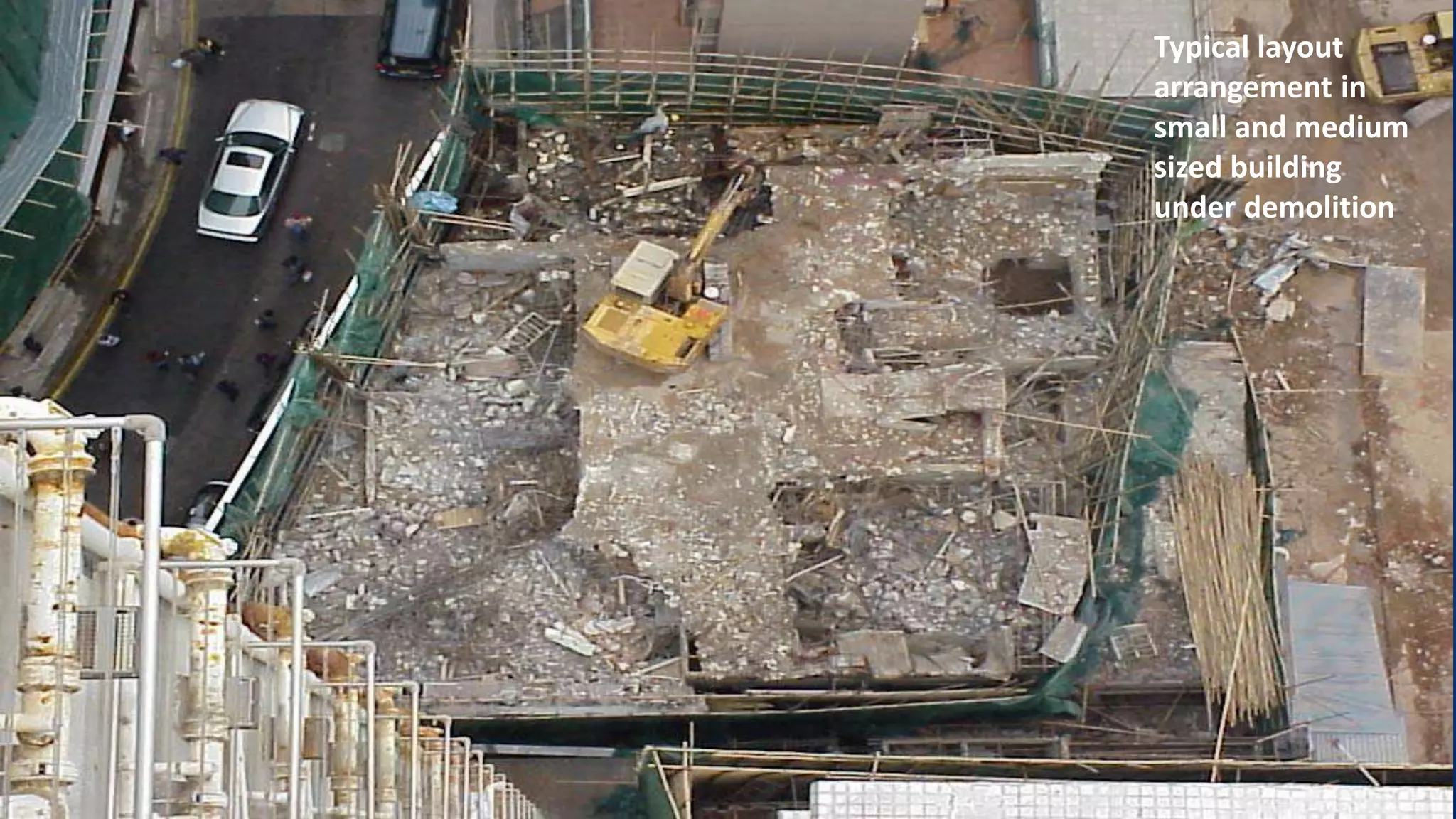
15
Typical layout
arrangement in
small and medium
sized building
under demolition
METHODS OF DEMOLITION
 GENERAL CONCERNS:
The choice of choosing a demolition method depends on a
number of factors such as the project conditions, site constraints, sensitivity
of the neighborhood and availability of equipment etc.
In general, top down methods are applicable for most sites,
particularly for those situated in busy urban areas. Other mechanical
methods applied from the outside of a building lines, demotion by hand held
tools or the cut and lift process may be a safe solution.
For structural projections such as balconies, canopies and
verandahs extending beyond the building lines, demolition by hand held
tools or the cut and lift process may be a safe solution.
16
METHODS OF DEMOLITION
 There are various methods of DEMOLITION of structures.
1. Demolition by human operatives.
2. Deliberate Collapse method.
3. Using of applied pulling / pushing forces.
4. Using of wrecking ball.
5. Use of powered plant or demolition machine.
6. Using saw cut method.
7. By Implosion (explosive).
17
DEMOLITION BY HUMAN OPERATIVES
 This method particularly suitable for use in smaller site
with congested space where larger machine cannot be
employed.
 In this case, human operatives are used in the demolition
process using simple electrically or pneumatically
powered tools such as picks, hammers, wire cutters or
hand driven hydraulic jacks etc. to carry out the
demolition of individual elements.
18
19
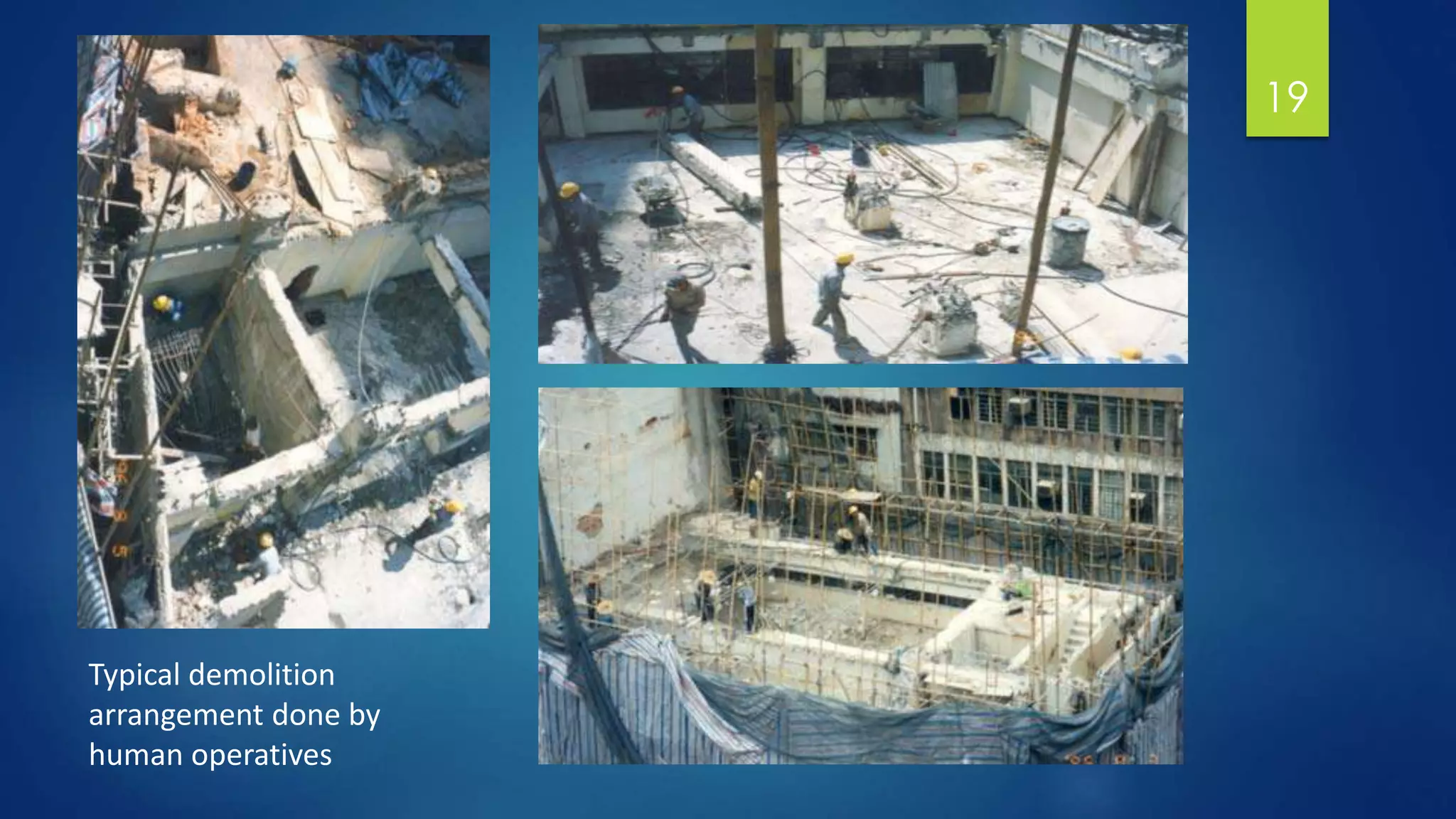
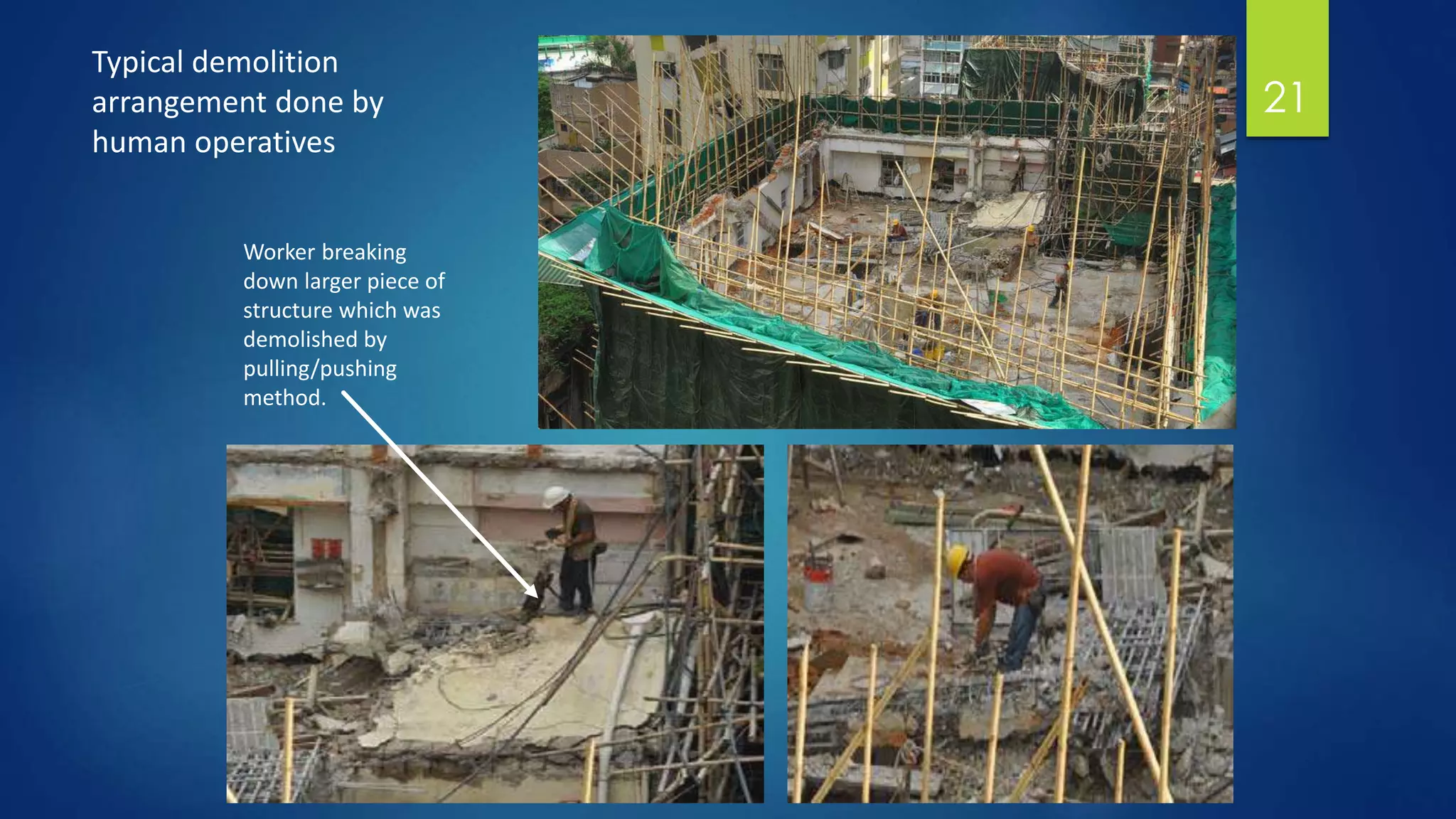
Typical demolition
arrangement done by
human operatives
20
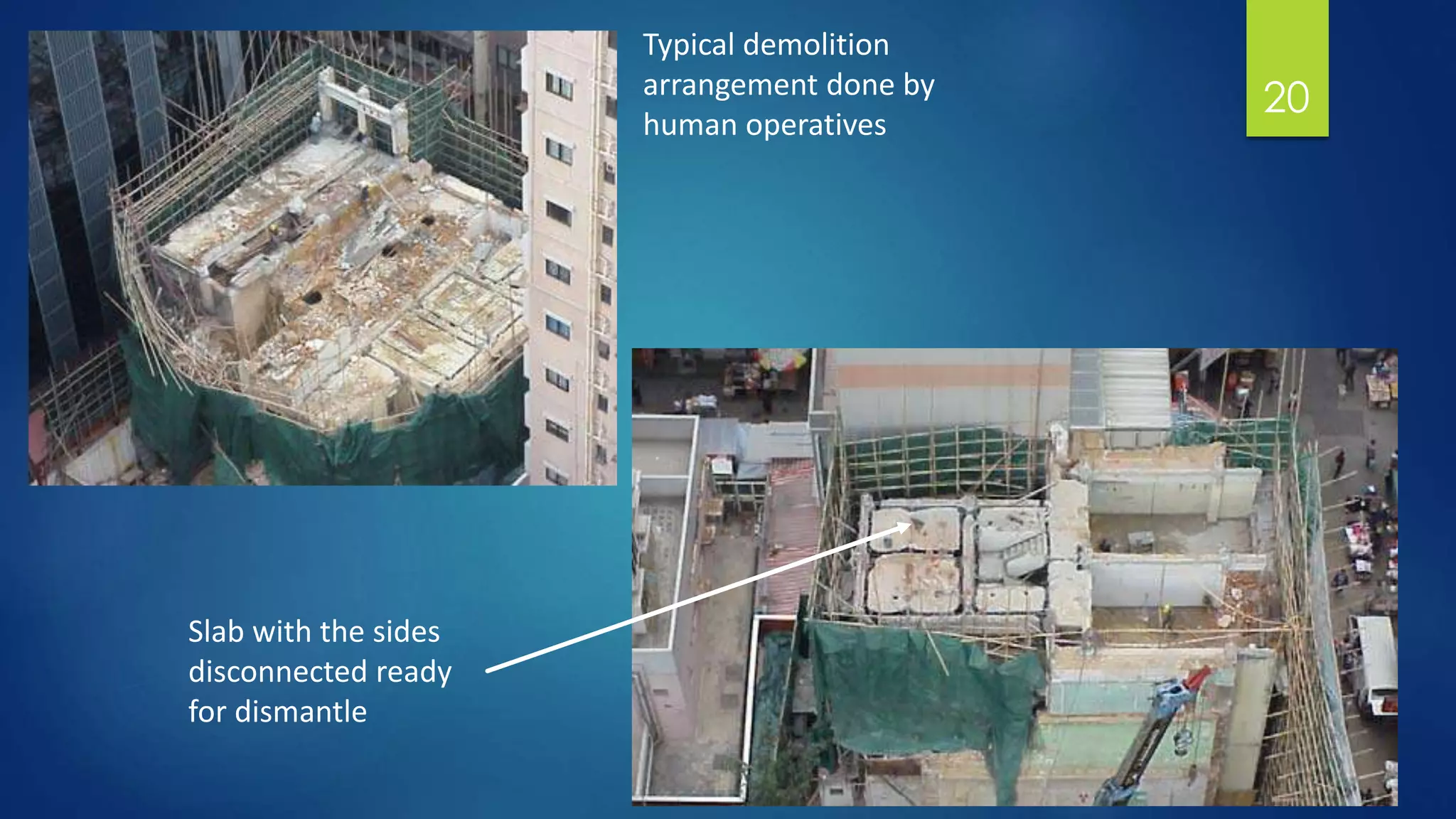
Typical demolition
arrangement done by
human operatives
Slab with the sides
disconnected ready
for dismantle
21
Typical demolition
arrangement done by
human operatives
Worker breaking
down larger piece of
structure which was
demolished by
pulling/pushing
method.
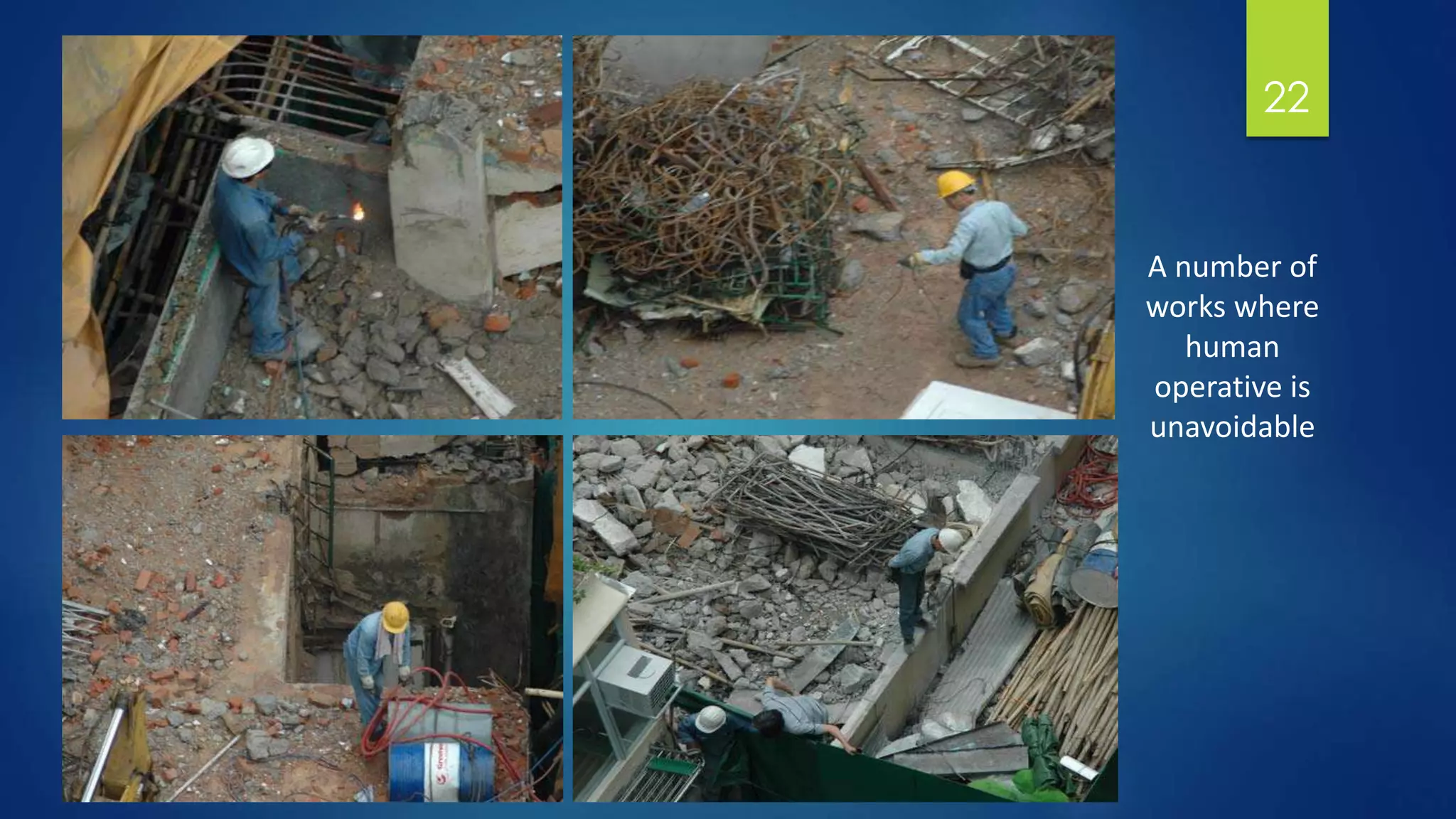
22
A number of
works where
human
operative is
unavoidable
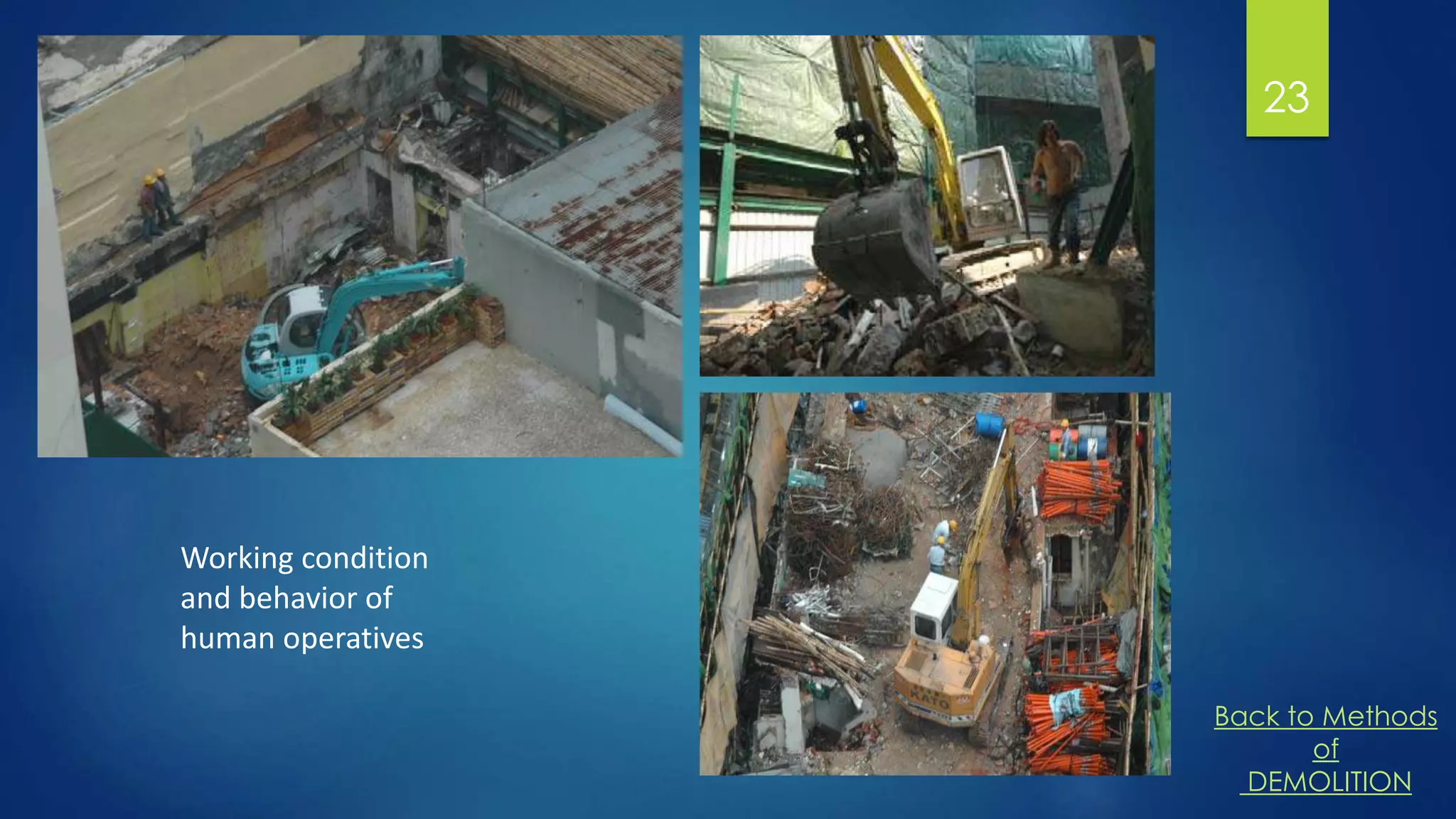
23
Working condition
and behavior of
human operatives
Back to Methods
of
DEMOLITION
DELIBERATE COLLAPSE METHOD
 DEMOLITION by deliberate collapse consists of systematic removal, or
weakening of the key structural elements to induce the collapse of the
structure.
 However, when applying this method, several precautions should be
observed, such as:
1. Sufficient distance of collapse should be provided.
2. Collapse procedure should be carefully designed so that there is no
pre-mature collapse or collapse out of anticipated area.
3. Control height of building structure to be collapsed.
24
Back to Methods
of
DEMOLITION
USING OF APPLIED PULLING / PUSHING
FORCES
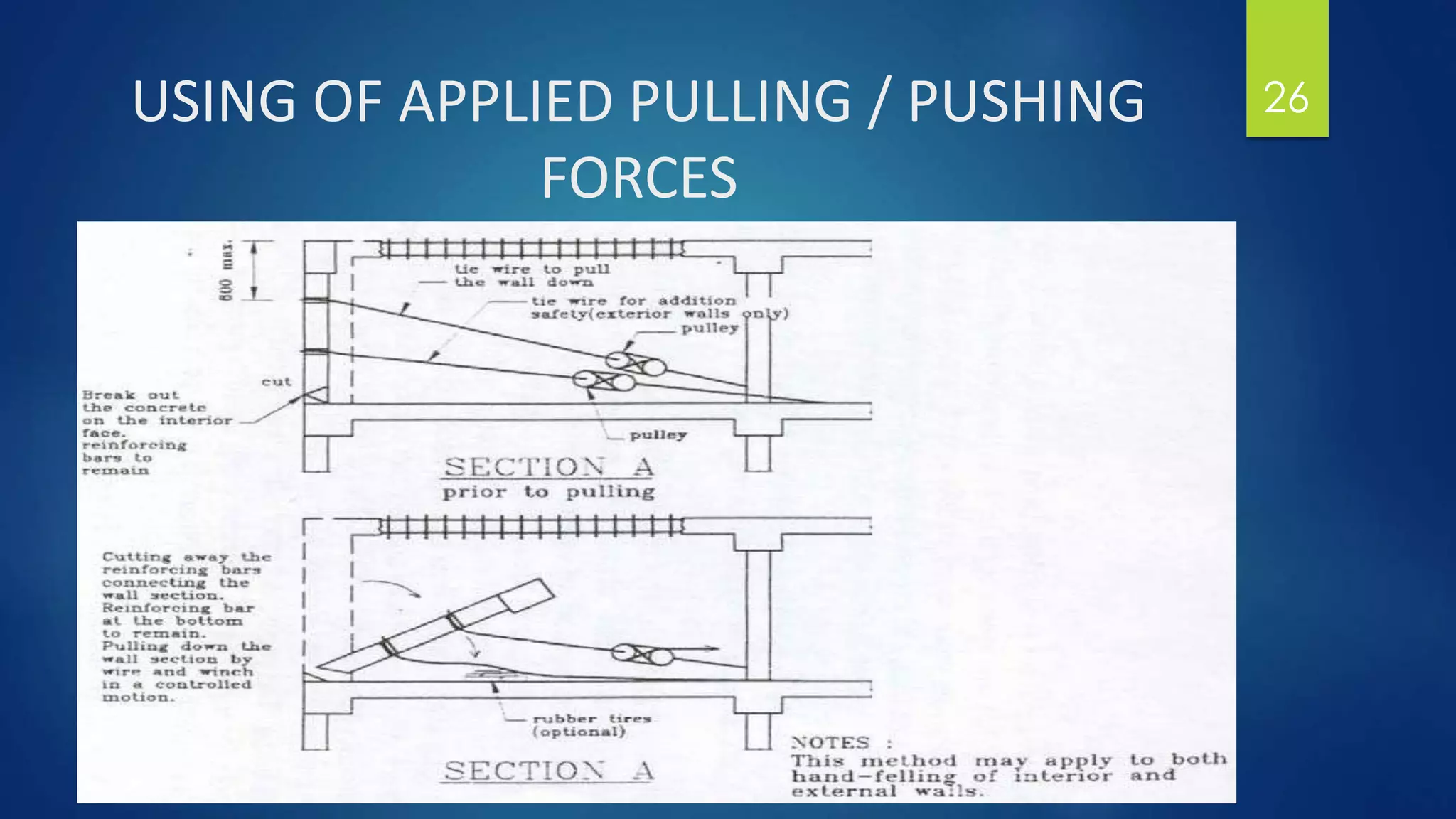
 Connecting structural members are disconnected first allowing part of the
remaining structure to be dragged down by the use of some
pulling/pushing equipment such as powered jack, winching machine,
pulley systems, pushing arms, powered blocks or from the pull/push of a
hydraulic excavator.
 However, a firm base in the demolishing building is required such as
basing on an undisturbed core wall or a strong column section for the
applying of pulling/pushing forces.
25
USING OF APPLIED PULLING / PUSHING
FORCES
26
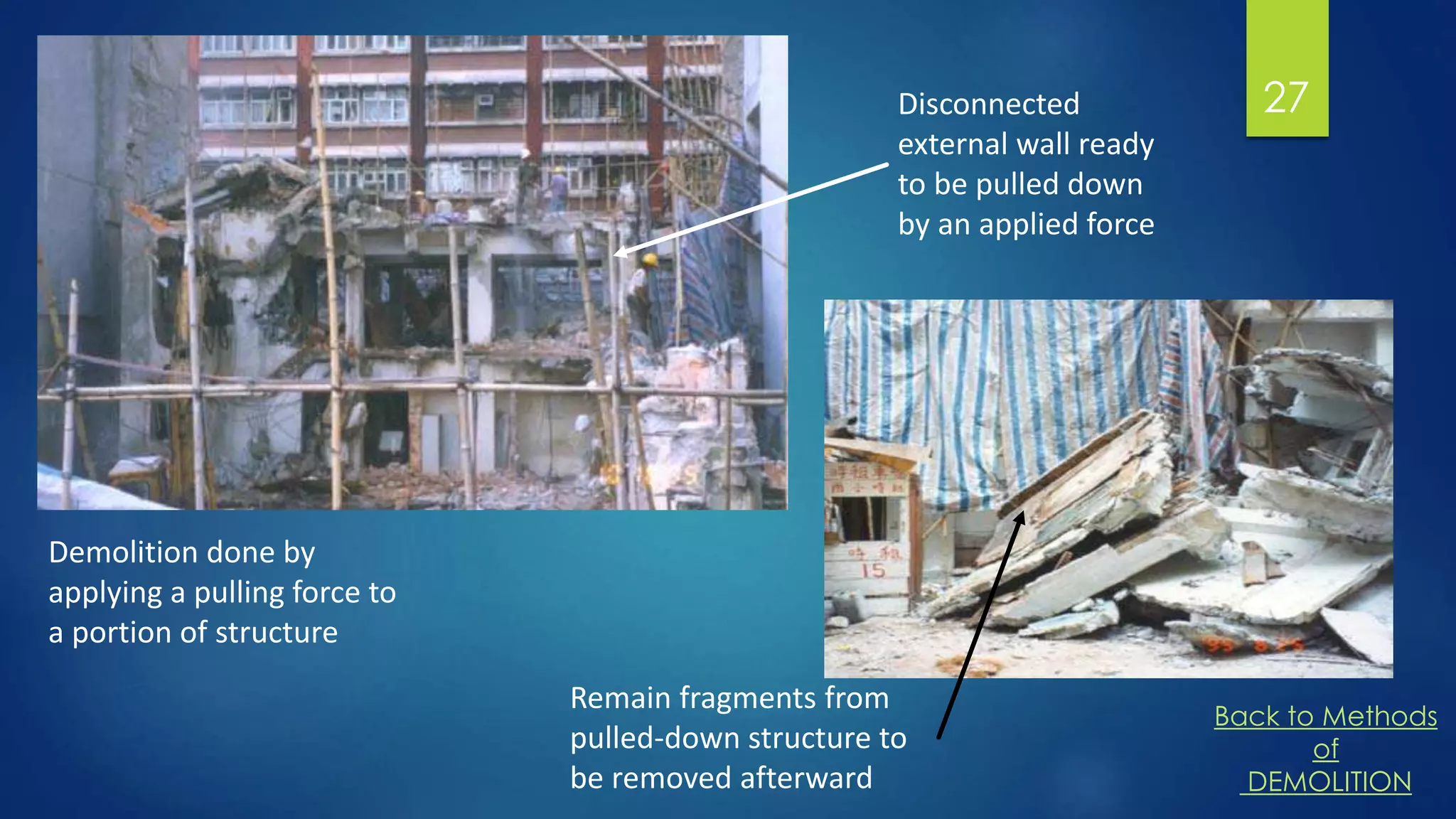
27Disconnected
external wall ready
to be pulled down
by an applied force
Remain fragments from
pulled-down structure to
be removed afterward
Demolition done by
applying a pulling force to
a portion of structure
Back to Methods
of
DEMOLITION
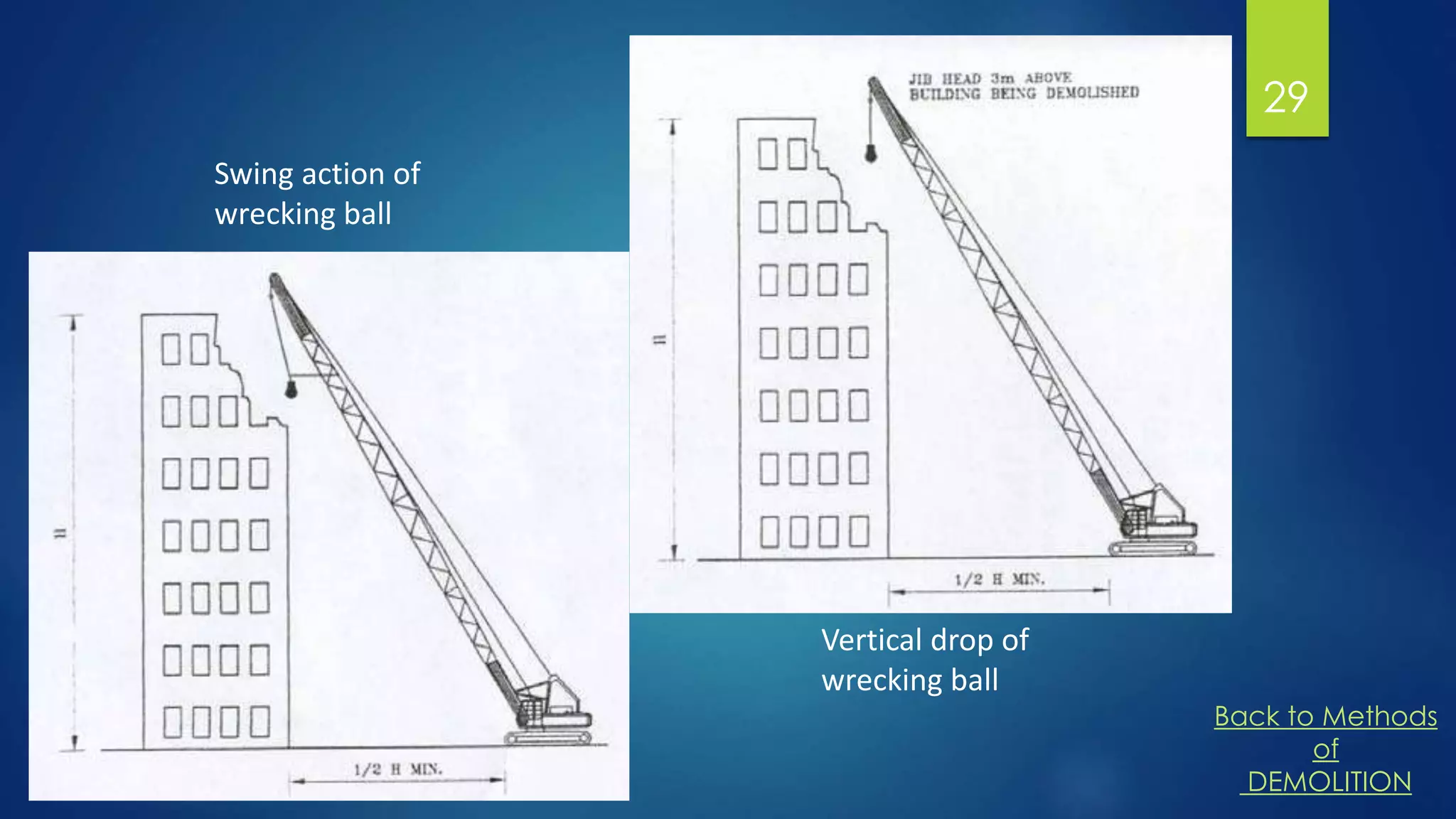
USING OF WRECKING BALL
 The use of wrecking ball method requires a crane equipped with a steel
ball.
 The DESTRUCTION of the building is caused by the impact energy of the
steel ball suspended from a crawler crane.
 The wrecking ball can be operated outside or inside a building.
 In case the process is operated inside a building, sufficient clearance from
the building interior should be made first .
 This also demands experienced operators in order to handle the wrecking
ball and control the DEMOLITION.
28
29
Swing action of
wrecking ball
Vertical drop of
wrecking ball
Back to Methods
of
DEMOLITION
USE OF POWERED PLANT OR DEMOLITION
MACHINE
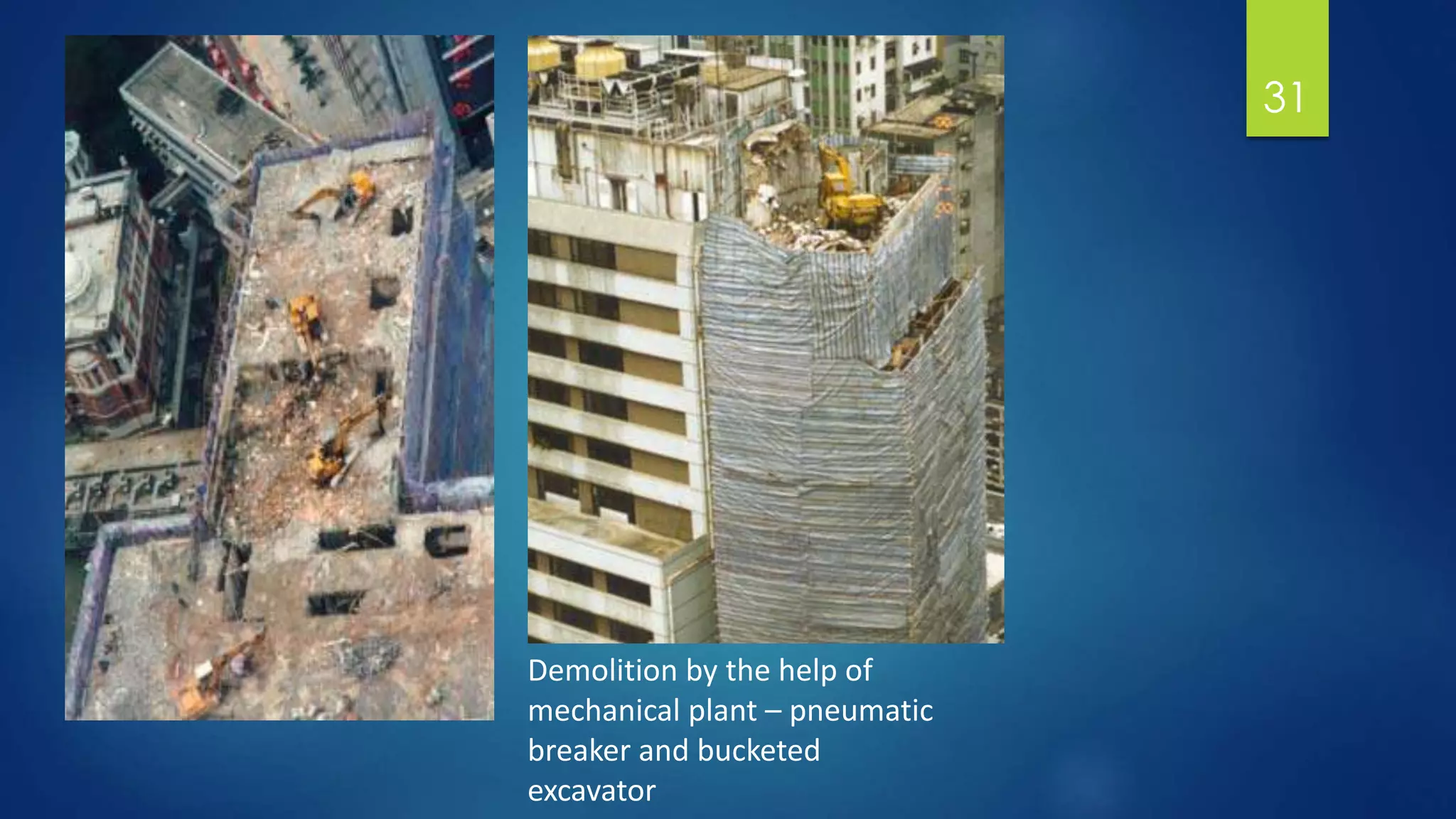
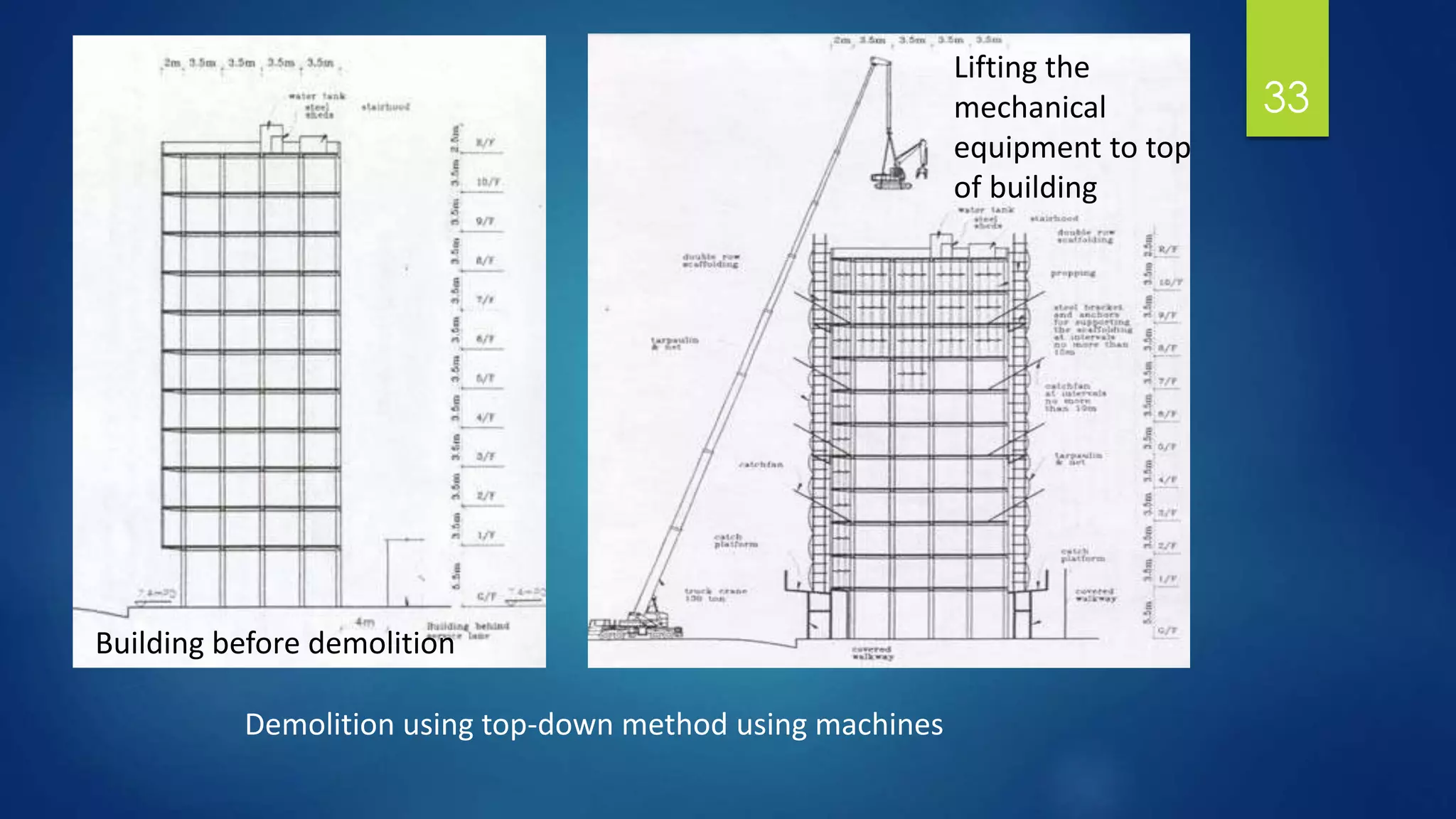
 The principle of demolition by machine is typically the same as the top-
down manual method, except that most of the demolition begins with the
lifting of the mechanical plant on to the building top floor.
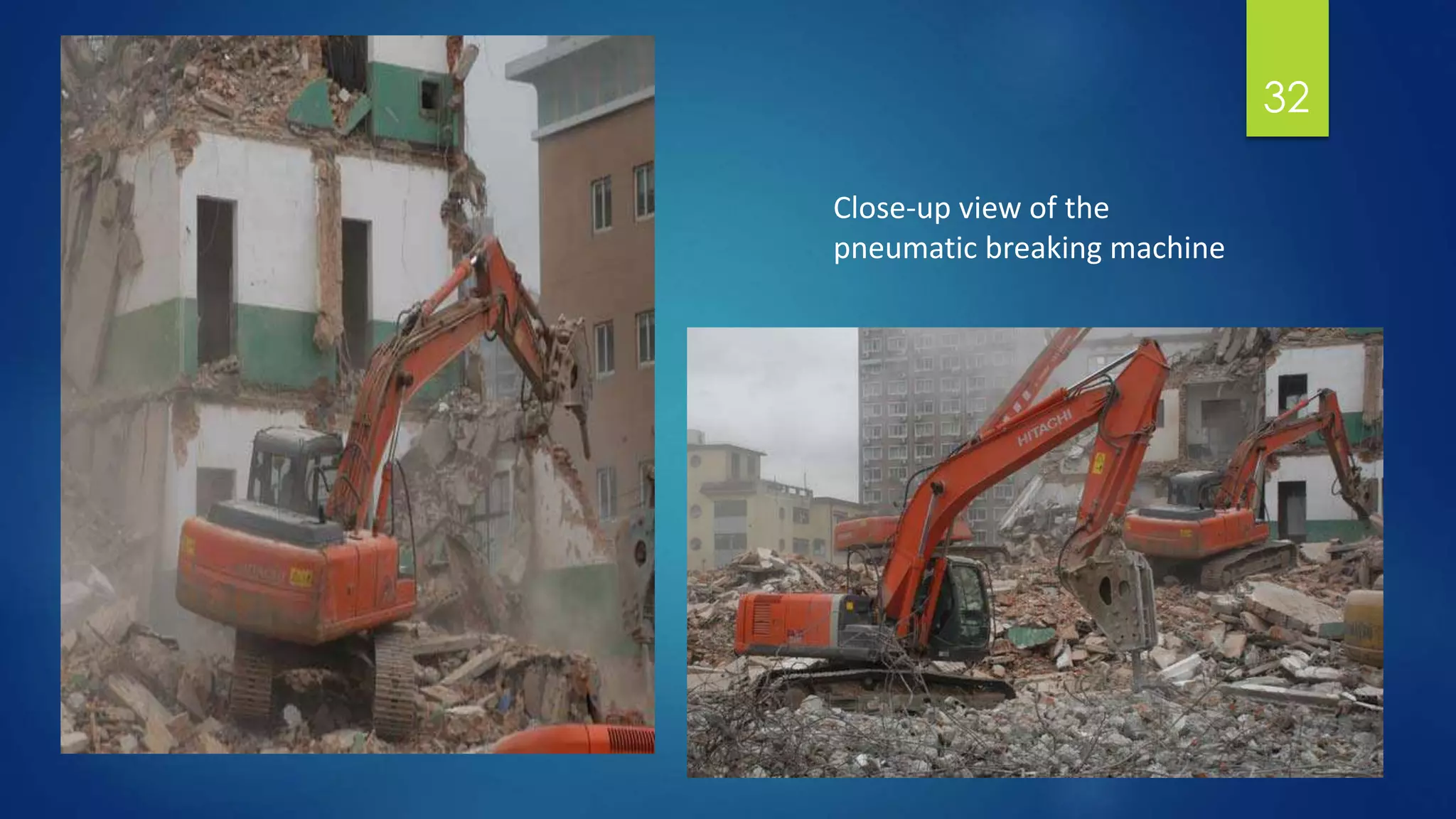
 Powered plant such as crawler mounted breaking hammer are used in the
demolition process and excavating machines with bucket are used in the
removal or handling of the demolished materials.
 However, due to the weight of these machines, they should be properly
supported such as by the use of steel props no matter in still or in
operating condition.
30
31
Demolition by the help of
mechanical plant – pneumatic
breaker and bucketed
excavator
32
Close-up view of the
pneumatic breaking machine
33
Lifting the
mechanical
equipment to top
of building
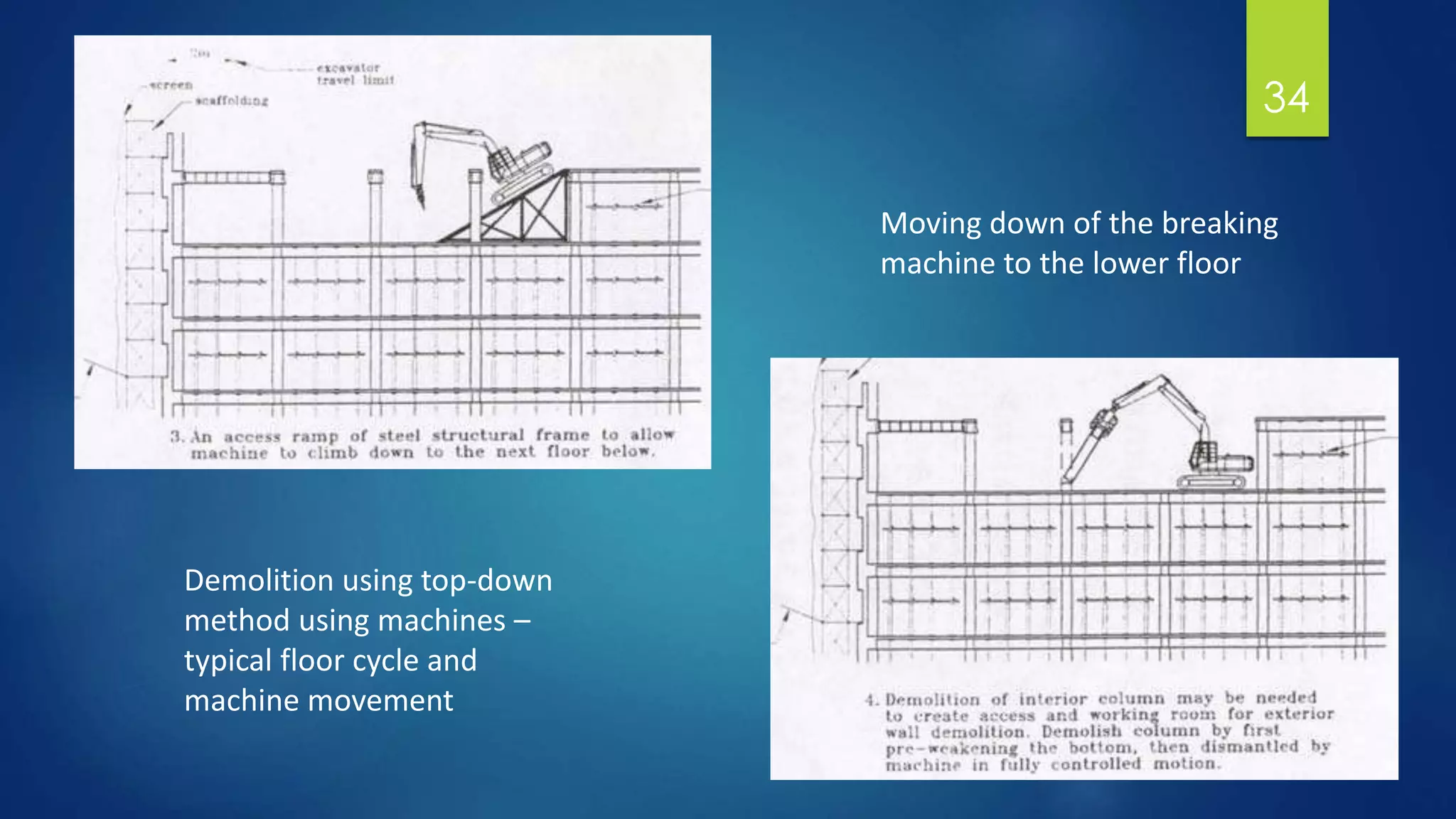
Demolition using top-down method using machines
Building before demolition
34
Moving down of the breaking
machine to the lower floor
Demolition using top-down
method using machines –
typical floor cycle and
machine movement
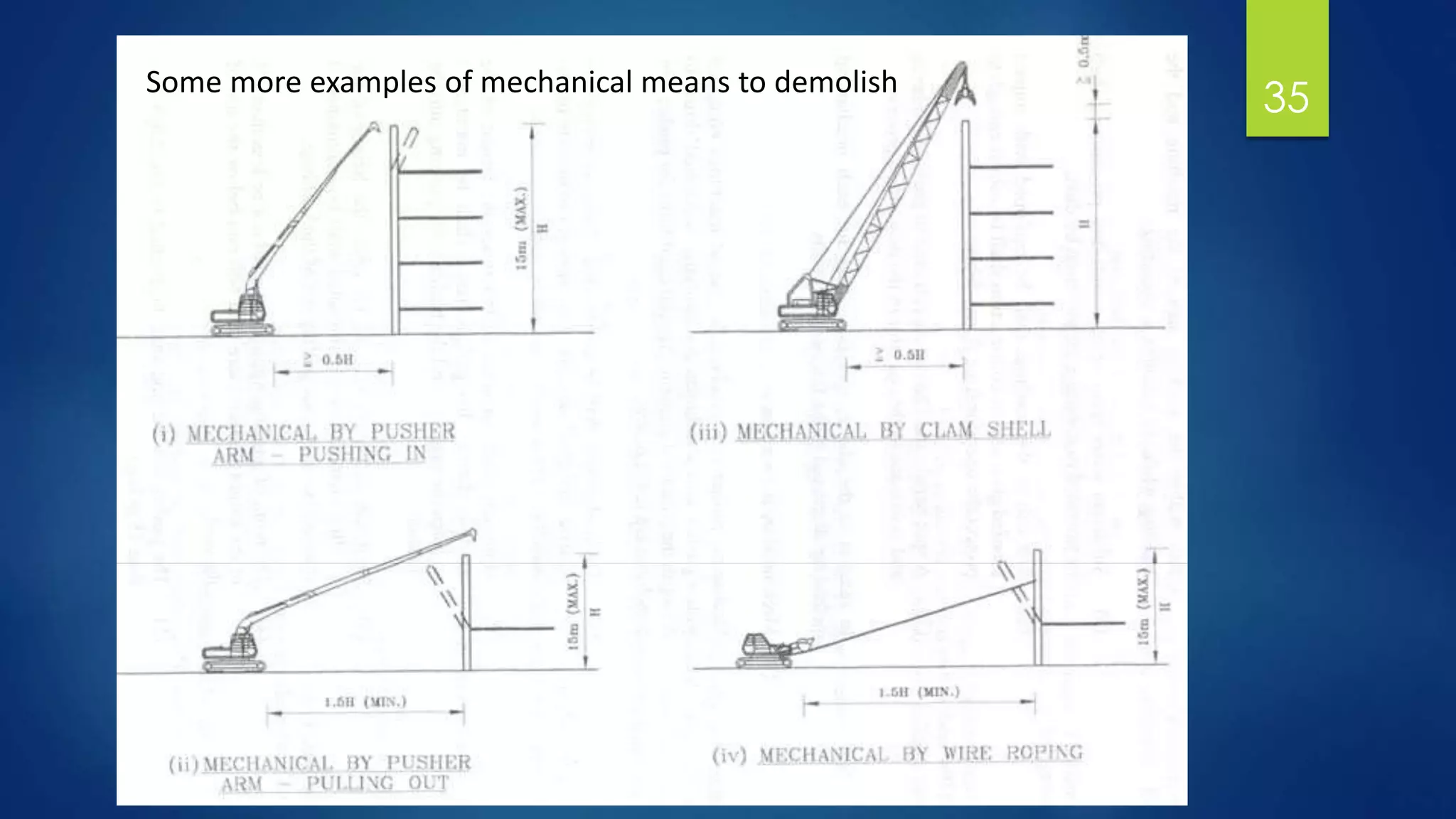
35Some more examples of mechanical means to demolish
36
Back to Methods
of
DEMOLITION
USING SAW CUT METHOD
 This method is suitable for alternation and additional works where
accuracy is important and restriction on noise and vibration is required.
 It can be used to cut concrete slab and wall elements into segments or for
the forming of openings, breaking into existing structure like a basement,
servicing tunnel, flyover, or the other part of an inhabited building in the
process of alteration or renovation works.
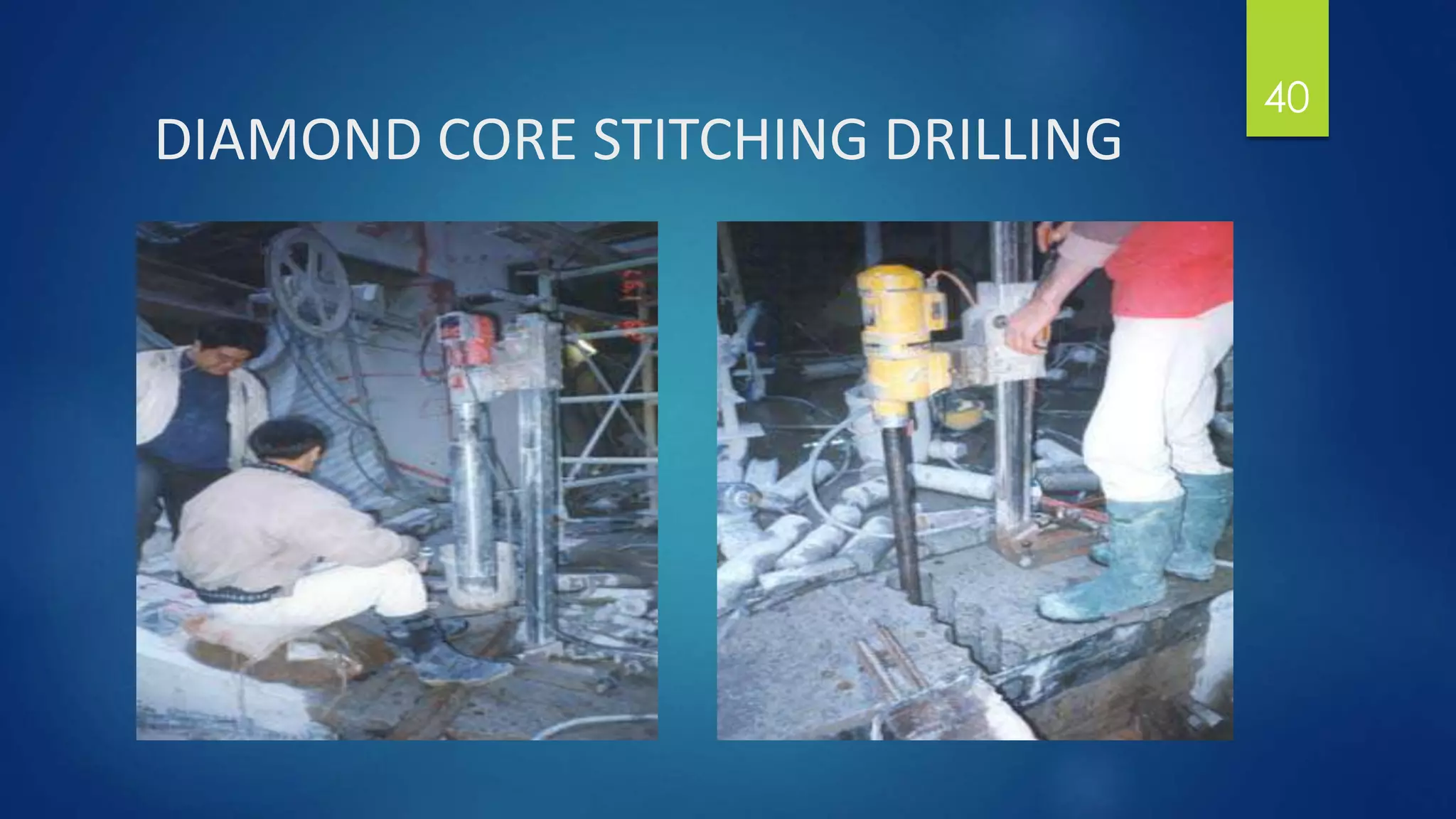
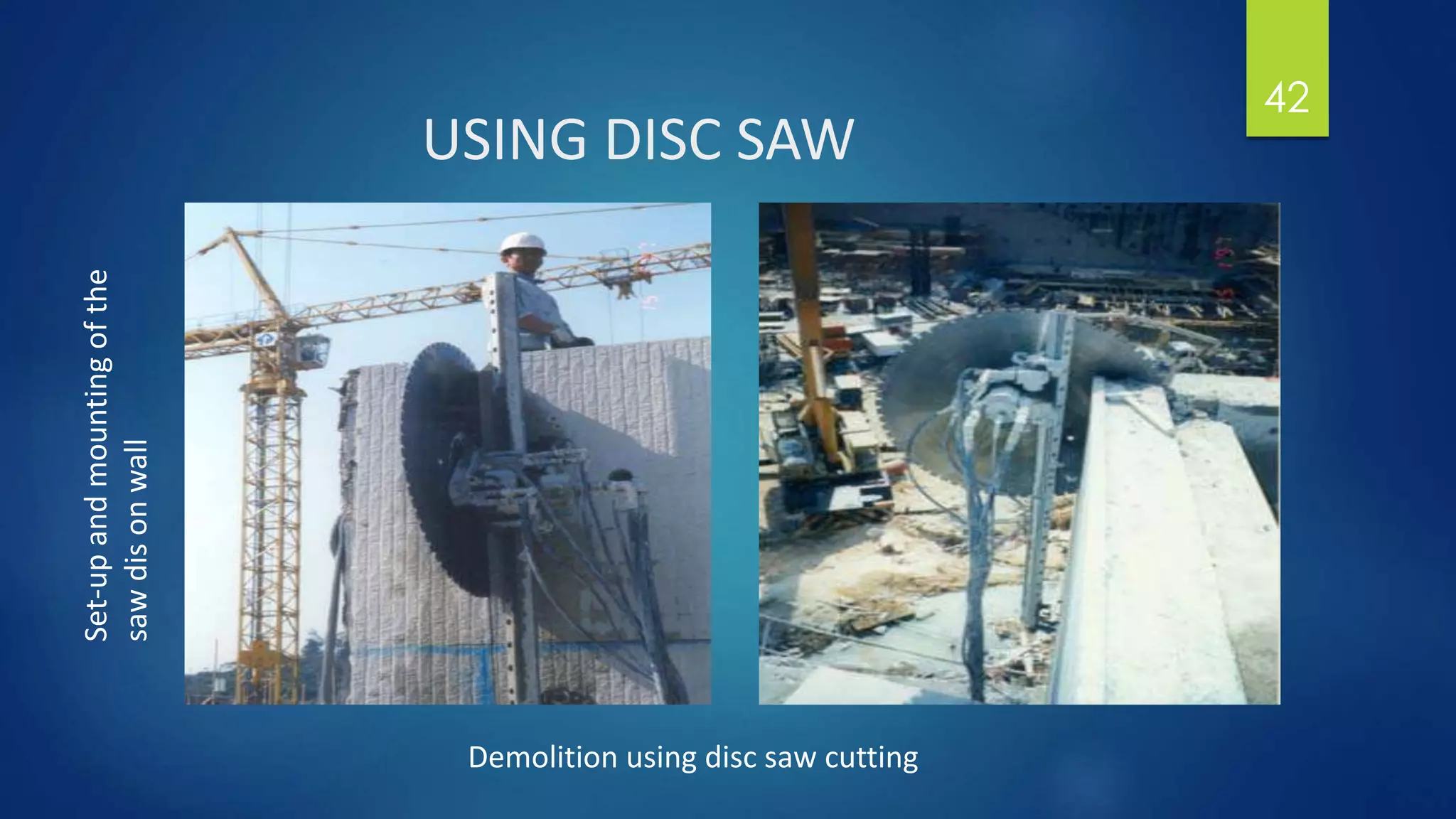
 Saw Cutting can be done using the following methods:
1. Wire Saw Cutting
2. Diamond Core Stitch Drilling
3. Disc Saw
37
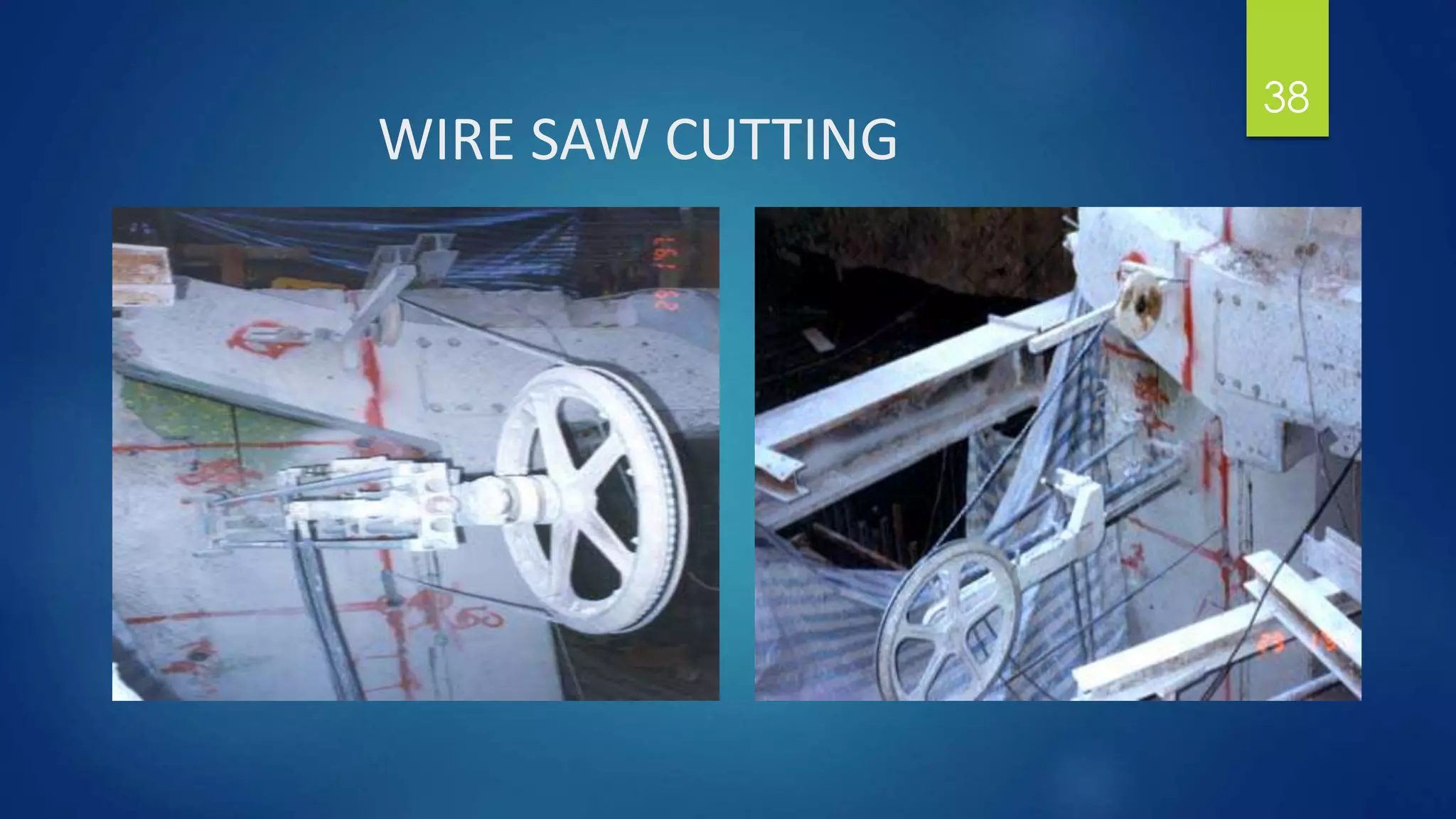
WIRE SAW CUTTING
38
WIRE SAW CUTTING
39
DIAMOND CORE STITCHING DRILLING
40
DIAMOND CORE STITCHING DRILLING
41
USING DISC SAW
42Set-upandmountingofthe
sawdisonwall
Demolition using disc saw cutting
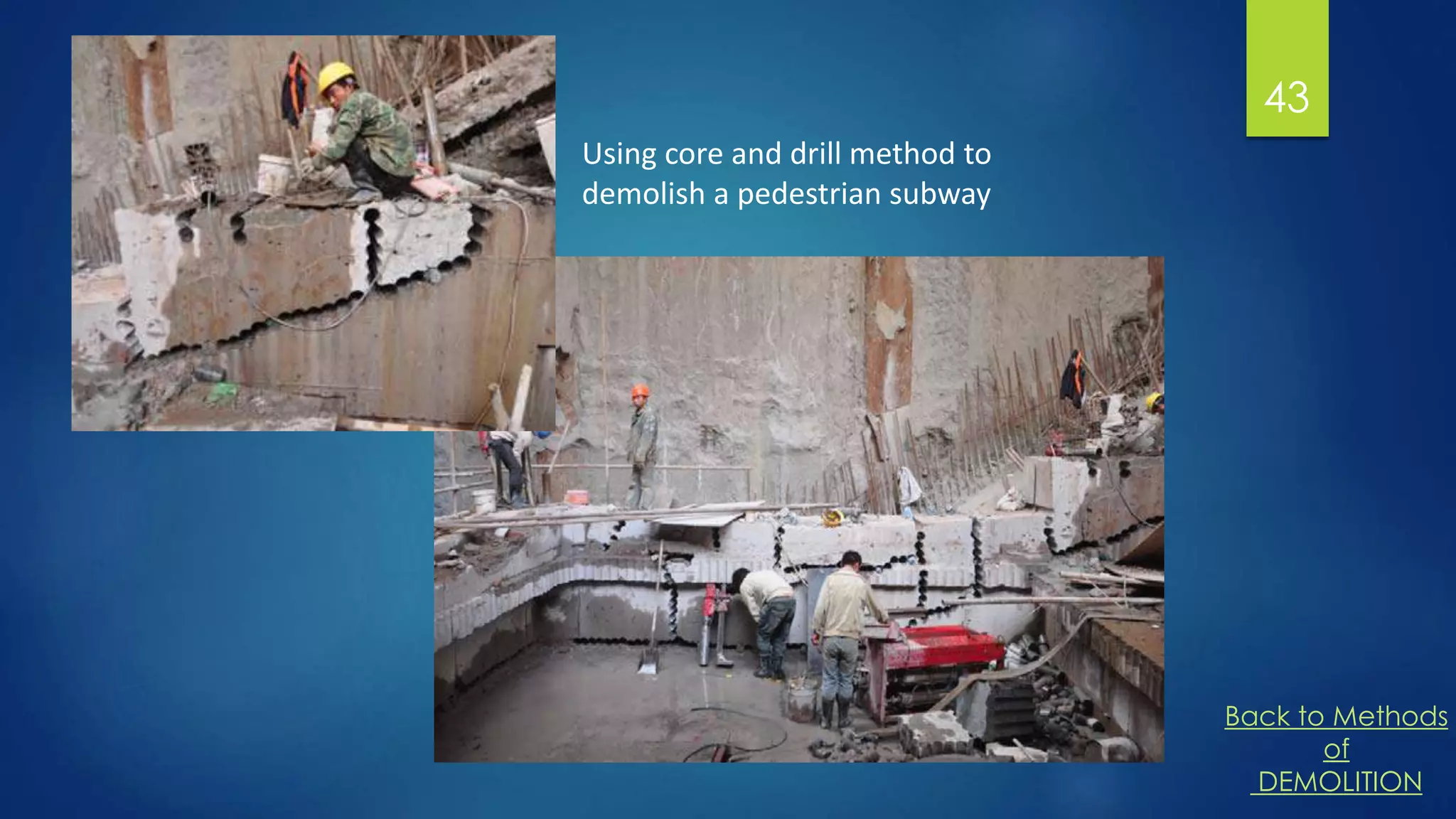
43
Using core and drill method to
demolish a pedestrian subway
Back to Methods
of
DEMOLITION
USING IMPLOSION (EXPLOSION)
 If using this method to demolish a building, contractor should carry out a
comprehensive risk and environmental assessment on the effect of
implosion on the neighborhood.
 A detail demolition design is also important, which should cover:
1. Method to pre-weaken the structure (e.g. demolish some load
taking structures)
2. Placement of explosive
3. Time-delay design to allow the building to collapse under control
director and location
44
USING IMPLOSION (EXPLOSION)
 Charges of explosive are placed within the fabric of structure and
detonated to cause partial or complete collapse. Competent explosive
specialist is required when demolition is to be done by using explosive.
 There are numerous types of explosives for use for various types of
demolition (sometimes including non-explosive agent). Consideration
such as the spacing and depth of explosive to be located, the amount of
explosive to be used, or the degree of fragmentation required in order to
control the boundary of demolition etc., are required throughout the
planning and operation process.
45
USING IMPLOSION (EXPLOSION)
46
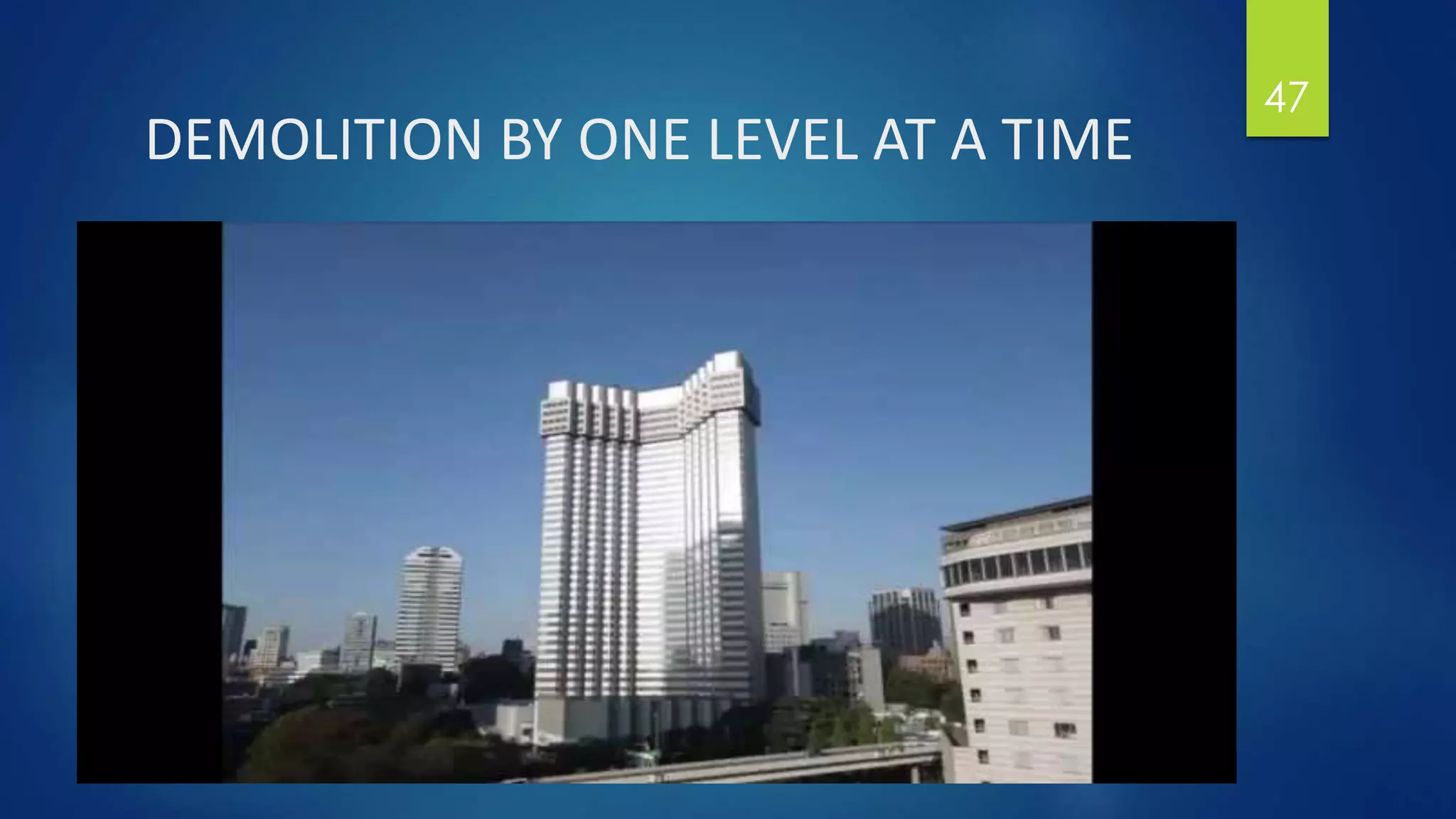
DEMOLITION BY ONE LEVEL AT A TIME
47
48

Demolition of Structures.

  • 1.
    Demolition of Structures. 1 By: ChintanVaria Pratik Sureja Akshay Kasundra
  • 2.
    Why DEMOLITION isDANGEROUS?  Demolition work is one if the most dangerous operations in construction.  REASONS/CAUSES: 1. Easy to cause injury to human workers due to the difficulty of accessing into or working inside a building which is under construction. 2. Falling of smaller objects or debris from the demolishing building. 3. Falling of Partially demolished structure. 4. Collapse of unstable structure due to original structure being disturbed. 2

  • 3.
    Why DEMOLITION isDANGEROUS? 5. Collapse of heavy demolition equipment due to inadequate support of the partially demolished structure. 6. Collapse of the partially demolished structure due to the accommodation of large amount of un-cleared debris. 7. Congested site environment that easily cause damage to human workers, or to the third parties and their properties that are situated nearby the demolition site. 3
  • 4.
    DEMOLITION PLAN  Formingpart of the submission information, the DEMOLITION Plan should include: a) A set of drawings showing: the location of the building to be demolished other existing structures and facilities in vicinity. b) Proposed method of DEMOLITION. c) Proposed shoring and precautionary measures for the adjacent buildings. d) Proposed shoring and protection for the building to be demolished 4
  • 5.
    DEMOLITION PLAN e) Proposedmethods of handling and disposing of the demolished materials. f) Proposed sequence of carrying out work. g) Detail of equipment used, with methods of raising, lowering or supporting the equipment. h) Structural calculation to justify the proposal. i) Proposed arrangements for site supervision. 5
  • 6.
    6 Catch Fan Typical dustscreen and fans provision to protect building and minimize disturbance to public during demolition
  • 7.
    7 Provision of Hoardingas a protection to public
  • 8.
    8 Shaft for falling ofdebris Common ways to get rid of the demolished debris – to control the falling of the debris into a pre-determined vertical shaft formed on the floor slabs
  • 9.
    9 Debris shaft formedby opening temporarily cut on floor slab Debris collection area at ground floor under the debris shaft
  • 10.
    10 Temporary props erectedto support heavy equipment
  • 11.
    11 Erection of shoringto support affected structure a) Basement demolition (left) b) A nearby retaining wall (right)
  • 12.
    12 Typical sectioning/ sequencing arrangementof work during demolition – demolish from exterior inward
  • 13.
    13 Typical sectioning/ sequencing arrangementof work during demolition – demolish from one side to the other side of building
  • 14.
    14 Typical layout arrangement insmall and medium sized building under demolition
  • 15.
    15 Typical layout arrangement in smalland medium sized building under demolition
  • 16.
    METHODS OF DEMOLITION GENERAL CONCERNS: The choice of choosing a demolition method depends on a number of factors such as the project conditions, site constraints, sensitivity of the neighborhood and availability of equipment etc. In general, top down methods are applicable for most sites, particularly for those situated in busy urban areas. Other mechanical methods applied from the outside of a building lines, demotion by hand held tools or the cut and lift process may be a safe solution. For structural projections such as balconies, canopies and verandahs extending beyond the building lines, demolition by hand held tools or the cut and lift process may be a safe solution. 16
  • 17.
    METHODS OF DEMOLITION There are various methods of DEMOLITION of structures. 1. Demolition by human operatives. 2. Deliberate Collapse method. 3. Using of applied pulling / pushing forces. 4. Using of wrecking ball. 5. Use of powered plant or demolition machine. 6. Using saw cut method. 7. By Implosion (explosive). 17
  • 18.
    DEMOLITION BY HUMANOPERATIVES  This method particularly suitable for use in smaller site with congested space where larger machine cannot be employed.  In this case, human operatives are used in the demolition process using simple electrically or pneumatically powered tools such as picks, hammers, wire cutters or hand driven hydraulic jacks etc. to carry out the demolition of individual elements. 18
  • 19.
  • 20.
    20 Typical demolition arrangement doneby human operatives Slab with the sides disconnected ready for dismantle
  • 21.
    21 Typical demolition arrangement doneby human operatives Worker breaking down larger piece of structure which was demolished by pulling/pushing method.
  • 22.
    22 A number of workswhere human operative is unavoidable
  • 23.
    23 Working condition and behaviorof human operatives Back to Methods of DEMOLITION
  • 24.
    DELIBERATE COLLAPSE METHOD DEMOLITION by deliberate collapse consists of systematic removal, or weakening of the key structural elements to induce the collapse of the structure.  However, when applying this method, several precautions should be observed, such as: 1. Sufficient distance of collapse should be provided. 2. Collapse procedure should be carefully designed so that there is no pre-mature collapse or collapse out of anticipated area. 3. Control height of building structure to be collapsed. 24 Back to Methods of DEMOLITION
  • 25.
    USING OF APPLIEDPULLING / PUSHING FORCES  Connecting structural members are disconnected first allowing part of the remaining structure to be dragged down by the use of some pulling/pushing equipment such as powered jack, winching machine, pulley systems, pushing arms, powered blocks or from the pull/push of a hydraulic excavator.  However, a firm base in the demolishing building is required such as basing on an undisturbed core wall or a strong column section for the applying of pulling/pushing forces. 25
  • 26.
    USING OF APPLIEDPULLING / PUSHING FORCES 26
  • 27.
    27Disconnected external wall ready tobe pulled down by an applied force Remain fragments from pulled-down structure to be removed afterward Demolition done by applying a pulling force to a portion of structure Back to Methods of DEMOLITION
  • 28.
    USING OF WRECKINGBALL  The use of wrecking ball method requires a crane equipped with a steel ball.  The DESTRUCTION of the building is caused by the impact energy of the steel ball suspended from a crawler crane.  The wrecking ball can be operated outside or inside a building.  In case the process is operated inside a building, sufficient clearance from the building interior should be made first .  This also demands experienced operators in order to handle the wrecking ball and control the DEMOLITION. 28
  • 29.
    29 Swing action of wreckingball Vertical drop of wrecking ball Back to Methods of DEMOLITION
  • 30.
    USE OF POWEREDPLANT OR DEMOLITION MACHINE  The principle of demolition by machine is typically the same as the top- down manual method, except that most of the demolition begins with the lifting of the mechanical plant on to the building top floor.  Powered plant such as crawler mounted breaking hammer are used in the demolition process and excavating machines with bucket are used in the removal or handling of the demolished materials.  However, due to the weight of these machines, they should be properly supported such as by the use of steel props no matter in still or in operating condition. 30
  • 31.
    31 Demolition by thehelp of mechanical plant – pneumatic breaker and bucketed excavator
  • 32.
    32 Close-up view ofthe pneumatic breaking machine
  • 33.
    33 Lifting the mechanical equipment totop of building Demolition using top-down method using machines Building before demolition
  • 34.
    34 Moving down ofthe breaking machine to the lower floor Demolition using top-down method using machines – typical floor cycle and machine movement
  • 35.
    35Some more examplesof mechanical means to demolish
  • 36.
  • 37.
    USING SAW CUTMETHOD  This method is suitable for alternation and additional works where accuracy is important and restriction on noise and vibration is required.  It can be used to cut concrete slab and wall elements into segments or for the forming of openings, breaking into existing structure like a basement, servicing tunnel, flyover, or the other part of an inhabited building in the process of alteration or renovation works.  Saw Cutting can be done using the following methods: 1. Wire Saw Cutting 2. Diamond Core Stitch Drilling 3. Disc Saw 37
  • 38.
  • 39.
  • 40.
  • 41.
  • 42.
  • 43.
    43 Using core anddrill method to demolish a pedestrian subway Back to Methods of DEMOLITION
  • 44.
    USING IMPLOSION (EXPLOSION) If using this method to demolish a building, contractor should carry out a comprehensive risk and environmental assessment on the effect of implosion on the neighborhood.  A detail demolition design is also important, which should cover: 1. Method to pre-weaken the structure (e.g. demolish some load taking structures) 2. Placement of explosive 3. Time-delay design to allow the building to collapse under control director and location 44
  • 45.
    USING IMPLOSION (EXPLOSION) Charges of explosive are placed within the fabric of structure and detonated to cause partial or complete collapse. Competent explosive specialist is required when demolition is to be done by using explosive.  There are numerous types of explosives for use for various types of demolition (sometimes including non-explosive agent). Consideration such as the spacing and depth of explosive to be located, the amount of explosive to be used, or the degree of fragmentation required in order to control the boundary of demolition etc., are required throughout the planning and operation process. 45
  • 46.
  • 47.
    DEMOLITION BY ONELEVEL AT A TIME 47
  • 48.